




Abstract
Through formal control and social control, technology platforms can acquire the information knowledge needed for ambidextrous learning of engineering project team, but whether technology platforms influence ambidextrous learning of engineering project team through the intermediary role of ambidextrous control (formal control, social control) is still lack of theoretical and empirical support. In order to explore the influence of the co-use of technology platform and ambidextrous control on the ambidextrous learning of engineering project team, this paper constructs a theoretical framework between the performance of ambidextrous control (formal control, social control) and different types of technology platform (BIM, AI, VR, AR, MR) and different types of learning (exploratory learning, exploitative learning). A questionnaire survey was conducted among 210 project managers. AMOS22.0 and bootstrap software were used for analysis and test, SPSS22.0 was used for hierarchical regression analysis, the results of hierarchical regression analysis show that formal control, social control and the balanced use of both have significant positive correlation with the ambidextrous learning and balanced use of ambidextrous learning of engineering project team. Formal Information Technology Platform (BIM) and Informal Information Technology Platform (AI, VR, AR, MR) have significant positive effects on the ambidextrous learning of engineering project team. The balanced use of formal Information Technology Platform (BIM) and informal Information Technology Platform (AI, AR) has significant positive effects on the ambidextrous learning balance of engineering project team. Formal control and social control mediate the positive correlation between information technology platform (BIM, AI, VR, AR, MR) and ambidextrous learning of engineering project team. In addition, information technology platform (BIM, AI, VR) regulates the impact of formal control and social control on learning (exploratory learning, exploitative learning). Generally speaking, different types of technology platforms and ambidextrous control strategies are still effective for the ambidextrous learning and balance of engineering project team.
Introduction
Ambidextrous learning (exploratory learning and exploitative learning) is related to the actual survival and long-term development of the organization. Therefore, there is no doubt about the importance and necessity of ambidextrous learning. Ambidextrous learning of engineering project team has the characteristics of one-off and uncertainty. Therefore, it has situational patience for ambidextrous learning of engineering project teams. However, most of the existing researches on ambidextrous learning study the impact of ambidextrous learning on performance from the enterprise level. 1,2 Little research on promoting ambidextrous learning is also conducted on the aspects of structure, 3 situation and leadership. Since these research factors that promote ambidextrous learning also belong to enterprise level factors, these factors are not suitable for ambidextrous learning of engineering project teams.
Recently, some researchers have also studied the factors that promote ambidextrous learning of engineering project teams from the perspectives of formal control and social control. 4 However, the influence of technology platform on ambidextrous learning is not considered. Resulting from the progress of the Internet, technology platforms have penetrated into all aspects of life and work. For example, AI, VR, AR, MR and other Internet-based information technology platforms, namely artificial intelligence, virtual reality, augmented reality, mixed reality and so on, have gradually penetrated into the daily life of Chinese people. Regarding BIM, a building information model technology platform, China’s Ministry of Housing and Construction is also vigorously promoting it in China. The way people obtain information may change from active knowledge seeking to vigorous push of artificial intelligence. The development of information technology platform provides new opportunities for ambidextrous learning of engineering project teams. 5 Therefore, in order to explore the influence mechanism of different types of information technology platforms on ambidextrous learning and its balance of engineering project teams. In this paper, technology platform, formal control, social control and ambidextrous learning are brought into the overall framework for research, which not only responds to the appeal of existing researchers, but also meets the need for realistic development.
In addition, many researchers believe that the success of China’s projects benefits from the formal control mechanism represented by FIDIC clauses and Chinese traditional culture. Influenced by Chinese traditional cultures such as the Book of Changes, Taoism and Confucianism, the Chinese pay more attention to project change, risk and integrated management. However, the characteristics of formal control mechanism, such as information focus and compliance with traditional culture, restrict people’s divergent thinking and, to a certain extent, restrict the exploratory learning of engineering project teams. Therefore, seeking the synergistic balance between exploratory learning and exploitative learning has become a strategic problem to be solved urgently by China’s engineering project teams. 6
In addition, the theory of Yin and Yang and the Five Elements is the essence of Chinese traditional culture and the treasure of the Chinese nation. The law of “mutual generation and mutual restraint” of the five elements is the basic law of the universal connection of all things in the universe. Through the relationship between “generation and restraint,” the whole system of heaven and earth presents a relatively stable dynamic balance. Similarly, the relationship between formal control, social control, technology platform and ambidextrous learning of engineering project team can also show relatively stable dynamic balance through the relationship between “generation” and “restraint.” 7,8
To sum up, this paper will build a theoretical framework between technical platforms (BIM, AI, VR, AR, MR), formal control, social control and ambidextrous learning of engineering project teams, and analyze it in combination with the five elements theory in traditional Chinese culture, collect data from the construction industry for hypothesis testing, and put forward management suggestions according to the research findings.
Literature review and concept definition
Chinese traditional culture and administration
Five elements theory
Five elements theory is the core of Chinese traditional culture. On the origin of the Five Elements, many researchers believe that in the long-term life and production practice, ancient Chinese people realized that wood, fire, earth, gold and water were the most basic and indispensable substances. From this point of view, everything in the world was generated by the movement and change of the five basic substances: wood, fire, earth, gold and water. Among these five substances, there exists a relationship of mutual generation and mutual restraint, which maintains a dynamic balance in the continuous intergrowth movement (Figure 1 Five-element phase diagram).

Five-element phase diagram.
The basic principles of the five elements theory include “mutual generation and mutual restraint.” “Five elements mutual generation” refers to: fire generates earth, earth generates gold, gold generates water, water generates wood, wood generates fire. fire generates earth, because when a fire burns an object, the object is reduced to ashes, and ashes are earth; Earth generates gold, because gold is contained in mud and stones, and gold is extracted only after smelting; Gold generates water, for if gold is burned by fire, it dissolves into liquid, which is water; Water generates wood, because water irrigates trees, trees can flourish; Wood generates a fire, because the fire uses wood as the fuel material. When the wood is burned out, the fire will go out automatically.
“Five elements mutual restraint” refers to: fire restricts gold; gold restricts wood; wood restricts earth; earth restricts water; water restricts fire. fire restricts gold, because fire can dissolve metal; Gold restricts wood, because metal casting cutting tools can saw down trees; Wood restricts earth, because the root seedlings are powerful, can break through the obstacles of earth; Earth restricts water, because earth can be waterproof; Water restricts fire, because the fire goes out when it meets water. It is inseparable that things cannot happen and grow without life. Without restraint, things cannot be restrained, and normal coordination cannot be maintained. The five elements are born together, and at the same time there is mutual restraint. There is also mutual existence in mutual restraint. It is an indispensable condition for everything to maintain a relative balance.
The Relationship between five elements theory and administration
Same as above, borrowing the principle of “gold generates water” in the Five Elements Theory, the relationship between formal control, social control, technological platform and learning should also have the relationship of gestation or restriction. For example, control (formal control, social control, technology platform control) is as tough as gold and has mandatory control function like a sword. Learning is like water, which can nourish people’s hearts. Therefore, whether formal control, social control and technology platform can promote ambidextrous learning of engineering project team deserves further study.
In addition, because the five elements theory is also called yin-yang five elements theory. Therefore, according to the “Yin and Yang Theory” of Chinese traditional culture, everything is divided into two parts, that is, opposition and unity, and a balance needs to be achieved. For example, exploratory learning and exploitative learning are opposite and unified. Therefore, exploratory learning and exploitative learning need to be balanced. Formal control and social control are both opposite and unified. Therefore, formal control and social control need to be balanced. Technology platforms are divided into formal technology platforms and informal information technology platforms, which are opposite and unified. Therefore, formal information technology platforms and informal information technology platforms need to be balanced. Technology platform belongs to the category of artificial intelligence, while formal control and social control belong to the category of human intelligence. The two are opposite and unified. Therefore, technology platform and control mechanism (formal control and social control) need interactive balance. To sum up, how to balance formal control, social control and information technology platform to achieve the balance of learning (exploratory learning and exploitative learning) is still a question to be answered.
Ambidextrous learning of engineering project team
According to previous studies, the engineering project team is different from the general group or organization. It is built to realize the objectives of the engineering project. It is an organization that carries out the work of the engineering project according to the team mode and is the aggregation of the engineering project human resources.
For the definition of the concept of ambidextrous learning, the current research status and the places to be further studied, see the following contents:
Definition of concept: March’s research theme is mainly about organizational learning. Many researchers have applied March’s viewpoint to the field of innovation and divided ambidextrous innovation into exploratory innovation and exploitative innovation. 9,10 Similarly, this paper divides ambidextrous learning of engineering project team into exploratory learning of engineering project team and exploitative learning of engineering project team. Exploitative learning refers to the refinement of existing knowledge, skills and paradigms, while exploratory learning refers to the search for new knowledge, skills and paradigms.
Research Status: Many researchers took ambidextrous learning as an independent variable and studied the relationship between ambidextrous learning and performance. 11 –13 However, there are still few researches on the factors that promote ambidextrous learning. For example, some researchers believe that ambidextrous learning can be realized through the division of organizational structure. 1
What remains to be further studied is that both exploratory learning and exploitative learning involve acquiring, absorbing and reconstructing information from outside. Therefore, finding the antecedent Variables to promote ambidextrous learning in engineering project team can search for answers from the environment in which the engineering project team is located.
Control mechanism
The relevant literatures on the division of control mechanism, the internal relationship of control mechanism, and how to measure the balance of ambidextrous control are detailed as follows.
Control division: Ouchi first divided control mechanism into formal control and social control 14 Many researchers have studied the results of formal control and social control. 15,16 It is generally believed that although social control has a positive impact on performance, For example, many researchers believe that relationships are conducive to improving performance and achieving business success. 17 However, the advantages of formal control cannot be ignored. For example, homogeneity and heterogeneity information can be obtained through compulsory measures of formal control, 18 which will have a positive impact on ambidextrous learning.
Internal relationship: Whether formal control and social control are substitutes or complementary has not been decided. 19 There are two viewpoints about the relationship between formal control and social control. One is that formal control and social control are substitutes, the other is that formal control and social control are complementary, many researchers have proved this view. 20 Although there is no definite conclusion as to whether formal control and social control are complementary or substitutive, what is certain is that researchers all admit that formal control and social control interact. 21,22 In other words, formal control and social control can interact. However, whether formal control and social control can achieve an interactive balance deserves further study.
What needs to be further studied is that the existing studies mainly focus on the impact of a single control mechanism on learning. It is not proposed that the balance between the two has an impact on ambidextrous learning. Referring to the concept of ambidextrous learning, formal control and social control are expressed by ambidextrous control. The balance formula 1 − |a − b| / (a + b) is used to represent the two-way managed-controlled balance and the two-way learning balance.
Technology platform
The concept definition of information technology platform (BIM, AI, VR, AR, MR): BIM: building information model, which is based on relevant information data of construction projects, builds a building model and simulates the real information of buildings through digital information simulation, Because the Ministry of Housing and Construction is vigorously promoting BIM, BIM is regarded as a formal information technology platform. 23 AI: The artificial intelligence technology platform can gradually solve the problem that tacit knowledge of engineering project teams is not easy to transfer. 24 VR: That is, the virtual reality technology platform. More and more scientific research evidence shows that if head-up users can move freely, the creation of empathy in virtual reality will be more successful. 25 AR: That is, augmented reality technology platform, for example, building drawings are reviewed in advance for parametric modeling and visualization of three-dimensional models, which facilitates project partners to organize collaborative inspection of various specialties, facilitates timely communication and communication among specialties, avoids on-site construction conflicts, and reduces rework phenomenon. 26 MR: The hybrid reality technology platform creates a virtual scene that can enter real life and recognize you at the same time. For example, through MR equipment, you can see a scene in your eyes that can measure the scale and orientation of objects in real life. Its biggest characteristic is that the virtual world and the real world can interact.
Nowadays, AI (Artificial Intelligence), VR (Virtual Reality), AR (Augmented Reality) and MR (Mixed Reality) have become important channels for information acquisition and help to improve the quality and efficiency of information acquisition. For example, the Palace Museum uses popular scientific means such as VR, AR and MR to display its collection of exhibits, including Qingming River Map. Using VR, AR, MR and other new technologies to realize the spread of culture, the Forbidden City culture is no longer static and solidified, but iterative, fission and richer. This is the greatest value and ultimate goal of the technology platform. At present, there are not a few researches on how information technology promotes performance. For example, Iyengar, Sweeney and Montealegre’s research on 783 real estate enterprises shows that the use of information technology promotes the efficiency and absorptive capacity of enterprise knowledge transfer. 27 The study further found that a single information technology platform does not necessarily improve the quality of information exchange. Only when the information technology platform includes information collection, information release and discussion, decision criteria discussion and bidding mechanism can the quality of decision-making be better improved. 28
However, there is still a lack of theoretical and empirical tests on the impact of different types of information technology platforms on ambidextrous learning of engineering project teams. For example, formal information technology platforms (BIM) and informal information technology platforms (AI, VR, AR, MR) convey different types of information. The former mainly publishes standardized work content, while the latter may be full of random social content and discussion space. Because information exchange of different contents has a positive impact on ambidextrous learning of engineering project teams, the joint and balanced application of formal information technology platform (BIM) and informal information technology platform (AI, VR, AR, MR) may also promote ambidextrous learning and its balance of engineering project teams. To sum up, how to make better use of different types of information technology platforms to promote ambidextrous learning of engineering project teams is still a question to be answered.
Theory and research hypothesis
On the basis of reviewing the relevant literatures such as ambidextrous learning, ambidextrous control and technology platform, and according to the existing theoretical and empirical studies, this paper specifically studies: (1) the influence of control mechanism on ambidextrous learning of engineering project teams; (2) the influence of technology platform on ambidextrous learning of engineering project team; (3) Control mechanism mediates the influence of technology platform on ambidextrous learning of engineering project team; (4) The influence of technology platform regulation and control mechanism on ambidextrous learning of engineering project team. Since the research framework of this paper is mainly to study the factors that promote the ambidextrous learning of engineering project teams, as the construction industry plays an important role in China’s engineering projects, the questionnaire will be sent to the person in charge of the construction industry’s engineering projects to fill in. Through collecting the data of the construction industry and inputting the data into SPSS16.0 software and AMOS22.0 software, the data will be analyzed and tested, and the research hypothesis will be tested at the same time. To sum up, the following conceptual model is proposed, as shown in Figure 2.

Conceptual model.
The influencing mechanism of control mechanism on ambidextrous learning
Engineering project team acquires information through the control of their partners. Research shows that formal control of information interaction in written form provides an effective carrier for learning of engineering project team; social control based on trust is more conducive to the quality and efficiency of information transmission; through formal control, problems and information can be found, and social control eliminates the distrust that may arise from the use of formal control. 29 Therefore, the joint use of formal control and social control brings synergistic effect to the ambidextrous learning of engineering project team.
Due to the synergistic effect of formal and social control, the balanced use of formal and social control has a positive impact on the ambidextrous learning balance. Research shows that formal control collects focused information around the focused goal of formal control, and social control collects open information around the divergent goal.
30
Therefore, formal control is more conducive to exploitative learning with clear objectives of engineering project team, and social control is more conducive to exploratory learning that engineering project team needs to disseminate information. Based on this, the following assumptions are put forward: H1: The balanced use of formal control and social control is positively correlated with the ambidextrous learning balance of engineering project team. H1a: Compared with social control, formal control has a stronger positive correlation with exploitative learning of engineering project team. H1b: Compared with formal control, social control has a stronger positive correlation with exploratory learning in engineering project team.
Effect of technology platform (BIM, AI, VR AR MR) on learning
Because information technology platform can transmit information through video, voice, pictures, text and other forms, it can achieve the quality and efficiency of information transmission through visual and auditory stimuli. Therefore, according to the transaction cost theory, the use of information technology platform may save the time, manpower, financial resources, procedures needed for formal control in the past, and information can be more easily shared and disseminated within the engineering project team. 31
The University of Maryland, a world-renowned university, has proved through experiments that using 3D VR learning can improve memory more than traditional 2D learning methods. Eric Krokos of the University of Maryland led a team that divided two groups of participants into two groups: the traditional 2D group and the 3D VR group. Before the experiment, the famous characters were observed in advance. After the experiment started, the location information of the characters was observed in the virtual experimental environment of 2D and 3DVR, memory palace, respectively. After observation, the two groups recalled the positions of famous people in their respective scenes. The results showed that the performance of the three-dimensional group with VR glasses was about 10% higher than that of the traditional two-dimensional picture observation group. The volunteers who participated in the experiment said that the observation in the three-dimensional VR could obviously focus their attention and help improve memory.
32
Since VR can help memory, it should have a significant impact on learning. Similarly, BIM, AR, MR and AI information technology platforms based on the same high-tech content should also have a significant impact on the ambidextrous learning of engineering project team in terms of improving the quality and efficiency of information dissemination. In addition, the information content and openness of formal information technology platforms (such as BIM) and informal information technology platforms (such as AI, VR, AR, MR) are different. The information transmitted by BIM technology platforms is closely related to the actual needs of engineering project team at the present stage, which is conducive to the exploitative learning of engineering project team, while informal technology platforms (AI, VR, AR, MR) have more possibilities for exploratory learning, which is conducive to exploratory learning of engineering project team. Therefore, the balanced use of formal information technology platform (BIM) and informal information technology platform (AI, VR, AR, MR) is positively correlated with the ambidextrous learning balance of engineering project team. Based on this, the following assumptions can be made: H2: The balanced use of formal information platform (BIM) and informal information platform (AI, VR AR MR) is positively correlated with the balanced use of ambidextrous learning (exploratory, exploitative) in engineering project team. H2a: Formal information platform (BIM) is positively correlated with ambidextrous Learning (exploratory and exploitative) of engineering project team H2b: Informal information platform (AI, VR AR MR) is positively correlated with ambidextrous learning (exploratory and exploitative) of engineering project team
Ambidextrous control mediates the effect of technology platform on ambidextrous learning
The information obtained by boundary personnel of project partner organizations through information technology platforms (BIM, AI, VR, AR, MR) does not necessarily promote the ambidextrous learning of engineering project team. When there is cross-organizational control among project partner organizations, because of the mandatory control mechanism, the information obtained through the information technology platform will be disseminated in the engineering project team through the mandatory system.
33
In addition, according to transaction cost theory, due to the convenience and richness of information transmission by information technology platform, the cost of process complexity and abstraction faced by the use of control mechanism is reduced, such as the interactive immersion of MR.
34
Good information transmission can be achieved through the interactive contact of limbs. Therefore, the control mechanism mediates the positive correlation between information technology platform and ambidextrous learning of engineering project team. Based on this, the following assumptions are put forward: H3: Ambidextrous control (formal control, social control) mediates the positive correlation between information technology platform (BIM, AI, VR AR MR) and ambidextrous Learning (exploratory and exploitative) of engineering project team.
Information technology platform adjusts the impact of ambidextrous control on ambidextrous learning
Because of the high quality and fast speed of information transmission, the application of information technology platform can significantly improve the quality and efficiency of information collection through formal control or social control. 35 For example, the interactive communication of information technology platform, video, voice, pictures and other functions can significantly improve the quality and efficiency of information collection through the control mechanism. Therefore, information technology platform positively regulates the relationship between formal control or social control and ambidextrous learning of engineering project team.
H4: Information technology platform (BIM, AI, VR AR MR) positively regulates the relationship between ambidextrous control (formal control, social control) and ambidextrous learning (exploratory learning, exploitative learning) of engineering project team.
Research design
Sample and data collection
We use questionnaires to collect relevant data, and the sample comes from project managers in the construction industry. A total of 300 questionnaires were sent out and 210 valid questionnaires were retrieved, with a recovery rate of 70%. Among them, 134 questionnaires reflect the relationship between the owner and the contractor, while 76 others describe the relationship between the general contractor and the subcontractor. Of 210 project managers, 172 (81.9%) were male, with an average age of 34.43 years and an average tenure of 10.57 years. The qualifications of project managers are as follows: 6.9% of junior college students, 41% of undergraduate students, 35.5% of master students, 16.6% of doctoral students and above. The average duration of 210 projects in the questionnaire is 24.91 months, with an average budget of 130 million yuan. In addition to background information, all items were assessed by Likert 7 scale. 1 indicated “very disagreement” and 7 represented “very identification.” In this paper, Harman single factor test is used to test the deviation of homology method of sample data. SPSS22.0 is used to analyze all items of the questionnaire by exploratory factor analysis. The results showed that the first factor explained 24% variance, and there was no factor with great explanatory power. There is no significant common method bias in sample data.
Measurement variables and reliability and validity test
In order to ensure the reliability and validity of the questionnaire, the study adopted the mature scale in the existing literature, and then revised it according to the purpose of this study. Among them, the measurement of BIM, AI, VR, AR and MR is based on the research of Kuegler et al., 36 and the measurement of formal control and social control is based on the research of Li, Y, Liu, Y and so on. The scale for measuring organizational learning of project comes from the study of March. 37 The reliability analysis of related Variables is shown in Table 1 reliability analysis.
Reliability analysis.

Using AMOS 22.0 for confirmatory factor analysis, the statistical results show that the nine-factor measurement model is the most consistent with the data, and the convergence and discrimination validity are confirmed (Figure 3 Nine-factor confirmatory factor analysis, Table 2 the results of confirmatory factor analysis). Among them, χ2 represents chi-square value, DF represents freedom, χ2/df represents chi-square degree of freedom ratio, GFI represents fitness index, CFI represents comparative fitness index, TLI represents non-standard fitness index, IFI represents value-added fitness index, RMSEA represents progressive residual mean square root. Figure 3 shows the drawing model of the nine-factor model in amos22.0 software, and also shows the relationship between latent variables (circle diagram) and latent variables (circle diagram), and the relationship between latent variables (circle diagram) and observation variables (square diagram). Table 2 shows the comparison results of the nine-factor model and other reference models. As can be seen from Table 2, the CFI value of one-factor model, two-factor model, three-factor model, four-factor model, five-factor model, six-factor model, seven-factor model and eight-factor model did not meet the minimum requirement of 0.9, GFI value did not meet the minimum requirement of 0.85, TLI value did not meet the minimum requirement of 0.9, IFI value did not meet the minimum requirement of 0.9, RMSEA value all exceeded the requirement of the highest critical value of 0.08. However, the CFI value of the nine-factor model reached the minimum requirement of 0.9, GFI value reached the minimum requirement of 0.85, TLI value reached the minimum requirement of 0.9, IFI value reached the minimum requirement of 0.9, RMSEA value did not exceed the requirement of the highest critical value of 0.08. To sum up, the nine-factor model and the data fit well. Choosing the nine-factor model is a more reasonable choice.

Nine-factor confirmatory factor analysis.
The results of confirmatory factor analysis.

Note: Nine-factor model: BIM, AI, VR, AR, MR, formal control, social control, exploitative learning, exploratory learning; Eight-factor model: formal control, social control, exploitative learning, exploratory learning, BIM, AI, VR, AR+MR; Seven-factor model: formal control, social control, exploitative learning, exploratory learning, BIM, AI, VR+AR+MR; Six-factor model: formal control, social control, exploitative learning, exploratory learning, BIM+AI, VR+AR+MR; Five-factor model: formal control, social control, exploitative learning, exploratory learning, BIM+AI+VR+AR+MR; Four-factor model: formal control, social control, exploratory learning + exploitative learning, BIM + AI + VR + AR + MR; three-factor model: BIM + AI + VR + AR + MR, formal control + social control, exploitative learning + exploratory learning; two-factor model: BIM + AI + VR + AR + MR + formal control + social control, exploitative learning + exploratory learning; single-factor model: formal control + social control + BIM + AI + VR + AR +MR + exploratory learning + exploitative learning.
Control variables
Based on previous studies by Ryall and Sampson 38 and LePine et al., 39 we chose organizational nature, size and age as the control Variables in this study. Organizational nature includes state-owned enterprises, collective ownership, private enterprises, joint ventures and foreign-funded enterprises. In the questionnaire survey, 1–5 Variables should be used for Variable assignment. Organizational scale is divided into five types: 50 people below, 50–100 people, 100–500 people, 500–1000 people and 1000 people above. In the questionnaire survey, 1–5 values should be used for Variable assignment. The age of the organization is measured by the natural number of years since the establishment of the enterprise.
Statistical analysis
Descriptive statistics and correlation analysis of the main Variables in the study are shown in Table 3 the results of descriptive statistics and correlation analysis. Mean represents the average, SD represents the standard deviation, 1,2,3,4,5,6,7,8,9 represents the nature of project organization, project organization scale, project organization age, BIM, AI, VR, AR, MR, formal control, social control, exploitative learning and exploratory learning respectively. As can be seen from the mean value term in Table 3, except for the control variables, the values of all independent variables, dependent variables and adjustment variables are between 3 and 6, and there is no extreme value, so the overall concentration trend of data is better. As can be seen from the standard deviation term in Table 3, except for the control variables, the standard deviation value is about 2, indicating that the degree of data dispersion is relatively low. From Table 3, the project organization nature of the first variable is significantly related to the project organization size of the second variable and the project organization age of the third variable, so the project organization nature should be controlled. From Table 3, the project organization scale of the second variable is significantly related to the project organization age of the third variable. Therefore, the project organization scale should be controlled. From the correlation between the project organization age of the third variable in Table 3 and other variables, it can be seen that the project organization age of the third variable is significantly correlated with other variables. Therefore, the project organization age should be controlled. From the correlation between abscissa and ordinate variables 4–12 in Table 3, we find that all independent variables, dependent variables and regulatory variables are significantly correlated. Therefore, the choice of independent variables, dependent variables and regulatory variables is a reasonable choice.
The results of descriptive statistics and correlation analysis.

* p < 0.05 (Double tail test) **p < 0.01 ((Double tail test)) ***p < 0.001 ((Double tail test).
Hierarchical regression analysis was used to verify the hypothesis. The validation is divided into four steps: (1) Model 1 is a benchmark model with only control Variables. (2) Model 2 adds independent Variables (such as BIM, AI, VR, AR, MR) to model 1. (3) Model 3 adds intermediary Variables (formal control, social control) or equilibrium items on the basis of model 2. The results of hierarchical regression analysis are shown in Tables 4 to 13, where R2 represents the determinant coefficient, F represents the variance test, and R2 represents the change of R2.
The results of hierarchy regression analysis.

Note: ***, **, * respectively indicate P < 0.01 P < 0.05 P < 0.1.
The results of hierarchy regression analysis.

Note: ***, **, * respectively indicate P < 0.01 P < 0.05 P < 0.1.
The results of hierarchy regression analysis.

Note: ***, **, * respectively indicate P < 0.01 P < 0.05 P < 0.1.
The results of hierarchy regression analysis.

Note: ***, **, * respectively indicate P < 0.01 P < 0.05 P < 0.1.
The results of hierarchy regression analysis.

Note: ***, **, * respectively indicate P < 0.01 P < 0.05 P < 0.1.
The results of hierarchy regression analysis.

Note: ***, **, * respectively indicate P < 0.01 P < 0.05 P < 0.1.
The results of hierarchy regression analysis.

Note: ***, **, * respectively indicate P < 0.01 P < 0.05 P < 0.1.
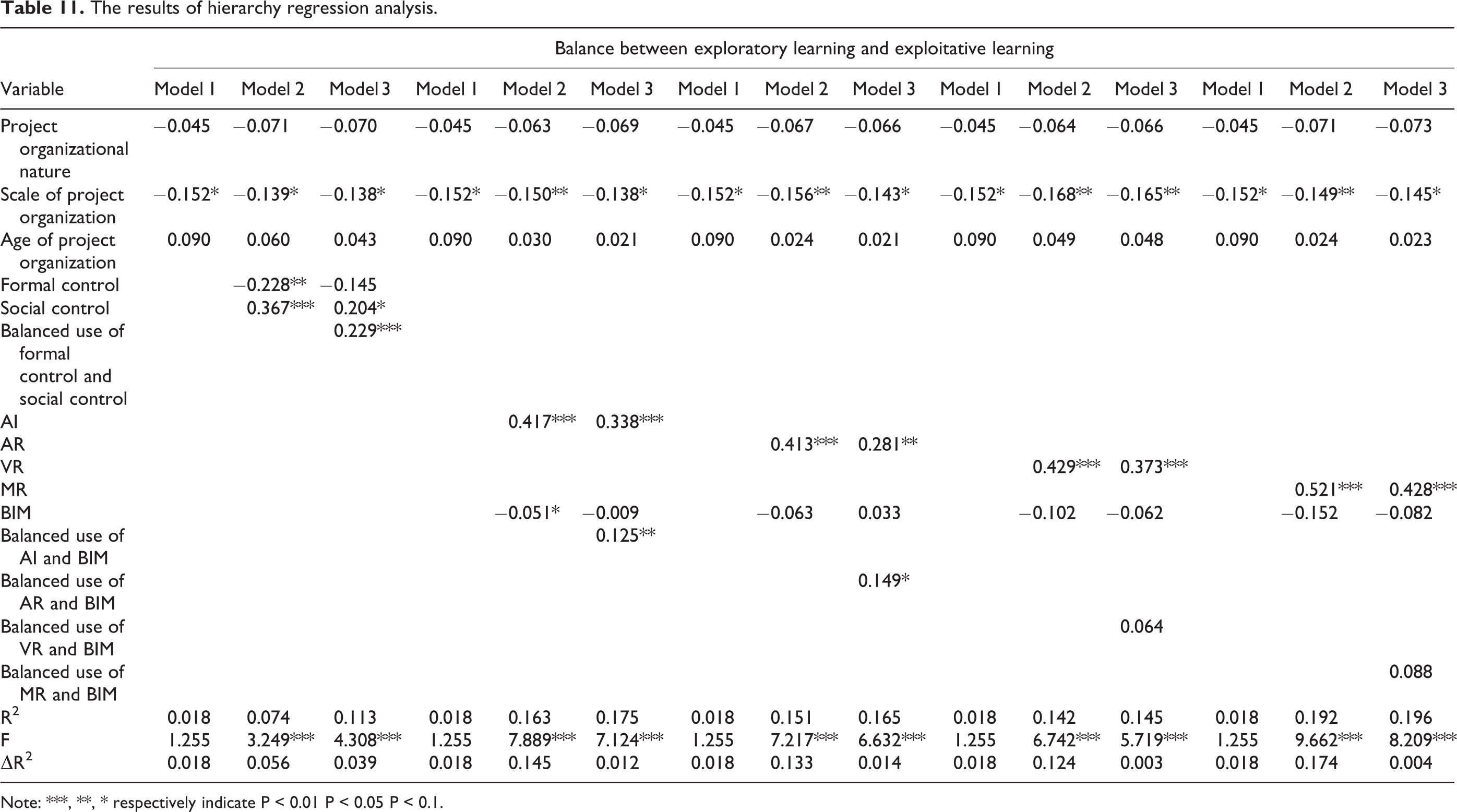
Table 11 Model 3 shows that the balanced application of formal control and social control has a significant positive effect on ambidextrous learning balance (beta = 0. 229, p < 0.01), so hypothesis 1 has been confirmed. Since balanced applications of BIM and AI, the balanced applications of BIM and AR have significant positive effects on ambidextrous learning balance. The balanced applications of BIM and VR, the balanced applications of BIM and MR on ambidextrous learning balance were not significant (beta = 0. 125, p < 0.05; beta = 0. 149, p < 0.1; beta = 0. 064, p > 0.1; beta = 0. 088, p > 0.1), so hypothesis 2 was partially confirmed.
The results of hierarchy regression analysis.
Note: ***, **, * respectively indicate P < 0.01 P < 0.05 P < 0.1.
Table 12 Model 2 shows the effects of formal control and social control on exploitative learning and exploratory learning. The results show that both formal control and social control have significant positive effects on exploitative learning and exploratory learning (beta = 0. 568, p < 0.01; beta = 0. 628, p < 0.01; beta = 0. 551, p < 0.01; beta = 0. 627, p < 0.01). Table 13 Model 2 shows the influence intensity of formal control and social control on exploratory learning and exploitative learning. The results show that social control has stronger influence on exploratory learning and exploitative learning than formal control (beta = 0. 171, p < 0.05; beta = 0. 494, p < 0.01; beta = 0. 211, p < 0.05; beta = 0. 464, p < 0.01). Therefore, hypothesis 1a is not confirmed, hypothesis 1b is confirmed. Tables 4 to 8 model 2 results show that information technology platforms (BIM, AI, VR, AR, MR) have significant positive effects on exploitative learning and exploratory learning respectively (beta = 0. 501, p < 0.01; beta = 0. 560, p < 0.01; beta = 0. 562, p < 0.01; beta = 0. 537, p < 0.01; beta = 0. 537, p < 0.01; beta = 0. 511, p < 0.01; beta = 0. 597, p < 0.01). Therefore, hypothesis 2a and hypothesis 2b are confirmed.
The results of hierarchy regression analysis.

Note: ***, **, * respectively indicate P < 0.01 P < 0.05 P < 0.1.
The results of hierarchy regression analysis.

Note: ***, **, * respectively indicate P < 0.01 P < 0.05 P < 0.1.
Tables 4 to 8 model 3 and model 4 results show that formal control and social control have significant positive effects on exploitative learning and exploratory learning (beta = 0. 449, p < 0.01; beta = 0. 506, p < 0.01; beta = 0. 463, p < 0.01; beta = 0. 477, p < 0.01; beta = 0. 498, p < 0.01; beta = 0. 443, p < 0.01; beta = 0. 443, p < 0.01; beta = 0. 482, p < 0.01; beta = 0. 405) on the basis of controlling control variables and independent variables (BIM, AI, VR, AR, MR). Tables 9 and 10 Model 2 results show that information technology platforms (AI, VR, AR, MR, BIM) have significant positive effects on formal control and social control (beta = 0. 298, p < 0.01; beta = 0. 315, p < 0.01; beta = 0. 295, p < 0.01; beta = 0. 422, p < 0.01; beta = 0. 452, p < 0.01; beta = 0. 452, p < 0.01; beta = 0. 452, p < 0.01; beta = 0. 417, p < 0.01; beta = 0. 513, p < 0.01). In conclusion, formal control and social control mediate the effects of information technology platforms on exploratory learning and exploitative learning of engineering project teams, so hypothesis 3 is confirmed. Bootstrap method (lower limit is 0.082, upper limit is 0.325, excluding 0) is adopted to further support hypothesis 3.
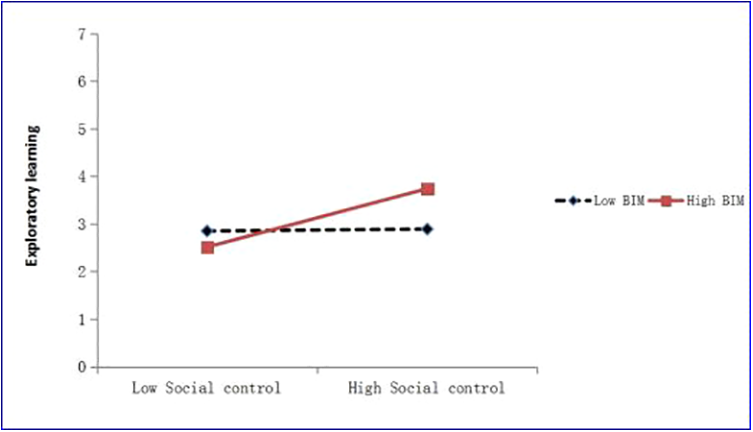
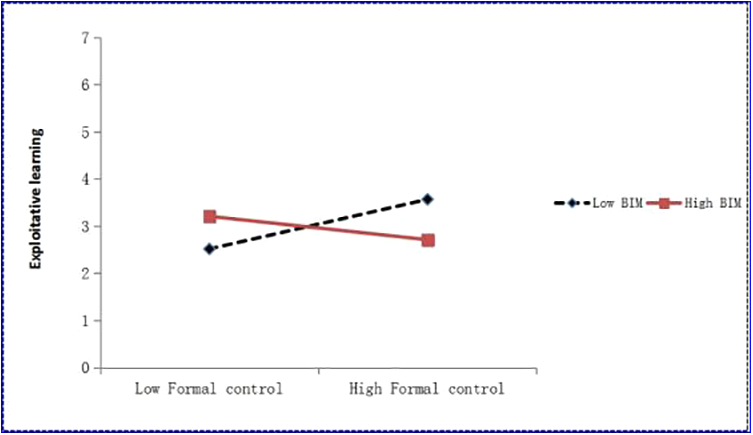
Table 13 Model 4: The product terms of information technology platform (BIM, AI, VR, AR, MR) and control mechanism (formal control, social control) have partially significant effects on exploratory learning and exploitative learning, only the product terms of BIM, AI, VR and control mechanism (formal control, social control) have significant effects on exploratory learning and exploitative learning (beta = −0. 258, p < 0.05; beta = −0. 297, p < 0.05; beta = −0. 646, p < 0.05; beta = −0. 729, p < 0.05; beta = −0. 387, p < 0.01; beta = −0. 560, p < 0.01; beta = −0. 884, p < 0.01): BIM negatively regulates the effect of formal control on exploratory learning; BIM positively regulates the influence of social control on exploratory learning; AI negatively regulates the influence of formal control on exploratory learning; AI positively regulates the influence of social control on exploratory learning; VR negatively regulates the influence of social control on exploratory learning; BIM negatively regulates the influence of formal control on exploitative learning; BIM positively regulates the influence of social control on exploitative learning; VR negatively regulates the influence of social control on exploitative learning. As shown in Figures 4 to 11, to sum up, only some information technology platforms (BIM, AI) of information technology platforms (BIM, AI, VR, AR, MR) can positively adjust the influence of control mechanisms (formal control, social control) on ambidextrous learning (exploratory learning, exploitative learning) of engineering project teams, so Hypothesis 4 has been partially confirmed. See Table 14 for details of hypothesis test results.

The impact of BIM negative regulation formal control on exploratory learning.
BIM positively regulates the impact of social control on exploratory learning.

The effect of AI negative adjustment formal control on exploratory learning.

AI positively regulates the impact of social control on exploratory learning.

VR negatively regulates the influence of social control on exploratory learning.
The impact of BIM negative regulation formal control on exploitative learning.

BIM positively regulates the impact of social control on exploitative learning

VR negatively regulates the influence of social control on exploitative learning
The testing results of all hypothesis.

Discussion
The results of model 3 and model 4 in Tables 4 to 8 show that information technology platforms (BIM, AI, VR, AR, MR) can have significant positive effects on ambidextrous learning of engineering project teams through the mediation of formal control and social control. At the same time, the intermediary effect of social control is greater than that of formal control. In addition, the intermediary effect of most social control overcomes the direct effect of information technology platform. The enlightenment is that enterprises should not only pay attention to the joint application of technology platforms and control mechanisms, but also pay more attention to the joint application of social control of information technology platforms (BIM, AI, VR, AR, MR), because most information technology platforms (BIM, AI, VR, AR, MR) have a stronger influence on ambidextrous learning of engineering project teams through the intermediary effect of social control.
The results of model 2 in Tables 9 and 10 show that information technology platforms (BIM, AI, VR, AR, MR) have significant positive effects on formal control and social control. These results, together with the results of model 3 and model 4 in Tables 4 to 8, prove that information technology platforms (BIM, AI, VR, AR, MR) can have a significant positive impact on ambidextrous learning of engineering project teams through the mediating effects of formal control and social control.
As can be seen from that results of model 2 in Table 11, Formal control and social control, Formal Information Technology Platform (BIM) and informal information technology platforms (AI, VR, AR, MR) have a negative and a positive impact on the ambidextrous learning balance of engineering project teams. However, from the results of Model 3 in Table 11, it can be seen that the balanced application of formal control and social control, the balanced application of formal information technology platform (BIM) and informal information technology platform (AI, VR, AR, MR) can eliminate the negative impact of formal control and formal information technology platform on the ambidextrous learning balance of engineering project teams. The enlightenment from this is that enterprises should strengthen the balanced application of formal control and social control, and at the same time strengthen the balanced application of formal information technology platform and informal information technology platform, because the balanced application of control mechanism can bring balanced learning effect and eliminate the negative impact brought by the separate application of control mechanism.
These results from Table 12, Model 2 show that both formal control and social control have a positive impact on ambidextrous learning of engineering project teams, and the positive impact of social control on ambidextrous learning of engineering project teams is stronger than that of formal control on ambidextrous learning of engineering project teams. The inspiration from this is that under the premise of limited resources, enterprises should pay more attention to the application of social control, because social control can more strongly meet the needs of ambidextrous learning of engineering project teams.
As can be seen from Table 13, Model 1 is a baseline model with only control variables (nature, size and age of project organization), Model 2 adds independent variables (formal control, social control) to the benchmark model. Model 3 adds regulatory variables (BIM, AI, VR, AR, MR) to model 2, and model 4 adds product terms of regulatory variables and independent variables to model 3. From model 4, it can be seen that BIM negatively regulates the influence of formal control on exploratory learning and negatively regulates the influence of formal control on exploitative learning. BIM positively regulates the influence of social control on exploratory learning and positively regulates the influence of social control on exploitative learning. AI negatively regulates the influence of formal control on exploratory learning and positively regulates the influence of social control on exploratory learning. VR negatively regulates the influence of social control on exploratory learning and negatively regulates the influence of social control on exploitative learning. Although BIM has positive and negative regulatory effects, the positive regulatory effect of BIM can eliminate the influence of negative regulatory effect, so BIM has positive regulatory effect on the whole. The inspiration from this is that when enterprises use formal control and social control, they should cooperate with BIM information technology platform, because BIM information technology platform can accelerate the influence of control mechanism on ambidextrous learning. Although AI has positive and negative regulatory effects, the positive regulatory effect of AI can eliminate the influence of negative regulatory effect. Therefore, AI has positive regulatory effect on the whole. The inspiration from this is that when enterprises use formal control and social control, they should cooperate with AI information technology platform, because AI information technology platform can accelerate the influence of control mechanism on exploratory learning. Since VR only has negative adjustment function, the enlightenment brought by this is that enterprises should avoid using VR information technology platform when using control mechanism, because VR information technology platform is not conducive to the influence of control mechanism on learning.
Why can social control bring greater learning improvement than formal control in both exploratory learning and exploitative learning? This may be because social control is based on trust and can eliminate the risk of information disclosure, thus promoting learning. Why does the balanced use of BIM, VR and MR have no significant effect on the learning balance of project organizations? This may be because the construction industry is closely related to the actual needs of life. Therefore, it is necessary to combine with AR and AI, which are closely related to reality, to promote learning. Why are AR and MR not positively regulated? This may be because resource-constrained theory, technology platforms such as AR and MR focus on the needs of augmented reality and mixed reality, thus failing to adjust the impact of control on learning. The reason why BIM and AI negatively adjust the impact of formal control on learning may be that information technology platforms such as BIM and AI are often used for formal control of enterprises. Therefore, the use of such platforms has to some extent weakened the need to collect information through formal control mechanisms among project partners. Therefore, BIM and AI negatively regulate the influence of formal control on learning. Why does VR negatively regulate the influence of social control on learning? This may be because VR can enhance people’s compassion and empathy to a certain extent and meet people’s social needs, thus weakening the need to collect information through social control, thus negatively adjusting the influence of social control on learning.
The results of this study show that formal control and social control have complementary effects, which further confirms previous studies. 40 –42 In addition, this paper further finds that the joint application of information technology platform and control mechanism can promote ambidextrous learning of engineering project team. In practice, we should pay attention to the joint application of information technology platform and control mechanism in order to promote the ambidextrous learning of engineering project teams.
Conclusions, limitations and future research directions
This paper has the following three findings: First, this paper finds the differentiated effects of different types of technology platforms and different types of control mechanisms on learning; Secondly, this paper finds the differentiated influence of the combined application of technology platform and control mechanism. Third, this paper finds that the control mechanism mediates the influence of the technology platform on learning, and at the same time finds that the technology platform regulates the influence of the control mechanism on learning.
Limitations and future work of this paper: First, the sample of this paper uses data from the construction industry, which affects the universality of the conclusion to a certain extent, so data from other industries can be used to verify the universality of the conclusion in the future; Second, this paper uses the questionnaire survey method to collect data, which cannot avoid the possible homology deviation. Therefore, more objective methods are needed to prove the stability of the conclusion in the future. Third, this paper divides the control mechanism into formal control and social control in general. Therefore, more detailed control mechanisms, such as result control and process control, can be used for research in the future.
Footnotes
Declaration of conflicting interests
The author(s) declared no potential conflicts of interest with respect to the research, authorship, and/or publication of this article.
Funding
The author(s) received no financial support for the research, authorship, and/or publication of this article.
