




Abstract
Achievement of excellence in the aviation industry largely depends on a highly effective workforce. In the management of organizational behavior, the well-being of employees is essential in the workforce and organization’s outcomes. Despite the roles of occupational burnout in well-being and productivity, not much exist in the global literature that includes the Saudi aviation industry. Our study was designed as a survey to examine the prevalence of occupational burnout in the aviation industry. It involved a sample size of 1051 from different work groups in the industry. Questionnaires that required information on socio-demographics and contained the Maslach and Jackson’s burnout inventory that was adapted for the study were utilized for data collection. A prevalence of 41.7% of occupational burnout was found and it existed by age and work group differences in the sample. The findings are indicative of burnout as a near epidemic that has significant potential to negatively influence employees’ productivity in the industry. Enlarging the scope and inclusion of some other dispositional variables that could enhance impact analysis of occupational burnout may be considered in future researches. Nevertheless, the study has provided empirical basis to raise awareness of occupational burnout for management, scholars and practitioners. It is expected to guide interventions that promote employees’ well-being, and also help to expand the global literature on aviation industry data.
Introduction
The global aviation industry is characterized by continuous quest for excellence in service delivery. Each sector in the industry thrives on gaining competitive advantage. Over the years, the industry has become a major focus in national development programs. The noticeable development in some Asian countries that dominated management discussions since the last two decades has brought to fore the critical role of aviation industry in the realization of national socio-economic development and expansion programs. For instance, in the Saudi government’s “Vision 2030” development program, promoting tourism and foreign participation and investment in the economy are well emphasized. Realization of the goals would largely depend on the ability of its aviation industry to compete favorably in the region and be globally prominent. In order to achieve continuous improvement on service delivery, the aviation industry would depend on talent and skills of its workforce whose level of adjustment and well-being are guaranteed in their occupational life. Therefore, understanding the employees’ experience of burnout as an extreme stress that negatively impact their adjustment and well-being becomes deserving of attention in management and behavioral studies. Though burnout is not often classified as a clinical mental health condition, its manifestation in employee feelings of exhaustion, being used or under-valued, and fatigued in occupational life are precursors to variety of employees and their organization’s negative work outcomes.
In their investigation, Maslach and Leiter explained burnout of employees as a psychological syndrome that emanates from prolonged reaction to severe interpersonal stressors on the job. 1 For instance, it has been well documented that burnout negatively affect job satisfaction, work-related well-being and work engagement in a study by Rothmann. 2 Also, an earlier study of the South African police force by Rothmann, Steyn and Mostert reported a strong association between extreme job stress and wellness. 3 Due to its known implications in organizations, it becomes necessary to examine the prevalence of burnout in different groups of employees across sectors of the Saudi aviation industry.
Literature
The conservation of resources (COR) theory by Hobfoll offers a framework that supports the examination of burnout in this study. 4 It emphasized the place of stress in the loss of resources or threat of loss and inability to gain those valued experiences that are expected in the workplace. In other words, it concerns the extreme stress that results from conditions which make those things that an employee consider important to be lost or threatened to be lost or unavailable. The analysis of COR links experiences of occupational burnout to the conditions in terms of employees’ valued concerns. Therefore, prevalence of occupational burnout would indicate the extent of loss or lack of gain of the valued concerns as resources. When burnout is significantly present among employees, the COR becomes more relevant in explaining the industry’s conditions.
In a longitudinal study that covered Finnish dentists, Ahola, Hakanen, et al found a positively significant association between burnout and depressive symptoms. 5 Apart from depressive symptoms and anxiety showing strong association with burnout as severally reported, it has also been recently found by Koutsimani, Montgomery, and Georganta in their meta-analytic review that found burnout as significantly linked to forms of anxiety. 6 This indicates that burnout as an occupational experience, though not a clinical mental health condition in the workplace, does play a role in onset of depressive and anxiety symptoms which are known to constitute significant psychological disorders that have debilitating effect on employees’ performance. In an earlier study, Upadyaya, Vartiainen and Salmela found an inverse relationship between burnout and work engagement. It shows that as employees experience higher level of burnout, their level of work engagement declines. 7 This is a supportive justification for examining burnout in organizations to identify its prevalence, especially in unique and important industry as aviation.
Studies of occupational burnout and its prevalence that previously covered Saudi samples were largely limited to healthcare employees. 8 –11 Available literature shows a dearth of burnout studies in the aviation industry, particularly in the region. Yet, literature is replete with the role of burnout in employees work attitudes, engagement, perceived wellbeing and performance (work outcomes) in other settings. On a global scale, there seem to be paucity of literature on the level of burnout experienced by employees in the aviation industry from emerging economies, such as the Arab region. This is despite the much attention the topic has enjoyed since 1974 when Herbert Freudenberger and Sigmund Ginsburg offered the first scholarly description about burnout syndrome. 12,13 They identified burnout as a negative workplace mental health experience, though not necessarily of clinically demanding condition.
Existing literature from the investigation of burnout in the aviation industry involved studies from Western countries. They are societies where organizational practices are significantly different from those of emerging economies, including the Arab region. For instance Demerouti, Veldhuis, et al examined burnout among European pilots and how psychosocial factors relate to happiness and performance at simulator training. 14 They found that 40% of pilots experienced burnout, and that burnout negatively correlated with performance. The high prevalence among pilots in the study necessitates increase attention on burnout in the aviation industry in order to address it as a workplace counterproductive experience. Unlike Europe where the professional pilots association reported their burnout levels, prevalence of burnout experience in Saudi aviation industry has not been examined in order to be reported as part of the global literature. In a similar direction, Brezonakova examined the air transport industry and identified aspects of human behavior as vulnerable under exhaustive work conditions that also define burnout. 15 The study concluded that high exposure to burnout among pilots is a human factor limitation.
The case for prevalence in Saudi aviation industry
In their study, Hombrados-Mendieta and Cosano-Rivas found burnout as showing negative effect on workplace support, job satisfaction and life satisfaction in a Spanish sample of social workers. 16 Similar to several other studies, the investigation of burnout in Spain were mainly done in the health and education sectors. The bulk of reports on workers in many other countries considered nurses and other health care professions and some organization leadership positions. There is a trend that does not need to be ignored. It implies that burnout has not been sufficiently studied to include several industries across the occupational spectra. As previously reported above, investigation of burnout in Saudi Arabia had been largely limited to the healthcare industry. This makes it imperative to add the prevalence in aviation industry to the available literature.
The important attention burnout has received generally resulted in several studies that were designed to investigate its prevalence in work populations. Ripp et al identified 337 studies that specifically focused on prevalence of burnout. 17 In their own assessment of burnout among obstetrics and gynecology residents, Rua et al found that 36.1% of the residents reported a high evidence of burnout. 18 The high prevalence makes burnout a concern and deserving of more attention in scholarship. Similarly, the study of Tunisian medical residents which involved 149 participants found that residents of all specialties were at risk of burnout, but identified differences that showed some specialties as more affected. 19 It implies that burnout experience differ among units and departments in the same organization. Therefore, it can be predicted that similar differences may exist among work groups in aviation industry being examined.
According to the review of 4108 healthcare professionals in Arab countries by Elbarazi, Loney et al, a self-reported burnout was found to be similar to the prevalence in non-Arabic speaking westernized developed countries. 20 Again, it shows that burnout is a concern in Arabian workplaces as it in others where it has been investigated. However, much of the studies have largely focused on the healthcare industry and not aviation, especially the Saudi Aviation industry. Therefore, examining the prevalence in the present study would significantly bridge the gap in literature.
Personal factors and occupational burnout
The significance of age and work experience as employee dispositional and situational characteristics are known to offer part explanations for employee’s reactions to organizational experiences. These factors are being considered as necessary in examining occupational burnout in the present study. A meta-analytic review focused on studies that investigated the relationship between age or years of working experience and burnout in some fields in the United States. 21 They reported significant findings that established negative correlation between age and burnout, and negative correlation between work experience and burnout. Their analysis of several empirical studies identified age and experience of employees across several work settings as significantly linked with burnout. Its investigation among healthcare professionals in Ethiopia by Bhagavathula, Abegaz et al found gender, being single, and years of experience as factors that significantly determine emotional exhaustion; a major item that describes burnout. 22 Though gender and marital status are not the focus in our study, the Ethiopian teaching hospital findings that reported employees of younger age (about 30 years old) and years of experience (< 5 years) as significant predictors of burnout may be similar or different from a sample of Aviation workers.
In their examination of age related effects of job characteristics on burnout and work engagement Ramos, Jenny, and Bauer specifically suggested the development of occupational health models that consider age, job tenure and position type because younger workers were more susceptible to burnout related experiences than other workers with managerial experience who are more resilient.
23
These findings are contrary to the study of burnout among primary healthcare providers that were examined in Iran.
24
The Iranian study found no significant relationship that exist among burnout and age, work experience, level of education, and satisfaction with income. However, a common trend in all the reviews above shows a focus on healthcare and sectors other than the aviation industry, especially in Middle Eastern countries. Nevertheless, the above reviews have shown that various studies identified the importance of age, work experience, and different workgroups in employees’ experience of burnout. Therefore, apart from seeking to establish the rate of burnout among workers in the present study, the following hypotheses are proposed:
Method
Design
The cross-sectional study assessed employees’ experience of occupational burnout involving different groups in the aviation industry using a contextually designed survey. The survey which covered Saudi Arabia was translated to the Arabic language. And the institutional language and translation center enabled the translated version.
Population and sample
Respondents were drawn from workers in the Saudi aviation industry across offices and airport facilities in Riyadh. A sample size of 1051 was obtained from the data collected through purposive sampling method. This deliberate selection of participants from a specific industry was considered appropriate due to the focus of the study. All the respondents cut across various departments/ units, work categories, gender, age groups, educational levels, and years in service. For instance, the respondents’ age distributions are as follows: those within the age group of 18–30 years old were 628 (59.8%); the 31–45 years old were 251(23.9%); and those who are 46 years old and above were 172 (16.4%) of the entire sample. The respondents that indicated they are married were 580 (55.2%), while 471 (44. 8%) reported being single at the time of data collection. Their educational qualifications ranged from high school certificate with 164(15.6%) to Diploma through higher degrees that had 887 (84.4%) of the respondents. In terms of work experience in the industry, 322 (30.6%) had spent 2 years or less, while 562 (53.5%) had job duration of 3–9 years and those with 10 years and above were 167 (15.9%). The organizational distribution of respondents indicated that airport based staff was 60.4%, employees of airlines had 13%, air transport authority and General aviation with ground services contributed 26.6%. In terms of job position distribution, employees at the junior rank were 466 (44.3%), intermediate level showed 398 (37.9%), middle management level had 175 (16.7%) and top management cadre had 12 respondents (1.1%). The personal identification of each respondent was not required. Information supplied was used strictly for the research.
Research instruments
The main instrument for the data collection involved questionnaires with different sections. Each questionnaire requiring respondents to provide demographic information and their experiences on the occupational burnout scale. The first part of the questionnaire requested for each respondent’s socio-demographic characteristics to enable comparison between and within the groups. The second part contained the occupational burnout inventory. In order to measure the level of occupational burnout of a respondent, the Maslach’s and Jackson burnout scale was adapted and used accordingly. 25 Apart from its shorter items that made it suitable for respondents in a high work-paced industry as the aviation, it also contained the main constructs in the popular Maslach’s inventory which has been reported as the “gold standard” in measuring burnout by Williamson, Lank and Cheema. 26 It has 14 items that are scored on a 3-point Likert format with responses ranging from “Never,” “Occasionally” to “Very often.” The retained items loaded significantly between 0.44 and 0.82, and the scale yielded cronbach α of 0.73. There were no negative items on the scale. The questionnaires were in two versions: English and Arabic. The translation was done by university translation center. Each questionnaire has a prompt that direct each respondent to click on English or Arabic version as deemed convenient. At the end of data collection, the data base was automatically programmed to show all responses in English, which was the language for analysis.
Procedure
The study proposal was initially submitted for institutional review and approval by the Research Ethics committee. It was after the approval that the main research began. The measures were ensured by adapting the Maslach’s and Jackson burnout scale. Data collected which was made possible by Research Assistants (RA), was done in a period of 4 weeks. Each questionnaire had both the English and Arabic versions for a respondent to choose as he or she considers appropriate. Based on the initial translation that was enabled by the university translation center, each completed questionnaire in Arabic automatically translate to English on the electronic platform. A total of 1051 responses were obtained. They reflected the full completion of each set. There were a few who omitted part of the items, and their responses could not be used for analysis.
Results
The data collected and collated utilized the SPSS.25 for the analysis, which involved both descriptive and inferential statistics. The results showed that 428 out of the sample of 1051 reported a burnout level of one standard deviation above the mean of 20.6. This represents 41.7% of the entire sample. Findings indicate that a near half of employees in the sampled workforce reported high level of burnout.
The predicted hypotheses were tested using appropriate statistical tools that involved one-way ANOVA statistics. It was adopted in order to compare multiple levels of each variable as they reported burnout. The first hypothesis stated that there would be significant difference among the age groups on their reported experience of occupational burnout in the aviation industry.
The Table 1 above presents one-way ANOVA results that showed significant differences among the age group on occupational burnout [F (2, 1048) = 63.7, p < .001]. Hence, the results confirmed the hypothesis as predicted.
One-way ANOVA result table that shows comparison of employees of different age groups on occupational burnout.

Key: Group 1 (18–30 years old); Group 2 (31–45 years old); Group 3 (46 years old and above).
In other to determine where the differences existed among the age categories, a post hoc analysis was carried out to test for the exact point of difference. The effect size, calculated using eta squared, was .011. Post-hoc comparisons using the Tukey HSD test indicated that the mean score for the first group of 18–30 (x¯ = 19.74, sd = 3.47) was significantly different from the second group of 31–45 (x¯ = 22.08, sd = 3.49) and the 46 and above group (x¯ = 22.16, sd = 2.51). However, there was no statistically significant difference in mean scores between the second and third groups [31–45 (x¯ = 22.08) and 46 and above (x¯ = 22.16)].
Hypothesis two stated that there would be a significant difference in burnout among employees based on work experience in the aviation industry. It was tested by using One-way ANOVA statistic. The results are presented in the summary table below:
The Table 2 above represents one-way ANOVA result that showed significant differences among employees of work experience categories [F (2, 1048) = 27.5, p
One way ANOVA results showing the comparison of employees of different work experience categories on occupational burnout.

Hypothesis three posits that significant differences would exist among the work groups on occupational burnout. It was tested by using the One-way Analysis of variance (One-way ANOVA). Results are shown in the table below:
The Table 3 above is a summary of one-way analysis of variance results (Anova). It indicates significant differences among the work groups that was explored on occupational burnout. Participants reported six different works groups in the aviation industry based on their tasks activities. Results showed a statistically significant difference at the p < .001 level in burnout scores for the workgroups F (5, 1045) = 23.9, p < .001.
One way ANOVA analysis showing a comparison of different work groups/departments on occupational burnout on burnout.
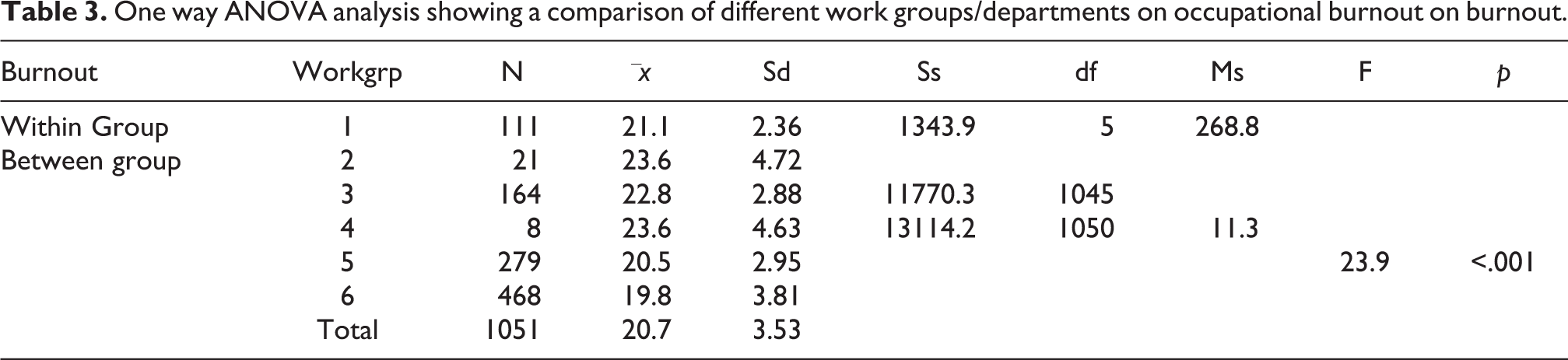
Despite reaching statistical significance, the actual differences in mean scores between groups were not as large across the groups. The effect size, calculated using eta squared was .01. Post-hoc comparisons using the Tukey HSD test indicated that the mean score for burnout among maintenance operations staff (x¯ = 23.62, sd = 4.72) was significantly different from others (x¯= 19.79, sd = 3.81). The mean score of burnout for administrative staff (x¯ = 22.75, sd = 2.88) was significantly different from the mean score for customer service staff (x¯ = 20.54, sd = 2.95) and others (x¯ = 19.79, sd = 3.81). There was no statistically significant difference in mean scores of burnout for flight operation staff and the rest of the working group; maintenance operation staff with the rest of the group except others; and training staff with the rest of the working group. The operations staff group had the highest level of difference from the rest. In other words, the group reported the highest level of burnout experience among the workgroups.
Discussion
Apart from ascertaining the level of occupational burnout in the examined aviation industry which yielded a high prevalence, there were three hypotheses generated from literature and tested accordingly. Findings indicated a 41.7% prevalence of burnout in the sample. The high rate of occupational burnout in the sector shows that it is common. The result finds relevance in the conservation of resources (COR) theory by Hobfoll. 4 The high prevalence of occupational burnout is an indication that employees’ concerns in the industry are largely unmet, which is the focus of the conservation of resources theory. The finding is supported by previous literature that reported high prevalence in other sectors Demerouti, Veldhuis, et al. They found occupational burnout prevalence of 40% among the European pilots surveyed. Our study found a higher prevalence in a large sample of the industry than the European report. However, the study involved only pilots, which is a subset of the industry.
The findings by Rua et al that 36.1% of residents reported a high evidence of burnout is in the direction of the present study. The high prevalence in both the resident doctors and aviation workers’ studies imply that burnout is a workplace concern in different industries.
Similarly, Brezonakova found that occupational burnout is a significant human factor limitation for Pilots. In our study, we covered more sectors by considering a broader scope in the aviation industry. The observed difference in the prevalence of burnout in both studies may have been due to differences in scope. Though not a large difference, it is probable that a larger sample of the entire aviation industry in a European country may have yielded a much higher prevalence. Nevertheless, findings from both studies indicate the extent of occupational burnout that characterize the industry. The 40% of pilots in a European study and 41.7% across the industry in Saudi are significant enough to expand the global literature and raise more awareness that may attract relative interventions. In all the studies, it can be inferred that when not addressed despite its high prevalence, occupational burnout can significantly limits human factor.
The hypothesis that predicted a significant difference among the age groups on their reported experience of occupational burnout was confirmed in the direction stated. The employees who participated in the study were classified into three age groups of 18–30 years, 31–45 years, and 46 years and above. The first group reported a significantly lower level of occupational burnout than groups two and three. The difference between groups two and three was insignificant, but both were remarkably higher than the level reported by the lowest age group. However, a major inference from the finding is that the level of burnout progresses with age. For instance, while the youngest group of employees reported a mean value of 19.7, the middle and older age groups reported 22.1 and 22.2 respectively. The finding shares similarity with the meta-analytic review by Brewer and Shapard, which identified age as a factor in burnout across several industries but did not include aviation. In contrast, while they found negative correlation between age and burnout, our finding indicated an influence that shows progressive experience of burnout with age. However, both studies identified age of employees as a significant factor of influence. The confirmation of the hypothesis justifies the consideration of age as important factor in occupational burnout among employees.
The study of Ethiopian healthcare professionals found age and years of working experience as factors of significant influence on occupational burnout. 22 They found younger employees of about 30 years and others who have spent more than 5 years on the job as reporting higher level of burnout than those who are older in age and less duration on the job respectively. Apart from supporting the first hypothesis in the present study (though differ in the direction of age that influence burnout), the identification of working experience as a factor in their study also support our second proposition. It was stated that a significant difference in burnout would exist among employees based on their work experience. Contrary to their finding which identified those who have spent 5 years and above as reporting more burnout, our finding showed that those who have spent less than 3 years on the job reported significantly higher level of burnout than those who have spent more years. Those who have spent 10 years and above were not significantly different from the second (above 3 to 9 years).
The findings that confirmed the third hypothesis, which predicted significant differences among the work groups in the sample, followed the direction of previous studies identified in Ripp et al. Operations’ staff and customer service employees reported significantly higher level of occupational burnout than the rest of the workgroups. The findings can be described as reflecting the relative demands of job on the personal resources of employees by the different occupational paths in the same industry. As shown among the aviation work groups, a Tunisian medical residents’ study also found high prevalence of burnout across specialties but identified differences, which indicated that some specialties were more affected. 19 In agreement with the present study of aviation industry, it implies that burnout experience differ among units and departments in the same organization. The findings in the present study further justify the suggestions by Ramos, Jenny and Bauer that occupational health models need to be developed to consider such demographics as age, job tenure and workgroups that includes position. They identified the differences in susceptibility to burnout as resulting from resilience. It implies that adaptation to work conditions can result in peculiar job demand differences. This may also apply to industries and countries. For instance, previous review of healthcare professionals’ self-reported burnout in Arab countries found similar prevalence in non-Arabic speaking westernized developed countries. 20 Despite showing that burnout is prevalent in both westernized and Arab countries, the studies did not cover aviation. Nevertheless, existing reviews have lent support to the present findings, which is expanding occupational burnout across industries.
Conclusion
Literature is replete with studies on occupational burnout in Western and emerging countries of Asia, including the Middle East. However, most of the reported findings on prevalence of burnout covered professionals in the healthcare industry. There is dearth of studies that cover the aviation industry in the Middle East, and Saudi Arabia particularly. Not much in the literature that included the scope of this study. Discussions of worker issues in aviation that concern management and deserving of scholarly attention rarely focus on occupational burnout. Based on findings in our study, it can be concluded that a high prevalence of occupational burnout exists in the Saudi aviation industry. Across the various work groups surveyed, findings showed sectorial differences in the experience of occupational burnout in the workforce. There is progressive experience of burnout on the job as employee ages, and there is low level of female participation as employees in the Saudi aviation industry. This study has provided an empirical basis for more attention on occupational burnout as a workplace psychosocial experience that has been known to negatively impact employees and organizational effectiveness.
The outcome of our study has offered insight to the presence of a counterproductive workplace experience among employees in the aviation industry. It is expected to have significant implication for management and their employees as they continually seek ways to identify and improve on factors that affect continuous improvement on people and processes. As found in the literature reviewed, the bulk of existing studies on burnout are mainly in health-related journals. Yet, it is a workplace experience that has significant impact on organizations’ outcomes. Therefore, disseminating our research in a management journal is expected to sensitize management scholars and practitioners, especially in the aviation industry on the need to increase attention to occupational burnout. The empirical data may guide management in the development of intervention programs in training and talent management generally.
Despite the findings that offered a broader expansion of knowledge of people-issue in the industry, inclusion of more variables may have sufficiently addressed the determining factors that could enhance the holistic impact analysis in the aviation industry. Inclusion of employee variables of personality, diversity orientation, family responsibilities and others may have expanded the findings, and show the specific capacity to affect workplace reactions and perceptions. It is suggested that future researchers on occupational health related topics, such as burnout should incorporate the variables as potential factors of influence. The dispositional and situational variables would enable future researches in occupational burnout in aviation industry to show their predictive influence. This is an indication of a yawning gap in researches that deserve more attention. Involvement of qualitative researches is highly encouraged to be explored by future researches in the area. Qualitative research methods, such as indepth interviews that can offer wider opinions on issues that concern the aviation industry, which may yield new dimensions and expand the knowledge of what is presently known about occupational burnout.
Nevertheless, the study has provided empirical basis to raise awareness of occupational burnout for management, scholars and practitioners. It is expected to guide interventions that promote employees’ well-being and adjustment. For instance, the findings offer the awareness on the need to focus attention on stress management training in order to minimize burnout among employees. This study will also help to expand the literature by adding Saudi aviation employees’ experience to the literature on occupational health and aviation management. Previously, much of the burnout literature covered the healthcare industry. This study has pioneered interest in burnout as an occupational health issue that deserve more attention in promoting employee and organization’s effectiveness, especially in aviation industry.
Footnotes
Acknowledgement
We are grateful to Prince Sultan University that offered the institutional research grant (number: RP-DES-2018-09-16) which made this study possible.
Declaration of conflicting interests
The author(s) declared no potential conflicts of interest with respect to the research, authorship, and/or publication of this article.
Funding
The author(s) disclosed receipt of the following financial support for the research, authorship, and/or publication of this article: Prince Sultan University offered the institutional research grant (number: RP-DES-2018-09-16).
