




Abstract
Electric vehicle (EV) has made a revolution in the automobile industry. The largest automobile industries are moving toward this. Within the next 5–10 years, the world will shift to EVs. Bangladesh is one of the emerging countries in Asia, so it will have great market potentiality. Bangladesh will have a big opportunity for EV business. However, there are some challenges too to introduce a new business model like EV business. In this study, we have tried to analyze the market potentiality and the business strategy in Bangladesh through strengths, weaknesses, opportunities, and threats analysis and analytical hierarchy process to analyze different strategies. These strategies had a feasible solution proved by sensitivity analysis.
Introduction
The world is moving faster by adopting new technologies. Technologies help us to work smarter, quicker, and more efficiently than before. The electric vehicle (EV) is one of the most advanced technology in the field of the automobile sector. It began to change the whole infrastructure of the automobile sector that people did not imagine before. Within 2020, EV will be in mass production in Europe. It has been realized that EV business will be a top priority in the upcoming days. Bangladesh’s neighbor country India has set its goal to switch into EV within 2029. The global market for EVs is increasing day by day. The era of EVs starts in around 1832 by Robert Anderson, a British inventor. 1 At the end of the nineteenth century, an inventor named William Morrison introduced the first EV in the United States. The EV1 model was the first EV in the United States launched by General Motors. In 2006, Tesla Motors breakthrough the automobile market with a fully electric car named Tesla Roadster. This car made the EVs successful in the automobile industry by which the other automobile makers were also inspired. 2 As the fuel cost was much higher than electricity in all continents, countries, or even regions, people and automobile makers were felt the necessity of EVs. Also, the electric car has zero emission to the environment, which is an unquestionable advantage over combustion vehicles (CVs). Thanks to its fast charging option, it can travel shorter distances around the town within a couple of hour charging. 3
Although EV has more advantages, there also have some issues in this sector. Many developing countries are not ready yet with their infrastructure to adopt EVs into their transportation system. Cost is another vital barrier in this section. Due to the high cost, people in developing countries are not capable of affording it. However, recently, the Asian countries are encouraging more to introduce and adopt it in their transportation system. Japan, Singapore, China, and India are already using EVs in their countries. Also, to remind that China is the largest market of EVs until 2040. 4 It means developing Asian countries like Bangladesh are going to adopt this new technology in the transportation system for the welfare of the environment and energy.
To start a business organization, it is needed to analyze the market very well and set up strategy. But from hundreds of strategies, the best strategy has to be picked. Making the correct decision is always difficult. But today’s decision will determine the future. Analytical hierarchy process (AHP) is one of the popular methods of decision-making. Strengths, weaknesses, opportunities, and threats (SWOT) analysis is also used a lot to analyze the situations. In this article, we will merge both SWOT and AHP to determine the criteria, subcriteria, and the best strategies of EV business in Bangladesh.
Literature review
EVs have started a new era in the automobile industry. The developed countries are already introducing their transportation system from internal combustion vehicle (ICV) to EV. It is assumed that EVs will reach price equivalency with ICV shortly and that EV sales will overtake petrol and diesel sales.
Bangladesh has enormous opportunities in the transportation sectors by implementing this new technology. EV can play an important role in taking the automobile sectors in Bangladesh into a new level. All the developed countries are switching their transportation system to EV; so, starting a business on EV will be profitable and effective for the entrepreneurs. 5 This automobile sector has a significant contribution to Bangladesh’s economy. The transportation industries play a major role in the development of vehicles as people demand and their purchasing power. Bangladesh achieved 7% economic growth because of stable unemployment and a rise in foreign investments. A large number of vehicles are imported in Bangladesh, which indicates that EVs have an excellent opportunity to rule this automobile market in this country. 6 Bangladesh, along with its government and transportation policymakers, is needed to put effort into this sector which can help to develop the country's economy. The market industry is mature enough to import EVs and also build automobile industries in Bangladesh. So, it can be easily realized that starting a business on EV in Bangladesh will help to build the transportation system at the global level. EV ensures zero emission and helps to reduce the greenhouse gas of the environment. It is also an eco-friendly technology and cost-effective to the global market. 2
An organization needs to assess their opportunities and chances as well as the risks and threats before starting a business in a new location. It is crucial to understand the situation before investing. The situation can vary from one place to another. To assess the situation, SWOT analysis is an essential tool. SWOT stands for strengths, weaknesses, opportunities, and threats. Strengths and weaknesses are internal factors. And opportunities and threats are external factors. “SWOT Analysis is a simple but powerful tool for sizing up and an organization’s resource capabilities, and the external threats to its future.” 7
But the inclusion of the AHP into SWOT helps an organization to make its strategy more appropriate. Organizations often face complex situations in making decisions. 8 AHP is a very effective tool for dealing with these complex decisions. “We are all fundamentally decision-makers. Everything we do consciously or unconsciously is the result of some decision.” 9 If the decision-making is too complex to take, then AHP helps to make the correct decision. 10 A goal, criteria, subcriteria, and alternatives are needed at first. Then we need to find out the best alternative to make the correct decision. 9
Strengths
The four main strengths are determined as follows:
Environmental awareness of Bangladesh Government
Bangladesh Government flagged various initiatives to adapt to climate change in a proactive manner through its resources and international cooperation. It was particularly mentioned that a roadmap for implementing Bangladesh’s Intended Nationally Determined Contribution was currently in the making. Bangladesh signed the Historic Paris Climate Agreement at the United Nations on 22 April 2016.
“Collective wisdom and commitments are essential to implement the Paris Climate Agreement…We all must consider the urgency of acting now,” the statement read.
Bangladesh urged, “All countries need to be united in our collective journey, keeping in mind that one’s non-compliance may threaten the existence of all. However, developed countries have to take the lead in this case.” 11
Plug-in EVs (also known as electric cars) do not emit carbon, chlorofluorocarbons gas. It helps to keep the world clean and emission-free and helps to reduce the greenhouse effect. As Bangladesh is very permissible to take any supportive role for the welfare of the environment, so it means that any organization will get enough support to start their own EV business in Bangladesh.
Lower duty charge
Bangladesh Government is encouraging the EV transportation system. If we look at the supplementary duties of EV and ICV (Table 1), it will show that imported EV cars will be charged 15–50% lower. It is a good sign for any company that might be interested in doing business here. It would encourage manufacturing companies as well. 4
Supplementary duty charge of regular vehicle and EV. 12

EV: electric vehicle; CC: cubic centimeters.
Fuel efficient
In the modern world, the economy of every country depends on fuel. But the stock of fuel is decreasing day by day. So, people are trying to invent fuel-efficient technologies like EV. EVs convert about 59–62% of the electrical energy from the grid to power at the wheels. Conventional gasoline vehicles only convert about 17–21% of the energy stored in gasoline to power at the wheels. An electric motor typically is between 85% and 90% efficient. 13 That means it converts that percentage of the electricity provided to it into useful work. The only losses occur in EV by charging and discharging battery and power transmission from battery to motor.
Introduction of new technology
In the modern world, every developed country is switching EV over CV. Day by day, companies are introducing new technologies for their customers to grab this big market. In 2030, 125 million cars sold will be of the electric variety, accounting for one-third of the global car fleet. 14 As this technology is still new and Bangladesh is not familiar with this, the organization that will bring this technology here will have better chances to attract their customers and grab the market. 15
Weaknesses
The four main weaknesses are determined as follows
Underdeveloped infrastructure
Bangladesh is a developing country in South Asia. Though Bangladesh is developing day by day, it lacks behind from the developed countries. It is quite difficult for Bangladesh to start a business on EV because the infrastructure of the transportation system is not ready yet. The charging station, energy for the vehicles, road infrastructure, and so on should be done properly for ensuring this aspect. Without guaranteeing the infrastructure, this EV business will not be easy to start.
Lack of trained manpower
Skilled manpower is vital for any organization. This manpower leads an organization to achieve its own perspective goals. EV is a very new technology in Bangladesh, so there is a lack of trained and skilled manpower for starting the business. It mainly hampers the after-sale and maintenance of the product and is a major weakness for the business.
Energy crisis
Crisis of power is one of the major issues in Bangladesh. Day by day, the gap between demand and production of energy is increasing rapidly. Moreover, most of the power plants are gas-based, which will be phased out in the future. Bangladesh’s energy infrastructure is quite small, insufficient, and poorly managed. The per capita energy consumption in Bangladesh is one of the lowest (136 kWh) in the world. Commercial energy consumption is mostly natural gas (around 66%) followed by oil, hydropower, and coal. Electricity is the primary source of power for the country’s most economic activities. Bangladesh’s installed electric generation capacity was 4.7 GW in 2009; only three-fourth of which is considered to be available. Only 40% of the population has access to electricity with a capacity of 136 kWh per annual. 16
The public transportation system is not ready to switch yet
Economic growth of Bangladesh more or less depends on transportation. A large number of vehicles are registered and moving daily in Bangladesh. This number of vehicles often causes traffic congestion, time waste, energy loss, and fuel loss by which our traveling getting more complicated day by day. As describe earlier, most of the vehicles are fuel-based. And the initial cost and infrastructure cost are high for EVs. So, the owner may not buy EVs.
Opportunities
The four main opportunities are determined as follows:
Digital Bangladesh
Bangladesh has a vision of full digitalization in every sector before 2021. 17 The government has already taken many steps and has the plan to invest more in this sector. So, any business or organization that would help to fulfill this vision will be benefited. An EV is not only a mechanical structure but also becoming an electronic device. Lots of electric sensors, wire, motor, and batteries are mounted here. It can also be programmed. Driverless cars and internet of things are also important features. To make a digital transportation system, EV can play an important role and this will also help Bangladesh to be introduced as a digitalized country.
Renewable energy
Energy or in specific electricity is one of the essential things for EVs. We have already discussed that Bangladesh does not have energy security. However, there is hope that Bangladesh has already taken some steps and has a master plan for developing renewable energy power plants. Bangladesh has already invested in its first nuclear power plant. There are two plants and each one will add not less than 1150 MW in the national power grid in the year 2023. 18 Bangladesh has good potentiality for wind energy. The country has its two-wind energy plant at Muhuri Dam, Feni, which has a capacity of 0.9 MW (225 KW, four turbines) and another one at Kutubdia Island (20 KW, 50 turbines) with a capacity of 1 MW. 19 Bangladesh also made its first solar energy power plant at Teknaf’s Hnila, which can produce 28 MW and will feed 20 MW to the local substation during sunlight hours. 20 Again, the EVs can be powered through solar panels of their own as well. So, it will not need energy from outside and the car does not need to wait in the charging station.
Market increasing
The automobile market is increasing at a constant rate globally. Bangladesh also has a growth rate over the last few years. In 2017–2018, a total of 4,68,706 vehicles were registered. And it was 5,24,016 vehicles in the following year. 20 So, this is a positive sign for doing the automobile business in Bangladesh. Bangladesh also has around 7% gross domestic product (GDP) growth from 2010 to 2018. As EV is cost-effective and its price is lower than ICV, middle-class people can quickly enter this market.
No competitor yet
Bangladesh is a big market. Around 160 million people live here. But still, there is no promising company for this EV market. So, the market is fully unsaturated. The company that will move fast in this business will have more extensive opportunities. It can easily grab this huge market by fulfilling customer’s requirements. A company that does not have any competitor gets not only a large number of customers but also may get good brand value and a recall value from the customers. These values will also help the company to maintain constant growth in the future as well.
Threats
The four main threats are determined as follows:
Energy failure
As Bangladesh is an underdeveloped country, there is a lack of power sources and charging stations. EV entirely depends on electricity. The power sector in Bangladesh has one national grid with an installed capacity of 16,525 MW. The total installed capacity is 20,000 MW (combining solar power). But the demand is too high than its supply and this demand is rising every day. For this, Bangladesh has a severe concern about load shedding for many years. Furthermore, this problem may bring unhappiness to customers. If the power system fails to provide the demand for EV, then it will be a colossal disaster for the transportation system. This threat can make the whole system in a standstill. 21
Political instability
Since the liberation war of 1971, Bangladesh has lots of political violence. It had a disastrous impact on the market as well as the progress. As political instability has extremely involved with the country's market, it is an important concern for threats. As political unrest continues to take a toll on the Bangladesh economy, major sectors have incurred a loss equivalent to Tk 4900 crore or 0.55% of GDP of FY2015 from January to mid-March this year. So, the organization should have a good focus on this point. 22
Rising price of raw materials
EV is a new era of technology in the global world. As this technology just came to the market, so there may have a lack of parts in the market. This technology is still in the research and development sector. So, the mass production of EV needs some time to launch the market. Moreover, the industrial eco-system of EV has not grown yet. So, the price of the parts is still high. It leads to the high price of the vehicle.
Low sales lead to low revenue and profit
As EV is very new to the global world, there is a high risk that the sales of the EV may not grow properly. People of Bangladesh may not feel comfortable with this technology because they are not ready to enter this system. It will lead to a high impact on the business sector of EV.
In this article, we will collaborate with both SWOT and AHP techniques to determine the business situation of EV in Bangladesh. SWOT will give us the external and internal factors that should be taken care of before making a strategic plan of starting the EV business in Bangladesh and AHP will prioritize the factors. So, SWOT-AHP will give us a quantitative overview of the potentiality of EV business in Bangladesh. The result will be more relevant to take. A lot of research has been done to solve problems by SWOT-AHP. Kahraman et al. used this same method to solve their problems. 23
Data sampling plan
SWOT-AHP model is based on data analysis. So, data sampling is important. Good data sampling will provide fewer errors and better results. There is no definite rule for selecting the least quantity of experts in sampling. In this study, a total of 30 experts were used. The experts were from different departments, such as operations management, planning, business development, and engineering. All the experts had sufficient knowledge and practical experience in their particular field. The questionnaires were designed carefully and were well structured.
Research methodology
The steps of our methodology of this article are given below: Determine the strengths, weaknesses, opportunities, and threats of EV business in Bangladesh by SWOT analysis. Find the criteria, subcriteria of strengths, weaknesses, opportunities, and threats. Make pairwise matrices of criteria and subcriteria and calculate the priorities of these criteria with the help of AHP methodology. Find out the best alternative and rank them. Sensitivity analysis to observe the behavior of any alternative with the change of priority weights.
The basic procedure of AHP consists of following these steps. 24 These are given below: Developing the weights for the criteria by (1) evaluating a single pairwise matrix for the criteria; (2) normalizing each column of the matrix and calculating appropriate priority or weights; and (3) computing and checking the consistency ratio (CR) by using the following equation.

Here, CI = Consistency index =
where the small n denotes the number of criteria. Random Consistency Index (RI) is taken from Table 2.
Random consistency index.

RI: random consistency index.
If the CR is less than 10%, then the pairwise matrix will be accepted. Otherwise, the pairwise matrix will be rejected. From Table 3, we can see the fundamental scale of absolute numbers. It is also known as Saaty’s scale. Here, 1 is referred to as equal importance and 9 is absolute importance. Saaty’s 1–9 scale is given in the following.
The fundamental scale of absolute numbers. 9

AHP analysis
SWOT-AHP analysis
SWOT analysis gives the internal and external factors used to make a systematic decision for the future. The internal and external factors are summarized within the SWOT analysis. SWOT analysis is used for strategic decision making but it does not give any quantitative results. That is why it is not easy to assess which factor influences the strategic decision most and where the AHP gives a pair-wise comparison between each factor. So, the combination of both SWOT analysis and AHP can provide a quantitative measure of each factor in decision-making, which is much more acceptable for any organization to make a better decision.
In Figure 1, we identified and analyzed the SWOT of the EV business in Bangladesh. Now in this section, we will prioritize the criteria–subcriteria through pairwise comparison matrices (Figure 2). These pairwise comparison matrices were filled by the experts of the automobile industry, business strategy maker, marketers, and technical experts of Bangladesh, so that the data reflect the original scenario and drive us toward our goal.

SWOT analysis of EV business in Bangladesh. SWOT: strengths, weaknesses, opportunities, and threats; EV: electric vehicle.
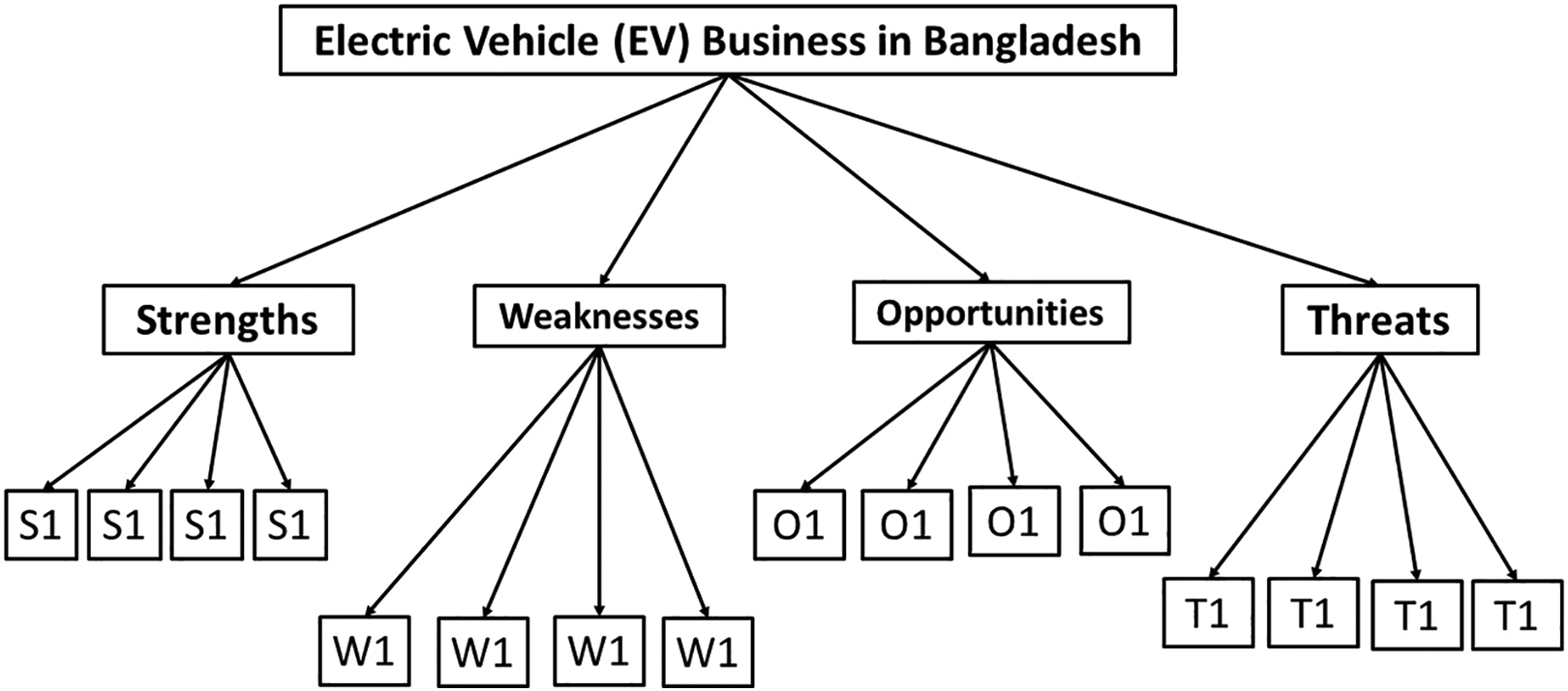
Hierarchy SWOT. SWOT: strengths, weaknesses, opportunities, and threats.
Tables (4 –13) show the pairwise comparison matrices and priorities of each matrix. The CR is determined and each CR is less than 10%. According to AHP methodology, the pairwise comparison matrices and priorities of the criteria are accepted.
Pairwise matrix of SWOT.

SWOT: strengths, weaknesses, opportunities, and threats.
Priorities of the criteria of SWOT.
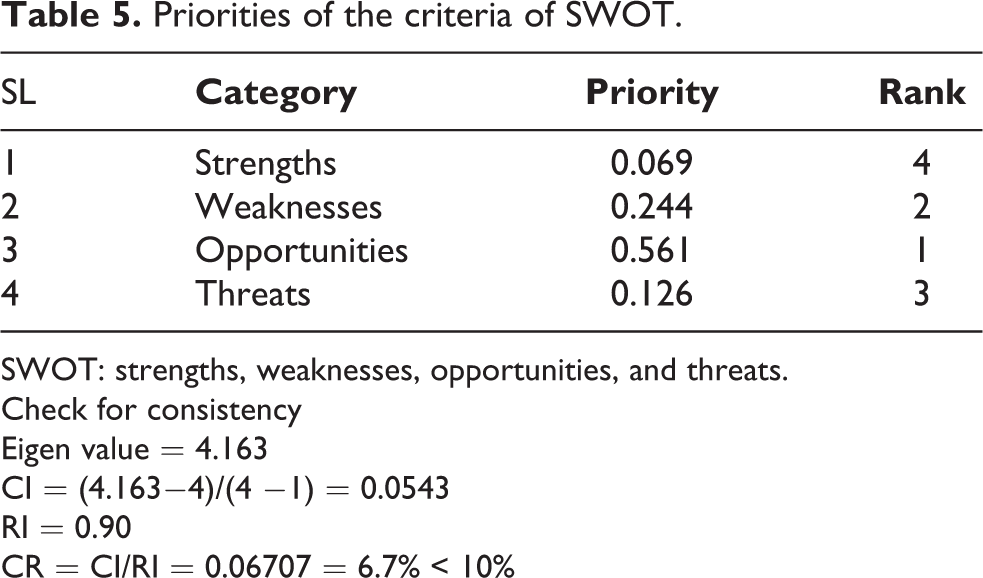
SWOT: strengths, weaknesses, opportunities, and threats.
Check for consistency
Eigen value = 4.163
CI = (4.163−4)/(4 −1) = 0.0543
RI = 0.90
CR = CI/RI = 0.06707 = 6.7% < 10%
Pairwise matrix of criteria of strengths.
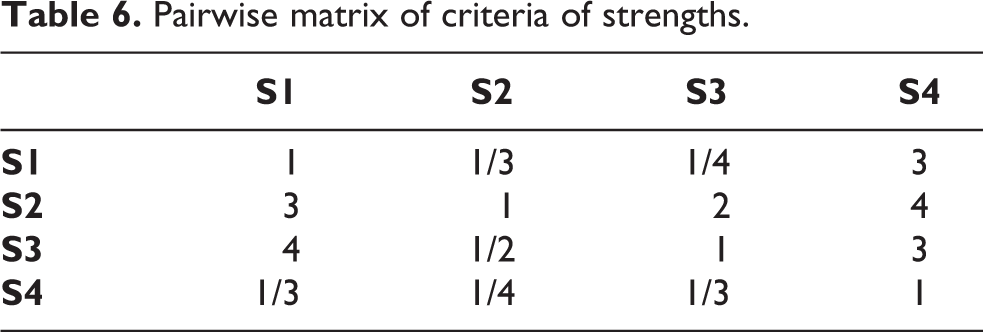
Priorities of the criteria of strengths.

Check for consistency
Eigen value = 4.238
CI = (4.238−4)/(4 −1) = 0.0793
RI = 0.90
CR = CI/RI = 0.08811 = 8.81% < 10%
Pairwise matrix of criteria of weaknesses.

Priorities of the criteria of weaknesses.

Check for consistency
Eigen value = 4.150
CI = (4.150−4)/(4 −1) = 0.05
RI = 0.90
CR = CI/RI = 0.0555 = 5.55% < 10%
Pairwise matrix of criteria of opportunities.

Priorities of the criteria of opportunities.

Check for consistency
Eigen value = 4.079
CI = (4.079−4)/(4 −1) = 0.02633
RI = 0.90
CR = CI/RI = 0.0292 = 2.92% < 10%
Pairwise matrix of criteria of threats.
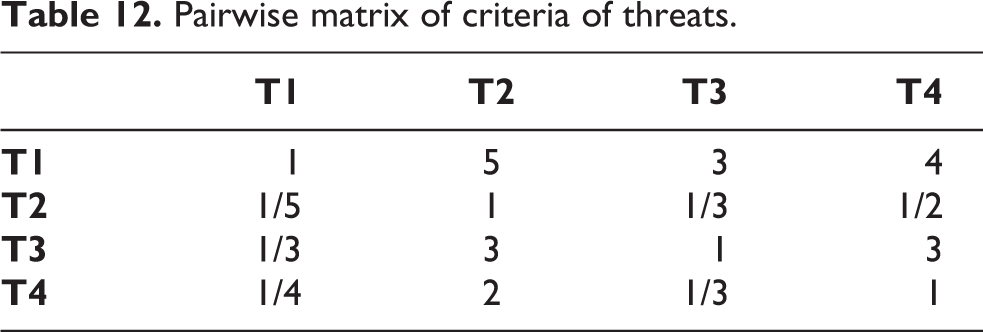
Priorities of the criteria of threats.

Check for consistency
Eigen value = 4.108
CI = (4.108−4)/(4 −1) = 0.036
RI = 0.90
CR = CI/RI = 0.04 = 4.00% < 10%
Table 14 represents a summary of all the criteria and subcriteria priority. From Tables 4 and 5, we obtained the priorities of SWOT. And after that, we calculated each subcriteria of SWOT. The overall priority of the factor is the multiplication of the criteria and subcriteria priorities. The result is shown in Figure 3.
Priorities and CRs of comparisons of the SWOT groups and factors.

SWOT: strengths, weaknesses, opportunities, and threats; CR: consistency ratio.
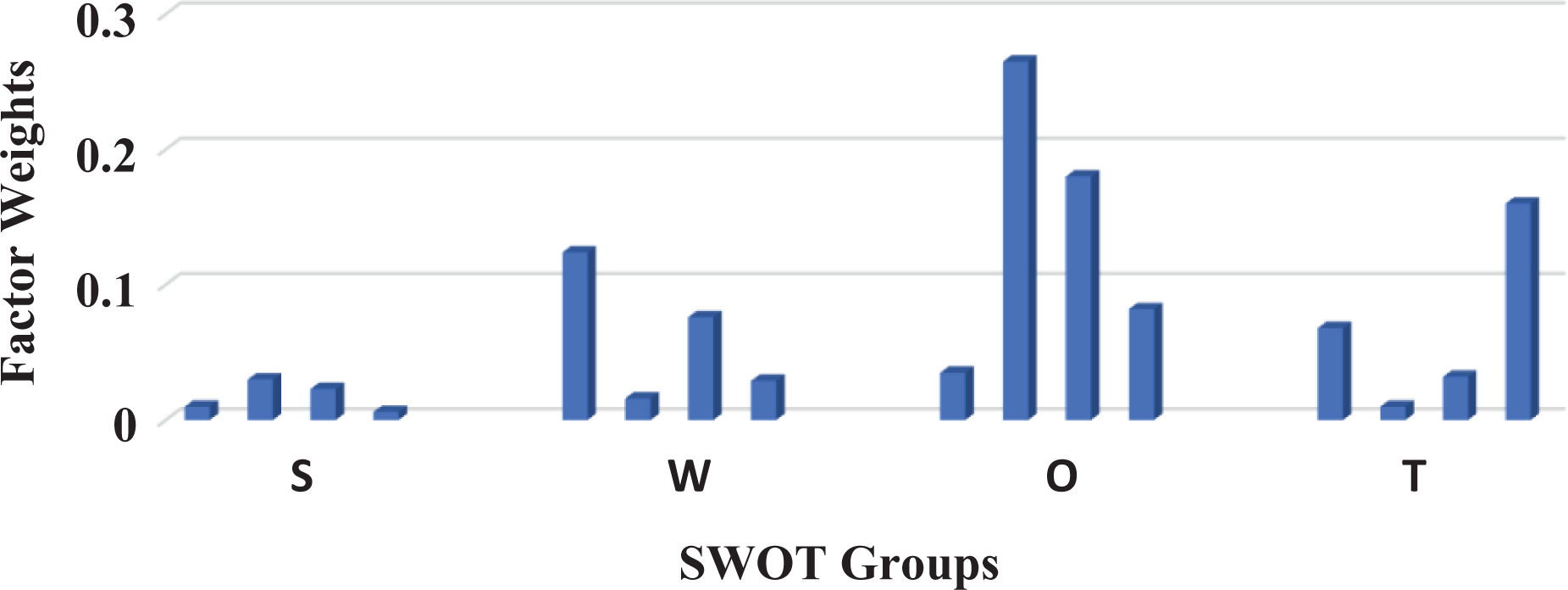
The priority weights of the categorized subfactors.
Possible business strategies
Any start-up business needs robust strategies. These strategies determine the future of business. Before introducing the EV business in Bangladesh, the firm should consider the vehicle and service at a low cost and satisfy the customers. Considering outside the capital city, Bangladesh is not ready yet to welcome EVs as its vehicle infrastructure is poor. So, a firm may take four strategies to grab significant market potential.
(A1): Analyze customer behavior and grab market attention with new technologies
Customer-oriented organization has more sustainability than product-oriented organizations. A firm should understand European or North American customer demands and Bangladeshi customer demands are different. So, the firm should have a keen realization of market and customer data, which may help it to grab big market opportunities.
(A2): Introduce efficient and low operating cost vehicles
Efficient vehicle always attracts new customers. As Bangladesh has high energy costs and it also has an energy crisis, so efficient car will attract the customer. A firm should introduce low price vehicles than internal CVs. Operating cost is another headache of the consumers. A firm should take this in their consideration as well.
(A3): Customized vehicle suitable in Bangladeshi infrastructure
Bangladesh imports customized vehicles of renowned brands. As the infrastructure is not up to date, the organization needs to customize to increase the durability. It is crucial for customer satisfaction. Minor customization might also do.
(A4): Vehicle availability according to customer demand
Different customer has different taste and their purchasing power is also not constant. So, to grab the big market potential, the firm should have variety in their product. It will help the different categories of people to be more interested in EVs.
Tables 15 –18 represent the pairwise comparison matrices of four alternative strategies for each subcriterion of strengths, weaknesses, opportunities, and threats respectfully. The CR and priorities of the alternatives are determined by the AHP methodology.
The pair-wise comparison of alternative strategies for the strengths.

CR: consistency ratio.
The pair-wise comparison of alternative strategies for the weaknesses.

CR: consistency ratio.
The pair-wise comparison of alternative strategies for the opportunities.
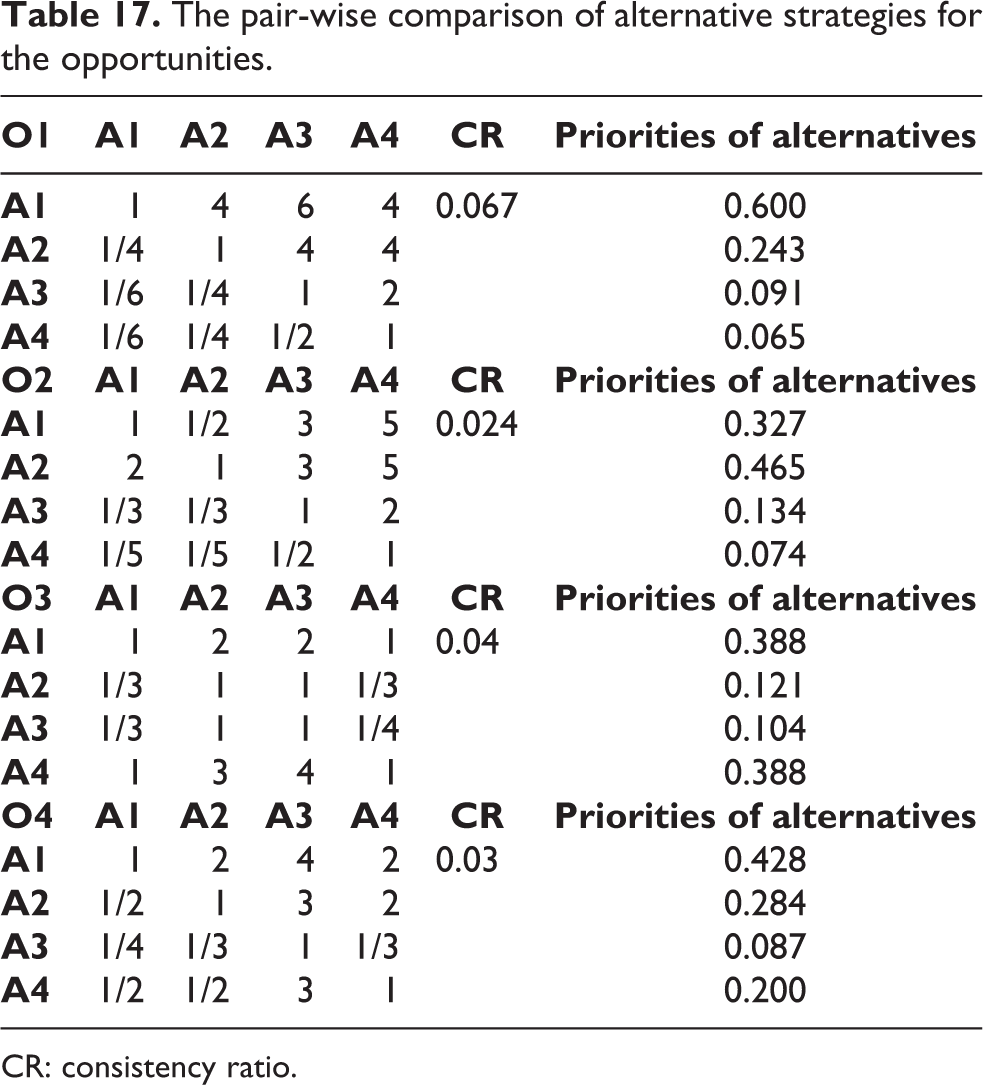
CR: consistency ratio.
The pair-wise comparison of alternative strategies for the threats.

CR: consistency ratio.
We aimed to identify the best alternative that suits the EV business of Bangladesh. We took four best alternatives, which might be the best alternatives. However, we have to select one strategy. Table 19 represents all the subcriteria and their overall priorities (Table 14) of alternatives (Tables 15 –18). These overall priorities of all the criteria and alternatives are multiplied and added respectfully. The percentage of summation gives us a clear view of the best alternative.
Synthesized table for the optimal alternative selection.

SWOT: strengths, weaknesses, opportunities, and threats.
Percentages of the total score show that the A2 strategy wins (Figure 4). It secured 32.36% of the total score. After that A1, A3, and A4 contain 21.11%, 21.27%, and 19.25%, respectfully. So, the best strategy of starting the EV business is A2 or Introduce efficient and low operating cost vehicles.
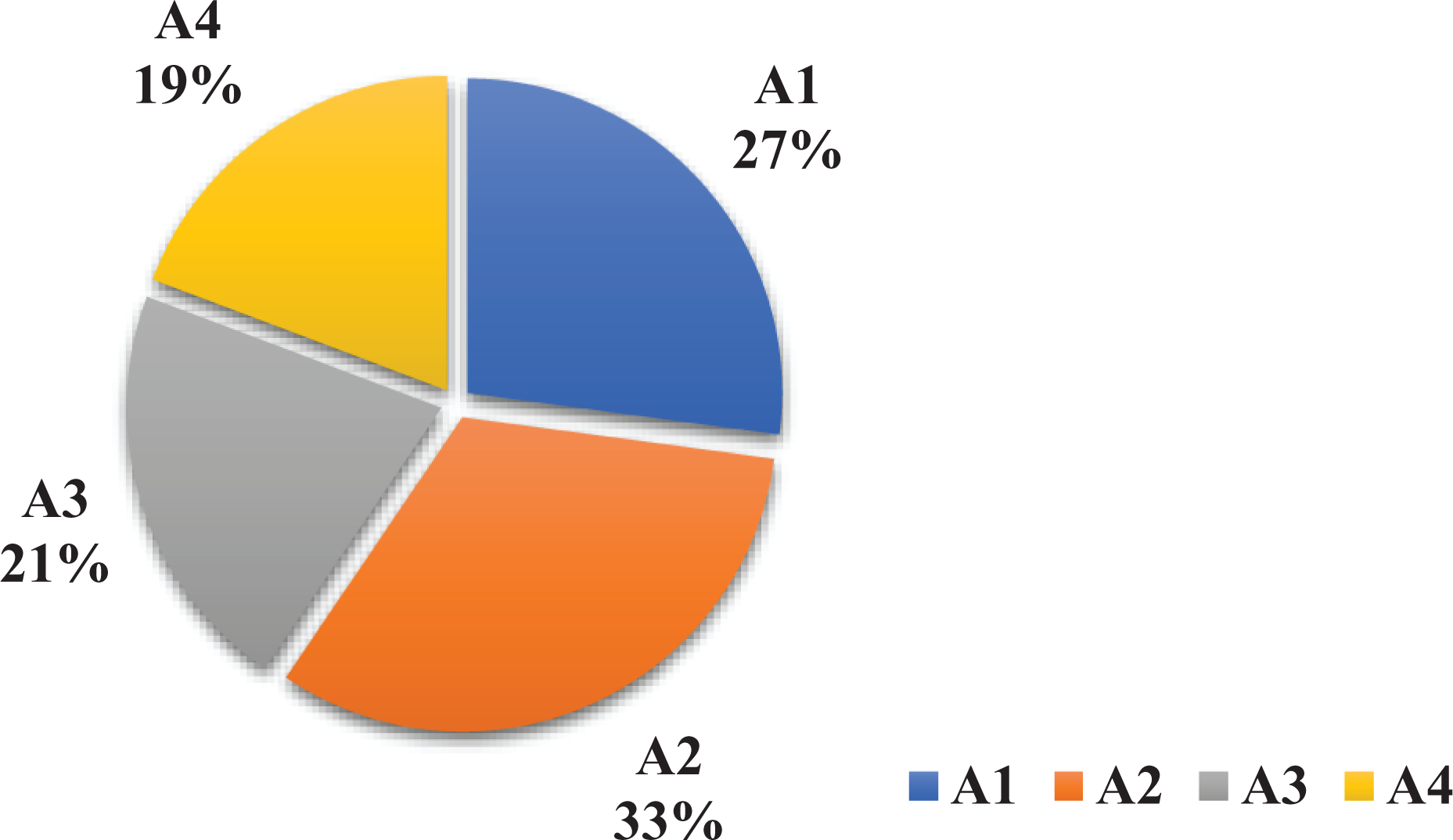
Percentages of alternative selection.
Sensitivity analysis
A sensitivity analysis is a methodology that shows how different values of an independent variable affect a particular dependent variable and this is the study of the relative importance of several inputs influencing the total output. In AHP, when the weight of criteria is changed, the final decision will also change. This is why a “what if” analysis is taken under consideration. 8
In prior calculation, we estimated that renewable energy (O2) has the largest impact than the others. The change of its criteria weight may have a significant impact on decision-making. From Table 19, we can see that renewable energy has a 26.50% impact. If we increase it up to 50%, then overall priorities of A1, A2, A3, and A4 will be 27.11%, 32.36%, 21.27%, and 19.25%, respectively. Now, if we increase it up to 75%, then overall priorities of A1, A2, A3, and A4 will be 27.96%, 34.53%, 20.00%, and 17.4363%, respectively.
Again, if we do not consider the impact of O2, then overall priorities of A1, A2, A3, and A4 will be 23.94%, 24.34%, 25.74%, and 25.98%, respectively. Here, alternative 4 or A4 will be the right decision.
Conclusion
This research is a brief presentation of opportunities and business strategies for EV business in Bangladesh. Efficient and low operating cost vehicles would be better here. Proper market analysis is also very essential to sustain in the market for a long period. The strengths and opportunities are looking brighter. But energy crisis, undeveloped infrastructure, and political instability may create some issues. So, organizations should be aware of this. Nevertheless, as Bangladesh’s economy is rising at a good pace, it will be a good market for big automobile industries. The whole world is shifting to the EV. The market opportunity is enormous. Robust analysis and strategy will set the market winner. Bangladesh also should be ready for the change. The development should be done in the transportation sector. Bangladesh should invest more in renewable energy to keep pace with market demand. Roads, highways, and other infrastructures should be ready and attract investors throwing excellent opportunities to them. Good collaboration from the public and private sectors may lead Bangladesh to be a better country to invest in the EV business. In the future, the criteria may change and new challenges will arise; this model will help the organizations and the industries to make a correct decision. Further research may be done to find the solution to the problems and find out the best market strategy. In this study, only 16 criteria were taken into consideration. The researcher may find out the result using more criteria. Using more criteria and subcriteria will give better results. The alternatives can also be increased and changed as requirements. This model is also appropriate for different countries and regions. The criteria, subcriteria, and alternatives may change according to the situation.
Footnotes
Declaration of conflicting interests
The author(s) declared no potential conflicts of interest with respect to the research, authorship, and/or publication of this article.
Funding
The author(s) received no financial support for the research, authorship, and/or publication of this article.
