




Abstract
This article presents a comprehensive framework which identifies the relevant factors that can influence the standard adoption process, along with insights for performing a qualitative perspective analysis on the possible market diffusion of a specific standard under development or under review. This article also shows an example of framework application to the ISO 22400 standard, evidencing organizational and managerial implications on the standard adoption process.
Introduction
The International Organization for Standardization (ISO) has published over 22,000 international standards so far, 1 ranging from company’s management system to domestic and commercial equipment standards. These standards can be crucial for the economic activity of a company, since the compliance to a certain standard could be a requirement either for public/private tenders or for the penetration of a marketplace. 2,3 Moreover, the relationship between standards and innovation has been studied by several authors, showing that standardization is a valuable tool to drive innovation. 4 Therefore, companies should constantly monitor the evolution of state-of-the-art standards to identify which could be relevant to their business activities.
The adoption of a standard often requires to evaluate and re-design the company’s internal procedures, processes and/or products and is usually characterized by a costly and time-consuming process. Hence, to define the convenience of the standard adoption, it is essential for a company to thoroughly assess benefits and costs that result from the specific standardization process. 5 However, even though strategic guidance has been provided to encourage the spread of standards – such as the National Standardization Strategic Framework for United Kingdom 6 and the United States Standards Strategy 7 – there is no framework to define the factors that influence the adoption of a considered standard. Consequently, this void hinders the evaluation of real benefits and drawbacks that could result from that adoption, giving the way to ambiguity and vagueness.
The lack of such framework generates issues for both sides of the standardization process: the standard developers and the stakeholders, especially firms and policy makers. 8 On the one side, the major issue faced by standard developers during the standardization process is that they could not really know in advance whether a standard will be adopted by many stakeholders, therefore they might undertake costly and time-consuming processes without achieving any private and social benefit. On the other side, the lack of a framework that helps stakeholders to evaluate the potential tangible (or intangible) benefits, which stem from the standard implementation, hinders the definition of unbiased estimates of those benefits. This shortcoming leads firms, whose motivations to standardize highly influence the perceived advantages obtained from the adoption, 9 –12 to implement inefficient solutions 13 or policy makers to promote the same inefficient solutions. 14,15
In the light of these considerations, this article’s objective is twofold. First, the present research aims at identifying motivations and barriers relevant to the standardization process to define a comprehensive framework for evaluating the convenience of the standard adoption. Indeed, the standardization dynamics can be multifaceted, and many significant variables can determine either the process success or failure. Nevertheless, standard developers and stakeholders seem lacking a common framework that, without any loss of generality, provides guidance on the elements that should be considered when assessing the potential benefits and drawbacks resulting from the standard adoption. Hence, the first research purpose of our contribution is to determine the relevant factors that can influence the standardization process to understand why a firm should implement an international standard.
Second, applying the framework to a specific standard, either under development or that is undergoing review, this article aims at gathering insights for performing a perspective analysis on the possible market diffusion of the standard. This application should be performed analysing in a qualitative way the identified variables in relation to the characteristics of the considered standard and its potential adopters. Through carrying out the analysis, it would be possible to identify the potential relevance that a framework’s factor can have upon the standard adoption process and to determine eventual further areas of development for the standard. Following this approach, the main actors of the standardization process can understand more in depth the potential market evolution of a specific standard. Therefore, the second purpose of our research is to apply the identified framework to provide standard developers and standardization stakeholders with useful insights on the standard adoption process for performing decision-making activities.
This article is therefore divided into three main parts. Within the first part, an extended literature review is presented, while the second part of this article describes a comprehensive framework of the factors that influence the standard adoption; this is successively validated using data of the market diffusion of four popular standards: ISO 9001, IATF 16949, ISO 14001 and ISO 50001. The last part of this article focuses on a specific standard, namely, the ISO 22400 standard, to apply the framework to a real case for gathering insights on its possible market diffusion. Note that the framework application is performed through analysing the proposed factors in relation to the characteristics of the considered standard and its potential adopters and allows to define eventual developments and uses of the norm.
Previous research
In the literature, some authors have made several attempts to define the factors that affect the choice to adopt or not a standard. Even though the approach generally followed is quite similar and often entails the use of data analysis techniques, such as regressions and correlations, the variety of data used is enormous and does differ among authors. For example, the studies are focused either on data of firms based on a limited geographical area, as reported in Blind and Mangelsdorf, 3 or on data of particular portions of the market, as in Zoo et al. 4 and Riillo et al. 16 or on data of firms within the same sector and with approximately the same dimension, as in Blind and Mangelsdorf 3 and Poksinska et al. 17 Therefore, it seems reasonable to review the extant literature distinguishing the studies on a data-basis, namely regarding to the kind of data used for the analysis.
Studies on a limited geographical area
These research works are focused on a limited geographical area and particularly on a single country, which means that the results can be biased due to the economic or regulatory trend relative to that country. However, among the articles that exhibit results from data gathered within the European Union zone, the only one that attempts to provide a taxonomy of the various motivations that can lead a company to adopt a standard is that of Blind and Mangelsdorf, 3 which identifies the factors through an explanatory factor analysis on data of German companies. The other articles, 18 –20 simply divided the motives to standardize in external and internal motivations without providing a taxonomy, but they also supplied an analysis of the barriers to the adoption of a standard. Differently from the previous articles, the contributions of Alvarez-Garcia and Cruz 9 and of Castillo-Peces et al. 12 show evidence of the relationship between the drivers of the standard implementation and its perceived benefits, concluding that the perceived benefits strongly depend upon both internal and external motivations; for instance, the improvement of operations, organization and commercial performance, and that only the internal motives can influence the perceptions of the barriers to the standard adoption.
Focusing on the Arab countries, Magd 21 investigated the adoption of ISO 9000 in Saudi Arabia, one of the countries with the highest number of certifications within the Arab zone, finding that the most important benefits regard organizational improvement and the opportunity to access the international markets. On the other hand, the adoption of ISO 9000 in Iraq, one of the countries with the lowest number of certifications within the Arab zone, is analysed in Al-Najjar and Jawad, 22 which concludes that the top management commitment is the highest barrier to the adoption.
Moreover, the relationships between motivations, barriers and benefits are further examined through case studies on the implementation of ISO 14001 in Brazil, as reported in Gavronski, 23 and on the implementation of ISO/TS 16949 by Russian companies, as reported in Panyukov and Kozlovskiy. 24
Studies on a limited portion of the market
The most predominant portions of the market identified and analysed in the literature are the uncertain markets, the developing countries and the markets relative to a single standard.
In their article about the effect of standards and regulation on markets with low and high uncertainty, Riillo et al. 16 show that formal standards are positively correlated with innovation in markets with high level of uncertainty, therefore leading to the assumption that innovation is one of the most important drivers for standard adoption in this kind of markets, while the contrary holds for markets with low level of uncertainty. This article also lays the foundations for the usage of formal standards to supporting public policy.
Furthermore, in the context of developing countries, Zoo et al. 4 studied the independent roles and relationships of the parties involved in the standardization process dynamics, illustrating how standards can drive innovation and enhance the level of technology within the whole country. This allows to understand the main drivers of the standardization process within those countries.
The other contributions consider the diffusion of a specific standard on a broader perspective than the uncertain markets or developing countries, but still limited to a single standard. Indeed, Franceschini 25 provides an analysis of the trends of ISO 9000 diffusion using the ISO survey data and Sampaio et al. 11 performs a study through a deep literature review. The latter article also examines the relation between motivations and effects of the standardization process. In the context of ISO 14001, Darnall 26 draws its analysis on the resource-based view of the company, considering knowledge as the most important factor for the standard adoption. On the contrary, McKane et al. 27 considers the lack of top management commitment as the most determinant factor for the failure in implementing the ISO 50001 standard, but this result can be due to the different features of the standard. These considerations help to understand the need for a broader analysis of the market, which should take into account several different standards and market features.
Studies on firms within the same sector and with approximately the same dimension
In the context of small organizations, Poksinska et al. 17 analyse the decisive factors for the adoption of the standard ISO 9001:2000 through the experience of three different companies. The results show that the crucial elements are the internal motivations of the firm, particularly the commitment of all the firm’s members and especially of the top management. However, the authors do not provide a proposal of a framework that integrates the motivations to standardize. The same result holds for the Egyptian manufacturing sector, as reported in Magd, 28 which also identifies the absence of qualified and skilled personnel as one of the highest barriers to the standard adoption. On the contrary, Blass et al. 29 find that the most enabling factor for the adoption of ISO 50001 is the top operations managers’ involvement, while the top management involvement does not make any substantial difference. However, this could be due to the different nature of the considered standard.
Considering the automotive sector, analyses of trends and diffusion of the technical specification ISO/TS 16949 are performed by Hys 30 and Franceschini et al., 31 which both aim to determine the macroeconomic variables that influence the standard spread. Another contribution is the one reported in Bevilacqua et al., 32 in which an example of the ISO/TS 16949 implementation is examined. This article shows that the high-quality requirements, which implicitly means high external pressure, are a crucial driver for the adoption. Even though the presented contributions try to define some key drivers for the standardization process, no effort is made for determining a more general framework.
Shortcomings of the literature
Even though several efforts have been made to define as general as possible the motivations and barriers that influence whether adopt or not a standard, the available literature has several limitations. As shown in the previous subsections, the extant literature is generally focused on a specific class of data, thus creating issues when the analysis aims to obtain far-reaching conclusions. Moreover, despite the interesting insights provided by these contributions, no quantitative analysis or proposal for a framework is presented that could help companies in evaluating the opportunity of adopting the standard. Indeed, in our opinion, the factors that can influence the standard adoption process should not be defined only in relation to a specific situation, namely, as regards to a certain standard, but should be defined as general as possible and then applied to the standard.
However, the previous research review allows to conclude that the literature’s major shortcomings are: Lack of a comprehensive and exhaustive framework that explains which key intrinsic features, motivations and barriers determine whether a standard will be implemented, adopted and maintained. The results of the studies are generally not extendible to other standards, since the motivations and barriers to the adoption of a standard are analysed only focusing on a specific sector, country, firm or group of firms. Therefore, if the research study is performed considering only one standard, as in Sampaio et al.,
11
del Castillo-Peces et al.,
12
Poksinska et al.,
17
Tzelepis et al.,
18
Magd,
21
Al-Najjar and Jawad,
22
Francheschini,
25
Magd,
28
Cai and Jun
33
and Yaya et al.
34
that consider the standard ISO 9001, or as in Panyukov and Kozlovskiy,
24
Franceschini et al.
31
and Bevilacqua et al.
32
that consider the technical specification ISO/TS 16949, or as in Alvarez-García and de la Cruz,
9
Heras-Saizarbitoria et al.,
10
Gavronski,
23
Darnall,
26
Bansal and Jiang,
35
Morrow and Rondinelli,
36
Diabat and Govindan,
37
Rivera-Camino
38
and Neumayer and Perkins
39
that consider the standard ISO 14001, or as in Majerník et al.,
19
McKane et al.,
27
Blass et al.
29
and Marimon and Casadesus
40
that consider the standard ISO 50001, the analysis should be replied also on other standards to assess if its results can be generalized. The same idea applies to an analysis that is performed considering only one or few sectors, countries and firms.
40
Lack of an analysis that divides the intrinsic features of the companies (e.g. the size of the firm) from the motivations and barriers and defines their impact on the standardization process. Lack of a qualitative perspective analysis on the possible diffusion of a standard, which allows to draw up conclusions on the content of the chosen standard.
Methodology of analysis
The model proposal is performed by two main phases. First, the article introduces an exhaustive and comprehensive model of the factors that influence the standard adoption process of a firm. Second, an analysis of the framework effectiveness is carried out through data on the diffusion of several popular standards. This procedure has a strong importance since it allows to understand if the posited factors are relevant within the standard adoption process and it is useful to validate the proposed framework. Moreover, the analysis of ex-post data provides guidance to modify the framework according to its outcomes, thus helping to create a more comprehensive and thorough model.
Once the framework proposal has been described, an application to a specific standard is reported. The standard chosen for the application is the ISO 22400 standard, which has been first published in 2014 and is undergoing review. The approach followed for the analysis is represented in Figure 1.

Methodology of analysis.
The circles indicate the presence of a hypothesis while the rectangles indicate the presence of data on which the hypotheses are tested. Starting from the proposed framework, the initial hypothesis H
1 is tested on the results of the four popular standards diffusion, which gives feedback on the model adequacy. Indeed, these tests allow to calculate the effectiveness of the framework, to understand if the model is capable of explaining the motivations that have led to the standard adoption. Once the tests have been performed, the framework will be modified according to their outcomes, either adding or eliminating factors, and a new hypothesis
Framework design
The central idea of the framework relies on the company’s role within the standard adoption process: the role of standard adopter. When introducing the model, the first step is to understand the intrinsic characteristics of a firm that can influence the implementation of a standard. Only once this analysis has been performed, it is possible to introduce the motivations and barriers that intervene in the decision-making process.
However, the intrinsic features of a firm can represent either a motivation or a barrier for the standard adoption process. This leads to the possibility of defining the model as the interplay of motivations and barriers, which are shaped by the firm’s structure. Therefore, given a specific firm with its characteristics, the framework of the standard adoption process can be represented as in Figure 2.

Representation of the standard adoption process with its crucial factors of influence.
The model depicts the various elements of the standard adoption process: intrinsic features, external motivations, internal motivations, external barriers and internal barriers. The decision-making process is triggered by the firm motivations, which activate the idea of the standard adoption. The motivations should then be compared with the factors that divert the firm from the standard implementation and finally, if the potential tangible and intangible benefits that stem from the certification outweigh the barriers, the standard adoption will be successful.
Intrinsic features
A firm has intrinsic features which must be considered when analysing the standard adoption process. These features can represent either a motivation or a barrier to the standard adoption process, which depends upon the specific firm’s structure. Therefore, to perform a thorough analysis, the general framework must be applied to the single firm and cannot overlook its characteristics, otherwise the analysis could neglect potential determinant factors. The classification of the intrinsic features is provided by Figure 3.

Classification of the intrinsic features.
The firm’s intrinsic features are described as follows:
Size: the company size is a crucial factor for several reasons. First, the costs of implementation and standard compliance certification have a different impact on the financial performance of the company depending on its size. For example, according to the article of Jiang and Bansal,
35
the costs to be borne for the ISO 14001 adoption ranged from US$24.000 to US$128.000 in 2003. Moreover, the same article reports that the costs for maintaining the standard after the accreditation are between US$5.000 and US$10.000 per year. It is straightforward that the extent to which these costs impact on the financial situation of the firm depends on its resources and in turn to its size. Second, while big-sized companies have more expenditures in terms of R&D activities, smaller companies tend to invest less funds in these activities. Moreover, there is general evidence that bigger firms present higher level of technologies, due to their higher revenues. In conclusion, this means that standards can be used as a tool for driving innovation within the company for small and medium-sized rather than for big-sized firms, in which standards are used to spread innovation, as suggested in Blind and Mangelsdorf.
3
Industrial sector: the industrial sector to which a firm belongs strongly influences the decision to adopt a standard or not. This concept can be easily exemplified with the evolution of the ISO/TS 16949. According to Darnall
26
, this technical specification has been issued for the first time in 1999 to provide automotive suppliers with a comprehensive framework for complying with all the specifications they were subject to. The technical specification has been periodically revised in accordance with the evolution of requirements and the number of certificates has grown and is still growing each year.
41
Country: the country in which a firm operates plays a determinant role in the adoption of a standard. This importance can be easily understood taking into consideration the power held by the authorities to influence a firm’s behaviour through public policy and legislation. This perception is confirmed by Sampaio et al.,
11
which compares the number of ISO 9001 certificates per 1000 people and the gross national income per capita of the top 10 countries for number of ISO 9001 certifications. The two variables seem to be correlated, except for Italy and the United States. The reason why there are these two outliers is that: the US Government and market have never paid so much attention to ISO 9001, hence the very low number of certificates per 1000 people
25
; the Italian government requires the ‘SOA certificate’ for participating to public procurement, which in turn requires compliance with the ISO 9000 standards,
42
hence the high number of certificate per 1000 people.
Organizational member’s commitment: commitment is one of the major drivers to accomplish an objective. This concept is still valid when studying the factors that influence the adoption of a standard. The importance of the organizational members involvement has been deeply studied in literature, as in Poksinska et al.,
17
Al-Najjar and Jawad
22
and Blass et al.
29
and there is general consensus that the firm’s members commitment, starting from the top to the bottom levels of the organization, is a determinant element to implementing, adopting and maintaining a standard throughout the years.
Available resources and knowledge: the influence of this factor on the standard adoption process has several facets. If a company already knows elements that are referenced in the standard, for instance if it has a pre-existing in-house quality management system and is willing to be certified with ISO 9001 standard, the implementation and adoption would be relatively easy. On the contrary, a firm that has no experience in working with standards surely needs an external consultancy support, therefore raising costs, timing and difficulty of implementation. This also means that the available resources and knowledge factor is strongly related with the size factor, because generally the larger the size of a company, the higher the level of knowledge within it.
External motivations
The external motivations are factors related to the stakeholders that interact with a firm and to the opportunity to use the standard as a source of knowledge. Therefore, these elements do not take into consideration the strategic objectives of a company. Indeed, as represented in Figure 4, the external motivations are divided into three main elements.

Classification of the external motivations.
The categories can be defined in the following way:
External pressure (EP): which refers to the incentives for adhering to a standard elicited by institutions or customers. In fact, an authority can declare a standard to be adopted by companies to provide evidence of compliance with the legislation, whether mandatorily or voluntarily. However, the pressure caused by institutions is not the only one that drives companies to adopt a standard, because customers can force suppliers to comply with a norm as an assurance that they are meeting some specific requirements.
Market accessibility (MA): standards are increasingly referenced in public procurement and private call for tenders as basic requirements for the company participation. This means that if a company is willing to participate to a tender procedure, it shall be certified with one or more specific standards required by the tender launcher. Consequently, failures to show compliance with a specific standard can result in a huge loss of money for the company, hence the importance of MA as a factor that influences the standard adoption process.
Knowledge-related motivations (KR): this factor considers the incentives to implementing a standard provoked by the characteristics of the norm itself. Each standard provides the certified company with a set of competences that can be used as the basis for further developments, therefore the standard’s foundation of knowledge can be ‘complemented’ with more technical and specific tools.
Internal motivations
The internal motivations are directly connected with the considered firm, as they represent the strategic objectives of the company. Within the proposed framework, the internal motivations factor comprises two main elements, as shown in Figure 5.

Classification of the internal motivations.
The proposed internal motivations are:
Primary activities (PA): this factor considers the will of the company to improve either the organizational and operational performances, or the marketing and corporate image performances, or both. Therefore, this element considers the possibility to use a standard as a tool for obtaining competitive advantage and breakthroughs.
Financial performance improvement and cost savings (FP): which reflects the efforts made by a firm to adopt a standard for improving its financial performance and reducing the costs of its activities.
External barriers
The external barriers are factors connected with the standard itself, the firm’s stakeholders and environment, which hinder the adoption process (Figure 6).

Classification of the external barriers.
These factors are represented in Figure 6 and defined as follows:
Costs (C): the costs for implementing, certifying and maintaining the standards represent one of the highest barriers to the standard adoption. It is possible to immediately underline that firms already acquainted with the usage of standards will have lower costs than firms without experience in this field, thus these costs are strongly dependent from the organizational structure taken into consideration. This holds true also for the firm’s size: the lower the company’s dimensions, the higher the degree to which the adoption costs impact on its financial performance. However, the certification costs depend upon another party in the standard adoption process: the accreditation bodies. As a matter of fact, there are several accreditation bodies and each of them acts independently, defining its own work procedures and costs for the certification. Therefore, if the auditing costs are large, these elements represent a barrier to implementing the standard.
Incompatibility with other standards or systems (IS): the diffusion of a norm is also related to the extent to which it is capable of being jointly implemented with other standards. In fact, the more a standard can be combined and complemented by other elements, the easier its implementation. For instance, the ISO 50001 standard, which provides guidance for implementing an effective energy management system, can be easily implemented with the ISO 9001 standard, which provides guidance for developing a quality management system (QMS), with the ISO 14001 standard, that provides guidance for the implementation of an effective environmental management system, and with the ISO 22000 standard, which provides guidance for developing a food safety management system, due to their similarity. Even though these standards do differ for the scope and consequently for their core requirements, there is correspondence between different requirements, which can be fulfilled in the same way. It is straightforward that standards with a correspondence or at least that do not contrast themselves can be implemented without any problem. Unfortunately, this is not always the case and sometimes standards have substantial differences that become barriers to their implementation.
Internal barriers
The internal barriers are factors directly related to a firm’s intrinsic features; therefore, they are consequence of the company’s organizational structure. As well as the external barriers, these factors hinder the adoption process and can be categorized as represented in Figure 7.

Classification of the internal barriers.
The proposed internal barriers are the following:
Lack of organizational members participation and commitment (LO): if the standard is adopted without effort and commitment towards a correct implementation, there will be only poor results without any perceived benefit.
17,29
Lack of available resources and knowledge (LA): this factor is one of the major barriers to the standard adoption and it is directly connected to the implementation and maintenance costs, which have been described within the external barriers. As a matter of fact, if a company misses a quality manager able to develop an effective QMS that complies with the ISO 9001 standard, it needs external consultancy. Therefore, a lack of available resources and knowledge can cause also an increase of costs to be borne for the standard adoption process.
Framework validation
This section introduces the methodology through which the framework is validated. The validation is performed since it allows to understand whether the proposed factors are relevant within the standard adoption process and measures whether the framework has been properly designed. The proposed framework is validated through testing the effectiveness of its hypotheses on the outcomes of the diffusion of four popular standards: ISO 9001; IATF 16949:2016 (which is the newest version of the standard ISO/TS 16949:2009, thus the results of ISO/TS 16949 are assumed to hold true for IATF 16949); ISO 14001; ISO 50001. The analysis of ex-post data provides guidance to modify the framework hypotheses according to its outcomes, helping to create a more comprehensive and thorough model. It is worth noting that neither the intrinsic features of a firm nor the barriers to the adoption will be tested because they are strongly related to the single firm, therefore it is not possible to test and analyse these factors without considering each specific case. For this reason, this methodology of analysis is performed only on the motivations that drive the firm to adopt a standard, which can be studied in a more general way without knowing exactly each organizational structure.
Data collection and sample choice
The data on the diffusion of the popular standards are extracted by 30 scientific articles and papers that analyse the standard adoption process. The data collection procedure has been performed regarding the kind of standard, namely there are no restrictions in terms of firm’s features – size, industrial sector, country – but the only restriction was in relation to the standard. In this way, the analysis has a standard-oriented approach and the sample is not limited by any kind of restriction. The international standards that have been chosen for the analysis are the most popular ISO standards, whose number of certifications in 2016 covered the 93.66% of the totality of management system standards certifications.
Rating system
For each article, the macro-factors of the framework will be rated with a three-point rating scale, as in Table 1.
Three-point rating scale.

This rating scale allows to associate the evidence that a motivation has influenced the choice to adopt a standard to a score and to report the data of the articles in a mathematical structure. All the motivations previously introduced, namely EP, MA, KR, PA, FP, are studied and rated for each article.
Let

where

The same reasoning applies for the other standards, hence the overall score that a macro-factor j assumes for the IATF 16949 standard is given by equation (3), for the ISO 14001 standard it is given by equation (4) and for the ISO 50001 standard it is given by equation (5).


Thus, it is possible to define
Framework effectiveness
The data structure presented in the previous subsection allows to calculate both the effectiveness of the framework regarding one of the standards and the effectiveness of the macro-factor j regarding all the standards. In fact, the effectiveness is defined in every context as the ratio of the actual output, namely the real output of a process, and the theoretical output, namely the maximum output that the process is capable to achieve. The general expression of the effectiveness is given by equation (6).

Adapting the general expression of the effectiveness, it is possible to calculate the effectiveness of the framework relative to a standard k. Suppose that the framework is the considered process, if the process reaches the maximum output it means that each factor of the framework has highly influenced the standard adoption process for that standard, namely there has been strong evidence for each factor. Giving the total number of macro-factors, the maximum output that the framework is capable of achieving is

It is worth noting that the value of the effectiveness should be interpreted with caution. If the effectiveness reaches 100%, it does not mean that only the motivations included in the framework have influenced the adoption of the standard, since there could be factors that have unconsciously not been included but that have influenced the standard implementation. Therefore, a 100% effectiveness means that all the motivations included in the framework have driven the standard adoption.
However, this effectiveness is useful to determine the general framework accuracy, but it does not allow to distinguish the various single contributions of the factors. Therefore, this reasoning entails the need for defining an index that shows which is the real contribution on the standard adoption process of a single macro-factor. In what follows, this index will be defined as the factor effectiveness.
Factor effectiveness
The framework also allows to compute the factor effectiveness, namely the degree to which a macro-factor has influenced the standard adoption process for different standards. The starting point is once again the effectiveness formula (6). Suppose now that the factor is the considered process, hence if the process reaches the maximum output it means that there has been strong evidence that the factor has highly influenced the standard adoption process of each standard. Giving the number of standards included in the analysis, the maximum output that the factor is capable of achieving is

However, it is worth noting that while the framework effectiveness considers the effects of all the macro-factors jointly and is indicative for the adequacy of the model, the factor effectiveness allows to modify the framework according to the testing feedbacks. In fact, the factor effectiveness considers the influence that a macro-factor has had on all the standards, therefore it is an overall assessment of the considered motivation. This means that it is possible to define a threshold value and if

If condition (9) is not verified, there is not enough evidence that the macro-motivation j influences the standard adoption process and it will be removed from the framework.
Main results
This subsection presents the main results of the analysis and the model tuning. Clearly, for practical reasons, only few summarizing tables and figures which result from the framework validation are shown. Indeed, this procedure entails the definition of many indexes needed to compute the overall scores, therefore tables and figures presented in this subsection are shown with the aim of providing the main results, without entering into details of calculations.
Once the analysis of data on the four popular standards diffusion has been performed, it is possible to summarize the outcomes as in Table 2 and compare them to gather feedbacks on the proposed model. The computed overall scores are used to calculate the factor effectiveness defined by equation (8). Table 3 presents the effectiveness in percentage for each factor.
Summary of the macro-factors overall score and framework effectiveness.
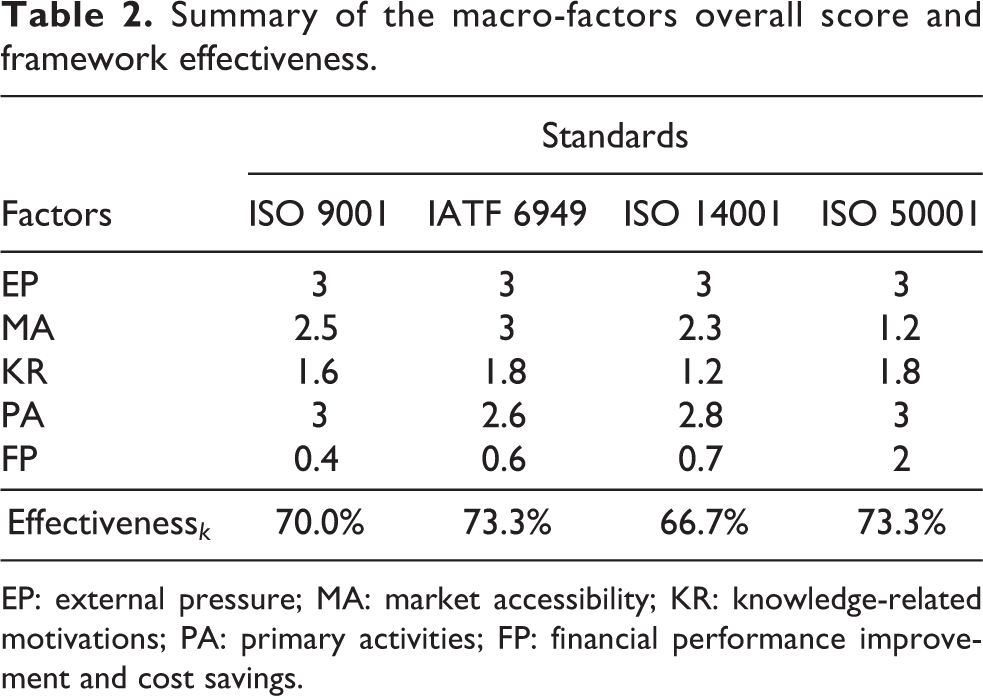
EP: external pressure; MA: market accessibility; KR: knowledge-related motivations; PA: primary activities; FP: financial performance improvement and cost savings.
Macro-factors effectiveness in percentage.

EP: external pressure; MA: market accessibility; KR: knowledge-related motivations; PA: primary activities; FP: financial performance improvement and cost savings.
The results reveal that each macro-factor has at least an overall low evidence in each one of the standard adoption processes, except for the motivation FP. Indeed, this element has an effectiveness equal to 30.8%, which means that there is less than low evidence that it influences the adoption of a standard. Moreover, this value of the FP effectiveness does not satisfy the condition defined by equation (9): the FP macro-factor shall therefore be removed from the framework. It is worth noting that the highest values of effectiveness are reached for the macro-motivations EP and PA, which highlights that these factors play a crucial role in implementing a standard. However, the effectiveness of MA and KR reach 75.0% and 53.3%, respectively, showing that these motivations are relevant within the adoption process.
Model tuning
Once the testing feedbacks have been obtained and analysed, the framework has been modified according to the scheme of Figure 1. The first adjustment regards the factor EP. This motivation has an effectiveness value equal to 100%, which means that it always influences the standard adoption process. Indeed, analysing the articles, it comes out that not only the institutional pressure and the customers pressure can influence the standard adoption process, as reported in Figure 4, but also other forms of pressure.
These pressures might be exercised by group of interests, alliances and non-governmental organizations, as reported in Neumayer and Perkins 39 and Blind. 43 This effect is caused by either the ‘regulatory vacuum created by the failure of public law and enforcement’, 39 which leaves the way to groups and stakeholders that define norms to regulate the companies’ activities, or the firms’ will to create a cluster of companies that adopt the same standard, such as the creation of the QS 9000 standard by the Big Three automobile manufacturers. 44 Hence, it is possible to introduce this factor in the framework, which is defined ‘externality pressure’, as shown in Figure 8.
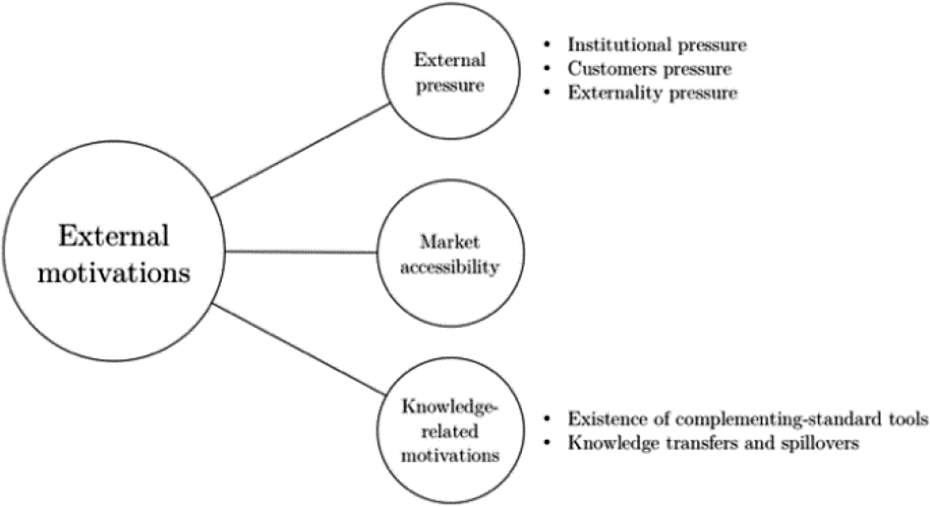
Revised classification of the external motivations.
The second adjustment considers the result of the FP effectiveness. According to the testing feedbacks, there is less than low evidence that the financial performance improvement and cost savings factor influences the standard adoption process. To deeply understand this outcome, it is possible to consider the overall score that the factor EP has obtained for each standard, as reported in Table 4. The overall score P FP,k is greater than the threshold value, namely 1, only for the ISO 50001 standard. This allows to understand that FP is a major driver when the costs savings are directly measurable, which is the case of ISO 50001 rather than the other standards. Moreover, in the case of ISO 50001 the costs savings are directly linked with an enhancement of energy efficiency, therefore they are a consequence of organizational and operational performance improvements. Applying the same reasoning to the other standards, it is possible to highlight that financial performance improvements and costs savings are obtained as the outcome of performance improvements in terms of organization, operations, marketing and corporate image, and that they can be a major driver only in relation to the macro-factor PA. Hence, the macro-factors PA and FP cannot be considered separately and the adjusted framework takes into account the cause-effect relationship between them, as shown in Figure 9.
Overall scores of the macro-factor FP.
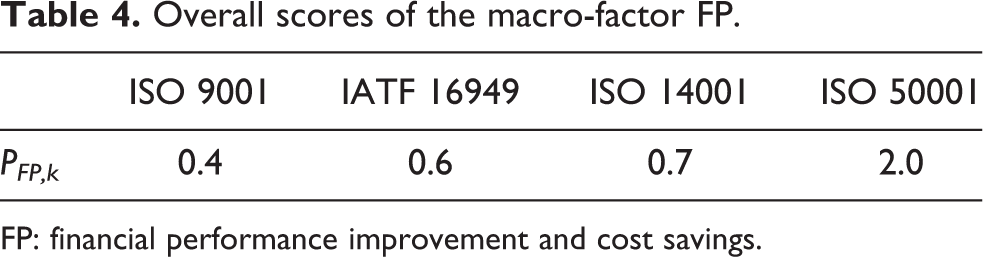
FP: financial performance improvement and cost savings.

Revised classification of the internal motivations.
It is also possible to calculate again the framework effectiveness without considering the FP overall score. The new results are compared with the ones originally obtained in Table 5.
Framework effectiveness comparison.

The table shows that there is an overall increase of the framework effectiveness, thus a higher percentage of factors defined by the framework can influence the standard adoption process.
Framework application: The ISO 22400 standard
The scope of this section is to apply the framework to perform a perspective analysis on the possible market diffusion of the novel ISO 22400 standard.
It is worth noting that this procedure can be carried out either while the standard is still under development or when the standard has been already developed, but it is undergoing review. In the first case, the standard can be designed according to the factors presented in the framework and the more a factor is believed to be relevant to the standard implementation, the more attention should be paid to it. For instance, if it is believed that a standard under development could be introduced in public procurement tenders as a prerequisite for access, the standard shall have characteristics that allow its usage in public procurement tenders. The same reasoning applies when the standard has been already developed but it is undergoing review, which is the case of the ISO 22400 standard. In fact, the standard can be revised considering the influence that each factor can potentially exert on the standard adoption to determine a wider market diffusion.
ISO 22400 case
The ISO 22400 standard, named ‘automation systems and integration – key performance indicators (KPIs) for manufacturing operations management’, has been published for the first time in 2014, therefore it is a novel standard on the market. It has been developed within the technical committee 184 (TC 184), which holds responsibility for ISO standards in the field of ‘automation systems and integration’, by the sub-committee 5 (SC 5), whose activities focus on ‘interoperability, integration and architecture for enterprise systems and automation applications’, and particularly by the working group 9 (WG 9), which is responsible for ‘KPIs for manufacturing operations management’. 45
ISO 22400 and ISO/IEC 62264
According to the definition reported in ISO/TC 184, 46 the norm ‘ISO 22400 specifies an industry-neutral framework for defining, composing, exchanging and using key performance indicators (KPIs) for manufacturing operations management (MOM), as defined in IEC 62264-1, for batch, continuous and discrete industries’. This means that the ISO 22400 standard is based upon ISO/IEC 62264, which aims to standardize the data exchange protocols within manufacturing enterprises.
The scope of the ISO/IEC 62264 standard is ‘[.] to reduce the risk, cost and errors associated with implementing enterprise systems and manufacturing operations systems in such a way that they interoperate and easily integrate’. 47 The ISO/IEC 62264 standard is jointly developed by ISO and IEC, particularly by the joint working group 5 (JWG 5), and it is in turn based on the ISA 95 standard, namely a standard created by the International Society of Automation (ISA) which focuses on enterprise-control systems integration as well. Moreover, the IEC 62264 standard provides a description of the various levels of information in a manufacturing enterprise through the functional hierarchy model reported in Figure 10. Based on the classification of Figure 10, the ISO 22400 standard introduces KPIs for the manufacturing operations management level, which encompasses four main activities: production operations management, maintenance operations management, quality operations management and inventory operations management.

Multi-level functional hierarchy of activities. 47
Intrinsic features analysis
The first step of the framework application is the analysis of the intrinsic features, which are defined in Figure 3, in relation to the specific structure of the ISO 22400 standard and its potential adopters.
The defined framework can be either applied to a single firm, with its own intrinsic characteristics, or to a group of firms, which share similar features, to perform a standard analysis. In this case the ISO 22400 standard is relatively novel on the market, therefore the potential adopters’ features should be assumed for carrying out the prospective study. However, even though ISO 22400 can be implemented by firms which have not moved yet steps towards a smart manufacture, the standard is ultimately thought to be applied in a smart manufacturing environment, thus it is possible to determine the outline of firms that are potentially adopters accordingly. The considered features are described as follows:
Size: firms that are willing to implement the ISO 22400 standard are supposed to have a high degree of automation, which directly means high fixed costs and investments to be borne for the manufacturing operations. Therefore, the costs for the standard implementation can be perceived by the company as a further investment for having a better operations control, regardless the company size. This means that size does not seem to be a relevant factor for the ISO 22400 implementation, as it is directly linked with the degree of automation of the firm.
Industrial sector: ISO 22400 defines KPIs for the MOM level of the hierarchical structure provided by IEC 62264. This means that the standard can be adopted by firms in the manufacturing sector. Moreover, the standard supplies the general description of a KPI and then specifies the production methodology to which the KPI applies. For this reason, manufacturers which use different production methodologies (e.g. batch, continuous and discrete) can adapt the KPI to their specific instances.
Organizational members commitment: the organizational members commitment can be a determinant factor to the ISO 22400 standard adoption, as it can considerably influence if and how the standard will be successfully implemented. Indeed, since ISO 22400 is a technical standard the commitment of all the organizational levels is crucial to understand the KPIs system.
Available resources and knowledge: generally, the bigger the company dimension, the higher the level of resources and knowledge held by the firm. However, in a smart manufacturing context, being a small-sized company does not necessarily entail that the level of resources and knowledge of the company is low. Indeed, there could be firms with completely automated plants, but with small or medium organizational dimensions. Therefore, the available resources and knowledge factor plays an important role in terms of overall degree of automation, systems interoperability and systems integration.
Country: the ISO 22400 standard has been developed to be implemented in a smart manufacturing environment, thus it is possible to hypothesize that governmental policies and initiatives which aim to enable the usage of high-tech systems will increase the firms’ probability of implementing ISO 22400 in the considered country.
48
External motivations analysis
Once the intrinsic features have been analysed in relation to the ISO 22400 standard, the triggers for implementing the norm should be considered. These triggers are the external motivations and are studied as follows:
External pressure: considering the institutional pressure, this factor can be a determinant motivation for ISO 22400 implementation if policy makers can find relevant areas in which standardized KPIs have to be used. Indeed, especially in the context of sustainable and eco-friendly manufacturing, legislators can establish requirements in terms of KPIs threshold using some of the KPIs introduced within the ISO 22400 standard.
On the other side, referring to the customers pressure, it is possible to posit that the wider the spread of ISO 22400, the more firms will tend to adopt it and the more customers will require processes data in terms of standardized KPIs. Lastly, the pressure of groups of interest and alliances can be another important sub-factor for ISO 22400 implementation. Indeed, the entrance in a group of interest or in an alliance can require to show conformity to specific standards, including the ISO 22400 standard. Taking into consideration the group of IT providers, namely companies which manage servers, systems and core IT infrastructure for organizations, it is possible to imagine that the system of KPIs provided by ISO 22400 can be effectively integrated within the IT systems. In conclusion, it is possible to posit that the external pressure is a factor which can heavily influence the adoption of the ISO 22400 standard.
Market accessibility: it is considered one of the most important drivers to implementing a norm, whose importance can be also highlighted in the eventual market diffusion of the ISO 22400 standard. Indeed, ISO 22400 establishes relevant metrics to assess the performances of a firm’s manufacturing operations, which can be used referencing ISO 22400 in public procurement and private call for tenders as basic requirements for the company participation.
Knowledge-related motivations: ISO 22400 is based upon the ISO/IEC 62264 standard, therefore if a firm already implemented the enterprise-control system integration provided by IEC 62264, it would be relatively easy to approach with the technical notions introduced by ISO 22400. The same reasoning applies to the other standards related to one of the four levels of the functional hierarchy, which is shown in Figure 10. This leads to posit that the KR factor can be determinant for the diffusion of the ISO 22400 standard, especially considering all the standards that are defined in the context of the smart manufacturing.
Internal motivations analysis
The ISO 22400 standard lays the foundations for evaluating the current performances of manufacturing operations and for their continuous improvement, through a system of KPIs that measure the outcomes of a process. This means that an effective implementation of ISO 22400 can considerably result in organizational and operational performance improvements.
On the other side, it is difficult that the marketing and corporate image performance improvements goal can be determinant to the ISO 22400 adoption. Indeed, this standard pertains to the activities in the MOM domain, whose performances are not relevant in the eyes of most of the customers’ product choice. Nevertheless, if one further development of ISO 22400 would be the introduction of KPIs which assess the environmental impact of the manufacturing operations, then it will be valuable to show, in marketing campaigns or advertisements, excellent environmental KPIs values to build an eco-friendly image of a firm’s supply chain.
However, differently from the SCOR model the ISO 22400 standard does not tie KPIs to companies’ relevant strategic goals. Indeed, among the criteria that shall be fulfilled by measurements to define an effective performance measurement system (PMS), indicators should be linked and aligned with the main strategic objectives of the organization, 49 –51 to allow managers to define adjustments and to take corrective actions for enhancing the company’s performance. Tying indicators within ISO 22400 to corporate goals not only can help managers to use more effectively the PMS but can also help standard developers to spread the standard diffusion.
External barriers analysis
The next step of the framework application is the analysis of barriers in relation to the specific structure of ISO 22400, which are analysed as follows:
Costs: as it has been already described for the size factor, firms in the smart manufacturing context are supposed to have a high degree of automation. This means that the costs for the standard implementation, in comparison with the eventual investments in automation systems, can be considered as trivial by the company. Therefore, it is possible to assume that the costs factor does not appear to be a major barrier to ISO 22400 adoption.
Incompatibility with other standards or systems: the ISO 22400 standard is directly linked with the standards referred to the various levels of the functional hierarchy, therefore it is straightforward that it can be implemented with the other norms without any incompatibility problem. Nevertheless, it is worth noting that there could be standards which are not developed by ISO, that show a different way to calculate a specific KPI. Indeed, if a company already implemented the standard, the transition from that standard to ISO 22400 would be costlier and time-consuming, thus being a major barrier to the ISO 22400 standard implementation. For instance, the SEMI E10 standard provides a time-model for the possible states of a manufacturing equipment,
52
which differs from that assumed in ISO 22400. This consideration allows to understand that a company which uses the OEE as it is specified by the SEMI E10 standard will face difficulties when implementing ISO 22400. In conclusion, it can be assumed that the potential incompatibility with other standards or systems factor is a major barrier to the ISO 22400 standard adoption.
Internal barriers analysis
The internal barriers are factors directly related to a firm’s intrinsic features; they are therefore a consequence of a company’s organizational structure. As well as the external barriers, these factors hinder the adoption process and can be analysed in relation to the ISO 22400 standard:
Lack of organizational members participation and commitment: the organizational members commitment can be a determinant factor to the ISO 22400 standard implementation, as it can considerably influence if and how the standard will be successfully implemented. Indeed, the standard has a high level of technical content and the commitment of all the organizational levels is crucial to understand the elements defined by the standard.
Lack of available resources and knowledge: the available resources and knowledge factor plays an important role within the ISO 22400 standard adoption process, in terms of overall degree of automation, systems interoperability and systems integration. The usage and usefulness of this scheme of KPIs strongly depends upon the ability to communicate and jointly operate of the manufacturing systems. Indeed, systems that are totally integrated are capable of exchanging data and relevant information, therefore allowing a real-time monitoring and the development of clues for continuous improvements. However, if the firm does not have enough resources and knowledge to create systems capable of exchanging data and working together, the lack of available resources and knowledge factor will constitute a major barrier to the ISO 22400 implementation.
Implications for standard developers
The analysis of the identified determinant factors shows that there could be several different possible developments of the ISO 22400 standard, to increase the adoption of the norm. The first observation is that some environmental KPIs, which quantify the impact of the manufacturing operations in terms of relevant unit of measures, can be introduced in the standard. Indeed, introducing KPIs which assess the environmental impact of the MOM activities can be useful either to increase the institutional pressure for using those KPIs or to lead the companies to use the KPIs as a tool for marketing campaigns and for having a better corporate image. Obviously, the more the standard is believed to be useful for the stakeholders’ purposes, the wider standard diffusion can be supposed.
Another possible development of the standard is the introduction of guidance for linking KPIs with a firm’s strategic objectives. Managers should be able to evaluate the outcomes of the PMS and easily draw up conclusions for improving the business performance. However, without providing guidelines for defining relationships between KPIs and strategic goals, firms can face difficulties to interpret the value of a KPI.
The third observation is that the system of KPIs provided by ISO 22400 can be effectively integrated within IT systems. Indeed, both IT providers and standard developers can benefit by the introduction of the same PMS within information systems, since it can effectively improve the interoperability of corporate IT systems and enhance the diffusion of ISO 22400 among companies.
Furthermore, another eventual development of the norm can be its usage within other standards. For instance, the ISO 50001 standard can be integrated with the energy efficiency KPIs introduced by ISO 22400. In this way, compliance with ISO 22400 will ease the process of compliance with ISO 50001, which in turn incentivises the adoption of both standards. It is worth noting that this approach can be replicated with different standards, to encourage the compliance with ISO 22400.
In conclusion, it is possible to summarize the identified eventual developments of the ISO 22400 standard as reported in Table 6, which also illustrates the factors on which the possible development makes leverage to enhance the market diffusion of ISO 22400.
Summary of the possible developments and uses of ISO 22400 in relation to the framework factors.

KPIs: key performance indicators; EP: external pressure; MA: market accessibility; KR: knowledge-related motivations; PA: primary activities.
Managerial implications
The managerial implications entailed by the framework analysis indicate which can be the best approach of the firm to ISO 22400 implementation. Using the analysis, managers can obtain an evaluation of the potential relevance that each barrier can have upon preventing the standard adoption, therefore attaining a clearer overview on the process. The potential relevance of the barriers in relation to the ISO 22400 are reported in Table 7.
Summary of the potential relevance of the barriers in relation to the ISO 22400 standard adoption.

C: costs; IS: incompatibility with other standards or systems; LA: lack of available resources and knowledge; LO: lack of organizational members participation and commitment.
As it has been described within this section, ISO 22400 is directly based on the IEC 62264 standard and is linked with several other standards referred to the various levels of the functional hierarchy. This means that to fully take advantage of ISO 22400 directives, a firm should really understand the activities within the MOM domain and their description provided in the IEC 62264 standard. Moreover, since IEC 62264 aims to standardize the enterprises’ data exchange protocols, firms that set their business in the smart manufacturing context should implement jointly the previously mentioned standards. This practice will help firms to improve systems interoperability, develop a uniform system of data exchange and lay the foundations for continuous improvement.
However, as it came out during the framework analysis, the ISO 22400 standard requires a profound knowledge of the elements that are needed to calculate and understand the KPIs values. Therefore, managers should develop information campaigns within the company for allowing employees to comprehend the importance of adopting the standard. In fact, without a great effort towards this direction, even though machines are capable to analyse data, define trends and modify the production parameters, it will be difficult to interpret data and identify areas for improvement among manufacturing operations.
Conclusions
This article shows the relevant factors within the standard adoption process to understand why a firm should implement an international standard. Moreover, through the definition of a framework which considers all the motivations and barriers to the standard adoption, this article allows to gather insights for performing a perspective analysis on the possible market diffusion of a specific standard, either under development or that is undergoing review, along with an example of its application to the ISO 22400 standard.
This article is divided into six main sections. The first two sections explain why it is needed to deeply analyse the factors that influence the adoption of a standard from three different perspectives: standard developers, firms and policy makers. Furthermore, they provide an extended literature review, which leads to the definition of shortcomings of the research studies.
While the third section illustrates the methodology of the performed analysis, the fourth and fifth sections propose an exhaustive framework of the factors that influence the standard adoption process of a firm. The model proposal is performed through two main phases. First, the framework is designed considering all the variables that can determine whether a standard will be implemented or not by a firm. Three main factors have been identified: firm’s intrinsic features, motivations and barriers. Second, an analysis of the effectiveness of the framework and its factors is carried out through data on the diffusion of several popular standards. The data allowed to determine which are the most relevant factors to the diffusion of an international standards and allowed to modify the presented model accordingly. It is worth noting that the validated model not only helps to understand the determinant motivations that lead to a standard implementation, but it can be used by standard developers to develop more effective standard and by main stakeholders to choose whether to adopt or not a standard.
Finally, the last section uses the adjusted framework to perform a perspective analysis on the possible market diffusion of the novel ISO 22400 standard. Indeed, after introducing the ISO 22400 standard and its context of relevance, the factors of the model have been studied in relation to the characteristics of ISO 22400 and the firms that potentially will implement it. Through carrying out this analysis, it has been possible to identify the potential relevance that a motivation or a barrier can have upon the standard adoption process and to identify eventual further developments and uses of the ISO 22400 standard.
Therefore, it is possible to underline that, since the framework is effectively applicable to each specific standard, it has proved to be useful for: standard developers, to understand the relevant factors to the standard adoption process; for firms, to identify motivations and barriers of the standard adoption; for policy makers, to evaluate how to effectively drive the adoption of a specific standard.
However, at the same time some indications on how to support and improve the framework application came out from this study. The framework is useful to determine a qualitative analysis of the motivations and barriers to the standard adoption process, but it does not consider the standard implementation from a quantitative point of view. This leads to state that a further eventual extension of this framework is the introduction of a procedure to address: benefits, which stem from the motivations analysis; overall costs of the standard implementation, which stem from the barriers analysis, to provide also an indication on the financial flow that goes along with the standard adoption process. Such extension will allow standard developers, firms and policy makers to obtain a better understanding of the standardization process and to develop, implement and promote effective standard throughout the market.
Footnotes
Declaration of conflicting interests
The author(s) declared no potential conflicts of interest with respect to the research, authorship, and/or publication of this article.
Funding
The author(s) received no financial support for the research, authorship, and/or publication of this article.
