




Abstract
The present study investigates co-creation in new product development by providing a conceptual background in the psychological factors favoring consumer participation in company processes. The work explores the consumers’ profiles willing to participate in co-creation, through the identification of their personality traits, key motivations, and barriers. Two product typologies are investigated, namely high-tech and high-touch products through survey research on a sample of Italian consumers. Results from structural equation modeling show that consumers’ personality traits affect the perceived motivations and barriers to co-create, in turn shaping their willingness to co-create. Furthermore, consumer willingness to co-create varies depending on the product typology. Under a managerial viewpoint, the research study provides practitioners with keys to design targeted co-creation activities, fitting with the specific product typology and audience, and to devise the most suitable participation incentives to offer.
Introduction
The possibilities provided by new media, enabling ubiquitous access to content and information, as well as the opportunity for users to generate their own content, push the development of online co-creation initiatives by companies. 1 –3 Among them, co-creation in new product development, defined as “a collaborative new product development activity in which consumers dynamically contribute and select various elements of a new product offering” 4 emerges as a salient form of consumer participation. Co-creation encompasses a broad range of activities, such as proposing ideas for new product or service development or the improvement of existing ones, by means of supporting the design phase, evaluating ideas and alternatives, or contributing to the definition of the launch campaign.
From a marketing perspective, co-creation is posited as a lever to develop products or services able to fulfill needs not met in the market yet. 5 The possibility to spur innovation and to enhance performances explains the rising interest of companies and scholars in such activities. 6 –8 The development of ICT-based platforms diminishing the barriers for companies to manage large-scale co-creation activities also explains the growing relevance of the phenomena in recent years. The web has enabled innovative forms of virtual co-creation in new product development thanks to ubiquitous access to content, enhanced interaction opportunities and cost savings, 1,9,10 improving consumer engagement through larger reach, persistence, speed, and flexibility. 11
As a result, co-creation literature is burgeoning. Rich pieces of research have broadly discussed topics such as (i) the potential beneficial effects of co-creation for companies 12 –15 ; (ii) cases of success in co-creation 6,16,17 ; (iii) managerial approaches and practices to run co-creation activities. 13,18 –20 Just recently, yet, literature has focused its attention on the consumer-level variables affecting co-creation processes. In particular, two main research streams are worth noticing. On the one hand, studies about the impact of consumers’ willingness to co-create (i.e. to participate in co-creation activity) on the outcomes of co-creation activities. 21 –23 On the other hand, the role of company-managed stimuli in boosting consumer participation. 24,25 However, less is known about the reasons and motivations, as well as the conditions and the variables leading consumers to co-create. Prior studies indeed identified consumer groups and traits that, in given circumstances, were able to better contribute to co-creation activities. 5,20,26,27 Whereas more research is needed to understand whether there are consumer profiles who are inherently more willing to co-create than the others.
Co-creation is susceptible to consumers’ self-selection so that consumers engaged in co-creation could dramatically differ from the ones eventually targeted by the innovating company. This, in turn, could make co-creation activities dysfunctional and potentially biased. Hence, understanding the traits of the co-creators is essential to avoid wrong targeting decisions and the development of products that may not fit with the actual or envisioned buyers. Furthermore, previous research has shown how firms need to create an environment of trust to encourage consumers’ participation, providing them with the freedom to be creative and generate shared value. 28,29 This implies that firms need to understand the needs, preferences, and motivations of the potential co-creators in order to provide them with the right incentives to participate.
In the present research article, we move forward in the understanding of the consumers’ profiles more prone to co-create, as well as their key motivations and their major barriers. With this aim, we develop a conceptual model in which different kinds of barriers and motivations, as well as personality traits, are hypothesized as antecedents of the individual’s willingness to co-create. We adopt the high-tech/high-touch dichotomy to test the framework in order to observe product-specific barriers and motivations to participate. High-tech products are referred to products that are technologically advanced and complex, requiring specialized skills from consumers who are usually moved by utilitarian needs. Whereas high-touch products appeal more to emotions and product image plays a relevant role. 30,31 Despite both product typologies may be associated with a significant level of consumer involvement, 32 they are indeed very different, thus they may elicit dissimilar consumer responses to co-creation, and attract different kinds of co-creators.
Following the proposed approach, the article aims at investigating two main research questions:
Through an online survey on Italian consumers, we collected data on two product typologies: a co-creation activity concerning a high-touch product (a T-shirt) and one concerning a high-tech product (a mobile application). Our results show that personality traits that are transversal to the product involved in co-creation strongly determine the willingness to co-create. Further, we show that product typology defines the key motivations and barriers to co-create that, in turn, influence the consumers’ willingness to co-create. Our results, by highlighting which are the key motivations and the key barriers for different customers and product typologies, contribute to co-creation literature showing how consumer-level variables cannot be neglected when analyzing the dynamics determining the success of co-creation initiatives. Furthermore, the research enriches existing literature by showing that the high-touch/high-tech product dichotomy is relevant not only in shaping the purchase process but in driving co-creation interest as well. Our results finally provide several managerial implications to support innovation and marketing managers in co-creation design and management, shedding some light on the key drivers of customer participation.
The article is organized as follows: firstly, the theoretical background and related hypotheses are discussed, following a tripartite classification scheme that encompasses (i) motivations and barriers to co-create, (ii) product typology, and (iii) personality traits. Next, the methodology is presented followed by empirical result presentation and discussion. Lastly, the contributions of the article together with managerial implications and future research opportunities are discussed.
Theoretical background and hypotheses
Consistently to the objectives of the article, we develop our conceptual framework analyzing: (i) personality traits potentially affecting consumer’s perception and approach to co-creation activities; (ii) consumer-level motivations; and (iii) consumer-level barriers to co-creation. Consumer motivations and barriers are further discussed in conjunction with high-tech/high-touch product typology. This would sharpen the theoretical and managerial implications of the study, providing a deeper understanding of the motivations for co-creation as well as an operational lever to design suited co-creation activities.
Personality traits
Personality traits play an important role in predicting and explaining human behavior. 33 Literature is rich in studies analyzing the peculiar traits of co-creators. 34,35 In our framework, we consider three main personality traits, namely mavenism, shopping enjoyment and quality consciousness, grounding on prior research on the topic. 24,36,37
Mavenism characterizes “Individuals who have information about many kinds of products, places to shop, and other facets of markets, and initiate a discussion with consumers and respond to request from consumers for market information.”
38
Market mavens
37,39
are customers with extended knowledge of the product and a strong focus on other people’s needs. They are motivated by a sense of obligation in information sharing and the desire to help others and tend to express their need for uniqueness more than other consumers do.
40
These traits potentially lower their perceived constraints to participation, being already apt to social sharing and the connected risks. Mavens could be represented, for instance, by insiders or devotees in online communities, attaching great value to information sharing with other consumers. Their interpersonal tendency reflects belongingness and emphasis on relationships with others. Mavens may decide to involve in co-creation also to avoid the social risks connected with standard product consumption. This may happen if the company product/service hinders the consumers’ self-esteem or reputation (e.g. a gift not fitting the beneficiary taste). On this line of thought, we hypothesize that the mavenism trait influences both the consumer’s perceived motivations and the barriers to co-creation. Such an assumption is further supported by previous studies analyzing the motivators, barriers, and enablers for successful online co-creation practices.
41
Accordingly, the following hypotheses will be tested:
Shopping enjoyment trait characterizes people who love shopping and value entertainment and marketing information.
42
They find shopping more pleasant and enjoyable than other consumers.
43,44
People, indeed, do not only shop to fulfill their needs but also for hedonic and affective reasons.
45
They shop to gain attention, share time with peers, meet people with similar interests, seek gratification, keep up with new trends, or simply relax.
46
Individuals with such inclination may consider co-creation a funny and pleasant activity, enabling social interactions. They may experience, indeed, a psychological reward from the shopping process per se, even if not directed to purchase.
47
Further, they may experience lower barriers to co-create, as they are used to spend more time shopping and interacting with brands than other consumers.
48
Therefore, we expect that shopping enjoyment trait affects the perceived motivations and barriers to co-create. More formally, we predict the following:
Quality consciousness explains the need for self-care. It is defined as a characteristic of consumers for whom product quality is the most relevant dimension.
49
It deters consumers from purchasing products perceived as inferior in quality.
50
–52
Participation in co-creation may reduce the risks associated with accepting inappropriate products.
53,54
This may happen when a product or service does not perform as anticipated and thus not deliver the benefits the consumer expects (e.g. if the software does not have the needed functionalities). Or even when the quality of the output might change from one purchasing to another (e.g. a meal). Quality conscious consumers devote great time and effort to learn product information, essential to properly evaluate the product quality. Thus, we assume that they face lower economic barriers to co-creation, being already involved in such processes. We propose that they may perceive a lower cost of discredit and social risks as well, being focused on obtaining the best for themselves. Therefore, we posit that quality consciousness trait affects the perceived motivations and barriers to co-create. Accordingly, we formulate:
Motivations and barriers to co-creation
A motivations–barriers approach has been adopted to analyze the reasons underlying consumers’ willingness to participate in co-creation processes. Such an approach appears indeed to be the most common in analyzing consumers’ intention to co-create. 36,41,55 –60
Motivations to co-create
Self-determinant theory 61 classified motivations using differences in reasons or goals as a discriminant, leading to a conceptualization of extrinsic versus intrinsic motivation, classification further explored by subsequent studies. 62,63
Intrinsic motivation is referred to the individual need to feel competent and pride in something. 36,62 It could be psychological, namely evoking enjoyment such as play at chess or paint. 5 It may involve self-efficacy, by generating a sense of competence associated with self-made products or problem-solving activities, 64 such as assembling or personalizing your own piece of furniture. It may provide empowerment, supported by Internet and new technologies, 10 like the possibility for museum visitors to define their own personalized experience. 65 Intrinsic motivation could alternatively be dominated by the consumer’s curiosity 57 classified as a specific curiosity if addressed to a particular product, or diversive curiosity when the consumer searches new stimuli, for instance, to run away from boredom. Social context or external occurrences may also affect intrinsic motivation (cognitive evaluation theory 61 ). Particularly relevant in this regard is the effect of extrinsic rewards, 66 –68 which have been proved to undermine intrinsic motivation by shifting people from an internal locus of causality to an external one.
Extrinsic motivation can be defined as the performance of an activity in order to attain some separate outcomes, 62,63 in terms of direct or indirect financial rewards. 69 The first category includes all monetary rewards, such as monetary prizes or profit sharing, while visibility and intellectual property rights are the main indirect financial rewards. 5,57,70,71 While monetary rewards may be particularly effective in attracting consumers, they might not represent a true motivational factor. 57,69 –72 A further source of extrinsic motivation may be related to the dissatisfaction with the current offer. 5 In such a situation, the consumer tries either to prevent the risk of future inadequate products 71 or expresses a desire for customization. 36
A third category, internalized extrinsic motivation, according to psychology research 62,63,73 could be identified as a behavior aligned with personal values and lifestyle but that has separate rewards. It could be the opportunity to enhance personal technology knowledge, 5 thanks to the hands-on development of a product or the information exchange with peers, such as in joint software development. The possibility to access private information about a brand or a product is a further motivational factor. 57 Of particular interest are social motivations 5,71 for the relevance they assume in communities, which represent important points of aggregation of co-creators. 74,75 Titles and recognitions, such as https://Amazon.com’s “Top 100 Reviewer” 76 or the possibility to get in touch with like-minded people could be significant drivers. Lastly, some individuals may engage purely driven by a sense of altruism, an authentic desire to help and provide useful information, 23,77 such as in the enhancement of medical treatments and devices.
Barriers to co-create
Costs and efforts represent the other side of the equation. Two main barriers can be identified 36,78 –80 : economic barriers that include the cost of consumer’s time and resources and noneconomic barriers that involve the potential psychological and social losses. An example is the opportunity cost of time spent in co-creation. 55,81 This may be related to the product development itself and to the time devoted to information seeking and knowledge learning. For instance, developing a new packaging implies, above the design of the concept, information-seeking activities to understand the adequate materials to use, the shape that enables easy use and efficient and safe transportation. Intense participation in the production stage is likely to be limited, given the high time and effort required. 82
Noneconomic barriers include the cognitive effort needed to acquire the knowledge necessary to participate in the co-creation project. They also encompass the risk of participating in product failure or to become subject to other co-creators’ opportunistic behaviors. Furthermore, the cost of cultural and behavioral adjustments could arise as well, 83,84 particularly when collaboration is organized in teams or communities. These barriers may decrease if the consumer possesses great technical knowledge, diminishing the psychological effort requested to decision-making, new skill learning, and information seeking. 5,85
Product typology
Consumers co-create in product categories in which they feel expert 24,70 and where differentiation plays an important role. 36 For some products, such as software, co-creation is synonymous with high quality 70 because consumers often possess high technical skills and are experts of the specific product category. 10 Here customization of the product plays an important role. On the contrary, when differentiation exerts a minor role, as it can be for commodities, consumers may not be willing to engage in co-creation. The importance of the product category is confirmed by previous literature asserting that the levels of perceived empowerment and enjoyment are the determinants of consumer participation in virtual new product development projects. 10 They do vary according to the participants’ task, product involvement, and creativity. Even if research acknowledges that product differentiation and customer involvement are two needed characteristics to engage consumers in co-creation, the level/nature of such differentiation has not been explored. In particular, prior studies identified two poles at which products may pertain: high-tech and high-touch. 30,31 Despite both are associated with significant consumer involvement and a shared language, 32 they are indeed very different and may thus drive different consumer reactions in terms of co-creation.
High-tech products are complex and technologically advanced, requiring the collection of specialized information by consumers, who have rational needs or interest in buying them. 86 High-touch products appeal to senses more than intellect and the consumer motives are more emotional, giving importance to the product image. 87 Buyers of high-tech products may require considerable product information to make their decision. For instance, personal computers are bought on the basis of functional features, identified through a common language made of technical terms, regarding the memory capacity, the processor speed, the display brightness, the weight. High-touch products (e.g. jewelry, perfumes, or fashion items) generally require less specialized information in the purchase process. However, consumer share a common language as well, made of meanings and icons more than technical vocabularies. 30
Products on either pole usually share common symbols and semantic. For high-tech, software users or photography equipment passionate may share common terminology and establish a dialogue about the technical aspects. In high-touch, buyers share the same perception about the product image, style, but also inherent feelings such as familial love and friendship. We assume that consumer involvement and purchase motivations may differ between these two categories, according to their functional versus more hedonic characteristics.
Grounding on such discussion, we posit that high-tech products may generate more barriers to co-create, due to the great effort they require in terms of understanding or learning the specific terminology, while high-touch products require less specialized skills from the consumer. In terms of motivations, we hypothesize that extrinsic motivations and internalized extrinsic motivations, such as improving or customizing product functionalities, are a driver of co-creation for high-tech products. On the other side, intrinsic motivations, such as sharing common values and feelings, may push high-touch product co-creation. More formally:
Grounding on the aforementioned hypotheses, we propose a tripartite conceptual model suggesting that the importance consumers attribute to motivations and barriers to co-create determines their willingness to co-create. Perceived motivations and barriers change significantly according to individual personality traits and to the object of co-creation in play. In this work, yet, more than evaluating the specific decision whether to co-create or not, which can be strongly related to the specific co-creation task, 24,36 we will look at the overall attitude to co-create. The model is presented in Figure 1.
Methodology
Subjects and data collection
We tested our conceptual model on two different product typologies: a co-creation activity concerning a high-touch product (a T-shirt) and one concerning a high-tech product (a mobile application). They both are relatively diffuse supplies, already object of relevant co-creation initiatives in Italy (e.g. Threadless and Vodafone Lab) but significantly different in terms of the nature of the product. We obtain data from an online survey on Italian consumers above 15 years of age using a smartphone or a tablet (due to the specificities of the questionnaire, as described below). Questions regarded (i) the psycho-demographic profile of the interviewee, (ii) the importance attributed to barriers and motivations with reference to the two cases of co-creation of a mobile app and a T-shirt, (iii) the interest to participate in co-creation activities for the two cases. At the beginning of the questionnaire, a tutorial about the concept of co-creation was provided. All along with the questionnaire, the definition of co-creation was reported at the top of each relevant section. This procedure ensured clarity about the meaning of “co-creation” in the survey. All the constructs but demographics were measured on 7-points scales, anchored alternatively with “not important at all” and “extremely important,” or with “completely disagree” and “completely agree” depending on the nature of the question. The questionnaire was completed both for the high-touch and the high-tech case to assess differences in perceived motivations and barriers between the two product typologies. Psychographics, as they reflect individual co-creator traits, was assessed only once. We collected 203 complete responses. To address the concern of nonresponse bias, we followed recommendations found in previous literature 88 and tested whether late respondents differ significantly from early respondents. We found no statistical differences between these two groups on key measures (including sample characteristics). Accordingly, we concluded that nonresponse bias is not a significant concern for the present study.
Measures
Scales measuring motivations and barriers to co-create were adapted from previous literature. 24,76 To measure the importance attributed to co-creation barriers we led back to the previous works. 24,36,89 We integrated these scales with some ad hoc questions emerged after 15 preliminary in-depth interviews with consumers, conducted to tackle with a more comprehensive set of possible motivations and barriers. Regarding the personality traits, mavenism measure was adapted from previous research studies, 38 as well as quality consciousness, 42 shopping enjoyment, 49 and willingness to co-create. 10,90 Cronbach’s α served as a measure of internal consistency (reliability) of each construct (motivations, barriers, personality traits, and willingness to co-create). The examination of item factor loadings led to the deletion of some items. Table 1 presents Cronbach α indicator for each construct.
Constructs Cronbach’s α.

Data analysis and results
Relationships among constructs were evaluated using structural equation modeling. This method allows to simultaneously examine the measurement component (factor model) and the structural component (path model). The analysis followed a two-step procedure. Firstly, a measurement model was composed. Secondly, a structural model was used to conduct a path analysis and to test the hypotheses proposed in the research model. Specifically, two models were developed: the first for the high-tech products and the second for the high-touch product typology.
Measurement model
The purpose of the measurement model is to describe how well the observed indicators serve as a measurement instrument for the latent variables. The hypothesized model included 33 observed items measuring 10 latent constructs: willingness to co-create, intrinsic motivations, extrinsic motivations, internalized extrinsic motivations, economic barriers, noneconomic barriers, mavenism trait, quality consciousness, and shopping enjoyment. We overall obtained a reasonable fit (RMSEA = 0.0799, GFI = 0.779, SRMR = 0.0736, NFI = 0.865, CFI = 0.918).
Structural model
Next, we tested the research hypotheses. We examined the structural model in terms of model goodness of fit, overall explanatory power, and hypothesized links.
Model goodness of fit
For the high-touch product, the overall fit of the model is acceptable, being the goodness-of-fit statistics (CFI 0.911, RMSEA 0.055, SRMR 0.074) satisfactory, with the χ/df ratio = 1.61. 91 For the high-tech model, test statistics suggest reasonably adequate model fit, showing a CFI of 0.913, RMSEA of 0.056, SRMR of 0.079. The χ/df ratio is very good with a value of 1.63.
Overall explanatory power
Our model explains 41% of the variance in willingness to co-create for the high-touch product and 38% of the variance in willingness to co-create for the high-tech product. According to previous literature, 92 R 2 of endogenous latent variables can be considered as substantial when the value is 0.26, moderate at a value of 0.13, and weak at a value of 0.02. Thus, our results are highly satisfactory.
Hypothesized relationships
To test the structural relationships, the hypothesized paths were estimated. Figure 2 shows the hypotheses testing results for the high-tech product. Figure 3 shows the testing results for the high-touch product. Path coefficients and coefficient of determination R 2 for the two product typologies are reported in Table 1A in Appendix 1.

Conceptual model.
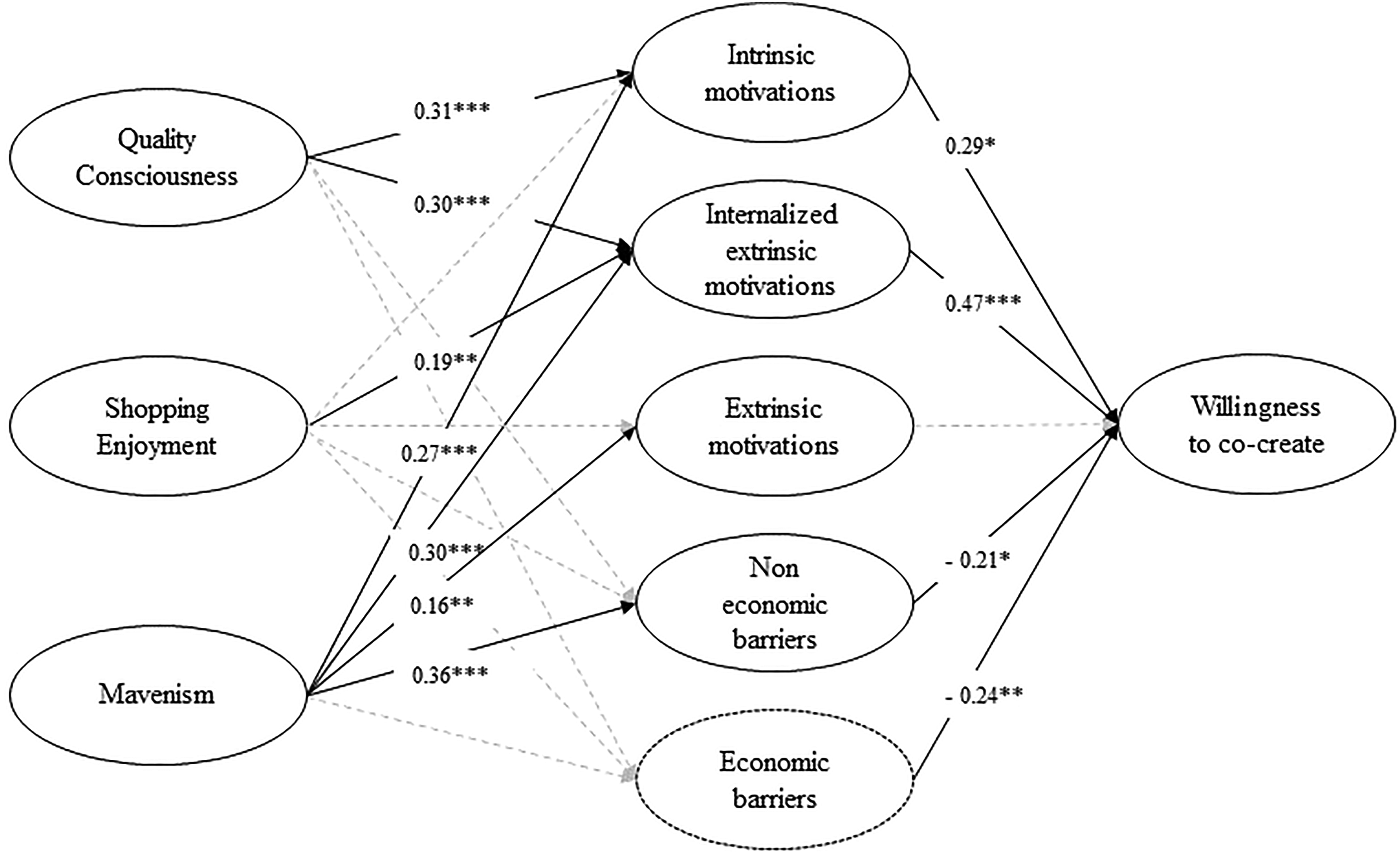
Structural model results—High-tech products. Hypotheses testing results (N = 203; *p < 0.1; **p < 0.05; ***p < 0.01).

Structural model results—High-touch products. Hypotheses testing results (N = 203; *p < 0.1; **p < 0.05; ***p < 0.01).
Regarding the direct effect of individual characteristics on motivations and barriers, we found evidence that the mavenism dimension has a positive impact on intrinsic motivations, internalized extrinsic motivations, and extrinsic motivations for both products, with similar path coefficients, confirming H1. Mavenism trait also has a positive impact on noneconomic barriers of co-creation while it does not have a significant effect on economic barriers, supporting H2.2 but not H2.1. Regarding the dimension of shopping enjoyment, we found a positive effect on internalized extrinsic motivations for both products as well as on perceived intrinsic motivations for the high-touch product. No relations have been found for extrinsic motivations and barriers (thus partially confirming H3 but not H4). Finally, for the quality consciousness construct, we found evidence of a positive effect on intrinsic motivations and internalized extrinsic motivations, similar for both products. No impact has been found on extrinsic motivations and barriers, again partially supporting H5 but not H6.
As concerns the direct relationships with the willingness to co-create, we found evidence that intrinsic motivations have a positive effect on willingness to co-create for high-touch products, supporting H7.1. However, they show to be relevant for high-tech products as well. Internalized extrinsic motivations have a relevant influence on attitude to co-create in the high-tech case, supporting H7.2, while extrinsic motivations are not significant for both products, only partially confirming H7.3. For the high-tech product, both economic and noneconomic barriers have a negative impact on willingness to co-create, confirming H8.1 and H8.2. These results show that the product typology highly influences the perceived motivations and barriers.
Discussion
The study makes three specific contributions to the literature on co-creation. First, the study analyzes the influence of motivations and barriers on willingness to co-create, showing how they affect consumer participation in co-creation activities. Second, the analysis of different products further uncovers the motivational drivers and barriers to co-create, thus providing a comprehensive account of the factors influencing the consumer evaluation process. Third, the conceptualization and analysis of co-creator profiles and personality traits unfold the roots of consumers’ motivations and barriers to co-create. On the following, each contribution is further detailed.
Impact of motivations and barriers on the willingness to co-create
The results show empirical support for our conceptual model. The structural model analysis highlights that specific motivations and barriers do influence the individual willingness to co-create, consistently to past research. 5,36,76 Specifically, among motivations, intrinsic motivations and internalized extrinsic motivations are the ones which really spur consumers in participating. Extrinsic motivations seem not significantly shaping consumer interest. On this point, prior research suggests that external rewards may attract the wrong individuals into the co-creation process. 70,71 Our findings complement this claim, indicating that extrinsic rewards do not represent such a stronger incentive to participate than others, and intrinsic motivations seem more effective. Interestingly, the relevance of barriers for the high-tech product highlights the consumer effort to collect information and learn new knowledge necessary to participate in technically complex product development processes. 85 Such evidence does not hold for the high-touch product, thus reinforcing the relevance of product typology in consumer perceptions.
Impact of product typology on motivations and barriers to co-create
The relevance of different motivations and barriers varies accordingly to the product category, confirming the importance of the product in shaping the consumer interest in co-creation. 10 In particular, our study shows that actually, the high-touch/high-tech dichotomy is an interesting and discriminating perspective on co-creation phenomena. This contribution is significant as the dichotomy has not been explored yet in the co-creation field even if it has shown to be relevant in the consumer decision-making process, given its linkage to consumer involvement. 32 Further, we enrich existing knowledge by showing which incentives and obstacles consumers perceive when evaluating co-creation activities and the process through which they work for high-touch and high-tech products. Particularly, intrinsic motivations show to be the main drivers of co-creation in high-touch products, while in high-tech products also internalized extrinsic motivations arise and barriers become relevant. These findings are in line with the notion that high-tech products, being more complex and technologically advanced, require a cognitive effort and the collection of specialized information. 30 Co-creators of these products may require considerable product knowledge and to dedicate effort to new skill learning, making the dimension of cost relevant. High-touch products, instead, generally require less specialized skills and competencies from the users and less effort in terms of learning, explaining the irrelevance of economic and noneconomic barriers. Moreover, due to their hedonic and experiential nature, they are mainly connected to intrinsic motivations. On the contrary, for high-tech products also internalized extrinsic motivations matter, such as the possibility to enhance technical knowledge or get in touch with like-minded people. The possibility to be the first to possess a product could be relevant in motivating participation, for instance, in the development of software beta applications or product prototypes.
Impact of personality traits on motivations and barriers of co-creation
A relevant outcome of this article regards the impact of psychographic characteristics on motivations and barriers to co-create. Results confirm that a relation exists between consumer personality traits and motivations to co-create and further detail the direction of such relation, complementing existing research on motivational drivers and barriers. 24,36 This result suggests that consumers with certain personality traits are more prone to co-create. This is the case of mavens, who may satisfy their tendency to share product information with other consumers 37,38 and gain visibility in their network of contacts through co-creation. This entails also the risk of participating in product failure, becoming subject to opportunistic behaviors and sustain the psychological effort requested to information seeking and decision-making. Intrinsic and internalized extrinsic motivations, related to the high-quality learning about the product enabled through the co-creation activity, stimulate quality conscious consumers. Their need for control over the product quality, the availability of more information about it or about the brand are valuable drivers of participation. Similarly, shopping enjoyment trait positively affects the relevance of intrinsic and internalized extrinsic motivations thanks to the activity-related enjoyment, fun and excitement, the enhancement of product/brand knowledge or even the attainment of some kinds of social motivations, such as recognition from other consumers. Such an outcome enriches our understanding of co-creation phenomena in a twofold way: on the one hand, it supports the idea that specific clusters of customers are more prone than other to co-create. 58,93 On the other hand, it raises the idea that social exposure is potentially as important, or even more important, than personal motivation in leading a consumer to co-create. This not only raises interesting managerial implications (discussed later), but suggests a richer theoretical framing of co-creation, not only as a way for the consumer to get better products/services, 94 or as a way to express “engagement” in a brand, 93 but also as a lever to express the consumer personality in a social context.
Managerial implications
This work raises several implications for practitioners. First, it helps understand the key motivations and constraints to participation in the new product development process of companies. This could help firms in developing the right co-creation practices, enhancing the perceived motivations and lowering the perceived barriers of participation for the specific target. Particularly interesting, in this respect, are the findings of extrinsic motivations, indicating their irrelevance for all consumers’ segments. This suggests firms should not invest in monetary rewards or prizes to incentivize consumers but on the real, and more embedded, drivers of participation. Furthermore, consumers moved by intrinsic motivational factors are usually “better” co-creators, in terms of outcomes, then individuals moved by external rewards. 70,71
Some further considerations emerge on consumer personality traits. We observed that some typologies of individuals are intrinsically more interested in co-creation, thus easier to attract. Companies need to focus on such profiles which can also deliver additional value: quality consciousness consumers can help in developing high-quality products, both high-tech and high-touch. Shopping lovers could participate in co-creation activities not only in the new product development stage but also along the consumer buying funnel (for instance, in promotional activities). Mavens, due to their “network propensity,” could enhance and promote the activity of the firm, through word-of-mouth, and even attract more co-creators, in a virtuous circle.
Lastly, co-creation activities should be designed not only according to the participants the firm wants to attract but also on the base of the offer it wants to develop. For high-touch products, as only intrinsic motivations seem relevant, firms should focus on how to enhance the enjoinment, the fun side of the activity, and improve consumer learning about beloved brands or products. Firms may run games and contests or propose creative activities on their channels. For instance, consumer apparel manufacturers may provide platforms in which consumers can design artistic T-shirts or shoes, save and share the product designed with their peers and the community. For high-tech products, intrinsic motivations are important but internalized extrinsic motivations assume more relevance. Thus, firms should enhance interaction and communication with the consumer, for instance, through an online forum where consumers can exchange information or ask for advice directly to the firm or to other consumers. Another option is to launch online brainstorming events (IBM is a pioneer in this—https://www.collaborationjam.com) to direct the creativity of participants on solving complex issues. Eventually, this can lead to new business offering grounded on consumer solutions rather than in-house development.
For high-tech products, economic and noneconomic barriers matter. For the first, firms should try to lower the perceived opportunity cost of time dedicated to co-creation. A clear tutorial explaining how to practically participate in product development, the provision of friendly and intuitive user interfaces or an instant chat system to support the user could be desirable solutions. Further, simulation tools, enabling consumers to experience the solution in a virtual environment, may simplify the prototype assessment and improvement. Additionally, firms may provide toolkits for user innovation, online tools enabling participants to develop new products through an easy to use, interactive interface, or design kit. Regarding noneconomic barriers, firms should recognize and protect the consumer’s paternity of ideas, reducing the risk of opportunistic behaviors from other consumers. At the same time, they should take care of consumer privacy to avoid public embarrassment if the product fails or the market does not accept it. Summarizing, new product development managers and marketers should pay attention to adopting the right co-creation instruments and systems according to the characteristics of the product and the consumer.
In conclusion, we can think of co-creation as an activity that produces a shift from the traditional role of new product development manager, involved in in-house research and planning, to the role of enabler of knowledge exchange between the firm and the consumers. Managers should address the company’s effort to the right segments of consumers, attracting individuals who are more likely to co-create. Moreover, they should develop appropriate co-creation practices in order to enhance perceived motivations and lower perceived barriers, according to the product characteristics.
Conclusions, limitations, and future research
This study proposes a conceptual framework to explore the phenomenon of consumers’ participation in co-creation activities, opening several constructive paths for further studies in this field. Our analysis moves from existing literature in order to lead back co-creation participation to a set of motivations (namely intrinsic, extrinsic, and internalized extrinsic) and barriers (economic and noneconomic). Moreover, the article identifies three personality traits of individuals, mavenism, quality consciousness, and shopping enjoyment, investigating their effect on consumer perceived motivations and barriers to co-create. Results show that personality has an impact on the perceived motivations and barriers to co-creation. However, only intrinsic motivations are a significant antecedent of willingness to co-create for high-touch products, while intrinsic and internalized extrinsic motivations together with barriers are significant in explaining the interest in co-creation for high-tech products. The relevance of barriers for high-tech products suggests that external constraints impair consumers participation for complex or technologically advanced products. Conversely, the co-creation of high-touch products is not subject to external barriers, being potentially less structured and knowledge-intensive. Such findings, above supporting the development and management of co-creation activities for different product typologies, uncover a new area of future research, that is, the exploration of the high-tech/high-touch dichotomy effects on participation in co-creation activities.
The study presents some limitations, which suggest areas for further research. First, in the present review, the authors investigate various typologies of co-creators in the new product development process. Nevertheless, it is important to remind that also the collaboration between the consumers and the firm in alternative processes is a subject of interest in co-creation. Collaborations with existing customers in order to enrich the consumption phase are particularly relevant in this perspective. For instance, firms may provide suggestions on alternative uses of the product purchased, connect customers through brand communities that exchange valuable feedback, suggestions, and ideas about the product. They may organize events to improve customers’ connections and increase brand loyalty or propose creative and sustainable ways to reuse the product by engaging the customer in the disposal phase. Investigating how the interest to co-create is shaped in such processes could be a relevant focus of future research. Secondly, the present study investigates three consumer’s personality traits, judged relevant in co-creation activities. However, it could be interesting to explore other characteristics of co-creators, to facilitate the engagement of the right consumers inside the new product development process. Thirdly, the study has been conducted on Italian consumers. Future studies should consider the applicability of the model across different countries and cultures. Consumers with different social habits may, indeed, perceive different motivations and barriers to co-creation. Finally, we investigated the interest to co-create as the outcome variable of our model. Further research could investigate the topic with a more comprehensive perspective that integrates the actual co-creation behavior, for instance, the number of ideas submitted, the level of creativity and insightfulness of the contribution or the intensity of the participation to the online community.
Footnotes
Declaration of conflicting interests
The author(s) declared no potential conflicts of interest with respect to the research, authorship, and/or publication of this article.
Funding
The author(s) received no financial support for the research, authorship, and/or publication of this article.

Appendix 1
Multigroup analysis results.a

| High-tech products |
High-tech products |
|
|---|---|---|
| Quality consciousness → Intrinsic motivations | 0.31*** | 0.29*** |
| Quality consciousness → Internalized extrinsic motivations | 0.30*** | 0.25*** |
| Quality consciousness → Extrinsic motivations | ns | ns |
| Quality consciousness → Noneconomic barriers | ns | ns |
| Quality consciousness → Economic barriers | ns | ns |
| Shopping enjoyment → Intrinsic motivations | ns | 0.13* |
| Shopping enjoyment → Internalized extrinsic motivations | 0.19** | 0.21** |
| Shopping enjoyment → Extrinsic motivations | ns | ns |
| Shopping enjoyment → Noneconomic barriers | ns | ns |
| Shopping enjoyment → Economic barriers | ns | ns |
| Mavenism → Intrinsic motivations | 0.27*** | 0.30*** |
| Mavenism → Internalized extrinsic motivations | 0.30*** | 0.31*** |
| Mavenism → Extrinsic motivations | 0.16** | 0.15** |
| Mavenism → Noneconomic barriers | 0.36*** | 0.31*** |
| Mavenism → Economic barriers | ns | ns |
| Intrinsic motivations → Willingness to co-create | 0.29* | 0.51*** |
| Internalized extrinsic motivations → Willingness to co-create | 0.47*** | ns |
| Extrinsic motivations → Willingness to co-create | ns | ns |
| Noneconomic barriers→ Willingness to co-create | −0.21* | ns |
| Economic barriers → Willingness to co-create | −0.24** | ns |
| Willingness to co-create |
R
2
0.41 |
R
2
0.38 |
a N = 203.
*p < 0.1.
**p < 0.05.
***p < 0.01.