




Abstract
Learning by using online application facilities through the Internet is a new service for all users. However, there are many problems and obstacles faced by users, both by students and by lecturers in utilizing online application services via the Internet. The development of a distance education service management software application model provides facilities for academics to facilitate interaction between students and lecturers with using online-based information technology communication services through the Internet. In addition, the management of distance education services is able to provide reports desired by students and lecturers using online-based information technology communication services through the Internet. This study used a descriptive–analytic method by presenting a summary of interviews and survey results in the form of a questionnaire to the faculty member. The method used is a qualitative method because it provides an explanation using analysis. This research uses Moodle application as a Distance Education System. The distance learning model used in the Trilogi University is considered sufficient, in terms of learning goals, learning materials, interactivity, and rules. The results also show that both lecturers and students argue that learning with a distance education system can simplify work, speed up work, accurate work, and be more efficient because it is interactive and user-friendly. This research can be applied to other school units or universities so that distance education services can help academics interact easily, quickly, and accurately. For its development, it can be applied using cellular-based applications.
Keywords
Introduction
The development of human resources is carried out to form human resources with character, smart, cheerful, skilled, and trust in God. Human resource development is also carried out as a basis for the formation of a complete human personality, which can meet the requirements of professionalism, competence, and high loyalty, in addition to having noble human nature and upholding moral ideals in carrying out the task of serving the State and Nation. Efforts to develop human resources can be done by increasing knowledge in education. By increasing knowledge in education is an effort to shape humans into well beings with character, smart, cheerful, skilled, and trust in God. Added in the Republic of Indonesia Law Number 20 (2003) is stating the vision, mission, functions, and objectives of national education and strategies for developing national education to realize quality education. 1
Information and communication technology (ICT) is used to access, manage, and use large amounts of information quickly and accurately. The development of ICT has opened up new insights and paradigms in the process of decision-making and information dissemination. Data representing real-world models can be stored and processed so that they can be presented and implemented in a simpler form. 2 Precisely defined needs of each client (user) by company increases the chance of maintaining him and getting the greatest possible profits. 3 To optimize on the various digital channels that are available, organizations are increasingly recognizing the importance of gaining solid insights into consumer behavior and preferences that can be translated into marketing strategies. 4 Along with the development of ICT in Indonesia, the development of ICT also has an impact on the learning process that occurs in schools and colleges in Indonesia. The learning process is no longer fixed as in conventional models which can only be done according to the same time and space but can be done in different spaces and at different times (anywhere and anytime learning and teaching). 5 Flipped classroom platform can provide research facilities on flipped classroom in different types of knowledge transfer. 6
The learning process using ICT assistance is used to minimize the available classrooms in each of the existing schools and colleges, to minimize the problem of lecturers who cannot attend due to various kinds of tasks that must be completed, and to minimize the problem of students who cannot attend because of various problems. Lectures using the hybrid or blended learning method have the aim of improving the quality of teaching and learning, teaching using online services or application tools via the Internet, which allows students to learn not to be limited by time and place, improves the quality of empowering learning and using information technology, building active student learning processes, and building student learning processes independently. The difference in styles between residents and faculty/fellows may be due to a generational gap, transition from medical school, or acquisition of technical skills required for grossing specimens; this is an opportunity for adopting blended learning models and active learning processes to cater to residents’ different styles and to allow for flexibility to use all styles as and when needed. 7 The new e-learning framework teaches students basic competency in positron emission tomography/computed tomography navigation and interpretation and is associated with a high degree of student satisfaction. 8
Added, lectures using the hybrid or blended learning method have the benefit of encouraging and facilitating the development of the potential of lecturers and students in the use of information technology at Trilogi University, encouraging and facilitating learning, the ability of students and lecturers, and building trust and government recognition of development science and technology in conducting lectures using the hybrid or blended learning approach. 9 Students and lecturers at Mzuzu University are experienced with most ICTs that can be adopted and adapted to create digital universities. 10 The research objective enables academics to interact easily, quickly, and accurately using distance education services in cyber-law lessons.
Learning by using online application facilities via the Internet is a new service for all users. However, there are many problems and obstacles faced by users, both by students and by lecturers in utilizing online application services via the Internet. Problems exist in the use of online application services through the Internet, including the unavailability of lecturers and students in using services or means of online applications through the Internet that are used for learning. Training is needed in using online application services via the Internet, ensuring good interaction between lecturers and students, ensuring good interaction between students and other students, and students can take the best lessons. With the theoretical framework of learning experiences, the proposed training engages students in a series of short online educational videos with preknowledge and post-knowledge assessments and patient interactions in clinical settings to strengthen newly learned skills. 11 The necessary skills to safely complete chemotherapy checking can be enhanced by the use of training module. 12
This study tries to raise the problem of how to manage distance education services, and distance learning can be done using online-based information technology communication services through the Internet in cyber-law lessons. The development of a distance education service management software application model provides facilities for academics to facilitate interaction between students and lecturers with online services. In addition, the management of distance education services is able to provide reports desired by students and lecturers using online-based information technology communication services through the Internet. So that this distance education software application model can help academics interact easily, quickly, and accurately in cyber-law lessons using Internet-based information technology communication services through the Internet.
A limitation in this study is that e-learning application services can only be used for less than 100 users simultaneously. More than that, e-learning application services will be disrupted and cannot even provide services. Changing the role of the teacher and who initially mastered conventional learning techniques are now required to know learning techniques that use ICT. Lack of interaction between the teacher and the student can slow down the formation of the value of the teaching and learning process. The role of e-learning in the learning process is complementary which presupposes that the way of learning with face-to-face course is still running but is coupled with an interaction model that is assisted by ICT. The implementation of e-learning in Indonesia will improve the quality of education in Indonesia. The application of e-learning has a positive impact on improving students’ abilities and insights, reducing the operational costs of education because it does not require special classrooms and there is still a learning relationship between teachers and students.
The International Journal of Engineering Business Management (IJEBM) is an international access scientific journal, which aims to promote an integrated and multidisciplinary approach in the fields of engineering, business, and management. This study tries to raise the issue of how to manage distance education services, and distance learning can be done using information technology communication services. The development of a distance education service management software application model provides facilities for academics to facilitate interaction between students and lecturers with online services. The model of distance education software applications is expected to help academics interact easily, quickly, and accurately in accordance with the scope of IJEBM.
Literature review
E-learning is a general and broad term that describes the use of various electronic technologies to convey learning. More precisely, not just to convey learning but further to create an optimal learning experience. Electronic technology can be in the form of computers, the Internet or intranets, and other electronic technologies such as audio or radio and video or television. 13 Successful instructional design strategies and barriers or contextual factors influence the effectiveness of online learning course delivery in health-care education. 14 It reveals that e-learning and mobile learning are subsets of digital learning. On the other hand, some learning tools could be considered as mobile learning as well as e-learning. 15 HoloLens tool is an effective way for students to learn complicated product designs. 16 Massive Online Open Course is a widely used e-learning and educational video platform, making information accessible to a wider audience. 6
Lectures using the hybrid lecture or blended learning service approach have an understanding that combining lectures held with face-to-face service is held in the Trilogi University classroom, where lecturers meet directly or face to face and provide lecture material directly to all students. The blended-learning programmed proposed, based on professional ethics and related to clinical practices, improves physiotherapy students’ attitudes, knowledge, and opinions toward learning professional ethics. 17
E-learning is implemented using Learning Management System. There is a lot of learning management systems that are currently developing, both open source and proprietary, including Moodle and Blackboard. Moodle is an online learning media application. Many features are offered in Moodle to optimize learning while also facilitating teaching and learning activities between teachers and students. 18 Moodle is an open-source learning management system that can be obtained freely. Blackboard is a virtual learning environment and system class management. Blackboard is a paid learning management system. Lecturers have a positive attitude toward the use of ICT in teaching and learning, but most of them still do not have the basic knowledge and skills of ICT, strong and deep ICT basic achievement. 19
The implementation of e-learning in lectures provides learning outcomes 90% of students graduate with a composition of 40% get A. 20 Simplifying procedures for operating learning management system applications and optimizing lecturer collaboration with the ICT team, the performance of lecturers in the implementation of learning increases, namely, easily sending material, giving online assignments, and holding quizzes. 21 A well-designed blended learning course must allow students with little experience with this kind of program to carry out the proposed assignment without affecting learning effectiveness. 22
The main advantage of the products produced in the physics education curriculum can run more effectively, efficiently, and innovatively. 23 Learning design that is used as a supplement or substitute for face-to-face lectures in class is considered adequate in terms of learning goals, learning material, role rules, interactivity, and support systems. 24 Through the use of electronic-oriented modules, students’ critical thinking skills have increased from an average of 27.6 (moderate) in the first cycle to 31.4 (high) in the second cycle. Student responses to the implementation of lectures that use electronic module for problem solving are very positive. 25
E-learning can be used as a learning and knowledge management tool. But not all learning is done through e-learning and still requires conventional or face-to-face learning. This combination is known as blended learning and continues to be developed. 26 By combining practical activities and theoretical teaching and learning, an imperative approach related to teaching project management is suggested. Action learning and game-based learning have proved to be effective in increasing student participation and motivation. 27
Method
Research on the implementation of cyber-law lessons using blended learning method in supporting distance education system was conducted at the Trilogy University located at Jalan Taman Makam Pahlawan Kalibata No. 1 Jakarta 12670, Indonesia. This study used a descriptive-analytic method by presenting a summary of interviews and survey results in the form of a questionnaire. The method used is a qualitative method, because it provides an explanation using analysis. Expert respondents and data sources in this study were obtained by distributing questionnaires to faculty members of the academic community involved in the management of distance education system services, namely, 1 Rector, 2 Vice-Rector, 80 Lecturers, 200 Students, and 10 Administrative Staff from the Trilogi University, Jakarta. This research was conducted from April 2017 to September 2018 at the Trilogi University, Jakarta. The roadmap in the study of the implementation of cyber-law lessons using blended learning method in supporting distance education system is given in Table 1. This research uses Moodle application as a Distance Education System because it is easier to use both in the development and implementation of the Distance Education System. The Moodle application is also well-known and widely used throughout the country.
Research road map.

Research on the implementation of cyber-law lessons using blended learning method in supporting the distance education system in the Trilogi University environment begins with field observations, how it allows academics to interact easily, quickly, and accurately in cyber-law lessons in the Trilogi University, and develops any features related to the distance education system in cyber-law lessons that allow academics to interact easily, quickly, and accurately. The description of distance education system services in cyber-law lessons using online-based information technology communication services through the Internet illustrates how interactions occur and where users must have and enter their respective username and password. Users enter their username and password correctly so that they can enter the distance education system service model and can interact with the distance education system service model.
Then, tracking secondary data was carried out in the field through various media, such as articles on the Internet and literature books and journals so that accurate information was obtained. Analyzing secondary data related to distance education systems in cyber-law lessons allows academics to interact easily, quickly, and accurately. In addition, this research process uses entity relationship diagrams and data flow diagrams as instruments and research designs. Testing all features of the distance education system in cyber-law lessons allows academics to interact easily, quickly, and accurately. Based on the results of interviews with expert respondents regarding the information and data needed in distance education system service research, the analysis process was carried out. Furthermore, the information and data obtained are processed to obtain results in the form of strategic steps that must be carried out for the development of a model to test the model of distance education system services in the Trilogi University environment.
Result and discussion
Data analysis and interpretation
The following is the description of a result of the data analysis and interpretation from the process of the results of the interview with expert respondents in the Trilogi University environment and how it allows academics to interact easily, quickly, and accurately in cyber-law lessons in the Trilogi University. The academic and faculty community involved in the management of academic information services is 1 Rector, 2 Vice-Rector, 8 Lecturers, 200 Students, and 10 Administrative Staff of the Trilogi University, regarding the process of distance education system services at the Trilogi University environment. Developing any features related to the distance education system in cyber-law lessons in the Trilogi University allows academics to interact easily, quickly, and accurately, which is done by computerizing and integrating each other to facilitate the teaching and learning process.
Data flow diagram
The development of distance education system service in cyber-law lessons at the Trilogi University environment proposed in this study is shown in Figure 1.

Data flow diagram research.
Figure 1 explains the process of managing the distance education system services in cyber-law lessons at the Trilogi University that allows academics to interact easily, quickly, and accurately. The faculty academic communities, namely, Lecturers, enter the distance education system as a sign of presence. Lecturers can provide lecture material and assignments, can make changes, and can delete them in the distance education system services in cyber-law lessons. After the lecturer provides the material and tasks in the management of the distance education system, Students enter the distance education system as a sign of attendance and they can read and learn the lecture material provided by the lecturer and can complete the tasks given by the lecturer in cyber-law lessons. The faculty academic community, namely, Administration Staff, will record all activities carried out by lecturers and students as lecturers. The presence of this lecture is used by lecturers as a summary of attendance for their salary, while students use this attendance recapitulation to get attendance assessment.
Entity relationship diagram
Furthermore, development of any features related to distance education system in cyber-law lessons at Trilogi University that allows academics to interact easily, quickly, and accurately is illustrated in Figure 2.

Entity relationship diagram research.
Figure 2 shows the relationship between existing entities, namely, Lecturers and Students in their interaction with the cyber-law lessons for each lecture that has been carried out by lecturers and students in the distance education system model in the Trilogi University environment.
User experience and user interface
The user experience and user interface models in the implementation of distance education system in cyber-law lessons at the Trilogi University that allows academics to interact easily, quickly, and accurately can be seen in the subsequent description.
Figure 3 describes a page that must be equipped with users in the user experience and user interface, so users can interact easily, quickly, and accurately with the distance education system model in cyber-law lessons at the Trilogi University environment.

Login page view.
Figure 4 illustrates the user experience and user interface in the distance education system in cyber-law lessons at the Trilogi University that allows academics to interact easily, quickly, and accurately. On this page, the lecturers must enter the correct username and password, so that the lecturer can interact easily, quickly, and accurately with the distance education system in cyber-law lessons at Trilogi University. On this page, the lecturers can see the calendar, the lectures they will give, and the lecturers can change profiles and other activities in the distance education system model in cyber-law lessons at the Trilogi University environment.

Lecturer home page.
Figure 5 illustrates the user experience and user interface that will be used by lecturers in interacting with their students in the distance education system in cyber-law lessons at Trilogi University. On this page, lecturers can provide lecture material to all students, and lecturers can provide assignment material that will be carried out by all students who attend lectures, so that all students are expected to play an active role in answering the assignments given by the lecturers at each class that has been determined in the distance education system in cyber-law lessons at Trilogi University. The process of giving lecture materials, assignment materials, and assessments will be recorded by the admin staff as a sign of the presence of lecturers and students from the distance education system service model at each particular class in the distance education system in cyber-law lessons at Trilogi University.
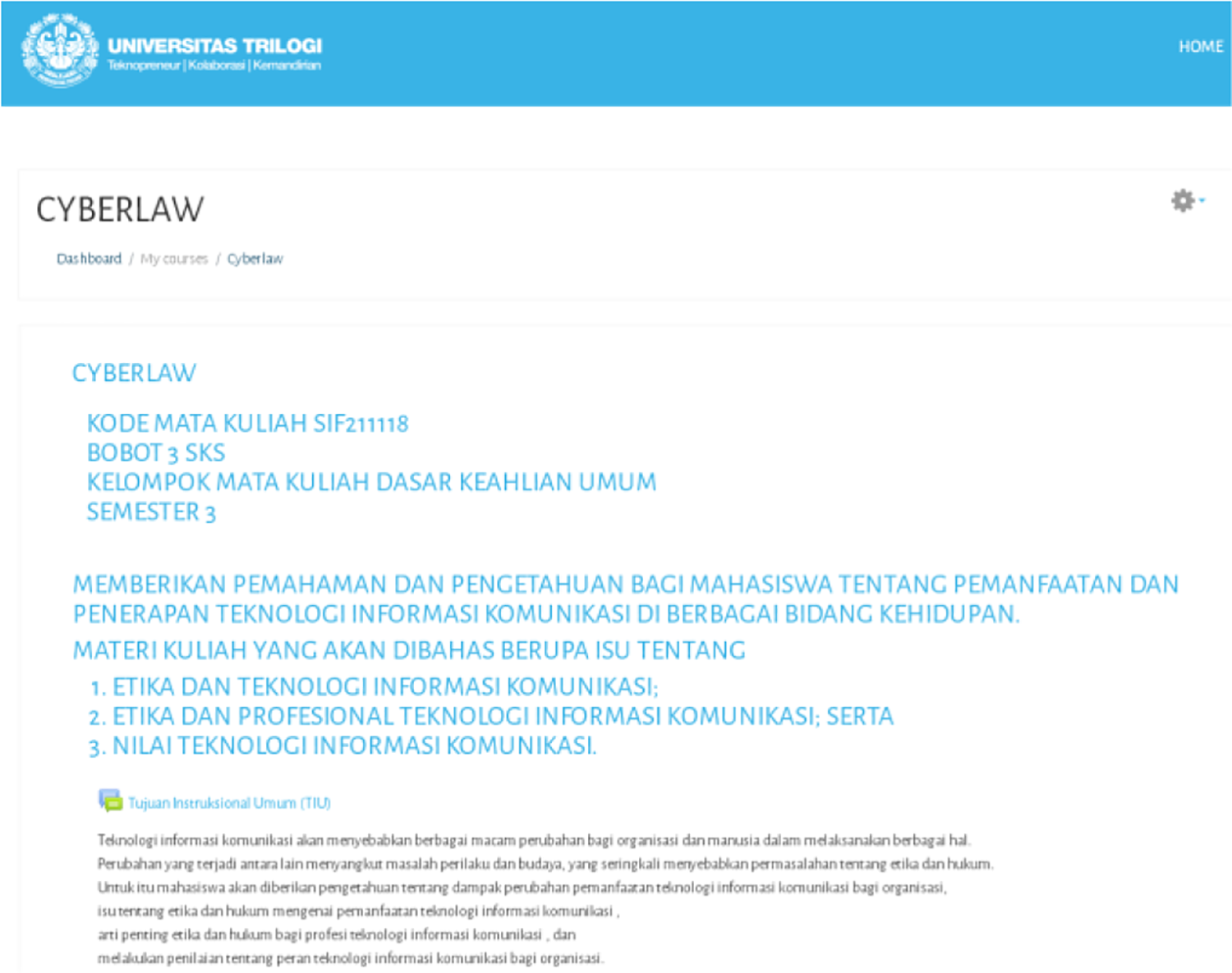
Lecture page views.
Figure 6 illustrates the user experience and user interface in the distance education system in cyber-law lessons at the Trilogi University that allows academics to interact easily, quickly, and accurately. On this page, the student must enter the correct username and password, so that the student can interact easily, quickly, and accurately with the distance education system in cyber-law lessons at Trilogi University. On this page, the student can see the calendar, the lectures they will give and the student can change profiles and other activities in the distance education system model in cyber-law lessons at the Trilogi University.

Student home page.
Figure 7 illustrates the user experience and user interface that will be used by students to interact easily, quickly, and accurately with their lecturer in the distance education system in cyber-law lessons at Trilogi University. On this page, students can read and study the lecture material provided by the lecturer, and students can read and answer the assignment material provided by the lecturer, so that all students are expected to play an active role in answering the assignments given by the lecturer for each particular meeting in the distance education system model in cyber-law lessons at the Trilogi University.

Student page view.
Model testing scenario
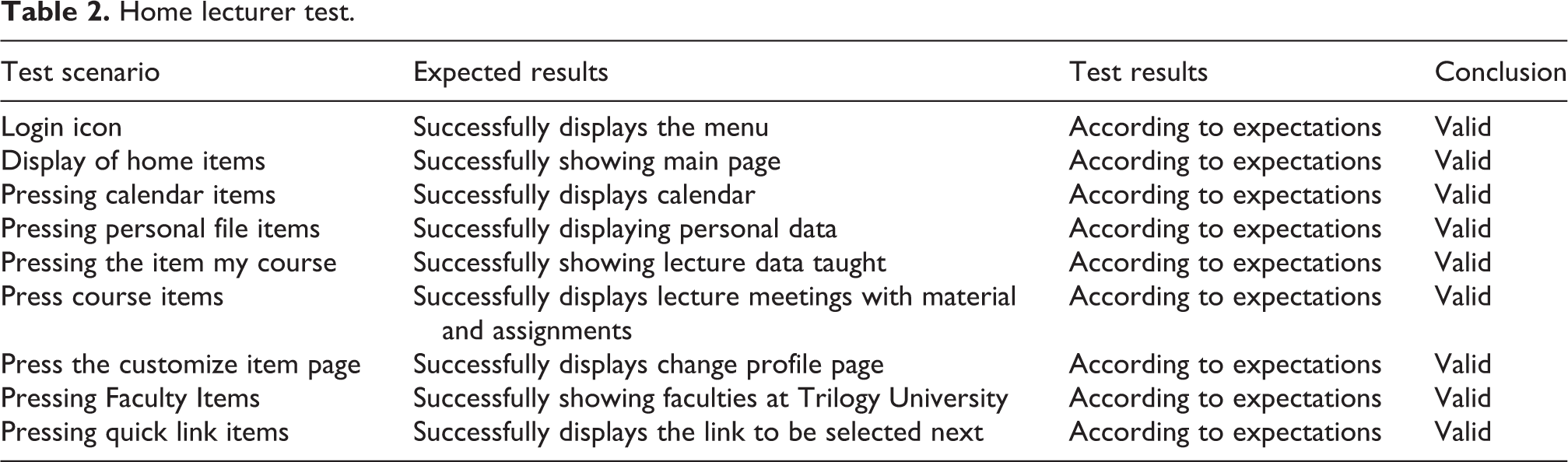
The test scenario results and the test implementation results from the research model of the implementation of cyber-law lessons using blended learning method in supporting distance education system in cyber-law lessons at the Trilogi University are given in Tables 2 to 5.
Home lecturer test.
Home student test.

Lecture page test.

Student page test.

The testing results of the distance education system in cyber-law lessons at the Trilogi University consist of home lecturer test, home student test, lecture page test, and student page test using black-box testing. From the table of the tests conducted previously, the application of the distance education system in cyber-law lessons at the Trilogi University that was developed functioned well.
Model interactive
From the results of testing the research model, the implementation of cyber-law lessons using blended learning method in supporting the distance education system in the Trilogi University has been carried out. Furthermore, questionnaires were distributed to faculty academics involved, namely, for 1 Rector, 2 Vice-Rector, 80 Lecturers, 200 Students, and 10 Administrative Staff of the Trilogi University, to find out the benefits of the distance education system in cyber-law lessons at the Trilogi University, how it allows academics to interact easily, quickly, and accurately in cyber-law lessons that had been implemented. The results of the questionnaire indicate that the research model on the implementation of cyber-law lessons using blended learning method in supporting distance education system in the Trilogi University can simplify work (easy), speed up work (quickly), accurate work (accurately), and become more efficient because it is interactive and user-friendly.
Conclusion and suggestion
The results of the questionnaire were distributed to faculty academics involved in managing the distance education system in the Trilogi University environment, namely, for 1 Rector, 2 Vice-Rector, 80 Lecturers, 200 Students, and 10 Administrative Staff of the Trilogi University, how it allows academics to interact easily, quickly, and accurately in cyber-law lessons that had been implemented. It can be concluded that the distance learning model in the Trilogi University used is considered sufficient, in terms of learning goals, learning materials, interactivity, and rules. The questionnaire results also show that both lecturers and students argue that learning with a distance education system can simplify work (easy), speed up work (quickly), accurate work (accurately), and be more efficient because it is interactive and user-friendly. This research can be applied to other school units or universities so that distance education services can help academics interact easily, quickly, and accurately. For its development, it can be applied using cellular-based applications, so that it can be opened through a gadget.
Footnotes
Declaration of conflicting interests
The author(s) declared no potential conflicts of interest with respect to the research, authorship, and/or publication of this article.
Funding
The author(s) received no financial support for the research, authorship, and/or publication of this article.
