




Abstract
This study contributes to the promotion of healthcare information integration and readiness assessment of the factors impacted by quality improvement in hospital performance, which is beneficial for developing the healthcare industry because errors or integrated information can significantly affect the safety of patients and their confidence in the healthcare system. This research method is proposed to identify and confirm capability factors after readiness assessment with empirical testing, and the data were collected from hospitals in Thailand. An analytic network process was used as a tool for calculating and testing the readiness assessment of the integrated information results. The results show factor improvement of information integration and effects on the performance of hospitals in the healthcare industry. Three capability factors were found to have a significant impact on information integration and hospital performance. The model analysis suggests that the identified capability factors (organizational, group and individual) should be improved with regard to information integration, which is used to evaluate performance in the healthcare industry, and this risk assessment may be useful in other relevant industries.
Introduction
In the healthcare industry, information has a significant influence on service efficiency, physician decision-making and human health. 1 The information of self-medication consumer’s behaviour is not come from medical diagnosis and is not imposed by physicians. 2 Good information integration are required for providing effective patient services. The healthcare industry should have the best information management because information has a grave impact on physician services. Information flows in the healthcare industry occur for the production of medicine and the manufacturing of medical supplies for hospitals, and they help organizations provide the right patient services. Assessment of the effectiveness of maintenance design and drug production data analysis can increase the performance of pharmaceutical production line. 3 Specific information helps physicians make correct treatment decisions. 4 Information management is the process of sharing information from the first level to improve information services and managing the process of integrating technology in the healthcare industry for performance improvement. 5
Information integration is a new conceptual system used for industrial development, improvement and operational efficiency. It is a better system that can be used for performance measurement and quality improvement. 6 The implementation of information integration is a technique that can be used for decision-making. 7 Most research has focused on information integration in the healthcare industry through information sharing, logistics coordination and internal and external linkages in and among organizations. 6,8 –11 Information integration is important and is needed to improve processes and to improve the quality of hospital services. Meanwhile, its management in the healthcare industry plays a crucial role in reducing the risk involved in providing hospital services. 4 Furthermore, information integration can be used as a tool for measuring the performance of patient services provided by physicians. 12 The healthcare industry needs information integration due to special concerns about patient safety and treatment waiting times. 7,13,14
This study investigates information integration in the healthcare industry and aims to analyse the influencing factors and the readiness assessment of information integration that affects healthcare performance using an analytical network process (ANP) model. In the first part, we introduce information integration in the healthcare industry. The second part provides the background, which is based on theory relationships of information integration. In the third part, we describe the testing and data collection, data design and data analysis conducted by using an ANP model. The study closes by providing an explanation and discussion of the results regarding the proposed hypothesis as well as a discussion of the critical success factors of information integration used to evaluate healthcare performance.
Theoretical background
Saaty 15 created the ANP theory as a concept to solve more sophisticated decision problems. Many researchers have used ANP for risk assessment 16 and readiness assessment 17 in organizations. Lin 18 used it for evaluation of sustainable supplier assessments in a supply chain management system. Amir and Razieh 19 used ANP to identify supply chain agility and product evaluation criteria. Dou et al. 20 used ANP for management of the greening supply chain by comparing market factors with supplier selection and showed improvement of the ANP method to identify green suppliers and developed a programme for evaluation of effective selection based on supplier performance. De Felice and Petrillo 21 presented the use of ANP to prioritize all of measures and strategies performance of fashion industry.
There are many other calculation methods to derive the priority values to solve decision problems. De Felice et al. 22 presented the use of analytic hierarchy process (AHP) approach for supplier selection is to carry out a comparative evaluation criteria of supplier performance. Battistoni et al. 23 evaluate the customer requirement by applying AHP method for priorities to new product development. Membership maximization prioritization methods for fuzzy AHP, fuzzy optimization and decision-making. 24 Do and Chen 25 implemented the fuzzy AHP to allocation of limited resources for tourism in Vietnam. The least penalty optimization prioritization operators derive the fittest priority vector from a reciprocal matrix. 26 A great number of research reports have used readiness assessment from the organization assessment point of view, and ANP has been used for evaluating success, risk management, readiness assessment and prioritizing work. Yuen 27 developed cognitive network process to improve some drawback of AHP. Karpak and Topcu 16 used ANP for setting evaluation criteria of entrepreneurs for investment by comparing the factors that influenced the success of the investment. The application of the ANP method helps in the selection of factors and offers decision-making to be used for software selection in successful development product. 28 Ergu et al. 29 proposed a threshold in risk assessment consistent with decision-making. According to Wua et al., 17 who demonstrated quantitative indicators from conceptual ANP, they could be used for evaluating strategy selection in the form of multi-criteria decision-making. The reasoning of ANP theory analyses the impacts and performs readiness assessment of key factors of risks presented by decision alternatives and aims to evaluate the risk level of intra-organization cultures for different industries in implementation. Therefore, ANP is appropriate for use in analysing the risk factors influencing assessment of system implementation, which can set the risk categories and readiness assessment factors. 30 The steps of development of ANP have been shown in numerous books and the research papers of Saaty. 15
The information integration factors readiness assessment
Information integration has a significant impact on healthcare performance. Business process improvement in healthcare organizations has been correlated with integrated information. 31 Furthermore, the information flow processes and linkages between the three capabilities levels of individual, group and organizational are essential for performance. 32 Each level consists of the influencing factors and is effective for information integration technology. Factor development is a tool used to measure healthcare performance and quality improvement. 33 The factor that influences and drives the quality of performance improvement is the information flow between internal and external organizations. 32 The framework developed in this research was used to analyse the factors that influence information integration and investigate healthcare performance. There are three levels of capability factors that have an impact on healthcare performance. It has also been suggested that a significant relationship in the conceptual framework should be defined.
The analysis and explanation of each factor are shown in Table 1. There are popular models for the capabilities of method evaluation, and they pattern methods differently. This study divided the models into individual, group and organization levels for increasing capabilities. The capabilities models were established as follows:
The capabilities perspective summary.

MM: mental model; CMM: capability maturity model.
Mental model
The mental model (MM) is the conventional sense of the organization that must reflect the behaviour of people in organizations and what occurs in learning organizations when members of the stereotypes exhibit consciousness while clearly operating the conductive reflection. The MM is used to increase capability in evaluating skilful and practices the individual level, and it is classified with the aim of improving the accuracy and to rule on various situations that arise with employees in an organization. The objective includes an understanding role of how to make a clarification to establish the clear decision correctly, and the driving force of personnel to potentially increase and carry life and work. The MM can analyse and find the predictive influence of social interactions on synergistic knowledge development. 34 The MM figures out the category patterns and the condition of people decision-making. 35,36 The MM is defined as a cognitive base for what is real or imagined, and it can be influenced by an individual’s perceptions and described as the influenced method of increasing the capability of people.
This model has attracted the interest of the healthcare industry. This is evident from the researchers who use medical personnel and information technology (IT) to increase patient satisfaction. 37 –39 The condition of applying MM in healthcare industries requires changing the style for appropriation. The MM is not only able to change the style for the evaluation of an organization, but it is also able to incorporate important factors influencing the development of the MM style, such as political MM style, financial MM style, efficiency MM style, social MM style, and system MM style. 36 The important factors of MM development in mental health styles are individual, organizational, community, state and supranational. 38 The MM improves team effectiveness by encouraging team members to develop resilience and the right foresight for their job, leading to coordination among members. 40
Capability maturity model
The development maturity model was proposed for capabilities as wide as the range of activities, including software development, supplier relationships, research and development effectiveness, product development, technology, innovation, collaboration, product design and reliability information flow. 41 These capabilities manage elements of organization as individual skills, routines and processes that reflect links across knowledge throughout the organization. 42 Thus, many researchers have developed models for sharing with capabilities and maturity models. The capability maturity model (CMM) is a tool developed to aid the selection of contract software providers in the US Department of Defense. It was developed in the late 1980s, and, subsequently, it has been extensively used by business organizations, which currently have transformed it into various forms depending on appropriate use in organizations. 44 Thus, the CMM underwent improvements in terms of organizations sharing and implementing it with increasing capability. There was a perspective used as an indication of the measurement capability in an organization and it performed increasingly well. The implementation of CMM improves schedules, productivity, quality, customer satisfaction, costs and returns on investment. 44 The method of CMM can be used to indicate the individual level, technology level and organization level. 45 The capability of incorporating various information levels could have a direct and significant effect on the quality of IT strategy implementation 46 and the quality of this process could affect business performance as well.
The CMM as applied to reconfigure the capability of organization learning is divided into three levels, such as, the individual level, group level and organization level. 47 CMM has been used to improve or assess the facilities management process capability and collaboration in a national healthcare system. 48 Furthermore, the improvement of maturity for increasing capabilities in organizations by providers creates patients’ satisfaction. The CMM perspective is divided into five levels such as the initial level, service delivery management, knowledge management, quantitative control and continuous improvement. The CMM approach for determining organizational abilities includes quality management and divides their designed CMM perspectives into reliabilities models in five levels such as solely reactive level, repeatable level, defined level, managed level and proactive level 71 which are technology, collaboration and sharing.
Capability maturity model integration
The CMMI was developed from the CMM by the addition of functional sided IT for the purpose of integrating functional or organization processes. CMMI is an integrated model framework of many CMMs that consists of the best process practices. 49 Since 1991, the Software Engineering Institute (SEI) of Carnegie Mellon University in collaboration with the software community developed CMM for myriad disciplines. 49,50 The SEI developed the new model capability maturity model integration for IT services management. CMMI was formed for solving CMM problems in multiple organizations. The framework of CMMI includes IT functions, which are related to strategic, trust and relationship within the organization. 50 –52 It also provides information process improvement and IT services management. 49 The purpose of CMMI is to provide guidance for improving the organization’s processes of its capability to manage and develop in three levels (individual, group and organization). 50,53 Their models are designed to help managers improve the software quality and reliability, employee satisfaction and returns on investment. Currently, software developers have made significant advances in developing models for software process improvement including the capability of maturity model integration. 54 CMMI was divided into six levels as follows: incomplete, performed, managed, defined, quantitatively managed and optimizing. 51
The importance of healthcare information integration
IT is continuously developing. Its development has led to information linkages among hospitals in the healthcare industry. The main objective was to utilize information integration in the healthcare chain. Alvarez and Zelmer 55 claimed that the development of business processes in hospitals has been improved as well as leading to highly developed informatics and good patient services. Information integration is important for developing the healthcare industry. Information integration has been used to support internal and external operations in and among organizations. Information integration focuses on information sharing and correcting integrated data. 8,56 –60 There are several techniques used for information integration that involve IT and performance improvement in terms of enterprise integration.
Information integration is related to data flows, processes, software applications 61,62 and communication technologies used in healthcare environments. 45 The aspects of internal and external integration are included in technical integration, information sharing, reward systems, process-oriented performance measurement and standards. 63
The systematic framework of integration developed by Wainwright 64 includes information on communication technology integration (TI), which requires organizational and strategic policies to be developed in a proactive manner before implementing information communication technology systems.
The process of integration involves adopting information integration techniques (IITs), which refer to techniques used for integrating the information of enterprises. Information integration involves combining information from resources by processing until the information moving from one unit to another covers the entire organization. There is an integration framework that defines the scope of the enterprise integration and includes (1) process integration, (2) application integration, (3) data integration (DI) and (4) physical integration. 65
IITs factors
According to a previous study and analysis, information integration is recognized as an important tool for business development. There are four success factors for information integration, including TI, architecture integration (AI), semantics of DI and organizational integration (OI).
Technology integration
TI describes how data are transferred between the same and different systems and within internal and external organizations. TI involves using physical and logical data to obtain the best information. Sometime this involves mechanisms for initiating actions in a system 56 and these mechanisms can be sent to other systems for data processing and for decision-making. Irani et al. 66 suggested that enterprise application integration supports both enterprise and cross-enterprise application integration by using enterprise resource planning software and IT infrastructure. Information and communication technologies include electronic data interchange systems, the Internet and the World Wide Web, which overcome the ever-increasing complexity of systems driving buyer–supplier relationships. 67 Information communication technology has developed into three basic conceptual categories, namely, computers, telecommunications and multimedia data. 68 The element of TI has important factors that can be applied to integrate technology.
Architecture integration
AI, which is supported by internal and external information decisions, involves a structured system of information development and processing with data connections. AI involves software system relationships and logic and technical infrastructure applications. AI focuses on how system design influences the possibility of easy achievements, safe data sharing and functionality between systems. 56 The system used to integrate enterprises is an extremely complex process that involves different technological, human and organizational elements. 45 AI that is designed to cope with the complexity of technical information, communication and determining functional requirements is needed to automatically integrate operations within an organization. 64
Data integration
The semantics of DI involve the content of different data, which could potentially be for either single or diverse systems. The rules for semantic integration have a completed meaning and have been categorized as follows: (1) the source, or reference, can be extended forward or away; and (2) the rule must be true or false. According to Zhou et al., 69 the relationships in the database are built by integrating information across enterprises, starting with the exchange of information using a database link from the data source and then evolving to a hierarchical structure (Schema) and the construction of a recorded database structure (Ontology).
In the system engineering field, ‘ontology’ refers to the system engineering of artefacts and consists of a vocabulary that is used to describe something specific, with clear specifications, meaning, vocabulary and limitations, which add new knowledge to the fullest extension. It has been claimed that it is more important to be aware of the semantic inconsistencies (different meanings in different systems) than to actually eliminate the differences, which may be very difficult, especially in systems from different vendors. The important element is ontology. 56
Data ontologies have been used to enable classification and reasoning. Ontological languages not only allow conceptual modelling based on the introduction of vocabularies and taxonomies but also provide a logical framework that can be used to specify rules and explain expressions. Ontology is defined as the structure of what we do that is meaningful to the extent of our knowledge. Currently, ontology is being applied in the standard model of the design structure of the eXtensible Markup Language and in the definition of the conceptual model of database structures. 70
Organizational integration
OI should be focused on user integration in the same and various systems. This means that enterprise capabilities need to include sharing skills, knowledge in terms of structural organization, cultural organizational analysis and social collaboration between organizations to support government policy. There are two types of OI: (1) internal OI and (2) external OI. From the system integration perspective, interrelationships between subsystems occur when subsystems interact or communicate with another element and integrate and organize various traits, relations, attitudes, behaviours and so on into one harmonious personality. 68
OI is required to motivate members in organizations to share information at the same and at different levels. There are some factors influencing inter-organizational information sharing, such as the organization and management, technology, politics and policy. 71
Materials and methodology
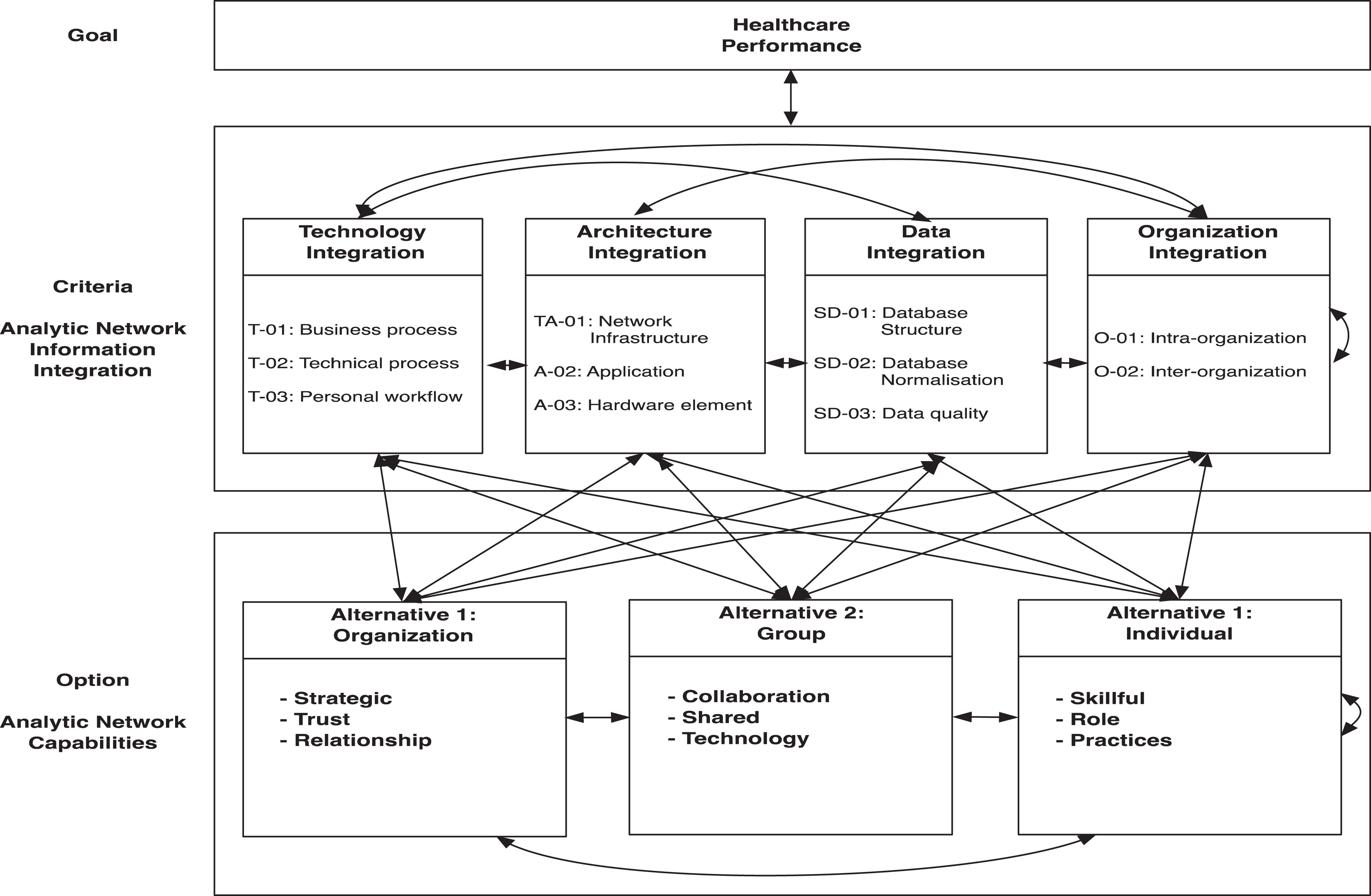
Many research papers have focused on the relationship between the information flow between both internal and external organizations for the service delivery of healthcare and thus focus on readiness assessment in the healthcare industry. This step means we used the theory of readiness assessment management of information integration in the healthcare industry of Thailand by selecting the use of ANP theory, and the steps of readiness evaluation are as follows (Figures 1 and 2): 1. The model construction of this research for readiness assessment related to information integration was the main factor of readiness assessment for information integration in the healthcare industry. The relationship of information integration factors shows decision-making and factors that are criteria of information integration such as technology, architecture, semantic data and organization. Model construction is the first step to create the structure of problems and define clearly problems for the results of the decision-making such as the research of Cao et al.
72
who identified the structure of a problem related to the method with selected IT projects from other outsourced companies. The aim of model construction was to describe the relationships among decision-making problem goals and related other criteria. All relations evaluated by pairwise comparisons and a super-matrix which are finding factors explain in theoretical background. A matrix of influence among the elements is obtained by priority vectors. ANP has been for weighting the criteria and subcriteria, and cluster comprises in network model. Finally, the cumulative influence of each element on every other element with which it interacts is obtained by raising the super-matrix to limiting powers in order to calculate the overall priorities. When a network consists of two clusters from the goal, namely criteria and alternatives or criteria and sub criteria, the matrix manipulation.
73
The network used in this article is based on the structure of hierarchy with dependencies within components (Figure 1). 2. Comparing the internal factor hierarchy by using a comparative sequence couple matrix with finding the weight matrix that was referred to in the methodology of Saaty,
15
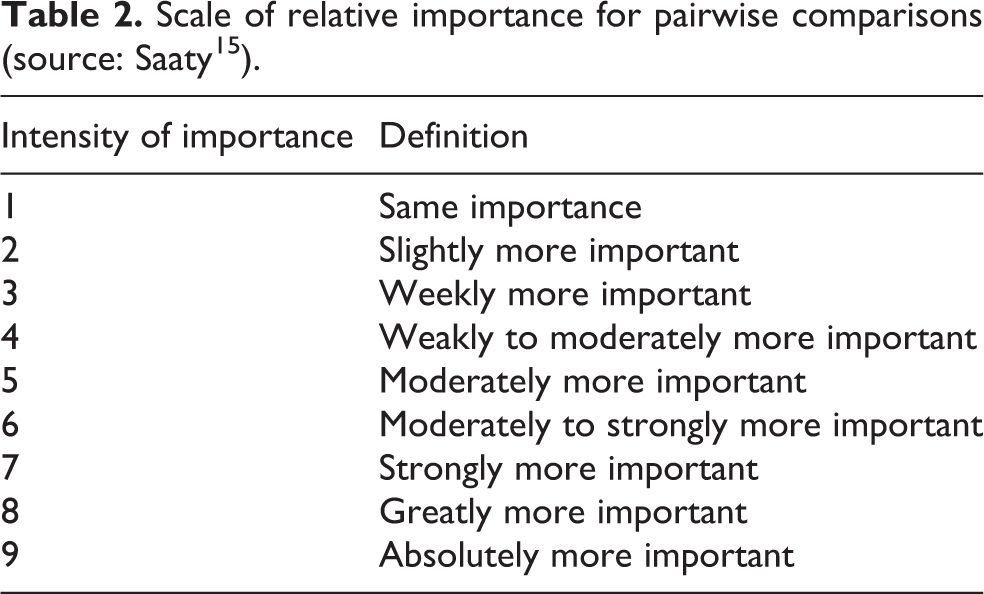
the information integration includes the factor comparison. Comparison is the second step to grade the important elements by using a matrix that is a tool to compare with the sequence couple. It can evaluate the comparison with the group of elements. This methodology is used for finding weight values for achieving index assignment. The results from weight values represent the importance of numeric value level. Saaty
15
invented the master of measurement or to give numeric values as shown in the important level value (Table 2). 3. The matrix calculation is used to find the important sequence value of comparisons in each factor. After operating the comparison of all factors with the pair comparison between factors and criteria used for calculating the matrix as the representative of the value substitution in matrix, then questionnaires are used to evaluate the priority of factors according to ANP calculations.
28,72,74
The matrix calculation is the third step to represent the value substitute in the matrix and important sequences that show numeric values in the matrix. The important sequence value in the ANP technique derives from the evaluation of relations of factors or groups of relations of elements derived from comparison. The matrix comparison is shown by many articles of interest on the ANP topic.
28,72,74
In Figure 2, we present the pairwise comparison between factors and criteria by aij referring to objective comparison scores i and j.
After they finished the study of the comparison and evaluation between factors (i) and (j), the result is shown in matrix A. The next step is to find important values of criteria or factors from matrix A by calculating them from equations. 4. Final assessment provides the answer of readiness assessment that shows the value of priority for each selection and explains the best decision-making to manage the information integration. As a result, the answer would show the score number; that is, if the score was in a high level, it meant that it was the best selection under the consistency of various factors influencing healthcare management. The final step is also shown as the calculation method below: Analytic network process structure model of interactions between the subcriteria. The matrix pairwise comparison. Scale of relative importance for pairwise comparisons (source: Saaty
15
). Example to sums of the vertical.



The results shown after dividing.
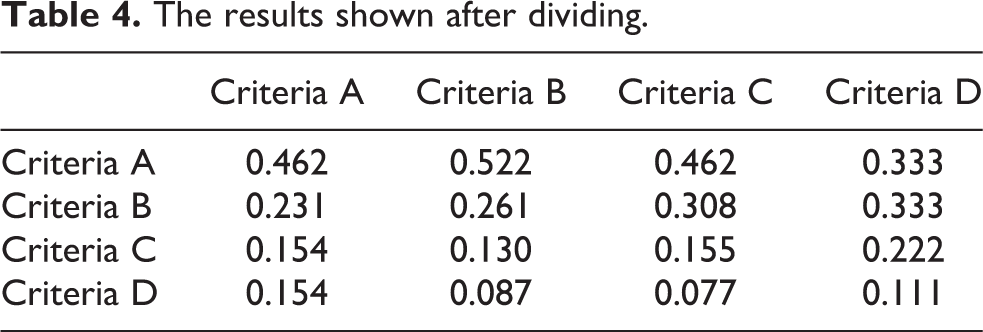
Step 3 → This step is the last step to find the average values in each row by finding the sum of each row/number of criteria or total factors, for example:

The result computed the degree of importance by sequentially decreasing 0.445, 0.283, 0.165 and 0.107, which is represented as factors or criteria influencing the readiness or decision-making and the most influential are factor A or criteria A. The result of readiness assessment of information integration in the healthcare industry is decision-making to manage the information integration in the healthcare industry. Therefore, evaluating information integration is important for designing and developing a framework for performance measurement and readiness assessment.
Thai government’s healthcare policy outlines the management of the health services provided to Thai people and is the basis for developing health systems that improve the quality of life of Thai people. There are 13 health service networks involved in the management of the healthcare service system according to the Ministry of Public Health in Thailand (in an announcement made by the Ministry of Public Health). The subjects for this study have been selected from one hospital in Thailand and have selected experts about 30 persons including physicians, nurses, IT management executives and healthcare staff members who works in this hospital. The criteria used for determining sample size are functions of the estimation variables approach proposed by Saaty. 15
Results
The pairwise comparison is a process of information integration in pairs to judge the qualitative and quantitative aspects of each variable and its impact on healthcare performance. As indicated in Figure 1, there are two scenarios of pairwise comparison in the ‘capabilities’, that is, with respect to ‘information integration’ and goal as ‘healthcare performance’. The question asked with respect to goal, for example, is what organization capability influences trust more than other internal factors with regard to information integration? Answers to questions of this sort are obtained from pairwise comparisons for all capabilities and information integration. A summary of the results for the pairwise comparisons is illustrated in Table 5, which has input data shown in Appendix Table 1A.
Weight-value score.

TI: technology integration; AI: architecture integration; DI: data integration; OI: organizational integration.
ANP computation weight-valued scores for each factor have high and pass criteria that mean the case study has a given importance with information integration and shows self-assessment that agrees with the model.
The super matrix is made of the pairwise comparison matrices of interdependencies and can enable identifying the effects of interdependence (Table 6). 75 –77 Satisfaction and TI are factors that have scores better than all other factors, which are important for increased healthcare performance and improvement consideration that exists between capabilities (organization, group, and individual) and information integration. The number of pairwise comparisons determines causes it to have a size of 16 × 16, which shows the results of relative importance and measures each factor for performance structure determinants that are the first priority consideration. In the next stage, the super matrix is converged to obtain a result of readiness assessment that can find the weights.
ANP variable matrix comparison.
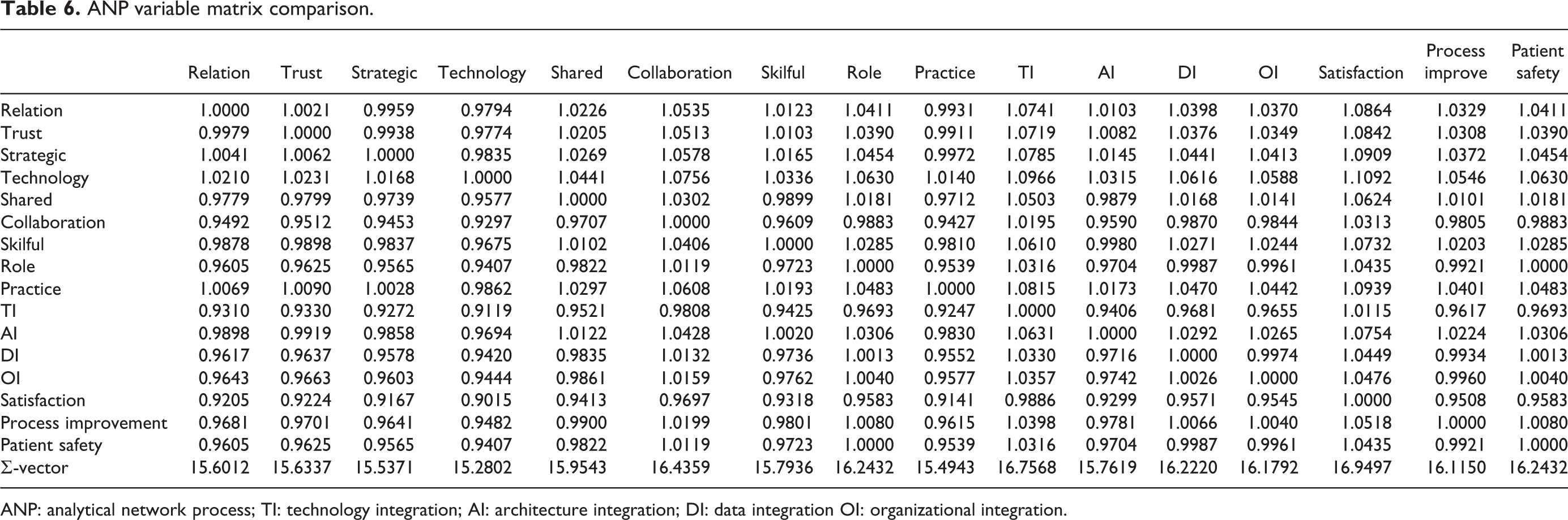
ANP: analytical network process; TI: technology integration; AI: architecture integration; DI: data integration OI: organizational integration.
Table 7 shows the weight-valued scores after factors comparison by experts at the hospital at the management level, which agree on the adopted factors. Strategic and technology are factors that have scored better, which show the importance of organization in the considerations. 7,78,79 TI and satisfaction have scores that are ultimately low. The reasons for this are in accordance with the research results, because organization and group capabilities are factor considerations that are part of strategic and technology. The considerate compositions are vision, policies, communication, collaboration, coordination between organizations and groups of associated staff internal and external to the hospital.
Importance weight values into factors comparisons.

TI: technology integration; AI: architecture integration; DI: data integration OI: organizational integration.
The hospital study gives known related IITs within performance improvement that is a fact with regard to executive understanding and managing of healthcare. A novel information architecture can clarify policy when there is understandable management, which means senior managers must use vision and missions to organize strategies to increase performance. 80 Hospital management contexts need to take into account these key characteristics to improve understanding of effective policy and government mechanisms. 81 The successes of operation come from internal control of technological performance and uses mechanisms up to the management level of the chief executive officer. 82 This is consistent with previous research results 83 which showed that analytical relationship strategies have a positive effect on government performance. When considering the results from the table, they have certainly confirmed it can find action plan capabilities into information integration.
When score sorting from higher to lower, we can see that all factors have passing criteria but group capability is lower than the other factors, because it is intermediary and rarely involved in decision-making and they only follow the executive orders and policies. This suggested case study shows that the goal of information integration is an increased capability of manager and staff in organizational healthcare and should be an action plan to develop health information organizations for sustainable integration. Management and orientations in functional operations of hospitals have influence on healthcare organization performance. 83 This indicates that knowledge creation, sharing and retention between individuals and groups can be optimized to increase organization performance. 84 Among the main reasons identified for successful information integration that should be given attention are the capabilities of the organization, group and individual.
The results of the readiness assessment (Table 8) of the case study are suggestive and provide an action plan for improvement and development. As the random index associated finding with Eigenvector values and absolute (ABS) values, that have many studies used this method to comparison factors to readiness assessment. According to Yuen,
85
the study applies Eigenvector method by considering consistency ratio (CR) to evaluate the consistency index of reciprocal matrix. To determine the validity, if CR > 0.1, the pairwise matrix is not consistent, then the comparisons should be revised. Otherwise, the pairwise matrix is accepted. When consider CR value of Topics to consider namely organization capability (Relationship, Trust, Strategic), group capability (Technology, Shared, Collaboration), individual capability (Skilful, Role, Practice), information integration (TI, AI, DI, Organization integration), and healthcare performance (Satisfaction, Process Improvement, Patient Safety) in Table 8, which have presented CR < 0.1 (all topics to consider). Therefore topics to consider are accepted pairwise matrix and pass evaluation, namely: Group capability has scored lower than other factors and has three observable variables, including technologies, share and collaboration. This case must have improvement in terms of its collaboration variable, because it specifically affects shared IT. Deploying appropriate IT to integrated collaboration and configurations should be to the top performers in the high-level group for quality improvement.
86
Teamwork that has collaboration and delivers good service will be constructive and result in the most customer satisfaction.
87
Successful implementation within the organization, that is, the creation of customer satisfaction, allows work groups to share adoptions and be collaborative within improved processes.
88
Individual capability is a factor that must receive support and development with regard to the ability of group capability. Skilful, role and practice factors are observable variables from the operation. Role creation and work practice increase skilful. Training and culture that have good attitudes towards operations, leading to understanding the principal practice of duties and responsibilities, are concerns in innovation considerations of organizational policies.
89
Once pointed to a job description, individuals need work instruction to ensure the job description is clear and has described the roles correctly, and the different roles of individual workers that require more skill should always be trained and practised.
90
The results of the readiness assessment.
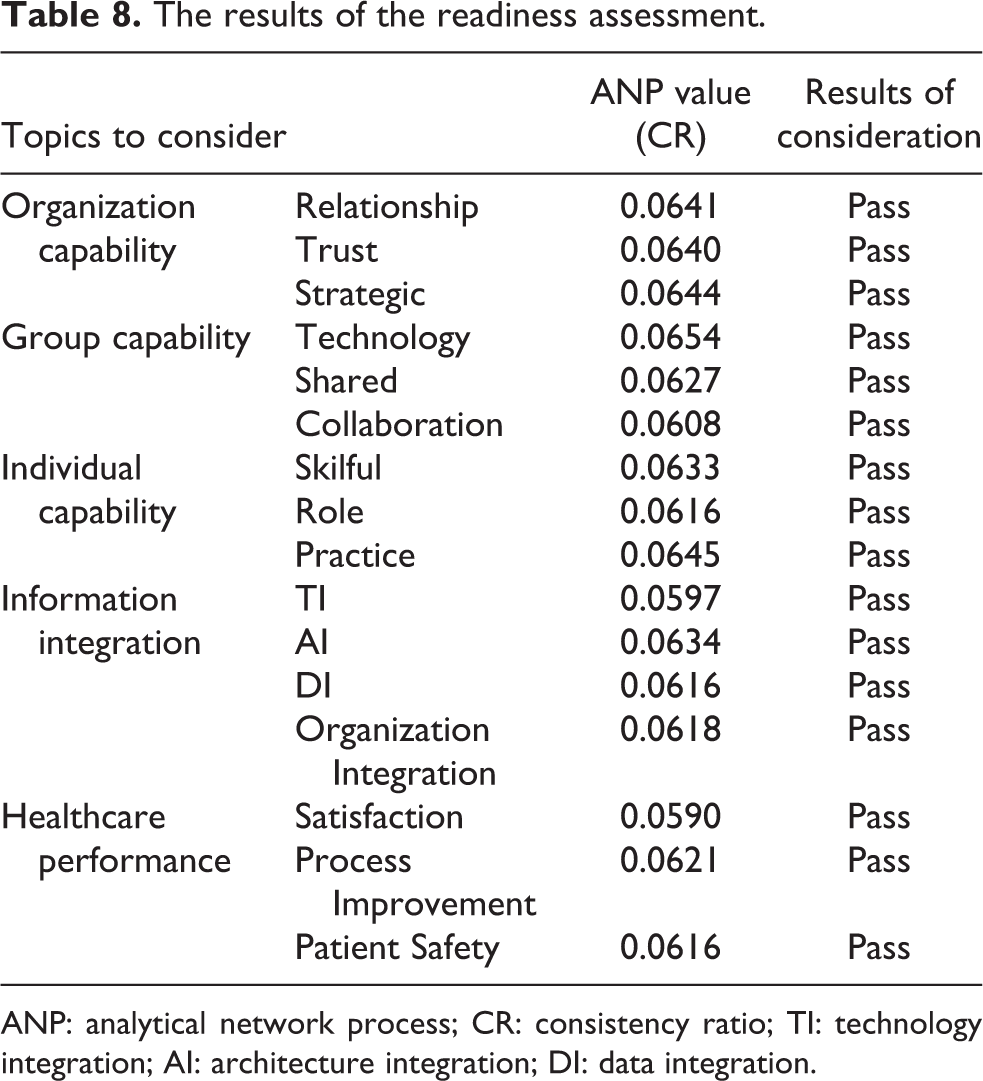
ANP: analytical network process; CR: consistency ratio; TI: technology integration; AI: architecture integration; DI: data integration.
Discussion
After modelling is used to improve performance and has finished its confirmation, the researcher used a hospital to evaluate for readiness of assessment and implement modelling and chose one hospital to explore its readiness for information integration. The objective is to monitor the status of factor influences on information integration after they are identified as factors by experts in the hospital and through the use of ANP, a theory for decision-making readiness assessment. Then, we can propose guidelines on improvement of factors and when to consider the weight of the factor by comparison with the criteria of the ANP standard. The answer received can be developed into an action plan for information integration improvement in the future.
The results of testing showed the sample hospital passed the assessment criteria, because it is a large hospital in Thailand and has a large budget for hospital management in which the executives placed emphasis on health information systems. There is a campaign to use hospital management methodology by using decision-making information, and as a result, there is encouragement for continuous improvement of IT. In particular, there is an initiative to integrate all information systems in the hospital into a health information service centre. Referencing the ANP result, there are some factors that meet criteria, but their weight is less than other factors, namely, group capability as collaboration, technology and sharing. To these ends, senior management must place importance on improving them quickly, because these factors have direct and indirect effects on information integration. Focusing on group capability should be the first improvement because its weight was lower than other factors.
Group capability is a middle management between the organizational and individual levels. When the group level receives information from the organization level, they must share it with individual levels or internal group members for understanding roles and practices so they can comply with policies on the organization level. At the same time, they must have cooperated and coordinated using collaboration with the organization to clearly identify operations for continuously controlled result audits. Finally, focusing on modern technological knowledge is required for the integration of information. These guidelines must be continuously developed and need support from the organization level to the individual level at all times.
This research has suggested ways to improve performance if a healthcare organization becomes aware of information integration and its recommendations can be used to improve the implementation of healthcare performance in the precinct of information integration.
Conclusion and limitations
In conclusion, this study provides an ANP for readiness assessment focusing on information integration of hospital to create healthcare network. We have analysed information integration factor of literature related to healthcare network with the goal of understanding and reviewing the key topics in readiness assessment of information integration in a hospital.
Our results have suggested the ways to assessment of performance improvement and make healthcare organization becomes aware of integrated information which have impacted to patient safety and process improvement of hospital in the precinct of information integration. Some limitations of this study are related to the selection of methodology and data collection used in the study. Yet, we believe that the most important of this study is math model used readiness assessment and understand organization. Future research needs to find factors in depth of integrated healthcare supply chain management and monitor the factors that both directly and indirectly influence information integration in healthcare organization for decision-making in a healthcare network integration.
Footnotes
Declaration of conflicting interests
The author(s) declared no potential conflicts of interest with respect to the research, authorship, and/or publication of this article.
Funding
The author(s) received no financial support for the research, authorship, and/or publication of this article.

Appendix 1
Input data.a

| 1 | 2 | 3 | 4 | 5 | 6 | 7 | 8 | 9 | 10 | 11 | 12 | 13 | 14 | 15 | 16 | 17 | 18 | 19 | 20 | 21 | 22 | 23 | 24 | 25 | 26 | 27 | 28 | 29 | 30 | |
|---|---|---|---|---|---|---|---|---|---|---|---|---|---|---|---|---|---|---|---|---|---|---|---|---|---|---|---|---|---|---|
| Relationship1 | 6 | 9 | 10 | 8 | 8 | 10 | 8 | 8 | 10 | 9 | 8 | 10 | 8 | 8 | 8 | 6 | 8 | 10 | 9 | 6 | 8 | 8 | 8 | 6 | 8 | 10 | 8 | 10 | 6 | 8 |
| Relationship2 | 6 | 8 | 8 | 8 | 10 | 8 | 8 | 8 | 8 | 10 | 6 | 8 | 8 | 8 | 8 | 8 | 8 | 8 | 8 | 6 | 8 | 8 | 8 | 8 | 8 | 9 | 8 | 8 | 8 | 8 |
| Trust1 | 8 | 8 | 8 | 8 | 8 | 10 | 10 | 6 | 10 | 8 | 8 | 8 | 4 | 10 | 8 | 8 | 8 | 8 | 8 | 10 | 8 | 8 | 8 | 6 | 8 | 10 | 8 | 8 | 8 | 8 |
| Trust2 | 8 | 8 | 8 | 8 | 10 | 10 | 10 | 8 | 7 | 8 | 8 | 8 | 8 | 10 | 8 | 8 | 8 | 8 | 8 | 6 | 8 | 8 | 8 | 6 | 8 | 10 | 8 | 8 | 6 | 8 |
| Strategic1 | 4 | 8 | 8 | 8 | 8 | 8 | 8 | 8 | 10 | 8 | 8 | 6 | 8 | 10 | 8 | 8 | 8 | 10 | 10 | 10 | 8 | 8 | 8 | 4 | 8 | 10 | 8 | 8 | 8 | 8 |
| Strategic2 | 6 | 10 | 8 | 8 | 8 | 8 | 8 | 10 | 8 | 10 | 8 | 8 | 4 | 8 | 8 | 8 | 8 | 8 | 10 | 6 | 8 | 6 | 8 | 8 | 10 | 10 | 8 | 8 | 8 | 8 |
| Technology1 | 8 | 8 | 8 | 8 | 8 | 10 | 8 | 8 | 10 | 8 | 6 | 10 | 6 | 10 | 8 | 8 | 8 | 8 | 8 | 6 | 8 | 8 | 8 | 8 | 8 | 8 | 6 | 8 | 10 | 8 |
| Technology2 | 6 | 10 | 8 | 8 | 10 | 8 | 10 | 6 | 8 | 8 | 4 | 6 | 10 | 8 | 10 | 4 | 8 | 8 | 10 | 10 | 8 | 6 | 8 | 4 | 8 | 8 | 8 | 8 | 8 | 8 |
| Shared1 | 6 | 8 | 8 | 8 | 10 | 10 | 8 | 8 | 8 | 8 | 8 | 10 | 6 | 10 | 8 | 8 | 8 | 8 | 8 | 6 | 8 | 8 | 8 | 8 | 8 | 8 | 8 | 8 | 8 | 8 |
| Shared2 | 6 | 10 | 10 | 8 | 10 | 10 | 10 | 6 | 7 | 8 | 6 | 10 | 10 | 10 | 10 | 6 | 10 | 10 | 10 | 10 | 8 | 8 | 8 | 4 | 8 | 10 | 8 | 6 | 10 | 8 |
| Collabolation1 | 6 | 8 | 10 | 8 | 10 | 10 | 8 | 8 | 8 | 8 | 8 | 10 | 8 | 8 | 8 | 8 | 10 | 8 | 8 | 10 | 8 | 8 | 8 | 8 | 8 | 8 | 8 | 6 | 10 | 8 |
| Collabolation2 | 8 | 10 | 8 | 8 | 8 | 8 | 10 | 8 | 8 | 10 | 10 | 10 | 10 | 8 | 10 | 8 | 8 | 10 | 10 | 10 | 8 | 8 | 8 | 4 | 8 | 10 | 8 | 10 | 10 | 8 |
| Skilful1 | 6 | 10 | 8 | 8 | 8 | 10 | 8 | 8 | 10 | 8 | 6 | 8 | 10 | 8 | 10 | 8 | 10 | 10 | 10 | 6 | 8 | 8 | 8 | 8 | 8 | 8 | 8 | 8 | 10 | 8 |
| Skilful2 | 8 | 8 | 8 | 8 | 8 | 8 | 8 | 8 | 8 | 8 | 6 | 6 | 8 | 8 | 8 | 8 | 8 | 8 | 10 | 8 | 10 | 8 | 10 | 6 | 8 | 8 | 6 | 8 | 10 | 8 |
| Role1 | 8 | 6 | 10 | 8 | 8 | 10 | 10 | 8 | 8 | 8 | 6 | 10 | 10 | 8 | 8 | 8 | 10 | 10 | 8 | 6 | 8 | 8 | 8 | 8 | 8 | 8 | 8 | 8 | 10 | 8 |
| Role2 | 6 | 10 | 10 | 8 | 10 | 10 | 10 | 10 | 10 | 10 | 8 | 10 | 8 | 8 | 8 | 10 | 8 | 8 | 8 | 10 | 8 | 8 | 8 | 8 | 8 | 8 | 6 | 8 | 8 | 6 |
| Practice1 | 6 | 8 | 10 | 10 | 8 | 10 | 10 | 8 | 10 | 8 | 8 | 10 | 10 | 8 | 8 | 4 | 10 | 8 | 10 | 8 | 8 | 8 | 8 | 8 | 8 | 8 | 6 | 8 | 8 | 8 |
| Practice2 | 8 | 8 | 8 | 8 | 8 | 10 | 10 | 8 | 10 | 8 | 4 | 6 | 4 | 8 | 8 | 8 | 6 | 8 | 8 | 6 | 8 | 8 | 8 | 2 | 8 | 10 | 6 | 8 | 10 | 8 |
| Practice3 | 6 | 6 | 8 | 8 | 10 | 10 | 8 | 6 | 10 | 10 | 6 | 8 | 10 | 10 | 10 | 6 | 10 | 10 | 10 | 10 | 8 | 8 | 8 | 4 | 8 | 8 | 8 | 8 | 6 | 8 |
| Technology Integration1 | 8 | 10 | 8 | 10 | 10 | 10 | 10 | 8 | 10 | 10 | 10 | 6 | 8 | 8 | 8 | 8 | 10 | 10 | 10 | 10 | 10 | 6 | 10 | 8 | 8 | 7 | 6 | 8 | 8 | 10 |
| Technology Integration2 | 8 | 10 | 8 | 10 | 10 | 10 | 10 | 8 | 10 | 10 | 8 | 10 | 8 | 10 | 10 | 8 | 10 | 8 | 8 | 10 | 10 | 8 | 10 | 8 | 8 | 7 | 8 | 8 | 8 | 8 |
| Technology Integration3 | 6 | 10 | 6 | 10 | 10 | 10 | 10 | 8 | 10 | 10 | 10 | 10 | 10 | 10 | 10 | 10 | 10 | 10 | 10 | 10 | 8 | 10 | 8 | 8 | 8 | 8 | 8 | 8 | 8 | 8 |
| Technology Integration4 | 6 | 8 | 8 | 10 | 8 | 10 | 8 | 8 | 8 | 10 | 8 | 10 | 6 | 10 | 8 | 10 | 8 | 8 | 8 | 10 | 6 | 10 | 6 | 6 | 8 | 8 | 6 | 8 | 6 | 8 |
| Architecture Integration1 | 6 | 10 | 10 | 10 | 8 | 10 | 8 | 10 | 8 | 8 | 8 | 8 | 8 | 10 | 8 | 8 | 10 | 8 | 10 | 10 | 10 | 8 | 10 | 8 | 8 | 8 | 8 | 8 | 8 | 8 |
| Architecture Integration2 | 6 | 10 | 6 | 10 | 10 | 8 | 8 | 8 | 10 | 8 | 8 | 6 | 10 | 10 | 8 | 8 | 10 | 6 | 10 | 10 | 8 | 10 | 8 | 8 | 8 | 8 | 6 | 8 | 6 | 8 |
| Architecture Integration3 | 6 | 8 | 8 | 10 | 8 | 8 | 8 | 10 | 8 | 10 | 6 | 8 | 6 | 10 | 8 | 8 | 8 | 8 | 6 | 2 | 8 | 8 | 8 | 6 | 8 | 8 | 6 | 8 | 6 | 8 |
| Architecture Integration4 | 8 | 8 | 8 | 10 | 8 | 8 | 10 | 10 | 10 | 8 | 6 | 8 | 6 | 10 | 8 | 8 | 10 | 8 | 8 | 10 | 8 | 8 | 8 | 6 | 8 | 8 | 6 | 8 | 8 | 8 |
| Data Integration1 | 6 | 8 | 6 | 10 | 10 | 8 | 10 | 8 | 10 | 10 | 8 | 10 | 6 | 10 | 8 | 8 | 10 | 8 | 8 | 8 | 8 | 8 | 8 | 8 | 8 | 8 | 6 | 8 | 10 | 8 |
| Data Integration2 | 6 | 6 | 8 | 8 | 8 | 10 | 10 | 10 | 10 | 10 | 4 | 10 | 8 | 8 | 8 | 8 | 8 | 6 | 10 | 4 | 8 | 8 | 8 | 8 | 8 | 8 | 8 | 10 | 8 | 8 |
| Data Integration3 | 6 | 8 | 8 | 10 | 8 | 10 | 8 | 10 | 10 | 10 | 8 | 10 | 8 | 10 | 10 | 10 | 10 | 8 | 10 | 10 | 8 | 8 | 8 | 8 | 8 | 8 | 8 | 10 | 10 | 8 |
| Organization Integration1 | 8 | 10 | 10 | 10 | 10 | 10 | 8 | 10 | 10 | 8 | 10 | 10 | 8 | 8 | 10 | 10 | 8 | 8 | 10 | 10 | 8 | 8 | 8 | 8 | 8 | 10 | 8 | 10 | 8 | 8 |
| Organization Integration2 | 6 | 8 | 8 | 10 | 10 | 10 | 8 | 8 | 10 | 10 | 6 | 10 | 4 | 8 | 8 | 8 | 8 | 8 | 10 | 10 | 10 | 8 | 10 | 8 | 8 | 8 | 8 | 8 | 8 | 8 |
| Organization Integration3 | 6 | 8 | 8 | 10 | 10 | 10 | 8 | 10 | 8 | 8 | 8 | 6 | 10 | 8 | 8 | 8 | 10 | 10 | 10 | 10 | 10 | 8 | 10 | 10 | 8 | 8 | 8 | 8 | 10 | 8 |
| Organization Integration4 | 6 | 10 | 6 | 10 | 8 | 10 | 10 | 10 | 8 | 8 | 2 | 4 | 4 | 8 | 10 | 4 | 8 | 8 | 8 | 6 | 8 | 6 | 8 | 8 | 8 | 10 | 6 | 8 | 6 | 8 |
| Satisfaction1 | 6 | 10 | 8 | 10 | 10 | 8 | 10 | 8 | 10 | 8 | 6 | 8 | 8 | 8 | 10 | 8 | 8 | 8 | 8 | 10 | 10 | 8 | 10 | 10 | 8 | 10 | 8 | 6 | 8 | 8 |
| Satisfaction2 | 8 | 10 | 10 | 10 | 8 | 8 | 10 | 10 | 10 | 8 | 8 | 10 | 10 | 10 | 8 | 10 | 10 | 10 | 8 | 10 | 10 | 8 | 10 | 10 | 8 | 10 | 8 | 6 | 8 | 8 |
| Process Improvement1 | 8 | 10 | 8 | 10 | 8 | 8 | 6 | 8 | 8 | 8 | 8 | 10 | 10 | 10 | 8 | 8 | 6 | 8 | 8 | 6 | 8 | 8 | 8 | 10 | 8 | 10 | 8 | 8 | 10 | 8 |
| Process Improvement2 | 6 | 10 | 10 | 8 | 8 | 8 | 8 | 10 | 8 | 10 | 8 | 8 | 8 | 8 | 8 | 8 | 8 | 8 | 10 | 6 | 8 | 8 | 8 | 8 | 10 | 10 | 8 | 8 | 10 | 8 |
| Patient Safety1 | 8 | 10 | 8 | 8 | 10 | 8 | 6 | 8 | 8 | 10 | 8 | 10 | 10 | 10 | 8 | 10 | 8 | 8 | 8 | 6 | 8 | 8 | 8 | 8 | 8 | 10 | 8 | 8 | 10 | 8 |
| Patient Safety2 | 6 | 10 | 8 | 8 | 10 | 8 | 8 | 8 | 10 | 10 | 10 | 8 | 8 | 10 | 8 | 6 | 6 | 10 | 8 | 6 | 8 | 8 | 8 | 10 | 8 | 10 | 8 | 8 | 10 | 8 |
a Relationship: ((∑ Relationship1 + ∑ Relationship2)/2)/30); Trust: ((∑ Trust1 + ∑ Trust2)/2)/30); Strategic: ((∑ Strategic1 + ∑ Strategic2)/2)/30); Technology: ((∑ Technology1 + ∑ Technology2)/2)/30); Shared: ((∑ Shared1 + ∑ Shared2)/2)/30); Collaboration: ((∑ Collabolation1 + ∑ Collabolation2)/2)/30); Skilful: ((∑ Skilful1 + ∑ Skilful2)/2)/30); Role: ((∑ Role1 + ∑ Role2)/2)/30); Practice: ((∑Practice1 + ∑ Practice2 + ∑ Practice3)/3)/30); Technology Integration (TI): ((∑ Technology Integration1 + ∑ Technology Integration2 + ∑ Technology Integration3 + ∑ Technology Integration4)/4)/30); Architecture Integration (AI): ((∑ Architecture Integration1 + ∑ Architecture Integration2 + ∑ Architecture Integration3 + ∑ Architecture Integration4)/4)/30); Data Integration (DI): ((∑ Data Integration1 + ∑ Data Integration2 + ∑ Data Integration3)/3)/30); Organization Integration = ((∑ Organization Integration1 + ∑ Organization Integration2 + ∑ Organization Integration3 + ∑ Organization Integration4)/4)/30); Satisfaction = ((∑ Satisfaction 1 + ∑ Satisfaction 2)/2)/30); Process Improvement = ((∑ Process Improvement 1 + ∑ Process Improvement 2)/2)/30); Patient Safety = ((∑ Patient Safety 1 + ∑ Patient Safety 2)/2)/30).