




Abstract
While mobile marketing is widely practised in developed countries, this is not always the case for developing countries, such as Jordan, where the acceptance level for mobile marketing remains low. This study aims to uncover the predictors for the behaviour of Jordanian customers with regard to the acceptance of mobile marketing. For this purpose, a questionnaire based on quantitative research was conceived. This investigation involved the unified theory of acceptance and use of technology (UTAUT2), which was extended to include two additional variables: ‘trust’ and ‘risk’. For the empirical testing of the model, data was collected from 321 respondents, and the hypotheses were tested through variance-based structural equation modelling. SmartPLS 3.0 was used to analyse the data. The findings from this study suggest that performance expectancy, effort expectancy, hedonic motivation, social influence, price value, facilitating conditions, habit and risk significantly influence the behavioural intention of customers regarding the adoption of mobile marketing. On the other hand, the trust factor was found to be an insignificant predictor in this area.
Introduction
Mobile marketing can be defined as ‘the use of wireless media as integrated content delivery and direct-response vehicle within a cross-media marketing communications program’. 1 Mobile marketing is gradually gaining ground all over the world. To date, most studies on mobile marketing have been conducted in the developed countries. 2,3 However, in the context of developing countries, such as Jordon, such studies have remained few and far between. 4,5
Unlike European countries, Jordanian businesses are not required to seek permission from customers before carrying out a mobile marketing campaign. However, it was observed that the gaining of customer permission, and the positive marketing of Jordon’s Zain Telecomin, delivered optimistic responses from 1.9 million subscribers. 6,7 Umniah Jordan employed a similar strategy to take advantage of mobile marketing developments in the Middle East. 8 ‘Ad Market’ is another business model related to permission marketing. 9 This model predicts that consumers will provide the necessary information, which includes interests and preferences, to infomediaries. 10 The infomediaries then forward this information to selected advertisers or businesses. It is essential that all selected advertisers conform to the requirements of the consumers. This strategy serves to reduce clutter advertising, lower costs and provide an avenue for the exchange of information among infomediaries. 11
Currently, literature relevant to this subject matter is lacking in information on interactive, comprehensive and multidimensional theoretical models for assessing the attitude of Jordanian consumers towards mobile marketing. 12 For the most part, previous studies tended to focus on the behavioural intention (BI) of mobile marketing. 13,14 Very few studies emphasized the element of mobile marketing and further behavioural action. 15 An appropriate model is vital for companies and service providers to understand actual scenarios, and become more competitive and proactive in the current dynamic business environment. 16
There is also a dearth of information concerning the development of a mobile marketing research framework. Various studies overlooked the importance of dimensions related to integrated marketing communications. Integrated marketing communication can be defined as a strategic and operational process, that involves managing communication with coherence and consistency, in imaging the company, or reference object, by the integration of the company’s communication sources. 17 Mobile marketing is a form of integrated marketing communication, which allows firms to market their products and services, through the mobile services platform. Generally, researchers in this domain are focused more on technological acquisitions, than on the behavioural inclinations of consumers with regards to mobile marketing. Our undertaking involves the integration of the advertising value model. 18 The consumers purchase decision model, 19 and the diffusion of innovation theory, 20 into the technology acceptance theory adopted for this study 21,22 proposed the unified theory of acceptance, and the use of the unified theory of acceptance and use of technology (UTAUT2) model, with the inclusion of two new components: ‘trust’ and ‘risk’. This resulted in a substantial improvement in the variance explaining BI, which in turn offered practical approaches to reduce the theoretical gap and provide an improved marketing BI model.
In our attempt to reduce the existing gap in the literature regarding mobile marketing, we conducted empirical tests on the UTAUT2 model adopted from De Kerviler et al. 23 and Radder et al. 24 which comes with two additional components: ‘trust’ and ‘risk’. Other than the theoretical contribution towards the existing body of knowledge in this domain, this study also contributed towards the successful application of the UTAUT2 model in a Jordanian situation. The proliferation of smartphones, advanced operating systems and telecommunication infrastructures calls for the application of effective mobile marketing strategies by Jordanian companies. The results from studies conducted in the developed countries, with their own unique socio-economic backgrounds, policies and cultural settings, 13 may not be applicable within the context of a developing country. 25 As such, we strived to ensure that the mobile marketing approach proposed is applicable in a Jordanian setting.
Unified theory of adoption and the use of technology
The UTAUT2 is a theoretical model derived from the technology acceptance model. This model was used in several studies conducted for the purpose of understanding the user’s behaviour regarding the adoption of technology in general. Proposed by Venkatesh et al. 21 this model has the ability to provide an effective explanation for the technology acceptance behaviour. As such, we employed the UTAUT2 model, with the addition of two new variables (trust (TR) and risk (RK)), to understand the behaviour of Jordanian customers, with regards to the adoption of mobile marketing.
Literature review and hypotheses development
Research on mobile marketing, rarely takes into account the factors 26 affecting the BI to acquire products and services. However, in order to attain a multidimensional view of the research framework, it is essential that these factors be considered. For the most part, researchers used message factors, 27,28 innovation factors 13 and environmental factors 29 to explain customer behaviour towards mobile marketing. Dynamics, such as content personalization, location, interactivity, message space, design and selection of words, have been discussed thoroughly in message factors. 19 The dimensions of effort expectancy (EE), performance expectancy (PE), hedonic motivation (HM) and price value (PV), have been tested in the innovation factors, and were found to have a significant effect on the attitude of consumers. 30 The dimensions of context, distracter and clutter effects have been categorized and discussed under environmental factors. 31 The results from the tests indicate that these dimensions also have a significant influence over the attitude of consumers. 32 The inclusion of the UTAUT2 factors in the framework will add to the body of knowledge in the literature concerning mobile marketing.
This study incorporates the extended UTAUT2 model with two additional independent variables, that is, ‘trust’ 33 and ‘risk’ to predict the dependent variable construct. This dependent variable construct is the BI of Jordanian consumers to adopt mobile marketing. The constructs that may influence behavioural intention (BI) are described below. 34
Performance expectancy
The performance expectancy (PE) construct is considered one of the core predictors of the intention to adopt a technology
21
in the learning organizations. PE is pegged to customer belief that the use of mobile marketing will facilitate their acquirement of a wide range of products and services from the markets. Among the constructs of the unified theory of acceptance and the use of technology UTAUT2 model applied for assessing technology acceptance and usage, PE is deemed the strongest.
35
According to Cantrell et al.,
16
consumers are prone to permitting advertisements that highlight ‘familiar brands’ aligned with their own values and beliefs. A study to assess the intentions of customers during the usage of instant messaging on mobile devices also concluded that PE is a potential determinant of BIs.
33
Thus, it is imperative to recognize that the dimension of PE delivers a crucial influencing element to consumer attitude.
35
A positive relationship was uncovered between PE and BI during studies on mobile payment, app-based tour guides and diet food apps.
36
In light of the above discussion, we propose the following hypothesis (H1):
Effort expectancy
The attractiveness of a new product is determined by its relationship to the needs of consumers and their past experiences. The main role of marketing communicators lies in the choice of advertisements, which promote compatibility between a product, and the target market’s beliefs, past experiences and needs.
37
Wu et al.
38
define effort expectancy (EE) as the invention that is alleged to fit into a person’s action towards things. According to the previous studies, the greater the EE, the more rapid will the rate of adoption be for products or innovations.
11
The findings from empirical studies conducted by Lin et al.
33
and Okumus et al.
36
on mobile app adoption support the idea that EE has a positive effect on BI to use. Our proposed hypothesis for the effect of EE on BI to use mobile marketing (H2) is as follows:
Social influence
Social influence (SI) is directly correlated to the degree to which outcomes from using new products or innovations are noticeable to friends and relatives. If consumers observe others deriving pleasure from the use of new products or innovations, those products are more likely to be distributed faster among customers.
39
This construct is comparable to modelling.
9
According to Bere,
40
the thought of a person may occur vicariously, as a result of observing the behaviour of others, and the denouement or final outcome. The SI construct of the unified theory of acceptance and use of the technology UTAUT2 model is defined as the influence by peers and friends, on the customers within the local area in which they operate.
41
Several researchers, including Venkatesh et al.
21
forwarded that SI has a significant impact on the BI. This notion is supported by the results from investigations conducted by Soroa-Koury and Yang.
42
Our proposed hypothesis for the effect of SI on BI to use mobile marketing (H3) is as follows:
Facilitating condition
In the context of mobile marketing, facilitating condition (FC) can be defined as the ability of a business to inform consumers about products and services, in order to achieve the greatest possible satisfaction.
43
Facility condition refers to the degree to which a customer believes, that organizational and technical infrastructures are available, to support the use of mobile marketing applications. According to Jawad and Hassan,
44
FC plays an important role in the UTAUT2 model. The FC can be directly used to develop BI, which ultimately predicts behavioural achievement.
21
Another reason for assuming a direct link between FC and BI is that in many studies, FC is used as a substitute for the measuring of BI and action.
41
The UTAUT2 places this construct within a more general framework between relations among beliefs and BIs. As such, the FC can be applied to predict many BIs.
30
Lai
45
confirmed the relationship between FI and BI in the context of tourist guide mobile apps. Hence, our proposed hypothesis for the effect of FCs on BI to use mobile marketing (H4) is as follows:
Hedonic motivation
Hedonic motivation (HM) is described as the value of escapism in its potentiality to fulfil consumer needs for entertainment or emotional involvement. Thus, pleasant and likeable mobile marketing is generally thought to have a positive impact on consumers’ attitude towards the brand.
20
According to Ducoffe,
18
marketing is an important conduit of media content, thus making escapism an important aspect of the advertisement value for customers. Based on the findings from peer-reviewed research, the more noteworthy the component of amusement, the more noteworthy the buyers’ probability to depict an agreed standpoint towards mobile marketing.
21
Recent studies provided evidence to support the fact that perceived enjoyment influences the intention to use the Internet and mobile banking.
21
Venkatesh et al. investigated the impact of HM on BI to use in a mobile context. Our proposed hypothesis for the effect of HM on BI to use mobile marketing (H5) is as follows:
Habit
Habit (HT) helps to decrease the RK of consumers being displeased about a product, having internalized an emotional connection to it through an absolute purchase. This construct is closely tied to the concept of internal and external effects on the behavioural control.
21
In the opinion of Bere,
40
products or innovations that submit themselves to HT will be adopted at a faster rate. Previous studies, such as those conducted by Venkatesh et al.
21
revealed a significant relationship between HT and BIs to use. The existence of this relationship was further confirmed by Escobar-Rodríguez and Carvajal-Trujillo,
46
during a study on low-cost carriers’ websites. This discussion led to the following hypothesis:
Price value
Venkatesh et al.
21
considered price value (PV) as an important determinant of the consumers’ attitude towards mobile marketing. A consumer’s purchase decision is dependent on the dimension of the price.
47
Buyers are keen on a sensible cost during a business exchange. The cost paid must be firmly rooted in the fulfilment or benefit purchasers hope to get from an item.
10
Past research uncovered that the measurement of price significantly affects the buyers’ mentality.
43
In a previous study on UTAUT2, Escobar-Rodríguez and Carvajal-Trujillo
46
replaced PV with price saving and discovered that this led to a positive influence of PV on BI to use. Considering the discussion above, the following hypothesis was proposed:
Trust
Consumers’ trust (TR) in mobile marketing can be measured in various ways. 2 Information documented in relevant literature disclose that TR can be assessed by examining: the consumers’ perception about their likeability, with regard to mobile marketing, 48 the importance, 30 value and usefulness of the advertisement, their thoughts about using the innovation from the viewpoint of a positive/negative, good/bad or foolish/wise idea, 17 and their sense of fulfilment upon using a particular innovation. 1
TR has been established as a positive influencer and the most significant predictor of BI.
49
In view of the discussion above, the following hypothesis (H8) was proposed:
Risk
RK with regard to a particular advertisement can be traced to consumers who feel insecure or doubtful about the products and services offered. RK assessment, actually begins during the early developmental stage of a relationship, between a business and its prospective customers. 1 According to De Kerviler et al. 23 when, and if, a purchase occurs, is usually determined by the timing factor. In marketing, the timing factor can be regarded as the primary driver behind the success of convenience stores and electronic retailers. 29 It is important to minimize the effort to purchase the advertised products and services by adhering to the concept of ‘right time and right place’. Previous investigations on this issue indicate that the RK of an advertisement significantly influences the behaviour of consumers. 50
In a study conducted by Thakur and Srivastava,
50
the RK was used as a predictor of BI. The results derived from this study suggest that the relationship between RK and BI is negative in nature. Zhou
51
also deemed RK a negative influencer of BI. In light of the above literature, we propose the following hypothesis:
Framework of the study
Subsequent to a comprehensive review of literature on marketing concepts and communication systems, we developed an interactive, multidimensional mobile marketing BI conceptual model. This model, which is a modification of the UTAUT2 model, predicts the correlation pertaining to the dimensions considered for this study. Figure 1 shows the effect of PE, EE, SI, facility conditions, HM, HT, PV, TR and RK on the consumers’ behaviour, in relation to the adoption of mobile marketing.

The conceptual framework.
Method
A questionnaire was designed to acquire accurate responses from Jordanian customers. The items in the questionnaire were adapted from Venkatesh et al. 21 The TR and RK constructs used in this study were adopted from De Kerviler et al. and Radder et al. 23,24 Participants provided answers to each construct on the Likert-type scale (5 points). SmartPLS 3.0 was administered to analyse the factor loadings (FLs), coefficient of determination (R 2), average variance extracted (AVE) and composite reliability (CR).
Data collection
The study population was made up of Jordanian customers who are familiar with mobile marketing. The sample was ascertained in accordance with the table of sample determination, developed by Krejcie and Morgan. 52 As the number of customers is unknown, the maximum sample size of 384, as suggested by Krejcie and Morgan, 52 was adopted. Of the 384 questionnaires distributed, 321 were returned. Variance-based structural equation modelling, which comes with the capacity to cope with small sample sizes, was employed for the analysis. 53 The data were collected over a period of 3 months, stretching from June 2018 to September 2018.
Data analysis technique
The data analysis was conducted with the use of partial least squares structural equation modelling (PLS-SEM), which is an approach developed by Hair et al. 54 According to Hair et al., 55 this technique maximizes the explained variance of endogenous contracts. Although covariance-based SEM remains the more popular approach, variance-based PLS-SEM is rapidly gaining ground in a variety of management science disciplines. 53 We opted for the variance-based PLS-SEM for our data analysis, as it comes with the capacity to manage complex models, the non-normality of data and small sample sizes. 54
Results
Common method bias
Self-reported biases may cause common method variance, which can result in inflated relationships between variables. The Harman single-factor test offers an evaluation process for testing the number of biases by a single factor. In view of this, we employed Harman’s single-factor test to arrive at the results presented in Table 1. The variance explained by a sole component is roughly 40%. As this is below the benchmark value of 50%, this study can be deemed free of common method bias.
Total variance explained.a

CMV: common method variance.
a Extraction method: principal component analysis. Total variance explained shows the variation explained by a single factor to be approximately 40%. According to Podsakoff and Organ, 56 if the variation explained by a single factor is <50%, then the issue of Common method bias or CMV can be dismissed.
Social desirability bias
Social desirability bias refers to the tendency of research subjects to choose responses they believe are more socially desirable or acceptable, rather than those reflective of their true thoughts or feelings. This tendency can lead to the over-reporting of responses that are socially desirable, and the under-reporting of responses deemed socially undesirable/less desirable. Researchers have proposed several remedies to this dilemma. According to Grimm, 57 the collection of data through mail surveys, rather than through telephone or face-to-face surveys, can serve to reduce the social desirability bias. Taking this into consideration, we administered our questionnaires through e-mails to overcome the social desirability bias (Table 2).
Descriptive statistics.

PE: performance expectancy; EE: effort expectancy; SI: social influence; FCs: facilitating conditions; HM: hedonic motivation; HT: habit; PV: price value; TR: trust; RK: risk; BI: behavioural intention.
Convergent validity
Convergent validity guarantees that a specific objective is met, during the measurement of the constructs for quantification. An AVE of more than 0.50 suggests a 50% variance of its item, which consequently portrays sufficient merged legitimacy. The CR can be recognized during each component FL. The loadings in this study are more than 0.5, the cut-off point recommended by Hair et al. 55 The CR of all the independent variables was evaluated by way of Cronbach’s α. Table 3 presents the goodness-of-fit statistic for the composite reliability (CR) measurement model and all the measured indicators (items).
Outcomes of the measurement model.

PE: performance expectancy; EE: effort expectancy; SI: social influence; FCs: facilitating conditions; HM: hedonic motivation; HT: habit; PV: price value; TR: trust; RK: risk; BI: behavioural intention.
Discriminant validity
The evaluation of discriminant validity serves to determine whether the items inadvertently quantify differently. 55 Discriminant validity is arrived at when the square of the AVE is greater than the correlation among the constructs. Table 4 demonstrates the relationship grid for the constructs. As displayed, the components (the square foundation of AVE) are greater than the off-diagonal items.
The discriminant validity.
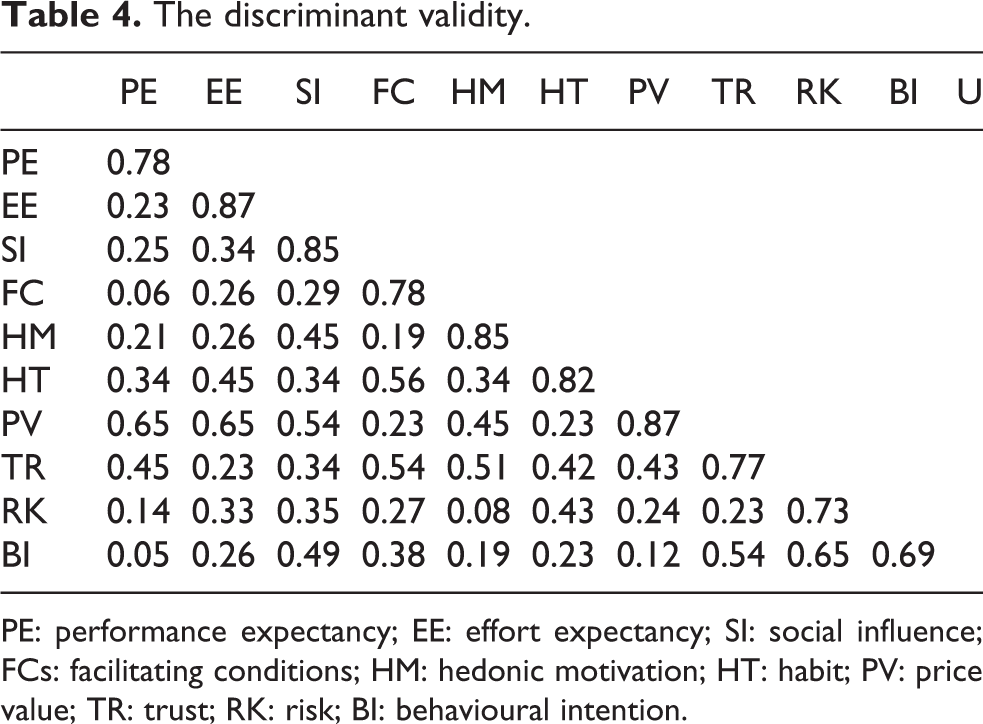
PE: performance expectancy; EE: effort expectancy; SI: social influence; FCs: facilitating conditions; HM: hedonic motivation; HT: habit; PV: price value; TR: trust; RK: risk; BI: behavioural intention.
Hypotheses testing
Table 5 demonstrates that the path coefficient R 2 for all independent variables is expressed to the measure of difference clarified by the model. The outcomes reveal that PE (β = 0.254, t > 2), EE (β = 0.3.77, t > 2), SI (β = 0.257, t > 2), FC (β = 0.634, t > 2), HM (β = 0.552, t > 2), H (β = 0.378, t > 2), PV (β = 0.258, t > 2) and RK (β = 0.791, t > 2) were accepted as significant influencers of BI. However, TR (β = 0.019, t < 2) was rejected. The R 2 of 0.352 indicates a 35% variation in the BI to adopt mobile marketing. This circumstance suggests that the implementation of mobile marketing will significantly influence Jordanian consumers’ attitude towards mobile marketing. The increasing number of smartphones, advanced operating systems and telecommunication infrastructures can be considered a contributing factor towards this situation. 54 Therefore, Jordanian companies should prioritize this dimension to realize an effective mobile marketing strategy. Analysts in this domain are in agreement that the greater the degree of social expectation, the greater the utilization of mobile marketing among Jordanian customers. At any rate, the TR factor (β = 0.019, t < 2) does not affect BI.
Summary of hypothesis.

PE: performance expectancy; EE: effort expectancy; SI: social influence; FCs: facilitating conditions; HM: hedonic motivation; HT: habit; PV: price value; TR: trust; RK: risk; BI: behavioural intention.
Discussion on the findings
The results attained through this investigation confirm that PE, EE, SI, FCs, HM, HT, PV and RK are related to the BI to use mobile marketing among Jordanian customers. The existence of this relationship is supported by the UTAUT2 model with the inclusion of two constructs (TR and RK) adopted from De Kerviler et al. and Radder et al. 23,24 TR is the only factor portraying a low relationship level with regard to the attitude towards mobile marketing. An overwhelming portion of the findings derived through this study is in agreement with those from previous studies.
Our investigation uncovered a significant relationship between PE and BI, which is supported by the studies conducted by the researchers. 21 –36 Hence, the hypothesis, which is deemed empirically supported, verifies that in the context of Jordan, PE plays an important role in the BI to use mobile marketing.
Our investigation revealed that EE also has a significant impact on BI. This is supported by the empirical studies conducted by Lai 45 on mobile app adoption. Hence, the proposed hypothesis can be confirmed, and the positive impact of EE can be documented.
Findings from the studies conducted by Venkatesh et al. 21 pointed to a significant SI impact on BI. This result is in agreement with those realized by Yang, 37 as well as Soroa-Koury and Yang. 42 Our investigation on the effect of SI on BI to use mobile marketing revealed a significant correlation. As such, the hypothesis for the impact of SI on the BI of Jordanian customers to use mobile marketing can be considered accurate.
According to Jawad and Hassan, 44 FC plays an important role in the UTAUT2 model. The FC can be directly used to develop BI, which ultimately predicts behavioural achievement. 21 Therefore, FC can be applied to predict a range of BIs. 30 Lai 45 confirmed the relationship between FCs and BI, in the context of tourist guide mobile apps. Our investigation revealed a significant effect of FCs, on BI to use mobile marketing, in the context of Jordanian customers.
HM, the new factor presented by Venkatesh et al. 21 in the UTAUT2model, was observed to have a positive effect on the BI of mobile marketing. Previous studies in this area confirmed the effect of perceived enjoyment on the intention to use the Internet and mobile banking. 58 The significant relationship between HM and BI to use, among Jordanian customers, demonstrated through our undertaking, is empirically and theoretically supported.
Our conviction of a significant relationship between HT and BI to use is in agreement with the outcomes derived through a study conducted by Venkatesh et al. 21 This relationship is further confirmed by Escobar-Rodríguez and Carvajal-Trujillo 46 in a study on low-cost carriers’ websites. Hence, there is ample evidence to support our standpoint that in terms of Jordanian customers, the HT has a significant positive impact on the intention to use mobile marketing.
Past research uncovered that the measurement of price significantly influences the thinking of buyers. In a study on UTAUT2, 46 replaced PV with a price saving to realize a positive influence of PV on BI to use. Working along the same lines, we uncovered a positive impact of PV on BI to use mobile marketing, in the context of a Jordanian setting.
It is important to minimize the effort to purchase the advertised products and services by following the notion ‘right time and right place’. According to the results from previous studies, the RK of an advertisement has a significant effect on the consumers’ behaviour. 59 With this in mind, we investigated the relationship between RK and BI. The results from this investigation revealed that in the context of Jordan, perceived RK has a significant negative impact on the BI to use mobile marketing.
Limitations of the study
This study is limited by several issues. Firstly, the information collected on customer mobile marketing experience is somewhat general in nature. The particular mobile company involved, or the particular product/service purchased, was not specified. Secondly, the sample size of 321 participants is relatively small. Thirdly, the participants, who were roped in from traditional Jordanian shopping plazas, may not reflect the attitude of people in other sectors of society. This includes government employees, the younger generation and university students. The fourth limitation has to do with the fact that we focused on the psychological reaction of customers while ignoring other important factors, such as website tendencies. The fifth limitation is related to the cultural aspect. Even though the importance of uncertainty avoidance was deliberated on during this undertaking, there were certain dimensions of cultural differences that were not taken into consideration. Figure 2 shows the effect of independent variables on dependent variable. And lastly, this study focused on a one-time-only collection of cross-sectional data. Longitudinal data collection procedures are recommended for future studies, as these procedures can keep track of changes in mobile marketing behaviour over time.
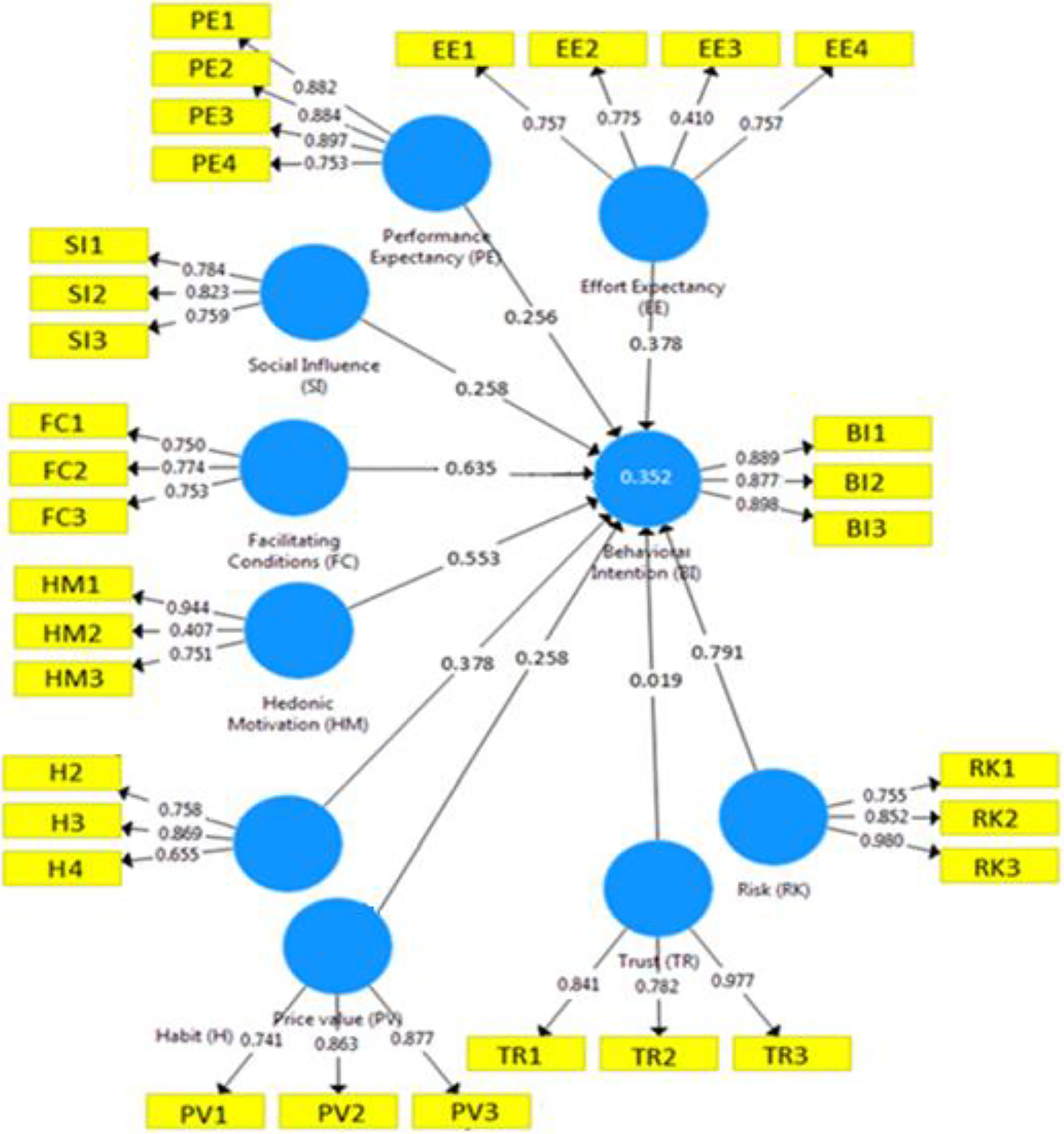
Structural model.
Future research
Based on the limitations discussed above, the following suggestions should be considered for future research. Firstly, an effective means for measuring the actual purchase behaviour, with regards to specific products/services from a particular website, needs to be conceived. To mitigate the second and third limitations, future research could consider increasing the sample size and covering other categories of society (households, offices, organizations etc.). Additionally, more effort needs to be directed at examining other factors that may affect mobile marketing behaviour, especially those pertaining to technical aspects, and mobile marketing features. With regard to culture, a comparative study involving Jordan and another developing country, such as Malaysia, could reveal the manner in which different culture predictor’s factor into customers’ mobile marketing. Future studies should also consider the addition of new predictors to the TR and RK factors, which were used to extend the UTAUT2 model.
Conclusion
This undertaking involved an empirical examination of the UTAUT2 model in the context of Jordanian mobile marketing. The model was extended with two additional constructs: ‘trust’ and ‘risk’. The results realized through this model verified that PE, EE, SI, FCs, HM, PV, HT and RK have a significant impact on the Jordanian customers’ intention to use mobile marketing. These results reflect the effectiveness and applicability of this model in the mobile marketing field. As the data analysis results for this study did not reveal any notable relationship between RK and BI, TR was left as the sole significant additional construct.
Footnotes
Declaration of conflicting interests
The author(s) declared no potential conflicts of interest with respect to the research, authorship, and/or publication of this article.
Funding
The author(s) received no financial support for the research, authorship, and/or publication of this article.
