




Abstract
This study examines the utility of project risk management maturity (PRMM) for project-based organizations across different domains. The relationship between organization-level PRMM and firm’s performance is studied. Two alternatives of theoretical model are developed on the basis of an extensive literature review. The first model (i.e. traditional model) posits a direct positive relationship between PRMM and organizational performance. The second model suggests that the relation between the two key variables is positively moderated by the average level of “complexity” of projects which are typically performed by respective organizations. A cross-sectional, self-administrated survey is carried out with targeted respondents of senior members representing their respective organizations in construction, ICT, and telco industries in Indonesia (distributed = 651, response rate = 21.5%, final sample size = 100). The result suggests that, in general, the utility of PRMM is observable across organizations—but its efficacy diminishes for organizations with lower level of “project complexity.” This study provides an empirical support to the moderation model. The finding contributes to theoretical refinement on studies pertinent to project risk maturity. From a practical perspective, the result highlights the importance of contextual variables (in this case, project complexity) when designing organizational maturity.
Introduction
Project-based organizations (PBOs), which include engineering and construction companies, IT firms, and consultants, 1,2 are experiencing greater complexity. 3 On a daily basis, such firms, which depend on delivering projects for generating revenues, encounter highly demanding customers, increasing competitions, and more complex projects. 4 To stay competitive, PBO needs to plan and to carry out strategic initiatives. One of the widely known approaches to conduct the strategic initiative is carrying out continuous improvement by utilizing an organizational maturity framework. 5
Maturity reflects the extent to which a particular organization is capable in fully utilizing consistent process in one or more business areas. 6 In a project context, project risk management maturity (PRMM) reflects the competence or proficiency level of a PBO as a unified whole to internalize the risk-focused perspectives and to reliably utilize project risk management (PRM) process. Along with the assertion by Ibbs and Kwak, 7 PRMM can be related to the degree of advancement of the organization in PRM practices, processes, and performance.
It is often argued that an organizational maturity framework could assist a more systematic and objective approach of organizational improvement 8 to address the previously mentioned challenges in PBO. A PRMM model usually comprises of multidimensional measures reflecting the broad concept of the maturity. Each dimension is then itemized representing specific aspects of maturity. The hierarchical, multi-perspective approach potentially provides a more objective measure of maturity. The improvement initiative can be carried out by using a standard, systematic cycle of measurement, benchmarking, and improvement. 9
Studies pertinent to project maturity have been progressing from emphasizing on the development of project maturity models to maturity benchmarking within and across industries to the analysis of maturity benefits. 10 As indicated in the “Literature review” section, studies which focus on the development of PRMM models and on conducting benchmarking process are observable. However, subsequent studies which specifically examine the benefits of PRMM are limited. Due to the limitations, researchers and practitioners alike would depend on the common wisdom and anecdotal evidence to infer the utility of PRMM. The traditional view of the organizational maturity implicitly assumes a simple positive association between maturity and organizational performance 11 —PRMM is not an exception. Accordingly, from this standpoint, PBOs are encouraged to strive for the highest level of PRMM to achieve project excellence. Within the perspective of evidence-based management, the anecdotal evidence as well as the common sense does not provide rigor indication and justification for pursuing the highest level of PRMM. The question remains unanswered whether there is empirical evidence to support the assertion that a higher maturity of PRM could be directly translated into better PBO’s performance.
In addition to the previously mentioned research opportunity, a more contemporary view on organizational theory suggests that the relationships between organizational structure (in this case, PRMM) and performance may be contingent upon other variable(s). 11 –13 Recent qualitative studies 10,14 identify “project complexity” as a possible attribute to explain the relationship between maturity and performance. A PRMM-performance model which introduces other contextual variable(s) is useful to extend the current knowledge in the area. Moreover, contextual analysis could provide practitioners with more refined insight into the intricate nature of the relationship. Nevertheless, as elaborated in “The utility of maturity models” section, a study which specifically develops theoretical propositions and empirically evaluates such models virtually does not exist.
The objectives of this reported study are twofold. Firstly, it develops a theoretical proposition on the utility of PRMM in a traditional perspective of “the more mature the better.” The supposition is then empirically tested. Secondly, an alternative, a moderation-based theoretical model is developed and empirically tested. This study promises two significant contributions, as follows: Firstly, from a scientific perspective the study could contribute to the advancement of the current understanding on the utility of PRMM for PBOs. Specifically, the empirically verified, moderation-based maturity model could provide an alternative and more refined perspective when compared to the traditional view of “the more the better.” Secondly, from a practical perspective, the study contests the traditional, perhaps more widely held view of the direct utility of PRMM. The study offers an alternative perspective of the maturity concept and its value toward organizations. This study provides compelling evidence for top decision makers to continuously adapt their respective organizational competence in PRM against the evolving environmental attributes. This is done by finding the right fit between “PRMM” and “complexity” for achieving organizational excellence.
Literature review
Maturity models in project management
The definition of organizational maturity varies and there is no single, universal definition for the concept. The maturity concept within an organizational setting is closely associated to the capability/maturity model. 15 Within this perspective, an organization is considered mature on a specific level of capability if it could demonstrate consistency of process. For different levels of maturity, a different set of areas of capability apply. An organization is considered mature in a particular level if all the pertaining capability items are fulfilled. 16 Many subsequent maturity models, however, extend the concept by suggesting that maturity could be measured uniformly in terms of capability areas. 15 In such models, the maturity level is computed from the aggregate of a fixed set of capability items. Maturity is then indicated by the overall score.
Organizational maturity is an overarching concept of measurement which reflects the capability of an organization in various areas of managerial proficiency. Apart from providing a factual “snapshot” of the organization’s proficiency, a maturity model provides a systematic and disciplined means of benchmarking and improvement. 17 The “snapshot” which reflects the current condition of a particular organization could be compared to the “best-in-class” to identify significant gaps (i.e. gaps analysis). 8,18 Results of the analysis provide methodical guidance for organizational improvement. As in its generic concept, project management maturity (PMM) indicates the proficiency of managing project within an organization. Albrecht and Spang 14 suggest that PMM model “provides a framework to gauge an organization’s project management competence.” In a similar fashion, project risk maturity model is specifically targeting organizational competence pertinent to PRM. 19 Along with the concept of PMM, PRMM indicates the level of proficiency of a PBO for carrying out the management of project risks. A more mature PRM indicates more conducive culture, people, process, and technology which support risk thinking.
Several PMM and PRMM models had been developed. For the PMM models, a five-level tool for a structured evaluation is developed by Crawford, 20 the KPM3 with five steps of maturity is constructed by Kerzner, 21 the Project Management Process Maturity or (PM)2 is built by Kwak and Ibbs 17 while the Organizational Project Management Maturity Model (OPM3) is developed by PMI. 8 More specific PRMM models are also available. The PRMM models include the Risk Maturity Model (RMM) by Hillson, 19 Business Risk Management Maturity Model (BRM3) by IACCM, 22 Risk Management Capability Maturity Model for Complex Product Systems Projects (CoPS) by Yeo and Ren, 23 Risk Management Maturity Model for the Construction Industry by Öngel, 4 Risk Management Capability Maturity (RMCM) Model by Pangeran et al. 24 ; while a psychometric-based maturity model is constructed by Hartono et al. 25 The implementation of those models for maturity measuring and benchmarking within and across industries have also been well-documented. 1,5
The utility of maturity models
The traditional view of maturity models suggests a straightforward, positive relationship between “maturity” and “performance”—a presumption of better.
11
As indicated by Albrecht and Spang,
14
in the project level: the basic premise in connection with the [Project Management Maturity]…is that with a higher maturity model, the chance…[to] successfully complete its projects increase. (p. 162)
The premise of the direct maturity utility seems to have considerable advocates from scholars and practitioners due to its conceptual simplicity which leads to a more intuitive understanding. Most of the developed maturity frameworks seem to be built upon an underlying assumption that there is an ideal state of maturity 15 which is positioned at the top maturity level. In addition, the terminologies to designate the maturity levels seem to reflect the advancement or progression toward more favorable states, and hence better performance. For instance, an early PRMM model by Hillson 19 provides four progression levels of maturity, with the following designations: naive (not aware), novice (no standard), normalized (comprehensive application), and natural (internalized, norm). The labels implicitly suggest that the subsequent, higher stage is considered more favorable.
Few past studies examine possible empirical evidence to support the traditional view with less than conclusive results. A quantitative study by Ibbs and Kwak 7 could not find significant statistical relationship between maturity and performance in terms of cost or schedule. This, in part, may be attributed to the small sample size (n = 15). Dooley et al. 26 conducted a survey of 39 new software development projects and found a positive relationship between project maturity and performance in terms of cost and time at the project (not organizational) level. A further analysis found no evidence of the possible moderating effects of “company size,” “market volatility,” or “industry type,” respectively. Jiang et al. 27 carried out a similar study in the software development domain with a larger sample size (n = 154). The result also confirmed the positive linkage between software development maturity and project performance. A further analysis found that only one of the three dimensions of the maturity construct was statistically significant. Yazici 28 performed an empirical study to investigate the possible link between PMM and perceived performance. The study was conducted in the United States with respondents from both service and manufacturing domains (n = 86). It is reported that PMM is not related to project performance, but it is related to business performance. A study by Jugdev and Thomas 9 found that maturity could lead to temporary competitive advantage but failed to find evidence for sustainable advantage. A recent global annual survey by PMI 29 targeting project managers provides an interesting report that process maturity pertaining to project management benefits the organizations. It is reported in the study that 32% of high performing organizations have a mature project management process in place while only 8% of the low performing counterparts have a mature process. In other words, maturity is more prevalent within the high performing organizations. While the study provides some indication to the merit of a higher maturity level, it does not explicitly examine a direct link between maturity and performance by means of statistical inference tools. Another more recent survey by Motaleb and Kishk 30 in the UAE construction industry indicates that maturity positively influences risk response for project success. However, the use of the multiple-case approach may result in the lack of quantitative rigor and the limited generality of results.
From the above elaboration, project-related maturity studies had been conducted in various settings within a traditional perspective. However, the empirical studies seem to lack statistical rigors. Those include the absence of validity and reliability tests for the instruments, the limited utilization of statistical inferential tools, and the limited sample size. The research outputs also suggest less than conclusive findings.
Studies within a more specific perspective of PRMM are found to be even more limited. Chapman 31 develops a PRMM model and finds a positive correlation between the introduction of the model and effectiveness of risk management. A cross-sectional survey of Indonesian construction industry by Hartono et al. 25 provides empirical evidence to the positive, statistically significant relationship between “project risk maturity” and organizations performance. The result, however, needs to be a preliminary due to the limited sample size (n = 30). Accordingly, it is imperative to examine the traditional perspective with a more rigorous statistical protocol, and larger number of sample size.
Project complexity and the moderation model
The traditional view of “the more the better” for project maturity is questioned 11 due to the mixed results. Hence from a scientific standpoint, given the observable contradictory results of past studies, a new perspective and theoretical model is required to better explain and predict the relationship between maturity and performance.
An extensive study by Besner and Hobbs 13 (n = 750) found a significant variation on the utilization of project management methodology and tools in different project types and contexts. The result provides compelling evidence against the uniformity principle for different project contexts and types. As such, project types and contexts are important factors for a more refined analysis. Furthermore, a recent qualitative study had provided strong indication that the “ideal” level of project maturity is dependent upon certain characteristics pertinent to the organization, especially complexity. 10,14 Organizations need to understand the contingent nature of the relationship and to find the right match between “risk management maturity” level and certain organizational “characteristics.” Another case study by Mullaly 11 suggests a “contingent and contextual approach to assessment is required” in studying project maturity.
A moderation model could provide a theoretical foundation underpinning the new model development. Hanisch and Wald 32 provide a bibliographic review on the utilization of contingency theory (on which moderation models are included 33 ) within project management studies. It is found that the number of studies related to contingency theory in project management had been increasing. The theory provides an alternative view on organization and performance relationship; it challenges the traditional concept of universality in management. Within a contingency perspective, 34,35 environmental contexts might need to be considered when designing organizational characteristics (e.g. “project management maturity”) to achieve high performance. The contingency approach suggests that performance of organizations is attributable to the fit between a set of contingencies. 12,36
In a similar vein, the introduction of new, contextual variable(s) is required in PRM research. Many studies had identified various “project characteristics” as a possible contextual factor. For instance, Crawford and Pollack 37 developed an analytical framework comprising seven dimensions to differentiate between “hard” and “soft” projects to reflect project attributes. Shenhar 38 proposes a 4 × 3 matrix combining “system scope” and “technological uncertainty” for project classifications. Müller and Turner 39 utilizes six categories to define project types. Scholars within a systems perspective argue that project characteristics are properly described by “complexity” of the projects. 10,14,40
Complexity, according to system scholars, is associated to multifaceted project attributes which reflect challenges to be encountered by project teams. 41 –46 The challenges include understanding, designing, analyzing, foreseeing, keeping under control, or managing systems or organizations. 47,48
Recent qualitative studies in project maturity and performance have provided early evidence to support the moderation assertion on PMM models. A multiple qualitative case study by Albrecht and Spang 14 suggested a possible linkage between PMM and project complexity for explaining organizational performance. Within a contingency perspective, the study further posited a possible moderation effect. A similar finding was reported in another multiple-case study by Albrecht and Spang 10 which suggested “complexity” as a moderation variable. A quantitative study was carried out by Ren et al. 49 for complex product and system projects within Singapore and Chinese settings and found a positive, moderated relationship between PRMM and project performance. The moderation variable was “complexity and uncertainty” at the project level. A worldwide survey by Crispim et al. 50 suggests that the firm-level PRMM positively influences PRM practices which in turn affects project performance. Moreover, it is found that project complexity moderates the relationship.
The above analysis demonstrates (i) the importance of project contexts or attributes to examine maturity–performance linkage, and (ii) the lack of follow-up quantitative studies to empirically verify the propositions. The literatures indicate that a theoretical/empirical study which emphasizes on the linkage between “PRMM,” “project complexity,” and “performance” at the organizational level is virtually not available. Accordingly, such a study for PBOs is highly required.
Theoretical work
The traditional model: The more the better
In this section, the direct association between PRMM and firm’s performance is conjectured. It is argued that many of project challenges are attributed to risks and uncertainty. We further argue that PRM would enable the effective management of the challenges. In effect, the improvement of PRMM may result in higher performance of the organization. Elaboration follows.
Projects are challenging endeavors for project stakeholders. One of key sources of the challenges is related to risks. Risks, by definition, are created by uncertainty which potentially affect courses and results of the projects. 51 –53 Risk may drive the preplanned project off courses and milestones; the situation may eventually end up with major deviations of the predetermined project objectives. Risks are also difficult to address due to cognitive limitations of project planners 54 –56 to identify the risk sources (the unknown unknowns). Comprehending the possible causes (risks) and effects (performance) is also difficult because the factors are often separated by space and time. 57,58 In addition, the number and the variety of and the interdependence among projects risks offer additional difficulties. 59 In sum, risks in project drive substantial challenges for project stakeholders to comprehend, to identify, to address, and to effectively manage.
It is asserted that PRM would greatly assist project stakeholders to deal with risks and related challenges. The existing methodologies of PRM provide a systematic, plan-and-control approach for handling risks. 60 Most PRM methods are developed for preparation and anticipation of upcoming, identifiable project risks. With PRM, planners need to foresee the possible risks and to assess the risk levels. Subsequently, project stakeholders need to proactively develop a risk response plan. The plan is eventually executed and monitored for reducing or eliminating deviations and changes. Willumsen et al. 61 highlight the benefit of PRM by creating specific values which may include project outcome, strategic benefit, and personal outcome.
A highly mature PRM would create supportive culture for raising awareness on the risk-inspired project mind-sets and good practices of PRM. As such, every major decision in a project should be weighed against their inherent risks (either positive or negative). Risk thinking should become the daily practice within the project and organization. Moreover, the process of risk management could encourage members to reveal plausible problems and opportunities and to learn on how to effectively anticipate them. As suggested by De Geus, 62 a “planning as learning” process goes beyond the direct result of the documented planning. It also mentally prepares the project stakeholders for many eventualities.
A highly mature PRM also reflects a standardized PRM process which is fully embedded within the core business of performing projects. Risk perspectives embody typical project flows. Furthermore, a proficient organization is highly capable of utilizing technology and other pertaining infrastructures to support PRM in planning, executing, and controlling (plan-and-control). The technology would assist the organization, project, and people for more systematic, comprehensive, and objective risk analysis and assessment. For instance, risk databases may help project planners in developing the risk register. Advanced risk analysis such as Monte Carlo Simulation, 63,64 Bayesian Models, 65 –68 and Systems Dynamics 69 –71 would support risk assessment with unbiased estimates and insights.
The maturity of PRM indicates the extent of sustained capability, competency, or proficiency of a PBO in the management of project risks. A highly mature PRM indicates more institutionalized initiatives in implementing PRM across different functions. Such organized efforts revolve around the underlying objective to eliminate or reduce negative risks (threats) and to exploit positive risks (opportunities). Changes, whenever occur, are closely monitored as necessary. By so doing, project planners would expect minimum deviations of project realization against the predetermined project plan and objectives. In highly mature PRMM, projects would then more closely follow the plan and objectives. The more mature the PRM, the less the deviations of the objectives—that is, the higher the performance of the projects. An empirical study by Hartono et al. 25 provides initial evidence for the assertion.
Hence, it is conjectured:
Project complexity as a moderating variable
Why “complexity”
Project complexity is chosen as a possible moderating variable because it offers a strong analytical perspective 59 for examining relevant challenges in projects which may eventually affect performance. Recent studies indicate that project management should not be analyzed uniformly, and “complexity” may become an important moderating variable for analysis. 10,14,72 Pich et al. 73 assert that effective management style should be chosen by considering job complexity.
From a theoretical perspective, many scholars argue that project risk has a close linkage with complexity. Project risk is considered as a key aspect of complexity. 74 –76 Accordingly, the management of project risk is an integral part of the management of challenges/complexity by means of a “plan-and-control” approach. In this sense, an evaluation of the efficacy of PRMM for different levels of project complexity may reveal interesting insights. Baccarini 77 argues that the idea of “project complexity” is crucial due to its specific role of strategic management of projects. Furthermore, by studying complex projects, Morris and Hough 78 found that complex projects require superior management approach if compared to the regular, less complex projects.
The moderation effect
It is conjectured that the degree of association between PRMM and performance varies across organizations which typically carry out projects with different levels of complexity. Organizations with project portfolios of high complexity may find strong benefits for an improvement of PRMM. Such organizations would typically encounter highly challenging project situations. When performing projects, the firms would find many risks and risk sources, a wide variety of risk types, and closely interrelated risks. As a result, project problems become very difficult to comprehend naturally (i.e. unaided), which leads to a problematic decision-making process.
In a high project complexity context, it is argued, the risk-related challenges can only be effectively addressed by organizations with highly competent PRM. Special efforts are required to tackle risk problems, which include to comprehend, analyze, find possible responses, monitor the realization of risks, and make effective decisions. For sustaining the extra efforts, a formalized management of project risk is highly required. An institutionalization of PRM would result in high awareness and supportive culture of risks, standardized risk management process, and more sophisticated methods and tools to analyze risks.
The improved maturity of PRM would eventually maintain the realized risks at acceptable levels. In effect, the project would be capable to sustain the progress with minimum deviations against the plan. Eventually, the project could deliver the predetermined objectives which lead to higher project performance. In short, for organizations with project portfolios of high complexity, improved PRMM would increase performance.
On the contrary, in a low complexity setting, the effect of PRMM improvement toward performance may not be significant. Projects with low complexity are reflected by fewer number of risks and their sources, and limited variety of project risks. In such a setting, it is asserted, risks and its pertaining challenges could be addressed with less effort. Simple risks could be handled more naturally or spontaneously by project stakeholders. Neither formal risk-informed project process nor advanced risk culture is necessary for effective PRM in a low-complexity context. Furthermore, challenges pertaining to simple risks may be solved by means of intuition or simple manual computation, 56 and hence sophisticated PRM infrastructure and methods/tools are considered overkill. In this context, a higher level of PRM maturity may not be translated into extra benefits for the projects. For organizations with project portfolios of low complexity, improved PRMM would not increase performance.
Hence, it is conjectured:
Operational definitions, dimensions, and items
Organizational performance
The dependent variable of this research is the company-level performance. Studies by Chan and Chan 79 and Ling and Peh 80 suggest various possible organizational performance indicators of PBOs (in this case, contractor), including rate of returns, revenues, and project backlogs. Ideally the pertinent performance indicators are gathered from hard, objective organizational data to ensure validity.
In many studies, including this study however, soliciting objective, hard data is not viable. This is especially true when data to be assembled are sensitive from the respondents’ perspective. This situation potentially leads to lower participation. To overcome the data sensitivity problem, many past studies had instead utilized subjective measures. Dedicated studies had been carried out to evaluate accuracy of subjective measures. Results provide compelling evidence to the validity of subjective measures for evaluating organizational performance. 81 –83
This study utilizes self-evaluated, subjective judgment to solicit organizational performance similar to that of Dawes. 82 Respondents are required to provide their subjective, self-evaluation of their respective organizations in terms of performance. In the PBO domain, two distinct types of project-related performance indicators are identified and measured. The first indicator reflects “performance of managing projects.” It is usually related to the realization of project triple constraints as compared to the baseline. Specifically, respondents were required to provide their estimate on the percentage of successful projects (on time, on schedule, within scope) which were carried out by their respective organizations. The second indicator is related to the ability of the projects to deliver ultimate “business performance” on PBOs. 84,85 It is associated to the extent to which the organizational strategic intent is realized by the projects. The second indicator is measured by self-assessment of company performance relative to the average performance of similar firms within the same industry (in percentile). Since the unit of analysis is the organizational level, both performance measures are elicited by asking respondents to report the average performance of their own organizations for the last 3 years.
Project risk management maturity
For the PRMM variable, this reported study adopts the concept, construct, dimensions, and items of PRMM which was developed by Hartono et al. 25 In the prior study, the construct had been empirically evaluated for validity and reliability within an Indonesian construction context with a limited sample size. In this reported study, the construct is reevaluated with much larger sample size as described in the “Method of inquiry” section.
Due to the broad, overarching concept, as seen in Table 1, the PRMM construct is classified into four distinct dimensions, namely (a) “culture and leadership,” (b) “process,” (c) “organizational experience,” and (d) “tools, methods, and applications.” “Culture and leadership” reflects the deeply rooted belief and awareness of the organization toward utility of PRM. It also reflects PRM strategy and role dictated by senior management. “Process” indicates the extent to which an organization has implemented and integrated various process of PRM within the organization. “Experience” suggests the past and current competence of the human resources pertinent to PRM as well as continuous effort for capability improvement. “Tools, methods, and applications” is related to PRM hard artifacts of the organization. Since the unit of analysis of the study is the organizational level, items of PRMM are elicited by inquiring respondents to provide self-evaluation for the average condition of the organization for the last 3 years.
Dimensions and subdimensions of PRMM.

PRMM: project risk management maturity.
Project complexity
Previous works by scholars 44 –46,86 identified various perspectives pertinent to complexity concepts. Despite variations, many of the reviewed concepts share similar notions that complexity is not only linked to the number of the system’s subsystems and components (i.e. structural or detail complexity) but also the interrelationship among them (i.e. dynamic complexity). 57,77,87 Two types of uncertainty, namely goal and method, also dictate complexity. 3,88,89 The mentioned four attributes also share similarities with the contemporary definition of project complexity. 47,90 The four attributes are confounded in complex systems and thus provide extra challenges and require greater competence to manage successfully.
This reported study adopts a measure of project complexity which was developed by Saputro and Hartono. 91 The instrument includes four dimensions of complexity as described earlier—namely, “uncertainty in goals,” “uncertainty in methods,” “detail complexity,” and “dynamic complexity” (see Table 2). “Uncertainty in goals” is the extent to which project’s objectives could not be defined in advance due to vagueness and tangibility. “Uncertainty in methods” is related to the ambiguity of determining approaches or methods to achieve the project goals. “Detail complexity” is pertinent to the challenges faced by project team due to the anomalous project size (very large or very small). “Dynamic complexity” is the difficulty of dealing with project due to the elemental interdependences leading to nonlinear and mostly counterintuitive behavior of the system. Since the unit of analysis of the study is at the organizational level, project complexity refers to the average complexity level of projects which are typically carried out by an organization for the last 3 years.
Dimensions and items for project complexity. 91

Method of inquiry
Prior to the main empirical survey, an instrument to measure PRMM level, project complexity, and organizational performance levels was developed. A literature review was performed to identify possible dimensions, subdimensions, and items pertaining to PRMM, complexity, and performance, respectively. The result of the literature review afterward was independently verified by two project experts from Indonesia to better reflect the actual practices in an Indonesian context. Subsequently, the instrument is developed with regard to the selected dimensions and subdimensions based on literature review process and experts’ feedback.
To obtain a credible instrument, a pilot study was also performed qualitatively to evaluate face and content validities. Six respondents were involved in the qualitative study focusing on assessment of form, logical flow, clarity of instructions, terminologies, sensitivity of inquired data, and the estimated time to complete the instrument. The instrument then underwent a series of statistical evaluations for a quantitative pilot study (n = 30). The evaluation includes exploratory factor analysis, and validity and reliability tests. Details of instrument development and assessment are reported in Hartono et al. 25
A post hoc validity analysis (confirmatory factor analysis, CFA) and reliability analysis of the instrument which utilized a much larger sample size (n = 100) provide further evidence for the validity and reliability of the instrument. Prior to the validity analysis (CFA), a series of assumption tests is carried out. The tests include Kaiser’s measure of sampling adequacy, Bartlett test, outlier tests (univariate and multivariate), and multicollinearity diagnostic test. It is found that data pass all the tests. The CFA is carried out for respective PRMM dimensions. Items with low factor loading (p < 0.5) or high p value (>0.1) are excluded for the subsequent analysis. An analysis for model fit is also carried out for respective dimensions, namely χ 2 and the goodness of fit index (GFI). Results suggest the scores for respective dimensions are better than the cutoff values. Furthermore, an inter-item reliability analysis is carried out independently at subdimension levels, whenever applicable. It is found that the values of Cronbach’s α for respective dimensions are greater than 0.6, indicating relatively acceptable reliability. 92 A similar procedure is also carried out for “complexity” variable which yields satisfactory results.
The main empirical study employs a cross-sectional, self-administrated survey which was distributed to senior members representing their respective organizations in the construction, IT, or oil and gas industries in Indonesia by utilizing a convenience sampling method. A more rigorous sampling method such as (stratified) random sampling could not be utilized due to difficulty in determining the sample frame. The empirical data were originated from multiple sources. Some participants were invited from a list which was developed from databases of project-based firms in Indonesia. In this case, the cover letters accompanying questionnaire kits specifically invited top management to participate in this study. However, in some occasions, it seems that invitations were redirected by the organizations to personnel of the lower managerial level who were perceived of having direct engagement with project management activities. In other occasions, the researchers attended professional conferences or symposiums pertaining to project management and distributed the questionnaires to all attendees. A portion of the attendees eventually participated in this study while the remaining targeted respondents declined to participate.
Some representative biases, therefore, are expected from the result. The main survey was distributed by both surface mail (offline) and electronic mail (online). Out of 651 invitations, 140 respondents responded to this study accounting for 21.5% of response rate. This response rate is considered typical in the project context. 93 After conducting data coding, data cleansing, and preparation procedures, only 100 data sets were considered usable for the subsequent analysis. Ten data sets were removed because the respondents were not qualified (experience <3 years) and further 30 data sets were excluded due to the missing of many key data.
Results and discussions
Profile of companies and respondents
It is reported that the respondents came from construction (n = 35), ICT (23), telco (22), and other industries (20). The company size of the respondents varies and based on a classification by Indonesia National Bureau of Statistics, 68 participating companies are considered large, 31 are of medium size, and 1 of small size.
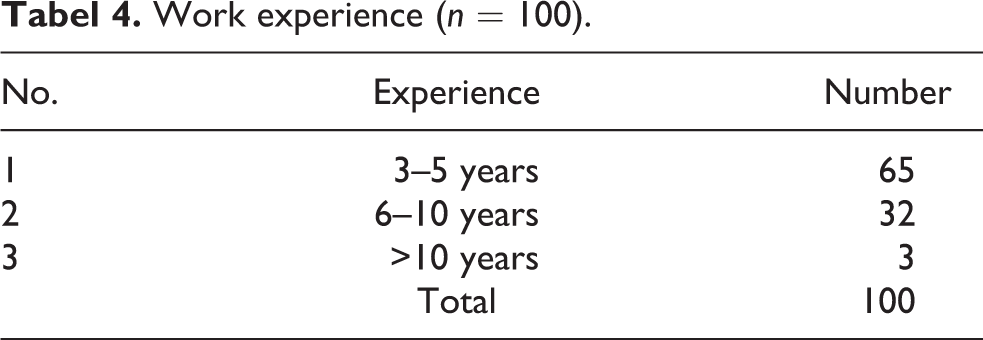
Table 3 indicates that a large portion of the respondents holds project manager (39%) and manager (13%) positions, respectively. Majority of the respondents (65%) possess 3–5 years of experience in projects as seen in Table 4. Summing up, the companies’ and respondents’ profiles suggest that the data represent relatively wide array of industry types and company sizes. The respondents’ experience and job designation, to an extent, also lend credibility for representing their respective organizations for this study.
Designation of respondents (n = 100).

BOD: board of directors.
Work experience (n = 100).
Organizational profile on PRMM
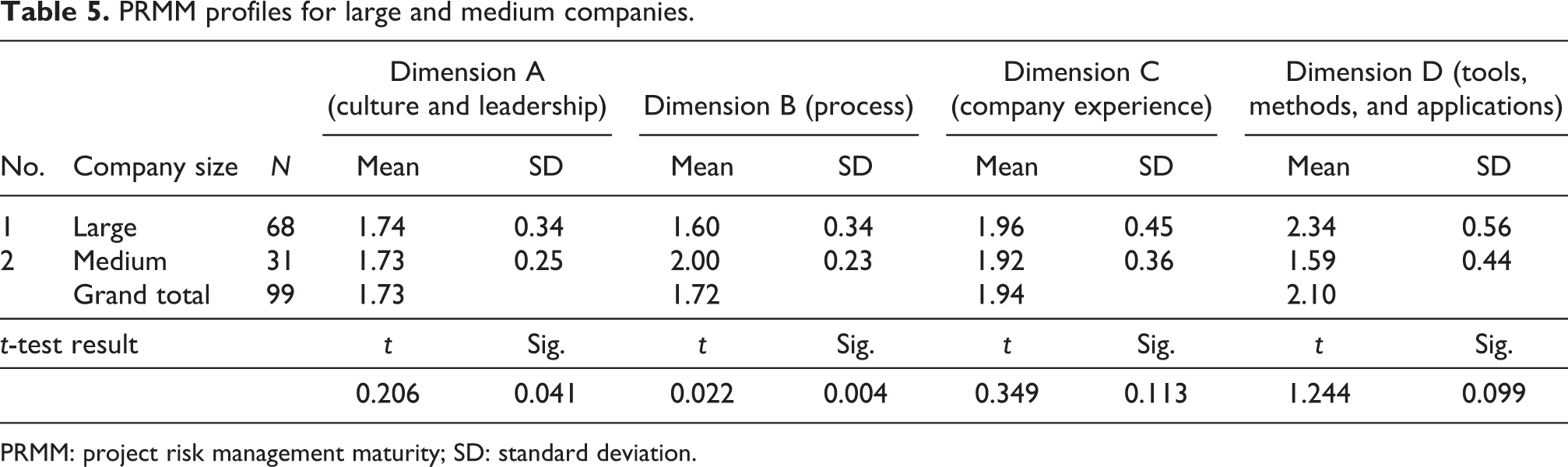
To provide a general overview on the organizational project risk maturity level, a subgroup descriptive analysis is carried out. Participating companies which are classified on the basis of their respective sizes and maturity profiles are examined for different groups. Small firms are excluded from the analysis due to the small sample size to prevent bias. The result is shown in Table 5.
PRMM profiles for large and medium companies.
PRMM: project risk management maturity; SD: standard deviation.
As can be seen in Table 5, the mean scores of dimension A (culture and leadership) are statistically different for the large and medium companies. The large corporations are generally more mature in terms of culture and leadership pertinent to PRM. A significant difference is also observable for the “process” dimension between large and medium companies. On the contrary to the first dimension, empirical data report that medium organizations are more mature. A further study is required to explain the finding. For dimensions C and D respectively, the means of maturity score for large companies are higher than those of medium companies. However, statistical analysis indicates that the differences are not significant at α = 0.05.
Organizational performance
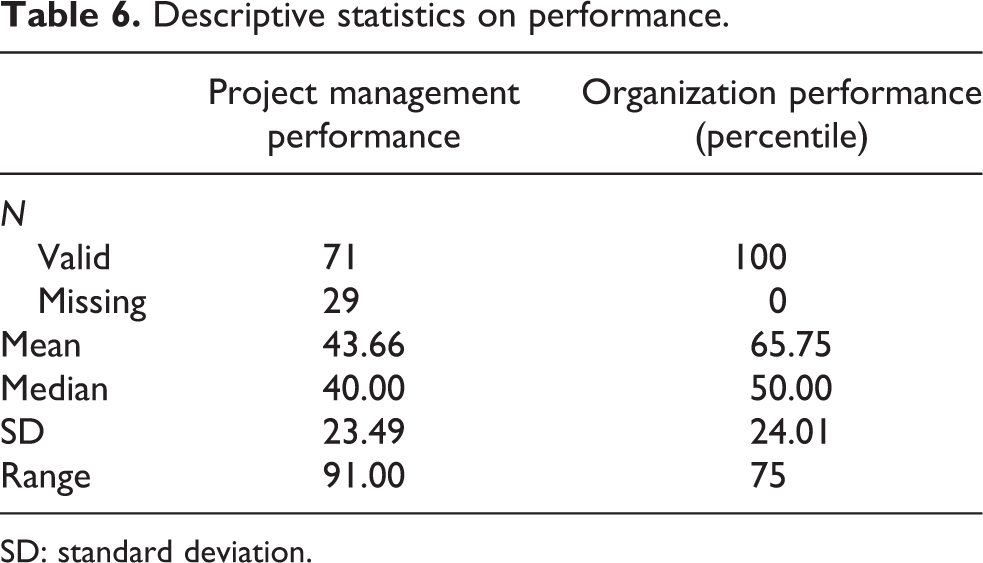
As stated earlier, two distinct measures of performance are elicited from the respondents. The first measure is related to performance of managing the project. The second indicator is related to the projects’ efficacy in delivering the ultimate business goals for the parent organizations. Seventy-one respondents provide their assessment for the first measure, while all 100 respondents respond to the second measure. Table 6 shows descriptive statistics of the performance.
Descriptive statistics on performance.
SD: standard deviation.
A Spearman correlation analysis reveals a highly significant, positive correlation between the two measures with a correlation coefficient of 0.478 (p = 0.001, n = 71). The result provides important insight that the two project measures of different level are consistent—that is, performance in managing projects is translated into relative business performance.
For subsequent analyses, the second performance indicator (i.e. self-evaluation on business performance) is utilized for three reasons. Firstly, as indicated earlier, the high correlation of the two indicators have provided some degree of confidence to the consistency of the analysis. In other words, model analysis by using either of the two indicators, to an extent, would provide consistent results. Secondly, the organizational performance provides more available data for analysis (n = 100). Thirdly, and most importantly, from a practical perspective, managers would be more interested to observe the ultimate benefits of having organizational maturity toward organizational business performance.
Model testing
A test of the traditional model
Table 7 shows a positive, significant relationship between PRMM and organizational performance (p = 0.002). As a side note, residual tests indicate that error terms of the analysis do not significantly violate assumptions of linear regression (errors are normally independently distributed with mean of around zero and constant standard deviation). It is also shown by the model that 1-unit increase of the maturity level would be translated to about 25-unit increase of organizational performance. The R 2 of the model is reported to be 9.1%, indicating that less than 10% of variation on organizational performance can be explained by variability of project risk maturity level. From the hypothesis testing perspective, hence, it is concluded to reject the null hypothesis in supporting the conjecture that, in general, the higher the PRMM level, the higher the organizational performance.
PRMM against organizational performance (n = 100).a

PRMM: project risk management maturity.
a R 2 = 9.1%.
Tests of the moderation model
The moderation analysis
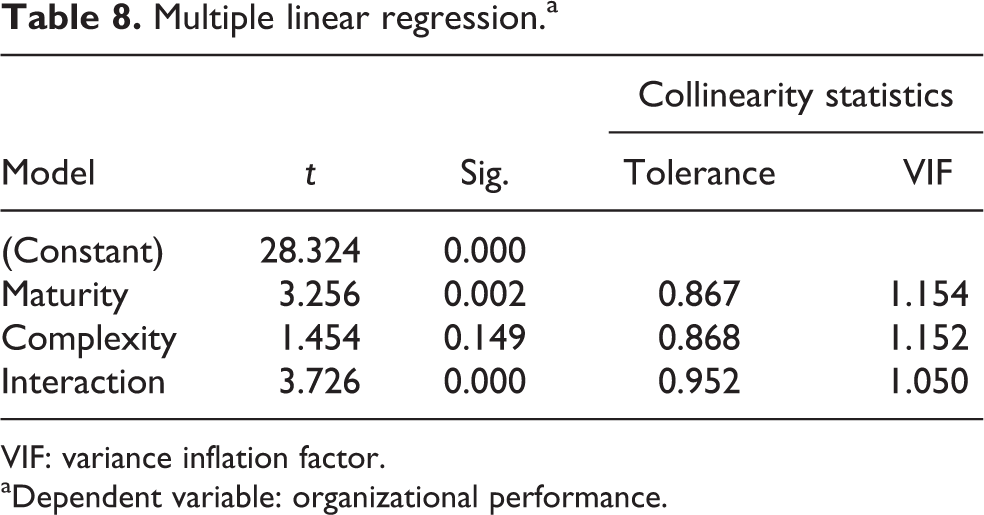
To evaluate the possible moderation effect, a protocol which is developed by Sharma et al. 94 is applied. A multiple linear regression (MLR) analysis is carried out involving PRMM, complexity, and its interaction against organizational performance (Table 8). A two-step analysis is then utilized as follows:
Multiple linear regression.a
VIF: variance inflation factor.
aDependent variable: organizational performance.
Step 1: Does “complexity” interact significantly with “maturity”?—Result: Yes.
As can be seen in Table 10, the MLR with interaction model suggests p = 0.000 (t = 3.726) for the interaction term indicating a statistically significant interaction. Hence the answer for step 1 analysis is “yes.”
Step 2: Is “complexity” related to “performance”?—Result: No.
Table 10 also indicates that the p value for “complexity” is 0.149 which suggests that the variable is not significantly related to the “organizational performance” at α = 0.05. Accordingly, the answer for step 2 analysis is “no.” From the result of the two-step analysis it could be concluded that according to Sharma et al., 94 complexity is considered as a “pure moderator variable.” As a note, multicollinearity is not evident in the model as shown by variance inflation factor and tolerance measures. 95
To provide further evidence, a follow-up analysis is carried out. Three regression models are developed in succession with the organizational performance as a criterion. Model 1 is the simplest model with one predictor of “PRMM.” Model 2 utilizes two predictors, namely “PRMM” and “complexity.” Model 3 involves three predictors which include the two previous predictors and the interaction term. Table 9 shows the changes of both R 2 and F values. As can be seen, model 2 does not provide significant changes on either R 2 values or F values at α = 0.05. In contrast, model 3 provides significant changes on both values with the inclusion of “interaction term.” In other words, for model 3, the added interaction term provides significant additional explanatory power on the model (as seen by R 2) as well as improving the overall model fit (as indicated by the F value).
Changes when different variables are included into the model.

SSE: sum of square error.
aDependent variable: organizational performance. Data are centered.
Visual analysis for the moderation model
To provide further insights, a graphical analysis is performed by using a software which was developed by Dr Daniel S Soper. Figure 1 shows regression estimates between PRMM level and business performance for three different groups of firms by considering levels of complexity—that is, higher = mean + SD, average = mean, and lower = mean − SD. The graph suggests different slopes of relationship—that is, the higher the complexity level, the larger the slope.
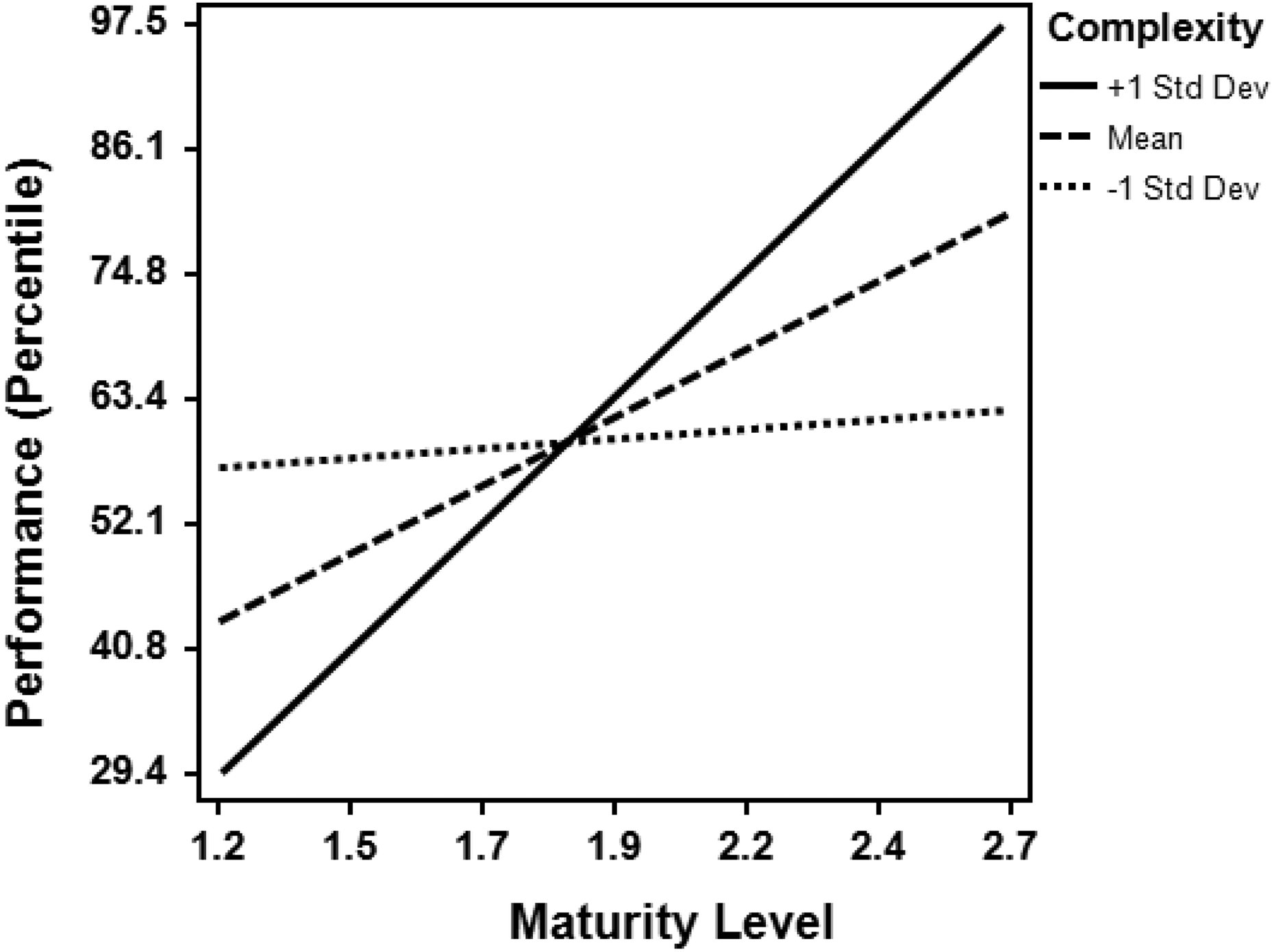
The PRMM level against performance for three levels of project complexity. PRMM: project risk management maturity.
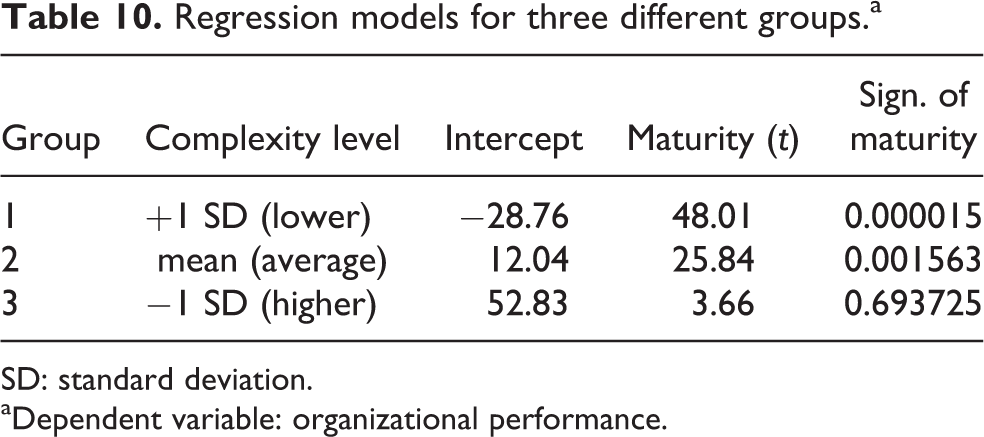
Table 10 further indicates a slope analysis of groups of firms with three different levels of project complexity. As can be seen, group 3 of firms with lower level of project complexity has no statistically significant slope for the regression model. Group 1 of firms with a higher level of complexity provides the largest, most statistically significant coefficient.
Regression models for three different groups.a
SD: standard deviation.
aDependent variable: organizational performance.
Discussions and insights
Results of the reported empirical study contribute to discussions from both scientific and practical perspectives as elaborated in the subsequent passages. In addition, secondary results pertinent to maturity profiles of Indonesian PBOs are also reported in this section.
Scientific contributions
From the scientific standpoint, the reported study offers an extension to the current body of knowledge in PRMM. A literature review on project management research for the past 50 years by Pollack and Adler 96 found a remarkable shift from studies on technical engineering perspectives (e.g. developing a new tool for risk analysis) to examinations of project risks from organizational and social contexts. This reported study follows the pattern and the results add to the discussions pertaining to PRMM. Furthermore, this study provides essential insights pertinent to the worlds of project as temporary organizations as opposed to enduring organizations—an important perspective on project management studies. 38
Within the theoretical framework, this reported study contributes to a PRMM conceptual debate between universality and contingency camps. 32 It provides refinement on the current understanding of PRMM by comparing vis-à-vis two hypotheses which are drawn from two differing principles—that is, traditional universality and contingency. In addition, this study, to some extent, addresses a concern by Shenhar 38 that many project management literatures assume the “one-size-fits-all” approach stemming to an underlying assumption that all projects are essentially uniform. The study provides a compelling explanation which reconciles the seemingly contradictory conjectures of the traditional and contextual frameworks of maturity. This study reveals that benefits of administering higher PRMM diminish as the project complexity level decreases across organizations. In other words, a contextual variable of project complexity is found to positively moderate the relationship between maturity and performance.
The use of moderation/contingency approach in project management research is growing only recently according to a bibliographic study by Hanisch and Wald. 32 Hanisch and Wald 32 also found that contingency-based studies were predominantly carried out in the context of North America and Europe. Hence project management studies within a contingency framework in an Asian setting are worthwhile. Another critical review by Deng and Smyth 36 found that contingency-based studies had been increasing in the construction management literatures. The review highlights some drawbacks of the extant construction contingency studies, including lack of explicit theoretical development and issues in methodologies (i.e. construct validity, reliability). This study attempts to address such concerns by employing explicit and stringent procedure of hypothesis development and utilizing rigorous research protocols. The utilization of “complexity” with a positive result also highlights its importance as a key contextual variable. To an extent, this reported study addresses one of many research agenda in project management as pointed out by Winter et al. 97 and Cicmil et al. 43 for developing new models involving complexity for project actuality.
Practical contributions
Empirical results of this study to an extent provide evidence to support advocates of maturity initiatives. Data from Indonesia suggest that in general PRMM is related to improved performance to organization. This further demonstrates the practical values for striving higher PRM maturity for PBOs. At the same time, however, the reported study also provides refinement on the understanding of maturity benefits. The result of the complexity-based evaluation suggests that the value of maturity is contingent toward complexity of projects which are typically performed by the organization.
Figure 1 and Table 10 reveal an interesting insight for project practitioners. PBOs which typically carry out projects of higher levels of complexity would benefit more by the improvement of PRMM than their counterparts with lower levels of project complexity. While a generally positive relationship is observable for three groups, the association between PRMM and performance diminishes as the complexity decreases. Analysis suggests that organizations with low project complexity would not—statistically speaking—significantly benefit from the improvement of maturity. In contrast, organizations with high complexity could have significant advantage by improvement of the maturity. Organizations with medium complexity, according to analysis, could also have significant benefits from maturity increase. However, the benefit per unit of maturity increase is fewer for organizations with medium complexity if compared to their counterparts with high project complexity.
The significant increase of performance along with the improvement of PRMM in organizations with higher project complexity seems to justify the cost of such initiatives. Cost which is inherently driven by maturity initiatives is a major concern for any organization. 7,98 Accordingly, a strategic initiative to improve maturity is considered feasible only if the benefit outweighs the investment and operational costs. Organizations may be committed to continuously pursue a higher level of PRMM only if they believe that the increase of benefit outweighs the cost. For instance, a small and medium-sized enterprise (SME) contractor with typically deliver portfolios of less complex projects may opt to operate at a lower level of PRMM due to two reasons. Firstly, investing in various advanced initiatives to increase the PRMM level is considered unaffordable. Secondly, as demonstrated by this study, the relatively simple projects do not benefit from advanced PRM proficiency. Hence for such an SME contractor, they may be able to perform well with the lower level of PRMM. For them, the ideal maturity level may not be necessarily the highest stage.
Since the reported study has yet to explicitly include the cost within the observation, further study will be required to prescribe the optimum level of project risk maturity—for different levels of complexity. Depending on the shapes and slopes of both cost and benefit curves, respective organizations may find that the optimal level of risk maturity varies. 14
From the above elaboration, the relationship between risk maturity and performance is not as simple and direct as the traditional proponents may suggest. Accordingly, strategic decision makers within the PBO should consider various contextual factors when considering the right level of PRMM. The concept is in line with an assertion by Pasian and Williams 99 that certain project types may need flexible project management.
Additional findings
For the secondary results, the study sheds some light on the PRMM profiles of PBOs in Indonesia. It was found that PBOs in Indonesia vary considerably in terms of PRMM levels. Furthermore, the study finds that the score means of some (but not all) dimensions of PRMM are significantly different for Indonesian large and medium firms.
The study also reports a high degree of consistency between two independent performance indicators reflecting different levels of project performance. 84,85 It indicates that—at least in an Indonesian context—the two performance indicators are aligned.
Limitations and further study
From a methodological perspective, some concerns are noteworthy. Firstly, the relatively low response rate may result in biases. Such a condition, however, is typical in empirical studies pertinent to project management. 93 Hence some cautions are necessary when interpreting the results. Secondly, the chosen sampling method for this study is convenient sampling due to the inability to identify the sampling frame. This may lead to some concerns on population’s true representation. Another possible concern is related to the use of single respondents for respective organizations. Brookes et al. 100 in the past maturity study have indicated a low inter-rater consistency within responding organizations. This indicates that maturity measures might not be accurately evaluated by single respondents of respective organizations. In this study, an attempt to use multiple raters had been performed which resulted in a very low response rate—hence rendering such data unusable. Despite all the stated limitations, this study attempts to comply with a rigorous protocol to maintain accuracy of the results. Those include a stringent procedure of theoretical creation, instrument development and test, data elicitation, and statistical analysis. Another potential problem is again related to the respondents and their representativeness. Profiles of respondents indicate that some respondents may not be the best representation of the firms, given their positions and limited understanding of the firm-wide variables to be inquired. This is especially true for large firms where respondents who happened to be, for instance project managers, would not have full understanding of the organizational attributes such as performance and average project complexity. For medium firms, however, the problem is perhaps less essential since, given the smaller firm’s size, project managers may have a more better grasp of their own firms’ conditions.
From a conceptual perspective, some further ideas are noteworthy for follow-up studies. Firstly, as indicated earlier, the reported study has yet to consider the cost elements of the maturity initiatives. From the cost–benefit (return on investment) perspective this study is unable to prescribe the optimum level of maturity initiatives for any given organizational contexts of project complexity. Thus, follow-up studies focusing on cost profiles of PRMM initiatives are deemed necessary.
Secondly, the reported study has yet to consider utility beyond financial and project performances. One of the central tenets for criticism against the traditional maturity view is the possible misalignment between maturity characteristics and company’s utilities. Some PBOs may challenge the traditional view because their inherent business values contradict with the attributes of advanced maturity level. 10 For instance, high organizational maturity may have an unintended effect against organizational flexibility and adaptability. Organizations which consider creativity and adaptability as major intangible asset may opt to operate in the lower level of maturity to avoid the rigid hierarchy and stringent procedure inherent with the higher maturity to cultivate creativity. 40 For such an organization, to perform means to stay flexible and creative—and higher maturity level may provide just the opposite, unfavorable value to the organization. Studies focusing on specific organizations which emphasize such specific trade-offs are important to carry out. This reported study, despite the relatively wide coverage with multiple types of firms, may not be representative for organizations with such special characteristics.
Thirdly, contingency studies which involve contextual variables other than project complexity are also worth pursuing. Apart from complexity, it is believed that other project management-related contextual factors may be equally important for further study.
Conclusion
This study examines the relationship between PRMM and organizational performance. Two alternatives of theoretical model are developed on the basis of an extensive literature review. The first proposition stems on the traditional view of maturity concept which suggests a direct, positive relationship between PRMM and organizational performance—that is, the higher the maturity level, the better the performance. An alternative theoretical model is developed based on a moderation perspective. It is conjectured that the relationship between the two key variables is moderated by the “project complexity” encountered by respective organizations. The result of the main study suggests that, in general, the utility of PRMM is observable across organizations—but its efficacy diminishes for organizations with lower levels of “project complexity.” In other words, this study provides empirical support to the moderation-based model.
Findings from this study are mostly consistent to those of past studies, as described in detail in the “Discussions and insights” section. Specifically, it offers a formal theoretical model and empirical evidence in a confirmatory fashion which complement exploratory works in the PRMM field. 10,14
The study contributes to both theoretical and practical understanding pertinent to project maturity. Firstly, it contributes to conceptual refinement on the benefit of project risk maturity across different organizations with varying degree of project complexity. Secondly, from a practical perspective, the result offers compelling evidence for decision makers to continuously adapt their organization’s competence against the evolving environmental attributes. Hence at the organization level, a senior management should continuously seek the right match between “PRMM,” “complexity,” and “project risk maturity.”
From a methodological perspective, some limitations are noteworthy. Firstly, the relatively low response rate may result in biases. Secondly, the chosen sampling method (convenient) may lead to some concerns on population’s true representation. Another possible limitation is related to the use of single respondents for respective organizations. Another potential problem is again related to the respondents and their representativeness. Profiles of respondents indicate that some respondents may not be the best representation of the firms, given their positions and limited understanding of the firm-wide variables to be inquired.
Some ideas are noteworthy for follow-up studies, as described in the earlier section. Firstly, the reported study has yet to consider the cost elements of the maturity initiatives. Secondly, the reported study has yet to consider utility beyond financial and project performances. Studies focusing on specific organizations which emphasize such specific trade-offs are important to carry out. Thirdly, contingency studies which involve contextual variables other than project complexity are also worth pursuing.
Footnotes
Declaration of Conflicting Interests
The authors declared no potential conflicts of interest with respect to the research, authorship, and/or publication of this article.
Funding
The authors received no financial support for the research, authorship, and/or publication of this article.
