




Abstract
This article aims to promote a theoretical framework for designing an educational website based on scientific standards for non-native Arabic speakers to improve their abilities and performance in learning Arabic language. As Arabic language is commonly known as the language of Holy Quran and is the language of Prophet Muhammad (last of the prophets), so it is considered as one of the oldest languages in the world. In addition, it is widely used around the world and is the spoken language of the Arab states in the Middle East and North Africa. So, increasing the number of people who show their desires to learn Arabic language as a second language leads to build various online educational approaches. But based on previous studies, many educational websites are not built based on scientific standards, which affect students’ academic performance; therefore, there is an emergency demand to promote the theoretical framework for designing an educational website based on scientific standards to facilitate language acquisition and help non-native Arabic speakers to overcome the difficulties that they face in learning Arabic language.
Keywords
Introduction
Arabic language occupies a great position in the thoughts of native and non-native Muslim speakers. 1 In addition, the two essential sources of Islam, the Holy Quran and the Sunnah, are available in Arabic language; as Arabic language is one of the official languages of the Arab nations, many non-native Arabic speakers around the world are studying Arabic language for different reasons and desires. Therefore, a lot of institutions and universities in Arab world offer courses for teaching Arabic language skills and exert the best efforts to deliver the history and culture of Arabic language for non-native Arabic speakers in a proper way. 2 Islamic Educational, Scientific and Cultural Organization (ISESCO) has an effective role in teaching Arabic language for non-native Arabic speakers and upgrading its teaching methods and learning tools both inside and outside of the Islamic world. 3
There is an emergency need to create the electronic programs for teaching Arabic language, and it is important to meet the needs and demands of the learners within broaden educational levels that start from beginners to professional learners. Also, there is an increasing demand for learning Arabic language by non-native Arabic speakers for various reasons such as political, educational, religious, cultural and economic factors. Many learners would like to learn Arabic language, but the expenses of travelling become an obstacle for this desire. Under these circumstances, learning electronic programme like computer-assisted language (CALL) is hardly needed. CALL is the application that refers to the use of computers as part of a language-learning course. It is a technological tool for learning Arabic language for non-native speakers. 4
Many countries exert too much effort to establish institutes and centres for non-native Arabic speakers for two purposes. The first purpose is a response to the market demand and the second purpose is responding for non-Arabic Muslim speakers who like to study Arabic culture and civilization of Islamic nation because Arabic language is the language of Holy Quran and is the language of Prophet Muhammad. 5
Today, the evolution of online teaching and learning approaches allows many learners to easily access many free educational websites to develop the basic learning skills for any language and learn a new culture for any country using the Internet. Obviously, the current advanced technologies help learners who have no financial abilities to acquire a new language easily. Furthermore, increasing the number of people who show their desire to learn Arabic language as the second language leads to build various online educational approaches. So, the electronic programs should be built based on a number of quality standards to teach non-native Arabic speakers in effective ways. 1
Teaching Arabic language for non-native Arabic speakers in Oman
Sultanate of Oman believes that the history and the Islamic culture of Arabic language must be spread widely among non-native Arabic speakers to build a communication bridge with other nations. As Sultanate of Oman is a tourist country and has many archaeological and tourist places, a lot of people come for studying and as tourists at the same time. Hence, the basic Arabic language skills should be presented and educated using latest technologies, with highly specialized teaching staff and comprehensive curriculum for teaching the main Arabic language skills (listening, speaking, reading and writing) (Figure 1) for all proficiency levels (beginner, intermediate and advanced).

Arabic language skills.
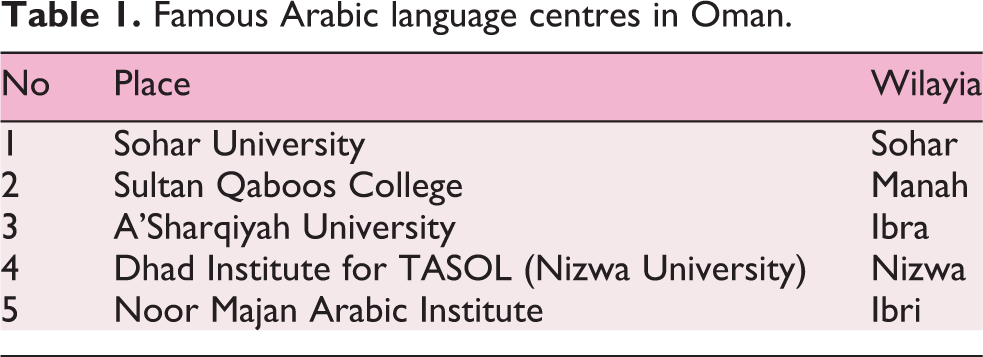
Therefore, in accordance with Royal orders of the Majesty Sultan Qaboos bin Said, Sultan Qaboos College is the first official and specialized institution for teaching Arabic language for non-native Arabic speakers, it is founded and located in Manah town. It employs qualified teaching staff and provides high-quality programmes and advanced technologies in teaching Arabic language. Sohar university is one of these institutions that offers Arabic language courses for non-native Arabic speakers who come from different countries to learn the language since 2012. Also, there are many others famous institutions in Oman that teach Arabic language for non-native Arabic speakers, which are given in Table 1.
Famous Arabic language centres in Oman.
Problem statement
Based on the previous studies, many educational websites are built without taking into consideration the educational content, interaction, design, evaluation and feedback and depend on unreliable resources and imprecise scientific data. 2 In addition, based on evaluating and analysing specialized educational websites for teaching Arabic language for non-native Arabic speakers through the Internet, the results approved that most designers focus mostly on the design of the website to attract more learners and ignore the importance of teaching Arabic language skills in first place. Also, the results showed that many educational websites are not designed based on the scientific standards and built with poor performance and low efficiency. 6 Moreover, many designers ignore the importance of educational content in terms of teaching linguistic skills (reading, listening, speaking and writing), and the results approved that there are many educational websites that are designed without focusing on teaching Arabic language skills equally. 7 Furthermore, many educational websites are built without consulting specialized experts and educational people, so most of them are built with weak content and untrusted resources. 8 Therefore, there is an urgent need for promoting a theoretical framework to design an educational website based on scientific standards to non-native Arabic speakers, which focus on teaching Arabic language effectively and helping non-native Arabic speakers to overcome the difficulties that they face in learning Arabic language.
Literature review
The authors discussed the previous literature reviews related to this research which consists of six literature reviews. Each of them contains multiple scientific standards and explains the results of each study separately as the following:
Khalid Al-Youbi 2 specified the scientific standards for building educational websites for teaching Arabic language for non-native Arabic speakers, which are subject, objectives, content, feedback, usage, interface, interaction, control, navigation, tasks, tool and management. The results of this study showed that there are many disadvantages in designing educational websites for non-native Arabic speakers related to design, content, flexibility, interaction and skills, because the designers do not take into consideration the correct educational curriculum for teaching Arabic language skills for learners. In addition, the researcher noticed that many educational websites are not designed based on the educational basis and most of them are built with poor quality and unsatisfied outcomes.
Yousif Eiydat and Mohamed Al-Amri 9 used the electronic design standards for evaluating the website of Yarmouk University from the viewpoint of information and communication technology specialists, which are design, language, accuracy, flexibility, navigation and interface. The aim of the researchers was to identify the availability of website design standards on university website from the viewpoint of information and communication technology specialists, so they prepared a questionnaire consisting of 42 items divided into 6 sections. The sample of this study consisted of 54 participants divided into 2 groups, with 32 faculty members and 22 computer technicians who worked at the Yarmouk University. The website design standards were used in this study based on previous studies and literature review. Six standards were selected and used to evaluate the websites. The results showed that the availability of the website design standards on the Yarmouk University website was very high from the viewpoint of information and communication technology specialists who work at Yarmouk University.
Layla Rasheed 10 investigated the relative importance of specific scientific design criteria in evaluating the usage of educational website from the viewpoint of students and based on students’ preferences to evaluate the websites of nine Jordanian universities. Five scientific criteria were used, which are navigation, architecture, ease of use and communication, design and content. In this study, the researcher requested undergraduate students to evaluate the usability of nine Jordanian universities websites based on some specific standards. The specific criteria for evaluating the usability of educational websites were developed from literature reviews and consisted of five categories. Nine Jordanian educational websites were selected, and the sample of this study consisted of undergraduate students from Faculty of Information Technology and Science. The results of this study showed that most of the students were happy with the usage of Jordanian university websites, especially they were satisfied with content and navigation standards of tested websites. The results revealed that Petra University got the highest score, while Al al-Bayt University got the lowest score.
Hedaya Al-Sheikh and Saleh Al-Suhaibani 6 specified the scientific standards for evaluating educational websites for teaching Arabic language for non-native Arabic speakers which are content, design, evaluation, exercises, activities, linguistic skills, language, educational tools and objectives. It is commonly known that for studying any language, there are four essential skills that should be taught equally for learners at diverse levels. According to the results of this study, it was noticed that many designers of educational websites concentrated on the design, objective and language standards and did not focus on the linguistic skills standard which is considered as the most important standard for teaching the basic Arabic language skills (reading, writing, speaking and listening). Also, the results showed that most of the designers focus on the design of the website with a score of 71.5% and do not concentrate on the teaching linguistic skills with a score of 42.5%. Moreover, many educational websites are designed without taking into consideration the basic goals and scientific standards for designing these kinds of sites, which as a result reflects poor educational outcomes and content.
Daud Elega 8 specified the basis and scientific standards for teaching Arabic language for non-native Arabic speakers through educational websites in the Internet, according to the educational basis and the technician basis. The results showed that the Internet is the most important educational tool to spread and teach Arabic language, but there are many institutions that are not interested to spread this language compared to other foreign languages. Also, the researcher noticed that some educational websites are designed without consulting educational experts, so the educational content is built with weak quality and poor performance. In addition, there is a lack of educational websites for teaching non-native Arabic speakers compared to foreign English language websites. So, the researcher advised to use the educational components and scientific standards for teaching Arabic language through the Internet and provide highly educational technologies and highly specialized qualified teachers for teaching non-native Arabic speakers. Moreover, the researcher recommended to organize training courses and workshops for teaching staff and educate them with the latest technologies and standards for teaching Arabic language. Furthermore, training sessions should be conducted for expert designers to educate them with the best educational and cultural principles for designing educational websites.
Mahsoub Abdul-Sadeq 11 specified scientific standards for evaluating online websites for learning and teaching English language as a foreign language based on scientific standards, which are authority, purpose, coverage, currency, objectivity, accuracy, technical aspects and usefulness. The researcher used 63 items of evaluation criteria checklist based on the previous studies to evaluate 6 educational websites for learning and teaching English language. In this study, the participants visited the websites and responded to the evaluation criteria checklist to determine the points of strengths and weaknesses and evaluate each website. The study showed that participants were satisfied and recommended to visit these sites, because it is useful and helpful for learning and teaching English language according to the evaluation criteria checklist. In addition, the results of this study showed that the six selected websites for this study are useful and helpful for learning and teaching English language according to viewpoint of the participants.
Research methodology
The purpose of this study is to promote a theoretical framework for designing educational website based on scientific standards to non-native Arabic speakers, which can help them overcome the difficulties that they face in learning Arabic language. The authors conducted a comprehensive search to gather the required data for this research from related literature reviews, scientific journals, textbooks, interviews, Google Scholar, master thesis and many other resources. Firstly, the authors used six literature reviews and conducted interviews with teaching staff in Arabic language centres to select the suitable standards.
The authors consulted 12 specialized teaching staff in teaching Arabic language for non-native Arabic speakers and for native speakers to help them selecting the appropriate standards (Figure 2).

Scientific standards for evaluating and building Educational Websites for Native and Non-Native Arabic Speakers according to the previous studies.
Finalized scientific standards
Based on the Selection results (Table 2), Figure 3 shows the finalized scientific standards.
Selection results.

Note: Boldface values: it determines the finalized scientific standards (blue color) which were selected by expert educational people. Colored shades: blue color determine the finalized scientific standards.
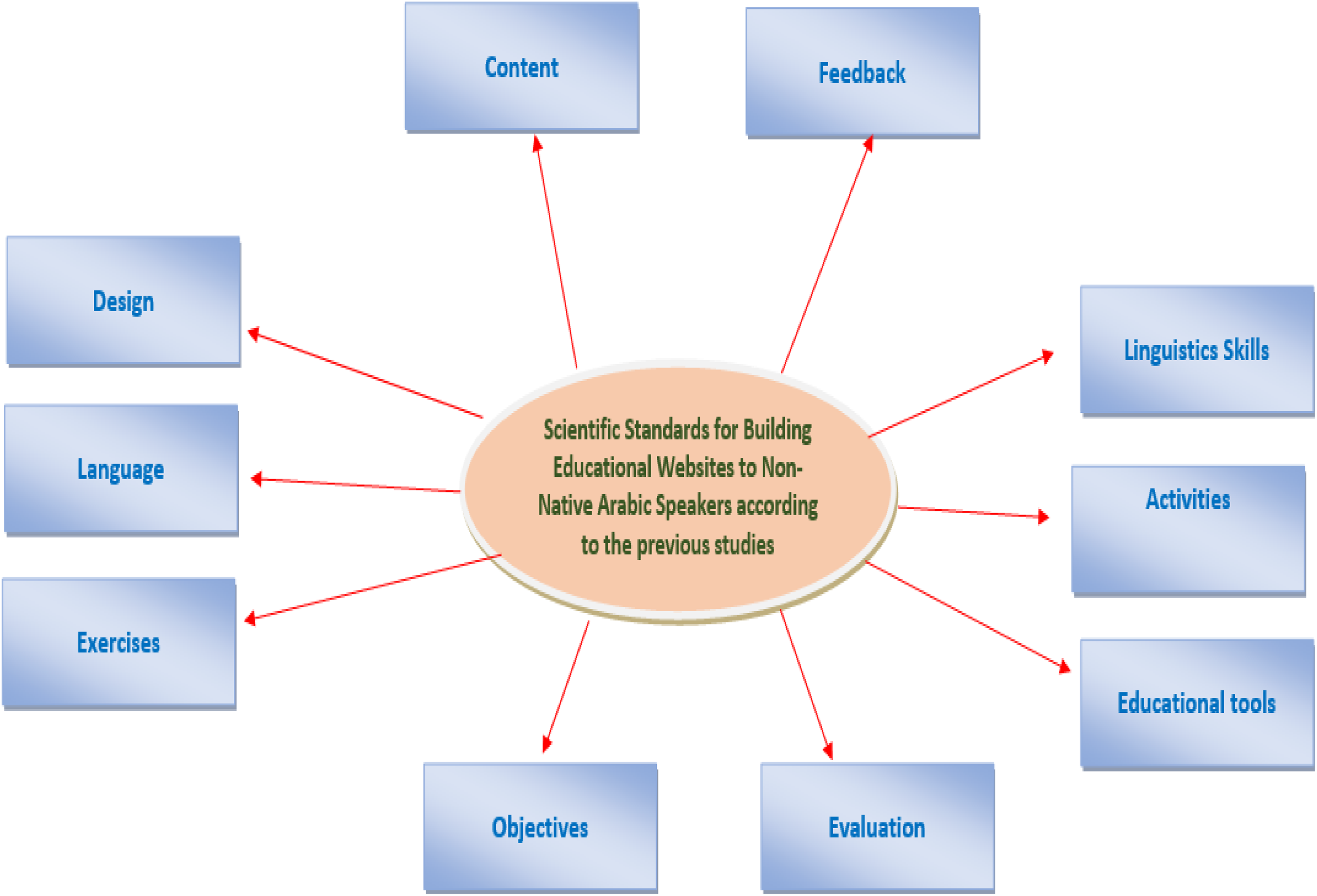
Finalized scientific standards.
Theoretical background
Secondly, the authors started looking for the theories related to this study such as learning theory, situational learning theory, social constructivist theory and social interaction theory, but the authors selected social constructivist theory as the suitable theoretical background for this study.
Social constructivist theory
This study used Vygotsky’ social constructivist theory as the theoretical background. Vygotsky 12 stated that knowledge and cognitive growth can occur first on the social level and knowledge is developed through the interaction of the learners in different events and collaboration with other learners in various activities. Also, Roth 13 stated that the interaction between learners and roots of individuals’ knowledge are basically found in their interactions with their surroundings in the environment and other learners before their knowledge is internalized. According to the studies of Derry 14 and McMahon, 15 culture and context in understanding what is occurring in the community and the knowledge construction that is based on this understanding are emphasized in social constructivism. Kim 16 pointed out that social constructivism is based on specific assumptions regarding learning, knowledge and reality. Kukla 17 argued that the members in the society or a group work together to invent the properties of the world or group. McMahon 15 stated that learning doesn’t take place only within the individual, nor it is developed passively by external forces such as social constructivists; so, meaningful learning can occur when individuals are engaged effectively in social activities and events such as interaction and collaboration with others.
Teaching tools of educational website
The educational websites should be built based on scientific standards, which are language, content, linguistic skills, evaluation, feedback, exercises, design, objectives, activities and educational tools according to the previous studies. Also, it should focus on teaching the following main learning activities.
Audiovisual equipment
Audiovisual tools such as video, radio, audio and images are considered as effective equipment to improve the abilities and performance of the learners and expedite language acquisition. Recorded dialogues such as music, speech, radio and song are considered as audio materials, and on the other side, the visuals are materials that can be seen, such as videos, images, graphics, poster, flash cards and charts. 18 In addition, audiovisual materials in teaching listening skills are used widely and have increased significantly, even the modern English Language Teaching (ELT) teachers are trained and educated well, so that they can learn how to incorporate audiovisual aids effectively in teaching language. 19 Moreover, visual aids create an excitement and add a big interest and enjoyment to the presentations because they enable learners to use more than one sense at the same time. 20 Furthermore, the idea of using videos is to facilitate communication, conversation, speaking, presentation skills and active viewing and to increase the students’ excitement, enjoyment and satisfaction with each lesson. Also, the learners focus and pay their attention and interest completely on the main idea of the video presentation. 21
Arabic language skills
The four Arabic language skills are considered the fundamental skills for language acquisition and the basic communication skills to become a well-rounded communicator. The relationship between listening, speaking, reading and writing during development is basically connected together, complete with each other and provide mutual support, which means that any practice done will contribute to the overall development of others and relate to each other. 22 In addition, any of the four language skills is very rarely done in isolation, meaning that when people engage in a communication or conversation with someone, they are listening as well as speaking to act and react with someone they are talking to. 23 Moreover, scientifically, the correct procedure in learning the language involves listening firstly, to be followed directly by speaking, then comes reading and finally the writing of the language. Also, the integrated skills approach leads to the optimal (English as a Second Language (ESL)/English as a Foreign Language (EFL)) communication by interweaving the four essential language skills during instruction. 24 Furthermore, the four language communication skills are considered the most important and crucial fundamental skills for learning and acquisition of the second language. 25
Arabic language lessons
The learners should be supported and guided with multiple lessons to facilitate the understanding of the four linguistic skills efficiently and to learn the foreign language easily. For example, the acquisition of vocabularies considers essential for successful acquisition of the second language and plays an important factor in the formation and construction of a complete spoken and written texts. 26 Also, vocabulary is defined as the word of a language, which includes single items and phrases that consist of several connected words which convey the particular meaning of the sentences, the way individual words do. 27 In addition, teaching grammar and following rules are undoubtedly necessary and are considered essential things for language acquisition and for achieving accuracy and fluency. 28 Absolutely, the students will be more active and motivated to learn the foreign language when related activities and exercises for language learning are exciting and interesting to them. 29 Furthermore, teaching Arabic culture is significantly useful and helpful for non-native speakers in terms of improving language skills and raising the cultural awareness of the students as well as changing their social attitudes positively towards native Arabic speakers in society and engage effectively with community. 30
Arabic language levels
Non-native Arabic speakers are typically classified into three levels based on their capabilities and knowledge. Each level introduces different topics for learners taking into consideration their abilities and skills in first place. The proficiency levels in language acquisition are categorized into three levels, namely beginner, intermediate and advanced. Basically, the learners’ performance history should be maintained and recorded firstly in the system after conducting the test and collecting the evidence, either positive or negative. Then, the students will be categorized according to their answers and final scores into three main levels, which is done and taken into consideration by the system. Obviously, the scores will go up and down, also the weighted results, depending on the parameters such as pedagogical objectives. The results show that a learner may be rated as a beginner in one particular aspect and as a proficient in another. 31 If the learner is considered as a beginner so the type of feedback he or she obtains is explicit. Conversely, if the learner is considered as an advanced learner, the feedback he or she will provide tends to be with less details. 32
Proposed model
Based on the theoretical background, learning activities and scientific standards of the educational website, a model was developed. The model illustrates the main learning activities for teaching Arabic language to non-native Arabic speakers using educational website based on scientific standards. So, the learners need to be actively involved in learning activities to expedite language acquisition using different learning tools. The theoretical framework for designing educational website based on scientific standards to non-native Arabic speakers was built based on previous studies and discussions with specialized teaching staff to promote a useful and educational framework (Figure 4).

Theoretical framework.
Figure 4 illustrates the theoretical framework for designing educational website consisting of three categories, namely student learning, learning activities and scientific standards. Learning activities in the educational website is based on scientific standards and consists of audiovisual equipments such as video, audio, radio and images. It is considered as the most powerful tool to develop Arabic language skills (reading, writing, listening and speaking) effectively and expedite language acquisition easily. Also, these educational tools enhance the abilities of the learners in pronunciation and help them communicate easily with native speakers. The main learning activities include learning Arabic language skills such as reading, writing, listening and speaking, which are considered as the four fundamental skills for language acquisition and the basic communication skills to become a good communicator. Therefore, the educational website educates each skill separately with more examples and exercises. In addition, the website provides more lessons for learners regarding teaching the phrases and vocabularies that are used commonly in our daily lives supported by images and examples. Also, it is teaching syntactic rules and grammar that helps learners to construct correct sentences and speak easily with native speakers. Moreover, the educational website introduces Arabic culture for learners which is closely related to Omani cultures such as customs and traditions, Tourism and archaeological sites because sultanate of Oman believes that the history and Arabic Culture of Arabic language must be spread widely among non-native Arabic speakers to build a communication bridge with other nations. In addition, as Sultanate of Oman is a tourist country and has many archaeological and tourist places, a lot of people come for studying and tourism at the same time. Furthermore, the educational website categorizes the learners into three proficiency levels, namely beginner, intermediate and advanced, and each level contains different topics and lessons according to the abilities and knowledge of the learners. Effective educational website can save time, papers and efforts of the teaching staff who work hard to prepare and provide all teaching materials for the students in class. They believe that Arabic language skills should be presented and explained theoretically and practically in an appropriate manner to meet the agreed goals and requirements of the Arabic language centre. Furthermore, this model will help designers to design effective educational website based on scientific standards and focus on teaching the main learning activities.
Conclusion
This research promoted a theoretical framework for designing an educational website based on scientific standards to help non-native Arabic speakers to overcome the difficulties that they face in learning Arabic language. This framework consists of three categories, namely student learning, learning activities and scientific standards. Recently, many educational websites and electronic programs for teaching Arabic language to non-native Arabic speakers are not built based on scientific standards, so these websites can impose negative effects on students’ performance and affect their abilities to learn a new language. So, the current theoretical framework can enhance the abilities of learners and encourage designers of educational websites to design the educational website based on scientific standards to cover the main Arabic language skills equally for all levels. In addition, researchers need to be encouraged to do more research in this area and publish more works, because most of the countries use Arabic language as the official language and huge numbers of non-native Arabic speakers around the world have tendencies and desires to learn this language for several personal reasons.
Footnotes
Declaration of Conflicting Interests
The author(s) declared no potential conflicts of interest with respect to the research, authorship, and/or publication of this article.
Funding
The author(s) received no financial support for the research, authorship, and/or publication of this article.
