




Abstract
The global economy is characterized by a progressive complexity, uncertainty, and volatility, which exert intense pressures to organizations and confronts them, with increasing frequency, to disruptive and unexpected events. In such environments, some organizations develop a resilience profile to increase the capacity to anticipate, adapt, and recover equilibrium or even, gain a new advantage position after the disruption. In this research, the factors of organizational resilience (OR) are identified and a structural equations model is developed. The article discusses the theoretical background and the literature of the resilience factors, and proposes their classification, which is used for the development of a questionnaire for the determination of the relative importance of the factors in several industrial sectors. The internal consistency of the questionnaire was validated with the Cronbach’s α coefficient and was applied to a sample of 159 manufacturing companies of the twin plant “maquiladora” industry of Ciudad Juarez, México, using a convenience sampling method. The key driver factors related to the development of OR are identified employing a partial least squares structural equation modeling approach, also is developed a structural model as a predictor of OR and its effectiveness, covering the description of the proposed model. By hypotheses tests, it is verified that resilient leadership explains the role of variables related to the development of OR, having a high influence in the organizational culture and in the capacity to organize and manage operations, being these three contributors, the drivers of the adaptation capacity that has a direct relation to the development of resilience.
Keywords
Introduction
Businesses competing in the high-intensity rivalry markets face adverse and high impact situations, most of the times, because of macroeconomic changes such as financial crisis, market losses, and confrontations with nontraditional competitors, besides of other uncertainties, such as the consumer change of preferences, technological change, discontinuities, merges, and the consequences of natural disasters. In this border region between the United States and Mexico, the multinational companies account close to 400 plants in which the most substantial fraction of investments comes from the United States, Japan, Korea, Germany, France, and Italy; the companies operate under several schemes of twin plant, (maquiladora) under free trade agreements. Most of the factories use high-level, state-of-the-art technologies of product, process, and equipment. Product lines are wide and deep of home appliances and computers, All terrain vehicles (ATVs), automotive and aeronautics harnesses, and electronics.
The companies, in this border region, face several disruptions, among them, the North-American financial crisis of 2000, the migrations from rural areas to cities, technological changes such as industry 4.0, and the social changes produced by drugs and violence. 1 –3 When companies face pressures generated by such changes, in the search for a better business, recur to internal measures such as the improvement of productivity and quality, but also resort to external measures like joint ventures, mergers, acquisitions, and moving to other countries. But under more severe disruptions, people in the companies need to develop a capacity to anticipate, adapt, recover rapidly and create new capabilities and abilities to deal with such events and environmental pressures while searching for better conditions than the mere reestablishment of equilibrium.
The term resilience entails the ability of some systems, such as ecological, 4 economic, 5 social, 6,7 or organizational, 8,9 to return to normal conditions after a disruptive event that changes its state. It is the capacity to adapt effectively when a disturbing event occurs by deploying specific and adequate responses and activities to reduce threats. 4,5,10,11 Resilience can be a useful capability of organizations 12 because it offers the ability to deal with emergencies and crises, 10 when the organization is in risk and unable to recover, resilience offers an approach to adapt to the new conditions. 11 Resilience is the system’s ability to adjust, adapt, and retain its basic functionality when errors, failures, and environmental changes happen, 1 this applies to any system, including organizations. 2 Because resilience theory is under development in several fields, this article presents the basic ideas in the following paragraphs with the purpose of highlighting the differences and open the way to the discussion of organizational resilience (OR) and the factors for its creation and development, which is the focus of this article.
Engineering resilience (ER) is the ability of designed systems to be resistant to disturbances, 3 and it has a crucial role to return and maintain optimal the system’s functionality. 13 In fact, according to Cai et al., 14 resilience is considered an intrinsic ability and an inherent attribute for the adaptation of an engineering system. Although change is unavoidable, ER recognizes that some variability could be beneficial, Lundberg and Je 15 and Righi et al., 16 and since failure and success originate from the same source, ER gives support at the moment of decision-making. 17 ER theory is related to the study of stability and control.
Regarding ecological resilience, it studies persistence, adaptability, and unpredictability, Holling, 18 although there are significant differences in the concept, worthwhile mentioning. According to Madni and Jackson, 19 Pariès, 20 Sheffi, 21 and Scheffer et al., 22 ecological resilience studies the system dynamics, the search for equilibrium, during the time spent after the disruption and all the way to the arrival to a steady state, more specifically, it is the ability of the system to persist in the case of disruptions, while for Gunderson, 23 Hollnagel, 24 Sutcliffe and Vogus, 25 and Youssef and Luthans, 26 resilience is the capability to recuperate after an unexpected and adverse disruption, returning to the initial state. Jackson 27 and Lengnick-Hall and Beck 28 go well beyond the search to recover the equilibrium and extend to the development of the capabilities and abilities to maintain the trends and for the creation of new opportunities. A resilient ecosystem can stay in equilibrium when facing a stressor or can adapt and enter a new stable state; it changes its structure while maintaining its functionality, through this process, the system guarantees its existence. 29
The behavior of organizations in business environments is typical of complex adaptation systems, 30,31 complex and adaptation because of the diversity and interconnections of the elements and their learning and adaptation capabilities. Resilience theory in organizations has under three perspectives, strategic, corporate, and organizational. Strategic resilience is highly dedicated to supporting business planning under a long-term horizon, 32 and it studies the capacity to reinvent the business model dynamically and the strategies under environmental changes, the anticipation, and adaptation to long-term trends, and the development of the capability to change on time.
The basic concept of corporate resilience is also, in some way, controversial. According to Fiksel 33 and Folke, 34 the capability is to adapt, survive, and grow when facing turbulent change, with a system reconfiguration new trajectories appear and opportunities open. For Nemeth et al., 35 it is the capacity to reduce the system vulnerability to expected and unexpected risks, and for Starr et al., 36 it is about identifying risks, defining priorities, and dealing with the main risks. Sutcliffe and Vogus 25 propose that corporate resilience emerges from the common adaptation processes deployed to deal with competitors to promote growth and the renewal of structures and practices. Corporate resilience has an evident strategic perspective because it emerges from the description of resilient strengths and weaknesses and the evaluation of the resilient strategies effectiveness. 10
Regarding OR, there are also some ambiguities and overlaps. It is the capability to absorb, effectively, the disruptive event, develop a response, and articulate a set of activities to resolve the threat, 28 while for Seah et al., 37 OR is the key factor for growth and success and also considered as the capability to absorb disruptions, maintain the structure, and keep the system functioning 38 in addition to the opening of new pathways. 39 In other words, OR is the ability of organizations to anticipate, avoid, and adjust to disruptions in their environment, 6 and it is an endogenous process based on the innovation of the company business models with the purpose of creating and delivering value to customers; 40 in this sense, it is a source of competitiveness. In essence, it is the adaptation capabilities, survival, and response of the organizational structure to keep the system in operation.
Despite the lack of generality of this basic concept, the differences in corporate resilience seem to be minimal, depending on the interpretation. 41 –43 We assume that differences are more than semantic and diverge because of the resilience types, although much can be learned while searching for consistent explanations, accurate interpretations of the literature, and experiences from the practice to improve the theory. Although this theory is just developing, other related fields add to increase the actual explanation power, such as social learning.
Social learning explains how people develop resilient profiles. 44 Everly et al. 45 comment explicitly that resilience is generated by means of the leaders examples and mentoring, the cohesion of the groups, the commitment to adopt the mission, the training for stress management, the promotion of creativity and innovation, and the promotion and execution of successful projects for the development of a “self-efficacy” sense. Seville 44 adds that resilient organizations characterize by the sensibility to threats and weaknesses, the acute environmental observation, high management commitment, and unity of purpose. Also, the human factor is the primary focus of the organization, because with empowered teams, with significant values, the organization may anticipate the disruption, with high preparedness to change and agility to respond. 46 Besides those profile features, because organizations are under constant change, the main characteristic of the human factor is the capability to adapt and manage information, 47 suggesting that people learn, acquire knowledge, and develop resilient profiles.
Despite the value of resilience, consistently acknowledged, the projects for its development are not deployed through well proven, generally accepted models, but through empirically based models, with questionable effectiveness, and since literature seems to be inconclusive and mostly anecdotal, it is pertinent to determine the relative influence of the factors and to take advantage of the theoretical opportunity for the identification of the critical success factors. Considering the economic importance of the plants in this border region to United States–México and the company country of origin, this article reports the factors found in the literature and their discrimination by their contribution to the success of the OR.
This article has five sections. The next one describes the theoretical background of OR and gives the associated hypotheses for the proposed structural model. The third section presents the details of the research design, and this section also provides the data analysis for the measurement model, including the results of construct reliability and discriminant validity and the partial least squares structural equation modeling (PLS-SEM) analysis of the OR model. The fourth section is about the managerial implications of the study; finally, conclusions and recommendations for future research are given in the fifth section.
Theoretical development
The first task is the development of a conceptual framework, containing the factors and variables, hypothetical relationships, and the constructs that may explain the development of resilience. Indeed, this is a complex and challenging problem task because there may be too many factors contributing to the effectiveness of resilient capabilities. The review of 87 publications in the literature of organizational development and behavior, OR, and complexity and complex adaptation systems led to the identification of 33 variables, they are: (1) vision sharing, (2) leadership, (3) decision-making, (4) management of change, (5) commitment with resilience, (6) network perspective, (7) values and identity, (8) prospective focus, (9) supervision and control of disruption, (10) knowledge management, (11) information systems, (12) silo thinking, (13) adaptation power, (14) managerial systems, (15) functions and responsibilities, (16) innovation and creativity, (17) driving forces, (18) simulation of disruptions, (19) connectivity awareness, (20) psychological alignment (PA), (21) commitment and involvement, (22) systems focus, (23) organizational learning (OL), (24) proactivity, (25) readiness to change, (26) business intelligence, (27) emerging technologies, (28) system’s flexibility, (29) organizational structure, (30) intellectual capital, (31) production agility, (32) financial support, and (33) understanding of risks and effects. Some of the social learning behavioral and cognitive variables are measured for the development of the model.
The 33 variables are organized in seven groups at two levels, only to facilitate the comprehension of the predictor model of Figure 1. 48 At the organizational level, they are resilient leadership (RL), resilient organizational culture (OC), 49 –51 adaptation capacity (AC), 36,50,52 and the organizational and managerial capabilities (OMC). 53 At the individual level, the awareness cognition, 51,54 OL, 55,56 and PA were identified. 53 The seven groups are organized in Figure 1, which is based on an adaptation of Zahra 57 predictor model. Zahra’s model proposes that the relationship between strategy and the outcomes (e.g. financial performance) can be modeled by a predictor relation, meaning that the latter is not obtained through a direct cause and effect relation because the strategy is deployed through a series of steps that extend in time and under a multifactor causality. Figure 1 presents the assumed predictor model for OR.
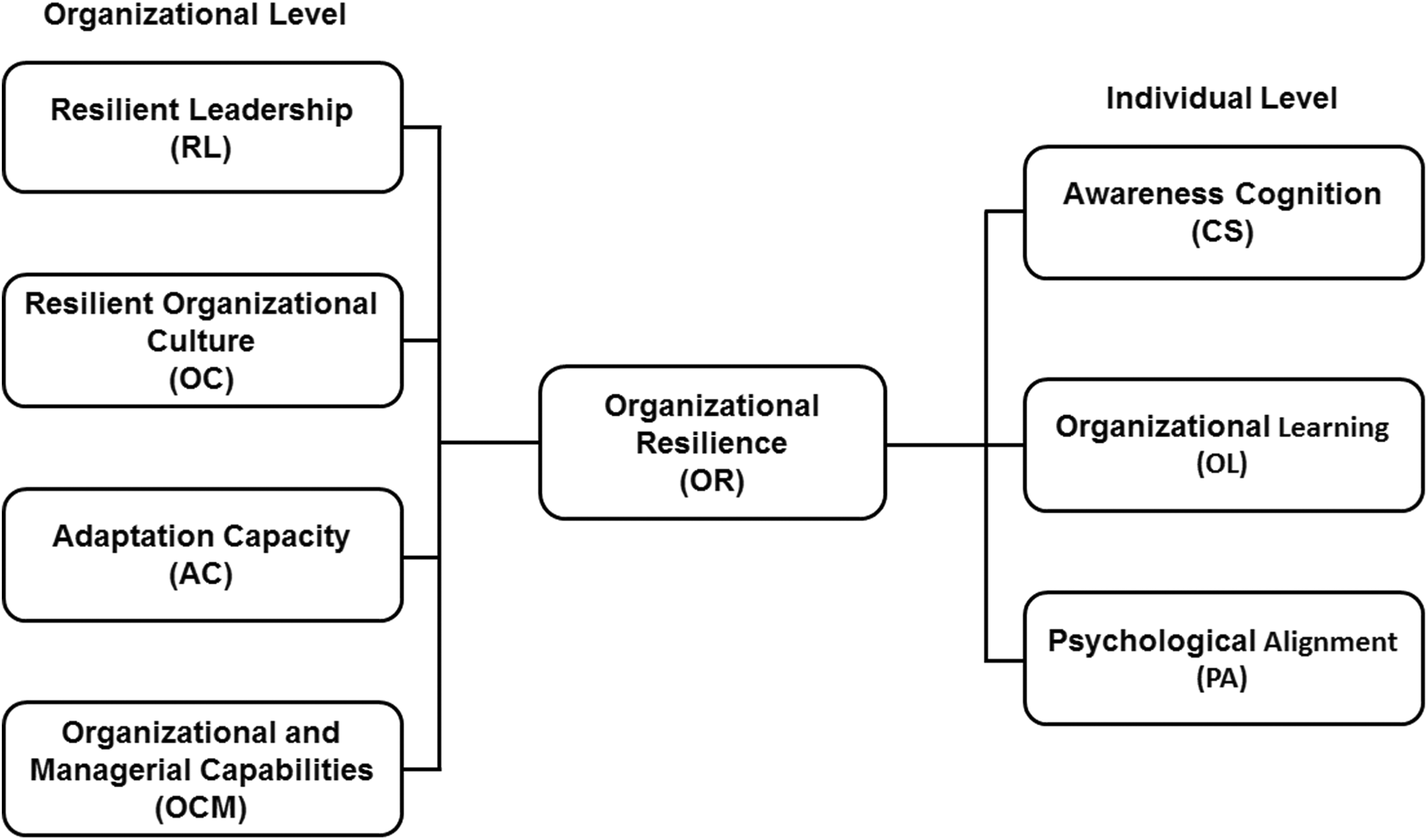
Predictor model of the development of organizational resilience.
Figure 1 indicates that OR can be developed by seven factors, because they have some influence and contribution to its development and deployment. To determine whether OR is effective, it is related to a performance variable, in this case, the company’s response while facing disruptions. As an example, the predictor AC at the organizational level is built based on 9 of the 33 variables listed: management of change, vision sharing, network perspective, commitment and involvement, functions and responsibilities, innovation and creativity, supervision and control of disruption, managerial systems, and readiness to change. By the same logic, the other relationships between the seven factors and their variables are built. Because this model is too large and for more reliable analysis and results, the article focuses on the determination of the key factors of the AC given in Figure 2.

Research model. OC: organizational culture; RL: resilient leadership; OCM: organizational capacity and management.
The model of AC is composed of an exogenous second-order construct called RL and two endogenous second-order constructs called OC and organizational capacity and management (OCM). In turn, these three constructs predict the AC as a part, to develop OR. The RL construct consists of three first-order subconstructs: vision sharing, leadership, and management of change. The OC construct integers by the subconstruct perspective network and the subconstruct compromise and involvement. The OCM construct is composed of two subconstructs, functions and responsibilities and innovation and creativity. Figure 2 presents the predictor model and the research hypotheses. Figure 2 is the base of the research hypotheses which are related to the organizational level of resilience. The next section explains the test of the hypotheses.
Methodology
Basically, the literature review is the base of Figure 1 and the constructs of the questionnaire (see Annex 1). The latter, to determine the importance of the factors and to understand their relative importance and through the search for concordance and coincidences among the answers in the sample elements, are identified the key factors for the development of OR. To assure the validity of content is analyzed by an expert panel, with the purpose to generate items that accurately reflect the proposed constructs. According to Hernández et al., 58 this was followed by a series of structured interviews to improve the clarity and precision of the questions, as a proof of the questionnaire adequateness, and to avoid the inclusion of unaware redundancy.
As a result of this procedure, the measurement of the variables is made with a 36-item instrument, with three second-order constructs and one endogenous construct. The three second-order constructs are (1) RL, (2) OC, and (3) OMCs, with 11, 8, and 7 items, respectively, while the endogenous construct is the AC with 10 items, all of them based on the 33 variables of interest (see Annex 1). Based on the 33 variables, the constructs are established and they define the relationships between variables and resilience performance measures. For instance, if the assumption was true: The RL is a predictor of OC, then, values, mission, vision, and their deployment have to be well managed, and there has to be sample elements to verify it. Also, vision sharing is to be observed in the people, expecting evidence of synergies in projects and teamwork effectiveness; the rest of the constructs follow this line of reasoning.
A Likert-type scale with six categories is used: totally disagree, disagree, some disagreement, some agreement, agreement, and totally agree. This research method has been used before for some authors 59,60 to measure latent variables that cannot be measured with quantitative index. The questionnaire was validated with Cronbach’s α formula. 61 –63 An α value below 0.6 indicates poor questionnaire effectiveness, in the range from 0.6 to 0.7 is considered weak, in the range from 0.7 to 0.8 is considered as acceptable, in the range from 0.8 to 0.9 is regarded as a good one, and higher than 0.9 is considered as excellent. 42 Thus, we conclude that the information obtained using the survey is valid because all the α values are bigger than 0.8, the minimum cutoff value for all constructs (0.923 < α < 0.940).
For the sample integration, the first task was to interview managers and identify the plants with more experience and success while being submitted to disruptive events, doing so, 164 managers of 68 plants were taken from a population of 327 industrial plants located in Ciudad Juarez. The companies and managers selected are aware and have experienced severe disruptions. The application of the questionnaires is made by interview, obtaining 159 questionnaires. This sample size meets the criteria recommended by Burnard and Bhamra 43 who suggest at least 75 cases to detect a coefficient of determination (R 2) of 0.25, with a significance level of 1% and a statistical power of 80% when it used a PLS-SEM. Samples are collected by a convenience sampling method. The model parameters were determined with SmartPLS 3. 64 Also, demographic data from the interviews were recollected, such as age, gender, seniority, and job position, which are presented in Table 1.
Demographic data.

Because the data from cross-sectional studies do not follow a multivariate normal distribution, 45 the use of a nonparametric approach based on PLS-SEM for testing research hypotheses is adequate. Additionally, the PLS-SEM approach is suitable when the research purpose is the development of theory, being especially useful in models with higher order constructs. 46 The statistical procedure recommended by Hair et al. 65 is followed. The measurement model was evaluated through the establishment of reliability and convergent and discriminant validity of the constructs that compose the model. The structural model was assessed through the results obtained (R 2, Q 2, f 2) by the estimation model, the magnitude, and the significance of the path standardized coefficients.
Results
This section presents the analysis of the data. Table 2 gives the values of the factorial loads of the indicator variables for each of the first-order constructs of the resilience model. If the indicators significantly load their representative factors with a t value above 2.58, then the test provides evidence of convergent validity. 46 As can be seen, all the indicators exceed the value of 0.70, indicating that the constructs reflect more than 50% of the variance of the construct they represent. The results of the evaluation of the reflective measurement model are summarized in Table 3 and they exhibit acceptable values of reliability and convergent and discriminant validity for all constructs. The reliability indices, Cronbach’s α, and composite reliability are higher than 0.70. 66
Evaluation of the reflective measurement model.

aSample mean, standard deviation, and T-statistics values were estimated through bootstrapping with 3000 replacements.
Construct reliability and convergent and discriminant validity (N = 159).a

AVE: average variance extracted; FR: functions and responsibilities; IC: innovation and creativity; PN: perspective network; CI: compromise and involvement; AC: adaptation capacity; VS: vision sharing; L: Leadership; MC: management of change.
aThe values of the square root of AVE are highlighted in bold and the elements below the diagonal are the correlations between constructs.
In analyses with the PLS-SEM approach, the convergent and discriminant validities are evaluated with the average variance extracted (AVE). Thus, convergent validity is evaluated if the construct’s value of the AVE is higher than 0.5 and discriminant validity is established when the square root of the AVE value is higher than the correlations with other constructs. 67,68 In Table 3, it is observed that for all the first-order constructs, the AVE’s values are greater than 0.5 and the diagonal elements representing the square root of AVE are also higher than the correlations indicated below the diagonal. Therefore, the construct validity was established.
Table 4 presents the results of the structural model evaluation. Initially, the model does not seem to present problems of multicollinearity because the inner variance inflation factor values are below 5 for all predictor relationships. 69 Additionally, f 2 and Q 2 values provide statistical evidence of the model’s predictive relevance, 70 it is recommended for Q 2 values greater than 0 and for the assessment of f 2, the values 0.02, 0.15, and 0.35, respectively, indicating small, medium, and large effects of the exogenous latent variable. Given that all Q 2 values are considerably above 0, this indicates the model’s predictive relevance with respect to the endogenous latent variables.
Evaluation of the structural model (N = 159).

RL: resilient leadership; OC: organizational culture; OCM: organizational capacity and management; AC: adaptation capacity.
a T-statistics values were estimated through bootstrapping with 3000 replacements.
bVIF = variance inflation factor whose value must be below 5 to discard a potential collinearity problem.
cValues outside the parentheses indicate the magnitude of the predictor effect of the relationship.
**p < 0.01.
***p < 0.001.
Also, because the f 2 values for the measurement of the predictive relationship between OC and OCM with AC are moderate, the predictive relationship of RL with OC and OCM is very strong. However, the predictive relationship of RL with AC is weak. In conclusion, these results imply that the RL, OC, and OCM factors reasonably predict the variable AC. Figure 3 shows the magnitudes of the standardized paths and in the parenthesis the corresponding t values. As can be observed, all of them have significance and, in all cases, explain more than 50% of the variance (encircled R 2 values) for every endogenous construct, meaning that the model has predictive capacity.

Resilience hierarchical model. OC: organizational culture; RL: resilient leadership; OCM: organizational capacity and management.
Additionally, all relationships between constructs have significant magnitudes (p < 0.01 or p < 0.001) while the RL, OC, and OCM factors explain 77.8% (R 2 = 0.778) of the variance of the construct AC, which is a substantial value in the field of organizational studies. 69 The model standardized root mean square residual value of 0.087 indicates that the adjustment of the structural model to the data is reasonable, which according to Hu and Bentler 71 is a measure of the average differences between the observed correlation matrix and the model-implied correlation matrix. For the reasons described in Table 4, the five hypotheses established in this research can be accepted.
Discussion
This research studies the contribution of the resilience factors. Some interact among them with interdependences in such way that the effects of one influence the development of other effects and by other factors. For instance, RL, considered as an exogenous predictor variable, explains that the role of other variables related to the development of OR, specifically, has a high influence in the OC, into the capacity to organize and manage operations, these three contributions are driving forces of the AC that has a direct relation to the development of resilience. It is important to underline their moderating effect, because RL does not seem to have, by itself, a relevant role in the development of adaptation capability.
Among other findings, OR depends to a great extent on the leader’s abilities and capabilities to develop the effective response and reach a satisfactory recovery to the crisis produced by the disruptive event. To deal effectively with this purpose, resilient organizations need high caliber leaders, capable of motivating and inspiring people, under such PA, people give their best. This perceived support provides a high contribution to OR, and these findings are consistent with Everly et al. 45 and Leong and Fischer. 72
Also, was verified that the development of resilient organizations is based on several factors, one of them, related to the development of an OC aligned to the development of values, attitudes, and technical capabilities, awareness, and compromise, for the people growth. A work culture built by leaders, in which compelling statements of the mission, values, principles and visions of the future promote harmony and synergies, gives rise to a sense of identity, pride and acceptable behaviours and is the foundation of the leaders’ driving force according to Sahebjamnia et al. 73 Continuous technical training is also required to build a capable and competent workforce that is prepared to address unexpected disruptive events. Thus, management commitment and investment support is required for the development of flexibility and adaptative capabilities.
Additional factors for the development of resilience are organizational changes. To build agile, flexible, responsive organizations, capable of fast adaptation, several changes are needed, among them, communication Webs for effective understanding between groups provide support for group’s cohesion and better teamwork, top management commitment, and support to changes and new perspectives for resources allocation. Strategies must be aligned with personnel caliber, leadership, with the operational environment, 74 besides of processes, organizational structure, and OC. 53 This is the organizational requirements needed to be capable of rapid and effective response, and they are a function of the societal components because the activity of the people constitutes the system resilience, whether intentionally or not. The companies studied with OR show those profiles, developing adaptation capabilities and willingness to do and change.
The maquiladora plants in the border, Ciudad Juárez—El Paso, have been immersed for 40 plus years in uncertain environments because of trade regulations, threats to supply chains because of customs and traffic, differences in the countries culture and in governmental issues, besides of the lack of a prepared workforce and staff caliber in some technologies although several issues are still unresolved, they have developed capabilities to maintain operations and even create new competitive advantage. Findings allow us to suggest that resilience is directly related to leadership, OC, and structure, contributing to the development of the power of adaptation and driving forces, and explain the resilience development in the maquiladora industry of the sample.
Conclusions
This article presents several significant theoretical contributions to the body of existing knowledge in the literature on the operations management and constitutes an important practical contribution. From a theoretical point of view, the article uses existing theories such as general systems theory, the theory of complex adaptation systems, the theory of high-performance organizations, theories of leadership and teamwork, and the theory of dynamic capabilities to explain the main antecedents and outcomes of OR capacity. Additionally, this article offers new and valuable knowledge of OR such as the factors for the development and effective deployment. Moreover, the increase of risks and the challenges of operating in a global market require that administrators have a better theoretical understanding of OR to effectively manage their businesses in the turbulent business environment in which they operate.
From a business standpoint, it is increasingly important to understand the factors that influence the continuity of business operations, and minimizing the negative effects caused by disruptive events, this article provides empirical evidence of the beneficial effects of resilience to face disruptive changes from an internal perspective. The research results can be applied to companies in their specific organizational contexts by adjusting and manipulating variables as needed for a particular case.
The value of the findings and contributions that this article presents has to be considered under several limitations because of the research design. First, we could not confirm a causality relationship because the data came from the same origin and through a cross-sectional source, besides, the variables were measured at the same time. In order to investigate the causal processes of how resilience behavior evolves over time, a suggestion is to adopt longitudinal study. Second, because the sample of this study was obtained from employees of the maquiladora industry in Juarez, Mexico, the findings cannot be generalized to all organizations, therefore is suggested the replication of this study in different contexts to test the generality of the findings. Third, the effect of individual level factors affecting resilience was not analyzed, so the interrelationships with the organizational level are not explained and the developed model only shows a snapshot of the resilience phenomenon. Thus, future research must incorporate other constructs not included in this study to gain a better understanding about the OR theory. Regardless of the limitations mentioned earlier, this article provides important theoretical implications for resilience theory and contributes to the literature with the identification of the “key drivers” related to the development of a resilient behavior in business organizations.
Footnotes
Author’s Note
Luis Raúl Martínez is now affiliated to Doctoral Program in Administration Sciences, National Autonomous University of Mexico.
Declaration of Conflicting Interests
The author(s) declared no potential conflicts of interest with respect to the research, authorship, and/or publication of this article.
Funding
The author(s) received no financial support for the research, authorship, and/or publication of this article.
