



Abstract
The aim of this study is to evaluate the impact of quick response (QR) codes on customer satisfaction and purchase intention in the online shopping context on the basis of perceived flow. This study also showed the impact of QR codes on perceived flow, followed by perceived flow on purchase intention and customer satisfaction, and finally the combination impact of perceived flow and customer satisfaction on purchase intention. Stimulus–Organism–Response theoretical model was used in this research. Data were collected by online questionnaires from 420 valid respondents who purchased a product online via QR code. The covariance-based structural equation modeling approach was used to analyze the structural model and measurements. This study showed that QR codes have a great impact on purchase intention and customer satisfaction. The findings of this article confirmed that QR codes influence perceived flow, combined effect of them, in turn, influenced online shoppers’ satisfaction and, finally, purchase intention. These findings are practically significant for both marketers and customers. Marketers should use QR codes as an embedded advertising tool with particular URLs that will lead to more profitability for shopping agency. Besides customers can also learn their behavior regarding QR codes in the online shopping context. This research has great real implications in the field of Internet shopping, online marketing, retailing, marketing promotion, and consumer behavior. Embedded QR codes with advertising are very helpful for advertisers to share and influence customer satisfaction and purchase intention. Sharing information via QR codes will influence customers to engage and share information with other customers in the online community, which will help to increase the volume of sales rapidly. To the best of our knowledge there is no research to evaluate the real impact of QR codes on purchase intention and customer satisfaction on the basis of perceived flow.
Introduction
Quick response (QR) codes are two-dimensional and machine-readable matrix bar codes originally developed and designed in 1994 by Denso Wave Incorporated for the purpose of accurate and fast inventory checks. 1 Conventional one-dimensional bar codes can store information only in the horizontal manner, while QR codes have the ability to store information both vertically and horizontally. So more perfect and huge information can be stored in QR codes than in one-dimensional conventional bar codes. 2 The stored information can be encoded as a URL, text, or other various types of data, which can be easily read by the cameras of mobile device. 3 With the increasing popularity of camera-enabled smartphones, the users of QR codes are increasing rapidly. Japanese advertisers and marketers swiftly embraced these codes as marketing tools in a broad range of marketing and promotional activities because of high information storage and encoding capacity of QR codes. 4 In the early 2000s, QR codes quickly gained very good reputation in the Europe, and in North America soon after, with marketers and manufacturers putting QR codes on many products and services from labels of wine to shampoo bottles to candy bars. 5 In China, QR codes are used in many daily activities including marketing, social platform (such as WeChat), m-payment, online shopping, and ticket management.
Basically QR code is two-dimensional and dynamic. If QR code is associated with a URL, and the linked URL changes any time, it is possible to amend the underlying data of URL without changing the image of the QR code. According to Pulliam and Landry, 6 QR codes are approved by International Organization for Standardization (ISO) and are freely available. Anyone can make a QR code freely for any data or link from the Internet. These codes are well-designed and well-planned, with a superior capacity to one-dimensional or conventional matrix bar code. QR also has error correction variability and capabilities. Up to 30% of obscured or damaged data can be recovered again.
In the area of both academic and commercial settings, this code has a broad range of uses 7 and is used by marketers to link customers for giving product- and service-related information, promotion, and selling product and service 5 and for E-commerce communication. 8 QR codes are commonly used for tracking inventory and labeling of product in manufacturing and as managing ticket activities in transportation. 9 QR code also supports mobile ticketing; helps in event promotion and in tourism afford location-based services 10 ; and is widely used in government offices to circulate instructions and various information, assist applications for documents and permits, and simplify regular office activities. 11 QR codes are also used as application tools in the social media such as WeChat, Facebook, and Snapchat. 12,13
Larkin 14 mentioned that marketer should use QR code because these codes enable a superior connectivity level with customers. This can fortify dedication to a specific brand. He also described that QR codes provide superior tracking and traceability functions. Different software of code reader programs can track different codes. Using these code reader software, it is very easy for marketers to identify the exact number of code scans per day or per month; the category of gadget such as mobile, laptop, or other gadget was used for scanning the QR code, scans executed time, website browsing duration, and the location of each customers. Such information enables marketers to understand what types of product should be sold and how the product should be customized. QR codes enable to examine the interest of customers quickly. They can connect marketers with customer in real time and can evaluate the specific interest of customer toward campaign or product instantly. By monitoring the number of scans, the marketer can obtain concurrent reaction about the effectiveness of marketing campaigns. Embedded QR codes into promotional image can arouse curiosity of consumers to grab attention to notice the marketing materials provided by the marketer, which is one of the most vital benefits of those codes for promotion. 14 Cooper 15 mentioned that QR codes have the ability to bring customers from off-line media into the online marketplace including outdoor ad campaigns and press. The cost-effectiveness quality of those codes as a marketing and advertising tool is another advantage for a marketer. 15,16 The embedded QR codes into promotion ads allow consumers to visit the websites that afford for getting additional information, enter sweepstakes, to download contents, access appropriate information, and link to marketer’s different social media sites during shopping. 17 QR codes also allow business to calculate the return of their investment in online business including mobile marketing. 17 Narang et al. 18 also noted that printing those codes on print advertising always offers interactivity and enables tracking of consumers, such as the consumer’s browsing time on the site, QR codes scanned frequency, and the consumer’s geographical location. All these gained information are very important for marketers to evaluate the effectiveness of all marketing campaigns.
Johnson & Quinn Inc. 19 described that QR codes allow consumers to connect directly with call to act and direct mail action. This ability of QR code eliminates several barriers such as time delay for response is one of the loss of interest causes. Through immediately provided many information within short time, during the thinking time consumer regarding a product or service QR codes can connect immediately with them. Marketers can get a huge return on investment and response rate from their campaign activities through integrating QR code with the conventional power of direct marketing mail. QR codes help to get valuable information regarding consumer behavior, demographic information, and response rates. QR codes help to collect customer reviews via website. After collecting online reviews, marketer can understand the behavior of consumers. 20 QR codes can also reduce the rate of products returned after purchase. QR codes help to know the customer’s demand by calculating the number of scans for each code, and on-demand service offerings are important for marketers. 21 QR codes can facilitate tracking activities of online interactions and make easier evaluating a campaign’s return on investment.
QR codes can be easily shared in various social media with product images that influence the purchase intention. 22 Marketers need to develop and maintain well-designed database for evaluating the needs and wants of customers from customers’ browsing behavior. Marketer may use these codes to present links for specific websites page URL and for collecting various information including questionnaires, voting and ranking product, the need and wants-related information, and so on. The collected information is then used and analyzed to decide appropriate offerings for the target consumer. 23 Those codes associated to e-mails or websites address can help to capture more information during registration process, content downloading time, and browsing time. 22 QR codes with embedded website influence consumers to purchase a product or service from a specific online shopping site. 22 These codes can be used with a personalized URL (PURL). 5 Basically PURL provides most distinctive Web address for each individual customer. PURL can provide more specific information from each individual customer. 19,24
Customized advertising via PURLs with QR codes can help to avoid sending inappropriate messages 2,24,25 to specific customers or group of customers and influence consumers to purchase the offered goods/services. Also PURLs can help to improve consumers’ positive emotion regarding new product and service. Personalized promoting also allows to gain information for understanding future advertising and marketing campaigns. QR codes allow consumers to visit the website anytime from anywhere to access companies’ websites and the contents. Customer can easily involve with the website by visiting, liking, and writing comment; this type of involvement is called customers’ involvement in business which is very important for conducting any business. So indirectly, QR codes help to grow business rapidly. Growth of information-sharing platforms and interactive communication technologies help to introduce new technological process in different ways. QR code is one new technology that can be used as an interactive marketing medium by marketers to advertise and promote their products or services. Besides, other advantages include free usage, quick scanning ability, and can be used by anyone without license. So QR codes can be chosen by marketers as interactive advertising and promotion media. Due to higher supporting capabilities, those codes are considering as strong marketing tools for marketer and shopping tools for consumers. As mobile phone technologies and its customers are increasing, QR codes are used for a variety of marketing purposes, and mobile marketing is one of them. 5,26
The users of QR codes are growing rapidly, but there was no research that can evaluate the real impact of QR codes on purchase intention and customer satisfaction, which was an important gap of this study. For the growing QR codes and online business activities, researchers are highly motivated for this study because researchers wanted to know the impact of QR codes on marketing activities, especially on purchase intention and satisfaction of customers. This study seeks to understand the impact of QR codes on purchase intention and satisfaction of customers by empirically testing a research model. The following are the research questions of this study: (i) How does QR code’s usefulness, feasibility, and acceptability influence perceived flow? and (ii) How does perceived flow influences customer satisfaction and purchase intention of consumers?
The findings of this study are practically significant for both marketers and customers. Marketers should use QR codes as an embedded advertising tool with particular URLs that will lead to more profitability for shopping agency. Besides, customers can also learn their behavior regarding QR codes in the online shopping context. This research has great real implications in the field of Internet shopping, online marketing, retailing, marketing promotion, and consumer behavior. Embedded QR codes with advertising are very helpful for advertisers to share and influence customer satisfaction and purchase intention.
Our study is organized widely into four sections. The first section is about conceptual framework and theoretical background, followed by hypotheses development. The subsequent sections describe the research method, data analysis, and findings of the study. Finally study limitations, contributions, and conclusion are presented.
Conceptual framework and theoretical background
Conceptual framework
In this study, Stimulus–Organism–Response (S-O-R) 22,27,28 research framework was used, as shown in Figure 1. According to the S-O-R research framework, stimulus is considered as an initial construct that affects the internal condition of the individual. The effect of the stimulus components on response construct mediates by the process of organism. Finally, response shows the impact of stimulus as a final result, such as satisfaction, dissatisfaction, or positive/avoidance behavior of customers. In the smart shopping context, the number of QR code users is growing speedily for usefulness, feasibility, and acceptability of QR codes. In this research, the usefulness, feasibility, and acceptability of QR codes affect consumers’ internal state. Furthermore, Webster et al. 29 mentioned in their study that perceived flow is a psychological situation, which fluctuates with different situational contexts and influences by a person’s interaction with different circumstances. Hence, that study posits that the usefulness, feasibility, and acceptability of QR codes are stimulus, which will influence perceived flow (considered as organism) of customers positively and then will affect purchase intention and customer satisfaction in the online shopping context (response).

The conceptual framework.
Stimulus: QR codes’ usefulness, feasibility, and acceptability
The conception of QR codes in the framework of Rosario Raymundo 22 has been implemented for evaluating the impact of QR codes on purchase intention and customer satisfaction. According to the basic framework (Figure 1), the impact of stimulus (usability, feasibility, and acceptability of QR codes) on purchase intention and satisfaction of customers 28 will be evaluated on the basis of perceived flow. Usefulness is the consumers’ own internal measurement about the need fulfillment capacity of specific product or service. Functionality and usability of product are the component of usefulness. Basically, utility or functionality is determined by the need fulfillment capability of a product. Functionality of product is often determined as “ease-of-use and joy-of-use” 22 of specific product or service. 30 Both product usability and functionality are imperative in marketing; they harmonize each other and together. 22
Feasibility refers to the degree of practicality involvement with the object or situation, that is, whether ample logistics and resources are offered and whether psychosocial and/or physical contexts works interfere for executing the situation or object. 22,31
Acceptability is defined as […] Evaluating good performance of an object (such as product or service in marketing) by the target population (such as consumer in marketing) and determine with the degree of need satisfaction capability.
22,30,66
Organism: Perceived flow
Condition of finest psychological experience is flow, 32 or most enjoyable own experience when a customer is unconsciously occupied in an action or activities, the customer becomes so absorbed when they lose their own sense. 28,33 Flow experiences generally come from different actions, such as artistic performances, hobbies, work, writing, sports, shopping, and ritual activities. The flow concept was initiated by Csikszentmihalyi 34 who defined flow as a situation of holistic and cognitive incident that people consider when they do something with complete involvement and losing self-control or “self-consciousness.” Gao and Bai 35 described that customers in a flow situation become totally engaged in a particular action and losing own self-consciousness. Basically the experience of enjoyment, curiosity, and concentration in an activity describes the flow experience. 36 Therefore, flow has gained inflamed concentration and used as the foundation for developing persuasive experiences. 28,32,37,38 Chen et al. 39 described how Internet can assist the flow occurrence, which is an important construct to depict and explain computer–human interactions. 35 Particularly, Internet access facilitates to flow condition. 28 Flow has been used in diverse online context, such as online shopping, online banking, online marketing, online games, online travel organization, and mobile messaging, 35,37 where customers engage in an action to build an enjoyable experience. 40 Particularly, Internet is the way to enter into the flow situation. Nonetheless, Novak et al. 32 described the flow concept to computer-mediated context and proposed flow as cognitive condition that is most intrinsically enjoyable and favorable experience. It becomes the center of attention and positively affects the attitudes and behavior of consumer; experience of flow is positively correlated to customers’ attitudes and behavior toward the marketers’ website and firm 41 and creates the intention to visit and browse website for long time. As a result, we can say that the perceived flow influences purchase intention and satisfaction of online shoppers.
Response: Customer satisfaction and purchase intention
Prior studies have exposed that satisfaction can create loyalty 42 and cause repurchase intention, 43 create affirmative word-of-mouth recommendations, 43 and improve profitability and market share of a company. 44 Satisfaction is the fulfillment of consumer’s response, 45 and the summary of psychological situation resulting when feeling adjacent disconfirmed hope is tied with a customer’s past feelings in relation to the experience of the customer. 45 Satisfaction is a pinpointing sign that helps to evaluate the customer expectations and can measure the consumer behavior regarding the product and service of organizations. 25 Anderson and Srinivasan 42 anticipated that “customer satisfaction may be the best implicit as an enduring assessment of the revelation intrinsic in a product acquirement and/or experience of consumption.” Basically, one of the most important user outcomes of experience is called customer satisfaction and acquiring satisfaction of the customer is one of the important goals of marketer. 46 Thus, the term satisfaction is an old concept, and many research contributions have been described to understand satisfaction’s background and consequences. Evaluating purchase intention and behavioral patterns of consumers has been implemented to envisage the actual behavior of consumers, 47 and the connection has been investigated empirically in the framework of tourism businesses and hospitality. 48,49 In addition, past literature is also available on behavioral intentions of customers in off-line environment. 50 In the online shopping context, during the browsing shopping website by consumer, changing the visitor into a buyer is the main challenge faced by the marketer. Moreover, purchase intention and satisfaction of customer directly influence the profitability and revenue of the organizations. So these are very important for any type of business including online shopping context. So in the model of our research, customer satisfaction was included as a dependent variable and purchase intention of customer was included as the ultimate dependent variable.
QR codes and perceived flow
For the QR code to hold more characters of information than a one-dimensional traditional bar code, it can hold more product description-related information including URL.
47
QR code can influence customer to visit marketers’ website. By visiting the website, customer can get many product-related information from marketers’ website. Presented information on the website has a vital impact on purchase intention of customers.
51
Rosario Raymundo
22
showed that the QR codes have an effect on flow experience of consumer, which can again influence their loyalty. System quality, such as an embedded website in the QR code, should be improved because poor system quality can’t influence purchase intention and satisfaction of consumer.
22
Usefulness refers to the consumers’ own internal evaluation regarding the need and want fulfillment capacity of specific product or service.
22
Feasibility is the degree of practicality connection with the object or situation and acceptability cab be determined with the degree of need satisfaction capability. QR code’s usefulness, feasibility, and acceptability can be used as information deliver tools pertinent to the clinical situation in a “comprehensive, timely, learner-centred way, and up-to-date.”
22,52
Prior studies have found that website’s usability,
37
functionality,
37
and acceptability have positive influence on perceived flow.
28
Therefore, this study believes that positive perceptions of QR codes delivered to their flow experience enable them to engross themselves in their online shopping activities. To give flow experience to consumer by QR with attributes (usefulness, feasibility, and acceptability), QR codes must be delivered or shared by the marketer in the online shopping context. The hypotheses are raised in the field of online shopping as:
Flow, customer satisfaction, and purchase intention
In the online field, researchers have shown that positive experience of flow creates the center of attention of consumers, allay price sympathy, and positively persuade subsequent behaviors of consumers.
32
In the online shopping context, several prior research studies have also showed very strong relationship between flow experience and subsequent consumer behaviors.
39,53
Flow experiences can boost positive perceptions of consumer toward online shopping and lead frankly to satisfaction of consumers. Cyr et al.
54
mentioned that consumers who got perceived flow experience during online shopping, in the future, their visiting website and purchasing product rate from the same marketer’s website will be higher. Prior studies have found that perceived flow
37
of hotel website has positive influence on customer satisfaction and purchase intention.
28
Consequently, perceived flow during shopping from online will grow the transaction rate and intentions of consumers.
22
On the basis of the above discussion, following hypotheses are made in the online shopping context as:
Customer satisfaction depends directly on customers’ experience during the periods of service encounter.
55,67
Satisfaction can be described as an emotional state that can be estimated on the basis of customer–marketer shared relational experiences, and satisfaction should be considered as the main goal of any organization.
56
Past research studies found a positive linkage in the online market place between satisfaction and purchase intention. If online customers gained a satisfactory service from one marketer’s offered product that will influence customer’s purchase intention, satisfied customer will show positive behavior-related intention toward that marketers.
57
Yen and Gwinner
58
showed that overall customer satisfaction with self-service technology has a positive effect on behavioral intentions, particularly on customers’ willingness to carry on buying from the same service provider. Rosario Raymundo
22
showed that satisfaction of customer is one of the key loyalty elements and can influence purchase intention.
28,37
So we argue that customer satisfaction in the online context through visiting the website via a QR code has positive effect on purchase intentions of customers. So the following hypothesis is raised:
Research methodology
In this research, to test hypotheses on the basis of S-O-R model (presented in Figure 1), quantitative method was implemented. An online Web-based questionnaire was designed in three main parts to capture the information regarding shopping via QR code. The first section consisted of some general questions to make sure that respondents of this study had shopping experience via QR code in the past 6 months. Therefore, in this study, only those respondents who had shopping experience via QR code were included. The next part of the questionnaire was considered to capture respondents’ demographic characteristics such as gender, income, age, and marital status. The respondents’ detailed demographic profile with percentage is presented in Table 1. The last part of the survey included main questions to evaluate respondent perceptions regarding the main variables of this study. QR codes were measured using the three dimensions, usefulness, feasibility, and acceptability and operationalized with four, five, and four items correspondingly. 59 Perceived flow was measured by three items, 28 whereas satisfaction and purchase intentions of respondents were also measured with three items for each. 37,60 A Likert-type scale (five-point scale) option from 1 = strongly disagree to 5 = strongly agree 6,37 was used for collecting information. Prior to the final data capturing, a pretest (sample size = 20) and pilot test (sample size = 45) were conducted. After pretest and pilot test, we modified some statements in the original questionnaire.
Profile of the respondents.
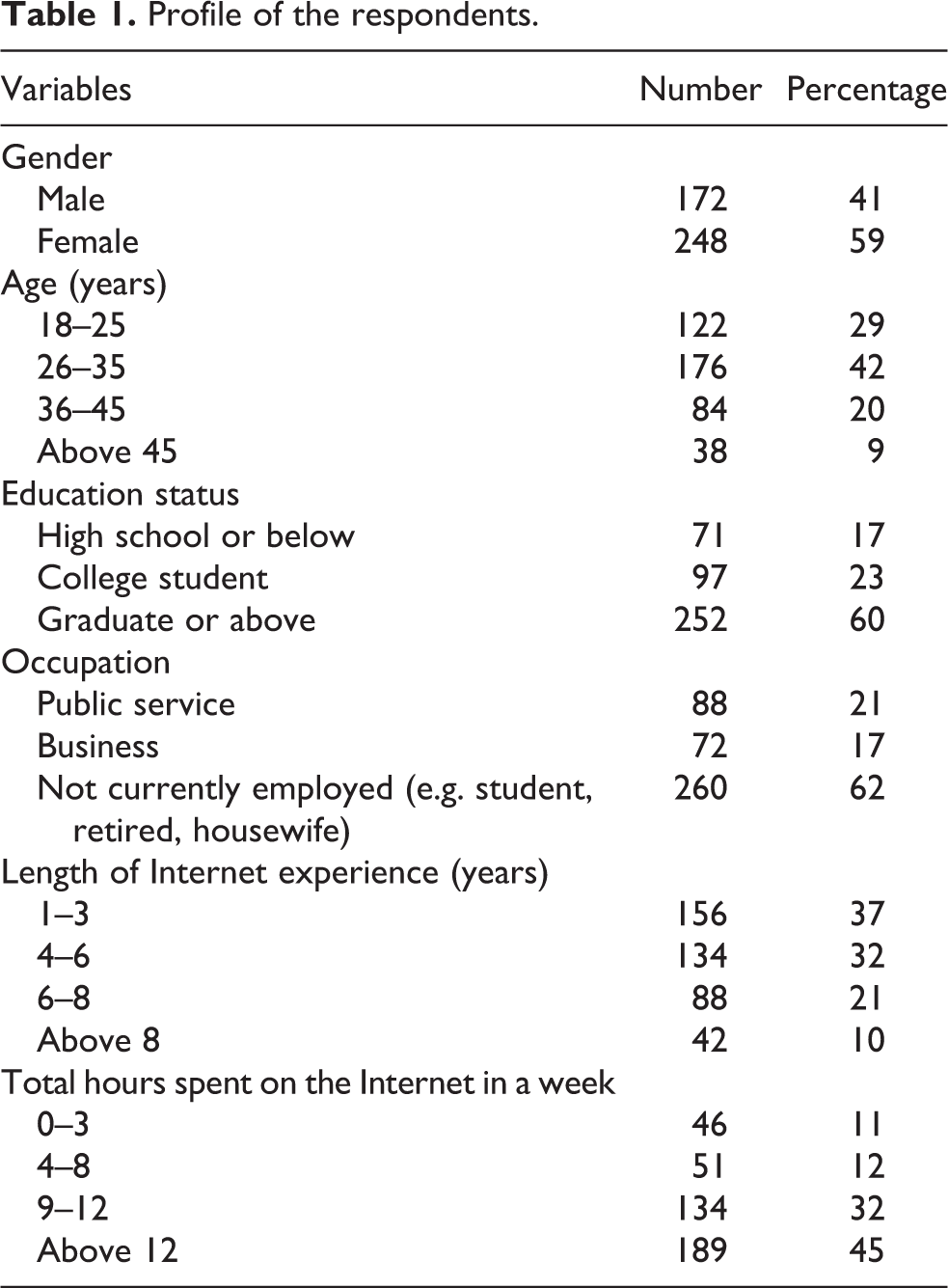
In China, users of QR codes are growing rapidly, 61 and these codes are used in many daily activities including marketing, social platform (such as WeChat), m-payment, 61 online shopping, and ticket management. So we selected China as our research context. Primary data were collected by online Web-based questionnaire from November to December 2017.
Data collection process was adopted from prior studies. 28,37 A survey invitation link was sent to 3000 potential respondents, among them 476 followed the survey link. Additionally, the link of the questionnaire also subsequently and repeatedly shared and post on a variety of social sites, such as WeChat, Facebook, and Imo. From those sources, a total of 520 responses were received. After removing and filtering systematic missing data, 420 respondents were finally selected for analysis. Among the 420 respondents, 41% were male and 59% were female; the most common age-group of respondents was 26–35, the most common education level was graduate school or above, and the most common occupation was not currently employed. Once finalized, nonresponse bias (those respondents who had no shopping experience via QR code) analysis of data was analyzed using wave analysis. 37
Measurement items
For convergent validity of the measurement, our proposed study model was analyzed. That was performed via factor loadings (FLs), composite reliability (CR), and average variance extracted (AVE). 37,62 Table 2 shows that with some exceptions, most of these measurement items’ FLs value were higher than the recommended minimum value (0.7). 62 However, for getting accurate values for CR and AVE, those exception items were stored. Values of CR which is the latent construct indicator were also greater than the recommended minimum value (0.7). 62 AVE represented that the overall variance of the indicators calculated for latent construct was also higher than the recommended minimum value (0.5). 37,63 Table 3 showed the squared inter-correlations of the variables. Those squared inter-correlations symbolize the shared variance among the study variables and do not exceed the square root of average variance explained.
Reliability and factor loadings.
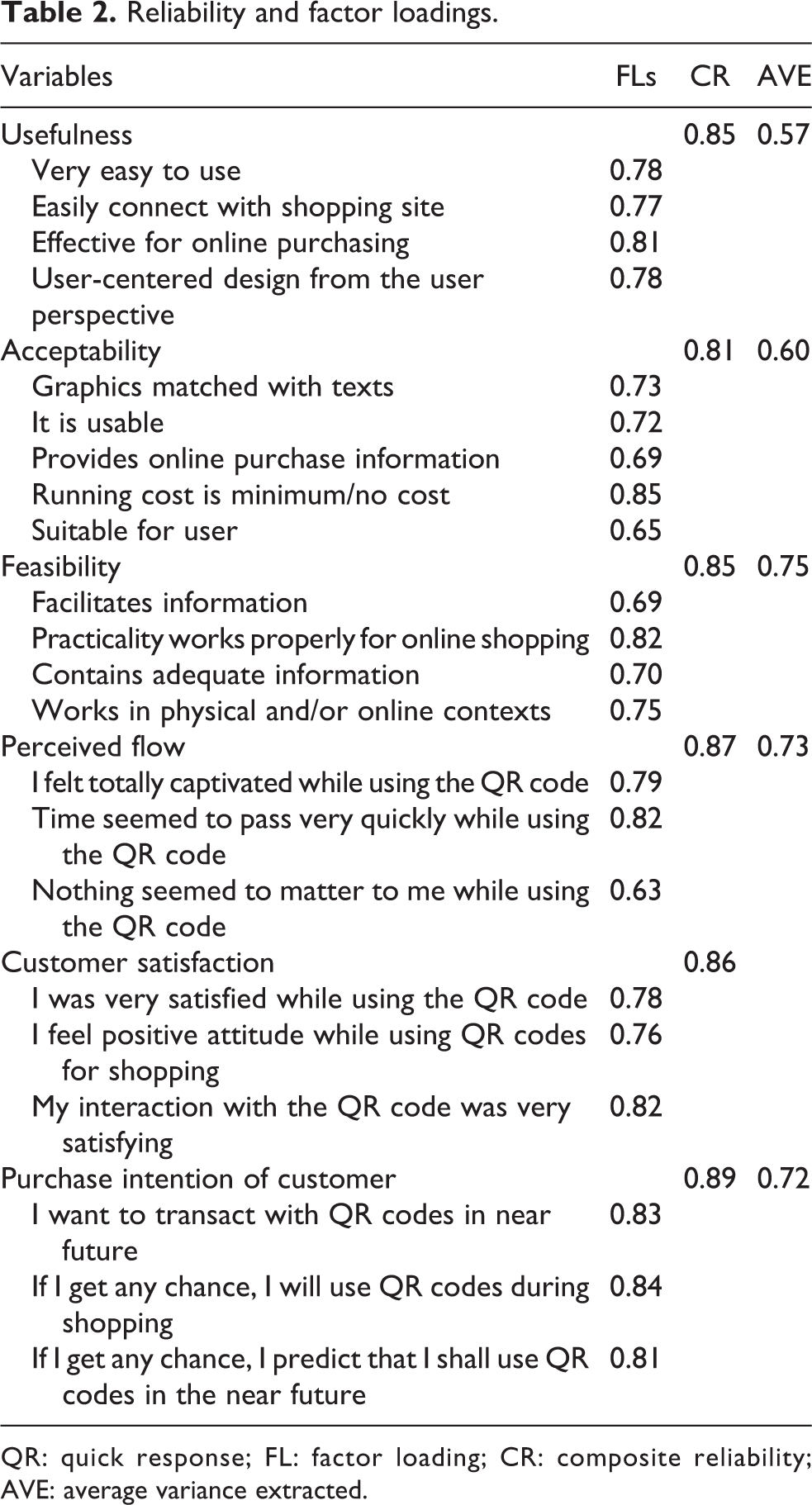
QR: quick response; FL: factor loading; CR: composite reliability; AVE: average variance extracted.
Squared intercorrelation among the constructs.a
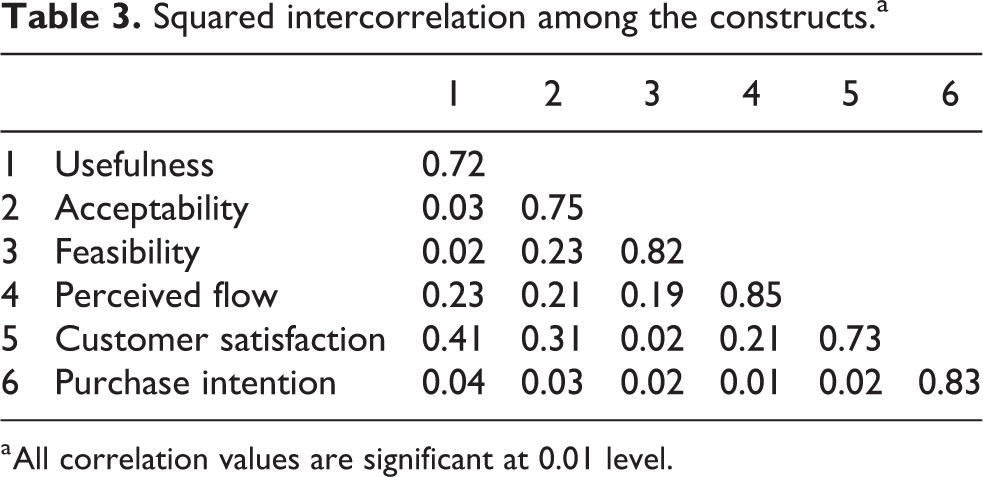
a All correlation values are significant at 0.01 level.
Discussion
The relationships between constructs in our proposed study model were test analyzed via covariance-based structural equation model using Amos 22.0. Figure 3 indicated that the χ 2 value was 723.19 with 344 degrees of freedom (p < 0.001); 3.12 was ratio of the χ 2 and the degrees of freedom. Relationship of all fit indicated a good model fit (goodness-of-fit index (GFI) = 0.79, adjusted GFI = 0.78, confirmatory fit index = 0.93, normed fit index = 0.91, root mean square error of approximation = 0.052). Only the GFI value (0.79) was at the marginal level of acceptance. 63 Figure 2 shows the structural model estimates. The estimation parameters are standardized path coefficients at the level of 95%, and all of the path coefficients were significant.

Usefulness, acceptability and feasibility of QR codes.
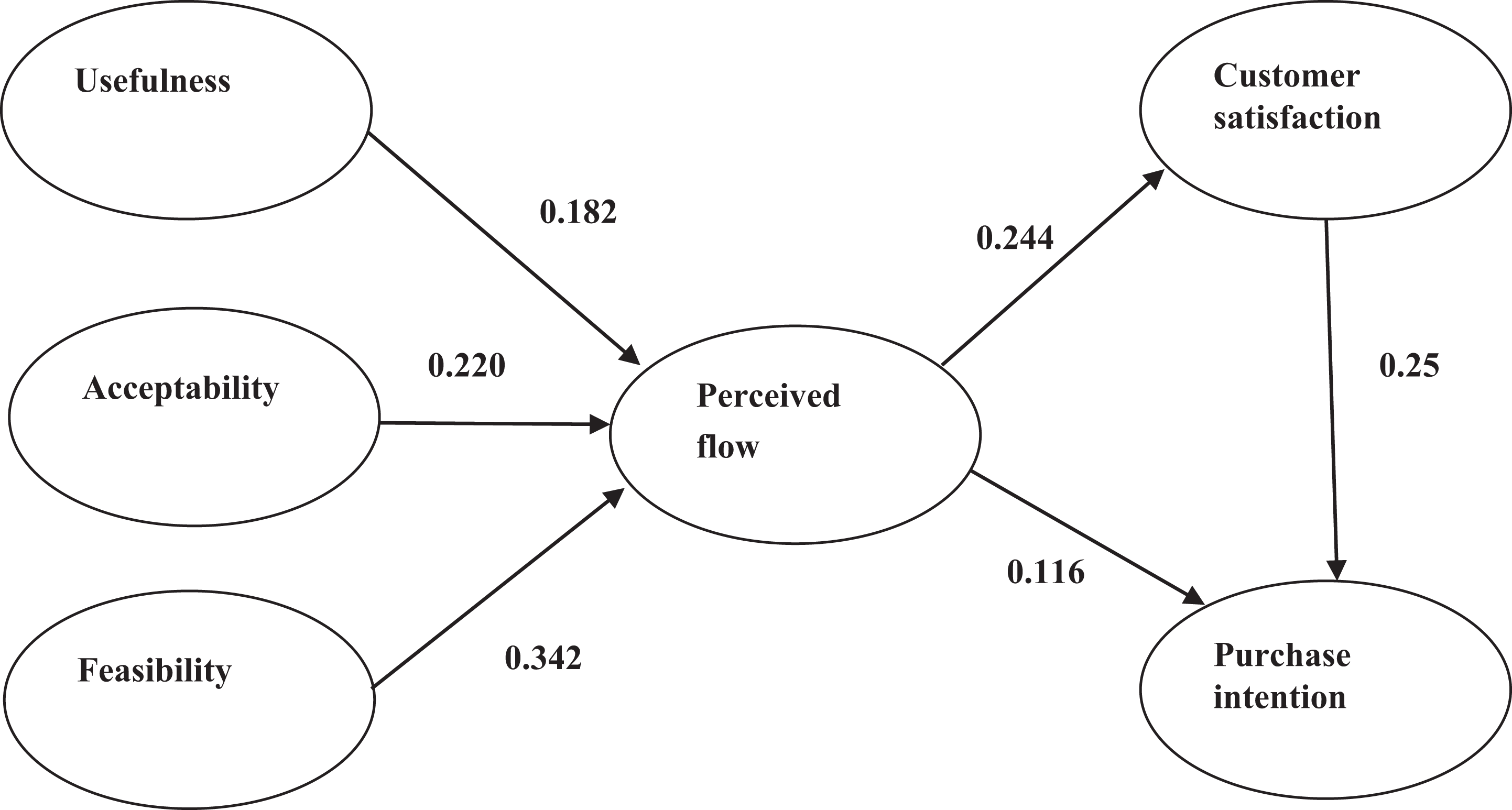
Results of structural modelling analysis.
Figure 3 represented analytical results that indicated that usefulness, acceptability, and feasibility are positively connected with perceived flow; as a result, H1a–c was supported. In the online shopping context, perceived flow is positively associated with customer satisfaction and purchase intention. H2a and b was also supported, and customer satisfaction via QR code is positively connected with purchase intention of consumers. This study showed that QR codes’ usefulness, acceptability, and feasibility have an impact on perceived flow, which then influences satisfaction and their purchase intention. From Table 4, we got that the total effects of the usefulness of QR codes on perceived flow, customer satisfaction, and customer purchase intention were 0.193, 0.033, and 0.102, respectively. The total effect of QR codes’ acceptability on perceived flow, customer satisfaction, and purchase intention was 0.241, 0.011, and 0.022, respectively, and the total effect of QR codes’ feasibility on perceived flow, customer satisfaction, and purchase intention was 0.021, 0.244, and 0.116, respectively. So we can say that in the online shopping context, QR codes’ usefulness, feasibility, and acceptability influence customer’s perceived flow and the result again affects their own satisfaction and purchase intention.
Direct, indirect, and total effects—estimates.a

a All correlation values are significant at 0.01 level.
Conclusion
Vast growth of information and communication technologies and the knowledge-based economic evolution are driving organizations to implement technical approach to business activities. 64 Implementing QR codes in marketing activities is a great deal in modern business because QR codes have great impact for online marketers; they can easily increase sales volume because of QR code’s usefulness, feasibility, and acceptability. QR code’s usefulness refers to very easy to use, easily connect with shopping site, very effective for online purchase, and user-friendly design; acceptability refers to graphics matched with texts, usable, providing information, cost is minimum, and very suitable for the user; and feasibility refers to facilitate appropriate and timely information and practicality works properly that work in physical and online context. This research supports the QR codes’ usefulness, acceptability, and feasibility as online shopping tools that can influence customer satisfaction and purchase intention. This study showed that QR codes are used for their usefulness, feasibility, and acceptability, which influence the perceived flow that indicates consumers felt totally captivated, felt very quickly time passing, and nothing seemed to matter to them while using the QR codes, which then again influence online shoppers’ satisfaction (consumer felt positive attitude and satisfaction for using QR codes) and finally purchase intention (consumers want to use QR code in near future), so online marketers should share their advertisement with QR codes that will influence customer satisfaction and purchase intention. Embedded QR code will help marketer to achieve the desired goal. Embedded QR codes with advertising are very helpful for the marketer to share and influence customer satisfaction and purchase intention because customer can easily scan the QR code provided by the marketer that influences purchase intention of customer. Sharing information with QR codes will influence customers to connect and share information with other customers in the online community. Also QR codes have been considered as tools of communication channel that can be conveniently executed by customers to obtain information and benefit from real-time transactions. 65 Additionally, QR codes facilitate that two-way communication via shopping websites can also be considered as a strong medium to manage and coordinate customer relationships. 65 This finding of this study is practically significant for both marketers and customers. Marketers should use QR codes as an embedded advertising tool with particular URLs that will lead to more profitability for shopping agency. In addition, customers can learn their behavior regarding QR codes in the online shopping context.
Limitations and future study
The implications of this study are tempered by several limitations, which should be considered in future research. This research was conducted only in the context of online profit-making organizations, so further studies can expand on our results by researching nonprofit contexts. This study only measured three dimensions of QR codes to operationalize the concepts of usefulness, feasibility, and acceptability of QR codes. However, there are other important issues related to QR codes in the literature, such as information, system quality, and service quality. Further studies may integrate those issues in our model for the online shopping and other context. Another limitation was that the sample was self-selected, so future studies could also test other possible ways of moderating the sample. Lastly, future studies may comprise diverse emotional components such as enjoyment, perceived excitement, or delight in our proposed model to calculate their consequence on customer satisfaction and purchase intention.
Footnotes
Declaration of Conflicting Interests
The author(s) declared no potential conflicts of interest with respect to the research, authorship, and/or publication of this article.
Funding
The author(s) disclosed receipt of the following financial support for the research, authorship, and/or publication of this article: This work was supported by the National Natural Science Foundation of China under grant numbers 71572034 and 71772038.
