




Abstract
Maintenance is one of the most crucial issues in today’s competitive manufacturing environment. Nowadays, productive methods are used in manufacturing plants to improve operations capabilities, which alternatively change business environmental factors leading to a competitive market. Consequently, selection and illustration of an optimal maintenance strategy play a significant role in achieving these goals. Also, lack of an integrated model is felt, one that consists of available criteria and options, a systematic approach in setting maintenance instructions and robust maintenance decision-making. So, based on the fuzzy analytical network process (FANP) method, which composes criteria and options, a new approach to selecting optimal maintenance strategy is proposed in this article. Here, using multi-attribute decision-making in conjunction with application of fuzzy numbers structure has been regarded as an efficacious method for determining the significance of each criterion and option. The criteria that are considered in the FANP method are organization, safety, administration, staff, and technical requirements. The options (strategies) that are taken into consideration in this study are time-based preventive maintenance, corrective maintenance, condition-based maintenance, reliability-centered maintenance, and predictive maintenance. After implementing the method proposed for a 5-MW powerhouse (a case study undertaken for the purpose of this study), the predictive maintenance strategy was selected. According to expert opinions, it is the administrative and staff requirements that must be highlighted for selecting the best strategies.
Introduction
Utilizing maintenance performance and management to encourage positive and proactive organizational change requires a management system for maintenance performance, which is designed to follow up on and enhance various aspects of maintenance effort. A process as such is supposed to be guided by the integration of factors involved in a critical success business, those which are derived from the overall strategy of the organization in question (Tsang et al., 1999). 1 Maintenance is defined as the practice of preserving a condition or situation or the state of being well-kept. Almost every industry has some sort of maintenance program for its physical assets. The starting point for the selection of the maintenance tasks for equipment is the maintenance classification and the related requirement specification assigned to the related location of the equipment.
The objective of the maintenance tasks is to secure the operability of the equipment, detect faults, and/or prevent functional failures. In maintenance management, evaluating criteria and selecting the best among them are complicated tasks due to the fact that various criteria and subcriteria such as cost, safety, strategy, and time requirements must be considered in the decision-making process. 2
The activity of maintenance management must be executed as effectively and efficiently as possible because it certainly affects the total operating costs of the industries: “It is better for the company to consider maintenance activity as one that could bring profit to the company in long term.” 3
Machine failure may cause various business-related problems such as failure to meet delivery dates, poor product quality, and loss of profit and opportunity. This being the case, maintenance should be carefully thought of in terms of planning, investment, and control. 4 Maintenance of industrial machinery has long been one of the major issues in all industries. Maintenance costs in all industries are typically 5–6% of fixed assets and reaches 12% in heavy industries. 5
Growing importance of maintenance has created a keen interest in the development and implementation of optimal maintenance strategies to improve the reliability of the system that includes preventing the occurrence of defects and reducing the maintenance costs of the system. Maintenance activities are especially necessary on systems whose failure or interruption can have serious consequences, namely those that provide critical services for society, such as power plants, defense and support military systems, and so on. 6
This article will aim at setting forth a new approach for selecting the optimal maintenance strategy based on the fuzzy analytical network process (FANP) method, which composes criteria and options. The use of multi-attribute decision-making in conjunction with the application of fuzzy numbers structure has been regarded as an efficacious method for determining the significance of each criterion and option. So, these criteria will collectively form a numerical priority with the aid of FANP (to precisely make realistic comparisons and inference of each criterion and option).
The problem
The study was carried out in a 5-MW powerhouse unit industry. Recently, production rate has declined in the industry due to lack of maintenance strategy. The company is currently using an annual maintenance strategy as a result of which the profit earned has been fluctuating every year. To be lucid, the problem here is “the absence of an optimum maintenance strategy for improving the production efficiency for better quality and quantity of products”. Therefore, the major problems faced by the company are as follows: Lack of proper annual maintenance has generated a decreasing trend in production. Selection of maintenance strategies is usually complex and unstructured and faces multiple constraints and perspective. To choose the proper criteria from numerous indexes available today is a complicated problem for the company. A serious need for an integrated model consisting of available criteria and options has also been a challenge. Finally, efforts to apply specialists’ opinion to selecting an optimal maintenance strategy has failed so far.
Because of the abovementioned issues, a multi-criteria method of decision-making based on cognitive uncertainty information processing was proposed and used in the decision concerning the maintenance strategy. Implementation of the strategy in an organization requires coordination of that strategy with the interests of its stakeholders. So, selecting the maintenance strategy is no exception. At each step, an expert opinion is of utmost priority. For a maintenance strategy to work, first, both the strategies and the criteria accepted by experts are examined; then, the researchers create different models trying to select the optimal maintenance strategy. So, choice of the right maintenance policy is one of the challenges for which the fuzzy multiple criteria decision-making (MCDM) could be applicable.
The main purpose of this article is to determine the optimum maintenance strategy for improving the production efficiency. By using the FANP tool, the best strategy could be selected, so that the quality and quantity of the products can also be improved. Thus, the company can meet demands and an increased profit rate can be attained accordingly.
Research literature
Research theoretical framework
Today, maintenance activities are done to improve machine performance, reducing the need to perform repairs and remove all causes of damage. Choosing the best set of maintenance policies for various forms of failure is a difficult issue. This choice requires science and knowledge in areas such as safety, environment issues, cost, budget constraints, staffing efficiency, main time between failure, main time to repair), and so on for each piece of equipment. 7
A proper maintenance schedule is required to improve reliability and safety of systems. A decision-making approach to maintenance strategy remains a long-standing challenge in those systems, and based on cognitive uncertainty information processing, a multi-criteria method of decision-making for the system is to be used in the maintenance strategy decision. 8
Selection of the optimum maintenance strategy for each piece of equipment is a vital decision for manufacturing companies, and many studies have been devoted to this area. 24
Faghihinia and Mollaverdi mention that most maintenance managers see the cost criterion as the most important and the only one to take into account. This kind of view is a very risky one. Therefore, one of the most important goals for maintenance managers is to reach a broader view by considering more than one criterion in making an appropriate decision for replacement of an item in preventive maintenance (PM) problems. 9
Considering various criteria, properties of strategies, and conditions of the industry in question, researchers attempt to choose the most optimal maintenance strategy.
In this regard, Bevilacqua and Braglia found the optimal strategy of the five preventive, predictive, condition-based, corrective and opportunistic strategies at an oil refinery in Italy. The criteria used in the survey included damage, constructability, added value and cost. Also in this study, the use of analytic hierarchy process (AHP) was investigated for optimality. 10
In a review by Almedia and Bohoris, some basic decision theory concepts were presented and their applicability in the selection of maintenance strategies was also discussed. 11
Also, Triantaphyllou et al. (2012) put forward a method for finding the criticality of each criterion that deals with maintenance strategies in which we address the simplification of the complex maintenance criteria. 12
Moreover, a new approach to selection of the optimum maintenance strategy for each class of system within a just-in-time environment was presented by Azadivar and Shu. 13
Wang et al. investigated the optimal strategy in a thermal power plant in China using the Fuzzy AHP method. In this research, standards of safety, added value, cost, and availability were taken into account. Preventive strategies, based on conditions, as well as the time-based, PM and corrective maintenance (CM) are the candidates of this research. 14
The research by Mollaverdi and Hossein Abdollahi, which considers system ability, developed a quantitative–qualitative model, which in addition to optimal strategy selection gives optimal time to strategy changing. One of the most important advantages of this model is that it not only brings into consideration both quantitative and qualitative criteria but also its selection strategy is dynamic. For this purpose, it uses the multi-criteria decision-making approach by considering the cost criteria. Finally, a factory manufacturing automotive parts was selected as the case study, and as user-friendly tools, diagrams were utilized for the sensitivity analysis of the results. 15
Using the strategic planning process and the FANP method, the research by Babaesmailli et al. provided a ranking for strategies of Strengths Weakness Opportunities and Threats (SWOP) matrix in a tile company and used these rankings to choose an optimal strategy. The strength of this study is in the quantification of the SWOT matrix components and taking into account the dependence between them. 16
Sadeghi and Manesh obtained the optimal strategy in Isfahan Mobarakeh Steel Company. In this article, researchers at first formed a 13-member team of professors, professionals, and industry experts, and considering the conditions of the industry, they then selected safety, delivery, quality, cost, and availability criteria. Each of these criterion goes with some subcriteria. Dependence between these criteria and subcriteria has a great impact on the selection of optimal solutions. Moreover, three strategies of world-class maintenance systems (WMS), total productive maintenance (TPM), and traditional maintenance (TM) were selected as candidates.. Finally, by establishing a relationship between the properties of the desired strategies and the capabilities of the industry using the FANP, a model was developed and WMS was chosen as the optimal strategy. 17
To our knowledge, there is no research in the field of maintenance strategy selection by integration of ANP method and fuzzy approach. So this article proposes an effective solution based on the multi-attribute criteria decision-making (MADM) method and fuzzy set number to help industry for the selection of favorable maintenance strategy.
This article sets forth an effective solution based on the fuzzy approach to help industrial companies select a favorable maintenance strategy. The aim of this article is to select an appropriate maintenance strategy for improving the production efficiency in a casting industry. Here, we considered 16 characteristic factors that could play a role in the selection of the maintenance strategy. The choice of maintenance strategies is a typical MCDM problem with differing goals. To solve this problem, FANP was selected for finding the dependency among criteria and options. The model presented in this article gives a clear view of the maintenance strategy selection involving five main criteria of organization, safety, administration issues, staff, and technical requirements. In view of the relations between these factors, a network with many criteria and subcriteria and a pairwise comparison were made. By using the FANP tool, the best strategy was selected so that the quality and quantity of the products can be improved. Thus, the company could meet the demands and an increased profit rate can be attained accordingly.
Fuzzy multi-criteria analysis
To solve the multi-attribute decision-making problem of limited schemes, multiple attribute indexes are generally synthesized to a single evaluation index. So, it is necessary to determine the weighing coefficient of each attribute index. 18 The process of MADM looks for the best of all the existing alternatives. The use of one or another multi-attribute decision theory depends mainly on decision-making situations. 19
MCDM refers to making decisions in the presence of multiple, usually conflicting, criteria. Here, different units of measurement, quality characteristics, and relative weight might be considered for each different criterion. Furthermore, some criteria may possibly be measured numerically and others could only be described subjectively. Modern MCDM foundations were developed in 1950s and 1960s. Currently, dozens of methods are available for solving MCDM problems. These methods are capable of providing solutions for a vast scope of management problems. 20 Development of MCDM research studies accelerated during the 80s and early 90s and continues to show rapid growth.
Despite the fact that MCDM has been successfully applied to various areas of knowledge, it still cannot fully match imprecise, vague, and incomplete information. The flexibility, dynamic, and receptive nature of MCDM opens a new multitude in leveraging the decision theory. When Bellman and Zadeh (1965) 21 , a few years later, introduced fuzzy sets into the playing field, and it paved the way for a new category of decision methods to deal with problems that had been inaccessible and insolvable with the standard MCDM technique. When the fuzzy set theory was introduced into the MCDM research, the methods were basically developed along the same lines. The first category of fuzzy MCDM contains a number of ways to find a ranking. This includes the degree of optimality, hamming distance, comparison function, fuzzy mean and spread, proportion to the ideal, left and right scores, centroid index, area measurement, and linguistic ranking methods. 22
The fuzzy sets theory introduced by Zadeh has been very successful in dealing with problems involving uncertainty. With an increase in inaccurate and vague information in real-life problems, several extensions of the fuzzy sets have been developed, one of which is the intuitionist fuzzy set (IFS) pioneered by Atanassov, which has a membership function, a non-membership function, and a hesitancy function. Zadeh presented a type-2 fuzzy set that allowed the membership of a given element to be a fuzzy set. The type-n fuzzy set generalized type-2 fuzzy set, thereby permitting the membership to be a type-n − 1 fuzzy set. 19 The Fuzzy multi-set introduced by Yager allowed elements to be repeated more than once.
Since the concept of the hesitant fuzzy set (HFS) was established, it has gained increasing attention and has been successfully applied to many uncertain decision-making problems. Many studies have also been conducted on the application of HFS aggregation operators and distance and similarity measures to multi-criteria decision-making problems. 23 Soft computing techniques, such as fuzzy sets and fuzzy logic, artificial neural networks (ANNs), and genetic algorithms (GAs), are useful in handling the uncertainty and vagueness associated with the real-world data. 24
FANP method
One of the primary examples of multi-criteria decision-making techniques is AHP, which is suitable for most complicated problems. Sa’aty founded ANP and offered it as a generalization of AHP. While AHP provides a context for hierarchical structures with single-direction relations, ANP allows modeling if internal relations between different levels of decisions and criteria exist. 25 ANP is developed to generate priorities for decisions without making assumptions about a unidirectional hierarchy relationship between decision levels. 26
One of the drawbacks of ANP is lack of uncertainty and complete reflection of human thinking in modeling. This kind of uncertainty in priorities can justify the fuzzy method. In other words, using the fuzzy model has more compatibility with linguistic and often ambiguous explanations to carry out a long-run prediction and to make decisions in the real world. In fuzzy literature, the rate produced by a decision maker is a fuzzy number originated from the membership function. This function specifies the membership degree of each member. Therefore, an exact description of each decision-making process is presented via merging fuzzy concepts with ANP.
In fact, in case ANP has all the characteristics studied so far, it will be a more general approach than AHP. Most decisions do not possess a hierarchical structure due to the fact that they incorporate the interaction and interdependence that are found between the components or higher and lower levels. To convert ANP to an FANP, one must use nine-component triangular fuzzy numbers (TFNs). By presenting fuzzy collection theory, Zadeh interprets and justifies the uncertainty related to the resulting ambiguity and conception as though a simulation of human thought is carried out. The FANP is a development of ANP. Additionally, the FANP has been employed to encompass the relationship between all the criteria affected by each other, thus making the relationship between selection criteria look more real. 27
The fuzzy numbers used in this method are triangular fuzzy numbers, and the fuzzy scale utilized is illustrated in Table 1.
Definitions of triangular fuzzy scales.
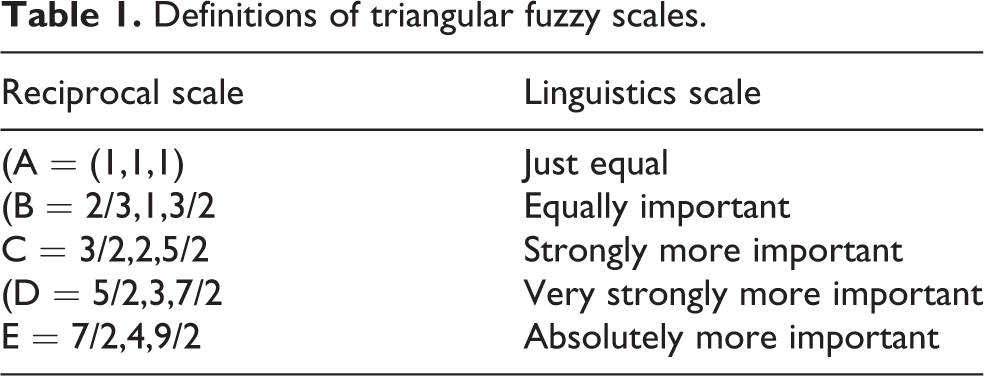
These scales are used for pair comparison. Suppose these two triangular fuzzy numbers are the following:



In the above equations, Li is the lower limit, mi is the average limit, and Ui is the upper limit of the triangular numbers known as optimistic, indifferent (average), and pessimistic limits of opinions. Figure 1 depicts two triangular fuzzy numbers in coordinate axis.
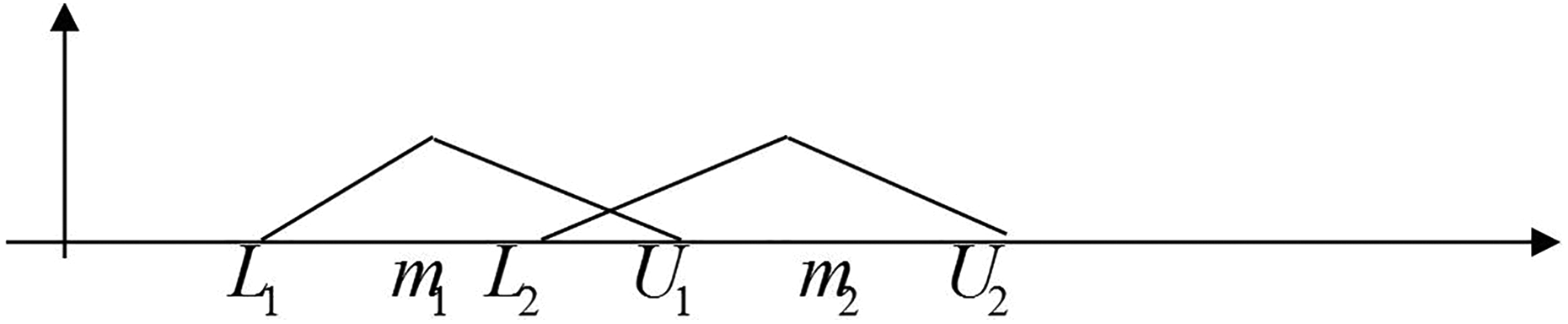
Two triangular fuzzy numbers (M 1, M 2) in coordinate axis.
The steps of FANP analysis can be given as in the following:



where W is a non-fuzzy number:

Criteria and options for selecting the optimal maintenance strategy
In recent years, the importance of maintenance and maintenance management has risen. Fast development of technology and automation has reduced energy production labor and increased the amount of capital employed for the production of equipment and development of structures. Use of an optimum maintenance strategy that goes along with the organization’s capacity proves a significant move in reducing the cost of maintenance.
3
Subsequently, a list of alternative maintenance strategies that are most popular in the literature are presented: CM: This strategy has also been called as fire-fighting, failure based, or breakdown maintenance. When this strategy is applied, maintenance is not performed till a failure occurs. Time-based PM: Here, maintenance is planned and performed periodically in accordance with the reliability characteristics of equipment to lower the risk of frequent and sudden failure. This maintenance strategy is called time-based PM, where the term “time” may refer to calendar time, operating time, or age. Condition-based maintenance (CBM): In this case, depending on the measured data received from a set of sensors in a system, maintenance decision is made at the same time as use is made of in the condition-based maintenance strategy. Hitherto, several monitoring methods have already been available, namely vibration monitoring, lubricating analysis, and ultrasonic testing. Predictive maintenance (PDM): This is a strategy that could foresee degradation of the temporary trend of performance and predict faults occurring in machines by analyzing the data related to the observed parameters.
28
Reliability-centered maintenance (RCM): In this case, analysis puts forward a structured framework to analyze the functions and potential failures in a physical asset (e.g., an airplane, a manufacturing production line, etc.), while the focus is kept on preserving the system functions instead of maintaining the equipment. The purpose of RCM is to create scheduled maintenance plans, bringing an acceptable level of operability along with a favorable level of risk in an efficient and cost-effective manner.
29
In manufacturing industries, choosing the maintenance strategy serves the goal of keeping the production resources applied in their best performances. A suitable maintenance strategy proves to be of considerable importance in the industries’ profitability and acts as a factor that impacts on industries’ general performance. 3
To select the most appropriate maintenance strategy, we can always find a plurality of criteria. Some of them are quantitative such as hardware and software costs, training costs, time between failures, and equipment reliability. Also, many maintenance objectives or comparative criteria should be brought into consideration here, for example, safety and cost, for the purpose of selecting the suitable maintenance strategies. 28
The criteria of safety, cost, and time were surveyed by Joshua and Mathew in 2016. The research, named as “Selection of an Optimum Maintenance Strategy for Improving the Production Efficiency in a Casting Unit”, attempted to find the best maintenance strategy between scheduled maintenance, reactive maintenance, corrective maintenance, and predictive maintenance. 30 In addition, Milad Aghaie and Safar Fazli used the “technical requirements” as one of the criteria clusters in their research. 33 The four evaluation criteria considered for the maintenance policies by Siew Hong and Shahrul Kamaruddin are safety, cost, reliability, and feasibility. 31
The priority vectors set forward as the alternative management strategies earlier (Corrective, Preventive and Predictive maintenance) were calculated under each criterion of low maintenance cost, improved reliability, improved safety, high product quality, minimum inventory, and return on investment, accepted and explained in a research under the name of “labor-enhanced competitiveness” by Odeyale et al. 3
Many essential factors that can be used by researchers and engineers to select the optimum maintenance policy were mentioned in the literature. Conversely, there is a need for general criteria to be more flexible and applicable in accordance with a variety of organizations. 32
In this article, the recommended critical factors (in this study, automobile manufactory) for examination and selection of the policy are grouped into five:
The administrative requirement consists of operational infrastructure area, the hardware, software, and technical tools.
The meaning of staff requirement is the readiness, acceptance, and training requirements in order to have professional staff as far as needed.
The safety requirement includes personnel safety, facility, machine security, and environmental concepts.
The organizational requirement contains management and integrated management concepts for the implementation of a new approach to maintenance strategy.
The technical requirement seeks to improve efficiency and decrease the break times and costs of operation.
Model development and implementation (case study):
The proposed methodology in this article includes the following steps: Generalizing the criteria and options for selecting a productive maintenance Inclusion of a quantitative methods (FANP method)
In the light of our literature review, we selected some criteria and options by using expert comments in the company.
In Figure 2, a decision tree of the goal (optimal maintenance strategy selection) has been delineated, and the goal has been defined to be with 5 criteria (organizational issue, safety, administrative issues, staff, and technical requirements) considered for prioritizing of requirements.
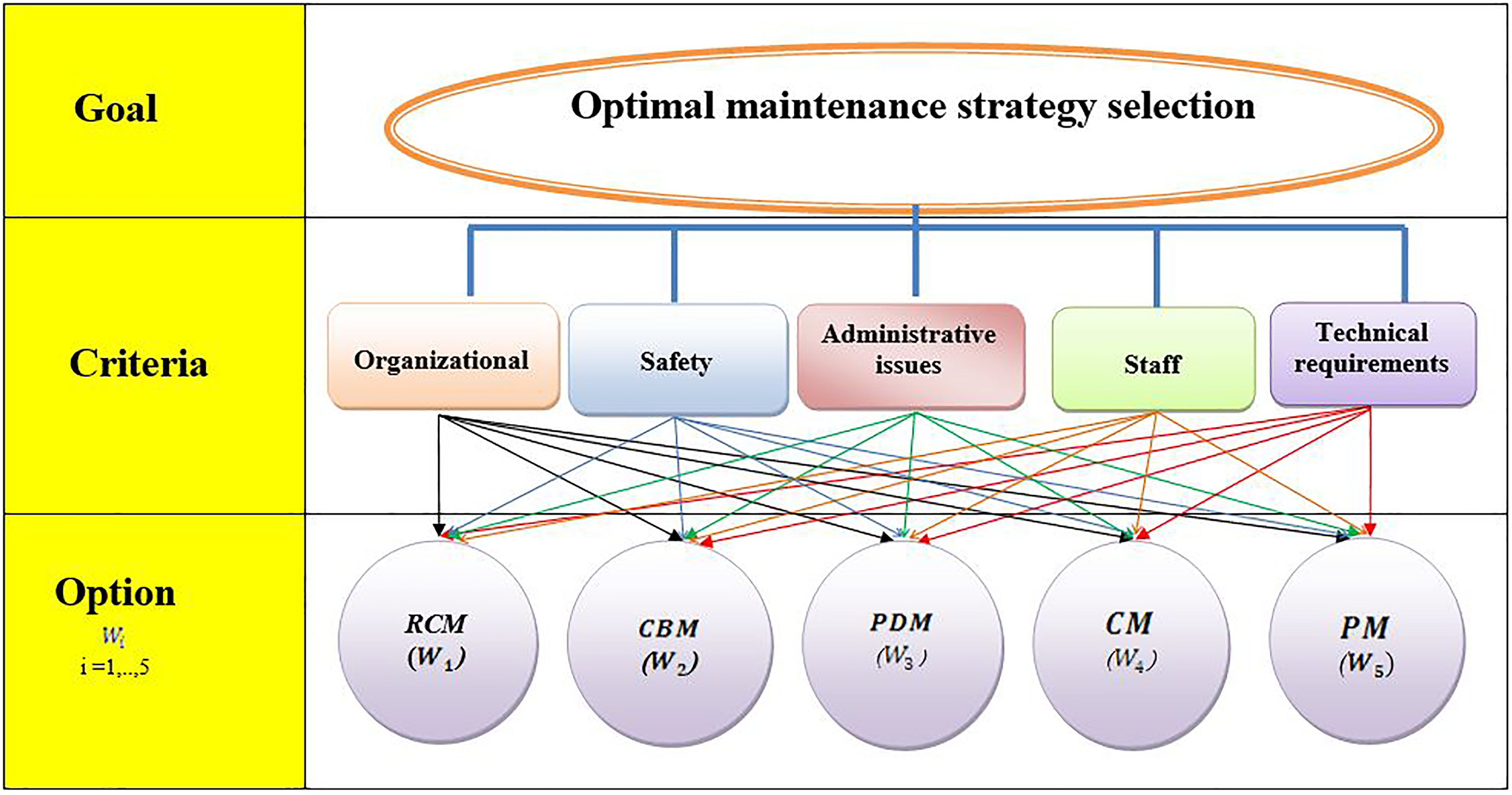
Goal decision tree.
For mutual comparison of options, a few experts in the company were gathered together and their viewpoints were collected. To shape this team, candidates possessing certain qualifying factors, such as adequate knowledge for decision-making and organizational familiarity were on the top of the list.
At the first step, consensus and unanimity for establishment of criteria and options (gathered from the literature review) was obtained by holding expert meetings. To prepare an enquiry about the importance and priority of options, criteria, factors, prioritizing, numerous questionnaires in the form of matrices were provided after normalizing and scrutinizing. In these matrices, rows and columns correspond to the criteria and options (as shown in Tables 2 to 4). Numbers in each cell in the matrices emphasize the priority of the criterion or measure versus others.
Criteria comparison for maintenance strategy via safety criteria.
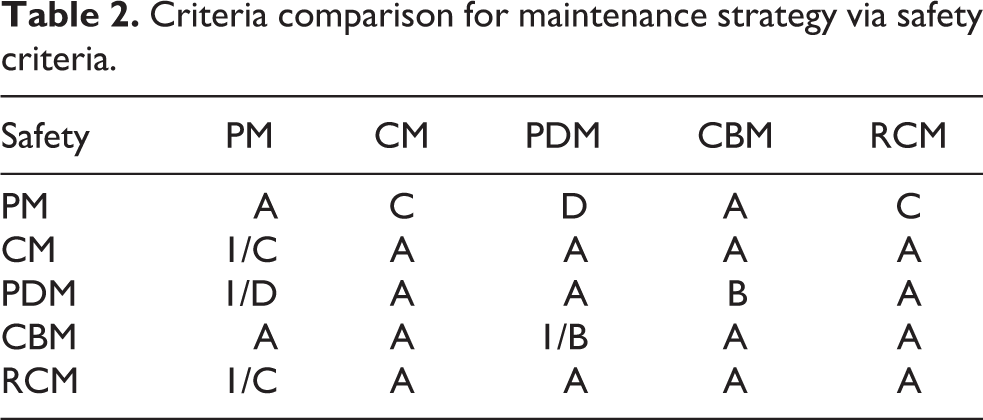
Criteria comparison for maintenance strategy via technical criteria.

Criteria comparison for maintenance strategy via safety criteria.

To complete these matrices, experts were required to make paired comparisons on the basis of the fuzzy logic and in accordance with fuzzy numbers of Table 1. Then, the geometrical average was used to gather the resulting data. After having fully utilized expert ideas and their inference in peer comparisons, the priority of criteria and options was developed.
A detailed description of the methodology is given below:
After the opinions and inferences of the experts were applied to the paired comparisons and the aggregation of the comments through the geometric mean of each stratum, the priority of each criterion and option is extracted on the numerical scale.
According to the MADM rules, we must ask all experts about the subject we are dealing with, that is, the survey (in the form of matrices provided). For this particular issue, 15 experts were selected for this case study, who were fully familiar with the criteria and options. To select them, attempts were made to consider such criteria as work experience, amount of knowledge, and awareness as to how to complete matrices. In the course of the meetings with this group, it was taught how to complete these matrices and make a paired comparison. Subsequently, during the period of 1–3 weeks, the experts completed and delivered the questionnaires.
By calculating the “inconsistency rate,” the validity of the comments applied was reviewed. Of these, the comments of six experts (according to the calculations of the inconsistency rate) were valid. Therefore, in order to aggregate the information obtained from this group of six, the geometric mean was used (in view of the fact that the pairwise comparisons of the data are created in proportion to the reciprocal property in the paired matrices, the geometric mean is mathematically the most appropriate for them).
Samples of the matrices completed by the experts are illustrated in Tables 2 to 4 as an example.
After obtaining these weights (each criterion via options), the results were combined with the mean of the average to obtain the coefficient of each of the options in line with the desired goal. (Table 5)
Comparison of criteria for the maintenance strategy via options.
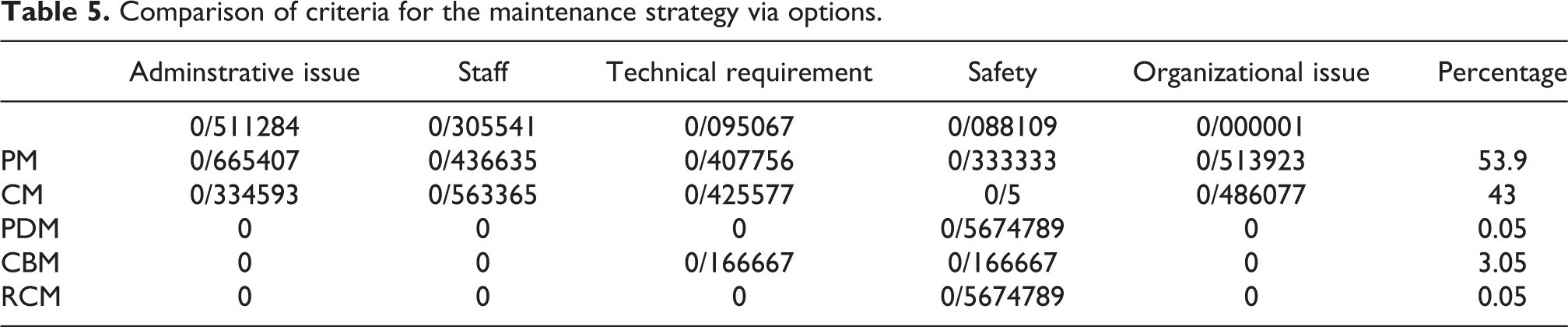
Table 6 is a general summary of all the priorities of the options. These weights were obtained in a way that the weight of each option is measured in line with the intended purpose. The results are shown in Table 6.
Priority value for the selection of maintenance strategy.

So the weight of each criterion, option, and, finally, the maintenance strategy were extracted (and presented in Tables 5 and 6) in accordance with the FANP method.
Conclusion and future research
Maintenance is defined as the practice of preserving a condition or situation or the state of being well-kept. A proper maintenance schedule is required to improve system’s reliability and safety, due to the fact that selecting the optimum maintenance strategy for any piece of equipment is undoubtedly and constantly a critical decision for manufacturing companies. The main purpose of this article is to determine the optimum maintenance strategy for improving the production efficiency. In this article, attempts were made to present a method based on the vague sets and Fuzzy theory to solve problems concerning decisions about the maintenance strategy. Moreover, in contrast with the traditional method, this study provides a practical way to understand attitudes of experts under uncertainty.
By FANP tool (applying expert’s judgment), the best strategy was selected, so that the quality and quantity of the products can be improved; and the company can meet the demands and an increased profit rate can be attained accordingly. The methodology used in this article was selection of a strategy related to maintenance via the FANP-based method which composes criteria and options. Here, using an MCDM in conjunction with application of fuzzy numbers structure has been regarded as an efficacious method for determination of significance of each criterion and options. Finally, by use of the FANP method as a case study in an automation company, the PM strategy was chosen. With this policy, equipment’s PM is carried out in fixed time intervals regardless of its failure history. According to expert opinions, administrative and staff requirements for selecting the best strategies should be highlighted. The top two options consist of operational area for infrastructures, the hardware, software and technical tools and readiness, acceptance and training requirements in order to have a professional staff as far as needed. These cases indicate that if the requirements related to operational/technical issues and human resources are met, the company can implement the strategy appropriately to reach high levels of productivity in manufacturing.
By implementing the model presented in this article, preventive maintenance strategy was chosen. As the name itself indicates, it is a schedule of planned maintenance aimed at preventing future breakdowns and failures of a system that is functioning properly. PM is an effective approach for reliability enhancement. In fact, PM is performed to prevent equipment failures before they actually occur and to keep the equipment working and/or extend its life.
By implementation of this strategy (PM), the problems referred to by the company under study will be overcome. So the strategy proves to have the following benefits: ease of predicting future occurrences; a more cost-effective type of maintenance; early detection or even prediction of a failure as a key point; and fault isolation and prevention of equipment breakdown.
As demonstrated by this case study, the method proposed in this article is a simple and effective tool for tackling the uncertainty and imprecision associated with MADM problems of maintenance decision-making, a tool that might prove beneficial for plant maintenance managers to define the optimum maintenance strategy for each piece of equipment in the system or subsystem. Hence, it can be used as a training material to enhance the skills of the maintenance personnel. As a future research path, applying another fuzzy MCDM method to determine the priorities of the strategy chosen could highly be recommended. In addition, we suggest comparison of those methods and measurement of efficiency of each method as a new line of research.
Footnotes
Author contributions
Contributions by the authors of this article included concept and design of the study, analysis and interpretation of the data, and writing and revision of the manuscript. All the authors participated in the screening of the results and contributed to the final draft.
Declaration of Conflicting Interests
The author(s) declared no potential conflicts of interest with respect to the research, authorship, and/or publication of this article.
Funding
The author(s) received no financial support for the research, authorship, and/or publication of this article.
