




Abstract
New trends for capital goods manufacturers push towards selling the products usage or performance rather than the product itself. This evolution from traditional business models, based on the product sales, to new service-oriented business models (BMs), has received increasingly attention both in the academic and managerial community. Despite this, a limited application of service offerings has been observed in the capital goods sector. This article reports the results from a survey carried out during the T-REX project, funded by the European Union under the Seventh Framework Programme, and has two objectives: (a) to empirically investigate the way BMs of capital goods companies are configured and (b) to analyse the degree of service orientation of such BMs. Finally, the main challenges for practitioners emerged from the survey are discussed in this article, highlighting directions for future research.
Introduction
Nowadays, increased competition in the capital goods sector challenges product-based competitive advantage, and manufacturers should embrace new strategies based on other sources of competitiveness. 1 As a result, capital goods manufacturers are moving from product-centric offerings to services and solutions in order to increase and provide steady/balanced revenues during time, and to build sustainable competitive advantage. 2 In particular, services represent one of the main elements to design such new strategies where firms’ value propositions move from selling products to provide product-service-systems. 3 Such phenomenon goes under the name of servitization, a ‘transformational processes whereby a company shifts from a product-centric to a service-centric business model and logic’. 4
Thus, this transformation implies not only a redesign of the value proposition but also companies need to reshape their business models (BMs). 5 –7 However, manufacturers undertaking such a shift face numerous challenges 8 that may lead to the so-called service paradox. 9 Also for this reason, even though several manufacturers are considering to undertake servitization paths a limited application of service-oriented BMs (SOBMs) has been observed, especially in manufacturing companies. 10 The successful implementation of advanced services, in fact, is still portrayed as an exception, and mostly concern large-sized companies. 11 This article reports the main results of a survey, carried out on around 100 manufacturers, within a European project, in order to investigate the degree of service orientation of BMs of capital goods manufacturers, with particular reference to the machinery, automation and transportation (i.e. forklift truck and earth moving machines) sectors. The analysis is based on a structured framework, in order to advance knowledge on specific BM’s features and gaps.
The article structure is the following. The next section describes the methodology of the empirical research. The “Main findings” section describes the main findings from the survey, while conclusive remarks and directions for future research are drawn in the “Conclusions” section.
Research framework and methodology
In order to better understand the BM configuration of capital goods companies and to identify the main challenges, an exploratory survey has been conducted among European firms that operate in machinery, automation and transportation sectors.
We developed a preliminary framework aiming to make data collection and analysis coherent and interpretable with respect to the objectives of potential redesign of the BMs to become more service-oriented. In particular, we used as a reference framework the BM Canvas, 12 reported in Figure 1, which has gained considerable attention among practitioners and scholars alike and can be used also to describe SOBMs. 13

Reference framework. 12
Each element (building block) of the reference framework is investigated through one or more variables and specific questions of the survey, following the BM framework developed by Adrodegari et al., 13 which laid the conceptual basis for the survey. The survey has been first designed and validated by the three research centres involved in the project. The English version of the survey has been replicated in an online survey editor and then submitted to the managers of industrial companies taking part to the European project for pilot testing, to assess completeness, and improve clarity and wording. The pilot testing has provided three answers that have led to revise aspects such as terminology and length of the survey. The survey has been then translated into the Spanish, Italian and German languages by creating new versions in the online editor. Once translated, the survey has been submitted to companies, selected through a non-probabilistic sample technique, in their mother language by email and also as a paper version during industrial fairs. As a result, the survey was completed by 95 companies. According to the new ‘small and medium-sized enterprise (SME)’ definition (provided by the European Community [EC] – 1 January 2005), we classified respondents based on companies’ size: micro and small 25%, medium 29% and large 46%. The sample is characterized by a greater share of medium and large companies compared with the European Union population, where SMEs are largely predominant. This may be due to the greater awareness and interest on servitization by large companies, while SMEs are expected to have a lower degree of maturity on service-related aspects. From a geographical point of view, the responding companies operate mainly in Italy (49%) and Germany (32%). The responding companies mainly operate in the machinery sector (67%; i.e. machine tools, packaging machines, textile machines, etc.); the remaining answers belong to the automation (16%; i.e. system integrators and robot manufacturers), transportation (9%; i.e. forklifts and earth-moving machines) and other sectors (8%). The answers collected from the three mother languages survey versions have been coded using a ‘coding map’ in order to assure the consistence and readability of data collected and then gathered into a comprehensive database in order to perform the analysis. Each answer has been analysed in order to assess its validity and to find out imputation errors. Finally, descriptive analyses have been performed considering the whole set of answers and segmentations, following criteria derived from contextual variables such as dimension and industry sector.
Main findings
The main findings of this study are organized around the elements of the reference framework of the study (a more complete report of the survey is available in the documents area of the project website).
Value proposition
The first aspect investigated in the survey is the value proposition. In particular, considering the value that customers attach to the offered products and services offering, Figure 2 displays how offers are still oriented to product performances (average score: 3.27 out of 4) and productivity (3.05). On the other hand, although value sources such as minimization of life cycle costs and operational risks are among the constituent elements of SOBMs (Neely, 2008) 14 , they are still valued as less important by European manufacturers. This is a frequent gap also on the customer side: It must not be taken for granted that customers are aware of how offerings based on new service-oriented value propositions may provide better answers to their needs and solve their problems. Hence, manufacturers have to understand deeply their customers’ needs and problems first, then develop new value propositions more customer-oriented, and finally, build new BMs that allow generating and delivering expected value.

Value attached by customers (0 – not at all; 1 – slightly; 2 – moderate; 3 – quite high; and 4 – extremely high).
Another important aspect concerning the value proposition that has been investigated in the survey is the service offering that, as Figure 3 shows, is still mainly anchored to basic services. 1 In particular, this Figure highlights that services as repair, spare parts and are widely offered while intermediate and advanced services, oriented to support the customer and its processes instead the product itself (e.g. optimization of customer processes and maintenance contracts), are only rarely offered by most respondents. Technology-based services, such as product remote monitoring and diagnosis, are offered only by 65%, while around half of respondents (44%) do not offer 24/7 technical assistance. Percentage of companies that always offer the service drops below 20% both for services supporting the sales such as financing and for services that are useful to guarantee a second life for products such as product disposal/relocation and second-hand products selling. As expected, among the least offered, there are services that require a radical change in the company’s BM, for example, rental and pay-per-use contracts that are not offered, respectively, by 58% and 70% of respondents.
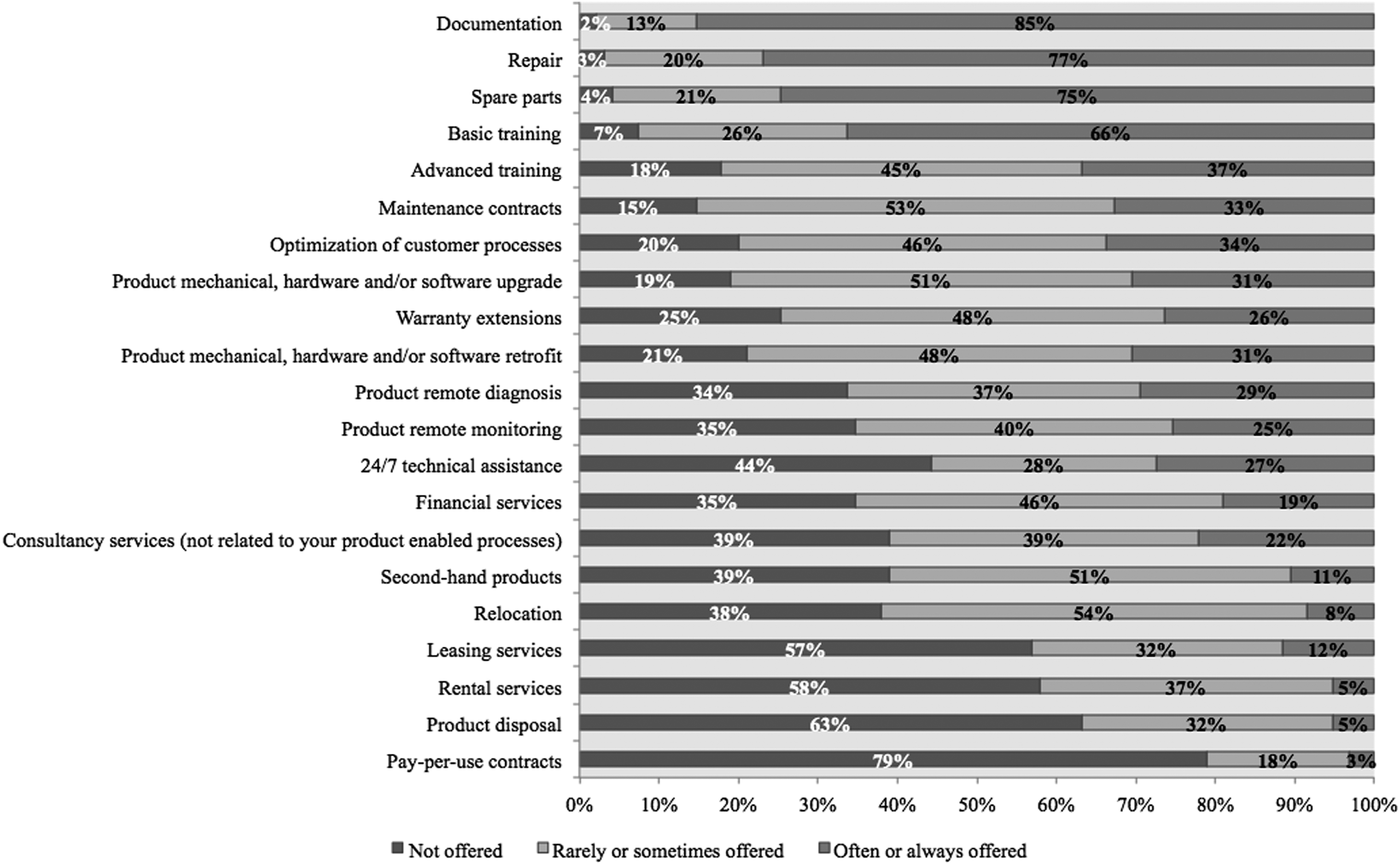
Service portfolio composition.
Important differences emerge among industrial sectors; in fact, companies operating in the transportation sector appear to have a more extended service offering with a consistently higher average score on almost all the services that aim to increase the product life cycle (e.g. sale of second-hand products) and this can enable new SOBMs (e.g. financial services, rental and pay-per-use contracts). On the other side, in the machinery and automation sectors, advanced and relational services are rarely, if never, offered and this partially explains the low adoption of SOBMs. 10,11 In fact, in order to be able to develop SOBMs, manufacturers first have to handle complex successful services such as maintenance contracts and warranty extensions, which imply high risks for the manufacturer.
Customer segments
As discussed above, companies should develop customer-specific value propositions that are linked to specific customer needs. 15 In fact, segmenting customers with specific criteria can enable the development of new, more customer-oriented value propositions. Therefore, customers should be segmented using multiple and advanced criteria. 13 However, our results show that the most common criteria to segment customers are still based on the revenue generated by customers through the product sales (84%) and their geographical location (72%), both based on information easy to collect for companies. As illustrated in Figure 4, criteria that rely on data such as the profits generated by customer purchase of products (62%) or services (45%) are the less adopted. In particular, this situation affects manufacturers that operate in the automation and machinery industry. Vice versa, transportation companies use to segment their customers with advanced criteria such as the profit generated by customer purchase of services (85%), underlining again the attention of this sector to the service business.

Adoption level versus perceived importance of customer segmentation criteria.
Customer relationships
The survey investigated in particular the adoption of systems and tools to facilitate the interaction and communication with customers. In fact, increased customer interaction is a distinguishing factor for SOBMs 6 and information sharing between the company and the customer is a prerequisite to establishing close customer relationships. 13,16 In particular, we focus on tools that can automate and ease the communication and interaction with customers in the after-sales phase, such as Web-based applications. These tools could improve the information exchange between a manufacturer and its customers as well as increase the effectiveness of service operations, especially in medium and large companies. However, Figure 5 shows that the majority of the responding companies has still not implemented such tools. In particular, quite surprisingly, ticketing applications that support companies and customers in handling service requests are still not implemented by the 64% of the respondent companies.

Diffusion of Web-based systems aimed to automatize relationships with customers during the after-sales phase.
Channels
The service delivery is a critical activity in SOBMs as it can directly affect customer satisfaction and retention. 6 In fact, field technicians interact frequently with customers, which makes them a key resource also for sales as they serve to establish a trust relation with customers. 17 Thus, often companies need to reconfigure the after-sales channel by internalizing/externalizing specific resources 15 and develop new resources dedicated to service provision. 6 Thus, in the survey, we investigated the channel configuration through which companies provide after-sales services to their customers. As depicted in Figure 6, all different after-sales activities are performed mainly internally by the majority of the companies (67%) and no particular patterns emerge looking at how answers are distributed across different contextual variables with the exception of the supply chain positioning.

Configuration of after-sales channels.
Moreover, as in SOBMs, companies need to rethink the way through which they create customer awareness about the new service offering, 13,16 we also investigated the ways firms help customers to evaluate their offerings. As illustrated in Figure 7, respondents consider the assessment of product reliability as the most important way to help customer to evaluate their offering, followed by other tangible and basic methods, such as comparisons of performance, use cases and on-site visits of previous and successful clients, that are typical of traditional product-oriented BM. Vice versa, sales and product life cycle–oriented methods, like the assessment of total cost of ownership and service level agreement, are still lacking attention.

Channels to support customers’ offering evaluation, perceived importance.
Key resources
A critical resource enabling SOBMs is the information and communication technologies (ICTs). 18 ICT systems allow to share information and knowledge extracted from data collected among different functions 15 and also towards customers and partners. Thus, traditional software systems (i.e. enterprise resource planning (ERP), customer relationship management (CRM), product life cycle management (PLM) and product data management) should be fully integrated, and applications that support supply chain management and collaboration activities should be implemented. 19,20 As expected, ERP systems are implemented by a large share of the sample (64% of respondents), while specialized systems aimed at managing product- and service-related information through their life cycle such as PLM systems have still low diffusion (18%). Thus, companies seem to adopt only rarely integrated and advanced information systems that can ease and support the information management needed to develop SOBMs. In particular, as presented in Figure 8, CRM systems would help managing relationships with customers and better collect and share information related with their needs. Moreover, PLM systems would support manufacturers in the collection of product life cycle data, helping different organizational functions to share important information that can foster a continuous product and service improvement. However, the above-described picture quite changes when categorizing companies according to their size: Consistently with theory and empirical evidences, a relationship between the ICT adoption level and company size clearly emerges.

Information systems adoption level across companies with different sizes.
A critical resource for most manufacturing firms is the installed base of goods. 17 Particularly, in SOBMs, managing the installed base is crucial, as it is a source of knowledge and creates critical insights about the products’ operation, enabling new service offerings and revenue models to be developed. 13 Monitoring several product health conditions, use and performance parameters allow developing advanced and proactive service offerings and related SOBMs. However, Figure 9 shows that only basic and easy to collect data such as maintenance history, or product failure modes and effects are widely managed by European companies. This is definitely another important gap on the way to develop new BMs.
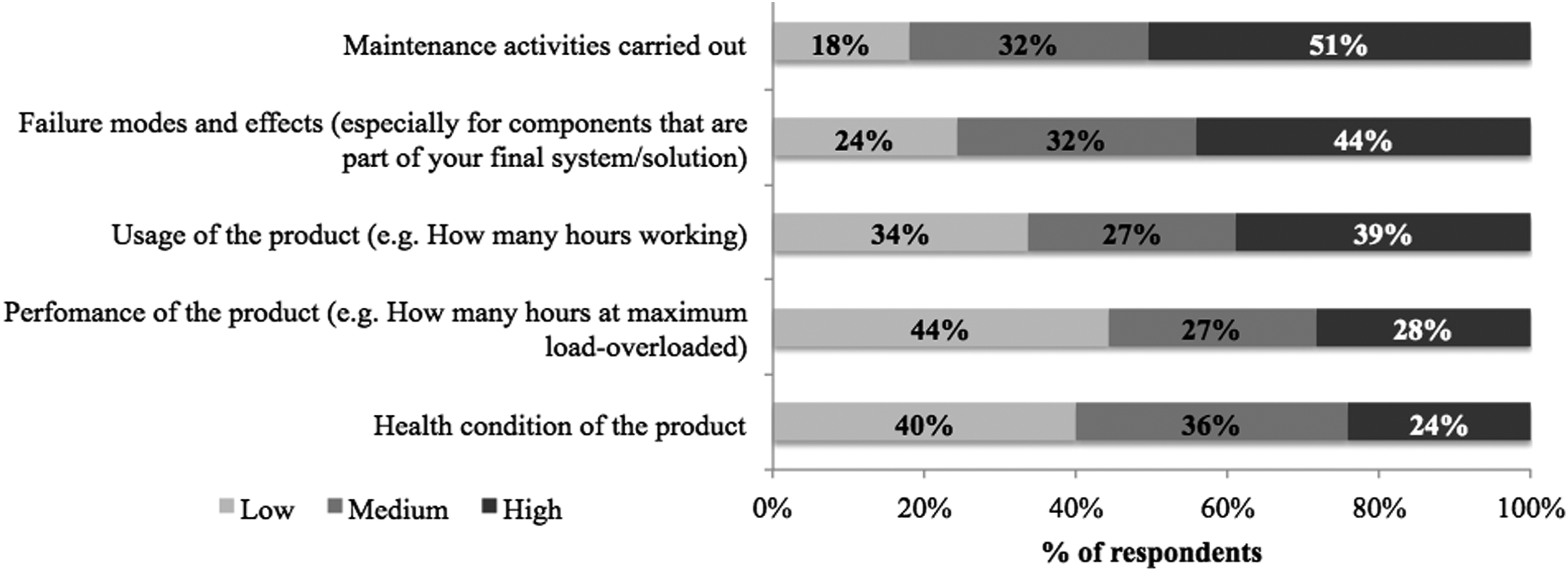
Data collected from the installed base (level of control).
Finally, as in SOBMs, the need for capital is high, since the company may remain the owner of the product, companies must have enough capitals or obtain funding from partners to sustain the new service offering. 21,22 It is not surprising therefore that 64% of the companies perceives financial resources as a critical barrier.
Key activities
In the survey, we investigated the perceived importance and the adoption level of a set of activities that typically support the development and delivery of SOBMs. 23 In fact, the service innovation may require industrial firms to change their internal organization, modifying current processes. 24 Quite surprisingly, we observe a relatively low importance attributed to marketing activities although the development of a new, more service-oriented value proposition could greatly benefit from the adoption of specific marketing activities to better understand customer needs. In line with other results, it also emerged that manufacturers are still focusing mainly on product-related activities and resources. As an example, in the majority of the sample, respondents perform research and development (R&D) on product, whereas R&D on services is perceived as the least important activity among respondents although it is crucial to develop new SOBMs. 25 In fact, as literature and best-in-class have shown, service-related activities (e.g. service engineering, new service development, etc.) are fundamental to successfully and effectively expand the service business. 24 Moreover, in order to effectively deliver the new service offerings, manufacturers have to develop new sales strategies. As an example, companies should be aware of the products’ total cost of ownership in order to price contracts correctly. 26 Further developing reliability assessment activities on product subsystems could contribute to increase product life cycle reducing at the same time costs, therefore increasing profitability of contracts that are typically offered by manufacturers implementing a service-oriented BM. Despite that, our analysis shows that a wide number of companies is still not performing these activities: In fact, only 20 companies assert that they have a high experience on the application of total cost of ownership models and in techniques for reliability assessment of product subsystems.
The transition from traditional BMs to SOBMs has to be supported also by service engineering practices. 27 In fact, new service development and service engineering activities may help product-centric firms to successfully extend their service offering and its integration level with the tangible component. To this end, specific processes, responsibilities, methods and tools should be defined. However, although the majority of respondents believe that the importance of service will increase (86% of the total), the number of respondents who state that their companies have already identified a specific strategy for the improvement and delivery of existing services, and for the new service development drops to 46% and 39%, respectively. Responsibilities for the development of new services are well defined only within 45% of the responding companies, as well as other important activities for the development of new services, such as formal processes, defined budget and methods, that are performed only by around 27% of the respondents. With the only exception of transportation sectors (Figure 10), the survey results show that the adoption of these kinds of practices is a main gap to be filled by companies that still have inadequate strategies, capabilities and methods for new service development.
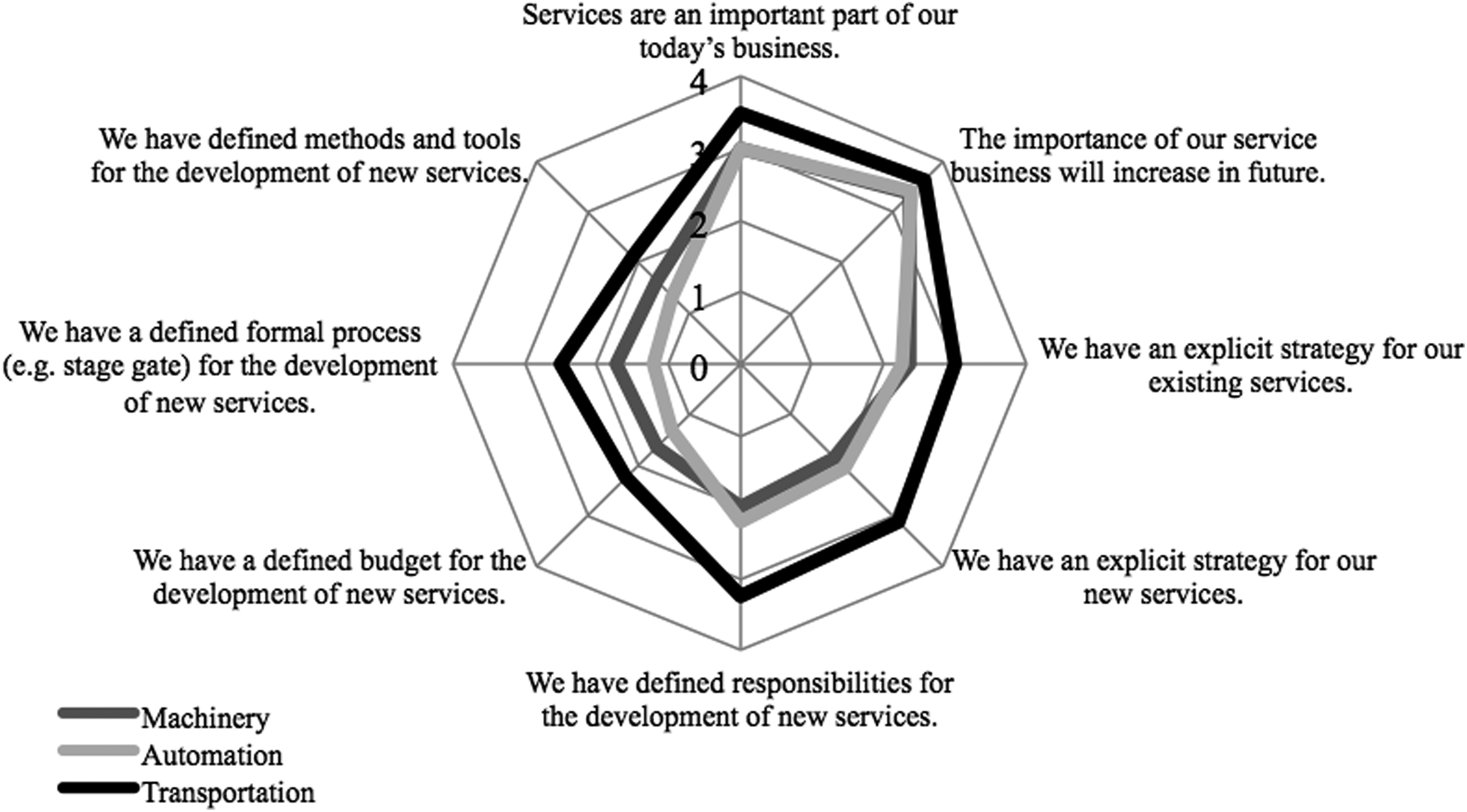
Orientation towards the service business and service engineering practices across industry sectors (0 – strongly disagree and 4 – strongly agree).
As mentioned before, SOBMs imply for the manufacturer higher responsibilities on product life cycle issues such as operating conditions and performances, maintenance and downtime costs. Activities such as fleet operation and maintenance practices have to be performed in order to mitigate the risks that such BMs generate for the manufacturer. 28 To achieve these objectives, remote monitoring as well as analysis on data collected remotely from the installed base would be truly beneficial. 29 However, as presented in Figure 11, advanced fleet operation and maintenance practices are still scarcely diffused among European companies: This represents a significant gap to be fulfilled by companies who are seeking to offer new service-oriented value propositions to their customers.

Diffusion of maintenance practices and fleet operation over the installed base. (0 – 0/20%; 1 – 21/40%; 2 – 41/60%; 3 – 61/80%; and 4 – 81/100%).
Partnerships
Partnerships are an important aspect to be taken into account when developing new value propositions and hence new BMs. In SOBMs, relationships with key partners, being suppliers of physical, human or intellectual resources, should be long-lasting, 15,22 for instance in order to improve spare parts management. 30 Due to the specific sectors analysed, it is not surprisingly that respondents are actually oriented towards long-lasting partnerships (Figure 12), although the majority of them (56%) still prefers to manage a wide portfolio of suppliers instead of focusing on few key partners. Another finding concerns the fact that while SOBMs generally require the association with a financial partner, only few companies have already started this kind of relationship.

Duration of relationships with suppliers.
Revenue model
The current low service orientation of the surveyed companies’ BMs can be inferred analysing the revenue model. In fact, we can observe that the main source of revenue is still the product sales, with an average contribution of 74% in the sample. Concerning service-related revenue components, the most important ones are spare parts sales and technical assistance (20%), while contribution of revenue components related both with advanced services such as service contracts (based on preventive/predictive maintenance) and with new SOBM such as renting or product-usage-fee (pay-per-x contracts) each contribute is overall under 6% of the turnover. Coherently with other results, the eight companies from transportation instead seem to have a more extended service offering (Figure 13). This is also due to the fact that, in this study, the transportation sector encompasses either manufacturers or dealers of earth-moving machines, elevators and forklifts, where SOBMs such as rental are spreading.

Revenue stream composition across industry sectors.
In order to better investigate this situation, specific questions related to obstacles concerning the development of new SOBMs have been addressed only to respondents that declared in a previous question that their companies are already implementing a service-oriented BM or at least have thought to offer them (32% of companies). Our results show that although the main reason for developing SOBMs stands in the possibility of locking-out competitor and achieve new competitive advantages, quite surprisingly, customers are perceived more as an obstacle rather than a driver in the servitization journey. In fact, at the same time, requests of service-oriented offerings from the customers are considered the less important drivers and customers’ culture is perceived as the more important obstacle to offer them (74%). Moreover, according to more than half of the respondents (64%), the data collection of product usage conditions information at the customers’ site represents another relevant customer-related obstacle.
Cost structure
Unlike the revenue stream composition, investigating the contribution of different cost centres to the cost structure of a company would have been too complex in a survey. Therefore, the cost structure has been assessed asking to respondents their perception of how different organizational units impact on the overall company costs. As shown in Figure 14, most of the respondents perceive production and purchase as the most impacting activities, in line with the results of the revenue model analysis and confirming that these companies are still product-oriented.

Impact of different companies’ function on the cost structure.
Conclusions
An exploratory survey was carried out to investigate the service orientation of the BM of companies that operate in the automation, machinery and transportation sectors. The main messages emerging form the survey are summarized in the following, also in relation with the extant literature: The adoption of SOBMs is still low in the analysed sectors, in particular with regard to the automation and machine tools industries where revenues are still dominated by product sales and services represent less than 20%. Moreover, this revenue stream is anchored to repair and spare part provision. Revenue coming from rental or pay-per-x models is negligible. This highlights a gap between what is posited by the literature in terms of rationale and benefits from servitization, and the actual adoption of this strategy by the capital goods industries surveyed in this article. It can be stated that the analysed sectors considerably lag behind other sectors much more mature in the offer of advanced services and SOBMs, as the photocopier one.
31
Although the majority of respondents believe that the importance of service business will increase in future (86% of the total), only 68% of them claim that services are already an important part of their company’s business. Moreover, Information systems and ICT technologies still have a great unexploited potential, especially in SMEs.
35
This does not relate only to the use of novel technologies for remote monitoring or fleet operation, but also to traditional software systems. Customer relationships are transaction-based and customers are perceived as an obstacle rather than an incentive to offer new SOBM.
23
This article contributes both to the practice and academic discussion about servitization, providing empirical data and adopting a novel perspective (i.e. the BM one) to analyse the service orientation of manufacturing firms. In particular, the business practice has been investigated through a specific research framework that defines a set of elements that can be used to assess the service level of companies operating in capital goods sector. Moreover, through this novel approach, we also identified significant gaps for each element to be fulfilled by companies seeking to develop new service-oriented value propositions.
As with any research, our study comes with some limitations that outline directions for future research. In particular, the data collection can be further extended in terms of sector and geographical areas besides the analysed ones, to increase the generalizability of the findings presented in this article. In addition, since little attention has been devoted to the description and formalization of SOBMs in literature, future works should focus on the development of guidelines, tools or techniques to be used by companies to design and implement SOBMs.
Footnotes
Authors’ note
The work described in this document has been conducted as part of the project T-REX (Life cycle Extension Through Product Redesign And Repair, Renovation, Reuse, Recycle Strategies For Usage & Reusage-Oriented Business Model).
Declaration of Conflicting Interests
The author(s) declared no potential conflicts of interest with respect to the research, authorship, and/or publication of this article.
Funding
The author(s) disclosed receipt of the following financial support for the research, authorship, and/or publication of this article: The research project T-REX (Life cycle Extension Through Product Redesign And Repair, Renovation, Reuse, Recycle Strategies For Usage & Reusage-Oriented Business Model) was funded by the European Union Seventh Framework Programme (FP7/2007-2013) under grant agreement no. 609005. For more details visit:  .
.