



Abstract
In contemporary society, increasing rates of divorce and non-marital childbearing have resulted in more children growing up without a father residing in the same household. Research on non-resident fathers has disproportionately focused on child support compliance or visitation schedules, with limited attention to the important quality and dynamics of father-child relationships. This scoping review examines the literature to identify the factors and dynamics of interactions between non-resident fathers and their contributions to children’s (0–8) social-emotional development in early years. Overall, this review establishes limited research and a gap in understanding of the interactional dynamics between non-resident fathers and their children. Furthermore, the analysis suggests that the narrow focus on behavioural problems and non-resident fathers’ visitation frequency as a measure of children’s social-emotional development demands a more holistic lens that values children’s perspectives.
Introduction
The increasing rates of divorce and non-marital childbearing in contemporary society have resulted in a growing number of children, living apart from their biological fathers, termed “non-resident fathers” in this paper. Research indicates that children raised primarily by single mothers may experience challenges associated with less contact and engagement with their non-resident fathers (Carlson, 2006; Demuth & Brown, 2004, Fegan & Palkovitz, 2011). Additionally, parental separation and the abrupt departure of one parent may lead to a child developing insecure attachment and anxiety issues (Bowlby, 1973).
Social-emotional development is a complex concept encompassing emotional expression, emotion understanding and regulation, behaviour regulation, social problem-solving and development of interpersonal skills (Denham, 2006). A substantial body of research demonstrates that children with secure attachment relationships established in early childhood are more likely to exhibit social competence and less likely to display internalising and externalising behavioural problems (Brumariu & Kerns, 2010; Dallaire & Weinraub, 2007; Fearon et al., 2010). Within this context, attachment relationships with non-resident fathers may provide opportunities for children to learn competent social interaction and emotional regulation skills (Kerns & Brumariu, 2014).
Empirical studies indicate that children with involved non-resident fathers tend to show more favourable social-emotional outcomes. For example, children whose non-resident fathers are at least moderately involved demonstrate better self-regulation and lower levels of aggression compared to children with limited father involvement (Vogel et al., 2006; Vogel et al., 2019). These studies suggest that maintaining relationships with non-resident fathers may support children’s social-emotional development. Despite this developing evidence, most studies on children’s relationships with non-resident fathers focus mainly on child support payments or = visitation schedules (Garasky & Stewart, 2007; Kim & Meyer, 2014; Turner & Waller, 2017). This narrow focus provides limited insight into the quality of father-child interactions and impact on children’s development.
Two meta-analytic studies (Adamsons & Johnson, 2013; Amato & Gilbreth, 1999) have shown a positive association between non-resident father involvement and older youth development. However, little is known about how non-resident fathers contribute to children’s early childhood social-emotional development, a period in which children’s engagement with the world is qualitatively distinct from later developmental stages (Hedegaard & Edwards, 2023). To address this gap, this review synthesises recent literature to examine how non-resident fathers contribute to their children’s social-emotional development in the early years, establishing the need for a more holistic lens that also includes children’s perspectives.
Research Aim
This paper presents a scoping review of research examining the relationship between non-resident fathers and their contributions to children’s social-emotional development in early childhood. The review synthesises existing literature to identify the factors and interactional dynamics between children and their non-resident fathers. The focus is on children from birth to eight years old, with particular attention to children’s social-emotional development.
The research question is:
How do non-resident fathers support their children’s social-emotional development in early childhood?
Research Method
A scoping review is an exploratory approach designed to map the existing literature and examine the extent, range, and nature of research activity in a topic area (Arksey & O'Malley, 2005). This method is particularly suited to topics that have not been extensively reviewed or are complex and heterogeneous (Mays et al., 2004). A scoping study enables the identification of evidence gaps where limited research has been conducted, as well as the synthesis and dissemination of existing findings.
This review followed the five-stage scoping process outlined by Arksey and O'Malley (2005): 1. Identifying the research question. 2. Identifying relevant studies. 3. Study selection. 4. Charting the data. 5. Collating, summarising, and reporting the results.
The findings are synthesised to present an overview of existing evidence, identify key themes relating to non-resident fathers’ involvement, and highlight gaps requiring future research.
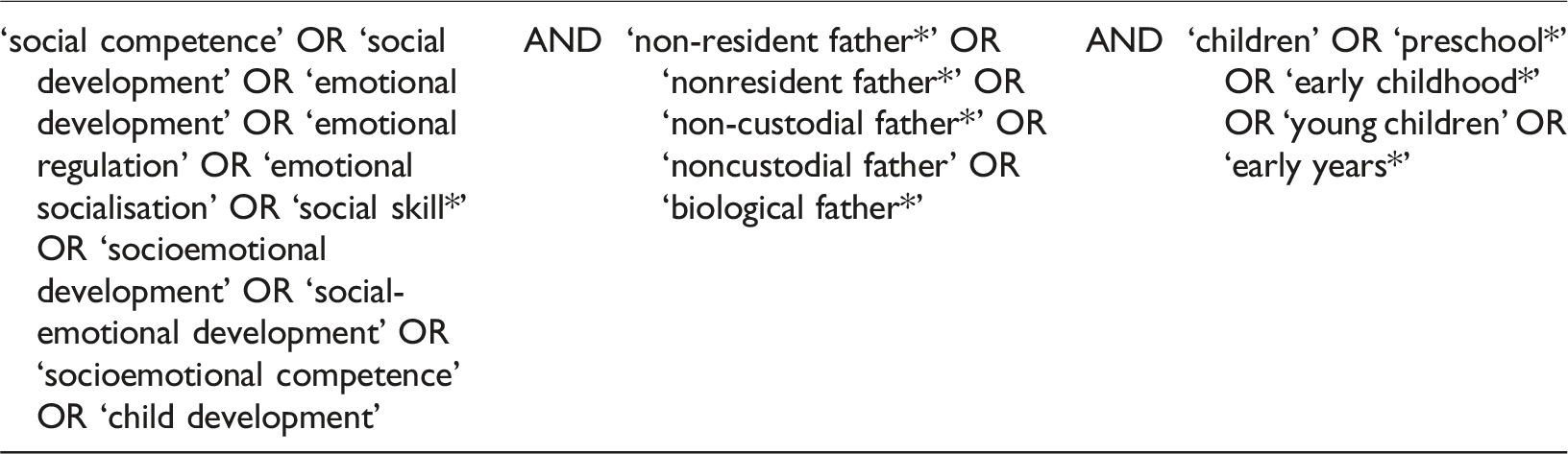
Search Strategy
Screening Processes
The initial database search yielded 385 articles, including 279 from ProQuest, 53 from ERIC and 53 from PsychInfo. Following consultation with librarians and keyword refinement, all literature was imported into EndNote and a systematic management platform (Covidence) for screening. Duplications were removed, leaving 260 articles for further screening. Screening was conducted in accordance with the inclusion and exclusion criteria listed in Figure 1 and proceeded in three stages. PRISMA flowchart outlining study selection process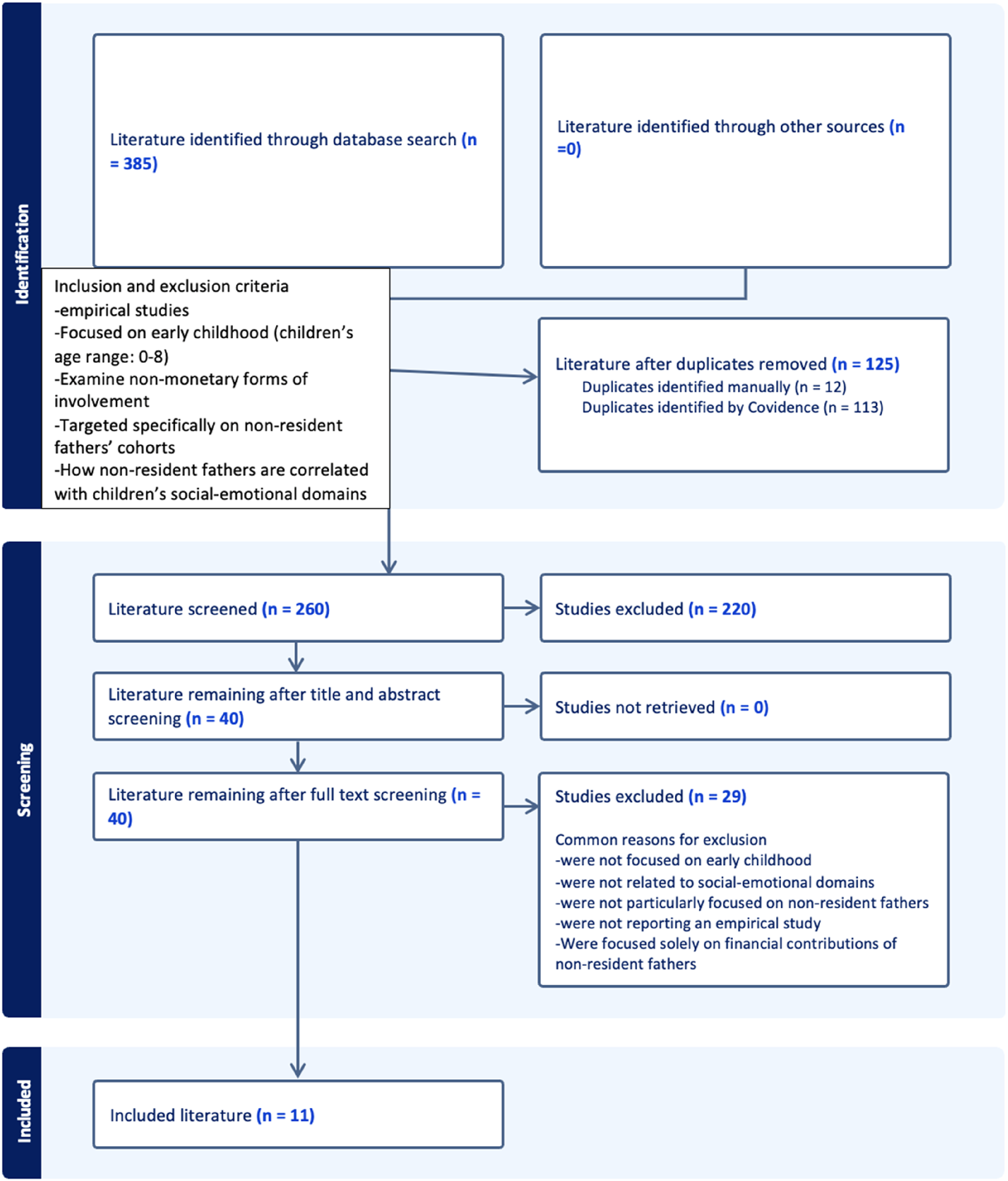
Stage 1: Title and Abstract Screening
Titles and abstracts of all 260 articles were screened against the selection criteria. More than 50% of abstracts were double coded by the authors.
Stage 2: Full-Text Screening
Forty articles were selected for full-text review. Of these, 29 were excluded for the following reasons: 1. the study did not focus on early childhood (children aged under eight); 2. the study was unrelated to social-emotional development; 3. the study focused on fathers in general or other father figures rather than non-resident biological fathers; 4. The study did not report empirical research; or 5. The study examined only financial support (e.g., child support payments).
Stage 3: Final Inclusion
Eleven articles met all inclusion criteria and underwent full-text analysis and synthesis.
Data Abstraction and Synthesis
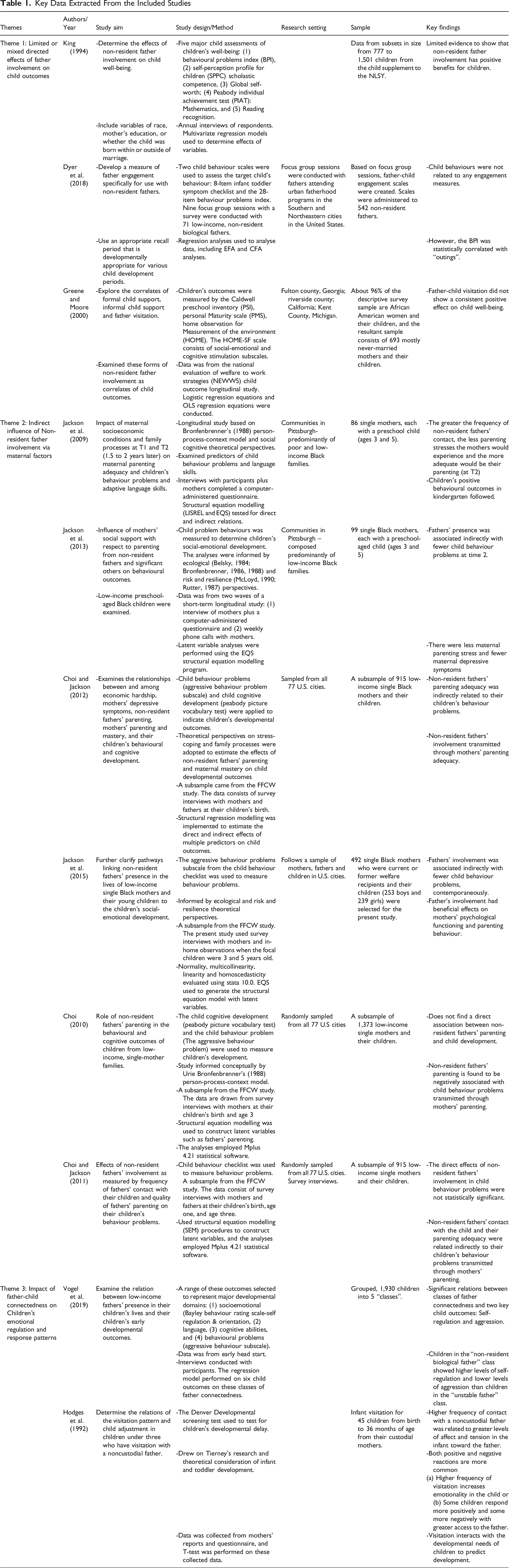
Key Data Extracted From the Included Studies
Findings
All eleven studies included in the final review employed quantitative research designs and were conducted in the United States. The findings from these studies are synthesised into four themes that capture how non-resident fathers’ involvement has been conceptualised and examined in relation to children’s social-emotional development. These themes are discussed in this following section.
Indicators of Non-Resident Fathers’ Involvement
Seven of the eleven studies focused on examining children’s social-emotional development by the metric of non-resident fathers’ visitation frequency (Choi & Jackson, 2011, 2012; Choi, 2010; Dyer et al., 2018; Greene & Moore, 2000; Jackson et al., 2009; King, 1994). These studies found that non-resident fathers’ visitation frequency and participation in parenting activities did not have a strong or direct association with children’s social-emotional development (Choi, 2010; Choi & Jackson, 2011; Dyer et al., 2018; Greene & Moore, 2000; King, 1994).
For example, King (1994) used data from the child supplement of the National Longitudinal Survey of Youth (NLSY) and assessed two measures: non-resident fathers’ visitation frequency and child support payments. Mothers reported how often their child had seen their non-resident father in the previous 12 months, with responses ranging from “never” to “almost daily”. Overall, the findings provide limited evidence to support the hypothesis that non-resident father involvement has positive benefits for children. King (1994) further argued that the quality of father-children relationships was largely unexamined and warrants more thorough investigation. It is important to note that the regularity of visits and duration of visits were not key to this analysis. More importantly, the quality of interaction was given no importance in these studies.
Non-Resident Fathers’ Influence on Children’s Behavioural Problems
Most studies included in this review focus on behavioural measures (frequency of problem behaviour of the child) as a main indicator of a child’s social-emotional development. These measures cover children’s observable expressions, such as aggression, disobedience, hyperactivity, inattention, and social withdrawal. Of the eleven papers reviewed, nine incorporated the behavioural problem index to measure and understand children’s social-emotional development (Choi, 2010; Choi & Jackson, 2011, 2012; Dyer et al., 2018; Jackson et al., 2009, 2013, 2015; King, 1994; Vogel et al., 2019).
A few studies reported a weak correlation between non-resident fathers’ involvement and children’s behaviour problems (Dyer et al., 2018; King, 1994). For instance, Dyer et al. (2018) examined 71 non-resident fathers attending nine urban responsible fatherhood programs in the northeastern United States and assessed multiple dimensions of paternal engagement. This included physical care, play, cognitive stimulation, emotional support, outings, and routines. The findings showed no statistically significant associations between most forms of fathers’ engagement and children’s behavioural outcomes, excepting outings for children aged one to five years. Dyer et al. (2018) suggest this may reflect developmental factors, as younger children are not yet exposed to school-related behavioural demands and may experience fewer conflicts in shared leisure contexts, while still benefiting from enjoyable joint activities.
Dyer et al. (2018) used a behaviour scale for assessing children’s development, a common method in this field. The predominance of behavioural problem indices reflects an underlying reliance on normative frameworks that define children’s social-emotional development in terms of socially accepted standards of behaviour. These frameworks present a binary division of aggressive and non-aggressive behaviours and much of the literature in this area focus on aggressive behaviour as a negative indicator of social-emotional development (Choi, 2010; Choi & Jackson, 2011, 2012; Jackson et al., 2015; Vogel et al., 2019). Instruments such as the aggressive behaviour subscale of the Child Behaviour Checklist are commonly used, emphasising the frequency and intensity of aggressive behaviour while giving limited attention to children’s emotional competencies. Consequently, this literature overlooks more nuanced aspects of children’s lived experiences and father-child interactions.
Non-Resident Fathers’ Presence and Children’s Adjustment
Research indicates that non-resident fathers’ presence and visitation patterns are associated with children’s adjustment in early childhood (Hodges et al., 1992; Jackson et al., 2015). However, for infants and toddlers, the direction of influence is not always linear, as children’s development may shape and be shaped by fathers’ involvement (Hodges et al., 1992). For example, Hodges et al. (1992) studied the associations between non-resident fathers’ visitation patterns (duration, frequency and consistency) and child adjustment outcomes for children under three years old. This included factors like perceptual-motor development, attachment, stranger anxiety, and separation anxiety. The results showed that increased visitation with non-resident fathers is correlated with both higher levels of affection and tension towards the father. The authors concluded that increased visitation heightened children’s emotional responsiveness, with children demonstrating positive and negative adjustment outcomes, underscoring the complexity of such relationships.
Similarly, Jackson et al., (2015) investigated the influences of non-resident Black fathers’ involvement on children’s social-emotional development at age three within lower-income families headed by single mothers. Using indicators of fathers’ involvement as love, time and financial contributions, the study found that love was more strongly associated with children’s contemporaneous adjustment.
Overall, these studies collectively highlight the role non-resident fathers play in shaping children’s adjustment in their early years and the importance of paying attention to nuance and contextual complexities.
Non-Resident Fathers’ Indirect Effects on Children’s Behavioural Problems
A body of research has shown that non-resident fathers indirectly influence children’s behavioural outcomes, rather than through direct father-child interactions alone (Choi, 2010; Choi & Jackson, 2011, 2012; Jackson et al., 2009, 2013, 2015). These indirect effects are predominantly conceptualised using Bronfenbrenner’s (1988) person-process-context model (Choi, 2010; Jackson et al., 2009, 2013). Across these studies, non-resident fathers’ involvement with their children benefits mothers’ psychological functioning and parenting adequacy, which in turn improved children’s behavioural outcomes (Choi, 2010; Choi & Jackson, 2011, 2012; Jackson et al., 2009, 2013, 2015).
For instance, Jackson et al. (2013) tested a conceptual model examining how social and instrumental support from non-resident fathers and others might influence low-income Black mothers’ psychological well-being and parenting adequacy. Following this, they analysed the social-emotional development of their pre-schooler children. Jackson et al. (2009) explain the full process of this transmission in a previous study, whereby increased contact with non-resident fathers function as a form of parenting support for mothers, leading to lower levels of parenting stress. Reduced maternal parenting stress was associated with more adequate parenting, which in turn was linked to fewer behavioural problems in children.
Collectively, these studies demonstrate that non-resident fathers have indirect effects on their children’s behaviour problems transmitted through mothers’ parenting and adequacy.
Discussion
Frequency of Non-Resident Fathers’ Involvement and Parenting Activities
The findings of this review indicate that future research must move beyond simple measures of contact frequency towards more theoretically driven and comprehensive analysis of the quality of non-resident fathers’ relationships with their children. This includes focusing on meaningful, non-financial forms of engagement, such as emotional connection, guidance, and consistent parenting, that support children’s social-emotional development in early childhood. While frequent interaction between non-resident fathers and their children is important, this alone is not sufficient to foster a close relationship. That is, the regularity of contact does not capture the nature, quality, or emotional depth of father-child interactions, nor the strength of attachment bonds that are more directly linked to developmental outcomes (Greene & Moore, 2000).
Meaningful paternal involvement is contingent on the presence of strong emotional ties and high-quality interactions. Thus, regular visitation and parenting activities do not guarantee a high-quality relationship or meaningful interactions. Fathers contribute resources to children only if the emotional ties between fathers and children are strong, as a result of high-quality interactions. This emotional tie may serve as a relationship dimension that has clearer implications for children’s social-emotional well-being than frequency of involvement (Amato & Gilbreth, 1999). When children feel loved and cared for by their parents, their sense of emotional security is enhanced, which supports children to cope with stress and be less likely to develop anxiety and depression (Davies & Cummings, 1994).
Importantly, frequent visitation does not necessarily entail emotionally meaningful interaction. Some non-resident fathers may visit their children frequently, but engage in activities that may not help build ties of affection and mutual influence between them. Therefore, future research should examine what occurs during visits, how children feel about these visits, and contextual factors to make predictions about the non-resident fathers’ involvement and children’s developmental outcomes.
Non-resident fathers’ involvement is a complex construct that cannot be adequately captured by visitation frequency or activity counts alone. There is a research gap to disentangle the various aspects of non-resident fathers’ involvement, such as support, discipline, and emotional ties. Observational studies of non-resident fathers and their children would be a useful supplement to surveys to provide in-depth insight into children’s social-emotional development. For example, the support which non-resident fathers bring to the interactions with their children may include responsiveness, encouragement, instruction, and assistance (Amato & Gilbreth, 1999). Additionally, Young et al. (1995) found that fathers’ intrinsic support (trust, encouragement, and discussing problems) has a positive association with children’s life satisfaction. In contrast, fathers’ extrinsic support (going out to dinner, buying clothes, and seeing movies) was not related to children’s life satisfaction. In sum, the frequency of contact is a poor proxy for assessing relationship quality.
The Need to Understand Contextual Complexities and Nuances
As highlighted in the literature findings, Bronfenbrenner’s (1988) person-process-context model has been prominent in analysing the indirect effects of non-resident fathers’ involvement on children’s behavioural outcomes. This perspective provides limited insight into the unique interactional style of non-resident fathers and the nuances of the developmental process, especially with respect to children’s social-emotional development in early years.
The nature of secondary data analyses may place certain limitations on the examination of children’s development. Children’s social-emotional development emerges through ongoing interactions between relational contexts and lived experiences, yet these interactional processes are largely absent from existing analyses.
For example, Jackson et al. (2015) use Bronfenbrenner’s model to demonstrate that non-resident fathers’ involvement was indirectly associated with fewer behavioural problems among three-year-old children through maternal psychological functioning and parenting behaviour. However, this does not include an examination of how father-child interactions themselves contribute to development change.
Bronfenbrenner’s (1988) model shows how individual factors, including a child’s behaviour problems, link with social context factors, such as fathers’ presence. One needs to take a step further to provide an understanding of the complex interplay between process and context (Tudge et al., 2009), and how they influence each other dialectically. Studies such as Choi’s (2010) demonstrate that non-resident fathers’ parenting is negatively associated with child behaviour problems, transmitted through mothers’ parenting. However, such studies do not reveal the intricacies of the relationship between non-resident fathers and their children. Therefore, future research should aim to capture the contextual complexities and relational nuances by examining how processes unfold within father-child interactions over time.
Children as Active Agents in Their Development
A further limitation in the reviewed literature is a lack of recognition that children are active participants in their development trajectories. In other words, scholars tend to focus on children as recipients of environmental inputs, reacting to paternal involvement and family context. This results in a lack of attention to the child’s developmental process and their individual experiences. As established earlier, a body of research is informed by Bronfenbrenner’s (1988) model, which demonstrates that non-resident fathers’ involvement with their children has positive effects on mothers’ psychological functioning and parenting adequacy, which results in better children’s behaviour outcomes (Choi, 2010; Choi & Jackson, 2011, 2012; Jackson et al., 2009, 2013, 2015). However, children’s social-emotional development has not yet been examined through the processes of reciprocal interaction between non-resident fathers and children; within those processes, children progressively develop more complex forms of active participation. Notably, there is no linear relationship between context and person, in which only one influences the other.
As proposed by Prati et al. (2019, p. 32), “Human development occurs through enlargements and approximations between the person and the various elements of the context that influence each other in a nonlinear and dynamic way”. The environment in which children interact with their non-resident fathers should not be seen simply as the source of stimulation that elicits the child’s responses, since the child has an active and intentional role in their own development. The focus on external social environment in these studies has a risk of considering children as mere objects, with limited or no agency. There is also a risk of describing a simple stimulus-response relationship while researching the complex dynamics of parenting and children’s development.
Dynamic and Holistic Conceptualisation of Social-Emotional Development
Finally, this review highlights the need for a more holistic lens on children’s social-emotional development. Although research in this area remains limited, existing studies have primarily relied on the Behavioural Problem Index (BPI) to assess children’s social-emotional development through standardised behavioural scales (Choi, 2010; Choi & Jackson, 2011; Dyer et al., 2019; Jackson et al., 2009, 2013, 2015; King, 1994; Rispoli et al., 2019). The behavioural-focused approach has facilitated an understanding of the external expression of social-emotional development as a starting point. Researchers should also consider the cultural context and social expectations of the paternal role. Additionally, significant work is needed to further unpack the concept of social-emotional development and conduct more evaluations to reflect a range of cognitive abilities, emotional processes, behavioural skills, social awareness, and personal and cultural values related to interpersonal relationships (Orpinas, 2010).
Conclusion
This scoping review mapped the existing literature on non-resident fathers’ involvement and effects on their child’s social-emotional development in early childhood. After reviewing 11 papers, the findings reveal a major gap in understanding social-emotional development, with a narrow focus on behavioural problems as the main factor. There is a need to disentangle the nuances of the relationship between non-resident fathers and their children, and how fathers contribute to children’s emotional processes, behavioural skills and personal and cultural values. Observational studies in natural settings could complement surveys, providing insights into children’s social-emotional development with non-resident fathers’ involvement.
Several studies use Bronfenbrenner’s ecological model, which integrates multiple layers of the social environment a child inhabits. However, these studies often overlook the dynamic nature of interactions between non-resident fathers and their children. A key insight from this analysis is that non-resident fathers’ engagement with their children is complex and demands a holistic framework to understand both perspectives. It is important to recognise children’s agency and characteristics when examining father-child interactions.
Collectively, the evidence highlights a significant gap in research on non-resident fathers and their contribution to early childhood social-emotional development. Most studies focus on visitation frequency and parenting activities, while the quality and interaction styles between them remain unexplored. Future research should uncover the processes and qualitative nature of these interactions and specify which social experiences best support children’s social-emotional development.
Footnotes

Ethical Considerations
There are no human participants in this article and informed consent is not required.
Funding
The authors received no financial support for the research, authorship, and/or publication of this article.
Declaration of Conflicting Interests
The authors declared no potential conflicts of interest with respect to the research, authorship, and/or publication of this article.