



Abstract
The Early Years Learning Framework for Australia V2.0 (EYLF; AGDE, 2022) guides education and care for children aged from birth to five years. This second version of the EYLF draws attention to children’s executive functions (EFs). However, the impact of the inclusion of EFs on pedagogy with children aged under three years has received little research attention. We reveal fine-grained interactional phenomena within a mother-infant dyad interaction and demonstrate how the mother’s conversational turns facilitate the three-month-old infant’s autonomous participation and sustained attention throughout a collaborative, co-constructed interaction. We highlight the sequential organisation of turns, carefully orchestrated by the mother, that creates opportunities for the infant to contribute to the back-and-forth interaction. We propose that early childhood educators could purposefully replicate some of the highlighted adult interactions in their talk-in-interaction with infants, as these create opportunities for infants to achieve sustained attention that may facilitate the emergence of EFs.
Introduction
Executive functions (EFs) are understood to be neurocognitive skills that include (but are not limited to) flexible and complex goal-directed behaviours such as working memory, inhibitory control, and cognitive flexibility, which essentially work together, are guided by an individual’s specific goals, and contribute to self-regulation (Zelazo & Carlson, 2023). EFs develop through practice, which in the early years of life typically occurs within the context of interactions with caregivers (Bernier et al., 2012). This means that educators who support the learning and development of infants and very young children need to interact with children in ways that create opportunities for emerging EFs to be rehearsed as children participate in back-and-forth interactions within the context of early childhood programmes. Such interactions presuppose sustained attention. This paper contributes to a small body of literature that highlights interactional phenomena that create opportunities for the rehearsal of antecedent EF skills.
For the first time, the Early Years Learning Framework (EYLF) for Australia V2.0, one of two approved learning frameworks that support Australian early childhood educators and promote children’s learning, includes references to EFs, defining it as: Includes working memory, flexible thinking and self-control. Executive functioning refers to the mental processes in the brain that enable children to plan, focus attention, remember instructions and manage multiple tasks successfully (Australian Government Department of Education (AGDE), 2022, p. 66).
The EYLF also refers to children’s developing EFs in two learning outcomes: Learning Outcomes 3 (“Children have a strong sense of wellbeing”) and 4 (“Children are confident and involved learners”). As a framework document, the EYLF does not go so far as to describe how educators go about supporting children’s emerging EFs and given that the framework applies to children aged from birth, educators would benefit from suggestions about how to support such emerging mental processes.
In this paper, we pay close attention to a mother-infant interaction and demonstrate that such interactions can be “an emergent, collectively organised event” (ten Have, 2007, p. 9), whilst highlighting the role played by the adult in creating opportunities for the infant to participate meaningfully in the conversation. Through the responsiveness of participants within an interaction, each serves as “both a source of affordances [for intentional actions] and a user of affordances made available by the other” (Raczaszek-Leonardi et al., 2013, p. 212). We use a fine-grained analysis of the back-and-forth interaction between a mother and an infant that starts with the mother singing to the child to highlight the mechanisms by which such affordances are operationalised. We set out to examine how the mother’s turns in the interaction create opportunities for the infant to take autonomous and contingent turns. By highlighting the characteristics of the mother’s turns, we address the how question by suggesting that her behaviours could be intentionally replicated by early childhood education and care (ECEC) professionals in their interactions with infants to guide and support infants’ attention, a critical early building block of EFs.
At around three to four months, the interactions infants have with objects other than their caregivers begin to increase and, with this, so too do opportunities for informational input (Hoehl et al., 2008). By an infant’s first birthday, some aspects of EFs may begin to emerge (Diamond & Goldman-Rakic, 1989) such as the ability of an infant to manage their own behaviour and to direct their attention towards a labelled object (Carpenter et al., 1998). EFs have been linked to children’s theory of mind understanding, proficiency in academic achievement, communication and social skills, moral competence, emotion regulation, mathematics and arithmetic, reading ability, and verbal and non-verbal reasoning (Bernier et al., 2010). The benefits of EFs persist throughout life (Diamond & Ling, 2016), yet little research has addressed the development of EFs in children aged from birth to 12 months (Holmboe et al., 2018) and these skills are not routinely assessed in ECEC environments (Rhinehart, 2022). This may be due to the challenges in measuring this emerging set of skills in very young children (Hendry et al., 2016). This paper does not assess the child’s emerging EFs but rather highlights sensitive and responsive behaviours on the part of the adult that facilitate sustained attention. Here, sensitivity is understood to be a dynamic process characterised by an adult being attuned to an infant’s behaviours and making accurate inferences from such behaviours, reciprocal give-and-take with the infant, and responses that are contingent upon and appropriate to the infant’s behaviours (Shin et al., 2008).
EF skills can be learned (Blair, 2016). A large-scale longitudinal study, for example, indicates that sensitivity and responsiveness, predict positive gains in child EFs from age 36–60 months (Blair et al., 2014). Other detailed studies report that parental autonomy-supportive behaviours show positive and unique associations with EFs in children (Castelo et al., 2022; Distefano et al., 2018, 2024). EFs are influenced both by ontogenetic brain development and environmental components such as social interactions and parenting behaviours, specifically parental (e.g., Carlson, 2009). Identifying adult-child interactions that encourage antecedent EF skills is important so that such practices may be purposefully taught in early childhood teacher preparation courses and enacted by early childhood educators (Madanipour et al., 2025). It is thus appropriate that a focus on EFs has been included in the EYLF (AGDE, 2022).
Maternal behaviours that support child executive functions
Human development is shaped by “processes of progressively more complex reciprocal interaction” between the developing individual and elements of that individual’s environment (Bronfenbrenner, 2005, p. 6). A key component of a child’s most immediate environment is frequently the child’s primary caregiver who may be the child’s father (Day et al., 2024; Meuwissen & Carlson, 2015), or another person who cares for the child on a daily basis. However, to date, much of the research has focused on mother-child interactions. Three characteristics of mother-child interactions are thought to support the development of EFs in children: maternal sensitivity, mind-mindedness, and autonomy support (Bernier et al., 2010). These are related to children’s EF skills, which include the interrelated core skills of working memory, inhibitory control, and cognitive flexibility (Diamond & Ling, 2016). Berducci (2016) describes maternal sensitivity as characterised by contingent and consistent responses to infants’ cues, which take the form of natural responses. These characteristics of maternal sensitivity align with the definition proposed by Shin and colleagues (2008). However, Berducci (2016) goes further, describing these actions as creating a proto-social-interaction order and contributing to the infant’s experience of having agency. Indeed, turn-taking interactions have been observed in interactions between adults and infants within the first eight weeks of life (Gratier et al., 2015). Mind-mindedness describes the caregiver’s comments on the child’s mental state within the context of the interaction; this supports a child’s awareness of their own responses (Meins et al., 2002). Autonomy support describes how the caregiver supports an infant to take an active role in the interaction (Carlson, 2023), again contributing to the infant’s experience of agency. Indeed, pre-lingual children are able to participate in these types of meaningful social interactions (Sierra, 2017), and by five months of age, most have learned that their vocalisations influence their caregivers’ behaviour (Goldstein et al., 2009). Parental scaffolding in this regard at two years of age has been found to have an indirect impact on child EFs at three years of age, and a direct effect on EFs at four years (Hammond et al., 2012).
A child’s later ability to self-regulate is preceded by the external regulation provided by the primary caregiver (Bernier et al., 2010). In an ECEC setting, the educator assumes this role and thus the dynamic process that is characterised by reciprocal, back-and-forth, attuned interactions between a mother and her child could occur between the educator and the child. Each of the characteristics of such interactions is observable. Consequently, there is a need to highlight how, in our data, the mother’s attuned responses embed the infant’s behaviour in such a way that the interaction becomes a meaningful event (Raczaszek-Leonardi et al., 2013). Identifying the characteristics of such interactions could inform intentional practice on the part of an educator.
The development of EFs relies on brain maturation but is also influenced by the caregiving practices of primary caregivers (Bernier et al., 2012). When infants and very young children attend ECEC programmes, ECEC educators occupy a unique position in the child’s microsystem because they develop close and sustained relationships with children early in their development (Bronfenbrenner & Morris, 2006). Making the serve-and-return of these turns visible (whether verbal or non-verbal), and how the adult’s turns both respond to and lead to a turn on the part of the infant, could contribute to the identification of intentional interactions that educators could employ to facilitate the development of attention as a precursor to EFs in young children.
Antecedent executive functions
The development of EF skills is related in particular to the development of the prefrontal cortex and interconnected neural regions (Diamond & Ling, 2016). The prefrontal cortex develops dramatically from approximately three years of age, yet research conducted with seven-month-old infants exposed to bilingual environments from birth suggests that such environmental conditions require the inhibition of one language in favour of another and thus cognitive control may emerge very early in life (Kovács & Mehler, 2009). Research on infants’ brain activity whilst they are demonstrating joint attention reveals evidence of memory and attention processes in four-month-old children (Hoehl et al., 2008).
Infants are selective in their attention from birth. However, their ability to control their attention – to shift the focus of attention from so-called sticky or obligatory stimuli (which cause infants to focus on one point) – emerges from four months of age and appears to rely on the “orienting” system of attention, also known as “rudimentary selective attention” (Hendry et al., 2016, p. 4). A second system of attention, characterised by voluntary control, emerges between nine and 18 months of age and increases in frequency and duration, influenced by opportunities for joint attention (Bono & Stifter, 2003). Indeed, joint attention necessarily requires maintenance and shifting of attention, and within the context of an adult-infant dyad one would see the adult either following the child’s attention or directing the child’s attention to the adult’s focus of attention in order to achieve joint attention within the context of an interaction. The latter would require the infant to disengage their attention from an alternative focus, shift attention back and refocus on the object that is the adult’s point of focus. Jacobson and Degotardi (2022) conceptualise joint attention as a dynamic system impacted by factors within the environment. When stable and reciprocal, such joint attention episodes create important collaborative opportunities for learning (Degotardi, 2017).
Pre-lingual children can participate in meaningful social interactions (Sierra, 2017) and maternal responses to selected infant behaviours sensitise an infant’s perception of the mother’s behaviour as a social affordance and through repetition, such dialogic interactions become purposeful acts (Raczaszek-Leonardi et al., 2013). At two months of age, infants can remember rhythms and melodies and actively interact, using eye contact, vocalisations and affective state (Lense et al., 2022) and by five months of age, infants have learned that their vocalisations influence their caregivers’ behaviour (Goldstein et al., 2009). Research has demonstrated that adults’ infant-directed speech and song take on a number of characteristics that differ from adult-directed speech such as “higher overall pitch, expanded pitch range, characteristic intonational contours, longer pauses, shorter utterances, and increased repetition” (Smith & Trainor, 2008, p. 410). Here, we draw attention to the characteristics of the mother’s speech and the infant’s utterances, and how the interlocutors collaborate to sustain attention.
Diamond and Ling (2016) emphasise that EFs “need to be continually challenged to see improvements – not just used, but challenged” (p. 37). From a pedagogical perspective, this is consistent with Vygotsky’s zone of proximal development (Vygotsky, 1986) and thus aligns with the importance of maternal sensitivity, autonomy support and mind-mindedness within the context of back-and-forth interactions: the role played by a mother to facilitate a child’s agency within the context of the conversation. It also highlights the transferability of mother-child interactions to educator-child interactions, since ECEC educators seek to support learning within the context of an informal curriculum, which is characterised by back-and-forth interactions between educators and children.
Method
Data take the form of one video spontaneously self-recorded by an early childhood educator with her infant and shared with the first author, a colleague. The mother is seated with her knees bent at 90°. The infant is supported to sit facing his mother with an unobstructed view of her face (Figure 1). The mother’s left hand is supporting her son’s head. The mobile device on which the video is recorded is positioned at the level of the infant’s head and he remains the focal point throughout the video; the mother’s head moves in and out of the shot. Infant seated facing the mother with unimpeded eye contact.
The interaction commences as the mother begins to sing “Three Little Ducks Went Swimming One Day” – singing this song with very young children frequently takes place in Australian early childhood programmes. After the song ends, the participants engage in back-and-forth interaction. The video lasts 1 min 45 s. On the date the video was recorded, the mother was 28 y 7 m old; her infant son was precisely three months old. Only one language is spoken at home: English. The mother is an early childhood teacher. Prior to analysing the video for this paper, full university ethics approval and parental consent for the analysis was obtained. Pseudonyms are used to anonymise the participants: “adult” and “infant”.
We employed a methodological approach that allowed us to reveal the interactional phenomena that occur within reciprocal social interactions. Conversation analysis (CA) is based upon the understanding that the characteristics of talk-in-interaction, whilst sensitive to the social context within which they occur, are nonetheless shaped most directly by preceding turns and thus the observed phenomena may be deemed to be context-free (Sacks et al., 1974). In other words, each turn responds to the speaker’s analysis of the preceding turn or interactional event and thus aligns with the contingency characteristic of attuned interactions that have been used in definitions of maternal sensitivity (Berducci, 2016; Shin et al., 2008). CA presents data and the discussion together and, in this way, the researcher makes the interactions visible to the reader.
To highlight the turns taken by both the adult and the infant, whether verbal utterances or not, the first author employed CA transcription conventions (Appendix 1). Thereafter, both authors carefully reviewed the video and the transcript to identify and analyse the impact of one turn upon the next within adjacent pairs of turns. Our focus was on the interactional phenomena themselves since we infer that purposeful enactment of such turns by ECEC educators may lead to similar responses on the part of infants should a similar interactional sequence take place within an early childhood programme.
Raczaszek-Leonardi et al. (2013) have argued that “the basis for purposeful intersubjectivity may lie in the shaping of individual behaviours into meaningful events through repetitive interactions” (p. 211). Within the context of an informal, play-based curriculum, it is important to pay attention to the nature of interaction experiences, as elements of proximal processes (Bronfenbrenner & Morris, 2006) that encourage sustained attention as an antecedent of EFs.
Data analysis and discussion
We intended to identify the collaborative scaffolding work that occurs despite the spoken language capability asymmetry of the interlocutors (Filipi, 2013). CA methodology is employed to transcribe and analyse the data and this paper thus adds to a small body of literature that has applied CA to interactions with infants (e.g., Berducci, 2010, 2016; Filipi, 2013; Forrester, 2017; Kidwell, 2009; Sierra, 2017). Detailed transcripts present utterances and use particular transcription conventions to indicate characteristics of the interlocutors’ turns. For example, square brackets indicate overlapping speech and are aligned so that they indicate the exact point at which the overlapping occurs. For example, in Extract 1, as the adult says ‘came’ in line 45, the infant simultaneously makes the sound ‘ehhh’. The data are presented and then analysed immediately thereafter, and explanations of transcription conventions are provided in Appendix 1.
CA recognises that “the social and collaborative practices enacted by children and teachers are both the vehicle for and constitutive of learning…[its] core concern is with the co-construction and choreography of social practices” (Church et al., 2022, p. 23). Despite the immaturity of the infant, the infant has a role within the interaction: because the mother treats the child as an actor within the interaction, the child is an actor (Garfinkel, 2006; Raczaszek-Leonardi et al., 2013). Communication on the part of the infant occurs in turns that reflect order in the form of turn-taking and sequencing and the interaction itself thus achieves intersubjectivity. Indeed, we observe the dynamic and shifting nature of asymmetry within the interaction as it unfolds (Filipi, 2013); nonetheless, intersubjectivity is achieved.
Encouraging settled attention
The control of attention is widely regarded as the foundation of growth in EFs (Cuevas et al., 2017). Attention is a prerequisite for working memory and is itself a complex process that draws on orientational and attention control systems (e.g., Kotyusov et al., 2023). In infants and older children, focused attention is identified by “a reduction of heart rate, intense facial expression and minimal body movement” (Garon et al., 2008, p. 35). Ruff and Capozzoli (2003) proposed an attention continuum with casual attention defined as looking at a toy without engagement, settled attention indicated by steady looking with some physical movement, and focused attention indicated by intense looking at a toy with very little movement or talking.
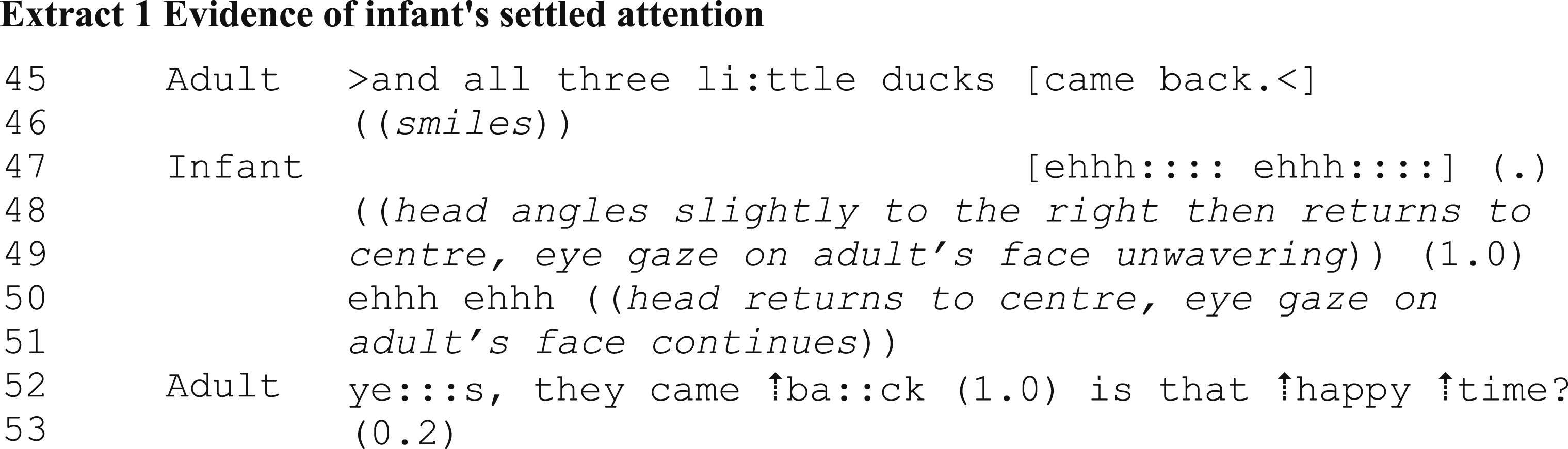
Evidence of the infant’s attention, which aligns with settled attention, that is, steady looking with some physical movement (Ruff & Capozzoli, 2003), is prominent throughout the data: the infant maintains eye gaze and makes vocalisations in response to prompts from the mother. At lines 48–51, the infant’s developing motor control causes his head to move briefly to one side, but evidence of his purposeful and settled attention is the sustained eye gaze despite this physical movement.
Facilitating turn-taking and contingency
Multiple instances are observed of the infant attending to and imitating the mother’s speech behaviours. Direct imitation is observed in two ways: first, the infant’s proximity to the mother’s mouth means that her mouth and tongue are clearly visible to him, leading to the infant moving/protruding his tongue and moving his mouth (e.g., lines 21 and 22). This finding aligns with well-established literature on infants’ imitation of facial and manual gestures (Meltzoff & Moore, 1977), and mouth movements resembling speech movements (Gratier et al., 2015).
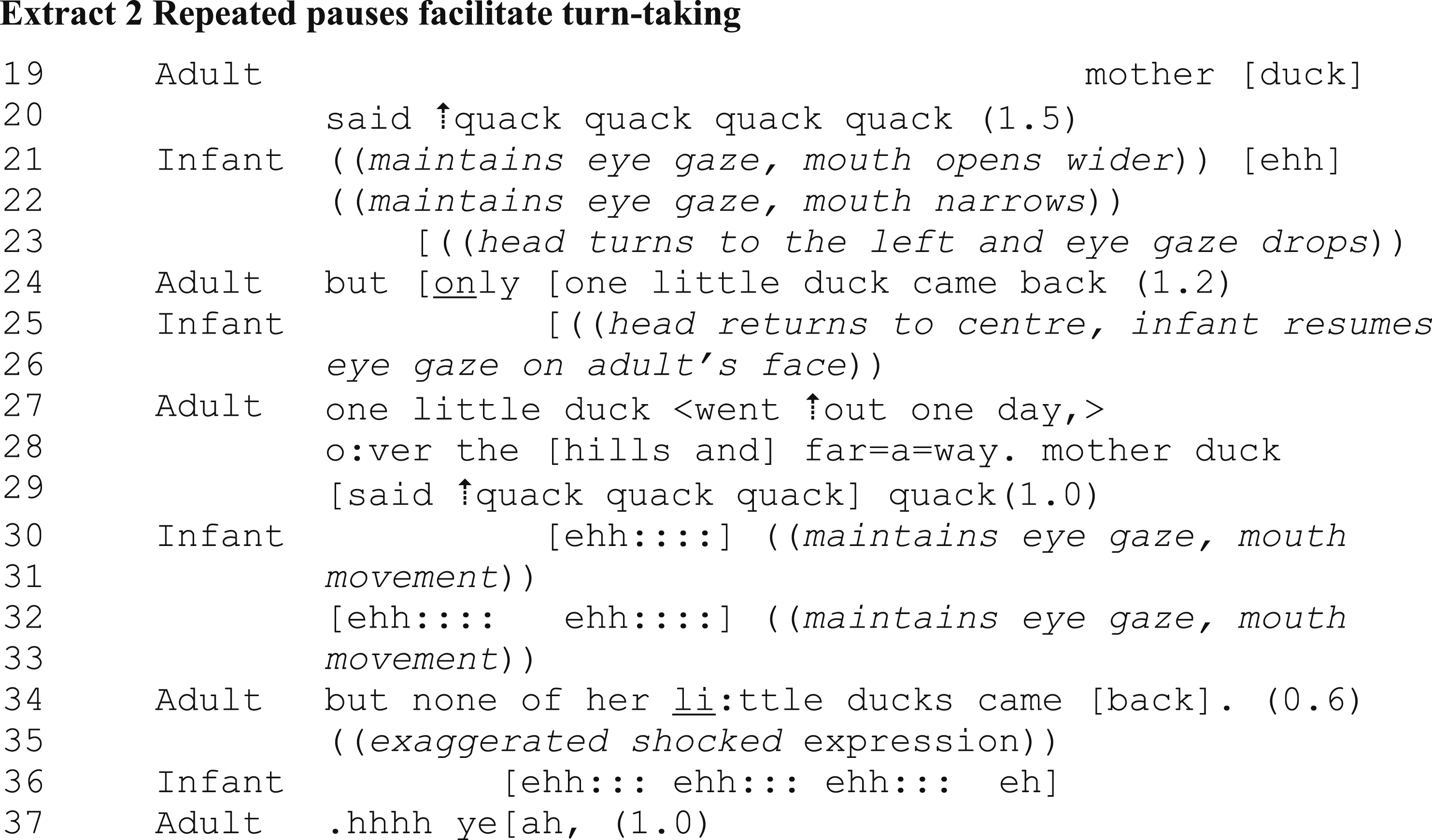
The measured pace of the mother’s attuned responses provides opportunities for the infant’s turns through the provision of pauses and by responding, the mother and the infant co-create meaning and are evidence of maternal sensitivity (Bernier et al., 2010). A pause at line 20 (1.5) is followed by the infant’s vocalisation at line 21. The infant’s head turns away and eye gaze drops (line 23). The second adjacency pair in Extract 2 begins at line 24 – here again, we observe the mother pausing at the end of her turn (1.2) and thus turns and contingency are achieved.
Similarly, the mother pauses at the end of line 29 – this too is followed by a protracted response by the infant (lines 30–33). A briefer pause at the end of line 34 is followed by an exaggerated facial expression and again is followed by multiple vocalisations on the part of the infant. Such pauses (Cohrssen et al., 2014a, 2014b) contribute to the dynamic, reciprocal give and take, create an opportunity for the infant to take an autonomous (Bernier et al., 2010), contingent (Shin et al., 2008) turn, and thus sequential and systematic turns taken by both mother and infant can be observed within the interaction. It should be noted however that by waiting at the end of her turn for the infant to contribute to the back-and-forth, the mother purposefully supports the infant’s autonomous contribution (Bernier et al., 2010), fostering the temporal coordination of the mother and the infant (Raczaszek-Leonardi et al., 2013).
Supporting inhibitory control
Inhibitory control includes the inhibition of attention (focus) and action (motor) in favour of a more appropriate response (Diamond, 2016). Inhibitory control is the skill we use to inhibit an impulse to react immediately, resist temptation, stay on task, and delay gratification (Diamond, 2012). This skill helps older children to persist when faced with challenges, such as when first attempts are unsuccessful. From an early age, children show persistence in different ways such as trying to grasp an object out of their reach, insisting on putting their clothes on independently or attempting to stack blocks. Inhibitory control requires a child to recall a “rule” and may require a child to demonstrate a physical response (Rhinehart, 2022).
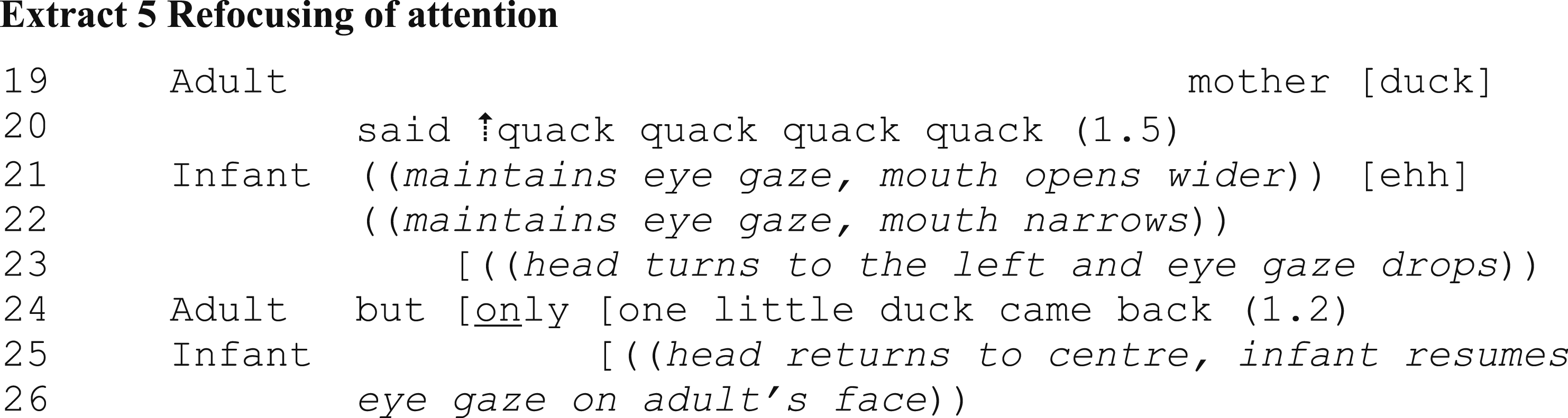
Multiple characteristics of the mother’s interaction are observed to result in the infant exercising inhibitory control and sustaining attention on the song (see Extracts 3, 4, 5 and 6). These include variations in emphasis (indicated by underlining), and heightened pitch (⇡) as observed at lines 6 and 8. Evidence of the effect of these strategies is observed in the infant’s sustained engagement and unbroken eye gaze despite movement of the infant’s head (lines 10–11).
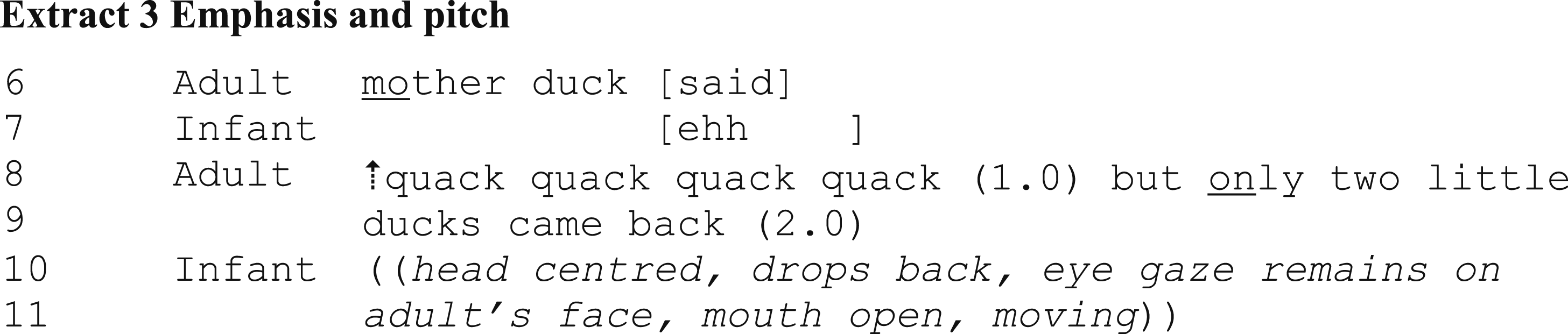
Changes in the pace of delivery by the mother are observed in slower speech (<….>) in line 27 combined with rhythmic sing-song delivery in line 28. In line 29, the use of marked upward pitch indicates the sing-song delivery. This aligns with Smith and Trainor’s (2008) finding that mothers adjust the pitch of their speech dynamically according to their infant’s feedback and thus the back-and-forth intersubjectivity is sustained. Evidence of the effect of these strategies is observed in the infant’s sustained engagement and unbroken eye gaze (lines 30 and 32–33).
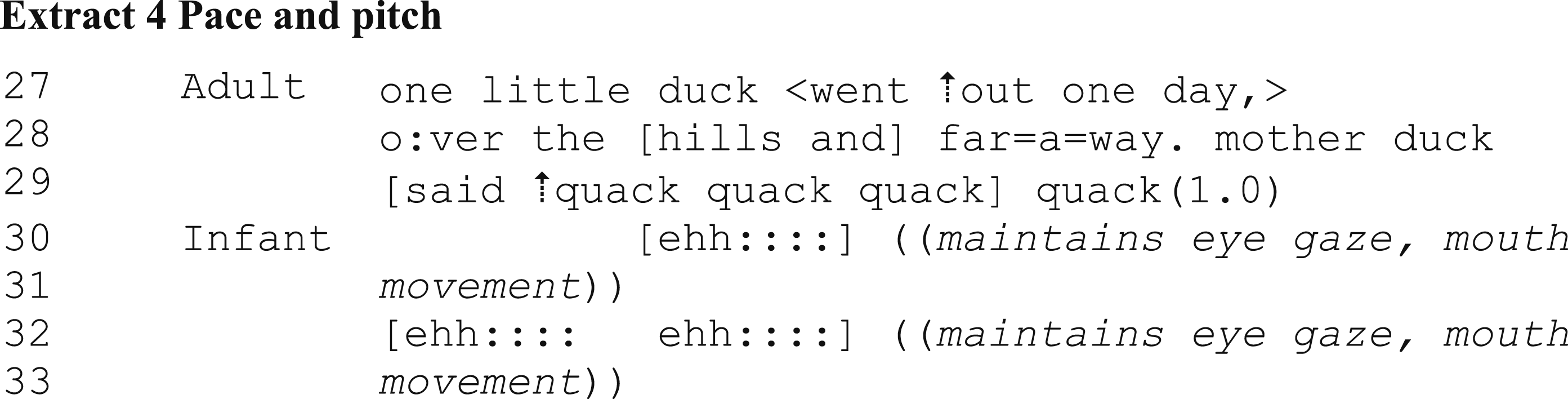
At line 23 of Extract 5, we see evidence of the infant disengaging attention by turning his head and looking away at the same time as the mother emphasises the word “only” in line 24. The mother’s emphasis on the word “only” is followed by the infant’s head returning to the centre in line 25 and refocusing – or shifting attention – back onto the shared song (lines 25–26). The refocusing is observed to co-occur with the mother singing “one little duck came back” immediately after the emphasis on the word “only”. The refocusing of attention thus encourages the infant to re-establish intersubjectivity and to rehearse sustained attention.
At lines 34–35, the mother emphasises the word “none”, pauses, and then uses an exaggerated shocked expression:

This animated engagement on the part of the mother (as observed in the exaggerated facial expression) is followed by repeated vocalisations on the part of the infant, to which the mother responds contingently, saying “yeah”, reinforcing the preceding turn-taking process and prolonging the back-and-forth conversation. Evidence of the infant’s sustained attention is observed in his unbroken eye gaze (line 38).
Conclusions
Using a fine-grained analytic approach (Sacks et al., 1974), we have demonstrated how a dyadic adult-infant interaction, framed by infant-directed singing, creates opportunities for an educator to encourage an infant’s settled and focused attention (Ruff & Capozzoli, 2003). Such interactions also lend themselves to an educator purposefully creating affordances for the infant to take autonomous (Bernier et al., 2010), and contingent (Shin et al., 2008) turns – despite the infant’s immature attention, communication and motor capabilities (Lense et al., 2022). The observer is not always able to see both participants’ heads simultaneously to track reciprocal eye gaze in this spontaneously recorded video of a mother interacting in a naturalistic setting with her child. However, this limitation is also a strength of the data: it is evidence of a naturally occurring, rather than staged, mother-child interaction.
Whilst the participants in this dyad co-construct the interaction, the adult plays an important role in facilitating the infant’s sustained attention and we argue that our data do not reveal “some type of order” (Berducci, 2016, p. 438). Rather, the collaborative achievement of sequential and systematic actions and interactions reflects mutual sensitivity and responsiveness, shaped by the affordances created by the mother’s turns (Raczaszek-Leonardi et al., 2013). Together, the mother-infant dyad creates an authentic order within the conversation, regardless of whether the infant’s turns are actions or non-speech vocalisations. Consequently, we argue that the infant’s interactional turns are not proto-turns but authentic turns. Creating opportunities for such turns could thus be incorporated as intentional pedagogical strategies by educators.
We revealed characteristics of adults’ infant-directed speech that support the guiding of infants’ attention (Smith & Trainor, 2008) and support attention, a critical early building block of EFs. Educator-infant dyadic interactions occur frequently within the context of an informal, play-based ECEC curriculum and consequently, the characteristics of adult behaviours should be intentionally replicated by early childhood educators when interacting with infants in their care. Despite being a single case study, given the evidence that parent-child interactions heavily influence the development of EF skills (Distefano et al., 2018; Meuwissen & Carlson, 2015), it is reasonable to conclude that ECEC educators similarly play a critical role. Consequently, we agree that “it is incumbent on caregivers to modulate and structure their own behaviour to best support infant engagement and development” (Lense et al., 2022, p. e7).
Further research that investigates the antecedents of EFs is needed (Bernier et al., 2010) as the findings from such research will have important implications for the quality of ECEC, and educator and teacher preparation to support the learning and development of infants in their care.
Footnotes
Author contributions
Caroline Cohrssen: Conceptualization, Literature review, Methodology, Data management, Formal analysis, Co-writing of original draft and editing. Parian Madanipour: Literature review, Validation of data analysis, Co-writing of original draft and editing.
Declaration of conflicting interests
The author(s) declared no potential conflicts of interest with respect to the research, authorship, and/or publication of this article.
Funding
The author(s) received no financial support for the research, authorship, and/or publication of this article.
