




Abstract
Early childhood influences value formation and mental wellbeing later in life. Early Childhood Education for Sustainability (ECEFS) aims to bolster children’s social emotional skills and instil environmentally sustainable attitudes and behaviours through transformative learning. The current study investigated the Learning in Nature Program (LNP), an ECEFS curriculum at an inner city preschool in Melbourne, Australia. Data from the 2021 (n = 27) and 2022 (n = 56) cohorts generally supported the expectation that children’s pro-environmentally sustainable attitudes and behaviours would increase after completing the LNP, both in the quantitative data analysis and the qualitative data from parent (n = 17) questionnaires. There were significant decreases in peer problems, emotion problems, hyperactivity, conduct problems and negative coping. There were significant increases in positive prosocial behaviour and empathy.
Introduction
Today’s children are expected to encounter challenges as they mature, including the increase of mental illness (Keyes & Platt, 2024) and environmental degradation (Pörtner et al., 2023). Early Childhood Education for Sustainability (ECEFS) presents an intervention to equip children to act for sustainability while developing social and emotional skills at a time of heightened neuroplasticity (Wright & Masten, 2005). Additionally, ECEFS refers to child-centred learning that encourages behaviour responsible for future generations (United Nations Educational Scientific Cultural Organisation (UNESCO), 2019). Sustainability comprises three intertwined dimensions, namely environmental (focus of the current study), social and economic sustainability (UNESCO, 2019). Fostering skills to enhance children’s psychological and interpersonal functioning has been formalised as Social and Emotional Learning (SEL, Murano et al., 2020). Facets of SEL relevant to ECEFS include empathy, emotional experience connected to awareness of another’s affective state (Hoffman, 2008) and coping, the process of attempts to manage stress and the demands of everyday life (Compas et al., 2017). Ardoin and Bowers’s (2020) literature review highlighted the effectiveness of early childhood programs encouraging environmentally sustainable attitudes and behaviours, alongside SEL outcomes. A review of nature play, a component of ECEFS, demonstrated that it is also implicated in prosocial behaviour and emotional wellbeing (Dankiw et al., 2020). However, Elliott et al.’s (2016) qualitative study suggests that some ECEFS programs were ineffective, considered superficial and limited in fostering meaningful behavioural change. Methodological issues including small samples and lack of quantitative data necessitate further inquiry to understand the underlying processes in ECEFS programs and connections to SEL.
Education for sustainability
The underlying rationale for providing education for sustainably programs for young children is that positive early experiences in nature are likely to increase pro-environmental attitudes throughout the lifespan (Ewert et al., 2005). However, Ernst et al. (2021) highlight the limited theoretical understanding of processes involved in behaviour change through ECEFS. ECEFS processes could be understood through Bronfenbrenner’s (1994) socio-ecological model. Children’s learning and development is considered dynamically within the nested and interacting microsystem (immediate influences such as caregivers and teachers), mesosystem (processes between microsystems), exosystem (wider systems such as government and educational structures), macrosystem (cultural context of values and beliefs) and chronosystem (influence of time, Bronfenbrenner, 1994). Stanger (2011) revised the socio-ecological model to emphasise how child development also intersects with the natural world at each level. For example, Stanger’s concept of the “microecosystem” could be incorporated into ECEFS by encouraging children to reflect on how the immediate natural environment enhances their wellbeing (Bell & Dyment, 2008). Reciprocally, children are encouraged to protect local habitats (Caiman & Lundegård, 2014). Tracking child development within the socio-ecological framework, the bidirectional relationship between children and the immediate “microecosystem” (Stanger, 2011) can expand over time. Adults that value the natural environment are able to facilitate changes at the macrosystemic level, in terms of policy and economic models, that mitigate damage to the environment (Green, 2016).
However, the socio-ecological model continues to conceptualise humans and the natural world as separate entities, which may have contributed to exploitation of natural resources and subsequent environmental destruction (Dreamson & Kim, 2022). Alternatively, the post-humanistic model intends to decentre human subjectivity (Dreamson & Kim, 2022) and emphasise the interdependence between humans and the broader non-human world (Deleuze & Guattari, 1987). Through ECEFS children become aware of this connection and form affective connections with the non-human world, encouraging pro-environmental actions (Dreamson & Kim, 2022).
Methods for investigating education for sustainability
Qualitative research provides in-depth insights (Johnson & Christensen, 2014) such as children’s specific emotional experiences throughout their ECEFS engagement (Chawla, 2020). This was exemplified by an analysis of transcriptions from child descriptions of drawings (“drawing-tellings”). These were collected at the beginning, middle and conclusion of the ECEFS program from the same cohort as the current study, suggesting an increase in emotional reactions to the natural world and enhanced social connections over time (Ching, 2024).
However, due to minimal quantitative ECEFS research it is difficult to establish causality in the field (Ardoin & Bowers, 2020). To overcome these limitations, a mixed methods approach using thematic and quantitative analysis of drawings and interviews was applied by Madden and Liang (2017) with forty-four children aged three to eight years, reflecting enhanced knowledge of environmental interconnection. However, statistical significance was not considered, which will be done in the current study to enhance generalisability.
Social and emotional learning within education for sustainability
ECEFS engages with developmental processes related to socialisation and wellbeing (Mygind et al., 2019). This could provide prevention prior to the onset of adolescence when depression and anxiety are known to increase (Keyes & Platt, 2024). Social and emotional skills encompass the ability to demonstrate empathy, consolidate positive relationships and regulate emotions and behaviour (Murano et al., 2020). Moreover, Social and Emotional Learning (SEL) is an educational approach which aims to enhance these skills (Murano et al., 2020). Murano et al.’s (2020) meta-analysis of SEL programs amongst 15,498 preschool students suggested efficacy, with a significant increase in social and emotional outcomes (Hedges’s g = .34) and a significant decrease in behaviours of concern (g = .32). Several outcomes are theorised to be implicated in SEL, which will be the focus of the current study, including social behaviours, emotional experiences, self-regulation, empathy and coping. These aspects are proposed align with ECEFS outcomes (Ardoin & Bowers, 2020). This may occur through enhancement of empathic processes, increased peer collaboration and support of emotional wellbeing throughout ECEFS programs (Ardoin & Bowers, 2020). These outcomes are proposed to occur through fostering children’s emotional connection to nature, overcoming physical challenges in natural settings and teamwork, common components of ECEFS (Ardoin & Bowers, 2020).
Interpersonal, emotional wellbeing and self-regulation outcomes
Ardoin and Bowers’s (2020) review of ECEFS highlighted positive outcomes in social and emotional domains. One of these studies compared 41 children attending a nature kindergarten with 41 controls (Müller et al., 2017). Socially, the nature kindergarten group demonstrated increased assertiveness, cooperation and self-control, proposed to be a result of teamwork skills fostered by outdoor play. The current study will extend these findings by investigating a larger sample in the nature immersion group.
Similarly, Dankiw et al.’s (2020) meta-analysis of nature play suggested that wellbeing and self-efficacy outcomes were theorised to be the result of dramatic play, fostering children’s social and emotional abilities. Play is a learning process for children (Whitebread et al., 2009), engaging higher-order meta-cognitive and self-regulatory skills, which were implicated in the outcomes observed by Dankiw et al. (2020). However, Dankiw et al.’s review encompassed a multitude of outcome measures, limiting the comparison of results. The drawback of having varied outcome measures could be overcome by using the Strengths and Difficulties Questionnaire (SDQ, Goodman, 1997), which assesses emotional and behavioural challenges of children using teacher responses and has been applied to ECEFS contexts by Sobko et al. (2018). The underlying five-factor model includes Emotion Problems (EP), Conduct Problems (CP), Hyperactivity (HA), Peer Problems (PP) and Prosocial Behaviour (PSB, Goodman, 1997).
Empathy
Empathy is a component of SEL that may be salient in ECEFS programs, particularly when interaction with nature is involved (Brussoni et al., 2017). Empathy is an affective experience arising from the anticipation of another’s emotional state (Hoffman, 2008). Empathy development begins when infants respond with the same affect that another is experiencing, progressing to attend to another’s feelings without distress at one year of age, followed by performing prosocial actions in accordance with others’ emotions (Hoffman, 2008). Rieffe et al. (2010) developed the Empathy Questionnaire (EmQue) using the responses of 109 parents of infants and toddlers (m age = 30 months). Prosocial Actions and Attention to Other’s Feelings were positively correlated with age. Brussoni et al. (2017) reported a significant increase in prosocial behaviour following nature play, which may reflect children’s enhanced empathetic processes. This could be the result of collaboration in problem solving, such as building structures for birds (Caiman & Lundegård, 2014). To date, no studies were identified that quantitatively investigated empathy and ECEFS.
Coping
Coping refers to the processes and attempts to control or manage stress over time (Compas et al., 2017) and is implicated in mental health outcomes (Yeo et al., 2014). Evidence suggests that the earlier that these skills are acquired, the more the long-term outcomes may be significantly improved (Frydenberg, 2021). Yeo et al. (2014) observed three distinct approaches: positive coping, negative coping–emotional expression, and negative coping–emotional inhibition amongst preschoolers. An association between childhood experience of anxiety and maladaptive coping was also identified (Yeo et al., 2014). It is proposed that ECEFS involving immersion in natural environments may foster coping by developing children’s resilience as they encounter physical challenges such as climbing logs, and problem solve (Deans & Deans, 2018). Ernst and Burcak (2019) observed greater resilience amongst children that attended preschools with specific nature play programs than controls.
Connections between SEL and ECEFS
As mentioned previously, Stanger’s (2011) environmentally-focused revision of Bronfenbrenner’s (1994) socio-ecological model of development provides a theoretical illustration of the connections between SEL and EFS. Stanger (2011) argues for the incorporation of an ecological factors model when considering social and emotional development, as human life is sustained by the natural environment. For example, at the microecosystem level, the health of the immediate environment is associated with mental wellbeing (Bell & Dyment, 2008), in addition to factors such as quality of peer relationships (Bronfenbrenner, 1994). Consequently, children learning to care for and experience the local natural environment could be considered a strategy in itself to improve emotional wellbeing (Müller et al., 2017). Furthermore, the chronoecosystem refers to temporal ecological influences on the wellbeing of the child (Stanger, 2011). In the context of increasing environmental degradation, threats to wellbeing such as extreme weather events, food insecurity and displacement are more likely (Pörtner et al., 2023). Children’s coping skills will need to be bolstered to meet these challenges (Caiman & Lundegård, 2014), alongside responding to the emotional impacts of environmental damage (Chawla, 2020).
In contrast, the post-humanist paradigm illustrates connections between SEL and ECEFS through children being interrelated within larger systems of nature (Dreamson & Kim, 2022). Due to this significant emotional relationship, children may experience distress when perceiving harm to the natural world (Chawla, 2020). Acquiring skills to protect the non-human world may simultaneously assist them to adaptively respond to negative emotions (Chawla, 2020).
Current study of the learning in nature program (LNP)
The Learning in Nature Program (LNP) is a component of the ‘Stepping Out, Finding Out, Speaking Out’ curriculum (2017), at an inner city preschool, involving a two-hour nature immersion. Children have a designated partner for the duration of the LNP. The preschool has developed intentions for the LNP including the understanding the importance of the setting for the First Nations people, immersive learning and play in bushland and caring actions for the environment (Deans, 2023; Deans & Deans, 2018). The content included First Nations perspectives, seasonal changes, local flora and fauna, habitats and awareness of environmental degradation. It must be noted that it was beyond the scope of the current study to investigate changes in children’s understanding of the importance of Country for First Nations people.
An unpublished evaluation of the LNP was conducted (McNamara, 2021) which reported improvements in social emotional outcomes and environmentally sustainable attitudes and behaviours. However, the program in 2021 was interrupted by COVID-19 lockdowns, which may have impacted the results. In another study, an increase in SDQ total difficulties (Time 1 m(SD) = 6 (3.8), Time 2 m(SD) = 7.9(5.2), p = .02) was observed by Specht et al. (2021) amongst Danish children (n = 40, m age = 5 years) after three weeks of lockdown. Consequently, the current research will investigate the LNP as it continuously ran in 2022 in terms of qualitative data from students and parents. Regarding quantitative social and emotional outcome data, the 2022 student sample will be combined with the previous year to increase statistical power and generalisability. However, the potential impacts of cohort year, in terms of time spent in COVID-19 lockdown, will be controlled for.
The aim of the current study was to investigate changes in attitudes and behaviour relating to environmentally sustainability and Social Emotional Learning after completing the Learning in Nature Program (LNP). It was expected that children’s pro-environmentally sustainable attitudes and behaviour would increase after completing the LNP. It was also predicted that children’s prosocial behaviours, awareness to emotions of others and positive coping would increase, meanwhile maladaptive behaviours, emotional contagion and negative coping would decrease.
Method
Participants
Participants were a convenience sample of LNP students (N = 83) and their parents (N = 17). LNP student participants attended an inner city preschool in Melbourne during 2021 (N = 27) or in 2022 (N = 56) with a mean age of 4 years 4 months at time 1 and 4 years 8 months at time 2. 40 were male and 33 were female. Students attended the LNP either one (N = 62) or two mornings (N = 21) per week.
Design
The current study sought to extend mixed methods research completed in 2021 that suggested that the LNP supports SEL development and instils environmentally sustainable values and behaviours (McNamara, 2021). The current study employs a larger sample size to enhance generalisability. However, using Cohen’s (1992) guidelines it was determined that only large effect sizes generated by the data would reach acceptable power of .80.
Procedure
Ethical approval was received on from the University of Melbourne Human Research Ethics Committee on 27th January 2022. Ethical approval was also received from the Victorian Department of Education on 15th February 2022.
Data collection
Qualitative and quantitative data were collected.
Quantitative data
Student coping actions were recorded in the Children’s Coping Scale: Teacher Rating Form (Yeo et al., 2014), Strengths and Difficulties Questionnaire (Goodman, 1997), and Empathy Questionnaire (teacher version, Rieffe et al., 2010) by participating LNP teachers.
Children’s coping scale: Teacher rating form (CCS)
This scale comprises 29 coping strategies, on which teachers rate how frequently a child employs these strategies in general scenarios, using a 3-point Likert scale (0 = never, 1 = sometimes, 2 = a lot). Subscales of positive coping (PC), negative coping-emotional expression (NEE), and negative coping-emotional inhibition (NEI) were calculated by summing relevant items in line with the three-factor model with internal consistency demonstrated to be within acceptable ranges (Cronbach’s alpha = .66 to .87, Yeo et al., 2014).
The strengths and difficulties questionnaire (SDQ) teacher version
This questionnaire for two to four-year-olds lists 25 questions that make up five scales: emotional symptoms, conduct problems, hyperactivity/inattention, peer relationship problems and prosocial behaviour using a 3-point Likert scale (0 = not true, 1 = somewhat true, 2 = certainly true). Each subscale was calculated by adding relevant items according to the five-factor model with satisfactory internal consistency, Cronbach alpha = .73, and acceptable cross-informant correlations (r = .34, Goodman, 2001).
Empathy questionnaire for children and adolescents (Teacher version) (EmQue)
This scale consists of 19 items which capture a child’s capacity to empathise with others over the past two months using a 3-point Likert scale (0 = no, 1 = sometimes, 2 = often). Subscales of contagion, attention, and prosocial behaviour were calculated through adding items in line with the three-factor model with acceptable internal consistency (Cronbach alpha = .7, Rieffe et al., 2010).
Qualitative data
Qualitative data was obtained from parents. The Questionnaire schedule for parents asked questions such as “What changes (if any) have you observed in your child since commencing involvement in the LNP?” to obtain data on attitude and behaviour change over time. Although this was provided to all parents of participating children only seventeen parents responded.
Data analysis
Quantitative analysis
The quantitative data was analysed through IBM Statistical Package for the Social Sciences (SPSS) Version 27. Outliers were removed from scores on the subscales of the SDQ, EmQue and CCS. Repeated Measures Analysis of Variance (ANOVA) and Multivariate Analysis of Variance (MANOVA) were used to determine the difference in subtest scores between Time 1 and Time 2 (with Time as the independent variable), combining data from 2021 and 2022. The dependent variables were emotional problems (EP), conduct problems (CP), hyperactivity (HA), peer problems (PP), prosocial behaviour (PSB), empathy contagion (EPCO), empathy attention (EPATT), empathy prosocial behaviour (EPPRO), positive coping (PC), negative coping emotional-expression (NCEE), and negative coping-emotional inhibition (NCEI).
Qualitative Analysis
Parent questionnaires were analysed to investigate themes that related to environmentally sustainable behaviour and SEL outcomes. Data from 17 parents were analysed. At least fifteen participants suggested to be ideal for qualitative analysis, as saturation, when novel themes are no longer expected emerge in the data, has been observed with this sample size (Guest et al., 2006). Thematic analysis of parent data was conducted in phases, as recommended by Nowell et al. (2017). A Microsoft Excel spreadsheet was used to input raw data. Raw data themes were then classified into higher order themes and labelled appropriately to describe the content (Braun & Clarke, 2006).
Results
Quantitative results
Mean, Standard Deviation and Repeated Measures Analysis of Strengths and Difficulties Questionnaire, Empathy Questionnaire and Children’s Coping Scale subscales.
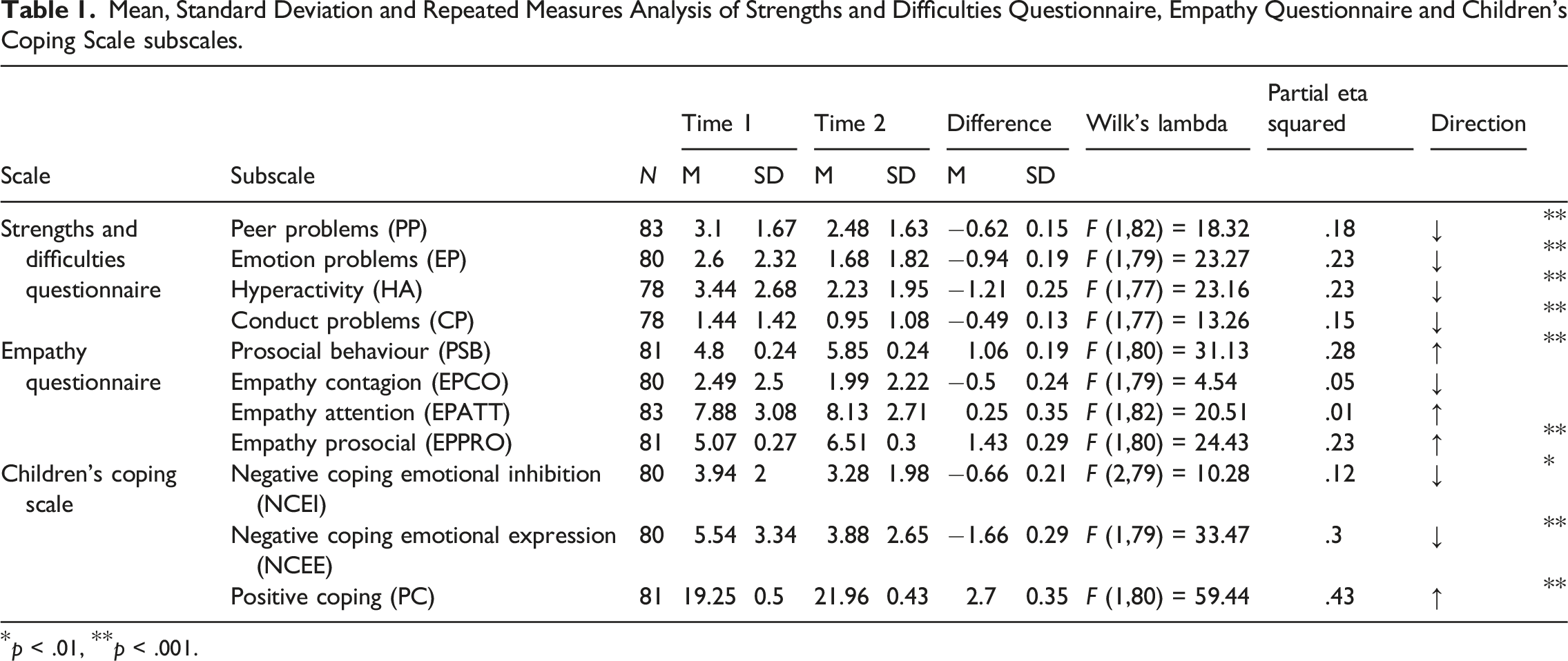
*p < .01, **p < .001.
Statistical analyses
Analysis of Variance (ANOVA) was used to compare Time 1 and Time 2 and is considered robust to violations of normality and excessive kurtosis observed in the data (Tabachnick & Fidell, 2013). Correlations between the subscales at each time point were inspected to determine which variables were collinear to conduct Multivariate Analysis of Variance (MANOVA). This would reduce the number of comparisons made and mitigate the risk of a false positive result (Tabachnick & Fidell, 2013). It was determined that Peer Problems and Empathy Attention would be investigated separately with repeated measures ANOVAs as there was insufficient collinearity with other subscales. Four MANOVAs were planned in line with underlying conceptual connections between the subscales: i. Emotion Problems and Empathy Contagion, ii. Conduct Problems and Hyperactivity, iii. Negative Coping Emotional Expression and Negative Coping Emotional Inhibition, iv. Prosocial Behaviour, Positive Coping and Empathy Prosocial. Gender and year participating in the LNP (2021 or 2022) were included as between subject variables to determine if they impacted on the results. The assumption of sphericity was violated for each individual Analysis of Variance (ANOVA), so the Greenhouse-Geisser statistic was reported (Tabachnick & Fidell, 2013). Mahalanobis distances were inspected to check for multivariate outliers and determined to be within acceptable ranges. A Bonferonni Correction was utilised to reduce the likelihood of obtaining a false positive and the alpha value was set to .008 (Pallant, 2020). Effect sizes were interpreted using Cohen’s (1992) guidelines. Post-hoc power analyses were completed for statistically significant results and were demonstrated to be in an acceptable range (>.9, Cohen). However, these should be interpreted with caution given that the sample sizes were not large enough to reach a priori power of .8 according to Cohen.
Social and emotional problems over time
Peer problems
A repeated measures ANOVA suggested that there was a significant reduction in Peer Problems over time, with a small effect size (F (1,82) = 18.32, p < .001, η 2 = .18).
Empathy contagion (EmQue) and emotion problems (SDQ)
A repeated measures MANOVA was run on Empathy Contagion and Emotion Problems, since these constructs are suggested to reflect underlying difficulties with emotion regulation (Table 1). A significant main effect of time was observed, with a small effect size (η 2 = .26). However, inspection of paired-wise comparisons suggested that there was no significant effect of time for Empathy Contagion. A significant reduction in Emotion Problems was observed with a small effect size (η 2 = .23).
Hyperactivity and conduct problems
Hyperactivity and Conduct Problems were investigated together as they may share underlying difficulties with self-regulation (Table 1). A significant yet small effect of time was observed (η 2 = .26).
A significant effect of year engaging in the LNP was observed for Hyperactivity, with children in 2021 demonstrating a greater decrease than the 2022 cohort, with a moderate effect (F (1,81) = 44.31, p < .001, η 2 = .35).
Negative coping emotional expression and negative coping emotional inhibition
Both types of negative coping were investigated together since they both represent maladaptive coping behaviours (Table 1). A significant main effect of time was observed with a medium effect size (η 2 = .26). Paired wise comparison suggested that there was a small effect for NCEI (η 2 = .12) and a moderate effect for NCEE (η 2 = .3).
Social and emotional skills over time
Empathy attention
No significant difference was observed between Empathy Attention before and after completing the LNP (F (1,82) = 20.51, p = .48 η 2 = .01).
Positive coping, empathy prosocial, prosocial behaviour
These variables were investigated together as prosocial behaviour is related to emotion regulation skills, which may be assisted by positive coping strategies. A significant and moderate effect of time was observed in the multivariate analysis (η 2 = .5). Regarding each paired wise comparison, a moderate effect of time was observed for Positive Coping (η 2 = .43) and small effects for Empathy Prosocial (η 2 = .23) and Prosocial Behaviour (η 2 = .28).
A significant effect of year participating in the LNP was observed for Prosocial Behaviour, with children in 2021 demonstrating a greater increase than the 2022 cohort, though this effect was small (F (1,81) = 9.52, p < .005, η 2 = .11).
Qualitative analysis
Parent surveys
A word frequency analysis was run on responses to the parent questionnaires to determine the occurrence of key themes. Figure 1 outlines the major themes and their occurrence in parent responses. Frequency of themes in parent responses.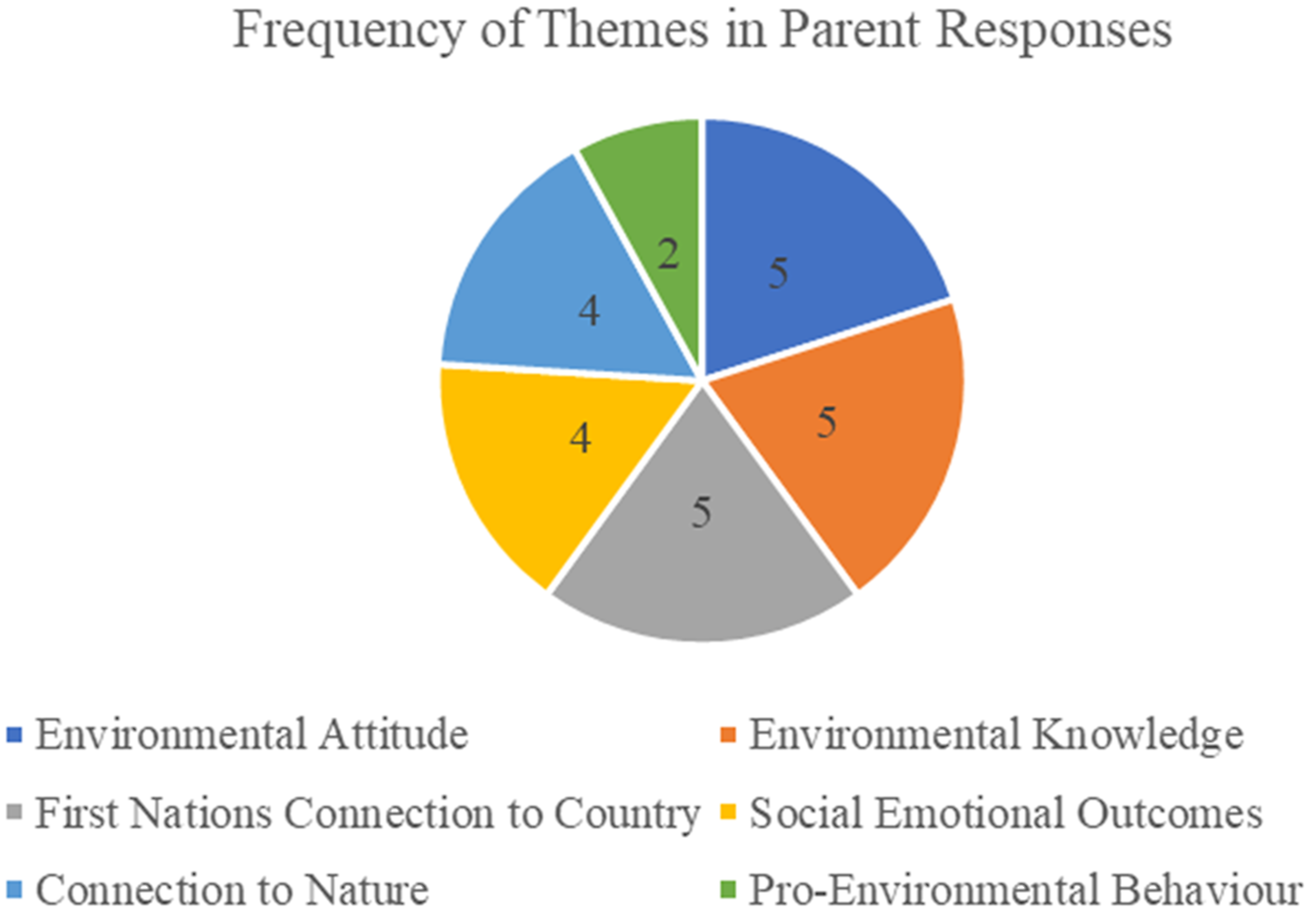
Five parents reported that their children had increased Environmental Knowledge, similarly, five parents stated that their children demonstrated improved Environmentally Sustainable Attitude. Two parents observed that their children demonstrated Environmentally Sustainable Behaviours. PB26 noted that their son “is now a stickler for picking up rubbish …talks about the how… the planet will be poisoned if we don’t.” Four parents reported Social Emotional Outcomes for their children in a variety of domains. PB2 noted a “positive contribution to…engagement with peers”. PB11 was reported to be “anxious about unfamiliar environments and new things, this program is ideal for her to stretch her confidence.” PB22 also reported “improved concentration” in their child. Four parents reported children demonstrating behaviours relating Connection to Nature, for example, SB3 “tells us about her friend Biel (the gum tree)”. Five parents reported children learning about First Nations Connections to Country, for example SB26 “took us on a Learning in Nature walk and told us about all the Indigenous names for animals etc. that he knows.”
Discussion
The aim of the current study was to investigate the Learning in Nature Program, an Early Childhood Education for Sustainability program, in terms of Social Emotional Learning and environmentally sustainable attitudes and behaviours. A mixed-methods approach incorporating quantitative and qualitative measures taken over several time points in a four-month period was utilised. The first hypothesis that children’s pro-environmentally sustainable attitudes and behaviour would increase after completing the LNP was generally supported. The second hypothesis regarding Social Emotional Learning outcomes was also substantially supported in that children’s prosocial behaviours and positive coping significantly increased, while maladaptive behaviours and negative coping decreased significantly. However, there were no observed meaningful changes in emotion contagion nor attention to emotions of others.
Social emotional outcomes
Empathy
Scores on the EmQue suggested that there was a significant effect of time for Prosocial Actions, where children demonstrated more behaviours aligned with reactions to others’ affective states, such as comforting others when distressed. These findings are consistent with Brussoni et al.’s (2017) observation of increased prosocial behaviour after a nature play ECE program.
Unexpectedly, no significant differences were observed between time points in terms of Emotional Contagion and Attention to Others’ Emotions. This may reflect that the children had already attained these stages of empathy development (Hoffman, 2008), thus stability across time was observed. Participation in the LNP may assist children to develop skills for acting in response to the emotions of others, but may not contribute to further developing underlying empathy processes of emotional contagion and attention to others’ emotions which may follow expected affective and cognitive developmental trajectories (Hoffman, 2008)
Regarding qualitative findings, children exhibited more positive engagement with peers and environmentally sustainable actions, such as picking up rubbish, as reported by parents. The increasing emotional connections with the natural environment were captured in Ching’s (2024) analysis of drawing-tellings from the same cohort. Chawla (2020) suggests that children’s experience of distress in response to environmental degradation reflects their awareness that they are interdependent with the natural world, which aligns with a post-humanist framework as pointed out by Dreamson and Kim (2022).
Coping
The current findings suggested that positive coping increased and negative emotional inhibition and expressive coping decreased after completing the LNP. These findings were supported in one parent’s observation that novel settings encountered in the LNP extended their child’s confidence, as the child would previously react with apprehension and avoidance, a negative coping strategy. This is consistent with previous research (Ernst & Burcak, 2019), potentially a result of overcoming challenges in the natural environment, such as navigating through unpredictable landscapes (Deans & Deans, 2018). Positive coping also entails assisting others or obtaining social support (Yeo et al., 2014), which may be connected to children’s enhanced awareness of friendships as the LNP progressed.
Social behaviours
The quantitative results suggested an increase in prosocial behaviour (PSB) and reduction in peer problems after the LNP. Similarly, parents reported enhanced connection with classmates. These results align with Müller et al.’s (2017) finding that greater cooperation was observed amongst children attending a nature-based kindergarten program than amongst controls. These findings may be beyond typical developmental trajectories, as overt value of social connections, as expressed in parent surveys, are not expected to emerge below age five (Frydenberg et al., 2020).
Reduction in emotional and self-regulation difficulties
A significant though small reduction in SDQ emotion problems was observed. These findings align with Brussoni et al.'s (2017) reported reduction in depressive symptoms after a nature play intervention. This may be related to the direct stress-mitigating effects of nature (Müller et al., 2017) and encouragement of dramatic play in natural environments, fostering children’s emotion regulation and social skills (Dankiw et al., 2020). The direct wellbeing effects of nature exposure are consistent with Stanger’s (2011) socio-ecological model, where the local natural environment is implicated in a child’s mental health at micro ecosystem level (Bell & Dyment, 2008).
Significant yet small declines in hyperactivity and conduct problems were observed, which may reflect enhanced self-regulation ability. These quantitative findings were supported by a parent report of their child’s concentration improving after completing LNP. The results converge with Müller et al.’s (2017) observation of improved self-control after attending nature-based kindergarten compared to controls. These changes could be attributed to enhanced self-regulation associated with child-directed outdoor nature play (Whitebread et al., 2009), as the learning process of play draws upon higher-order meta-cognitive and self-regulatory capacities, especially when adult assistance is removed. These self-regulation improvements reflect the wider theme of active citizenship as a key EFS outcome, equipping children to act autonomously to protect the natural environment (Caiman & Lundegård, 2014).
Environmentally sustainable outcomes
Qualitative results suggest that children developed knowledge of the natural environment early in the LNP, progressing to evidence of emotional connections with nature alongside pro-environmentally sustainable attitudes and behaviours. Perhaps children need to develop a base level of awareness that can be progressively combined with emotional connections to the environment to instigate attitude and behaviour change (Toomey et al., 2017). This aligns with a post-humanist framework, where awareness of their enmeshment in the natural world (Dreamson & Kim, 2022) may facilitate children to protect the environment through emotional connections (Chawla, 2020). Increased child awareness of First Nations (Deans & Deans, 2018) connection to the land, potentially reflected understanding the natural world beyond the prevailing Western notion of humans as distinct from land (Ritchie, 2012).
Differences in cohorts
The 2021 cohort made more gains in terms of prosocial behaviour and experienced greater reductions in hyperactivity than the 2022 cohort, with two potential explanations. Firstly, of the two teachers in 2021, one was the designer of the program so she could be expected to have a strong commitment to its success and that teacher also had more experience delivering the LNP than the 2022 teachers. Nevertheless, significant improvements also occurred in 2022, suggesting that the LNP program can be successfully implemented by ECE teachers regardless of previous experience. This is a helpful finding, as teachers reported limited familiarity as a barrier in implementing ECEFS programs in Elliot et al.’s (2016) study. Secondly, the 2021 cohort only experienced about five months of lockdown, while the 2022 students underwent eight months. COVID-19 lockdowns have been implicated in a decrease in prosocial behaviour and increase in hyperactivity on the SDQ (Specht et al., 2021), therefore enforced time away from peers may have had a cumulative impact.
Implications
The current mixed method comparison study provides further evidence of SEL and pro-environmentally sustainable outcomes associated with ECEFS. The larger sample size enhances the generalisability of these findings. The current study suggests that while teacher experience may further enhance outcomes (Elliot et al., 2016), inexperienced teachers can also successfully implement ECEFS. Findings also suggest that the LNP is an effective intervention for SEL outcomes across a variety of domains. Consequently, ECEFS may be an effective early intervention to prevent or mitigate mental health problems (Mygind et al., 2019). The current study also supports the efficacy of ECEFS for instilling pro-environmentally sustainable attitudes and behaviours through explicit instruction combined with child-directed nature play. Overall, the current study supports the implementation of similar EFS programs in other early childhood educational settings, demonstrating that EFS can be implemented in a meaningful way, beyond tokenistic measures (Elliott et al., 2016).
Limitations
In spite of the strengths of the current study, there were several limitations. Firstly, the study was conducted without a control group, as is often the case in a naturalistic educational setting where the researchers accommodate to the demands of the setting. Therefore, it is unclear whether the SEL outcomes were a result of the LNP or the result of developmental trajectories over time. For example, typically developing four-year-olds are expected to increasingly express frustrations by using more words rather than physical behaviours or crying (Frydenberg et al., 2020). Further research could compare children attending either the LNP or conventional ECE, similar to Müller et al.’s (2017) study.
The current sample was drawn from mostly highly educated, though also urban, family backgrounds that were likely to have ready access to natural spaces. Olsen et al. (2022) found that from a sample of Scottish children aged 10–11 years (n = 667), those with lower socioeconomic backgrounds had less access to quality green spaces. Given the wellbeing benefits associated with the LNP and the greater incidence of mental health problems amongst economically deprived children (Olsen et al., 2022), future research could investigate the impact of ECEFS in this cohort. The study could be replicated in other settings where there is a more varied population.
Conclusion
The current investigation of the Learning in Nature Program provides further evidence for the effectiveness of Early Childhood Education for Sustainability programs in terms of fostering pro-environmentally sustainable attitudes and behaviours alongside Social Emotional Learning outcomes. Quantitative results from the combined 2021 and 2022 samples suggested improvements in empathetic prosocial actions, prosocial behaviour and positive coping after completing the LNP. These were accompanied by reductions in problems in negative coping and in peer, emotional, hyperactivity and conduct difficulties. Qualitative data provided insight into how these changes occurred, such as making emotional connections to nature. The qualitative data also suggested that children acquired pro-environmentally sustainable knowledge, attitudes and behaviours. These findings support the wider implementation of ECEFS programs. Whilst the benefits of such programs can be identified, a deeper understanding of outcomes can be achieved where researchers have access to a control group.
Footnotes
Declaration of conflicting interests
The author(s) declared no potential conflicts of interest with respect to the research, authorship, and/or publication of this article.
Funding
The author(s) received no financial support for the research, authorship, and/or publication of this article.
