




Abstract
Global early childhood education workforce shortages have highlighted the importance of recruitment and retention. The development of effective leadership has not been a retention policy focus even though effective leadership has been identified as an important driver for improving working conditions and supporting educator retention. The aim of this research was to investigate what factors affect retention focussing on retention challenges for leaders in an under researched context. Participants were 34 early childhood educators in the Northern Territory of Australia. A constructivist grounded theory methodology framed the research and the data analysis, and a constant comparative method was used to generate categories. The lack of learning on leadership, coupled with competing priorities, were identified as critical factors that contribute to increased attrition. However, informal mentoring was found to support both the positional and emerging leaders, increasing the probability of their retention regardless of their access to leadership development.
The early childhood education (ECE) profession faces critical workforce shortages across the world (OECD, 2019). Leadership approaches and strategies within ECE are identified as key factors in educators’ attrition and retention (Thorpe et al., 2020, 2023). Despite this research, there is limited focus within the attraction and retention policy initiatives on leadership and leadership development. Instead, policies focus on improving the quality and supply of the ECE workforce, overlooking the influence of leadership on the recruitment and retention of educators (Council of Australian Governments (COAG), 2009; National Children’s Education and Care Workforce Strategy, 2021). There have been limited leadership development strategies implemented within ECE. The lack of mandated support means that emerging leaders are guided and developed by the leadership approaches of their organisational climate (Gibbs, 2022; Torii et al., 2017). Furthermore, retaining leaders and supporting the development of emerging leaders has not been part of ECE policy focus possibly placing positional leaders at a higher risk of attrition (National Children’s Education and Care Workforce Strategy, 2022; White, 2023).
This paper begins with a brief discussion on early childhood leadership approaches and the current retention challenges within the profession. The paper then identifies contextual influences on positional and emerging leaders and the retention challenges within the ECE profession. Finally, this paper offers suggestions on the opportunities available to support the retention of leaders regardless of contextual constraints.
Early childhood education leadership
In recent years, leadership in ECE has been shaped by intentional and relationally focused leadership (Waniganayake et al., 2023). This shaping encourages positional leaders, and emerging leaders, to make intentional and ethical decisions that support the ECE service to move forward, while focusing on the building and maintaining of relationships (Hard & Jónsdóttir, 2013; Waniganayake et al., 2023). However, Henderson et al. (2022) have asserted that the term relational does not adequately describe how leadership can be developed and enacted. Instead, the term leading identity is applied which encompasses both the development of leadership and how leadership approaches can foster change through reflective and purposeful practice. Additionally, Douglass (2018) identified that a teacher-leadership development gap exists. The gap has been created due to retention and attraction policies that are focused on increasing qualifications and upskilling educators but not on developing effective leaders. The limited focus on ECE leadership development leads to educators developing their leadership skills through the modelled behaviours of the leaders in their organisation. The emerging leaders’ organisational climates can vary and may not support effective, intentional, or relational leadership skills to develop.
The organisational climates of ECE services are included within the term working conditions. As well as the organisational climate, the working conditions encompasses the leadership structures of a service, the existing supports available to educators, and the existing relationships within the ECE service (OECD, 2018). An educator’s working conditions are a key determinant of their well-being, job satisfaction and retention (OECD, 2021). Challenges perpetuated by working conditions include compromised leadership capability, diminished workforce capacity and administrative burden (Fenech et al., 2021; Irvine et al., 2016; Jeon & Ardeleanu, 2020; Schaack et al., 2021; Thorpe et al., 2020). Furthermore, effective leadership can be constrained due to the context of the ECE service, the systemic structure, and the available resources. Effective leadership can also be affected by constraints of the context, the leaders’ skills and adaptability, their time availability, their self-awareness and how realistic their expectations are of those they lead (Ciuciu, 2022; Ciuciu & Robertson, 2019; Sims et al., 2017). Although leadership has the potential to support educator retention, currently, leadership development in ECE is only accessible to emerging leaders who have access to skilled and effective organisational leadership mentors.
Retention in early childhood education
Critical shortages have been identified in the ECE workforce internationally and in Australia. (OECD, 2019). Australia is experiencing difficulty retaining and attracting educators to the ECE profession, with 24,000 additional educators required by 2025 (National Children’s Education and Care Workforce Strategy, 2021). National educator retention research has identified that current retention challenges include low wages, a lack of professional recognition, and limited career pathways (Australian Children’s Education and Care Quality Authority (ACECQA), 2019; Fenech & Watt, 2023; Irvine et al., 2016; Thorpe et al., 2020; Thorpe et al., 2023). However, a national view of retention cannot provide a complete picture of retention challenges or opportunities due to diverse Australian ECE setting contexts.
This paper addresses the factors that enabled and constrained retention for a group of educators in the Northern Territory (NT), Australia thus providing one small regional perspective. Such a perspective may offer guidance for other diverse contexts within Australia that are not within the purview of the existing national literature. The NT is an Australian jurisdictional territory that has high proportions of the population living remotely or very remotely and a high population mobility with approximately 75% of the population moving away from the NT within the first four years after arrival (Australian Bureau of Statistics, 2021a, 2021b; Department of Treasury and Finance, n.d; Thurmer et al., 2019). Early childhood education workforce retention in the NT is different from other rural communities in Australia, as recruitment often depends on qualified staff migrating from other states and territories so newer staff may experience professional and personal isolation (Golebiowska et al., 2018; Speering, 2016). Additionally, infrastructure access issues, limited numbers of new ECE applicants with the required experience or skills and a lack of experienced mentors add to the NT retention challenges (Industry Skills Advisory Council NT, 2021).
The NT has high workforce mobility due to the population mobility of the NT; however, negative workforce factors can further increase turnover and attrition. These workforce factors include high staff turnover, stressful working environments, poor working environment quality, a lack of support from leadership and management, high administrative workloads, low proximity to services (including professional development) and a lack of understanding towards local cultural knowledge (Hall et al., 2007; Speering, 2016). While the ECE profession broadly experiences many of these factors the high population mobility, national workforce shortages and limited experience of educators compounds these factors for NT educators, particularly those in positional leadership roles (Fenech & Watt, 2023; Jeon & Wells, 2018; McKinlay et al., 2018; Schaack et al., 2020; Thorpe et al., 2020). These factors make the NT a unique area for research regarding ECE retention with the opportunity to provide guidance to other jurisdictions. The research study aimed to understand what enabled and constrained ECE retention in the NT. However, this paper specifically investigates the challenges leaders experienced that may have increased their risk of attrition. The paper also explores the supports leaders identified that may lead to ECE retention.
Research methodology
Constructivist grounded theory (CGT) was chosen to frame this research to ensure a broad approach was taken towards understanding the issues of educator retention. The research design, methods and procedures used to recruit participants and the data analysis were framed and informed by CGT which considers the data within the situated context (Charmaz, 2014, 2017). Constructivist Grounded Theory acknowledges that researcher bias exists, and that a researcher’s socially constructed knowledge frames the interpretation that informs the data analysis and generation of the data categories. In line with CGT data collection and data analysis occur concurrently with the main aim of a CGT approach to generate a theory about the data. The generated theory is established (grounded) from the data and justified by the data (Birks & Mills, 2015). Ethical approval was obtained from Charles Sturt’s Human Research Ethics Committee (approval number 2012/178).
Research method
Participant information.
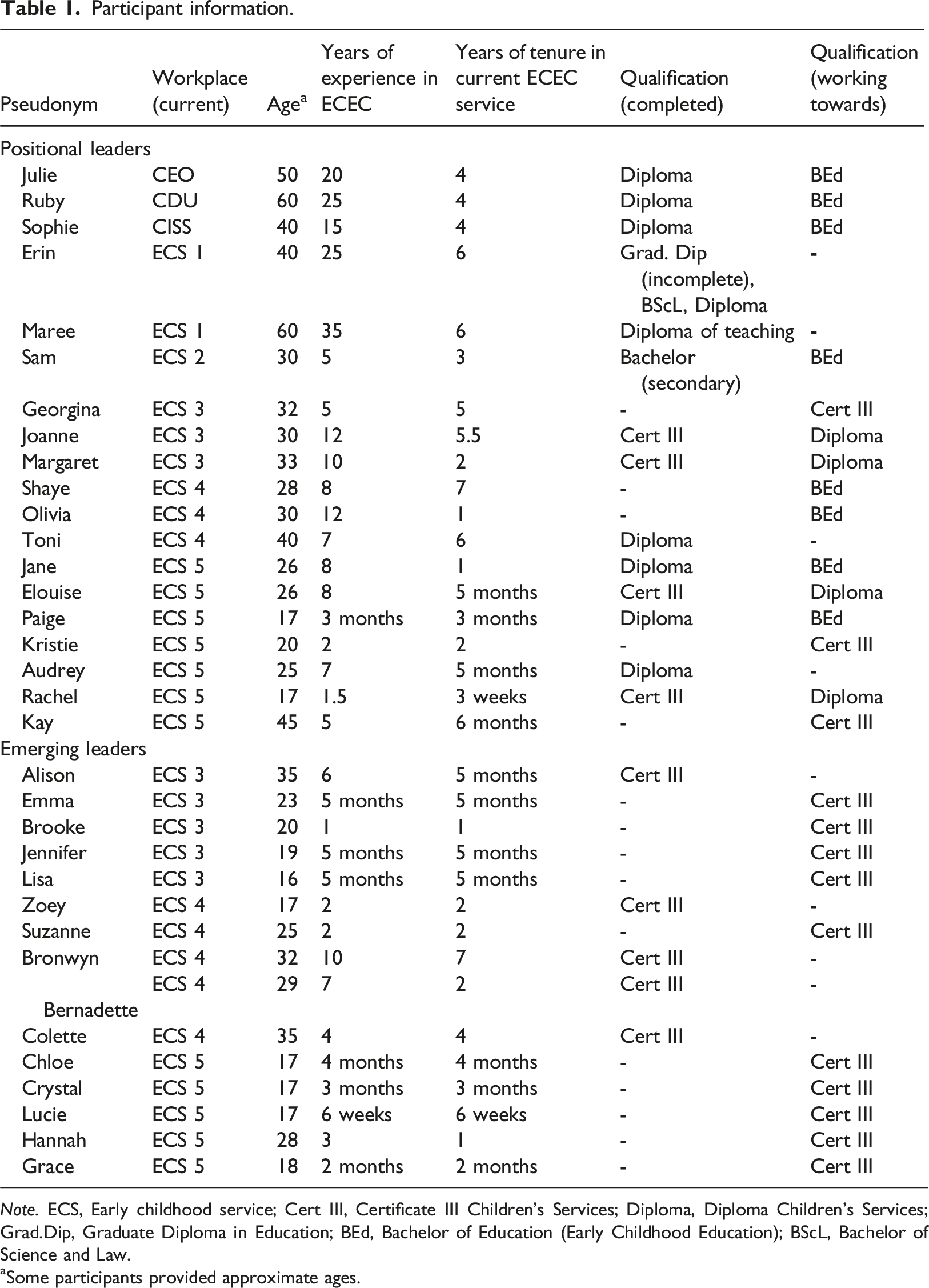
Note. ECS, Early childhood service; Cert III, Certificate III Children’s Services; Diploma, Diploma Children’s Services; Grad.Dip, Graduate Diploma in Education; BEd, Bachelor of Education (Early Childhood Education); BScL, Bachelor of Science and Law.
aSome participants provided approximate ages.
Workplace information.
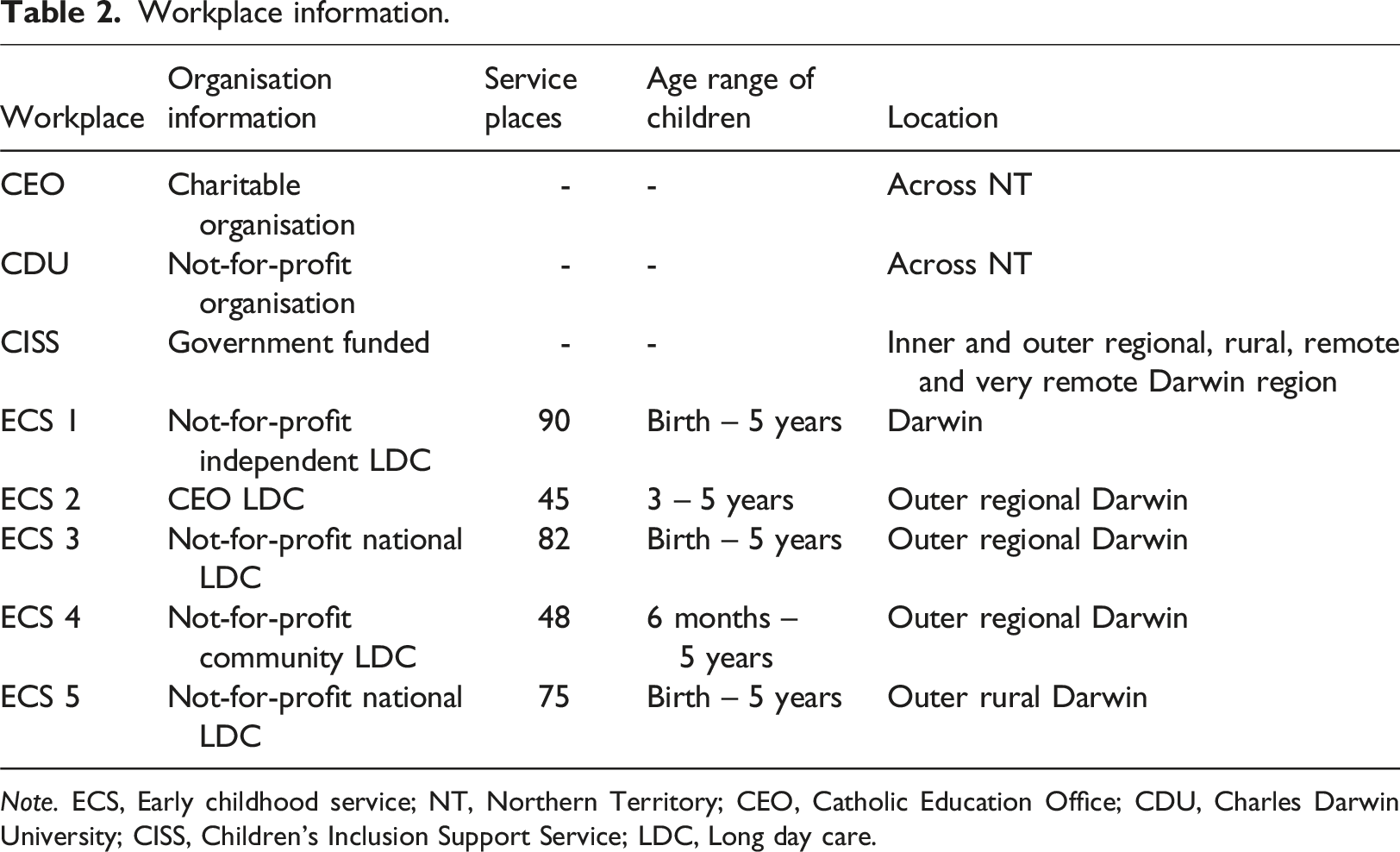
Note. ECS, Early childhood service; NT, Northern Territory; CEO, Catholic Education Office; CDU, Charles Darwin University; CISS, Children’s Inclusion Support Service; LDC, Long day care.
Small group interviews were conducted with the grouping based on educator convenience; one participant was interviewed individually. The other participants were interviewed in groups of two to four people in their workplace staff room. The interviews were open-ended and conversational, allowing the participants to determine the direction of the discussions. An interview guide based on the research focus was provided to participants with the participant information sheet. Data collection and analysis occurred concurrently, a CGT approach, which guided the future interview directions as the interviewing process was iterative. The role of the interviewer was to confirm information through further questions or to prompt further knowledge when a new focus-related direction was introduced by participants.
Data analysis
Data were transcribed and de-identified before the data analysis. A constant comparative analysis, characteristic of CGT, occurs simultaneously to the data collection and provides guidance in future interview sessions to highlight areas for further clarification (Birks & Mills, 2015). A constant comparative analysis compares incidents across differing groups throughout the data analysis. Reflective analytical notes were made during the analysis, known as memos in CGT. The analytical notes assisted to develop the generated conceptual data categories through critical researcher reflectivity (Charmaz, 2014). A CGT approach requires the researcher to continually revisit the data, the reflective notes, and the generated codes for reviewal and refinement (Birks & Mills, 2015; Charmaz, 2014). The data analysis process supported the development of a core category. The relationship between the codes and the core category were tested to ensure a logical pattern existed, supporting a theory-driven analysis, as opposed to just a descriptive or thematic analysis (Birks & Mills, 2015; Saldaña, 2015).
The data analysis process led to the generation of a core category, the need for participants to adjust their practices or accommodate educational values. The core category encompassed participants’ requirement to adjust their own practices in line with their colleagues’ or leaders’ practices or when the participants felt it was necessary to accommodate educational values, either their own educational values or those of others. Through the data analysis the two properties of the core category were identified, struggle and hope. Participant’s either struggled to adjust their practices or struggled to accommodate their own or others’ educational values or they found hope in these practices. This paper presents the findings that relate to how leader’s retention was enabled or constrained. A substantive grounded theory, the aim of a CGT approach, was generated and grounded in the data and encompassed the core category. The substantive theory was that building connection, builds retention. The findings presented in this paper demonstrate the substantive theory and explains the connections that can be developed and built through leading and leadership which can support retention.
Findings
The organisational climate of an ECE service is an integral characteristic of the organisation. Within ECE an organisational climate is defined as an individual’s perception and feeling of the overall atmosphere of the work environment including the expectations that exist within the organisation in relation to overall attitudes and behaviours within that ECEC service (Bloom, 2015; Hewett & La Paro, 2020; Slot, 2018). Organisational climate can influence leadership styles and approaches and how leaders communicate. Organisational climate can influence the conflict resolution strategies that leaders use and how everyday practices manifest themselves. These influences can be either negative or positive depending on how the educators view these approaches and practices (Hewett & La Paro, 2020). Participants’ organisational climate, their thinking at the point of time that they were interviewed, their attitude and their job satisfaction may have influenced how they framed the topics they chose to discuss. Furthermore, participants also discussed some points of their career retrospectively which may have influenced how they framed the topics discussed.
Participants’ discussion moved fluidly between the two properties struggle and hope. While the properties themselves are explained as definitive binary categories, participants experiences moved between them. The struggle that participants who were positional leaders identified in relation competing job task priorities is followed by participants discussing the need for learning to be a leader. The second section of findings discusses the hope participants found through informal mentoring connections.
Struggle
Competing priorities
All of the participants discussed the importance they placed on being available for the children in their care, identifying that they always tried to prioritise the children. While many participants highlighted that multitasking was a difficulty of the ECE role, participants in positional leader roles at two of the eight workplaces were seemingly more affected by this practice then the emerging leaders in these same workplaces. Furthermore, an in-depth discussion around participant’s competing priorities only arose in early childhood centre (ECS) 3 and ECS 5 which were both larger long day care centres owned by the same not-for profit company. Participants who were interpreted as struggling with this practice were those who were perceived as discussing increased stress when their job task priorities competed with their priority to educationally value the care of the children.
Participants discussed examples of job tasks that competed for priority with the children including cleaning and paperwork such as checklists and observations, which were undertaken at the same time as participants were required to actively supervise children. Margaret (ECS 3), who held a room leader role described the constant multitasking that occurred throughout the day and her difficulty in balancing the competing proprieties she felt, “By the time you start [completing the paperwork], you write two lines [and] you’ve got to go and play, [or] you’ve got to fix something, [or] you’ve got to go and [support a child to] negotiate. Then [you have] got to go back and re-start [the paperwork again] and that’s just that bit of paperwork, that’s without the other 5 things you’ve got to do”.
Time pressure was a factor that participants discussed in relation to their competing priorities, specifically the urgency of the completion of certain tasks. For example, the birth to two years, 5 minutes sleep check checklists or the cleaning up of routine meals was mentioned. Participants explained that the time pressure to complete some tasks while actively supervising and engaging with the children was difficult. At ECS 5, Audrey who held a room leader role identified that she felt, “there is not as much time with the children as I’d like… because you’re going back and forth [between documenting] all the checks [and being] with the children”. Jane, the positional leader at ECS 5 who held the director role, identified that the positional leaders carried the larger administrative responsibility. Jane explained that it was the positional leaders at her service who regularly worked unpaid after hours and on weekends to complete tasks. She added that the positional leader’s workloads increased due to internet connection issues, and inadequate technology and resources. Jane also clarified that different ECE services have different paperwork requirements, noting that she knew of other positional leaders in other ECE services who had lighter administrative loads.
The assistant director at ECS 5, Elouise, was also a positional room leader. She discussed that staff absences and newer staff also increased the time pressure that educators felt and the increased feeling of competing priorities. Elouise explained this time pressure intensified when Jane, the director, was absent. Staff at ECS 5 were also required to undertake the whole service cleaning three days per week as cleaners were only employed two days per week at the service. Again, this requirement added to the time pressure and competing priorities that participants discussed. Elouise identified that “a lot of my weekends are spent here [at work] catching up on the paperwork [unpaid]”. Elouise stated she preferred to spend her time at work “focus [sed] on what the children are doing … [that is what] we’re here for, the children.” As a leader Jane asserted that she had made the decision to set an expectation that the assistants (emerging leaders) were required to “step up and help out [with the positional leader tasks] because it’s [the tasks are] just way too much for one person to do.” She noted that she had made this decision due to the amount of unpaid overtime the positional room leaders were undertaking.
Jane had discussed creating an expectation at ECS 5 around assistants also completing paperwork. None of the participants at ECS 3 discussed a similar expectation although two participants identified that the room leader completed most of the administrative work. The director of ECS 3 was also new to the positional leader (director) role. While the emerging leaders in ECS 3 and ECS 5 did discuss competing priorities in terms of multitasking they explained that it was the positional leaders that mainly dealt with the stress of competing priorities. For example, Emma (ECS 3) commented “the group leaders do a lot more than us” and Chloe (ECS 5) who discussed she did not feel the pressure of competing priorities yet made the observation that “Kristie [the positional room leader] is a workaholic [as] on her lunch breaks she’s in and out with the kids”. Participants in other ECE services did not discuss competing priorities that were interpreted as a struggle, although multitasking was evident in these discussions.
Learning leadership
The importance of learning how to be a leader was raised by participants who were positional leaders as an ongoing struggle for emerging leaders. Julie acknowledged that many educators have a “passion for working with children”. However, that passion for being an excellent educator does not inherently make an individual a “good leader”. Julie asserted that “leadership skills are built” and that these skills take time to develop. Sam, who worked with Julie agreed that a large part of his positional leadership role was “assist [ing] staff with their leadership skills”. He noted the importance of teaching leadership skills due to how integral it was for the role. He noted this was especially true for the “diploma qualified staff member [whose role] is managing other staff [and] implementing change”. Sam identified that “a focus on teaching leadership” was important for the ECE profession.
Sophie recalled the difficulty she had felt moving from being an educator into a leadership position. Before becoming a positional leader, Sophie had completed a Diploma in Children’s Services, a Diploma in Frontline Management and a Certificate IV in Training and Assessing. However, she stated that these qualifications had not prepared her for the role as director. Sophie expressed that her move from “the position as someone who’s just working with the children and [into] having that [leadership] responsibility” was a steep learning curve. Sophie explained that she learnt a lot of her leadership skills in the positional leadership role through gaining experience and reflecting on her practices: A group leader that I really relied on [for] everything was going fine, and I’d ask her how she was going, because I did see that she was getting more stressed as the weeks went by. She just said she just ‘had enough,’ in the middle of putting the children to sleep one day [and she resigned]. … I was really sorry how it ended up and I was reflecting on it [afterwards], I should have been more forward in saying “I can tell that you’re stressed you know, come and talk to me about [it] and let's try and work it out’ and I didn't then.
This reflection from Sophie was interpreted as her struggle to enact leadership while still learning and developing leadership skills. She added that “the hardest thing for me [were] the staff, funny enough the children and the families and everything else you dealt with was fine”. Sophie also discussed that she did not feel “valued” or supported by her direct manager during this time which led to her eventual resignation and move to another service. Sophie’s comments around her direct manager indicates that learning leadership skills in the role can be difficult and that support cannot always be provided or provided in the way an individual can engage with.
Positional leadership and moving into a leadership position was also discussed by Ruby who recalled her positional leader role where she had begun as an assistant director and then moved into the director role a few years later. She explained “I couldn’t really direct, I could to a certain extent, but my hands were tied,” because of the ECE service management hierarchy and how they wanted Ruby to manage. She added that soon she realised that “I really actually missed the children … in the end I said look I don’t want to be the director anymore, just let me go back to the children”. Ruby’s comment infers a similar line of thinking to Julie, which was that having a passion for teaching children does not mean you will have a passion for positional leadership and management. The comment also highlights that professional autonomy may have been what Ruby was wanting as a leader and she felt she had more professional autonomy in her educator role. Ruby explained that she resigned from the position not long after this event which suggests that it may have been the organisational culture that was influencing how Ruby felt about leadership and not the role of leadership itself that was the issue.
While some of the participants who had held positional leadership roles discussed the struggle to learn leadership when in the role Olivia raised concern around the examples that were set for some emerging leaders. After undertaking casual work in an ECE service with very set roles of “I’m the leader, you’re the assistant” she discussed the lowered staff morale and work ethic amongst the emerging leaders. Olivia explained that this morale was reflected in the staff’s engagement with children and the program because the staff were not being mentored in their role and the environment did not have a “supportive atmosphere”.
The participants’ comments identify the leadership can be difficult. Positional leader participants’ who entered the role with minimal leadership skills or support found it difficult. Furthermore, the need for mentors and a supportive environment was flagged as necessary for emerging leaders to support children’s quality of care. These findings suggest that high quality mentoring may be the solution for both struggles.
Hope
Informal mentoring
While participants discussed struggling with their competing priorities and the importance of learning leadership skills, they also discussed supports that enabled their hope. Participants held discussions around the informal support that they provided as positional leaders or that was provided by positional leaders to them. This support was interpreted as a factor where participants found hope within their roles. The specific term of mentoring was not discussed by most participants, instead the term “support” was used which the researcher interpreted as informal mentoring.
Those participants who held positional leadership roles discussed the importance of spending time with newer staff or younger staff. Jane explained that part of her role was to teach the newer staff about the role of the educator, “it’s not a babysitting job, it’s a lot more than that you know, [and] getting them [the newer staff] to understand the overall picture of childcare is the biggest struggle”. Jane added that the reason time needs to be spent on the newer staff was because “there are a lot of things that in the workplace you’re just told to do and some of the assistants don’t understand why that has to be done, … just little things [for example] wiping kids noses with a glove on - it’s hygiene”. Audrey made a similar point that educators gaining clarity through asking questions was important. While Audrey did have experience working as an educator, she was new to ECS 5 and her comment highlights the importance of feeling confident to be able to ask questions, whereas Jane’s comment highlights that newer, less experienced staff often need more information and scaffolding around their practices.
Confidence to ask questions was also identified by Shaye, who shared that she researched “a lot of information on my own and I come back and discuss things with Lorraine [Shaye’s director].” Other participants in ECS 4 discussed that Lorraine’s relationships with the ECS 4 staff were the reason the service had high educator retention. The participants from ECS 4 all discussed how supportive an environment ECS 4 had and that Lorraine (positional leader – director) encouraged that support. Zoey, an emerging leader who was new to the profession discussed that she was given opportunities to learn processes through the support she received at ECS 4. Shaye reiterated similarly to Zoey that the positive environment of ECS 4 helped her to feel confident that even if she was absent from the room “[Zoey] can still get things done [and] if something happens and I can’t do it, then somebody else can”. Shaye explained that the ECS 4 team had supported Zoey to undertake opportunities to better understand her role as an educator and to develop skills. Shaye’s comment aligns with Jane’s (ECS 5) idea that educators need support to understand why certain tasks are completed the way they are, it cannot just be assumed an individual will know.
As a professional leader Ruby’s role involves supporting students on professional work placements in ECE services. Ruby discussed how staff shortages in the profession had led to student educators’ “learning some quite bad habits” that were “not respectful” to the children. She described having to role-model to student educators appropriate and respectful ways to speak to children. Ruby pointed out the importance of these types of conversations with newer educators particularly educators who may not have experienced appropriate role-modelling or supportive organisational climates.
A supportive organisational climate was also discussed in ECS 1. Erin and Maree, both positional leaders, agreed that the practice of critical reflection required scaffolding for some educators through professional conversations and role-modelling of reflective questioning. Erin explained that reflective practices require educators to ask themselves “what’s the thinking behind it [the practice]”? However, Erin and Maree discussed that many of their educators needed this practice to be scaffolded through role-modelling, through being prompted which then supported the educators to understand that “reflection is about exploring your ideas”. Erin and Maree identified that these types of conversations assisted to develop their staff’s practices and skills.
Similarly, to other participants, Sophie identified that the creation of supportive organisational climate was an important component of a leaders’ role, “because that [leadership] flows on, it’s very much whatever is happening at the top [of the management hierarchy] and whatever their [the leaders’] attitude is and their judgements are, that flows down into the rest of the staff”. The attitude and practices of the positional leader create the atmosphere of the organisation and the expectation of other educators. Alison expressed her expectation for support when she was confused about programming. She stated that she “had a sit down with Kate [Alison’s director] here a week ago and said oh help.” Alison’s expectation of support was confirmed by her leader’s responsiveness to her asking for help. Therefore, the creation of a supportive environment does appear to be connected with positional leaders’ who set the expectation that support will be available.
Discussion
This research provides evidence that participants, especially those in positional leadership roles, struggled in their role when they experienced limited social support or limited opportunities for leadership skill development. Additionally, participants discussed the need for educator support which was interpreted as informal mentoring. The social support, provided through informal mentoring, assisted to ensure children received high-quality and focused care.
Limited workplace resources can affect educator wellbeing and increase educator stress, lowering the quality of education and care they provide (Jeon & Ardeleanu, 2020; Kwon et al., 2020). Workplace resources, including human resources, can be affected by workforce shortages, limited availability of casual staff, difficulty ascertaining funding and an ECE services’ financial position. In this paper human resources, such as social support from colleagues, supported participants in ECS 5 to reduce their competing priorities. However, participants in positional leadership roles still identified that they regularly worked unpaid overtime due to their competing priorities, while their professional ethics encouraged the prioritising of the children. The prevalence of unpaid overtime in the ECE was identified by Cumming et al. (2021) who asserted that 90% of their participants worked unpaid overtime with 60% of these participants holding a positional leadership role. Alchin et al. (2019) confirmed similarly that 91% of the positional leaders surveyed identified that they worked unpaid overtime. Positional leaders with high workloads, stress, poor working conditions, low support and low wages are at risk of attrition as these factors are connected to high educator turnover rates (OECD, 2019). The findings in this paper indicate that positional leaders may be at greater risk of attrition which is not a focus of current retention policies (National Children’s Education and Care Workforce Strategy, 2022).
Responses from participants indicated that the learning of leadership skills could be a struggle. Participants discussed that learning the skills themselves could be difficult but that supporting emerging leaders to develop the skills could also be challenging depending on the workplace environment. The leadership skills that appeared to create the most struggle for participants were the organisational and management side of leadership, specifically the skills needed to manage staff, even though managing other people was identified as part of the leadership role. Sophie identified that her additional leadership credentials provided limited support to her in her positional leader role. Alchin et al. (2019) confirm this finding with leaders in their study reporting that additional study did not prepare them for leading. Despite these findings, professional development has become the policy focus for ECE retention, specifically leadership professional development and micro-credentials (National Children’s Education and Care Workforce Strategy, 2022; Thorpe et al., 2023). Furthermore, expected professional development from time poor positional leaders who are already undertaking unpaid overtime may increase attrition risks.
A lack of professional autonomy and managerial support, highlighted in Ruby’s excerpts, are factors that have been found to affect ECE retention (Ciuciu & Robertson, 2019). Ruby’s professional autonomy was limited due to the service management hierarchy which placed her in more of a middle management role. Ruby concluded that effectively leading in this situation was too difficult, leading to stepping down from the positional leader role and eventually to her resignation. While Ruby discussed her transition from a positional leadership role back to a teaching role, Sophie discussed her transition from an educator to a leader. Julie also discussed that being a passionate educator does not necessarily create an effective leader. These discussions highlight the different skills required for educator and leader roles. Furthermore, this research indicates if leaders are to be effective in their role they need support transitioning, which is not currently a focus within ECE policy (Douglass, 2018; National Children’s Education and Care Workforce Strategy, 2022). Sophie’s reflection on her transition into leadership also confirmed that she developed leadership skills through experience and reflection over time, not from her credentials. These findings support Henderson et al. (2022) and Douglass’ (2018) research on the concept of leadership identity never being static but unfolding and developing over time. Furthermore, it establishes the importance of leadership role-modelling for emerging leaders and the need for positive organisational climates when limited leadership development is available.
Limitations
The participants’ experiences provide insights into a specific context, limiting the generalisability of the findings. The point in time that interviews occurred also limited future retention and attrition predictions, as definitive rates were not ascertained. Despite the limitations this research offers insights into an under researched context that had limited resources. The research encourages the importance of adaptability when considering retention supports.
Conclusion
Although ECE policy has not prioritised leadership retention or development, this paper highlights that hope does exist, even in the face of critical staff shortages, limited experience among ECE mentors and infrastructure access issues (Industry Skills Advisory Council NT., 2021; National Children’s Education and Care Workforce Strategy, 2022; White, 2023). The findings of this research suggests that leaders are at greater risk of attrition and that leadership is an evolving learning process. Furthermore, this research indicates that a strategy to lower the risk of attrition is informal mentoring relationships. Informal mentoring relationship can provide mutually beneficial support for both positional leaders and emerging leaders. The development of a trusting and respectful professional relationship assisted the reduction of educators’ stress. Additionally, the scaffolding of practical knowledge for newer educators and emerging leaders created a social support system for the positional leaders. The practice of informal mentoring supported a leading identity experience where participants in positional leadership roles were able to reflect and adapt their practices which supported their leadership development. Therefore, the practice of informal mentoring increased participants’ social support and the prospect of their retention despite contextual constraints that may have influenced participants access to professional leadership development and experienced mentors (Elek & Page, 2019; Hadley et al., 2015). This paper demonstrates that the relationships positional and emerging leaders develop can provide substantial retention support, regardless of policy frameworks, service contexts and resource constraints.
Footnotes
Author contributions
BD collected, analysed, and interpreted the data regarding retention and attrition in early childhood. BD wrote the manuscript. WL, SM and LG substantively reviewed the manuscript. All authors read and approved the final manuscript.
Declaration of conflicting interests
The author(s) declared no potential conflicts of interest with respect to the research, authorship, and/or publication of this article.
Funding
The author(s) disclosed receipt of the following financial support for the research, authorship, and/or publication of this article: This research was supported by an Australian Government Research Training Program (RTP) Scholarship.

Data availability statement
The datasets used and analysed during the current study are available from the corresponding author upon request.