




Abstract
Educators working in early childhood education play a critical role in enhancing outcomes for children and families through active leadership. However, there are persistent paradoxical perceptions regarding the practical implementation of followership alongside leadership. This article addresses this followership paradox, as a key finding drawn from a larger doctoral study that explored followership practices in Australian early childhood education settings. By examining educators’ understandings of followership through the lens of established followership theories, and employing multi-site ethnography and reflexive thematic analysis, contradictory understandings were unearthed. Despite observing educators enacting effective followership behaviours, participants predominantly hold negative connotations associated with the role. These findings highlight the urgent need to acknowledge and appreciate the role of followers and their impact in co-creating quality workplace outcomes in early education settings. The article argues for integrating followership training alongside leadership development to foster more cohesive early childhood environments.
Introduction
In early childhood education (ECE), leadership is often tasked with improving quality and fostering children’s development (Douglass et al., 2022; Stamopoulos & Barblett, 2018). However, this study challenges this conventional wisdom by arguing that followership plays an influential and often underestimated role in attaining these successful workplace outcomes. Followership influence refers to the ability of followers to affect behaviours, attitudes, or decisions of leaders and other team members in the workplace (Shamir, 2007; Uhl-Bien et al., 2014). Like leadership, followership definitions are varied; broadly, followers are defined by their role in partnership with leadership and their “ability to follow leaders’ directives” (Crossman & Crossman, 2011, p. 492). As Shamir (2012, p. 487) states: For a phenomenon to be called leadership, we have to be able to identify certain actors who, at least in a certain situation and during a specified period of time, exert more influence than others on the group or the process.
These definitions highlight how followership is entangled with the phenomenon of leadership.
Organisational management scholars advocate for shifting the focus to a follower-centric approach in studying workplace outcomes, challenging the idea that followers are mere recipients who act on leaderships influence to achieve positive workplace outcomes (Shamir, 2007; Uhl-Bien & Carsten, 2018). The concept of ‘romance of leadership’ (Meindl et al., 1985) illustrates how workplace outcomes are often credited to leadership, by romanticising the leader’s role, while overlooking followers’ contributions. The lack of specific language regarding followership exacerbates these perceptions. Uhl-Bien and Carsten (2018) argue that while there are clear definitions and discussions about leadership, followership has not received the same level of attention. For example, software like Microsoft Word often flags the term “followership” as a spelling mistake, thereby highlighting its perceived insignificance. Therefore, prevalence of romance of leadership tendencies (Meindl et al., 1985) further underscores the critical need to understand followership in ECE.
This article presents findings drawn from a qualitative multi-site ethnography study that examined followership and following practices in ECE. Specifically, it delves into educator’s conceptualisation of followership, aligning with the existing literature on followership theories to address the research question: “how do educators understand and practice followership?”.
The discussion begins by outlining followership typologies and applying them to ECE contexts. Next, the methods used in the study are outlined. Then, three themes —contradictory followership, romance of kinder teachers and ineffective followership— highlight a followership paradox where educators’ negative perceptions did not align with the mostly effective following practices. These following practices offer innovative insights into educators’ professional practices from a follower-centric lens. The article concludes with a brief discussion of the implications, followed by concluding remarks.
What is followership and why does it matter in ECE?
Followership and leadership represent an uneven but co-productive partnership (Hurwitz & Hurwitz, 2015). Chaleff (2009) suggests that followership is not weakness but involves courage which gives leadership strength. Courageous followership transcends blind conformity; it empowers followers to voice their perspective, question authority, and hold leaders accountable when circumstances warrant (Chaleff, 2009). In this context, educators who epitomise courageous followership willingly take responsibility for their role in meeting quality objectives for children and families, actively contributing to leadership outcomes by enhancing the centres success. Therefore, within any discussion of leadership, followership should be given equal consideration. In this study, followership differs from general employee behaviour by incorporating leaders and leadership processes. For example, while routine care tasks for early childhood educators might involve feeding a bottle to a baby, followership occurs when the feeding routine is co-ordinated in response to a feeding roster and/or policy devised by leadership.
In organisational management studies, followership definitions emerge within three main overlapping views of followership: descriptive typologies, role-based followership and relational co-constructed approaches. Descriptive typologies are leader centric as they focus on formal hierarchical leader and follower roles in a workplace, specifically, how followers are recipients of a leader’s influence due to the leaders title and status (Crossman & Crossman, 2011; Shamir, 2007). For example, in ECE contexts, it could be a team of educators strictly adhering to the directives and guidance provided by centre manager for implementing curriculum activities, assuming a passive yet cooperative role by relying on leadership for decision making, thus acting as yes-people (Kelley, 2008).
Role-based followership presents a slightly different perspective, considering followership in terms of both formal roles (such as assistant educators) and informal roles and behaviours. This view “reverses the lens” to show how leaders can be recipients of a follower’s influence contingent on workplace circumstance (Shamir, 2007). In ECE contexts, follower influence refers to the impact that followers with various levels of qualifications and experience can have on leaders and workplace outcomes. For example, a team of educators follow the directives and guidance provided by the centre manager to implement curriculum activities. When one educator with expertise in child development suggest adjustments, the manager accepts these suggestions, demonstrating how leaders can be influenced by followers.
Role-based followership typologies.
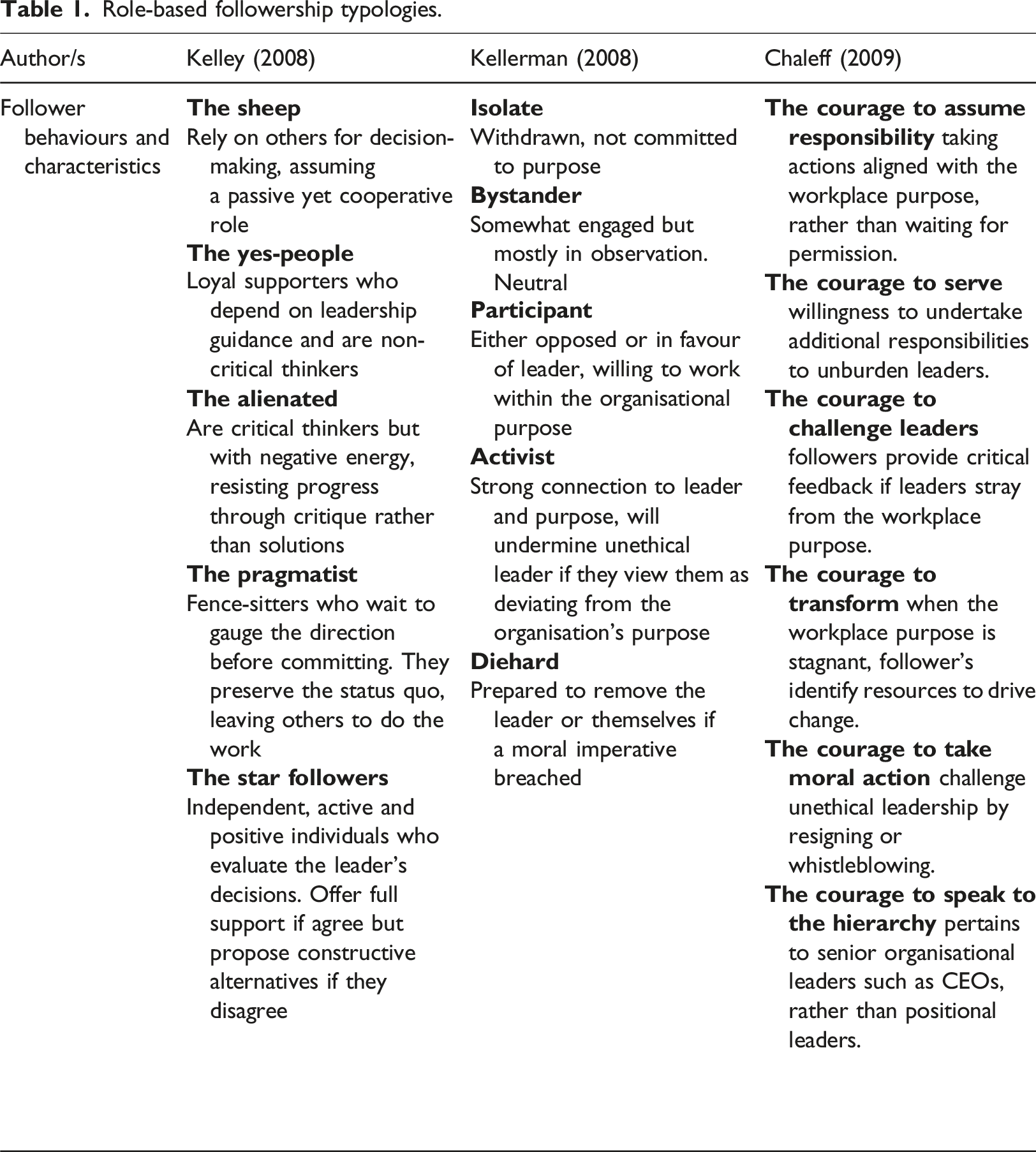
In ECE contexts, Kelley’s (2008) typology highlights how educators lower in the hierarchy actively make deliberate choices rather than blindly following. Kellerman's (2008) categorisation of followers is also relevant as isolate followers might be educators who show little enthusiasm in their interactions with children and other educators, potentially hindering the quality of care and education. Chaleff's (2009) courageous followership dimensions also involve making a choice to follow.
Semman and Waniganayake (2010) also use the term ‘courage’ in terms of educator’s actions in advocating for children’s rights. However, the discussion focuses on courageous leaders rather than followers, which overlooks an educator’s capacity to unburden leadership through effective followership (i.e., the courage to serve) (Chaleff, 2009). Educators in follower roles, such as trainees and assistant educators, exhibit ‘courage to serve’ (Chaleff, 2009) when willingly taking on additional responsibilities beyond their qualifications by enacting the mandated early years learning framework (EYLF) (Grieshaber & Graham, 2017). Conversely, the ‘courage to take moral action’ is also visible when educators leave the sector due to feeling overwhelmed by these same EYLF requirements that involve ‘complex educational work’ but little remuneration (Grieshaber & Graham, 2017, p. 96).
The ECE leadership research often approaches followership through a lens of ‘romance of leadership’, overlooking practical complexities in real world situations that rely on followers who actively follow (Meindl et al., 1985). For instance, romance of leadership can be observed in Aubrey et al. (2013), where educators perceive decision making as a top-down endeavour despite shared responsibility. The Australian Children Education Care Quality Authority (ACECQA, 2017), refers to followers as ‘others’ but does not adequately conceptualise what ‘others’ actually do as the emphasis is on leading. Irvine et al.’s (2016) National Workforce report highlights the notion of passive, yet effective followership where some educators preferred to avoid decision-making responsibilities, indicating a willingness to adopt a supportive role, yet the term ‘follower’ is absent in the discussion. These oversights hinder an informed understanding of followership and the influence of following in co-creating workplace outcomes (Uhl-Bien & Carsten, 2018).
Method
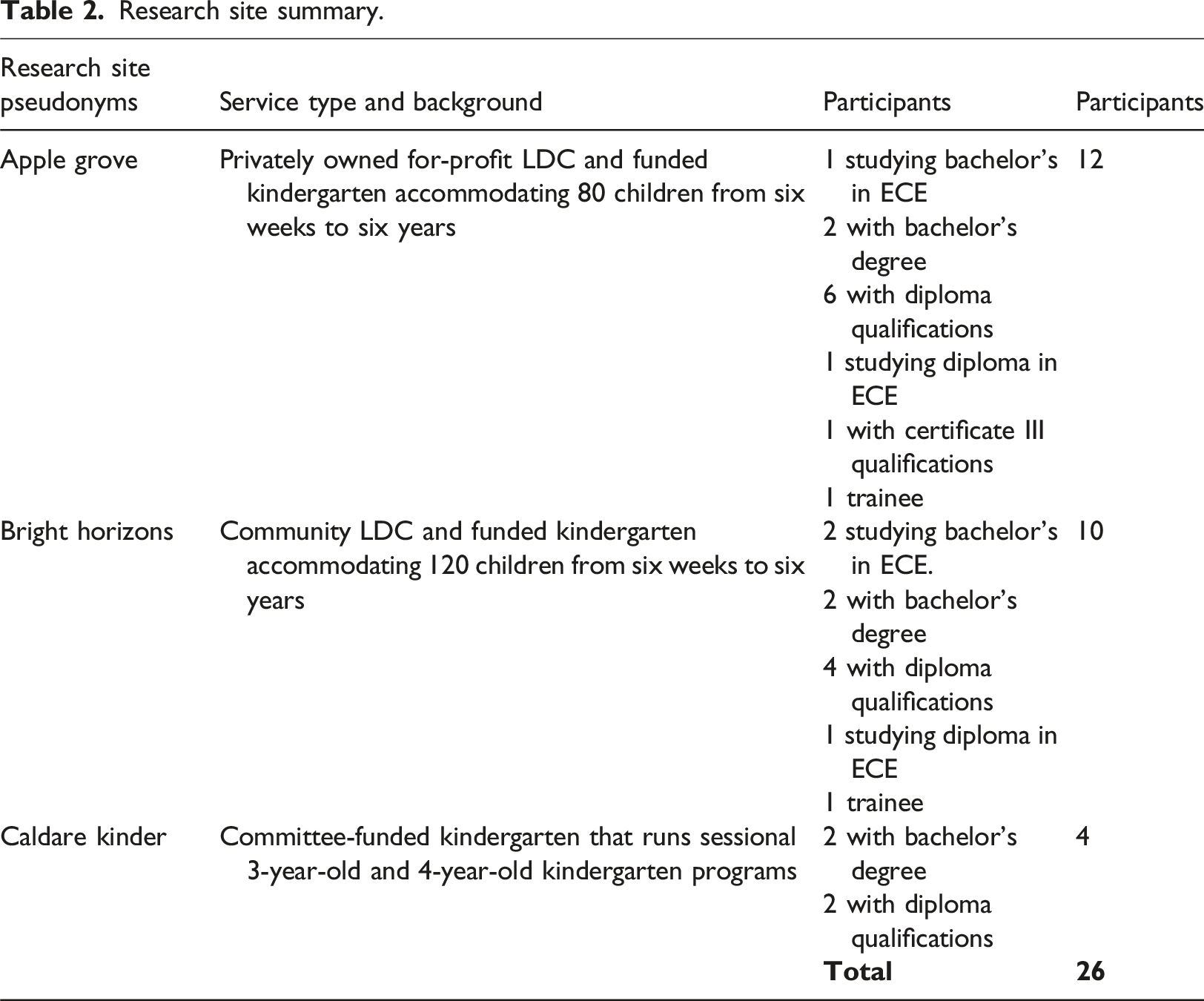
Research site summary.
The participants
The participants in this study comprised of ECE educators from the three research locations. The roles varied and included managers, who held leadership positions responsible for overseeing the overall operation of the setting; kindergarten teachers, who held a bachelor’s degree and were responsible for designing curriculum activities for children aged 3–5 years prior to starting school; room leaders, who were typically experienced educators taking on a leadership role within a specific classroom and age group; assistant educators, responsible for interacting with children and implementing curriculum plans. Lastly, trainees, who are educators undertaking a Certificate III qualification through on the job training under the supervision of more experienced educators. These various roles and qualifications represented a sample of the ‘cultural sharing group’ typical of ethnographic studies (Creswell & Poth, 2018, p. 150). This cultural sharing group embodied the collective practices, values and experiences shared among educators (See Table 2).
Ethics
The Charles Sturt University research ethics committee (approval number H20300) granted permission for this study to ensure ethical standards. This involved obtaining consent to enter the three research locations and closely monitoring privacy. Privacy was a key ethical concern, particularly during shadowing sessions where confidential information was exposed, such as names of children, families and site-based documents. Adherence to the Australian Early Childhood Sector Code of Ethics (Early Childhood Australia [ECA], 2016) ensured participants were aware they could halt shadowing field work sessions at any time if they felt uncomfortable. To further mitigate discomfort, private discussions between educators and families were not documented as per the information letters provided to educators and families.
Additionally, 10 of the 26 participants consented to a digitally recorded debrief interview conducted after fieldwork, as approved by the research ethics committee. This approval ensured that participants were fully aware that the interview was recorded and informed them of their right to withdraw consent at any time, with the assurance that their recoding would be deleted and excluded from the research. Participants were also informed that audio recordings were securely stored to prevent unauthorised access.
Data collection
Data were collected through shadowing notes, debrief interviews and a research journal kept by the researcher during fieldwork conducted over a six-month period in 2021 with a total of 26 consenting educators.
Shadowing
As a data collection method, shadowing involved closely observing a participant over time to understand their behaviours and actions, along with contextual questioning to delve deeper into the reasons behind these behaviours and actions in the workplace (Quinlan, 2008). Observations and contextual questions were guided by a specially designed followership behaviours and characteristics tool to help identify followership theories in action. The tool included followership behaviours identified in the followership literature, such as those listed in table 1. Behaviours and characteristics that the researcher perceived as following, such as a willingness to use initiative, were documented as field notes after each shadowing session.
Debrief interview
Given the fast-paced nature of the three ECE locations, participants had limited time to delve into their values, beliefs and understandings of followership during shadowing. To allow for reflection away from the workplace, debrief interviews were conducted a week after fieldwork, comprising a total of 10 Zoom sessions with 10 of the 26 consenting participants. During these interviews, I highlighted examples of observed followership practices and prompted participants to explain their interpretations. Debrief questions included: • Thinking about your role, to what extent do you see yourself engaging more in leadership or followership • Do you think there are benefits to being a follower
Using Zoom, the interviews were recorded and subsequently transcribed for participants to conduct member-check before starting data analysis. Transcripts underwent de-identification of educator names through pseudonymous to further protect participant confidentiality.
Reflexive journal
Applying Wolcott’s (2009) three ethnographic representation principles —description, analysis and interpretations— reflexive journaling was a crucial data collection method throughout the study, actively informing the research. For instance, re-examining data collected during field work in light of Chaleff's (2009) conceptualisation of courageous followership enabled the generation of more nuanced interpretations. The findings and discussion section below presents the data output from the reflexive journal entries, overlaying interpretations alongside participant voices. This utilisation of reflexive outputs not only validated researcher positionality (Creswell & Poth, 2018) but also served as a method to convey dimensions of followership that participants might have overlooked.
Data analysis
Braun and Clarke’s (2019) reflexive thematic analysis was instrumental in enhancing understanding of ECE practices that manifested followership. The identification of followership themes within the data involved two phases of analysis. In the initial phase, Microsoft Word’s Table of Contents (TOC) function was used to organise and interrogate raw data collected from shadowing field notes, debrief interview transcripts and reflexive journal entries. This initial phase aimed to bring out inconsistencies and patterns within the themes. The final phase involved a comprehensive review and interpretation of themes. These interpretations aligned participants and researcher viewpoints while drawing from followership conceptualisations derived from organisational management literature. As discussed in the following section, the converging accounts uncovered a paradox between educators’ followership understandings and observed practices.
Findings and discussion
Three key themes were generated from the data: contradictory followership views, romance of kindergarten teachers and instances of ineffective followership. These findings illuminate a paradox surrounding followership in ECE contexts, highlighting the need for a deeper understanding of followership.
Contradictory followership views
Followership beliefs.
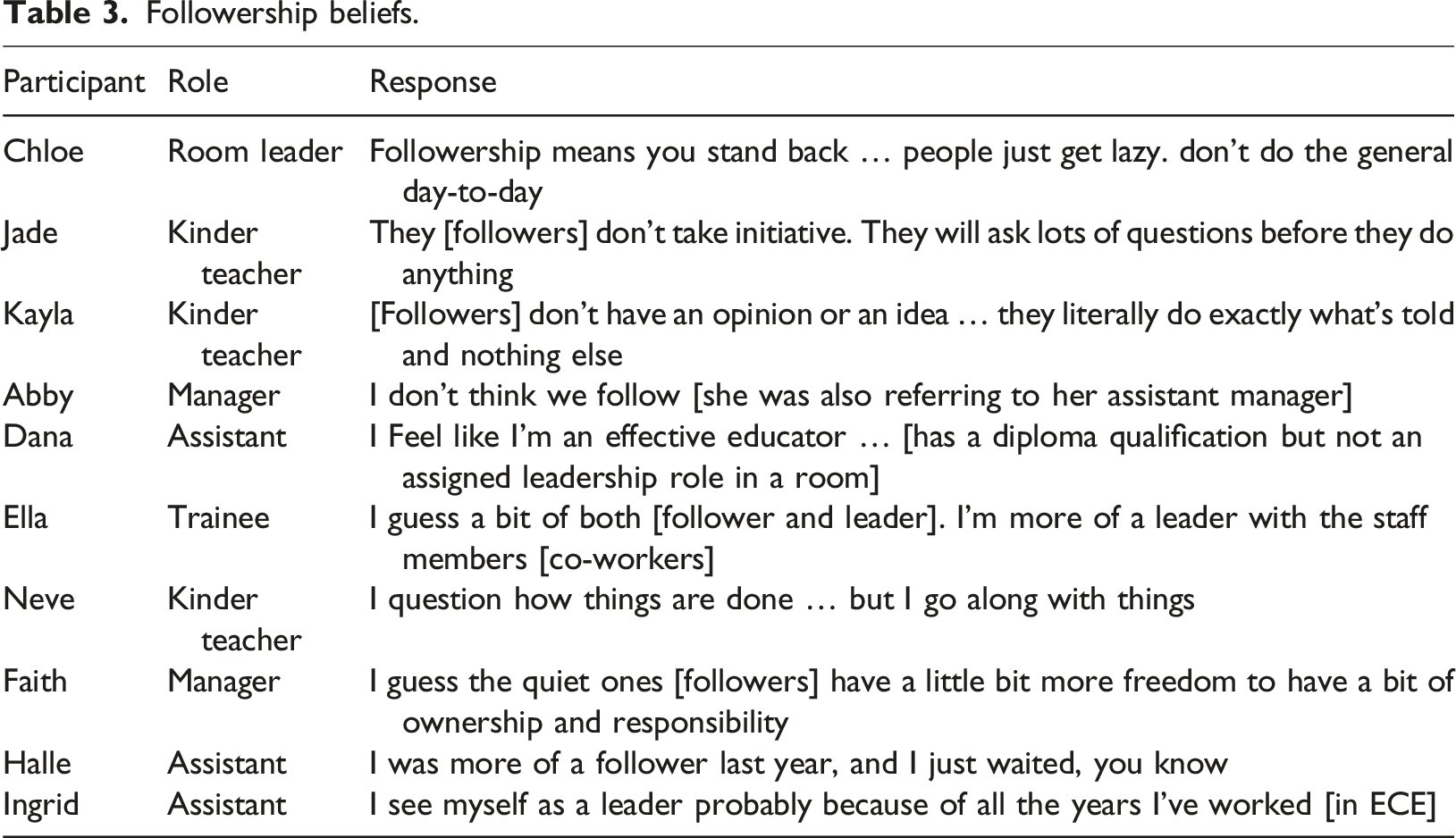
During fieldwork observation, educators, such as trainees, demonstrated a followership paradox by not always ‘standing back’. This observation highlighted a range of followership enactments within the team, including the courage to assume responsibility (Chaleff, 2009) and adopting a yes-people follower approach (Kelley, 2008) as illustrated in this reflexive journal excerpt. Prior to the lunch, Remi (trainee educator) suggested to the team that lunch could be a picnic outdoors. They did not ask Chloe’s (room leader) permission. Rather, they negotiated and initiated the process through a series of complementary leading and following practices. Remi and Sky (assistant educators) guided the children to wash their hands, retrieve their lunch boxes and sit under a tree. Chloe did not need to give directions. She joined the routine of hand washing and guiding children to the picnic mat. Chloe thus assumed a follower role by ceding power and authority to Remi (Shamir, 2007).
Contradictory beliefs, as illustrated in Table 3, overlook the necessity of followership, whether as a passive supporter or courageous. Additionally, Chloe’s willingness to follow exemplified the leader-follower trade approach, where leading and following functions were fluidly exchanged, resulting in mutual respect, empowerment and overall organisational effectiveness (Malakyan, 2014).
Drawing on the above excerpt, Remi’s actions as a trainee educator are noteworthy. During the lunch routine, contextual questioning revealed her intention to create a pleasurable experience for the children, rather than ‘lead’ the lunch routine. Remi displayed courageous followership by negotiating with both the team and the room leader, challenging the commonly assumed romance of leadership assumption that only leaders makes decisions (Meindl et al., 1985). This also supports Sy’s (2010) finding that followership impacts leader-follower interactions and outcomes. It is crucial to address this commonly overlooked element of effective followership as a strategy to build a more professional workforce.
Furthermore, in their workforce report, Irvine et al. (2016) noted that some educators chose not to assume a leadership role and the associated decision-making, indicating a preference to adopt a supportive, and by extension, a follower role. This suggests that gaining deeper understandings of the influence of followership could empower educators in their roles, enhancing their ability to advocate for themselves and children without the need of a leadership title. However, to truly value the role of followers, it is essential to challenge negative perceptions of followers such as being ‘lazy’ (Chloe) and ineffective. While existing literature highlights the significance of educators taking on leadership responsibilities (Stamopoulos & Barblett, 2018), there is a distinct oversight when it comes to exploring how followership is practically exercised in conjunction with leadership.
Romance of kindergarten teachers
The theme of the ‘romance of kindergarten teachers’ highlights another paradox in understanding followership, where educators idealise kindergarten teachers as the sole leaders, similar to Meindl et al. (1985) concept of the ‘romance of leadership’. Romanticised assumptions of kindergarten teachers emerge when educators create an idealised and heroic image of teachers as the sole leaders of the learning program. This idealisation becomes part of the ‘collective consciousness’, overshadowing the realistic day-to-day behaviours and interactions (Meindl et al., 1985). Drawing on interview transcripts and field notes from shadowing sessions with a bachelor degree qualified kindergarten teacher, the next two snippets of data examine how kindergarten teachers are often credited as leaders with more influence than they might realistically exert.
During a debrief interview, Kayla (Caldare Kindergarten) explained how she encouraged the assistants to contribute to positive leadership outcomes by telling them they have a voice and are welcome to share their opinions. However, shadowing and contextual questioning during fieldwork revealed that the assistants were reluctant to utilise courageous followership, such as the courage to assume responsibility (Chaleff, 2009), due to romanticised idealisations of leadership: Mikayla (assistant educator) was organising snacks at the table for children who were hungry, while Lana (assistant educator) interacted and engaged with small groups of children. The parents drifted in to drop off their children for the day. I noted that parents gravitated towards Kayla (kinder teacher) after settling their children. I asked Mikayla why she thought parents did this, and she explained that parents did not impart information to her or Lana because it might be a discussion about their child’s development. I then asked why she thought it happened. She had obviously never given it much thought and chuckled a bit in response. She then explained that kindergarten teachers are responsible for discussing a child’s developmental progress because of the teachers’ qualifications and elevated knowledge.
Digging deeper, I probed Mikayla by asking about her knowledge of children’s development acquired through her Diploma qualification and her ability to also explain children’s learning progress. Mikayla justified the division of expertise by explaining that when working in a LDC, parents do consult educators about children’s routines. However, in a kindergarten environment, teachers like Kayla are seen to hold not just leadership authority but also pedagogical authority.
Interestingly, Kayla indicated that she repeatedly sought ways to encourage assistants to use more initiative, drawing from a distributed leadership perspective. Despite her encouragement, Mikayla’s romance of leadership perception of leaders, equating leadership with knowledge expertise, may have influenced her choice adopt a passive yes-people follower role. Kelley (2008) defines this as allowing the leader to do the thinking, but still being active and engaged. These findings show that rather than focusing on more and better leadership training, increased understandings of the follower’s role in co-creating leadership and workplace outcomes is required (Uhl-Bien et al., 2014).
Similar romance of leadership assumptions were observed in the Bright Horizons LDC, where Jade (Kinder teacher) did not consider assistants Paige and Quinn as followers as she viewed followers as lacking initiative (See Table 3 above). However, observations confirmed their effective and courageous followership (Chaleff, 2009): Paige and Quinn required minimal directives. Quinn was engaged in a numeracy activity with a small group of children, in which they practiced one-to-one counting. Meanwhile, Paige worked in the far corner with a group of children crowded around a telescope. At one stage, a child become emotional because she wanted a turn to use the telescope, but other children were using it. Paige instantly calmed the child using a quiet voice to speak to her. Paige did not seek assistance; she used specific skills to address the situation before it escalated. During the incident, the kinder teacher observed but did not intervene. She explained how this occurred regularly, and that the child often needed help managing her emotions. Paige successfully helped calm the child, and the play resumed.
In kindergarten environments such as these, the drive to meet the children’s needs played a pivotal role in shaping Paige’s (assistant educator) courageous followership. Despite Jade’s perception of followers lacking motivation (See Table 3), Paige contradicted this assumption by exercising courageous followership where she assumed elevated responsibility and used initiative to achieve the common goal (Chaleff, 2009), which in this instance, was best outcomes for children. Despite lacking a bachelor’s degree and leadership title, Paige rejected the romance of leadership assumptions. Instead, she enacted effective followership founded on her expertise with children with attention deficit hyperactivity disorder (ADHD).
These examples challenge the romance of leadership assumptions where leaders are the key factor in achieving workplace outcomes. Furthermore, in ECE contexts, kindergarten teachers may not be capable of leading everyone effectively all the time, as assistants often worked in separate areas of the room and outdoor areas. Realistically, kindergarten teachers cannot practise leadership all of the time. Importantly, ECE contexts such as these require and depend on autonomous and independent decision-makers (Cumming et al., 2024). As such being a leader who oversees everything, and everyone is unnatural and unrealistic (Malakyan, 2014). The need for knowledgeable and autonomous educators is also reinforced by the Australian governments stipulation that everyone working in ECE requires a minimum of certificate III in early childhood education and care. Thus, challenging the followership paradox lies in increasing understanding of the influence of followership as a partnership where educators sometimes follow the workplace purpose to achieve quality outcomes, rather than leaders (Chaleff, 2009; Hurwitz & Hurwitz, 2015).
Ineffective followership
Despite the prevalence of effective followership, where educators pro-actively enact follower influence to improve educational and quality outcomes for children, instances of ineffective and unethical followership influence were reported by participants. The next fieldwork excerpt recounts a discussion with Ella, a trainee at Apple Grove LDC, who left her previous workplace due to ineffective followers in the team: During a busy period, a four-year-old child accidentally broke a toy, deemed misbehaviour by the manager, necessitating a timeout as punishment. Timeout entailed a portable cot that was flipped on its side and pushed up against the wall. The child was placed inside and could not crawl out. Despite Ella’s objections, the manager proceeded with the punishment, ostracising Ella for her resistance. Other educators in the team, though privately disagreeing, complied with management, leading to Ella’s decision to leave the centre.
According to Ella, she was the only educator to openly disagree, while other educators were complicit bystander followers (Kellerman, 2008), despite their moral objection. While Ella targeted the leader, from a followership lens the educators she worked with practiced ‘followersheep’ by blindly following management’s lead (Kelley, 2008). Ella explained how she was a resistant follower and did not comply, raising the question of whether she was displaying leadership or maintaining a follower role (Almeida et al., 2021). As Hurwitz and Hurwitz (2015, p. 15) explain: Sheep have such a strong instinct to follow that if one jumped off a cliff, the rest of the flock likely would, too. .. That strong instinct to blindly follow wherever the leader goes makes for a lousy partnership
Examining this data reveals two key conclusions. First, educators’ blind conformity or ‘followersheep’ it is not just a consequence of ineffective leadership, but of ineffective followership, although leadership typically takes accountability (Kellerman, 2008). Second, in ECE contexts, addressing the primary obstacle to the utilisation and acceptance of followership, which is the negative associations with the term ‘followership’, becomes imperative.
The prevalence of ineffective followership confirms Carsten and Uhl-Bien (2013) study, suggesting that followers who strongly adhere to romance of leadership assumptions are more likely to engage in ‘crimes of obedience’. Crimes of obedience, popularised by social psychologist Stanley Milgram in his study on obedience to authority, involves followers committing illegal and/or unethical actions in a workplace, typically under the authority of leaders (Carsten & Uhl-Bien, 2013). However, it is important to consider limitations of generalisability for this finding (Creswell & Poth, 2018), as it is based on Ella’s subjective individual experiences, rather than direct observation, and may not adequately represent the original context. Therefore, including participant anecdotes may not provide a comprehensive understanding of ineffective followership through crimes of obedience.
In summary, two central ideas are unearthed from these findings. First, followership embodies what Hurwitz and Hurwitz (2015) describe as a ‘generative partnership’ enriching the relational views of followership and leadership. Distributed leadership, on the other hand, differs from a generative partnership as it focuses on decentralising leadership functions to a collective responsibility, resembling collaboration rather than traditional notions of leadership and followership (Shamir, 2012; Uhl-Bien & Carsten, 2018). Instead, a generative partnership maintains the importance of the leadership concept recognising that both following and leading behaviours are required in certain situations to achieve effective outcomes (Carsten et al., 2010), as everyone cannot be leading all of the time.
Second, negative understandings of followership reinforce Meindl et al.s (1985) concept of the romance of leadership, which does not fit with the autonomous and relational nature of ECE educators professional roles (Cumming et al., 2024). For example, the ECE profession involves educators facilitating play and learning with individuals and groups of children, sometimes working independently and autonomously without specific leadership influence. Yet, ECE scholars often focus on more leadership training to help improve workplace outcomes (Douglass et al., 2022; Stamopoulos & Barblett, 2018) overlooking that 80% of the workforce functions as autonomous followers (Malakyan, 2014). Furthermore, Bennis (1997, p. 20) states “managing people is like herding cats”, which underscores the importance of understanding that followers with a collective purpose do not require much leadership direction when effective followership is in action. Despite this, effective followership is not acknowledged due to the lack of clarity around the term ‘followership’.
Implications
A greater understanding of followership could be useful in current ECE contexts across nations, as it validates the skilled and valuable work of all educators, not just leaders. Workforce shortages in ECE are particularly problematic (Irvine et al., 2016). Recognising the value of educators, especially those in the early stages of their career or those who may aspire to leadership roles, is crucial. Recognition of the importance of followership could improve job satisfaction and reduce turnover (Kellerman, 2008). For instance, followership training can help educators, including trainees with little experience, to effectively support leadership willingly carry out directives (Hurwitz & Hurwitz, 2020). Furthermore, Grieshaber and Graham (2017) question the equity of expecting the lowest paid and least qualified educator to assume responsibility for implementing learning curriculum, as higher paid and qualified educators would. Which further illustrates the importance of followership training to foster effective partnerships with leadership, rather than expecting educators to always be leading.
Rather than advocating for more leadership training, this study points to the undervalued and underacknowledged yet central role of followership and recommends followership training. Importantly, in team-based environments common in ECE “excellent leadership AND excellent followership are needed to optimize a partnership” (Hurwitz & Hurwitz, 2015, p. 21). When educators enact effective followership, it can significantly enhance the overall strength of ECE environments when combined with effective leaders within generative partnerships (Hurwitz & Hurwitz, 2015). Importantly, generative partnerships do not diminish the importance of leadership in favour of followership; rather, followership is given clearer conceptualisation by normalising the term by incorporating followership into leadership programs (Hurwitz & Hurwitz, 2020) and leadership literature.
Conclusion
This study investigated the phenomena of followership by examining by examining 26 educators across three ECE sites. Through analysis of fieldwork shadowing notes, interview transcripts, and reflexive journal entries, three key findings were generated—contradictory followership, romance of kindergarten teachers as leaders and ineffective followership. These findings revealed a paradox of followership as educators’ negative perceptions of followership across the three ECE sites did not align with observed effective followership and following practices. Despite this paradox, followership was a distinct skill complementary to leadership (Hurwitz & Hurwitz, 2015), further illustrating the impact of effective followership. Educators’ courageous and effective practices confirmed that followers are not inferior (Chaleff, 2009; Kellerman, 2008) nor dependent on motivation from leaders (Shamir, 2007). Therefore, when both the leader and follower share a common purpose (Chaleff, 2009), which in this study was quality outcomes for children and families, the focus shifts from leadership to the purpose itself.
The ‘romance of leadership’ (Meindl et al., 1985) also contributed to a followership paradox, shaping ineffective followership when educators complied with unethical leadership directives. Increasing understandings of followership could mitigate ineffective followership. As this study found, when educators are focussed on the workplace purpose they do not need explicit permission from leaders to act. The purpose serves as the guiding force, motivating both followers and leaders to take initiative and act in ways that align and advance the common goal of ECE. Overall, this study underscored the critical importance of raising awareness about the influential role of followership in ECE contexts and highlighted the need for followership training alongside leadership (Hurwitz & Hurwitz, 2020).
Footnotes
Acknowledgements
I gratefully acknowledge the suggestions made on a draft of this paper by Dr Tamara Cumming.
Declaration of conflicting interests
The author(s) declared no potential conflicts of interest with respect to the research, authorship, and/or publication of this article.
Funding
The author(s) received no financial support for the research, authorship, and/or publication of this article.
