




Abstract
This paper explores one element of a multi-faceted project that sought to investigate nature play in early childhood, namely the creation and co-creation of visual diaries by educators, children and academics. The methodology was participatory cartography, which involved the creation of visual and verbal mappings of nature play pedagogies by early childhood educators and academics, as well as visual mappings of nature play experiences by 4-5-year-old children. The visual diary supported, articulated, portrayed and documented the implementation of nature play pedagogies (by the educators), the experiences of nature play (by the children) and the analysis of data (by the academics). This paper explores this methodological slice of the project. It asserts that the visual diary is a useful, arousing and potentially aesthetic inquiry, documentary and resource apparatus for educators, enabling collaborative artmaking moments with children.
Keywords
Orientation
This paper explores a multi-layered educational inquiry that sought to explore the experiences of educators and children as they engaged in nature play, specifically how young children’s (4–5 yrs.) learning of scientific concepts may be supported through nature play 1 . Our project was situated in Queensland, Australia, in urban, suburban (Gold Coast, Sunshine Coast) and regional settings (Central Queensland), with one remote setting (Cape York). We invited educators from 21 centres and settings to join the project as researchers, with 152 children also contributing as researchers. The broad aim of the study was to understand how young children (4–5 years old) learn scientific concepts through nature play. Through this aim, we asked early years educators to consider pedagogies and practices that enhanced and enabled children’s deepening of their scientific and ecological ideas and concepts through nature play.
Specifically, the project was divided into four unique phases. Phase 1 educators mapped their settings in visual diaries; Phase 2 children were also invited to join the project as researchers, capturing images and videos of their nature play experiences in their settings, after kindy, and at home; in Phase 3, the educators were invited, as fellow researchers, to design, plan and implement the three nature play experiences and document them through photographs, video and visual diaries, facilitating a definition of nature play and its associated scientific concepts. Phase 4 children and educators were interviewed about the planned and implemented nature play experiences. Ethics approval was sought and granted by the University Human Research Ethics Committee, approval number ECN-19-018. The focus of this paper is to explore in more detail the educators’ use of visual diaries in the research study.
In orienting the educators, we conducted research training workshops (Rousell et al., 2017) that were also open to parents, where we shared the project aims, phases, methods, and conceptual frameworks. We ran training workshops for the educators and interested parents at our regional Queensland sites and our urban sites (Brisbane, Gold Coast and online) and also had several online check-ins as we progressed through the phases of the project. The research training workshops ran for 2 hours and were based on protocols developed by Cutter-Mackenzie-Knowles and Rousell (2018). We brought along our own visual diaries to share and made suggestions for how they might fill their pages. We also shared non-binding guidelines and examples of the possibilities of portraying pedagogies and learnings in visual form. Together, we practised and experimented with the supplied art materials and visual diaries and unpacked examples of creating visual mappings of place and play. The workshops were rich opportunities to kickstart the makings and doings in the diary and were vibrant and emergent communities of practice that provided a relational foundation for our subsequent site visits, interviews and analyses.
The children did not engage in research training in the same way, as it was not age-appropriate. Rather, consenting parents sat with each child and unpacked the children’s consent form and the information in it about what the children would be doing. It is ethically important in such participatory research to respect children’s agency, even for those as young as four, as in this study. Each child was asked before any data activity if they were comfortable participating, and if not, this was respected. The parents and educators were crucial in supporting the children in their making, photographing, videoing and drawing, and this was unpacked and explained at the research training workshops.
The study’s methodology was participatory cartography (Rousell, 2021), focusing on creating visual mappings of ideas, observations and pedagogies of nature play encounters through photography, video, artmaking and the visual diary. Whilst we have published other articles that unpack the study more completely (see Cutter-Mackenzie-Knowles et al., 2021; Cutter-Mackenzie-Knowles et al., forthcoming; Lasczik et al., forthcoming), this paper focuses wholly on the visually rich, aesthetically agentic, creative, relational and deeply useful pages of the visual diaries created by the educators, the children and the academics.
Our discussion begins by exploring the form of the visual diary (also known as the visual journal), followed by how the visual diary may be conceptualised in supporting pedagogy and curriculum as pedagogical documentation. We linger on notions of visual and written texts and reflective practice, before extruding these ideas through a posthuman theoretical lens to expand the utility of the visual diary as a living inquiry that has the potential to support affective, sensorial, aesthetically grounded learnings for both educators and children. We present examples of the visual diaries of the early childhood educators that include pages created by the children, as well as the visual diaries of the academics put to work as analysis. We have curated the diaries in this way to portray the differing ways the diaries were engaged in this study – respectively, as children’s artmaking, educator reflections, documentations and creations and the academic’s visual analyses. While the children collaborated on their artmaking with each other and the educators, we have not privileged children and educators’ collaborations as a focus of this paper (although we have acknowledged co-creation) and will explore co-creation more fully in a later publication.
The visual diary
Whilst the literature on the use of research journals is substantial, it is less so when it comes to the engagement of visual diaries and almost non-existent when it comes to the practice of visual diaries as data creation rather than collection. An exception would be Sarah Probine’s work on visual arts pedagogies (2016; 2022), where she gave teachers art journals to engage as reflective instruments, focusing on their visual arts pedagogies and beliefs and values about visual arts. The diary is also less apparent in the literature around documentations of learning and is seemingly absent in early childhood. Whilst floor books are a well-known pedagogical instrument in early childhood education (Warden, 2019), they differ from the visual diary, as unpacked below, although it is acknowledged that children’s voices, ideas and interests are recorded in them. The visual diary, by its nature, privileges the aesthetics of artmaking and creative practice in deeply posthuman ways, which is a lively point of difference. The important distinction in our study is that we sought to privilege visual languages as an idiosyncratic mapping approach. The following discussion will explore the visual diary as a reflective instrument before turning to pedagogical documentation and how the diary may operate as an aesthetic mechanism to ground relational learnings for educators and children alike, drawing inspiration from the aesthetic practices of Reggio Emilia. This discussion is positioned through the possibilities that mark-making affords before turning to the ways the diary can be considered a diffractive apparatus of inquiry. Following this, we share an exhibition of visual diary pages before a final discussion and closing thoughts.
The visual diary as reflective mechanism
Processes of creating imagery and text allow for the emergence of new perspectives, debriefing and insights as ways of knowing. Indeed, artmaking and writing as companion texts potentiate each other, revealing what words or images alone may not accomplish (Deaver & McAuliffe, 2009). Images with text were particularly evident across many facets of the educator and children’s visual diary pages. Most obviously, insights into nature play across the twenty-one sites were enriched exponentially by the intricate weaving of the written word – local Aboriginal language, questions, reflections, explanations, observations, descriptions, inspiration from research, theory, pedagogy, poetry, media snippets, and visual images – photographs, drawings, sketches, rubbings, paintings, collage, birds-eye view diagrams, inefficient maps (Knight, 2021) as well as the inclusion of various nonhuman material – snake skin, deceased tick and butterflies, feathers, mud, leaves, paperbark, flowers and the more traditional artmaking materials. In addition, it seemed that children’s drawings often served as a catalyst for pondering/reflecting/sharing by the educators and subsequently in the analyses by the academics. Although some educators invited children to participate in the diary in response to specific questions/directives, by and large, the children were encouraged to create and co-create organically in the visual diary, albeit with nature play as the guiding focus.
For even the more reluctant participants – generally, those who had not previously mapped their practice visually – the process of working into a visual diary allowed for an unpacking of the complexities of learning moments, tethering discussion to a shared learning mechanism, with the potential to slow and deepen learning when shared with the children (Isikoglu, 2007). Such sharing with children is made possible by perhaps the most valuable capacity of the visual diary – its potential to act as a portable studio. This portability enables the visual diary to become a constant presence in educational settings. In this project, it became a place for participating educators, children and sometimes even non-participating educators to contribute across a myriad of traditional and untraditional learning spaces – indoors and outdoors in the early childhood centres, in community gardens, parks, in the bush, in farms, by creeks, rivers and at the beach.
Loerts and Belcher (2019, p. 24) assert that the visual diary is a ‘multimodal artifact’ that enables practitioners to experiment with thought and materials for understandings as a pedagogical process that can be transdisciplinary and promote various competencies, including but not limited to visual literacies. Visual diaries are intimate spaces where creative thinking is given visual form in a non-sequential manner, allowing for the formation of concepts that can be ‘revisited, affirmed, developed, neglected, shared or discarded’ where possibilities can be celebrated and foregrounded, emerging from ‘uncertainty, ambiguity and pluralism’ (Messenger, 2016, p. 130.). While some participating educators in our study tended to keep their visual diaries focused intently on the aims of the project, for others, it became an intimate space for journaling, sharing, pondering, thinking, reflecting and processing both their practice and ways of engaging with the world more broadly. Each visual diary offered rich insights in its own way. However, the dispositions of some less creatively confident participants did indeed reflect the unfortunate broader reality that many generalist educators, such as those in early childhood settings, lack confidence in making practices and their own artmaking skills, likely due in some part to limited time in the curriculum for art experiences in their undergraduate courses (Cutcher, 2013; Lindsey, 2021; MacDonald et al., 2016; Pavlou, 2021). Research shows this lack of confidence, in turn, inhibits motivation to teach art effectively (Hotko, 2022), with the obvious flow on effects for children. Compounding this are persistent tropes that assert that process is more important than product and that children are somehow naturally drawn to art competencies if given only (questionable) art materials and time (Lindsey, 2017).
In response to our observations throughout this project and the evidence in the literature, we assert that engaging in sustained and legitimate artmaking practice (Payne, 2022) by keeping a visual diary – including responsive writing – maximises confidence in artmaking potential (Pavlou, 2022). Such practice, in turn, serves as an ‘effective antidote to the priority on product in the art classroom’ (Maguire, 2021, p. 4). This project demonstrated the great potentiality of the visual diary as a ‘playful companion, teacher and confidante’ (Messenger, 2016, p. 136), enabling knowings that are partial, incomplete, untidy and deeply situated (Mosurska, 2021).
The materialities of the visual diary can be integrated, vast and ephemeral (Messenger, 2016, p. 136), including all types of media as mentioned above; however, drawing is the likely cornerstone of visual diary practice. This is not to say that you must be a skilled technician to maintain a visual diary practice, but rather that drawing is comprised of any type of mark-making on any type of surface. Under this definition, a drawing can be a mark made in the sand with a stick, on the condensated surface of the shower screen, or the rear window of a dusty car. Children often draw for pleasure, enjoying the tactility of a stylus on a surface; adults, not so much (Messenger, 2016). This is unfortunate; drawing is a medium for conceptualisation, a process of inquiry, rather than a talent-based, mimetic skill (Majchrowska & Corso, 2022). We posit that the visual diary is a safe, sense-making place to make mistakes, to experiment and engage as a portable, private studio, confidentially. More importantly for this study, the visual diary is a rich and fertile transdisciplinary site for inquiry; it is an object, a tool, a vessel, a map, a discourse, a research instrument (Lasczik, 2019a) - a way to tell by hand (Ingold, 2013, emphasis added). As was enacted in this project, one such purposeful intent of drawing is as an analytical tool, a sensory expression of the researcher’s relationship to the data, revealing as much ‘about the adults/researchers as about children’s [and educators’] drawings’ as ethnographic method (Jellema et al., 2021, pp. 2-3). It is not so much a skill as a propensity, one which ought to be central to children’s education throughout the lifespan as sensemaking, as experience, and as a deeply satisfying apparatus of expression (Cutcher, 2013). Drawing is an intimate correspondence, one which embeds bodies, forces, energies and materials in sympoiesis – or makingwith (Haraway, 2016). In this study, the educators, children and academics engaged drawing as lenses into spacetimematterings of doings, knowings, and tellings (Lasczik Cutcher, 2017). Drawing was a key analytical protocol engaged as the authors dwelled with the data, but before that, the educators often utilised drawing as pedagogical documentation in their visual diaries.
The potential of the visual diary for pedagogical documentation
The Australian Children’s Education and Care Quality Authority [ACECQA] regulates early childhood education and care [ECEC] in Australia. Documentation of learning by ECEC providers is a professional responsibility to meet standards and learning outcomes, guided by the Early Years Learning Framework V2.0 [EYLF], whose main pillars are ‘Belonging, Being and Becoming’. Pedagogical documentation is not prescriptive and can be innovative or merely functional. ACECQA (2018) advises ‘there is no one-size-fits-all approach’ and encourages educators to ‘explore a range of styles and methods to determine what works best’ (p. 1). Notably, ACECQA suggests ‘how the documentation is used’ should be prioritised over the volume, precision and aesthetics of the documentation - that ‘it is not the amount of documentation you have, or how immaculately or colourfully the information is presented, but how the documentation is used’ (p. 2).
In recent years, research around pedagogical documentation has flourished internationally, both in relation to early childcare education practice (Knauf, 2020; Falco & Morchida Kishimoto, 2022; Hostyn et al., 2020; Tan & Yang, 2022) as well as research more specifically (Blaisdell et al., 2022; Carlsen & Clark, 2022), and even parental perspectives and involvement in pedagogical documentation (Chng et al., 2022; McLean, 2019). The centrality of pedagogical documentation in early childhood teaching and learning is widely recognised. However, there is a dearth of research on the specific role of the visual diary in this documentation process.
Whilst ACECQA (2018) asserts that pedagogical documentation need not be ‘immaculate’ or ‘colourful’, we challenge this notion and argue that an aesthetically created diary of pedagogies and learnings, made visible as record, artwork, and future resource is precisely the type of pedagogical documentation that is potentially deeply captivating, motivating and satisfying – outcomes which not only create an incentive-loop but which are indeed ‘immaculate’ and ‘colourful’. Such incentives speak to usefulness and self-motivation. Indeed, ‘more important than the documentation itself is what teachers or learners do with the documentation in order to support learning’ (Aquiline et al., 2019, p. 3, emphasis in original). This position is borne out by the highly successful and aesthetically important pedagogical documentation of the Reggio Emilia Approach.
Giamminuti et al. (2021) assert that the pedagogical documentation method of Reggio Emilia is the best-known yet most misused, misunderstood and misinterpreted mechanism of their approach. They argue that it has been co-opted as a reductive practice of recording, being accountable to curriculum and standards frameworks, and oversimplified through ‘neoliberal discourses of compliance and conformity’ – in other words, as but one more ‘instrument for surveillance and accountability’ (p. 441). Rather, in Reggio Emilia, ‘documentation is premised on connective values of encounter, interdependency, interconnectedness, difference, transformation, intent, research, uncertainty, complexity and possibility’ (p. 441), an approach that is potentially supported by actions that are in themselves open-ended, emergent, and deeply grounded in inquiry – transformative of practice, multi-layered and ethical. Such complexities and emergences are made possible in an engaging and satisfying visual diary practice, as is evidenced in this project. The visual diaries are more than their documentations; however, they allowed teachers (and the children) to explore the aesthetic complexities of particular learning moments by grounding discussions in a shared artifact of learning. The co-creations between children and with educators in this project were particularly rich and illuminating (see e.g., Figure 1 and images 2 and 3 in the visual diary exhibition below). Too often, the focus of pedagogical documentation falls on teacher accountability and assessment of children’s learning. Importantly, we position the visual diary as a valid and meaningful space within which to document and share collaboratively, which affords a moving ‘away from a solitary pedagogical doing and enter[ing] instead in dialog with children (their doing, feeling, learning)’, thus enabling generative ‘living participatory and empowering day to day pedagogical environments for children and educators’ (de Sousa, 2019, p. 382). Children working and collaborating in visual diaries during the inquiry.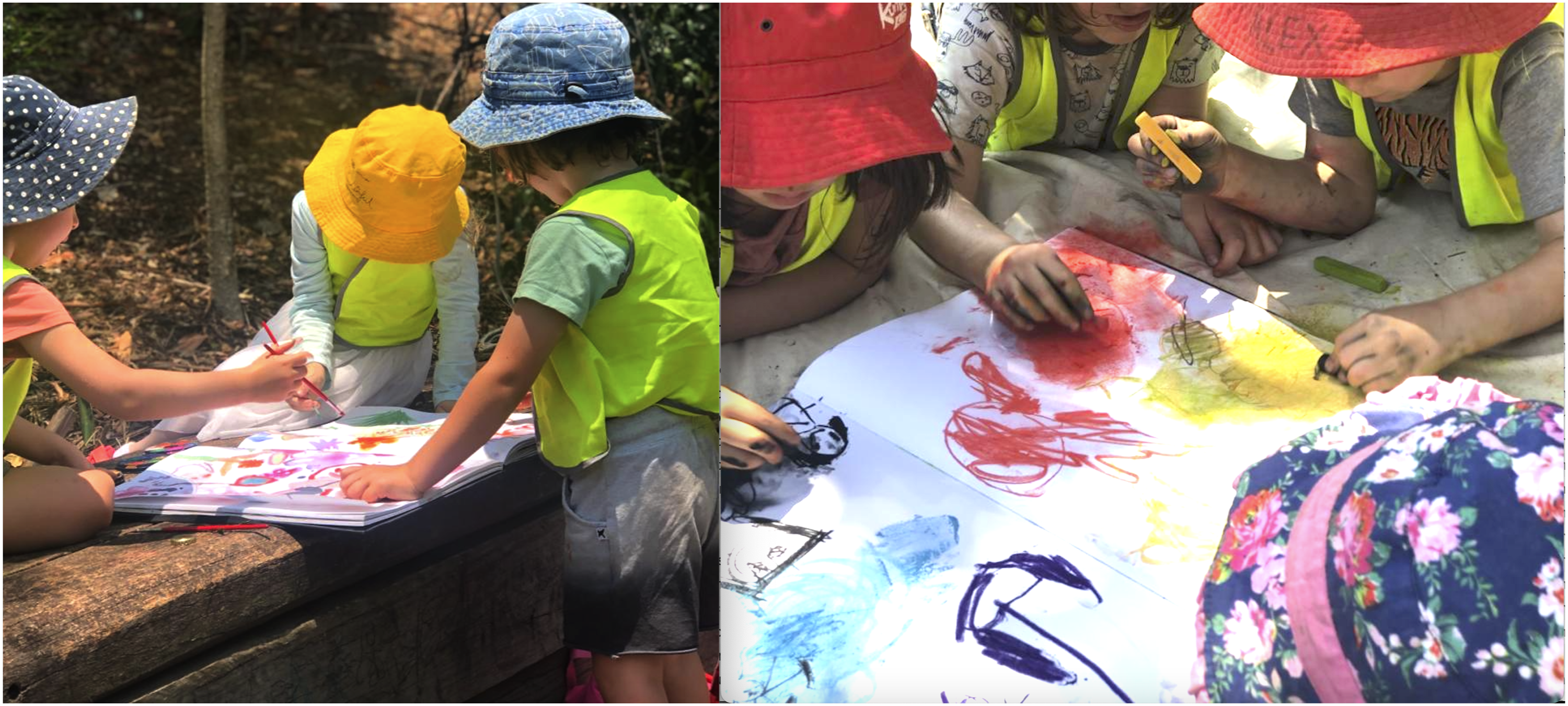
Pedagogical documentation through the visual diary can be used in transdisciplinary endeavours such as the arts and the sciences, as in this project, as both content and process that provoke reflections, discussions and thinkings about what constitutes learning and teaching (Lee-Hammond & Bjervås, 2021). These discourses become embodied and relational for children, educators, parents and systems, enacting complex, arts-based, open-ended inquiries (Aquiline et al., 2019). Indeed ‘children thrive when making art with teachers who share their experience’ (Cutcher & Boyd, 2018, p. 54). Such efforts afford insight into what a parent participant described as ‘the mystery that is my child’s day,’ in turn fostering relationships between parent and educator, and parent and child (McLean, 2019, p. 113). Certainly, research shows that the commitment of teachers and parents to pedagogical documentation supports the focus to remain on ‘children’s learning and engagement’ (Chng et al., 2022, p. 306).
Reggio Emilia pedagogies of invention ‘as aesthetic-ethical-political research located within the educational system, where teachers are viewed as research protagonists and innovators’ are grounded in an entangled, transformative aesthetics of pragmatic and speculative practice (Giamminuti & Merewether, 2022, p. 439). This practice honours educators’ knowledge and professionalism through material-discursive engagements (Barad, 2007), as the educator and the children collaboratively analyse and interpret in myriad ways (Isikoglu, 2007) the ever-emergent, ‘nomadic’ documentation, thereby becoming pedagogical as an always unfolding process (Merewether, 2018). This process slows down knowings, making learning and listening visible (Aquiline et al., 2019; Vecchi, 2010).
The visual diary as posthuman, relational, and aesthetic inquiry
The visual diary is a site for ‘the unthought, the spaces that are messy, uncomfortable, and complicated’ (La Jevic & Springgay, 2008, p. 85). These spaces are created through a dialogue of image, markmaking and writing that then creates a deeply relational intertextuality of creating/telling/reading/viewing/thinking between human, nonhuman and more-than-human bodies, materials, forces and intensities (Rousell, 2021) that are not circumscribed to themselves but rather are porous and leaky. The diary becomes deeply agentic, where meaning and matter are mutually implicated, and pedagogical documentation is entangled as material-discursive, where forces are at work as an ‘agentic assemblage’ (Merewether, 2018, p. 263). The materials of artmaking and the atmospheres of making have agency; they are not inert. They are, therefore, co-contributors to such pedagogical documentation as that which can occur in the visual diary, a type of ‘membrane’, as forces, materials, agencies and bodies generate ‘a sort of psychic skin, an energy-giving second skin made of writings, images, materials, objects, and colors, which reveals the presence of the children even in their absence’ (Ceppi & Zini, 1998, p. 25). When thinking of the assemblages and sympoeisis of the visual diary as skin, the relational entanglements must include the human and the more-than-human; they are never singular, always affecting each other in constant becoming (Merewether, 2018). The visual diary is a porous apparatus, ‘a doing, not a thing’ (Barad, 2007, p. 183), with the potential as ‘material-discursive documentations [to] offer transformative opportunities to reconfigure notions of child and childhood’ (Murris, 2017, p. 543). In this project, the agency of the visual diary became apparent in a multiplicity of ways.
In the juxtaposition and relationality of written text and image text, new and complex understandings are enabled in deep union as surfaces and concepts are layered (Scott Shields, 2016) in a ‘document of becoming’ (Richardson & St Pierre, 2005, p. 967) through the actions of materials that disrupt perception (Payne, 2022). In our project, the visual diaries were collaboratively made (Probine, 2014), collaboratively analysed, collaboratively understood in myriad ways, ‘challeng[ing] the assumptions of transmissive teaching’ (Aquiline et al., 2019, p. 11).
Working in the visual diary requires educators to act ethically in their documentations and to recognise ambiguities, be open to sensation, intra-ruptions, the unanticipated, and to concede that knowing is always situated, incomplete and biased. In these acknowledgements, aesthetics and relationality can be thought of as ‘activators for learning’ and ‘thinking as a sort of mobile threshold, a continuous back and forth between challenge and reinvention, reformulating faculty structures and domains, and how this tension is often a source of renewed paradigms and, therefore, a producer of creativity’ (Vecchi, 2010, p. 3). These more-than-human forces and intensities (Rousell, 2021) of affect and sensation, thought through the posthuman project, dislocate the adult-child binary in the co-doings of the visual diary, as ‘a form of listening’ (Murris & Reynolds, 2018, p. 18) working across spacetime (Barad, 2007).
In this way, the forces implicated in creating the visual diary are ‘nomadic subjects’ (Braidotti, 2013) in constant movement and flux, being and becoming in an ecology of transdisciplinary practice of human, more-than-human and nonhuman agencies and materialities. When reading through these subjects, agents and materialities in the collaborative practices of children, educators and academics, the traces and resonances of nature play experiences and encounters shatter through the visual diaries, which in turn become more-than. The diary transcends its purpose as pedagogical documentation, reflective mechanism, portable studio, and exists as itself, by itself, agentically, without human intra-action to give it purpose or meaning. It is its own thing.
The next section presents an exhibition of pages of the diaries from our project by the educators, children and academics. We do not position these images as figures; they are not illustrations but agentic, critical, visual texts. We similarly resist labelling them as representations; they are not. We also do not dwell in a semiotic interpretation of the meaning of each of them; to do these things would be reductive. Rather, we lean into the material-discursive nature of these diary pages as curated and partial texts, generative of affect, of sensation, and of their more-than-human potency. They are honoured as full-page presentations in a logical chronology of the educators’ and the children’s bodies of work, followed by the academics’ analytical renderings.
The visual diary exhibition
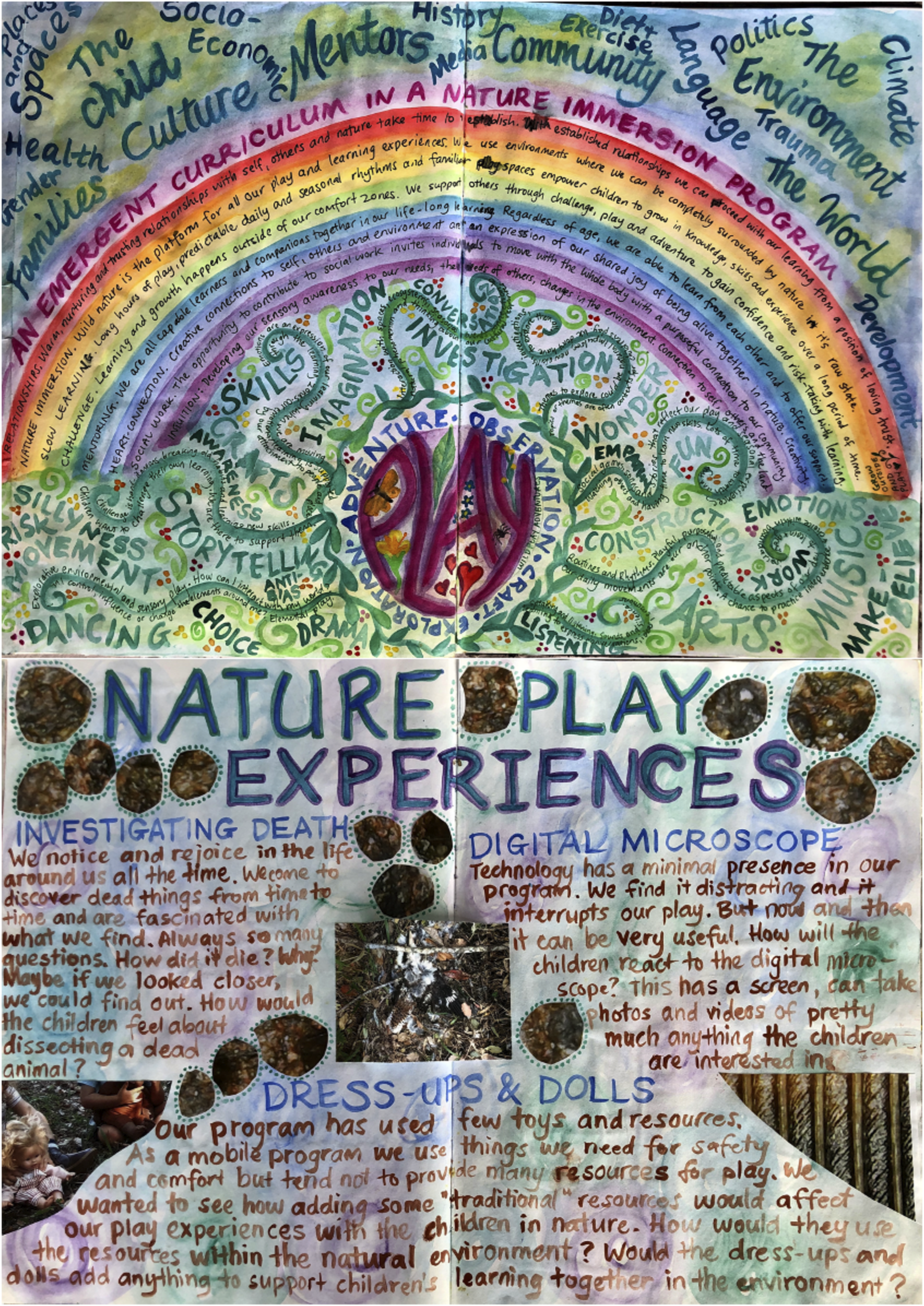
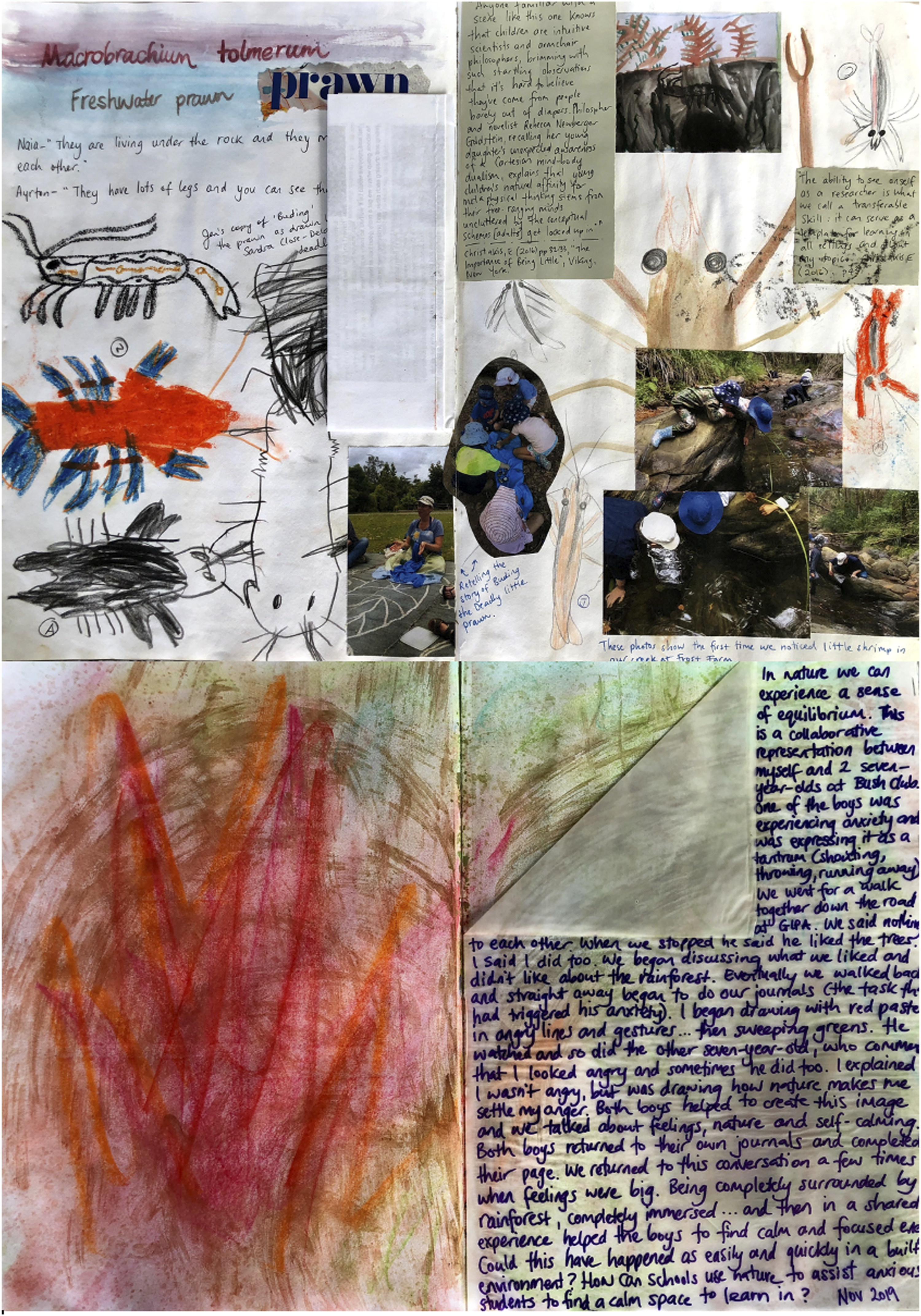
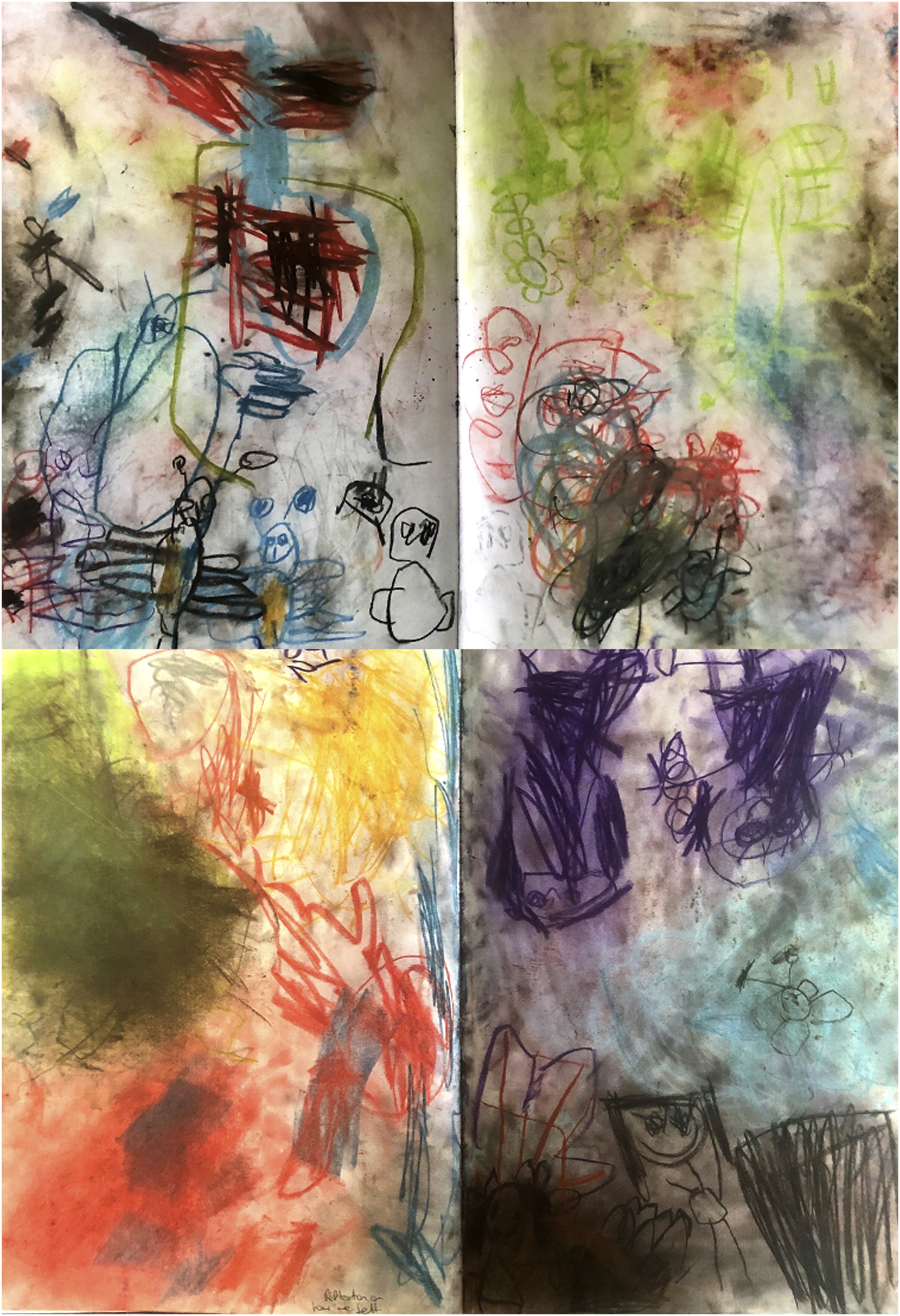
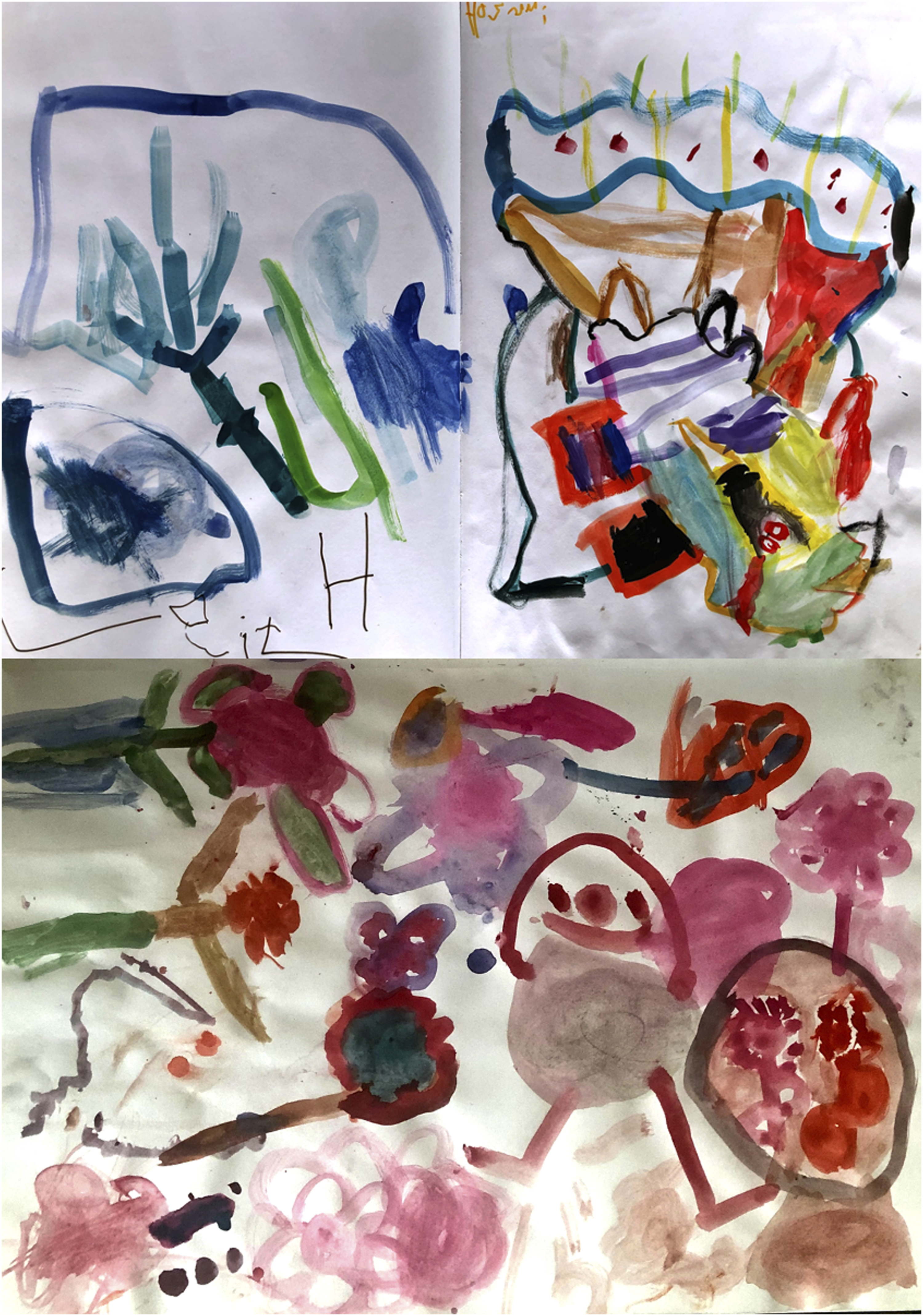
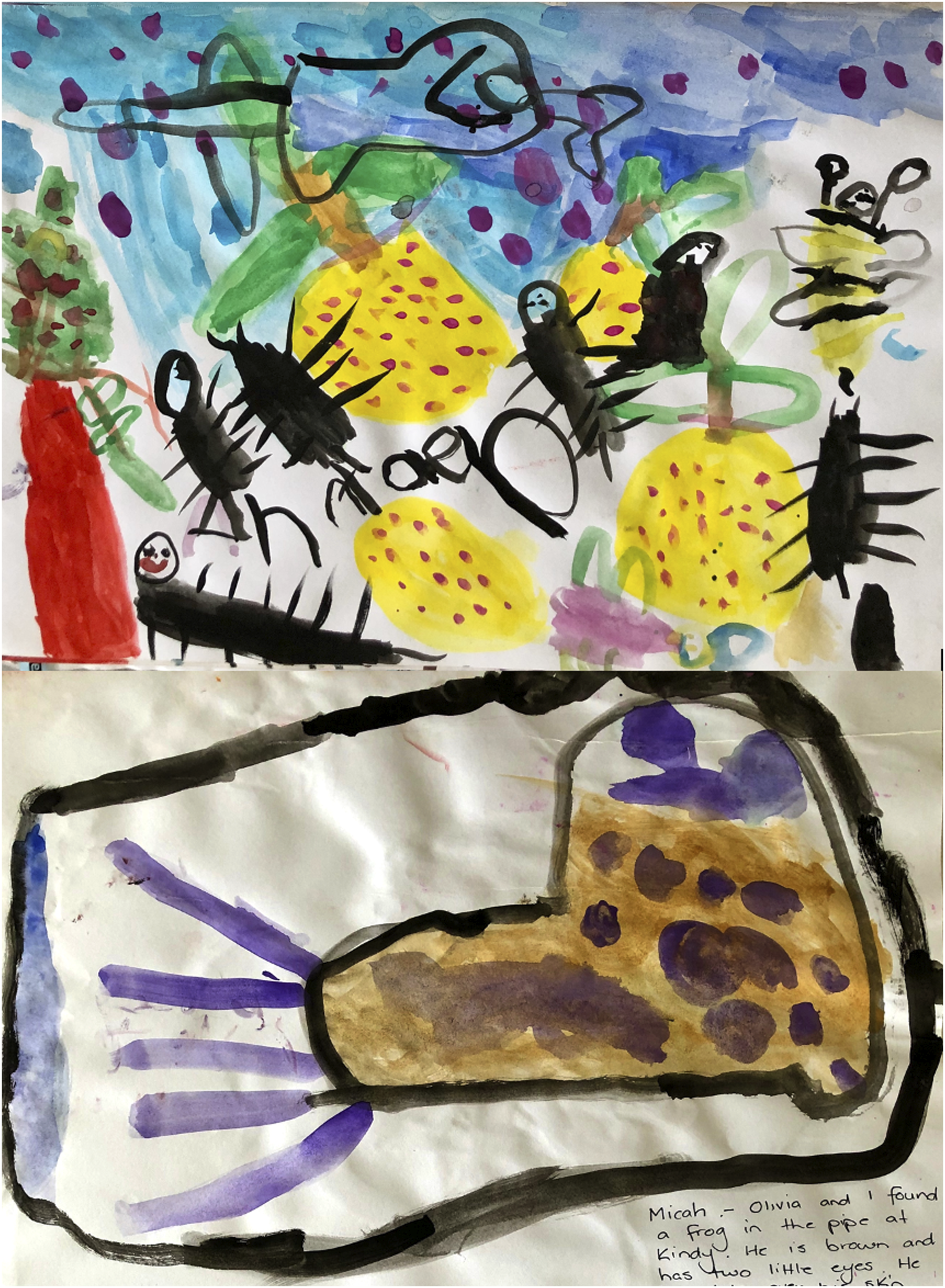
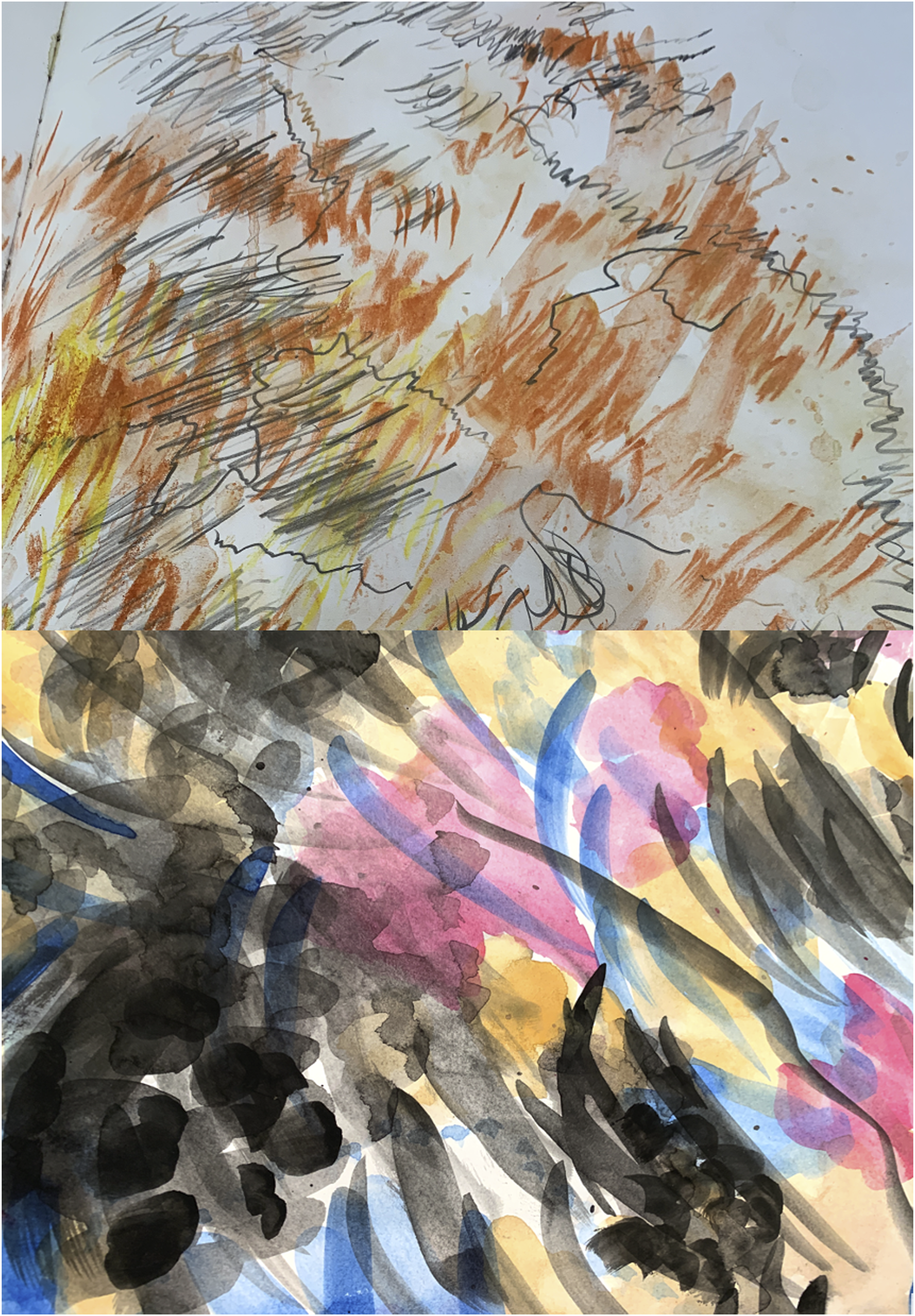
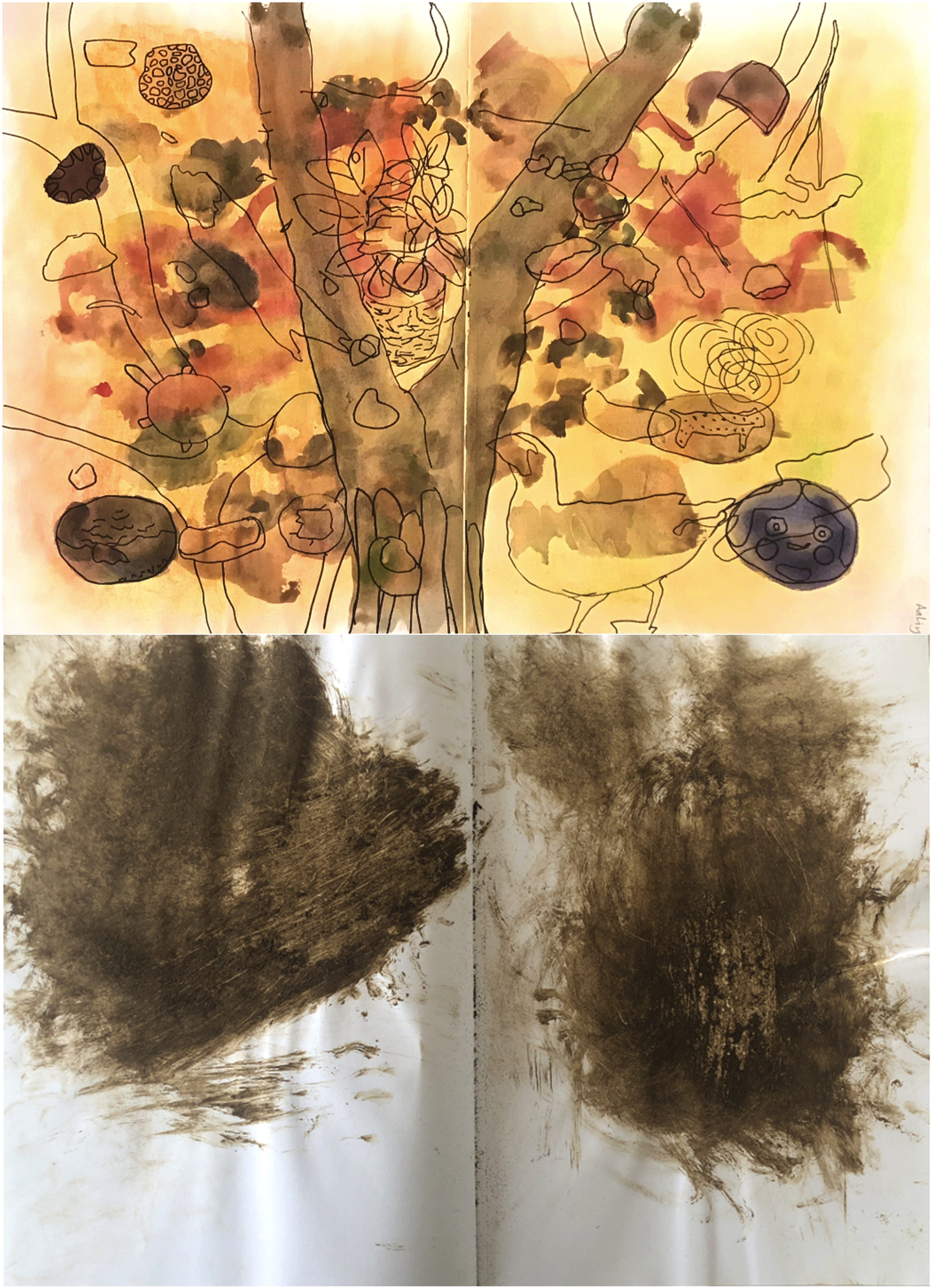
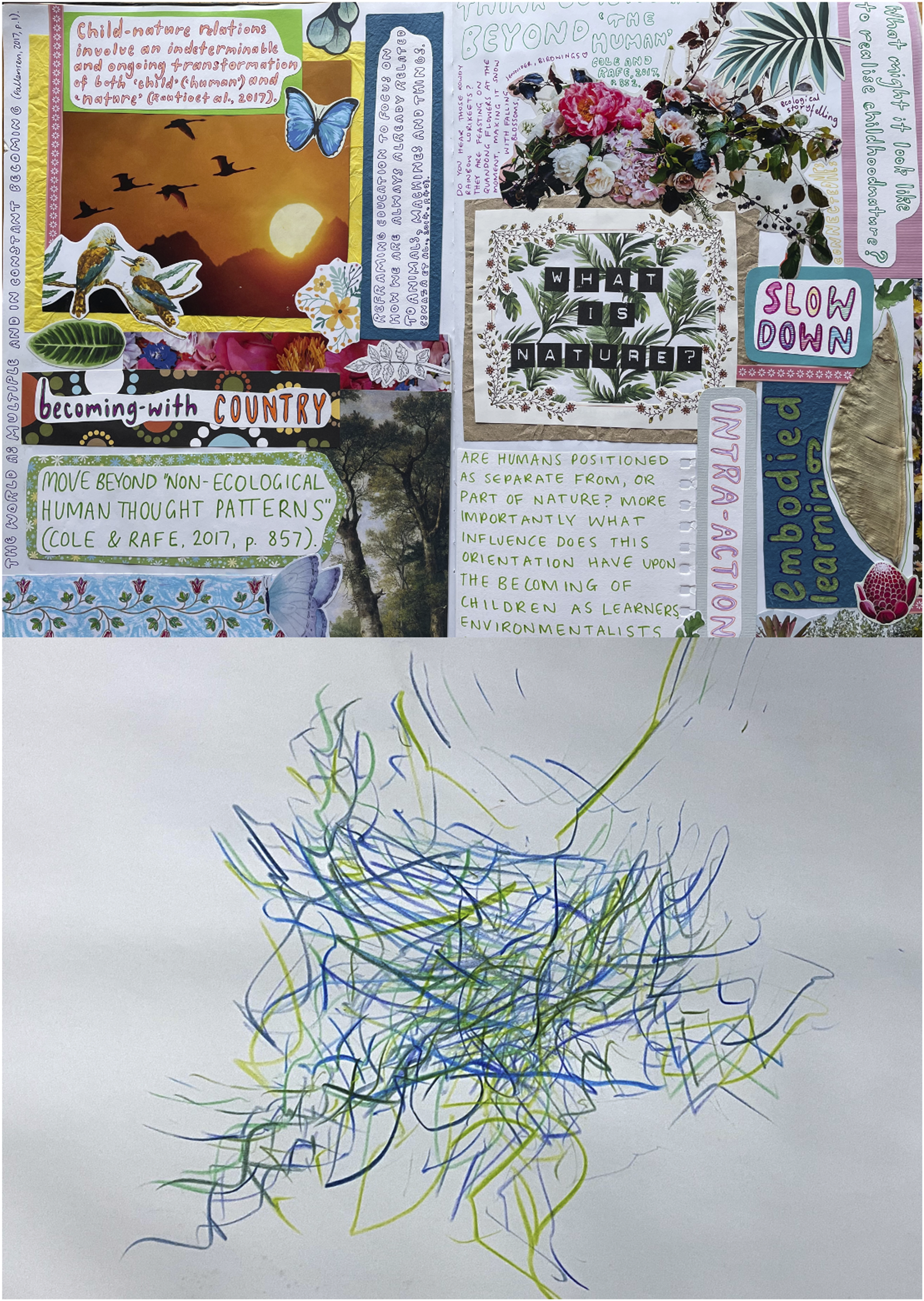
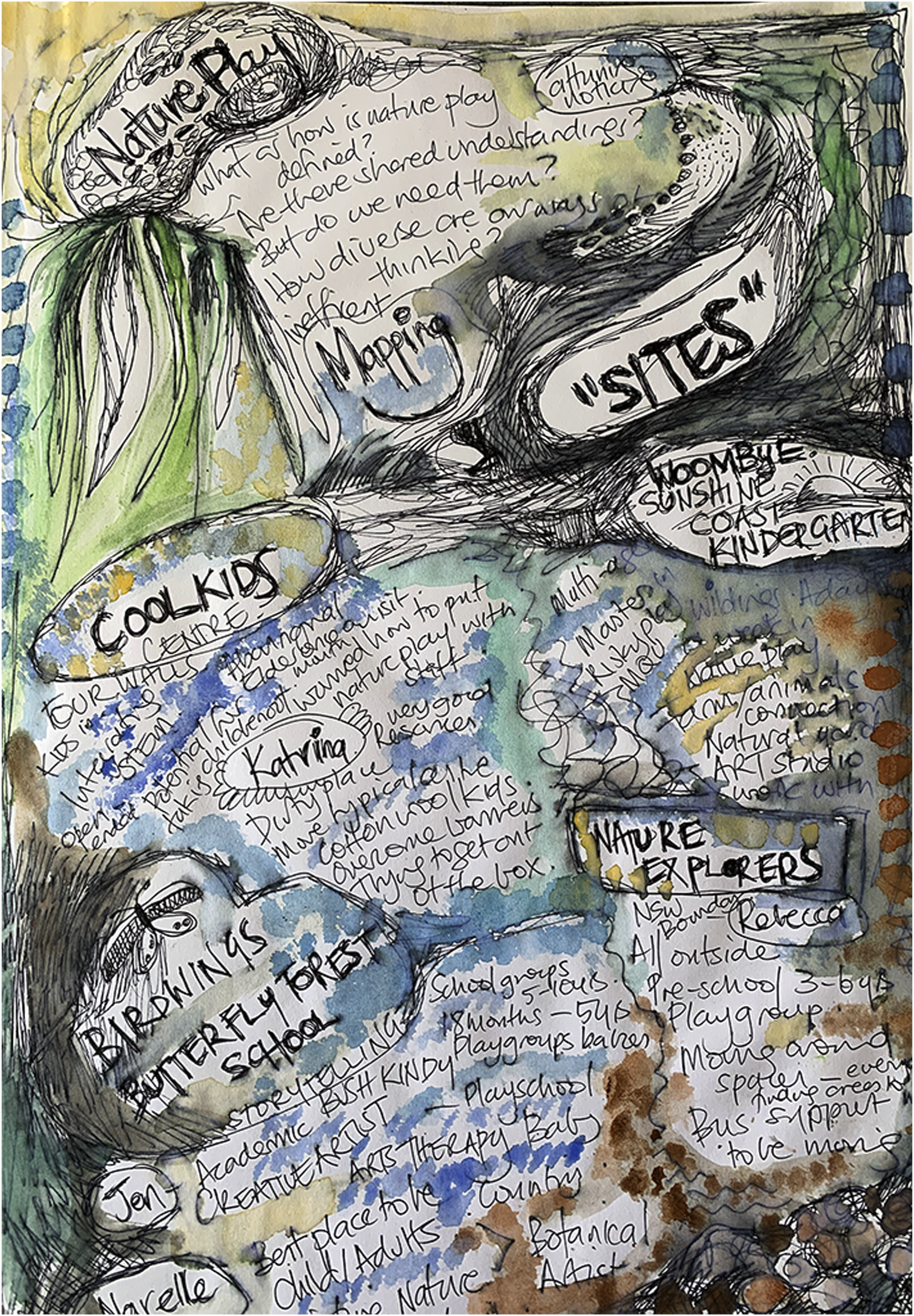
Discussion
The diary pages we have shared in this paper are deeply complex, relational and layered maps of nature play practice, encounter and materialities. Yet, they co-exist as a living curriculum (Aoki, 2005), a live performance that never ceases, in ‘aesthetic arrest’ (Leggo, 2018, p. 29). Their visual provenance gestures towards a ‘poetry-philosophy’, and its voluptuousness (Cixous, 1998) that is at once critical and useful, making learning visible.
The visual diaries in this study – emerging as data creations and analyses – are transformative, becoming a rich ‘database of raw evidence to draw upon… aesthetically arranged research evidence …layers of conceptual development … consideration given to form as well as content, and the deeply introspective’ (Lasczik, 2019a, p. 11). Making artworks, and making learning visible, ineffably transforms the maker, the viewer, the world (Grosz, 2009). Writing and graphic acts are closely related as ways of telling; written text is a visual system, whilst graphic forms entail signs that can be read (Ingold, 2013). Handmade visual texts such as the diary, which are splendidly analogue, and materially multilayered and encrusted with spacetimematterings, have myriad idiosyncratic impacts on educational research. ‘The visual portrayal of inquiry is thus not merely explanatory or descriptive but rather communicative of theoretical and aesthetic action’ (Lasczik, 2019b, p.3). Visual renderings are and are not themselves; they are always more-than, moving beyond the mimetic, the more-than-human, more than art, more than inquiry.
In our analyses of the large body of data creations in this study, including but not limited to the visual diaries, we returned again and again to our own makings, thinking through theory and thinking through the practice of creating concepts (Deleuze & Guattari, 1994) as we made art in analytical rejoinder and diffraction. This art was deeply personal, subjective, affective, and idiosyncratic. We came back again and again to the realisation that in this study, putting our visual diaries to transdisciplinary work gave us thinking room, a site, and a visual laboratory to experiment with these concepts. Our concepts sought to be pedagogically useful, created through visual musings in our diaries, which became an apparatus to read through and with theory, experimenting with thought, diffracting and reflecting - bending thought back - and taking thought in new directions. Thus, the academic’s diaries were ineffably entangled with the educator and children’s as we read back through the lineage of deliberations, actions and voices, noting the resonances, the traces, the vibrations of the material, and conceptual practices that were evident. We found that this way of doing analysis idiosyncratically and intuitively destabilises academic conventions generatively, as we iteratively worked our concepts.
Affects, percepts, and concepts (Deleuze & Guattari, 1994) in their becomings, as vibrations of forces, intensities and sensations, are vital and vibrant posthuman properties of artmaking and art-philosophy. As Grosz (2009) elegantly describes, art involves a process of ‘composing, extracting from the materiality of forces sensations capable of affecting life, that is, becomings, that have not existed before and may summon up future sensations, new becomings’ (85). In this way, art – and by extension, the visual diary – becomes usefully and seductively pedagogical, ‘a narrative pathway with arguments that seek to make sense of the events and processes’ (Turner & Wilson, 2009, p. 8).
The visual diary quite transcends its usefulness as a pedagogical mechanism or an instrument of recording and reflecting; it is potentially much more. In this project, we witnessed educators, children and ourselves as academics engage with the visual diary in profound and unexpected ways, affording rich insights into nature play, scientific concepts and perhaps most significantly, the more-than-human. The agency of the visual diary became increasingly obvious, unquestionable – thus confirming the visual diary as a relic of becoming, created through mark-making, inscribing and reifying in an ecology of experience, encounter, creativity, living curriculum, relationality and aesthetics as posthuman material/discourse. When created and engaged sensitively in nature play, with the important acknowledgment of place as unceded First Nations territory, the visual diary’s essence becomes agentic and vitally political.
In this endeavour, we foreground aesthetics as a critical force and intensity in the practice of making the visual diary. We assert that aesthetics is usefully generative, ‘because beauty gives you a fantastic, ‘impossible’ access to the inaccessible, to the withdrawn, open qualities of things, their mysterious reality’ (Morton, 2021, p. 4). When thinking of aesthetics, we refer to multispecies sensory attunements that are affective; beauty is one, disgust is another.
Aesthetics changes corporeal facilities through affect, and the atmospheres concomitant with affect, something Morton (2021) calls truthfeel – ‘beauty is truthy’ he says (p. 5); it is authentic. Aesthetics are uncanny, familiar, and strange at the same time. Yet in these catastrophic planetary times, ‘[i]t is neither comfortable nor simple to speak of beauty and aesthetics in a world afflicted by injustice, poverty, repression and cruelty… we feel almost ashamed to speak of them’ (Vecchi, 2010, p. 10). Nevertheless, the engagement of aesthetics is procreant, as a fertile site for being present; through ‘blocs of sensation’ - the language of affect has the capacity to move thought, to change – to create ‘possibles’ (Deleuze & Guattari, 1994). This change to thought and bodies is a productive site for education – the glorious subjectivities of percepts and affects, thoughts and feelings, beauty and malice – have the power to move. To move thought, action, behaviour, atmospheres, and ethics through, for example, the potentially shimmering practices of a visual diary.
We have resisted adding a ‘how-to’ guide for this work, because it could be exclusionary. This is because such instructions can be read as a formulaic ‘truth’ – “do it this way, this is the correct way, not that…”. Such discourses have resulted in, for example, many individuals attesting that they ‘cannot draw’ or are not creative. We, therefore, avoid giving explicit instructions, direction and methods for reflection and diary-making intentionally, although the images, theoretical positionings and descriptions of the project give some insight and are included for these and other reasons. The processes of artmaking, like the processes of diary-making, are abstract and gloriously idiosyncratic. We trust educators in making their own aesthetic choices that are valuable, and potentially useful in all manner of diverse ways, thus genuinely reflecting the needs and interests of children, educators, families and more than human others at any particular early childhood setting. Each individual must come to the making of their visual diary in discrete and peculiar ways. This is because choices around materials, the agency of materials, geographical and other contexts, the availability of resources, individual dispositions and artmaking styles will differ widely and wildly. This is a good thing. Decisions around practicalities, future learning opportunities, the ergonomics of the diary’s use in the moment or the future, and even storage and ownership are issues to be grappled with individually, ethically and in context.
We find that in neoliberal discourses, individual educators are often distrusted to make pedagogical or curricular decisions about children’s learning or their own professional development. We feel strongly that educators are professional, competent individuals who have the capacity to determine how their visual diary will be engaged, when, for what purpose and for how long. In this paper, we offer examples of what we have done, how it is theorised and what materials can be engaged from our particular project that sought to explore scientific concepts embedded in nature play, mapped through and reflected upon in the visual diary. Artists, like educators, like children, are individuals with their own experiences, tastes, subjectivities, preferences, thought processes and desires. Their diaries will reflect these particularities and more.
In closing, we return to the notion of the generalist educators’ reticence to make (MacDonald et al., 2016), to draw (Hotko, 2022), to be exposed on the white pages of a sketchbook or a blank canvas on display. Having the courage to embrace being vulnerable and draw/paint/create/experiment is a deeply efficacious way to engage in the process of thinking, imagining and proposing. It is an action, an art action that is not too far removed from writing by hand. Handwriting, after all, is a graphic signifier of thought, that is in the head as much as it is in the hands. Mark making, then, is drawing-thinking, but it is also looking-thinking and making-thinking. These thinkings are transformative and, therefore, political. These transformations include a change in the way vision is enacted; the way that looking is haptic as well as optical so that the attendant drawing is acknowledged as an entanglement of lines (Ingold, 2013). These lines are not only marks; they are also lines of sight and lines of flight, which are meshwork.
Speaking, writing, and drawing leave traces. These traces map movements of change that are political and, importantly for the educational project, pedagogical. Encouraging educators to draw, to make, to look haptically and to move thought usefully, the visual diary is a safe, valuable and (sometimes) private place to experiment and satisfy. Significantly, for the educators – and for the children who might co-create with them – engaging in sustained material-discursive-making practices has myriad benefits - for the development of thinking skills, metacognition, creativity, and criticality, to name but a few. More importantly, having a regular and sustained artmaking practice has the potential to unlock courageous and dextrous imagination, an outcome that in itself is pedagogically useful.
In making a rich and useful visual diary, it is imperative to simply begin where you are. In this, we take heed of Richardson and St Pierre (2005, p. 962), who fittingly argue, “There is no such thing as ‘getting it right,’ only ‘getting it’ differently contoured and nuanced”.
Footnotes
Declaration of conflicting interests
The author(s) declared no potential conflicts of interest with respect to the research, authorship, and/or publication of this article.
Funding
The author(s) disclosed receipt of the following financial support for the research, authorship, and/or publication of this article: This work was supported by the Department of Education and Training, Queensland Government; Horizon Grant Scheme.
