




Abstract
Mentoring is highly valued to support teachers’ professional growth. Yet little is known about mentors’ experiences and roles in supporting early childhood education teachers in Aotearoa New Zealand. This study sought to fill that gap by asking mentors how they foster teachers’ capacity, as well as the barriers and enablers they have experienced as mentors. Utilising an online survey, data were gathered from 138 participants who had diverse experiences of mentoring across the career span and came from a variety of early childhood organisations in Aotearoa New Zealand. This article reports on how mentors view their roles, the specific strategies and practices they use, and the challenges they face. While it is recognised that mentoring is a complex, skilled and rewarding role, many mentors may not have access to professional development and mentorship to support them in their roles as mentors.
Introduction
With 62% of zero to four year olds in Aotearoa New Zealand (NZ) attending a licensed early childhood education (ECE) service (Ministry of Education [MOE], 2024) and given the importance of high quality ECE (Neuwelt-Kearns & Ritchie, 2020, p. 5), it is imperative that ECE teachers are supported in their work to foster children’s positive learning outcomes (Education Council, 2015, 2018). Mentoring has been identified as an important approach for strengthening teachers’ capabilities at all career stages (Buckley et al., 2020; Nolan, 2017; Thornton, 2015). Mentors have been described as change agents, who raise the pedagogical capacity of teachers through individualised professional support (Lieberman et al., 2012; Thornton, 2015).
Despite a focus in NZ on strengthening teaching and leadership capabilities across career spans and the role that mentoring plays in this process (Education Council of Aotearoa New Zealand, 2018; Education Review Office, 2020), there is limited research highlighting NZ ECE mentors’ perspectives and experiences. This study sought to better understand NZ ECE mentoring and highlight mentors’ perspectives through the research question: What are early childhood education mentors’ perspectives on their roles, practices and experiences in mentoring?
Literature review
Defining mentoring
Mentoring has been described as a multifaceted relationship characterised by leadership, guidance, inspiration, support, motivation and challenge (Rajuan et al., 2010; Thornton, 2015). Originating from the Greek term “mentor”, denoting endurance, mentoring is inherently synonymous with perseverance. Mentoring is sometimes associated with coaching, as both are relational approaches to professional learning, but mentoring is characterised by a broader focus on the mentee’s holistic development over time (Thornton, 2015). Coaching can be seen as a distinct method that may be separate from, or integrated within, a mentoring relationship (Clarke et al., 2021).
Mentoring in education
A central tenet of mentoring lies in its relational nature, where the mentor assumes the role of a co-learner. The co-learner dynamic underscores collaboration and partnership, facilitating the exchange of skills, insights, and knowledge between the mentor and mentee (Education Council, 2015; Ellis et al., 2020; Trevethan & Sandretto, 2017). In NZ education contexts, an evaluation of the Learning to Teach research programme for early childhood, primary and secondary-based provisionally registered teachers (Sankar et al., 2011) informed the development of the Guidelines for Induction and Mentoring and Mentor Teachers (Education Council of Aotearoa New Zealand, 2015). The Guidelines for Induction and Mentoring and Mentor Teachers reflect a shift from advice and guidance to an educative mentoring approach, challenging historic views of the mentor as expert and the mentee as learner, and supporting a co-learner relationship (Harris & Kara, 2015). Co-learning is fundamental within the early childhood curriculum framework Te Whāriki (MOE, 2017). The principle of relationships (in which learning is situated within responsive relationships with people, places and things; MOE, 2017) and the concept of ako (in which learning is a lifelong endeavour, interwoven with teaching; Murphy, 2015) align closely with co-learning mentoring approaches and provide useful lenses through which to consider NZ ECE mentoring.
Mentoring is often tailored to the individual, shaped by the mentee’s existing knowledge, skillset, confidence, and openness to change (Peterson et al., 2010; Snider & Holley, 2020). Accordingly, several studies argue that a proficient mentor initiates a dialogue with the mentee to ascertain their preferences and aspirations for the mentoring experience (Ellis et al., 2020; Langdon et al., 2016). This dialogue serves as the foundation for negotiation and ongoing refinement of mutual expectations. In examining indivdualised mentoring approaches, Snider and Holley (2020) used Glickman et al. s' (2018) conceptual model of teacher development to support mentorship. Snider and Holley found when mentors individualised their strategies, all teachers in the programme shifted towards higher levels of abstract thinking and commitment. While accommodating the uniqueness of each mentoring relationship, a structure, such as the GROW model, has also been used to individualise mentoring (Harrison & Harris, 2020). The GROW model is a four-step process to support a facilitative coaching or mentoring structure, involving goal setting, identifying the current reality, examining options and finding a way forward (Mind Tools, 2024). Processes associated with coaching, including goal setting, observation of teaching and providing feedback may also be integrated within a mentoring relationship, with the intention of strengthening teaching practice (Clarke et al., 2021).
Support and training for mentors
Wider research highlights that mentor-focused professional support, as well as mentoring for the mentor, can foster behaviours and practices that support mentoring relationships and teachers’ pedagogical growth (Gardiner & Weisling, 2018; John, 2008). Yet, mentors may have limited access to mentor-focused professional support (Gardiner & Weisling, 2018; Whatman, 2016). In NZ, as has been recognised internationally, it is possible that many teachers shift into mentoring roles and draw from their teaching experience or engage in “on-the-job learning” (Ryder et al., 2017), rather than receiving any specific mentoring training. Calamlam and Mokshein (2019) caution against assuming that a good early childhood teacher will make a good mentor. As Calamlam and Mokshein point out, mentoring “requires a different set of skills, knowledge and attitudes to help cooperating teachers optimise their potentials” (p. 29).
Given the link between mentoring and high-quality ECE (Education Review Office, 2020) and the limited information about mentors’ roles and experiences in NZ ECE, it is important to know more about the strategies mentors use, as well as the barriers and enablers they have experienced in their roles. Therefore, the present study aimed to promote understanding of NZ ECE mentoring by exploring mentors’ perspectives on their roles, practices and experiences. A further aim is to disseminate mentors’ views.
The present study
The present study was guided by a pragmatic paradigm (Kaushik & Walsh, 2019), in which the practical approach of seeking mentors’ perspectives was used to learn more about mentoring in NZ ECE. A conceptual framework (Figure 1) for the study was informed by the principle of relationships, as espoused in Te Whāriki (MOE, 2017), and the concept of ako, in which learning and teaching are interchangeable and supported by values that emanate from a Māori worldview (Jenkins et al., 2015). Values inherent in the concept of ako include: whanaungatanga, involving building relationships; manaakitanga, involving a spirit of care; wairuatanga, involving engaging with others with integrity in ways that uphold esteem; kaitiakitanga, protecting what is important through using culturally responsive practice; and rangatiratanga, involving recognising strength and leadership qualities (Jenkins et al., 2015). Conceptual framework.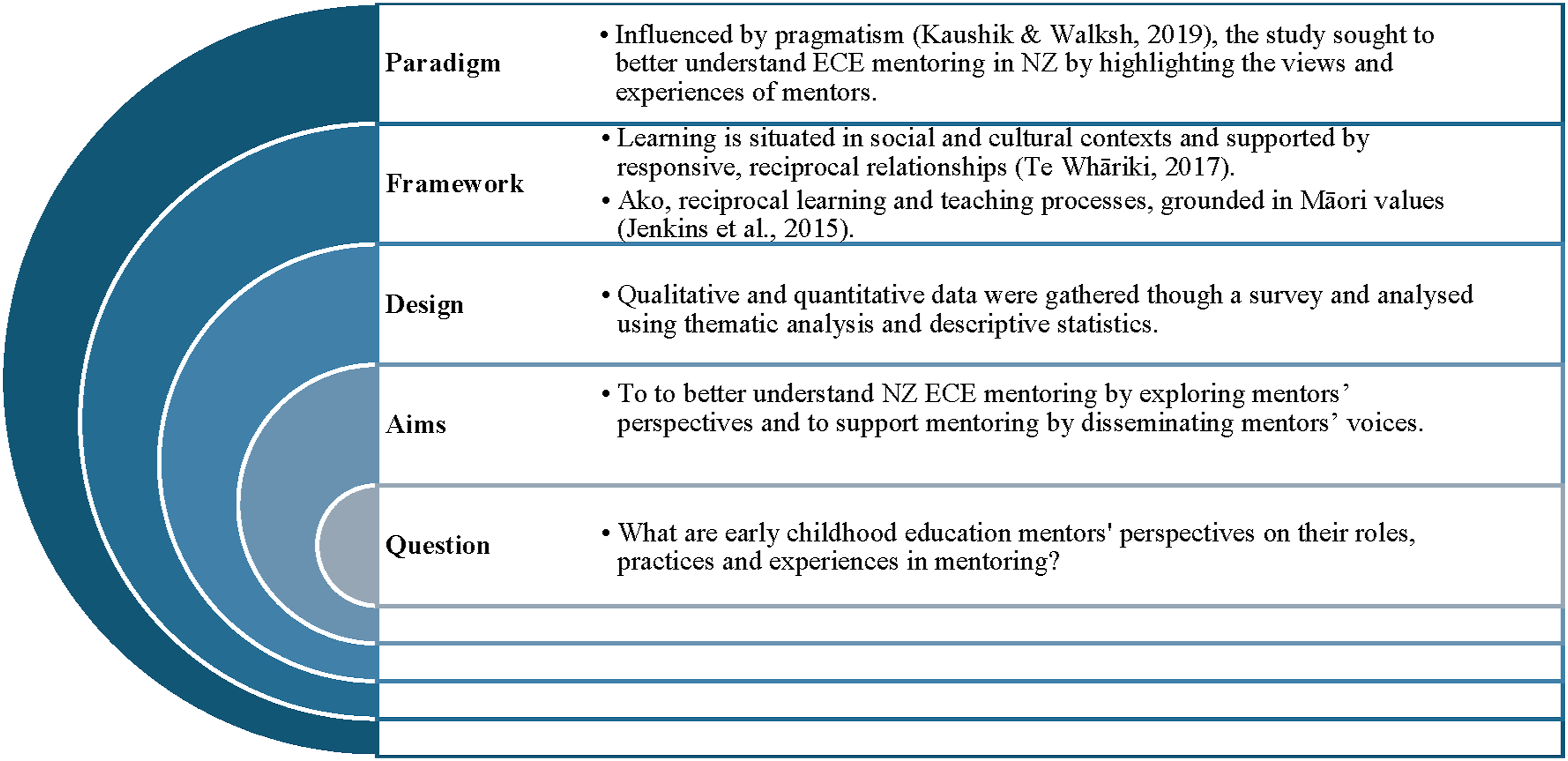
Methods
Ethics
Participants were informed of the purpose, benefits, and procedures for the research, including the anonymous, voluntary nature of participation. An ethics risk assessment was peer-reviewed and, given the nature of the survey questions and participants’ anonymity, was approved as low-risk. The Massey University ethics notification number is: 4000026187.
Recruitment
Publicly available email addresses and the Early Childhood Services Directory (MOE, 2018) were used to source potential participants from licensed ECE services, including kindergarten, home-based or education and care services and from professional development, and initial teacher education providers. An invitation email, which included ethics information and a survey link, was distributed on August 16, 2022. Inclusion criteria were that participants be a qualified early childhood teacher, with experience of formally or informally mentoring an ECE teacher or student teacher at any stage of their career.
Survey design
A survey, developed and administered with Qualtrics®XM, was used to gather data. The survey included closed, open-ended, and contingency questions to gather demographic data and to explore mentors’ perspectives on their roles, practices, and experiences in mentoring. Participants were asked to identify and base their answers on the cohort of teachers whom they had had the most experience mentoring. These cohorts included home-based, student, beginning or experienced teachers, peers and positional leaders.
The survey questions fit into five categories: demographic information, including teaching and mentoring experience; mentoring roles, strategies, and processes; mentoring style; professional development; and challenges and celebrations. There were 30 questions in total. Eight were closed choice questions with specified options provided and the opportunity to select ‘other’ and describe. In seven questions, statements were provided with Likert scales from never to frequently, or from do not agree to strongly agree. Twelve questions were open. Three contingency questions enabled participants to take different pathways through the survey, dependent on their answers. The survey took about 20 minutes to complete. The survey was designed in collaboration with an academic advisor. The survey was piloted by six ECE teachers with mentoring experience and refined and finalised based on the feedback provided. This article reports on a selection of the data collected through the survey.
Data analysis
Results from the closed and Likert survey questions were exported from Qualtrics into Microsoft Excel for analysis through descriptive statistics; open ended responses were analysed thematically (Braun & Clarke, 2022). Thematic analysis involved an iterative process of familiarisation, coding and generating sub-themes and over-arching themes. Castleberry and Nolen’s (2018) process of compiling, disassembling, reassembling, interpreting, and concluding was used to pull data apart then put back together in ways that enabled categorisation of the comments, while retaining the purpose and authenticity of participants’ comments. In this process, sentences, phrases and words were colour coded, with the smallest unit of analysis being a single word, providing any single word captured the participant’s meaning when taken out of context of the sentence. The units, including words, phrases and single or multiple sentences, were then grouped through a process of copying and pasting that involved “playing around” with potential categories and themes.
Thematic analysis is influenced by the analyser’s background, knowledge and interests (Braun & Clarke, 2022). With this in mind, analysis was undertaken by the first author then checked and sometimes reanalysed by both authors who collaborated to find agreement, including checking that categories and themes matched the apparent intent of participants’ comments. Results were then examined in light of extant mentoring literature. The purpose was to explore what the results meant in relation to literature and to identify ECE mentors’ views on mentoring, the strategies they espoused to use and the barriers and enablers to their mentoring practice.
Findings
Participants
One hundred and thirty eight respondents with a range of experience in teaching and mentoring participated in the survey. Participants worked across the sector as early learning centre managers (n = 24), kindergarten teachers (n = 15), kindergarten head teachers (n = 15), early learning centre teachers (n = 11), teacher educators for initial teacher education providers (n = 10), senior teachers/professional leaders for kindergarten associations (n = 7), visiting teachers for home-based educators (n = 6), professional development providers (n = 4), area managers for home-based networks (n = 2), or in other roles (n = 12). The participants reported as having had the most experience mentoring student teachers (n = 50), followed by experienced teachers (n = 35), beginning teachers (n = 31), home-based educators (n = 10), peers (n = 5), and positional leaders (n = 5). Data were statistically analysed across these cohorts to compare results. Despite a few exceptions, notably between mentors of positional leaders and home-based educators, analysis showed little difference in mentoring approaches according to cohort.
Participants’ perceptions on mentoring roles and practices
In their answers to open questions, participants (n = 128) made over 807 unique comments about roles, characteristics and practices they thought were essential for mentoring. Following the open questions, participants were asked to indicate how frequently they used specified mentoring practices, based on a scale of never; very rarely; occasionally; and frequently. Qualitative data were analysed thematically and quantitative data were analysed as percentages of responses for each point on the scale. The findings from both qualitative and quantitative analyses are reported below within the key themes of: relationships; responsiveness and individualisation; communication; facilitating and coaching; knowledge and skills; and professionalism. For the purposes of our reporting, each theme is discussed separately, however, in practice the themes weave together, reflecting the many-faceted nature of mentoring.
Relationships
Many participants highlighted a need “to form respectful and reciprocal relationships before mentoring can start.” In the context of relationships, encouraging by offering warmth, praise and positive motivation was reported as a frequently used practice by 95% of participants and occasionally used by 5%. Some participants perceived an aspect of the mentoring relationship as befriending, which involved showing warmth and interest in a professional yet personal capacity. Befriending was a practice reported as frequently used by 67% of participants, 25% occasionally, 7% very rarely and 1% never.
The importance of building “safe” relationships and environments for mentoring was reflected in comments such as: creating a “safe and secure environment where mentees can speak openly and honestly;” “build a sound trusting relationship with them so they can be completely honest about how things are going for them;” “encouraging and building [mentees’] esteem;” and working alongside teachers “in mana-enhancing ways,” with mana-enhancing involving recognising and uplifting people’s esteem. Many comments reflected the importance of being “kind” and “compassionate.” Being kind and compassionate appears to be paired with recognition of a mentees’ strengths and capabilities rather than a need to protect, since being a guardian by looking after and defending mentees was reported as frequently used by only 18% of participants; 49% occasionally acted as guardians, 31% very rarely and 5% never. Patience was mentioned frequently, however, it was not always clear whether participants were referring to the importance of being patient with a mentee or to the patience required to engage in a sustained, perhaps slow, process of supporting a teacher’s growth.
Responsiveness and individualisation
Individualising by adapting the mentoring style to suit the mentee was reported as a frequently used approach by 81% of participants, 18% occasionally and 1% very rarely. An individualised approach was reflected in comments such as “having a feel for if the mentee is sensitive so approach would be softer” and “finding out what [mentees] need … share knowledge.” Some participants mentioned the use of frameworks that supported them to individualise their mentoring, with one participant stating: “I use a GROW coaching model for performance,” and another, “we also use the Gallup strengths to understand individuals.”
A responsive mentor was described as “someone who celebrates uniqueness and autonomy,” who is “culturally responsive” and who is “able to recognise an individual’s unique teaching skills, abilities and styles and support them to grow those, using methodology tailored to suit the teacher.” Many comments reflected an understanding of responsiveness as an awareness of others and an ability to adapt to foster the wellbeing and learning of a diverse range of mentees.
A mentor’s ability to foster collaboration also fits into the responsiveness theme: having “an ability to ignite passion/motivate groups of individuals to achieve a common goal;” and “to have the ability to create a cohesive team that works together, supports one another, recognises and draws on each other’s strengths.” Related to fostering collaboration, 51% of participants reported frequently connecting mentees with people or resources to support the mentees with specific needs or goals, 41% occasionally and 8% very rarely.
Communication
Listening was a key aspect of communication, with 98% of participants reporting they frequently listened to mentees by paying attention and interpreting what was said and 2% said they occasionally listened in these ways. The word “listen” was reported often in response to open questions, with some participants elaborating to explain that mentors needed to have “listening skills and listening for understanding,” “listening effectively and responsively” and to ensure they took “time to listen.”
Seventy-three percent of participants reported frequently using questioning techniques to support communication and reflective dialogue, 26% occasionally and 1% very rarely. Comments reflected that it was important to “ask questions … and seek further information and clarification” from mentees. Some participants commented on the need for mentors to be “articulate;” to “speak a language that is clearly understood by the mentee;” “be able to paraphrase ideas;” and “talano and listen.” Talanoa is a Pasifika approach to communication that emphasises taking the time to talk, listen and be open to each other’s perspectives (Tātai Aho Rau Core Education, 2024).
Facilitating and coaching
Participants reported that facilitating a mentoring relationship often involved guiding mentees and sometimes involved challenging mentees. Seventy-one percent of participants reported frequently guiding mentees by gently leading with suggestions, 28% occasionally and 1% very rarely. Comments included: “guide;” “facilitate their learning;” “create or highlight opportunities;” “encourage mentees to reflect on their practice to support growth;” and “not always giving the answer but guiding good practice.” Fifty-nine percent of participants reported frequently challenging mentees, with 40% saying they occasionally challenged and 1% very rarely. Comments included: use “good questioning to challenge a mentee’s thinking and learning;” “challenging a mentee to be the best they can be;” “being prepared to challenge;” and “being open and prepared to challenge mentees’ ideas.” Often, challenging was paired with support, such as “being a gentle challenger and warm supporter” and “a critical friend, someone who will challenge in a way that is empowering and mana-enhancing.”
Numerous participants described coaching as part of the mentoring process, with some comments giving general descriptions, such as using “coaching strategies to support teachers’ thinking and practice,” while others specified components of coaching, including goal setting, modelling practice, observing and giving feedback. In terms of goal setting, helping mentees set and meet specific goals was reported as a frequent practice by 71% of participants, 27% occasionally and 1% rarely. One participant said it was important to “have the mentee’s goal in mind all the time” and “bring the mentee back to the goal.” Two facets of role modelling were evident in participants’ comments: being a role model in a general way and role-modelling by demonstrating a specific strategy. Seventy-eight percent of participants said they frequently acted as a role-model by implementing best practice, 16% occasionally, 7% very rarely. Demonstrating a specific skill or strategy was reported as a frequently used mentoring practice by 56% of participants, 16% occasionally and 7% very rarely.
Providing positive feedback on teaching practice was reported as a frequently used practice by 92% of participants and occasionally used by 8%. Comments included: “provide feedback to mentees to consider, reflect and weave into their practice or philosophy if they choose,” “provide positive feedback regularly;” and “ability to give positive feedback to support development of learning and growth.” Providing constructive feedback, defined as feedback based on observation of teaching, was reported as a frequently used practice by 82% of participants, 18% occasionally and 1% very rarely. One participant linked observation with listening and feedback in a comment: “I listen;” “I observe for a while” and “looking at how they react, talking about how they like feedback, how we can work together.” Although comments about observing a mentee’s teaching practice were limited, observation of teaching was reported as a frequent mentoring practice by 70% of participants, 24% occasionally, 5% very rarely and 1% never.
One comment indicated not all participants associate mentoring with coaching: “A mentor must be relational to their core, as the difference between mentoring and coaching is the focus on relationship and personal growth verses the focus on the ability to perform a task better.” This participant may be describing a directive view of coaching, which involves a master-apprentice type relationship focused on an “expert” coach directing a teacher (Knight, 2021).
Knowledge and skills
Participants emphasised the responsibility of a mentor to have content and pedagogical knowledge, and to continue to hone their knowledge and skillset. Comments included: have a “deep understanding of theory and ability to articulate it; ability to articulate practice; confidence in own practice” and “knowledge to stretch those they are mentoring—therefore [mentors] must be able to critically engage with research and theories from a variety of different viewpoints and bring these into the mentor/mentee relationship.” “Practical experience to draw on” was seen as important, as was content knowledge; “to have knowledge and skill in the area the mentee is learning.” Participants said that mentors needed to be able to think critically and reflectively: “[being] reflective in your own practice so you can improve on being a mentor.” Many participants mentioned the importance of being “open minded and open to further learning,” including learning from mentees, an idea that resonates with the concept of ako. A few participants touched on how mentors might be supported in their professional learning and growth, with comments such as “a good mentor must have a good mentor of their own” and must “know how to access other information from people or sources that will help.”
Professionalism
Many participants described professionalism and commitment, alongside the importance of being organised. Comments included: “professionalism,” “organised,” “planner,” “strong work ethic” and “maintaining confidentiality.” A professional mentor has the “organisation and time management skills to juggle their work and make regular weekly time to support, talk and mentor the mentees.” Dedication, commitment and passion were highlighted throughout the participants’ comments, including “passion for developing others to be successful.”
Participants’ perceptions on rewards, challenges and support
On a scale of do not agree, agree a little, mostly agree and strongly agree, participants were asked if they found mentoring to be a positive experience; if they found mentoring to be a challenging experience; and if they had received professional support specifically related to their work as a mentor. Participants were invited to comment on positive experiences, challenging experiences and professional support.
Positive experiences
Forty-five percent of participants strongly agreed that mentoring was a positive experience, 52% mostly agreed and 2% agreed a little. Participants’ comments revealed that the mentoring relationship helped to build positivity: “it’s a two-way relationship—openness to experiences and reflection leads to positive outcomes.” Some participants commented on how a mentee’s attributes contribute to positive mentoring, such as having “committed mentees who are reflective and open to feedback and learning.” Positive mentoring experiences were also associated with the mentees’ success: “seeing student teachers succeed and grow over a period of time is truly rewarding;” and opportunities to share knowledge, learn and give back to the sector: a “chance to pass on some of knowledge and skills,” and “future proofing ECE.” Mentors’ confidence in their role, including “affirmation of my ability to help someone else,” and “being able to enact tuakana-teina relationships” was associated with positivity. Tuakana-teina relationships can be described as a more expert or older person helping a less expert or younger person (MOE, n.d.). Finally, having effective organisational supports contributed to positive mentoring experiences, as reflected in comments such as: “when mentoring is valued at management level and so time and funding are available to support positive outcomes for all” and “having a team approach to mentoring.”
Challenging experiences
Six percent of participants strongly agreed that mentoring was challenging, 15% mostly agreed, 62% agreed a little and 17% did not agree. The most common theme associated with challenging experiences was mentees’ (perceived) unprofessional behaviours and attitudes, reflected in comments like: “[mentees] who appear disinterested, unwilling to work as a team and do little to support learning and development in children.” Some participants mentioned “a huge variation in what funds of knowledge teachers start their careers with” and “students [mentees] not meeting requirements set by the university.”
Some participants remarked on the challenge of developing their own confidence as a mentor, including confidence to individualise mentoring approaches, “work with different personalities” and “give feedback and have difficult conversations.” Some comments revealed an association between difficult conversations and confrontation: “I lack confidence and fear confrontation.” Lack of organisational supports, including limited time to dedicate to mentoring, also presented challenge: “I had little guidance/support in the role” and “mentoring is not always valued/resourced by centre leaders.”
One participant provided a reminder that challenge is often a positive experience: “challenging in that mentoring requires thought and dedication and focus. I feel that challenging need not always be construed as a negative. As a teacher and mentor, I learn with and from mentees because of the challenge. I see challenge as an opportunity to broaden perspectives.”
Professional support
Thirty-one percent of participants strongly agreed they had received professional support focused specifically on mentoring, 22% mostly agreed, 23% agreed a little and 23% did not agree. Those who did agree were invited to describe their professional support. Twenty-nine percent of participants had attended one-off courses on mentoring, leadership or management and 9% had engaged in sustained and in-depth professional development. When asked if they have had been mentored in their role as a mentor, 26% strongly agreed, 18% mostly agreed, 25% agreed a little and 31% did not agree. Those who were mentored said their support came from external consultants, professional development advisors, senior teachers or managers.
Discussion
Overall, our participants described a multi-faceted role of mentoring, in which a mentor could be summed up as a skillful, supportive and relational professional who has (and continues to develop) content and pedagogical knowledge as well as the abilities to implement mentoring and coaching strategies that support teachers’ thinking and growth. Our findings highlight the importance of mentoring relationships and specific mentoring practices, including listening, encouraging, individualising and giving feedback.
The relational nature of mentoring highlighted by our participants is not surprising, given that relationships are seen as the cornerstone of practice in NZ ECE, and emphasised in Te Whāriki (MOE, 2017). Likewise, the Educational Leadership Capability Framework (Education Council of Aotearoa New Zealand, 2018) highlights the importance of building and sustaining high trust relationships within education settings. The many comments our participants made about being kind and compassionate suggest a guardianship role that involves defending or protecting a mentee (Klasen & Clutterbuck, 2002), however, most participants reported only occasionally acting as a guardian. This may reflect that mentees only occasionally need their mentors to act as guardians. It may also indicate that participants’ comments about kindness and compassion were about building a trusting relationship and safe space for mentoring alongside recognition of a mentee’s strengths and capabilities.
Although not mentioned frequently by our participants, recognising or upholding a person’s mana may be a valuable way for mentors to consider their role in terms of building relationships and recognising an individual’s strengths and qualities. Mana and ideas of recognising and upholding mana are complex and can mean different things in different contexts. That said, a dictionary definition highlights mana as “prestige, authority, control, power, influence, status, spiritual power, charisma—mana is a supernatural force in a person, place or object” (Te Aka, n.d.). One explanation of mana-enhancing practice is: “mana enhancing practice is a way of engaging with others that cares for the spiritual, emotional, physical, and intellectual dimensions of a person” (Huriwai & Baker, 2016, p. 6). In such caring and holistic ways, recognising and respecting each other’s mana is likely to be a useful foundation for any mentoring relationship. Similarly, cultural norms and practices, including developing ako or co-learner relationships and engaging in talanoa, were mentioned by some of our participants and represent ways of engaging in mentoring that are worthy of further consideration. In NZ ECE, resources such as Te Hāpai Ō: Induction and mentoring in Māori medium settings (Murphy, 2015) have the potential to strengthen mentoring in all services, strengthening understanding of Māori world views and supporting relationships, including relationships perceived as “challenging” by mentors.
Many specific mentoring strategies described by our participants align with coaching strategies. Given that participants identified a mentor as a relational, responsive listener and communicator, the strategies described fit well with what Knight (2021) describes as dialogic coaching. In dialogic coaching, both partners bring their expertise to the relationship; “dialogical coaches ask powerful questions, listen and think with teachers, and collaborate with them to set powerful goals that will have a powerful impact on students’ lives” (n.p). In NZ ECE, dialogic approaches are aligned with the concept of ako, where learning is a partnership, ideas are shared and knowledge is co-constructed and the importance of kōtahitanga, involving working toward a common goal, is emphasised (Jenkins et al., 2015; Murphy, 2015).
The provision of both supportive and constructive feedback is recognised as a factor in influencing teaching practice change (Elek & Page, 2019; Kraft et al., 2018). In this study, there was high reported use of feedback, including constructive feedback based on observation of teaching practice. A discrepancy is evident in our findings, with 82% of participants reporting the frequent provision of observation-based feedback but only 70% reporting frequently observing teachers. While this discrepancy may simply be a reporting issue, it will be useful to know more about how ECE mentors enact observation and feedback. Further research into mentors’ observation and feedback processes is supported by Watson (2019), who investigated the induction and mentoring of provisionally certificated teachers in three NZ ECE settings. Watson found discrepancies in how mentors in her study understood and enacted the Teaching Council requirements for formal observation and feedback on teaching practice. Rather than being planned or used to evaluate impact on learning, observations were initially taking place in an ad hoc way.
Similar to positive and constructive feedback, many participants noted the importance of challenging mentees, often in ways that were balanced with support. Dual elements of support and challenge resonate with Hedges’s (2007) description of the mentor as a critical friend, and with research that has highlighted the combination of support and challenge as a lever to empower mentees (John, 2008; Nolan, 2017; Rajuan et al., 2010).
Barriers to mentoring included: lack of organisational supports; limited specialised training; and difficulties in the mentoring relationship, including what some participants described as mentees’ unprofessional attitudes and behaviours. Enablers were positive mentoring relationships; the reward of sharing knowledge and skills; and giving back to the sector. The wider literature has recognised that organisational supports are important enablers of positive mentoring relationships and outcomes (Graves, 2010; John, 2008; Langdon et al., 2016; Nolan, 2017). Findings also highlight a divergence in access to mentor-focused professional development. Yet, professional learning as well as mentoring for the mentor have been shown to improve a mentor’s effectiveness (John, 2008; Kupila et al., 2017). Ensuring supports and systems are in place for mentorship is an important area to continue to address in NZ ECE.
Limitations
While surveys are a simple and cost-effective way to gather information, used alone, a survey has limitations (Neuman, 2014). The limited scope means this study cannot claim generalisability, and biases from respondents may be possible (Andrade, 2020). Furthermore, responses may be limited by the ways questions were asked and interpreted. To mitigate limitations, researchers collaborated throughout the research design, analysis and examination of the findings.
Conclusion
This research uncovers the voices of NZ ECE mentors on important, yet mostly unheard, aspects of their work. Participants expressed views of the mentor as a relational, compassionate and dedicated professional; someone who shares their knowledge and skills through effective communication and through responsive and individualised mentoring practices such as coaching, facilitating and guiding; and as someone who is rewarded by seeing their mentee succeed.
Participants saw mentoring as a highly valuable experience. Mentors’ sense of satisfaction was enhanced when they experienced a positive mentoring relationship. Difficult mentoring relationships, limited personal confidence and lack of organisational supports contributed to challenging mentoring experiences. Almost half the participants had limited, or no access to professional support focused on mentoring, or mentoring for the mentor.
This research contributes to understanding of mentorship in ECE, identifying mentors’ views of their roles and the practices they use, and highlighting the need for equitable access to professional support focused on mentoring, mentoring for the mentor, and time and resources to allow mentoring to happen effectively. We see a pathway for future research that unpacks some of the cultural norms and approaches associated with mentoring in NZ ECE, including ako, talanoa and recognising and upholding mana within mentoring relationships.
Footnotes
Acknowledgement
I would like to offer my deepest thanks and appreciation to those who have mentored me and inspired this research, to the participants who freely gave their time to share their perspectives on mentoring, and to Linda for supporting me throughout the research and publication process.
Declaration of conflicting interests
The author(s) declared no potential conflicts of interest with respect to the research, authorship, and/or publication of this article.
Funding
The author(s) received no financial support for the research, authorship, and/or publication of this article.
