



Abstract
This paper makes a case for developing a theory of quality ecologies in early childhood education and care, and presents our initial thoughts around how that might be done, including how it might create a space for further thinking, research and discussion. First, the politicised, positivist nature of dominant contemporary interpretations of quality is discussed, including our case for theoretical experimentation and diversification. Then, we discuss existing applications of ecologies theory in education research and the opportunities it presents, followed by our thinking so far around how it can be applied to critical theorisations of quality ecologies. Last, we outline our research program and what we envisage can be accomplished by a theory of quality ecologies in early childhood education.
Introduction: quality contexts in Australia and beyond
This paper makes a case for developing a theory of quality ecologies in early childhood education and care, then presents our initial thinking around how that might be done, including the theoretical foundations and how those elucidate a series of guiding principles. Last, we discuss our ongoing research project operationalising quality ecologies theory as a methodological and theoretical frame. The quality of early childhood education and care (ECEC) settings has dominated the global economic policy agenda since the early 1990s, when research began highlighting how quality can protect children against long-term disadvantage, establish positive life paths, and return public investment at a higher rate than any other stage of life (Garcia et al., 2020; Heckman et al., 2021; OECD, 2012). In 2009, the Australian Commonwealth government in partnership with every Australian state and territory government invested an unprecedented $970 million to create a National Quality Framework (NQF) for ECEC services (Council of Australian Governments (COAG), 2009). The NQF suite of policies was intended to establish a national minimum standard and drive quality improvement (COAG, 2009); a notable shift in the previous policy agenda from expanding quantity (via market mechanisms) to expanding quality (Dahlberg et al., 2013). Driving these agenda in Australia was the assumption that ECEC services took place at a critical time of children’s development that would return human capital investments at a rate higher than any other stage of life (Heckman, 2000; see; Rudd & Macklin, 2007). This social investment agenda was a welcome one for the Australian ECEC sector advocates and stakeholders, particularly as the Australian government’s newly indited learning framework for settings serving children aged birth-5 years came with the vision to “give every child the best start in life” (COAG, 2009, p. 5). In 2014, following a National Childcare Inquiry (Productivity Commission (PC), 2014), the Australian Commonwealth doubled down on quality in ECEC by targeting spending on ‘quality’ factors. This response aligns with decades of OECD (2012) advice that quality in ECEC is more important than access (access is a different matter from quantity of provision).
The assumption that ECEC service quality is more important than quantity is driven by key members of the global ‘sub-industry’ of quality (Penn, 2011) including influential international organisations such as the OECD (2012), World Bank Group (see 2016) and Bernard van Leer Foundation (see Ionecu & Vonta, 2015). These third-party providers develop and sustain global consensus by producing and promoting knowledge, programs, instruments and activities concerned with identifying, measuring and comparing quality in early childhood settings - between and across both local and global scales (Hunkin, 2019). Notably these include the development of quality rating scales, standards, indicator frameworks and other policy packages (Jackson, 2021) from which many also derive and/or channel significant revenue streams (Ball, 2012). Alongside this work is economic cost/benefit modelling that seeks to ascertain specific foci to guide quality spending to secure the ‘best returns’ on investment (e.g., Heckman, 2000; Heckman et al., 2021). Since the 1990s, these interpretations of quality in ECEC settings have formed the basis of accreditation and regulation policy systems across the globe (Dalli et al., 2011), which continue to strengthen (Panaanen & Grieshaber, 2022).
However, these quality knowledges, programs and policy packages make imperfect measurements and tools at best (Roberts-Holmes & Moss, 2021). Standarised investment approaches to curriculum ‘quality’ and governance have not improved key markers of equity like access and achievement (EU, 2022; Urban & Rubiano, 2014), most likely because they ignore structural disadvantages around race, poverty and disability at the same time as they disincentivise teacher agency (Timberland et al., 2017). To date, the most impactful dimensions of quality are known to be interpersonal, including warm, frequent interactions and rich, responsive play-based environments (Heckman et al., 2021; OECD, 2018; Taylor et al., 2013), yet research into these dimensions of quality is underdeveloped (Cloney et al., 2013; Heckman et al., 2021; WBG, 2016). Dominant understandings of quality in ECEC draw on the notion of structural quality (e.g., the distinct and regulable factors) and process quality (e.g., every-day experiences - emotional, social and with the environment) (Le Paro et al., 2012; OECD, 2018). The former is typically overrepresented in quality measurement tools and discussions, since the latter is more difficult to quantify and evaluate across time, people and contexts (Dahlberg et al., 2013; OECD, 2018). Process quality is also more difficult to represent and quantify since notions of ‘benefit’ such as what constitutes benefit and who benefits are highly subjective and linked to socio-political views of child-rearing and responsibility, particularly in countries where market models of provision exist, like Australia (Hunkin, 2021; Penn, 2011).
For the ECEC sector, the material effects of standardised quality policy regimes are already being felt via an increase in performance pressures in early childhood settings (Paananen & Grieshaber, 2022; Roberts-Holmes & Moss, 2021; Sims, 2017) including increased focus on formal expressions of learning (Wood, 2014). As this early education bias increasingly dominates global notions of quality (Hunkin, 2021; Sims, 2017), early childhood professionals, academics and advocates have been calling for theoretical and methodological alternatives to the positivist, academic interpretations of quality that dominate global policy and knowledge production (Cloney et al., 2013; Hunkin, 2019; Roberts-Holmes & Moss, 2021; WBG, 2016). This is particularly so, as we know the least about the most impactful, interconnected and contextual dimensions of quality, such as warm, frequent interactions, and rich, responsive play-based environments (Garcia et al., 2020; OECD, 2018; Taylor et al., 2013).
As it becomes increasingly clear that the legacy of quantified, positivist, economic interpretations of quality in early childhood settings – what it is and does, and for whom – are falling short, this paper outlines our thoughts on an alternative theory of quality ecologies in early childhood contexts.
Critical ecologies theory and applications in education research
Notions of ‘ecology/ies’ have numerous interpretations and applications to research and theory. As distinct from ‘ecology-as-science’, in this paper we draw on Taylor’s (2005) notion of ‘ecologies-as-social-action’ (p.xvi) to outline a critical, conceptual ecologies approach. A conceptual ecologies approach seeks out complexity (Taylor, 2005) by investigating concepts as every-changing systems of human and non-human connection and multiplicity (Cole & Rafe, 2017; Harris, 2023). This is a critical positioning because it rejects a fixed, knowable reality and “the tyranny of simplistic abstractions as readymade solutions to poorly posed problems (Harris & Roussell, 2022, p. 430). Hence, the ‘social action’ component that Taylor (2005) signals is both the product and intent of conceptual ecologies approaches, because the deep questioning and opening up of the normative constructions creates the conditions for transformation and change (Cole & Rafe, 2017; Kinchin, 2000).
Harris and Rousell (2022) describe conceptual ecologies as a methodological and theoretical investigation into the ‘how’ of concepts, which is a shift away from the ‘what’ or the ‘how to’ enquiries that tend to dominate simplistic constructions (p. 430). Importantly, framing concepts as messy, never-finished, pluralities does not make them unknowable, or devoid of meaning. As Taylor (2005) points out, even the most ‘unruly complexity’ contains moments of structure and organisation, so the analytical focus of conceptual ecologies approaches is the relationship between the agents, communities and systems that together constitute the ecology, at least for a point in time (Cole & Rafe, 2017). Or as Harris and Rousell (2022) put it, the how questioning is applied to real moments in order to reveal the complex ‘joined-upness’ of those moments and the agents within them— be they human and/or non-human (p. 432). Drawing on principles of ecological systems theory, Taylor (2005) identified further points of analysis including: classifying key agents and ‘communities’, their characteristics and their behaviours, identifying feedback and/or causal loops, and causalities (Taylor, 2005). These points of analysis highlight how “the concept of ecology points in part to interconnectedness”(Barnett, 2018, p. 1) but also, relatedly, how “interconnectedness ultimately has no end” (p. 1). This allows considerations of ecological interconnectedness to traverse past, present and future, meaning that the ecologies view creates a “thick description” (Barnett, 2018, p. 17) of phenomena that that brings “fact and values together” (p. 17) across time and place, human and non-human.
The attributes and potentialities of conceptual ecologies approaches make them ideal for sociological and educational research (Harris & Rousell, 2022; Taylor, 2005), especially in recent times where “the conceptual aspects of educational research are frequently minimised and normalised through a reproducible ‘model’ of educational research that constructs a method to answer a question, and takes little account of ecologies external to this construction” (Cole et al., 2017, p. 850). Yet, despite this suitability, conceptual ecologies approaches to understanding educational concepts are scarce, and tend to show significantly different interpretations and applications of key ideas. Such as, for some time, science education researchers have been investigating the efficacy of teaching biological and ecological principals as concepts, rather than fixed knowledges, in primary, secondary (Kinchin, 2000; Taylor, 2005) and higher education contexts (Kinchin, 2020). This pedagogical work is described as a ‘conceptual ecologies’ approach, with an emphasis on the usefulness of concept mapping and other heuristics for mapping and developing student understanding (Kinchin, 2020), which we will expand on later in this paper.
Whereas, education researchers have applied conceptual ecologies approaches to holistic, and novel understandings of education concepts, with varied foci. One key example is Harris’ ongoing work in creative ecologies in education, which investigates how “learning environments operate as eco-systems of knowledge transfer and behavioural development” (de Bruin & Harris, 2017, p. 26).Harris’ (2023) study across East Asian (Singapore, Hong Kong) and Australia (Sydney) included interviews with senior leaders of creative environments (i.e., Fine Arts Institute directors, artists, festival directors) in order to better understand how creative ecologies can cluster at cultural sites and expand, both online and offline (p. 62). Harris (2023) emphasises how the creative ecologies studied did not include education settings, which were perceived as not suited to creative, digital and evolving styles of practice that constituted the creative ecologies (p. 62). Previously, de Bruin and Harris (2017) explored creative ecologies in Australian and Singaporean secondary schools so as to view the “field of relationships” or the “interconnections between place, space, and practices” (p. 30, our italics) that embed creativity education. They learned that the ways that educators interpreted and applied ‘creativity’ pedagogically was determined by how the school context understood, politicised and practised understandings of creativity. These findings emphasised the importance of understanding education practices as sitting within ecologies of interconnectedness.
Kemmis et al. (2012) applied a conceptual ecologies lens to reframe how teaching practices are understood, which they described as ‘ecologies of practice’. Observing practice in a small number of rural Australian schools, the authors concluded similarly to deBruin and Harris (2017), that teaching practices “are living entities and that they coexist in ecologies of practices that are living systems” (p. 34). These findings show how conceptual ecological approaches can have implications for how educational change is understood and approached.
In the early childhood context, Urban (2012) found that applying a critical ecologies view to early childhood (EC) professionalism allowed him to capture the “micro and macro-politics of everyday” experiences (p. 496). In other work, Miller et al. (2012) expanded this view of the ecological professional, arguing that it allowed them to “reflect the complex realities in which early childhood practitioners live their lives and their profession, and how practitioners’ realities are inextricably linked to their wider context” (p. 7). The focus was on understanding the lived experiences of educators as a means by which to open-up existing understandings, orientations and theorisations to the reciprocal, place-based and inclusive dimensions of the EC profession.
Drawing on this work, we see an opportunity for a conceptual ecologies approach to progress a more satisfactorily complex, nuanced, multi-persecutorial understanding of quality ecologies in EC settings. This would allow us to begin to bridge the false binary of structural and process quality factors/elements that dominates global constructions, and to celebrate the complexity and richness of quality. For us, this is a theoretical and methodological pathway forward with complexity, rather than simply stalling at noticing that complexity, which critical approaches in education have tended to do (Hunkin et al., 2022; Riddle & Apple, 2019).
Quality ecologies: our thinking so far
Hereafter we present our quality ecologies thinking-in-progress, drawing on the aforementioned theoretical and methodological foundations of critical, conceptual ecologies approaches to present an initial five points of interest within the broader ‘how of quality’ enquiry (Harris & Rousell, 2022). The goal in outlining these five principles is not to claim any universal, fixed markers or constructions of quality in early childhood settings, but rather to draw out some theoretical and methodology touchstones that can provide a starting point for further research and theory development. As the research program (outlined in section ‘The quality ecologies research program') progresses, we expect that this thinking will change and evolve in response to the data.
Quality is co-created
Taking a critical, conceptual ecologies view, quality is an entity that is co-created, since to enquire as to the ‘how’ of quality is to consider its ‘field of relationships’, which is co-created between agents, communities and systems, at their moments of ‘joined-up-ness’ (deBruin & Harris, 2017). This means that the co-creation of quality takes place in early childhood contexts where people interact in verbal and non-verbal ways with indoor and outdoor equipment (e.g., toys, grass, virtual spaces etc.), with policy documents (e.g., mandated curriculum, legislative requirements, specific service policies etc.), and the emotional and physical actions and responses that accompany these co-creations (e.g., how an environment ‘feels’ and ‘smells’). In other words, co-creation can occur with one or more individuals and things in a particular context, including among more than human entities that are agentic such as toys and grass (Harris & Rousell, 2022).
Quality is multidimensional
Quality ecologies are multidimensional because conceptual ecologies are “interconnected with so many facets of the world” (Barnett, 2018, p. 1), a plurality that spans time and place, human and non-human agents. We posit that a range of dimensions of quality interact dynamically and contextually, rather than according to any hierarchical or pre-determined layering or separation of characteristics associated with structures and processes. Dynamic and contextual interaction necessitates a multi-dimensional approach where quality is understood as context dependent, can also be inspirational, and is frequently a collaborative creation. Capturing this view of quality is what Barnett (2018) describes as a “thick description…[that brings] “fact and values together” (p. 17). Capturing personal accounts and lived experiences of quality in EC setting is therefore an essential part of capturing the multiple, shifting and tangled dimensions of quality ecologies.
Quality is impactful moments
As a multi-dimensional, co-created moments, quality ecologies produce short- or long-term impacts and can be impactful. Existing constructions of quality tend to place emphasis on observer evaluations of quality at a point in time, and/or quality as it is expressed by pre-determined, salient short- and long-term impacts. A quality ecologies view expands those foci through nuanced, multi-perspectival views of quality and its impacts. As Kemmis et al. (2012) remind, ecologies are living, nested systems that are always moving and changing. Hence the impactful moments of quality ecologies can come and go, or linger beyond the moment, or across time, agents and practices (Barnett, 2018) but both transitory and lingering quality instances are recognised as impactful— a perspective not currently well-captured by existing methodological and theoretical approaches. By revelling in the ‘unruly, wild, how’ (Harris & Rousell, 2022) of impactful quality moments, analytical emphasis sits with the complex tangle of perspectives and realities that embody the moments, and how those sit within broader, nested contexts of influence (Kemmis et al., 2012).
Quality can be emergent and spontaneous
The existing, dominant constructs of quality emphasise its process and structural elements with the view to maximising those elements intentionally, typically through the use of planned and systematic approaches that are documented rigorously. Quality ecologies places emphasis on how quality is quite capable of emerging spontaneously in any context, planned or unplanned, through the interconnectedness of place, agents and practices (deBruin & Harris, 2017). Quality events can be instinctive, inspirational, and in-the-moment, so taking notice of these expanded moments of quality can help us to understood quality as more than guiding principles, lists, and/or factors, whilst at the same time, also including them.
There are agents of quality
A conceptual ecologies approach emphasises the importance of identifying and understanding the agents of quality and their complex, multi-dimensional interconnectedness (Harris, 2023). More than one agent can be involved in co-creating quality, whereby agents include agentic humans as well as agentic more-than-human agents. Agents of quality might be photos, policy documents, non-verbal, sensory (e.g., what does quality feel like emotionally; what does it feel like to touch; what does it look, sound and smell like?), resources and equipment, as well as in the interactions among human agents and more-than-human agents. By observing and identifying moments of organisation, systematisation, and cooperation amongst these agents, new insights can be gained into ecologies of quality that can inform and transform practice (Kemmis et al., 2012).
Quality ecologies and mapping
A common feature of conceptual ecologies scholarship in science and biology education is the use of conceptual mapping to monitor and assess students’ and/or researchers developing conceptual understanding (Kinchin, 2020; Taylor, 2005). Kemmis et al. (2012, p. 37) expand on this notion by applying concept mapping to their depiction of practice ecologies, wherein teaching practices are represented as analytically distinct but also interconnected (p. 37). A second concept map was then used show to the ecology of practice amid its broader network of overlaying influences (p. 38). Drawing on these examples, we are interested in what concept mapping might offer to the theoretical and methodological work of quality ecologies, and further, to its applicability to professional practice within the sector.
As distinct from a mind map, which identifies fixed points toward a fixed knowledge, concept maps are visual heuristics that organise key points of information and attempt to chart their interconnections. As Taylor (2005) demonstrated in his work, the concept maps are personal and therefore idiosyncratic, and are best utilised in cycles of review and reflection. This suggests two areas opportunities that may be created through the adaptation of concept mapping to quality ecologies in early childhood settings: first, to create an accessible, easy to understand and discussion-providing heuristic map of quality ecologies theory, which would reflect key points of interest (as we have just done in the section above); second, how that heuristic map might be utilised in EC settings to support educator documentation and reflection.
As this paper presents our initial thinking, we offer the following quality ecologies concept map as a discussion starter, with the caution that it is expected to evolve as the research programme continues.
Drawing on Kemmis et al. (2012), Figure 1 maps the components of quality ecologies as analytically distinct but also interconnected. For practitioner use, the grey ring that highlights interconnectedness could be removed to support its usefulness as a planning or reflection tool. Practitioners might use the map to plan out/initiate the ecological conditions for quality, or as a means by which to document and reflect on a quality moment that was experienced. Lines and arrows could be used to highlight key relationships or interconnections within the quality ecology – either for the moment to occur or to the moment that has occurred- as well as the use of additional circles, pictures, or other meaningful heuristic devices. As Taylor (2005) pointed out, this type of exercise helps the practitioner “render a complex situation system-like… [which helps them to] represent and engage with unruly complexity” (p. 157). The goal is therefore not to oversimplify how quality ecologies are thought about but rather to provide a frame for how to enter into the ‘unruly complexity’ (Taylor, 2005). Quality ecologies conceptual map.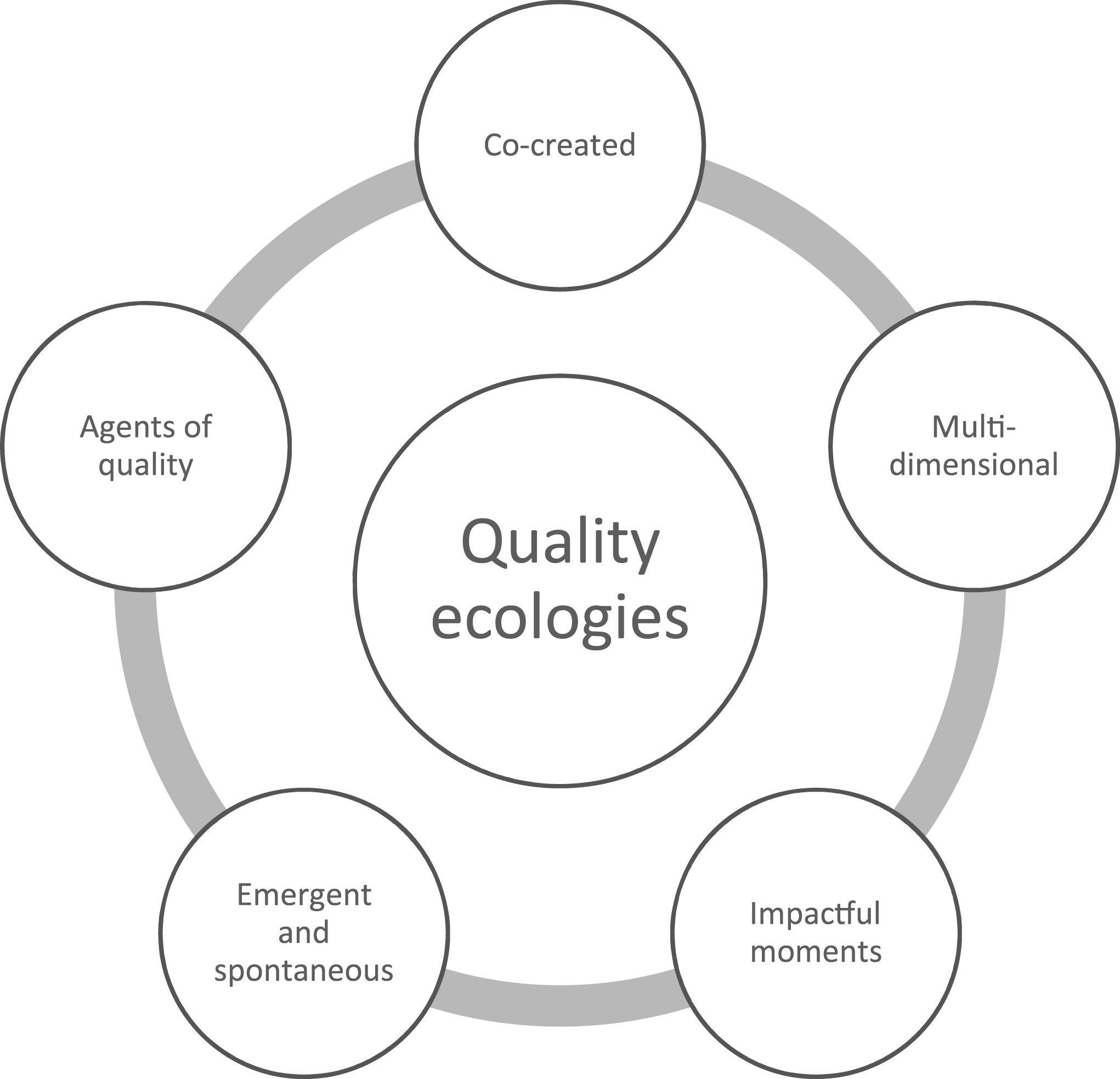
The quality ecologies research program
We will continue to develop and complexify this initial critical ecologies theory of quality via a research program that is part of the Early Childhood Professional Practice Partnerships program (funded by the Victoria Department of Education 2022–2024). The program is undertaken in conjunction with La Trobe University and industry partners and is designed to strengthen workforce retention and recruitment through providing high quality professional experience and building Higher Education partnerships with ‘Industry’. Educator and pre-service teacher participants in the program can elect to participate in the research, or not. The research question framing the study is: What constitutes quality in early childhood contexts for educators and pre-service teachers experiencing and co-creating quality in these settings?
The aim is to identify what educators and pre-service teachers perceive as their lived experiences and perspectives of quality as they undertake their daily work in early childhood settings. Through these perspectives, we hope to begin developing thick and wild (Harris & Rousell, 2022) insights into quality ecologies in EC settings, by drawing on lived experiences as rich, multi-perspectival realities (Miller et al., 2012).
There are two phases of data collection. Phase 1 involves digital data collection where participants (via a login) upload photos, audio, text, and/or video using a smart phone or tablet to a digital ethnography platform developed by sociologists. Participants self-elect to respond to digital provocations about dimensions of quality created by the authors that will appear on the digital platform three times per week for up to four weeks. Phase 2 involves focus groups with participants who elect to be involved, wherein insights from the Phase 1 data can be expanded upon through critical reflection.
From these data, we aim to distinguish agents, communities, systems and relationships in lived experiences of quality in settings across time and place, and how they sit without quality ecologies. We hope to identify critical junctures by which we refer to quality moments, or moments that linger, as described by participants, which we think that provide insight into the key principles of quality, such as: how the multi-dimensionality of quality is experienced; how participants co-create conditions for quality; how quality might be disrupted; how quality emerges spontaneously; how it is inspirational; how it is challenging; how it is routine; how it might be a confluence of ideas and circumstances that creates something different or new; how it might involve ethical dilemmas and decisions, and the understandings or deep learnings that moments of quality bring (or moments that linger).
In an attempt to capture thick and wild insights, a critical, digital short-term ethnography has been adopted as the methodology (see Grieshaber & Hunkin, 2023). The methodology has been developed in conjunction with the conceptual approach that is explained in this article, mainly because the research required a design that was not only critical in intent and perspective, but also capable of embracing the complexity of the ways in which the critical ecologies theory of quality is evolving and the job that we need it to do. In addition to enfolding the notions of process and structural quality, the methodology needs to be able to capture potentially unknown and uncharted dimensions of everyday life in ECEC settings that may not previously have been understood or conceptualized as quality. This stark fact was evident in the initial analysis of data that reflected predictable, time worn, and ‘standardised’ language that educators used to describe and record their experiences of quality (Grieshaber & Hunkin, 2023). We suspect that a silenced aspect of how educators understand and enact quality is as “embodied, sensory, and emplaced” (Pink & Morgan, 2013, p. 358). If this is the case, a critical, digital, short-term ethnography lends itself to such explorations.
The challenges of the methodological approach include first, our ability to encourage educators to reveal the ‘how’ and ‘when’ aspects of quality rather than the more well-known experiences (and language) associated with the ‘what’ of quality. Second, convincing educators that what they see and understand as quality is important, and that this need not necessarily coincide with the measures of process and structural quality that have dominated the sector for many years. We are expressing trust in educators and are keen for their perspectives about and experiences of quality, especially regarding the initial five points of interest within the broader ‘how of quality’ enquiry that we have outlined above. Third, we are encouraging educators to connect their feelings with moments of what they consider to be the how and when of quality, and to share these as part of data collection. However, we expect that this could be difficult as it is not something that has been associated with process and structural aspects of quality, and involves risk taking for some educators. We dare educators to ‘have a go’ at identifying their feelings when they are experiencing what they consider to be the how and when of quality, and to tell us about it. Fourth, we hope that this attempt to capture thick and wild insights will create “an embodied and emotional vocabulary of quality” that is a resource for the sector that can be used “to legitimate non-standardised expressions of quality” (Grieshaber & Hunkin, 2023). Liberating non-standardised expressions of quality is key to understanding and capturing the complexities that are ‘quality’ in ECEC.
Conclusion – what next?
In positivist approaches, process and structural aspects of quality provide indicators of how quality can be identified and as part of that, assessed. This suggests that if quality can be identified and assessed, it can be created intentionally. We propose that in addition to what might have been created intentionally based on process and structural aspects of quality, there is likely to be much more that may be unnoticed or seem invisible if the lenses of process and structural quality are the only perspectives used to determine what constitutes quality. There are aspects of quality that are intangible and able to avoid any possibility of capture by the tools currently used to try, and we hope that by adopting different perspectives we can reveal what may be hidden in plain sight, what may be waiting to be noticed, heard, smelled, touched, tasted, experienced, read, and more.
So far in this work-in-progress, we have identified five principles that we consider important in creating a theory of quality ecologies that can go some way toward accounting for the complex, multidimensional and contextual nature of what has been called quality in the ECEC literature. These include that quality can be co-created; that the well-known elements of process and structural quality can co-exist and be expanded, since quality is multi-dimensional; that moments can qualify as ‘quality’ and be impactful; that quality can be emergent and spontaneous, and that there are many agents of quality that may not be recognised in existing conceptualisations of quality.
Footnotes
Declaration of conflicting interests
The author(s) declared no potential conflicts of interest with respect to the research, authorship, and/or publication of this article.
Funding
The author(s) disclosed receipt of the following financial support for the research, authorship, and/or publication of this article: This work was supported by the Department of Education and Early Childhood Development, State Government of Victoria (Early Childhood Professional Practice Partnerships).
