



Abstract
This article discusses infant–toddler educators’ perspectives of using the Observe, Reflect, Improve Children’s Learning tool (ORICL) in practice. ORICL is a new tool informed by implementation science and co-designed with Australian early childhood education and care policy-makers, practitioners, and service providers. It aims to support infant–toddler educators to observe, reflect on, assess, and improve the quality of individual children’s learning experiences. Twenty-one educators working in Australian long day care and family day care services participated in the study, with a total of 66 ORICLs being completed for children ranging from 7 to 33 months of age. Educators also participated in an interview to share their experiences of using ORICL in practice. Findings show that ORICL enhanced educators’ understandings of infants’ and toddlers’ learning, development and wellbeing, and educators’ critical reflection. ORICL also helped educators to notice interactions, document and plan for children’s learning, and communicate children’s learning to others.
Introduction
By the age of 2 years, 59% of Australian children attend a centre-based long day care (LDC) or a home-based family day care (FDC) service for up to 30 hours per week; for some, this is combined with informal care arrangements; and, for many, this commences in infancy (Australian Bureau of Statistics [ABS], 2017). Despite overwhelming evidence that the first 1000 days of life is a critical period for children’s learning, development. and wellbeing (Centre for Community Child Health, 2018), that high-quality early childhood education and care (ECEC) is beneficial for language, cognitive, and social outcomes (Australian Institute of Health and Welfare, 2015), and that higher educator qualifications are correlated with improved child outcomes (Degotardi, 2010), infant–toddler educators in Australia only require a certificate-level qualification (Redman et al., 2021). Educators also report receiving insufficient training on the developmental and pedagogical needs of children from birth to two years (Chu, 2016) and having limited access to professional development to support their capacity to provide quality experiences for children from birth to two years (Egert et al., 2020). In Australia, infant–toddler educators are guided in their planning and programming by the Early Years Learning Framework (EYLF) (Australian Government Department of Education [AGDE], 2022) but report finding it difficult to locate their practice within the EYLF (Davis & Dunn, 2018). Consequently, infant–toddler educators in Australia do not have easy-access to age-related guidelines to support their teaching practice (Elwick & White, 2022), potentially resulting in 59% of our youngest citizens spending time in ECEC contexts that are less than optimal.
Evidence suggests (Dalli & White, 2016) that providing a high-quality infant–toddler program is multi-faceted and complex, requiring educators to (1) draw on specialist knowledge and skills of observing, reflecting on and interpreting very young children’s behaviour, communication, and interests; (2) effectively plan experiences to consolidate and extend infant–toddler learning; (3) facilitate infant–toddler exploration and engagement; and (4) maintain accurate documentation to track and communicate individual children’s learning progress with families and other stakeholders. Educators also need to embed a focus on each individual child, as well as on the group.
While there are resources currently available to support educators in their practice of observing and planning for very young children’s learning, such as developmental checklists (e.g. Bricker & Squires, 1999; Community Child Care Co-operative Ltd (NSW), 2015) and quality rating scales (e.g. Harms et al., 2006; Jamison et al., 2014; Siraj et al., 2015), there is no tool to address the interplay between areas of educators’ responsibility (observing, interpreting, planning, facilitating, and documenting) and to prompt critical reflection on pedagogical practice. Furthermore, existing tools that measure quality, such as the Classroom Assessment Scoring System (Pianta et al., 2008) and ECERS-E (Sylva et al., 2010), are largely designed to be completed by external assessors, require costly intensive training, and have limited involvement or input from the educators who work with and know the children best. These tools also emphasise the components that affect overall quality in the learning space, and thus wrongly assume that quality affects all children equally (Jeon et al., 2010). A new approach is needed: acknowledging that children’s experiences of quality are deeply personal and vary according to who is present on the day – both adults and peers – and the interactions that unfold between them. ORICL provides that approach. Unlike existing tools, ORICL focusses on the individual child within their ECEC context, as well as on the individual child with their peers and with their educators.
Designing ORICL: An Overview
ORICL was designed for the field, by the field, through our application of theory of change (Ghate, 2018) and Implementation Science (IS) (Redding, et al., 2017), and strategic alliances with industry stakeholders and end-users. IS refers to the study of the processes and conditions that promote or impede effective take up of evidence-based practices in real-world contexts. IS aims to address persistent problems with the enactment of evidence into practice in education, and in particular the rational-linear concept that assumes knowledge and evidence flows in a uni-dimensional progression from researchers to practitioners (Nutley et al., 2008). In contrast, IS views knowledge transfer as a co-designed, collaborative process. According to Metz et al. (2015), IS includes four overlapping stages and activities (see Figure 1): (I) Exploration of need with stakeholders, ensuring fit and feasibility; (II) Installation to test acceptability and ensure industry capacity and to build capacity for implementation; (III) Initial Implementation to initiate delivery, evaluate psychometric properties, and investigate implementation barriers and enablers; which together lead to (IV) Full Implementation to assess longitudinal uses and take up. Stage-based Principles of Implementation Science. Note. This figure was adapted from Metz et al., 2015. Example ORICL items.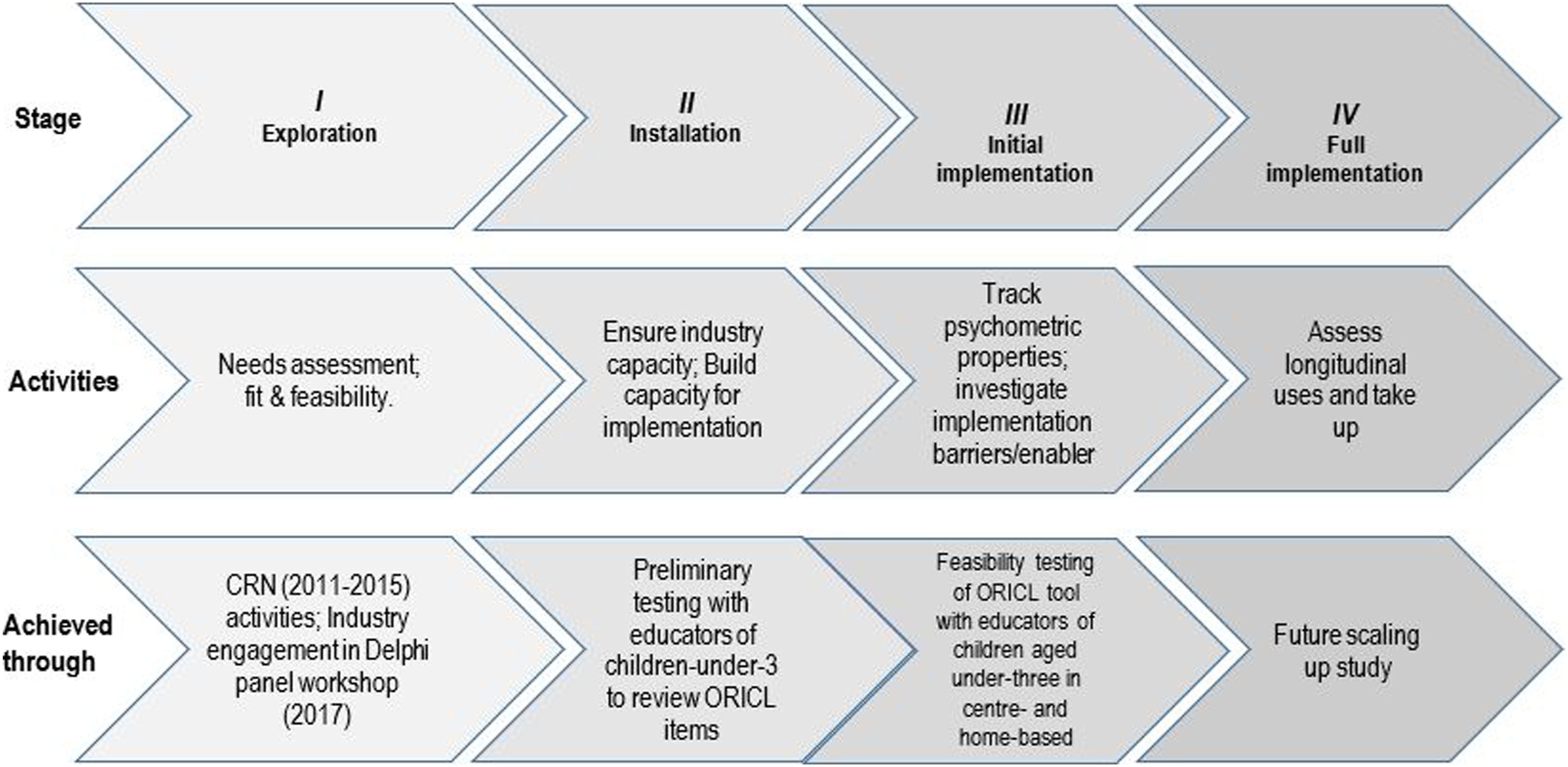
The third row of Figure 1 shows how each of the four stages was achieved in relation to ORICL: • Stage I: The first stage of ‘Exploration’ occurred through the research team’s engagement with other researchers undertaken within the Excellence in Research in Early Years Education Collaborative Research Network, an Australian Government-funded $5.4 million collaboration led by Charles Sturt University University with Queensland University of Technology and Monash University. The research team also engaged with key stakeholders in a 1-day planning workshop and follow-up Delphi process (Green, 2014) that included senior leaders in ECEC government departments from every state and territory, national peak bodies including advocacy groups and unions, and non-government organisations and providers of LDC and FDC services. Stage I resulted in the initial design of ORICL. • Stage II: The second stage – ‘Installation’ – involved the preliminary testing of the initial design of ORICL. This included a review of the stimulus items by the Delphi Panel via an online survey, resulting in 12 fully completed reviews.
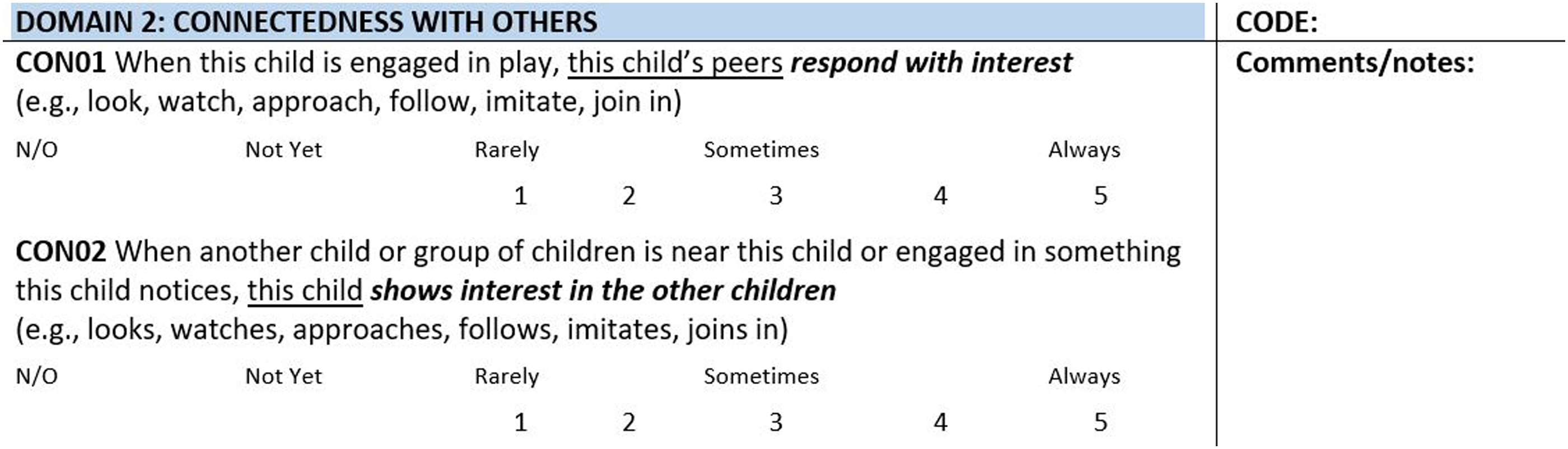
Based on Stages I and II, ORICL contains 118 stimulus items that are used by educators to observe a child’s interactions and experiences across six domains aligned with the EYLF (Australian Government Department of Employment Education and Workplace Relations, 2009) and the 2021–22 EYLF Update (AGDE, 2022): identity, emotional wellbeing, constructing knowledge, connectedness, physical wellbeing, and communication. This process generates a comprehensive record that is then used to guide educators’ reflections on the child’s learning, development, and wellbeing, and to inform collaborative planning and documentation. Within each domain, educators are asked to consider children’s experiences in terms of the following: • The child’s own • The • The • The
Each of the 118 stimulus items includes examples that support educators’ observations and a comments/notes column where educators can record comments whilst responding to each item (see Figure 2). The final section of ORICL asks educators to record the child’s demographic information (for further details on ORICL, see https://oricl.org/; Williams et al., under review and Harrison et al., under review). • Stage III: The third stage of ‘Initial Implementation’ was the feasibility testing of ORICL with educators in LDC and FDC services across four Australian states: Victoria (VIC), New South Wales (NSW), Queensland (QLD), and Western Australia (WA). Quantitative findings related to the degree to which educators used the full range of the rating scale, as well as the psychometric properties of ORICL, are reported elsewhere (Williams et al., under review). • Stage IV: The fourth stage of ‘Full Implementation’ will be enacted following completion of the associated Harrison et al., (2023–2025) Australian Research Council Linkage Project (LP210301171) that will identify implementation drivers for full implementation and scale up to population level for ORICL (such as educators’ perspectives about enablers and barriers to implementation of the tool).
In this paper, we report on Stage III findings from a feasibility study of ORICL. The study was guided by two research questions: 1. How meaningful and useful are the data collected by ORICL in terms of profiling infants’ and toddlers’ experiences in ECEC? 2. For what purposes is ORICL most useful in ECEC settings and what benefits or potential benefits of its use are reported?
Method
Ethical approval
Ethical approval was applied for and received from Charles Sturt University (H18082) and met the requirements of each jurisdiction and organisation. Participants were informed that participation in the study was voluntary and that they were free to withdraw at any time. No identifying information about participants is reported.
Participants, Consent, and Sample Size
Educator participants were recruited through organisations that participated in the co-design of ORICL (Stages I and II, outlined above) and through the researchers’ professional networks. Information about the project was provided to LDC Directors and home-based FDC Coordinators, and their consent for their services to participate in the project was obtained. Directors or Coordinators then invited eligible educators at the service (those working with children aged 6 weeks to 36 months) via a participant information letter that provided details about the voluntary nature of the project. Details of educators who expressed an interest were then forwarded to a member of the research team, who ensured participants’ informed consent. The participating educators then recruited children and families to participate. Eligible families for recruitment at each service were those with a child aged between 6 weeks and 36 months.
Twenty-one educators participated in the study, 20 of whom were involved in all aspects of data collection (outlined below). Fifteen educators were located in LDC: five in regional NSW, two in metropolitan NSW, five in metropolitan QLD, and three in metropolitan WA. Five educators were located in FDC: one educator was located in regional NSW, one in regional VIC, and three educators were located in metropolitan NSW.
All educators were female and aged 35–39 years (33%), 25–29 years (19%), or 40–44 years (14%). Thirty-eight percent of educators spoke a language other than English at home, and six educators reported using a language other than English at their workplace. All educators had worked in the profession for at least 3 years and had been employed at their current workplace for 6–10 years (33%), less than 1 year (24%), 1–2 years (19%), 3–5 years (14%), or for 11 or more years (10%). Most educators were employed full time (76%) with five (24%) employed part-time. The most common level of education was diploma (71%), followed by certificate (14%). On average, educators worked with 10 to 20 different children per week (38% of educators) or 21 to 30 children per week (24%).
ORICL Completion Process
Educators were asked to complete ORICL for each consented child during the course of their regular work, with the expectation that their response to each item would reflect the child’s ‘typical’ day in that setting. It was anticipated that ORICL would take approximately one hour per child to complete, and it was possible for educators to spread out its completion over a series of days or weeks, depending on the child’s attendance. In addition to completing ORICL for the child, educators were invited to record their experiences of using ORICL directly onto the tool.
Each educator used ORICL for one to seven children with an overall total of sixty-six children. ORICLs were completed for fifty-seven children attending the seven LDC centres, and nine children attending the five FDC homes (total n = 66). Children’s ages ranged from 7 to 33 months with a mean age of 20.7 months. There were 10 children aged 12 months and under, 35 children aged 13 to 24 months, and 21 children aged 25 to 33 months; 38 of the children (58%) were girls. There were no Aboriginal or Torres Strait Islander children, and two children spoke a non-English home language. Four children, all aged over 12 months, were described as having a disability or a developmental delay.
Data Collection Processes
After completing and returning the ORICLs to the research team, educators met with one of the researchers to complete a 15–20-minute telephone interview that consisted of 15 questions and was facilitated by an online survey proforma into which their responses were directly entered by the research team member. The interview questions were related to educators’ experiences of using ORICL in practice. After the interview, each educator completed a demographic survey where they provided information such as their qualifications, years of experience in ECEC, and years of experience working with children aged under three. Data for analysis included both the comments written by educators directly onto the ORICL and their interview responses.
Data Analysis
Three levels of analysis were applied to the interview data, with each level informed by the research questions (listed above). The method of collaborative analysis, which aims for greater complexity, critical reflection, and reliability than can be achieved by a single researcher analysing the data, informed the development of the analytical framework that is explained later (Cornish et al., 2014). Thematic analysis (Braun & Clarke, 2021) was also used to interpret the data once it was organised within the framework.
First-Level Analysis
First-level analysis involved two research team members working collaboratively to link each of the 15 interview questions with the research questions. This created a framework that was used to organise educators’ interview responses in relation to each research question. These two research team members then used the framework to individually analyse the first five interviews for possible themes, while keeping a record of reflective comments each. They then shared their analyses with each other with a view to confirming or contesting the framework’s usefulness. Following consensus, the agreed framework was used to analyse a further five educator interviews (a total of 10 interviews). The results were then discussed at a whole team meeting. This led to some realignment of the interview questions with the research questions and a decision to include another research team member in second-level analysis.
Second-Level Analysis
Second-level analysis involved three research team members working individually to use the agreed framework to re-analyse the 10 interviews that were analysed in first-level analysis. This resulted in 16 themes that showed a high level of congruence across the three sets of analysis. Given this congruence, it was decided that these themes would be used by one team member to analyse the remaining 10 interviews. This approach led to some refining of the themes to minimise duplication and to record emerging themes. Illustrative quotes were also included, along with a numeric ‘count’ that recorded how many times each educator said something related to each theme. The final step of second-level analysis was the inclusion of educators’ identification numbers and demographic details alongside each quote/count. This enabled further interrogation of the data according to certain categories of educator, such as LDC or FDC, qualification, and years of experience.
Third-Level Analysis
During third-level analysis, the comments that educators had written directly onto the ORICL were analysed to further contextualise second-level analysis.
Findings
Five key themes were identified. The ORICL: 1. contributed to educators’ understanding of infants’ and toddlers’ learning, development, and wellbeing; 2. contributed to educators’ critical reflection; 3. helped educators to notice interactions; 4. influenced documentation and planning; and 5. helped educators communicate their practices.
Using ORICL Contributed to Educators’ Understanding of Infants’ and Toddlers’ Learning, Development, and Wellbeing
Many educators reported that using ORICL contributed to their understanding of infants’ and toddlers’ learning, development, and wellbeing. Notably, this was the case for educators with varying qualifications, years of experience, and service locations. For example, one QLD educator with a certificate-level qualification and 3–5-years’ experience commented that completing ORICL ‘made me think more in depth about the children and different areas of development’. Another educator, also from QLD but with a diploma-level qualification and 11-to 15-years’ experience, felt that ‘when completing ORICL you are really thinking about the child’s emotional and social wellbeing and skills and abilities – it prompts you to think about how to support development’. Similarly, one educator from NSW with 16- to 20-years’ experience noted how ORICL helped them to ‘see where the child was at with their development’. Notably, this same educator reported finding this empowering as it also confirmed that they did ‘know the children well and where they are at’.
Other educators explained how using ORICL helped them to focus more closely on individual children and consequently get to know the children better. As one FDC educator stated, it ‘seems to be a great tool and I would use it to help me focus more on the children’. This comment was echoed by an NSW LDC educator with 20+ years’ experience who thought that ORICL provided ‘a detailed and clear picture of the child and what the child is like’. For some educators, this capacity of ORICL to provide a ‘clear and detailed picture’ enabled them to ‘get to know those children that [they] used the ORICL for a lot more’. On one occasion, it also enabled an educator to ‘learn different things about the child that wouldn’t have been observed normally, especially educator-child interactions’.
Educators with English as their second language made similar comments and emphasised how using ORICL helped them to ‘see’ things they had not noticed before. For example, one educator stated: I never thought about some areas in this way – different perspective of looking at things… The way we take documentation is focused on the child what they are doing and learning – the tool seemed more about emotional wellbeing. Some things were happening in front of my eyes that I didn’t notice.
Another educator echoed this statement by suggesting that this new way of seeing infants and toddlers enabled them to ‘understand differently what [they] were observing and how [they] should respond differently’. Others suggested that it helped them to find ‘out a lot of things that [they] didn’t know’, including that ‘Other children in the room [knew] about the child’s belongings…as [they] hadn’t thought of that and how children are in tune’.
There were also strong feelings that using ORICL enabled a more holistic understanding of infants’ and toddlers’ learning and development; and, that it had potential to make that learning and development visible over time. For one educator, this holistic understanding promoted ‘deeper observations that lead to quality experiences for the child’. For another, it helped them to ‘see the whole child and what they are capable of in each area of development’. Along similar lines, one NSW LDC educator with a diploma and 20+ years’ experience explained how they would use ORICL to generate a holistic view of the child that included an ‘overall picture of other children’s and educators’ contributions to the child’s learning and development’. They would then use this ‘over time to see progression like summary assessments, instead of summary assessments every three months’.
Using ORICL Contributed to Educators’ Critical Reflection
On Infants’ and Toddlers’ Learning
Not only did ORICL contribute to educators’ understanding of infants’ and toddlers’ learning, development, and wellbeing but it also enhanced their skills in critical reflection on infants’ and toddlers’ learning. This was the case even for educators with many years of experience. For example, one educator with 20+ years’ experience noted how they had to ‘really think to answer the questions and to recall what [they] had observed, and a lot of things came up that [they] hadn’t thought of or thought was a part of development’. Another educator with 6–10 years’ experience stated that ‘the rating scale made it easier to answer the questions – sometimes I couldn’t answer straight away so I had to reflect on what I had observed the child doing’.
ORICL also prompted educators to reflect on their own perspectives of particular children. For example, one FDC educator with 6–10 years’ experience noted how they became: more accepting and understanding of some behaviours. One child was dropping his playdough on the floor and I told him not to do it but then I realised he was using his shoe to make a print on the playdough. I thought of the ORICL and realised the child is exploring.
Likewise, an LDC educator noted how using ORICL helped them revise their perspective on an ‘emotional child who was impossible to get to sleep’. Instead of persisting with trying to ‘get’ this child ‘to sleep’, this educator reflected on the possibility that ‘maybe she doesn’t need sleep – let her play and when she comes to us for cuddles – change the timing based on the cues from the child’. This enhanced awareness towards noticing children’s cues was apparent across the data, with common responses including that educators were ‘more into looking’ and ‘more looking for cues’. Others commented how using ORICL ‘changed the way I look at the child’ and brought about the realisation that they should not ‘limit what [they] can expect of children’.
On Their Own Practice
Notably, ORICL’s capacity to enhance educators’ skills in critical reflection inspired many educators – from LDC and FDC settings – to think critically about their own practices. In LDC settings, educators reported liking that ORICL was ‘a lot about the educators’. It made them think more about their practices and what they were doing. For one LDC educator with 20+ years’ experience, using ORICL ‘reinforced in many ways what [they were] already doing, but also made [them] think about how to improve’. For some educators, thinking about how to improve resulted in changes to their practice. For example, one LDC educator with 11–15 years’ experience reported using ORICL to: …identify areas of strength and areas for improvement…one thing I am doing more is watching the children interacting together and sitting back a bit more rather than getting involved too quickly.
In FDC settings, educators reported finding ORICL ‘inspirational’ and a ‘good tool to help us think about practice’. One educator with 16–20 years’ experience found the section where they could write their own comments particularly helpful: At the end of each [question] I commented it is not possible to answer 'Always' for the educator questions because there are times when I am not present with the children – in this sense the tool prompted self-reflection on how I can do things better at those times when I get called away – when I have to attend to other things that take my attention away from some children to attend to a nappy change etc.
Similar to educators located in LDC settings, some FDC educators found that using ORICL led to changes in practice. For example, one educator with 6–10 years’ experience reported using ORICL ‘to develop [their] skills and grow and challenge [themselves]’.
Using ORICL Helped Educators to Notice Interactions
ORICL also supported educators to see interactions occurring within their room, including interactions between different aged children. For example, one LDC educator with 6–10 years’ experience commented that using ORICL alerted them to the interactions happening ‘between younger ones and older children’; and, to reflect on the nature of the interactions. For instance, when using ORICL to observe one young boy, they noticed that ‘the current peers in his group are older (about 1.5 years) and they are girls, so they see him as “baby A” and help him and play with him’. Educators from other services made similar comments, including that previously un-observed interactions between older and younger children seemed to provide opportunities for the younger child to ‘take risks when following other children’s lead’ and that ‘older children occasionally become frustrated with the younger child interfering in their play’.
Educators also reported paying more attention to, and critically reflecting on, their own and other educators’ interactions with individual children. One LDC educator with 16–20 years’ experience reported using ORICL to ‘look at it from the perspective of the room and all educators and how we interact with the children’. The ORICL tool did not require educators to report the outcomes of this reflection. Nevertheless, some educators reported noticing that they ‘could do more to involve’ children in play; and that ‘sometimes time doesn’t allow’ educators to be responsive to children’s communications of their feelings and/or need for assistance.
ORICL Influenced Documentation and Planning
Importantly, many educators reported that using ORICL had honed their documentation of individual children’s learning. One LDC educator, with over 20 years’ experience, thought that this might be because ORICL ‘made you aware of what is possible because of the examples provided – they trigger scenarios to look for’. Another educator with 6–10 years’ experience, who worked in an FDC environment, thought it was because ORICL had helped them to ‘notice more and pay more attention’ to individual children’s experiences within their home. This finding was reinforced by other educators, from both LDC and FDC settings, who felt that ORICL ‘gives you a focus’ and was more time-efficient than documenting lengthy observations.
Some educators also reported that ORICL provided a common language that improved the quality of their written observations. For example, one NSW FDC educator who had English as their second language stated: I love writing and I write a lot in my observations and the ORICL gave me key words and phrases to use so that I could write more clearly. As an ESL speaker this really helped me … We work solo but I send my observations to my coordinator and get feedback and at the end of the year when I was using the ORICL, she was so happy that she printed them and emailed to say how good they were…she is going to use them as an example of good documentation.
Educators also felt that this enhanced documentation of individual children’s experiences contributed positively to their planning for children’s learning. This was the case for both LDC and FDC educators with varying qualifications and years of experience, and for educators with English as a second language. For example, one LDC educator with over 20 years’ experience and a diploma-level qualification reported that using ORICL ‘makes you more aware of what children are doing and you can plan more for the children’. Similarly, another LDC educator with 6–10 years’ experience reported that their use of ORICL had helped them ‘tune into children’s experiences’ and, consequently, improve their planning and presentation of learning opportunities. Another educator with 3–5 years’ experience and a certificate-level qualification reported that when they used ORICL they spoke with other educators during programming time, and those conversations ‘fed into their planning’; with the outcome being that it resulted in ‘better planning and implementation of experiences’.
ORICL Helped Educators Communicate Their Practices
With Other Educators
Many educators stated that ORICL helped them communicate their practices to other educators, especially LDC educators who regularly work in a team environment. This communication often occurred when educators spoke with one another while completing ORICL, and later when they re-visited those conversations during lunchtime breaks. For many educators, the conversations focussed on utilitarian matters such as how best to use the rating scale. Nevertheless, these conversations prompted educators ‘to think a lot’ and to ‘reflect on whether other educators knew about what was being noticed’. Other educators reported ‘constantly talking with other educators about the questions’, with one educator calling ORICL a ‘conversation sparker’. For some, the conversations that were sparked were considered beneficial for seeing ‘other opinions’ and for working collaboratively with other educators to develop responses for individual children. One educator felt that the conversations would increase when ORICL was used with more children.
With Families
Educators also reported that ORICL supported their communication with families; and particularly liked that it ‘is strengths-based, nothing negative’. One educator found this strengths-based content particularly helpful for starting and continuing difficult conversations with families regarding early intervention. Other educators commented that ORICL revealed ‘new things’ and ‘raised questions’ that they then discussed with families. For example, one QLD-based LDC educator reported that ‘ORICL brought up questions about the child’s development…especially social and emotional wellbeing’. Another LDC educator spoke about how they ‘send home a magic moment each day’ and how ORICL had ‘revealed a few magic moments that they could share with parents’. For some educators, the conversations promoted with families through using ORICL had potential to involve families in the program by gaining their ‘feedback on what they had observed at home’.
The potential of ORICL to promote two-way conversations between educators and families is strengthened by educator feedback about family interest in the tool. For example, several educators from both LDC and FDC settings reported that families were keen to know more about ORICL and how it was being used. One FDC educator located in NSW reported that the parents were ‘very interested in what I was doing…and I was sharing it with them’. Likewise, one LDC educator located in QLD reported that ‘parents wanted to see what we were covering with the ORICL tool – they asked what feedback we could give them’. This was also the case in WA LDC, with one educator reporting that ‘parents were asking about the ORICL’.
Challenges
Despite these very promising findings, a few challenges were also identified. In particular, some educators were initially unclear about the purpose of ORICL, including a misunderstanding that it was a ‘checklist’. However, as they became more familiar with the tool, these uncertainties and misunderstandings were clarified. Some educators reported that it was difficult to find time to complete ORICL, while others provided some suggestions for managing the time to complete ORICL, such as completing it over several months. Further, some educators, and especially those who had English as a second language, expressed some difficulty in understanding some items on ORICL. Providing clear and specific examples within ORICL to assist meaning could assist in this regard.
Discussion
This paper reported on Stage III findings from a feasibility study of the ORICL tool, a tool for infant–toddler educators contextualising children’s experiences of quality that are deeply personal and vary according to adults and peers around them, and the interactions that unfold. The study aimed to address, first, how meaningful and useful are the data collected by ORICL in terms of profiling infants’ and toddlers’ experiences in ECEC; and second, discover the purposes for which the educators found ORICL was most useful in ECEC settings and the benefits or potential benefits of its use they saw.
In relation to the first research question, findings indicate that the data collected by ORICL is perceived by educators as meaningful and useful in terms of profiling infants’ and toddlers’ experiences of ECEC settings. Notably, educators with varying qualifications and years of experience reported that the information generated by ORICL enhanced their understandings of individual children’s learning, development, and wellbeing. ORICL also heightened awareness of individual children’s cues, the interactions occurring between individual children within the setting, and between individual children and educators. Importantly, these findings were reinforced by educators with English as their second language who reported that the data collected by ORICL helped them to notice things about individual children that they had not previously noticed.
In relation to the second research question, findings indicate that despite some initial challenges, educators found that using ORICL increased their ability to observe and document children’s learning, enabled a more holistic understanding of the children in their care, helped them to focus on and reflect critically on their own practices, promoted professional conversations with colleagues, and supported communication with families. By helping educators to ‘see’ things they hadn’t noticed before, using ORICL also enhanced individually targeted educational planning.
These results are encouraging when considered in light of the literature reported on earlier. What overwhelmingly stood out across that literature was educators’ sense of being underprepared for providing high-quality care and education for infants and toddlers (e.g. Chu, 2016; Davis & Dunn, 2018; Egert et al., 2020; Elwick & White, 2022). This sense of unpreparedness is concerning given Dalli and White’s (2016) emphasis on the multi-faceted, complex, specialist knowledge required to implement a high-quality learning and teaching program with infants and toddlers. As such, a key challenge is to provide infant–toddler educators with opportunities to develop specialist knowledge and skills, including skills of observing and reflecting upon the context within which individual children are learning and developing. This study’s findings indicate that ORICL has the potential to meet this challenge and, subsequently, to stimulate enhanced care and education for our youngest citizens.
Through our application of the theory of change (Ghate, 2018) and IS (Redding et al., 2017), along with strategic alliances with industry stakeholders and end-users, this study has also demonstrated the feasibility of ORICL and the success of the co-design process. Our findings indicate that the collaborative process of co-design (Metz et al., 2015) was effective in creating a tool that addresses a gap in infant–toddler pedagogy and practice. Although more research is needed to investigate how ORICL can be implemented on a larger scale (Stage IV), the results from this study support the use of a co-design process, particularly in creating a resource designed for the field by the field.
Limitations
One limitation of the study is the fairly small sample size. Further, there are some questions related to the clarity of purpose of ORICL, the time taken to complete the tool, and its clarity – especially for those with English as a second language. Thus, in the ‘scaling up’ stage of the implementation some amendments are required, in particular when introducing the tool to educators; and provision of examples. Further, on-going evaluation is required to ensure social validity and acceptability of ORICL to Australian educators.
Conclusion
A gap exists in Australia as well as other countries for tools that support infant–toddler educators in their teaching practice (Chu, 2016; Redman et al., 2021). Based on the stages of IS, ORICL was co-designed as a tool to support educators’ practice with infants and toddlers. This feasibility study was an important stage in the IS process and has demonstrated the promise of ORICL for supporting educators’ observations of, and enhancing their understandings about, infants’ and toddlers’ learning, development, and wellbeing. It has also demonstrated the potential of ORICL for deepening educators’ critical reflection and for helping educators to notice interactions within their setting, to document and plan for children’s learning, and to communicate children’s learning to others.
Footnotes
Declaration of Conflicting Interests
The author(s) declared no potential conflicts of interest with respect to the research, authorship, and/or publication of this article.
Funding
The author(s) received no financial support for the research, authorship, and/or publication of this article.
