



Abstract
This study aimed to examine associations between gross motor skills and executive functions (EF) in a large sample of Australian preschool-aged children. Of 566 children (mean age = 3.2 ± 0.4 years, 51.2% girls), locomotor, object control, and total skill competence were significantly associated with visual spatial working memory and inhibition (p < 0.05). Total skill competence was associated with shifting and locomotor skills were significantly associated with self-regulation (p < 0.05). Static balance was significantly associated with inhibition and shifting (p < 0.05). In boys, an association between object control skills and visual spatial working memory was observed. In girls, an association between static balance and visual spatial working memory, phonological working memory, and shifting was observed. The identification of significant associations between gross motor skills and different EFs is an important contribution to the growing evidence on the relationship between motor skills and EFs in early childhood.
Introduction
As children transition from preschool to primary school, the ability to sustain their focus towards learning, adhere to classroom rules, cooperate with peers, and become increasingly self-directed is important. These skills are a part of self-regulation, enabled by executive functions (Hofmann et al., 2012). EF are core cognitive capacities for maintaining and working with information, resisting distractions and contrary impulses, and flexibly shifting attention towards goal-relevant tasks. There is evidence that early self-regulation and EF predict social, health, financial, and behavioral outcomes into adolescence and adulthood (Howard & Williams, 2018; McClelland et al., 2014; Robson et al., 2020). Considered alongside longitudinal evidence that early growth in these abilities is associated with improved outcomes in later life (Moffitt et al., 2011), there is considerable interest in early self-regulation and EF intervention as a means to improve population outcomes. Yet the success of approaches to foster these abilities has been modest.
Successful improvement in self-regulation and/or EF has often been short-term and only for practiced abilities, with limited transfer to untrained abilities or long-term maintenance (Karch et al., 2013; Melby-Lervag & Hume, 2013Melby-Lervag & Hulme, 2013). It has been suggested that this is due to an insufficient understanding of the dynamic interactions between developmental factors during this period of rapid change. A case in point is physical approaches to fostering EF. Some studies have shown physical activity can influence EF (Best, 2010; Lubans et al., 2016), however, there might be better results when physical activity is accompanied by cognitive challenges such as thought, planning and/or inhibitory control, and it involves more complex movement sequences (Mavilidi et al., 2015, 2018). The basis of complex movement sequences lies in the development of gross motor skills (e.g., such as jumping, running kicking, catching, and balance skills). A relationship between gross motor skills and cognitive skills can be explained by the co-activation of the prefrontal cortex and the cerebellum during motor and cognitive tasks (Diamond, 2000). Additionally, the inter-connectedness of motor and cognitive development has underpinned fundamental theories in child development. According to Piaget’s “Cognitive Development Theory” (Piaget & Cook, 1952), actions created by the body enhance cognitive processes. The “Dynamic Systems Theory” (Thelen & Smith, 1994) proposes movement is the result of the interaction between sub-systems such as the cognitive, neurological, muscular, and skeletal. And the “Ecological Perspective” (Gibson, 1979) links cognitive and motor processes by proposing that infants act on information they perceive from the environment.
A systematic review found weak-to-strong evidence for the relationship between motor skills and cognitive skills in children aged 4–16 years (van der Fels et al., 2015). These correlations were mostly found for subcategories of gross motor and cognitive skills. It was recommended that future research examine correlations between different subcategories of motor and cognitive skills as well as examining specific age categories as most included studies were conducted using a wider age range of children. Additionally, most studies were conducted in children above the age of 5 years.
Despite the early years being a critical time for the development of both gross motor skills (Payne & Isaacs, 2016) and EFs (Howard et al., 2015; Shonkoff & Phillips, 2000), the relationship between gross motor skills and EFs and self-regulation in young children is an area that is underexplored. Few studies have examined the relationship between gross motor skills and EFs in preschool-aged children (ages 3–5 years) (Cook et al., 2019; Houwen et al., 2017). Results of these studies are inconsistent. Cook et al. (2019) reported a significant association between gross motor skills and EFs inhibition and working memory, while Houwen et al. (2017) only reported this association for working memory. This inconsistency may be explained by recruitment from different settings (countries and regions: urban vs. rural), the small sample sizes (both <160 participants), including both typically developing participants as well as those at risk of motor coordination difficulties, and using different measurement instruments (objective measures vs. parental proxy-report) (Cook et al., 2019; Houwen et al., 2017). Although there is evidence for a relationship between visual-motor skills and self-regulation (Becker et al., 2014; MacDonald et al., 2016), no studies have examined the association between gross motor skills and self-regulation.
Research is needed to understand the relationships between gross motor skills and EFs and self-regulation in preschool-aged children to inform intervention and education design. As sex differences have been observed in gross motor skills (Barnett et al., 2016; Veldman et al., 2018), it would be valuable to investigate whether the association between gross motor skills and EFs and self-regulation differs between boys and girls. Thus, this study aimed to build on the existing evidence base by firstly examining the associations between gross motor skills (locomotor skills, object control skills, and balance) and EFs (working memory, inhibition, and shifting) as well as self-regulation in a large sample of Australian preschool-aged children. Secondly, this study examined if these associations differed between boys and girls.
Methods
This study used the baseline data collected for the Jump Start study (Stanley et al., 2016). Jump Start was a two-arm, parallel group, 18-month randomized controlled trial aimed at increasing physical activity in preschool-aged children while attending ECEC services. The study was conducted across the state of New South Wales, Australia. Services randomized to the intervention arm participated in Jump Start, a multicomponent comprehensive physical activity program. Services randomized to the control arm maintained their usual practice, which provided access to a state-wide Government funded program known as Munch & Move. Munch & Move promotes healthy eating and physical activity in ECEC services, and includes several resources and online professional development (Hardy et al., 2010; NSW Ministry of Health, 2018). The study was registered with the Australian New Zealand Clinical Trials Registry (ACTRN12614000597695) and approved by the University of Wollongong Human Research Ethics Committee (HE14/137).
Participants
In total, 43 ECEC services were recruited into the Jump Start study: 22 services were randomized into the intervention arm and 21 services were randomized into the control arm. Children 3 years of age at the start of the intervention and who attended the ECEC service at least 2 days a week were invited to participate. Parents provided informed written consent and children provided verbal assent. Baseline data collection was conducted between February and June 2015. Detailed information on recruitment and data collection procedures for Jump Start can be found elsewhere (Stanley et al., 2016), as well as the outcomes for the 6-month data collection time point (Okely et al., 2020). Although the sample was large, it was not representative of Australia as the early childhood education and care centers recruited for Jump Start were intentionally recruited from areas of disadvantage and as such had a higher proportion of vulnerable children.
Gross motor skills
Gross motor skills were assessed using the Test of Gross Motor Development—2nd edition (TGMD-2) (Ulrich, 2000) and Get Skilled: Get Active (GSGA) (NSW Department of Education and Training, 2000). Both tests are process-oriented, meaning assessment is based on the qualitative execution of the skills rather than the outcome.
The TGMD-2 assesses 12 skills divided into two subtests: six locomotor skills (run, gallop, hop, leap, horizontal jump, slide) and six object control skills (strike a stationary ball, stationary dribble or bounce, kick, catch, overhand throw, underhand roll). The test is reliable and valid in children aged three through 10 years (Ulrich, 2000). Each skill was assessed on three to five specific performance criteria. Trained data collectors demonstrated each skill and after a practice trial, the child was asked to perform the skill twice to the best of their ability. Performances were video captured after which a blinded trained researcher scored all videos according to the performance criteria. The child received a score of “1” if they correctly executed the performance criteria and a score of “0” if the performance criteria were not executed correctly. The total raw score was calculated as well as the raw score per subtest. For each subtests the maximum raw score is 48 points. Raw scores were converted into standard scores per subtest (range 1–20) as well as the gross motor quotient (total skill competence; range 55–150). These standardized outcomes were used for data analysis.
The GSGA tool was used to assess static balance (NSW Department of Education and Training, 2000). Static balance was assessed on five performance criteria and similar to the TGMD-2, after demonstration, the child was asked to perform the skill twice to the best of their ability. Performances were video captured after which a blinded trained researcher scored all videos according to the performance criteria. The child received a score of “1” if they correctly executed the performance criteria and a score of “0” if the performance criteria were not executed correctly.
Executive function and self-regulation
EFs and self-regulation were assessed using the Early Years Toolbox (Howard & Melhuish, 2017) and the “Head, Toes, Knees, Shoulders” (HTKS) assessment (Ponitz et al., 2009).
The Early Years Toolbox (http://www.eytoolbox.com.au/) consists of iPad-based assessments that assess different aspects of EFs: inhibition (Go/No-Go), shifting (Card Sorting), visual-spatial working memory (Mr Ant), and phonological working memory (Not This). The toolbox has been validated for children aged three to 6 years and demonstrates good convergent validity with existing measures of EFs such as the NIH Toolbox (inhibition, r (80) = 0.40, p < 0.001, shifting, r (80) = 0.45, p < 0.001, visual-spatial working memory, r (79) = 0.46, p < 0.001 and phonological working memory, r (79) = 0.42, p < 0.001) (Howard & Melhuish, 2017). All assessments have built-in audio with instructions and practice embedded in the application. Trained data collectors ensured children understood the instructions, remained on-task, and clarified instructions where needed. The assessments were administered individually in a private area and each assessment lasted between five and 8 minutes.
The Go/No-Go task evaluated the ability of children to inhibit behavioral reactions in response to the “no-go” stimulus which was less frequently evaluated. During the task, children were asked to “catch the fish” by tapping on the screen when they appeared (“go” response) and “avoid the sharks” by not pressing anything when the sharks appear (“no-go” response). The task consisted of three mixed blocks of 25 stimuli, each consisting of 80% “go” trials. A stimulus was presented for 1.50 s on the screen followed by a 1.00 s inter-stimulus interval before the next stimulus. The inhibition task was scored according to the product of proportional go and no-go accuracy.
The Card Sorting task evaluated a child’s ability to disengage and re-direct attention (cognitive flexibility). During this task, children were presented with stimuli that varied in shape and color (red rabbit and a blue boat), one at a time. Children were asked to sort the shapes into castles that were denoted by a blue rabbit and red boat. They were first asked to sort the shapes by one dimension (color; six trials), known as the pre-switch phase, and then by another dimension (shape; six trials), known as the post-switch phase. After successful completion of at least five pre-switch and post-switch trials, the next step was a border version of the task (the border phase). In this phase children had to flexibly switch between the sorting dimensions depending on the presence or absence of a border around the stimulus. At the start of each phase, there was a demonstration and two practice trials. Additionally, instructions were repeated at every trial. Scores were given for every correct trial once the initial switch was made.
The Mr. Ant task evaluated visual-spatial working memory, which is defined as the amount of visual information that can be activated in the mind concurrently. The task assessed visual-spatial working memory by asking children to remember the spatial location of stickers on a cartoon ant. During this task, children were presented with an image of a cartoon ant, which had colored stickers on different spatial locations of his body for 5 seconds. Following a blank screen for 4 seconds, Mr. Ant reappeared without any colored stickers, children were asked to reapply the stickers by tapping on the recalled locations. The number of stickers increased with increasing level of difficulty, starting with one sticker and reaching a maximum of eight stickers. Per level, the child had three trials. The task finished when a child was not able to perform one of the three trials correctly. The task was scored on successful completion of each successive level, with at least two trials correct receiving 1 point, and all correct trials thereafter receiving 1/3 of a point.
The Not This task evaluated a child’s ability to carry out auditory instructions with increasing difficulty. During the task, children were asked to identify characters that did not match the phonological description regarding a particular color, shape, size, or combination of these. The amount of stimulus features that needed be activated in mind increased with every level, and every level contained five trials. In level 1, for example, children were asked to find shapes that were not green, whereas in level 4 children were asked to find shapes that were not red, not blue, not a circle, and not big. After the auditory instruction, played against a white screen, a 3-second white screen delay was followed by a 4 × 5 array of different colored and sized shapes with cartoon faces. This screen was displayed until the child tapped on one of the characters. The task finished when a child was not able to complete at least three of the five trials within a level. The task was scored with each successive level with at least three of the five trials correct receiving 1 point, and all correct trials thereafter receiving 1/5 of a point.
The HTKS assessment evaluated a child’s behavioral self-regulation and required skills such as listening and remembering instructions, initiating and stopping actions, and sustaining attention (Ponitz et al., 2009). The HTKS assessment has demonstrated to be a valid measure of cognitive flexibility, working memory, and inhibitory control, and predictor of academic outcomes (McClelland et al., 2014). The assessment consisted of a structured observation during which children were required to perform the opposite of a dominant response to different oral commands (head, toes, knees, shoulders). Trained data collectors administered the assessment individually in a quiet space. The assessment started with a demonstration of the oral commands and asking children to copy the command. For example, “First, I want you to copy what I do. Touch your head.” Following practicing commands, children were asked to “Do the opposite of what I say” (head vs. toes, knees vs. shoulders). During the first assessment phase, the data collector gave 10 commands (head or toes) which were each scored a “2” when the child performed the command correctly (opposite), a “1” when the child self-corrected, or a “0” when the child did not perform the command correctly (not the opposite). The overall score for the assessment ranged between 0 and 60.
Demographics
Data on the children’s date of birth and sex were collected via the consent form. The date of birth was used to calculate the child’s age at the time of baseline data collection.
Data analysis
SPSS version 21 (IBM Corp, Armonk, NY, USA) and STATA version 13 (StataCorp, College Station, TX, USA) were used to conduct statistical analysis. Descriptive statistics were completed in SPSS. Associations between gross motor skills and EFs and self-regulation were examined using linear regression procedures in STATA accounting for clustering of ECEC services (unit of recruitment). Regression models were adjusted for sex and age. The significance level was set at p < 0.05.
Results
Sample Characteristics.
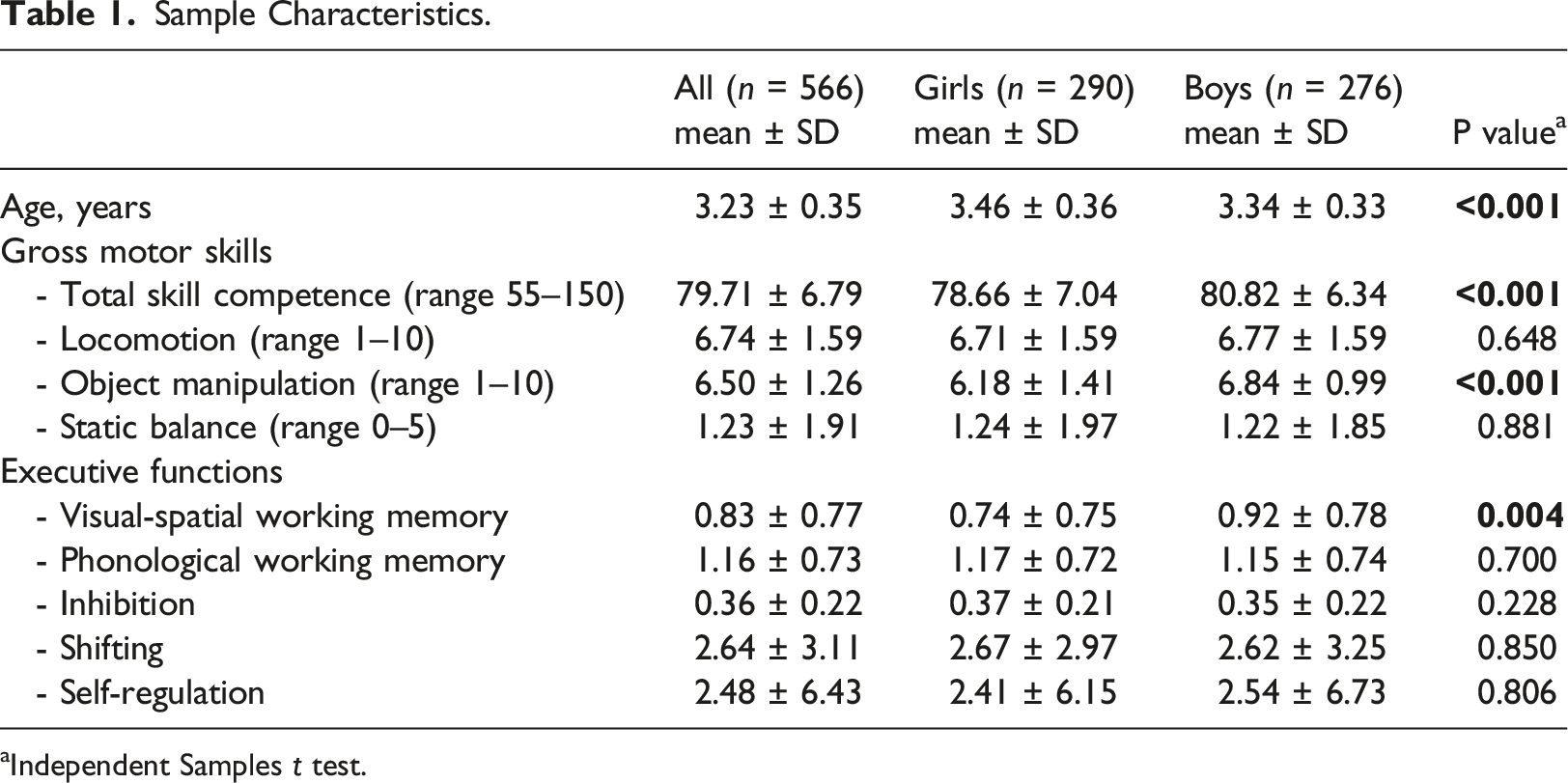
aIndependent Samples t test.
Associations Between Gross Motor Skills and Executive Functions.
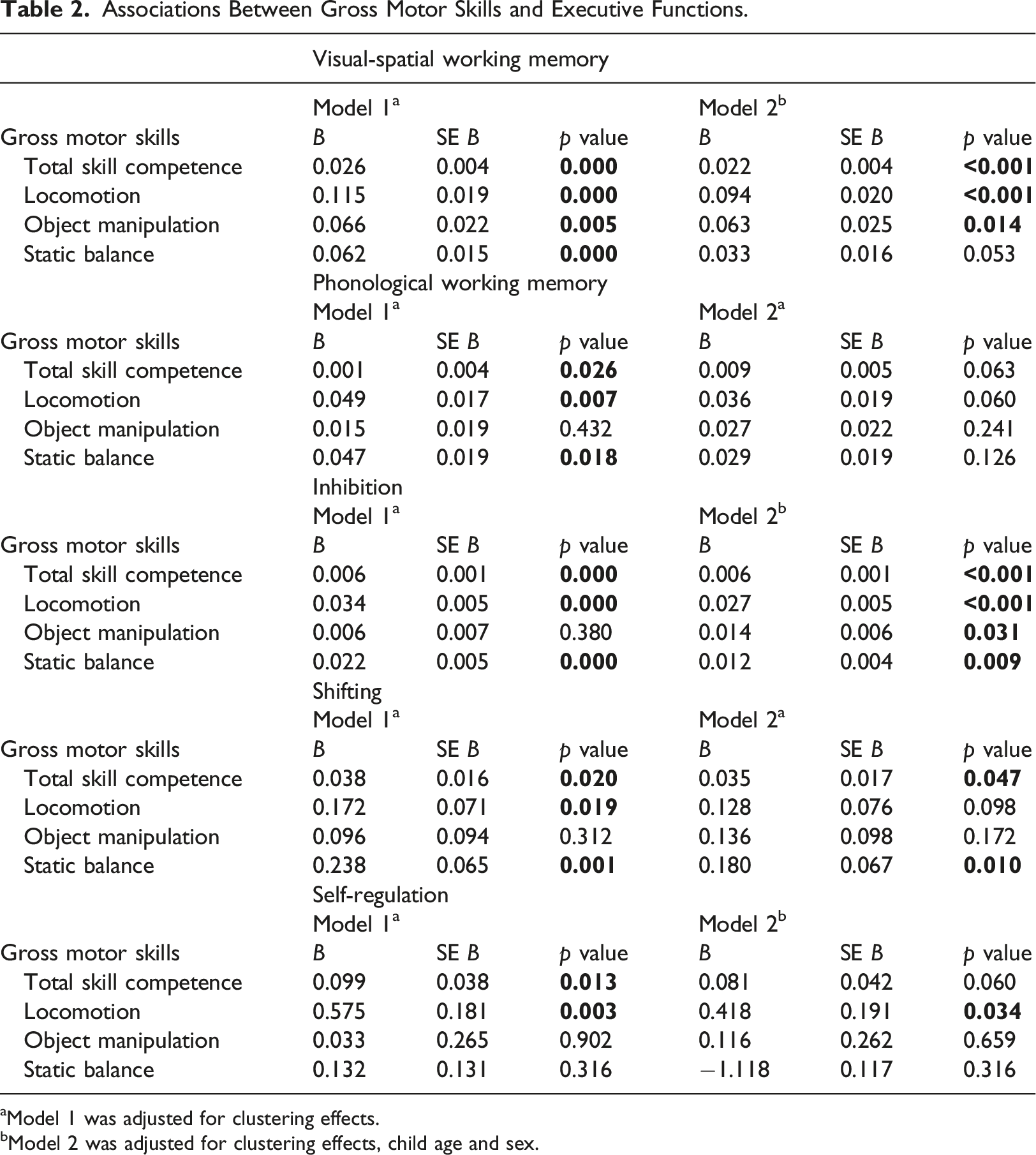
aModel 1 was adjusted for clustering effects.
bModel 2 was adjusted for clustering effects, child age and sex.
When examining sex differences, several associations were found for either boys or girls (see Supplementary Table 1). An association between object control skills and visual spatial working memory was only observed in boys. An association between static balance and visual spatial working memory, phonological working memory, and shifting was only observed in girls.
Discussion
This study reports on the association between gross motor skills and EFs and self-regulation in preschool-aged children. It extends current evidence by reporting the association between gross motor skills and self-regulation, as well as sex differences, aspects which have not previously been investigated. Furthermore, this study includes an extended gross motor skills battery which is inclusive of stationary motor skills (e.g., static balance). The study published by Cook et al. (2019) is the most similar to this study: they used the same test battery for EFs and gross motor skills and also reported associations between gross motor skills subsets (locomotor skills and object control skills) (Cook et al., 2019). Thus, Cook et al.’s (2019) study will be used as the primary source of comparison. However, given the dearth of literature, where appropriate, studies involving older children will also be discussed.
Overall, the reported associations between gross motor skills and executive functions, for example,, between total skill competence and visual spatial working memory, inhibition, and shifting, can be explained by several factors. First, brain development and architecture may be a contributing factor. It is well established that there is co-activation between a number of different parts of the brain (e.g., cerebellum, basal ganglia, and prefrontal cortex) whilst performing EFs and gross motor skills (Diamond, 2000; 2007). Second, it has been suggested that gross motors skills and EFs have a similar developmental pathway in which early childhood has been highlighted as a critical time. Children are not born with EFs nor gross motor skills: children need to be provided with opportunities to develop these skills and both need to be learnt (Howard et al., 2015; Payne & Isaacs, 2016; Shonkoff & Phillips, 2000).
The positive association between gross motor skills and the working memory EF reported in the current study, has also been reported in previous studies among preschool-aged children (Cook et al., 2019; Houwen et al., 2017; van der Fels et al., 2015). This positive association may be attributed to the type of assessments used. The assessment of gross motor skills involves children watching an expert perform a single skill. Following the demonstration children are immediately asked to perform the skill to the best of their ability, thus it is likely that the information about how to perform the skill is retained in the child’s visual-spatial working memory. Similarly, children are asked to watch a demonstration of how to complete the working memory assessment prior to the assessment. The amount and type of information provided to the children during these assessments aligns with the capacity of working memory for children at this age (i.e., two or three instructions at any given time). Furthermore, working memory is known to be enhanced by face-to-face instruction (Gade et al., 2017).
A positive association between inhibition and gross motor skills (total skill competence and all subtests) was reported in the current study, whereas the study by Cook et al. (2019) only reported this association for locomotor skills. Evidence suggests that EFs, including that of inhibition, mature significantly between the ages of three and 5 year (Shonkoff & Phillips, 2000). At 5 years, typically developing children have the ability to inhibit responses that are inappropriate and to execute multi-step instructions. They also have the ability to wait until they are called for their turn and to ignore distractions and stay on task. As suggested by Cook et al. (2019), inhibition would be expressed during the assessment of gross motor skills, as children need to wait their turn, complete the skill to the best of their ability by staying on task and without distraction.
For shifting, associations were found with the total skill competence and static balance but not for locomotor skills or object control skills. Cook et al. (2019) suggested an absence of an association may be because of the type of test battery used to assess the gross motor skills: TGMD-2 does not specifically include extensive shifting processes as skills are tested separately and with a break between skills. For static balance children were asked to shift between balancing on the left and right without a pause which might explain the association found. Additionally, the EF of shifting is thought to be developed later in childhood compared to the processes of working memory and inhibition, thus the association may not be identified in preschool-aged children (Garon et al., 2008)
For self-regulation, an association with gross motor skills was only observed for locomotor skills. This is surprising as object control skills are related to active play and activities related to social interactions with peers (Westendorp et al., 2014). When playing a ball game and thereby performing object control skills, children have more opportunities to practice their social skills as they need to adhere to rules and problem solve in order to behavior in a socially acceptable manner. However, given the limited and inconsistent evidence among young children, additional studies are needed before final conclusions can be ascertained.
Interestingly in this study, when examining sex differences, the association between object control skills and visual-spatial working memory was only present for boys. Looking at the two variables individually, boys scored significantly higher than girls. Sex differences were also observed in the association between static balance and visual-spatial working memory, shifting, and phonological working memory. The sex differences in both object control skills and balance skills have been observed in previous studies, where boys seem to consistently outperform girls in object control skills but girls perform better at balance skills compared to boys (Barnett et al., 2016). The latter, however, needs more research to be confirmed. The sex differences in object control skills can likely be explained by sociological factors. Compared to girls, boys receive greater support and encouragement to develop their object control skills whereas girls are more encouraged to develop their balance-related skills. These observations might be important for future interventions as they could influence the development of EF and self-regulation.
It is plausible to suggest that these results may be informed by the target population (i.e., children from areas of disadvantage), however, a number of studies have shown that area of disadvantages does not influence EF outcomes and gross motor skill outcomes. Howard and colleagues (2019) explored differences between young children’s EF from a high-income country (Australia) and a low-income country (South Africa). Their results showed that the most highly disadvantaged South African children outperformed middle- and high- socio-economic status Australian preschools on two of three EFs. Similarly, Tomaz and collegaues (2019) have shown that children from low-income countries have comparable gross motor skills as those from high income countries (Tomaz et al., 2019).
There are several strengths of this study. Valid tools were used to assess gross motor skills, EFs, and self-regulation and the chosen tools allowed for the examination of different components of gross motor skills (e.g., object control and locomotor, balance) and EFs (e.g., working memory, inhibition, and shifting). Another strength of this study is the large sample size, although not representative and small age range of children. These results should be considered in light of limitations associated with cross sectional data, that is, causal pathways cannot be determined. Furthermore, definitive conclusions are difficult in the absence of comparative studies both in preschool-aged children and those in older children.
Given the interest in the importance of EFs in early childhood (Robson et al., 2020) and the ongoing support for the promotion and development of gross motors skills in young children (Veldman et al., 2016), this study is timely. The identification of a number of significant associations between different components of gross motor skills and different EFs is paramount as these relationships are important for holistic child development and the findings provide a sound foundation for future research. Future studies should be of high methodological quality, incorporating a large representative sample size and utilize valid and comprehensive methods of measurement for both EF and gross motor skills. Further cross sectional and longitudinal studies would be beneficial to examine the relationship between gross motor skills and EFs and self-regulation and how this relationship differs by sex and develops across time. It may also be important to consider the associations with fine motor skills (Cameron et al., 2012) and influence of environmental factors (Smits-Engelsman & Hill, 2012) to acquire a comprehensive understanding of the associations between skill development and EFs.
Supplemental Material
Supplemental Material - Associations of gross motor skills with self-regulation and executive function in preschool-aged children
Supplemental Material for Associations of gross motor skills with self-regulation and executive function in preschool-aged children by Sanne LC Veldman, Megan L Hammersley, Steven J Howard, Rebecca M Stanley, Anthony D Okely, and Rachel A Jones in Australasian Journal of Early Childhood
Footnotes
Acknowledgements
We thank the ECEC centers, families and children involved in the study. We also thank Penny Cross, the study data manager, for cleaning the data prior to analyses.
Authors’ contributions
SV, AO, and RJ were responsible for the initiation, conceptualization and design of the current study. SV drafted the initial manuscript and MH and RJ assisted. All authors were responsible for critically revising the manuscript for important intellectual content. All authors approved the final manuscript.
Declaration of conflicting interests
The author(s) declared no potential conflicts of interest with respect to the research, authorship, and/or publication of this article.
Funding
The author(s) disclosed receipt of the following financial support for the research, authorship, and/or publication of this article: This study is supported by a National health and Medical Research Council (NHMRC) Project Grant [2014–2017; ID1062433]. ADO was supported by a National Heart Foundation of Australia Career Development Fellowship [CR11S 6099]. The funding body played no role in the study design; data collection, analysis, and interpretation; in the writing of the manuscript; or in the decision to submit the manuscript for publication.
Ethics approval and consent to participate
The Jump Start study procedures have been approved by the University of Wollongong Human Research Ethics Committee (HE14/137) and registered with the Australian and New Zealand Clinical Trials Registry (ACTRN12614000597695). All corresponding authors and data collectors who were involved with the data were included in the ethics application. A signed consent from parents/caregivers and educators was required prior to participation in the study.

Supplemental Material
Supplemental material for this article is available online.
References
Supplementary Material
Please find the following supplemental material available below.
For Open Access articles published under a Creative Commons License, all supplemental material carries the same license as the article it is associated with.
For non-Open Access articles published, all supplemental material carries a non-exclusive license, and permission requests for re-use of supplemental material or any part of supplemental material shall be sent directly to the copyright owner as specified in the copyright notice associated with the article.
