




Abstract
This research examined the experience of extradyadic infatuation, i.e., the tendency to think and to have feelings and desires about someone outside one's committed relationship, building on previous work on sexual fantasies and “crushes”. This research examined the experience of extradyadic infatuation, i.e., the tendency to think and to have feelings and desires about someone outside one's committed relationship, building on previous work on sexual fantasies and “crushes”. While past research mostly focused on the intensity of the extradyadic attraction, we aimed to explore the psychological dynamics of this experience. To this end, across three studies (total N = 546), we developed and examined the Extradyadic Infatuation Scale (EIS) and its relationships with other personal and relationship characteristics. Our first study examined the dimensionality and reliability of EIS. The second investigated its factorial structure, its criterion and construct validity through its associations with actual infidelity behaviors, authenticity and intimacy in one's committed relationship, as well as its links with two other psychological dynamics of the committed relationship, i.e., and jealousy and respect for one's partner. The third study examined the temporal stability of the EIS. The results suggest that the EIS has good psychometric properties and that individuals scoring higher on this scale are less emotionally intimate with, less respectful of, and more jealous of their committed partner. These associations may reflect, at least partly, ways in which extradyadic infatuation can increase the likelihood of infidelity and extend existing knowledge on the psychological and relational dynamics associated with extradyadic attraction.
Introduction
Although romantic relationships are associated with life satisfaction and psychological well-being, they can also be the source of intense suffering (Salmon, 2017). One of the most frequent and hurtful experiences that couples can face is infidelity (Loudová et al., 2013). Past research on Western samples found that nearly half of individuals report having developed romantic feelings for someone outside their current relationship (Belu & O’Sullivan, 2019), and over 50% acknowledge engaging in some form of infidelity (Thompson & O’Sullivan, 2016b). Cross-cultural studies highlighted differences in the prevalence of infidelity between countries, but at the same time it appears to be moderately common in most countries (Broude & Greene, 1976; Nowak et al., 2014; Weisfeld et al., 2021). Such experiences often carry significant relational consequences, including the dissolution of relationships following affairs (Selterman et al., 2020). Moreover, prior research has highlighted several substantial negative outcomes, affecting both the betrayed partner (Shrout & Weigel, 2017) and the unfaithful individual (Omarzu et al., 2012).
There are significant cross-cultural variations in the perception and tolerance of infidelity (Pazhoohi, 2022; Valor-Segura et al., 2022), although monogamy is a relational expectation in most cultures across the world (Watkins & Boon, 2016). Generally, infidelity involves the emotional or/and physical intimacy with somebody other than one's partner (Drigotas et al., 1999; McAnulty & Brineman, 2007). In a more detailed approach, Guitar et al. (2016) distinguished between sexual and emotional infidelity, while Wilson et al. (2011) found that various non-sexual behaviors can be also perceived as infidelious acts. Furthermore, Loudová et al. (2013) distinguished between physical infidelity (including extradyadic sexual activities) and mental infidelity, defined as the slow and gradual separation from one's committed partner and the inability to imagine the future with her/him when attracted to someone else. Our study explores another type of mental dynamic relevant for infidelity, that of the recurrent thoughts, feelings and drives that people in romantic relationships have about a third party. We use the term “extradyadic infatuation” to label this infidelious mental dynamic, consistent with past work on infatuation, i.e., the attraction experienced to a romantic partner, as one of the two distinct dimensions of romantic love, alongside attachment (Langeslag et al., 2013). The overarching aim of this research was to develop and validate a measure of extradyadic infatuation, and explore its associations with key relationship dynamics, such as intimacy, respect, jealousy, and infidelity.
This psychological experience of being mentally preoccupied with someone other than your partner may overlap to some degree with a type of mental content that has been examined by past research, i.e., sexual fantasies. This type of fantasy includes any mental image that is perceived by the individual as erotic (Leitenberg & Henning, 1995). Sex-related fantasies in general as well as those involving somebody else than one's committed partner have been found to be common (Lehmiller, 2020; Mullinax et al., 2015). The latter have been suggested in the literature as a type of infidelity (e.g., Brand et al., 2007) and included in measures of perceived infidelity alongside actual infidelious behaviors (Brewer et al., 2023). Also, past research found that people in committed relationships considered sexual fantasies of their partner to be highly unfaithful and jealousy-provoking (De Souza et al., 2006; Whitty, 2003).
The experience we focus on involves the mental occurrence of someone other than one's committed partner, accompanied by feelings of attraction, motivational drives, and consonant fantasizing of connecting to her or him, albeit not only in sexual manners. This type of psychological content is also related with the experience of having a “crush” i.e., a sexual and/or romantic attraction to other individuals outside the committed relationship (Foster & Campbell, 2005). Extradyadic attraction appears to be a common experience for individuals in relationships, and it often leads to recurrent mental focus or preoccupation with that person, which may entail daydreaming or mental imagery usually included in the notion of fantasy, with or without sexual content (Belu & O’Sullivan, 2019, 2024; Mullinax et al., 2015; O’Sullivan et al., 2021). Therefore, the mental preoccupation with an extradyadic person which is at the core of extradyadic attraction represents a more general type of experience in comparison to sexual fantasies, which comprise solely mental imagery. Furthermore, the scale that we set to develop for measuring extradyadic infatuation (the EIS) addresses both sexual and non-sexual forms of attraction, in line with past research highlighting the diverse facets of betrayal-related behaviors (Wilson et al., 2011).
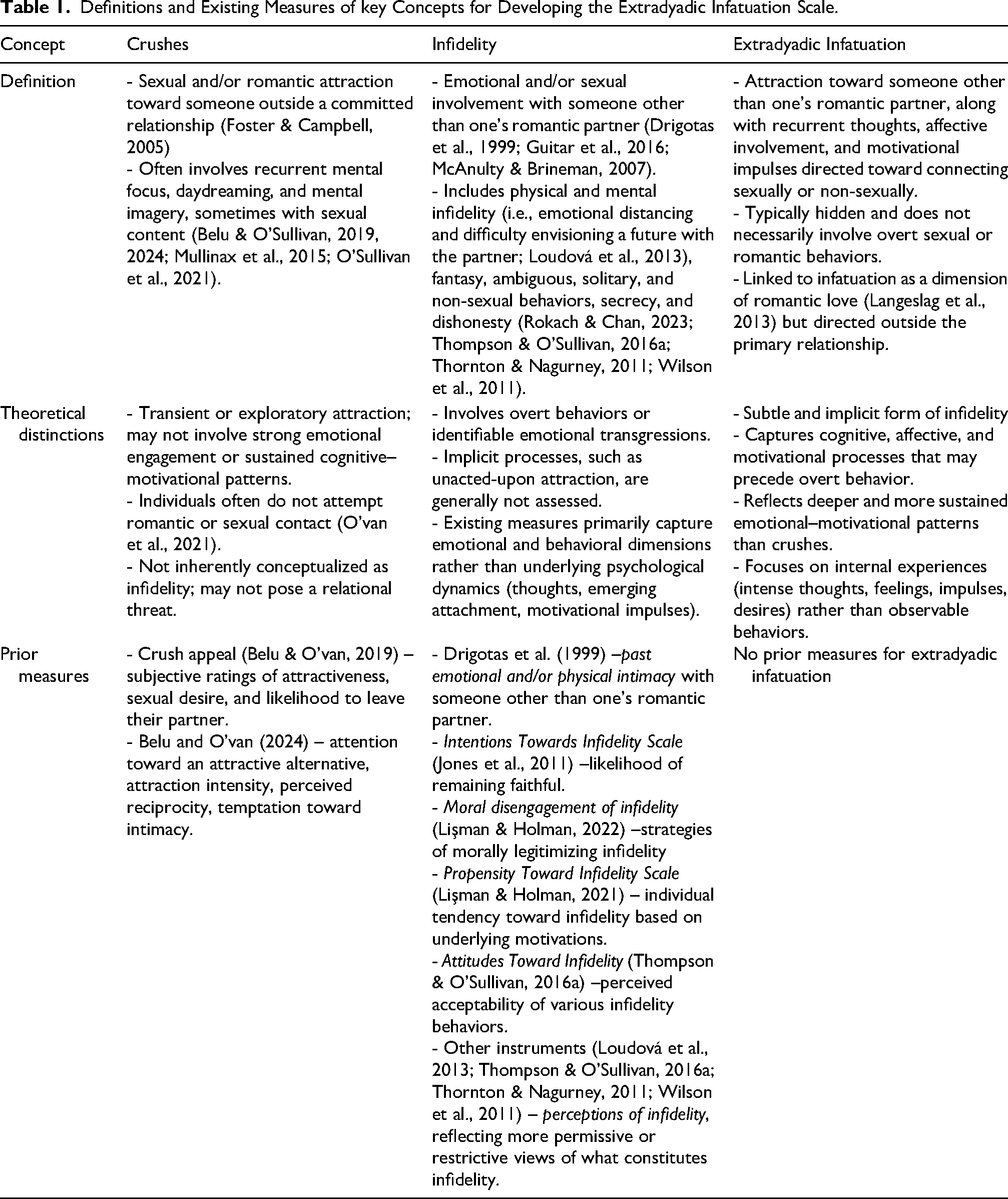
The instrument we propose also extends the existing measurement scales targeting the experience of “crushes”, which mostly focus on the intensity of the attraction towards that individual, through items tapping a variety of aspects of this attraction. Belu and O’Sullivan (2019) asked their participants to report sexual fantasies involving their crush and whether they would leave their current partner for their crush, while Belu and O’Sullivan (2024) used subjective assessments of physical attractiveness, temptation towards intimacy with and excitement induced by the respective person, time spent thinking about him/her, and actual flirting. While these evaluative and behavioral indicators are highly relevant in assessing attraction intensity, the EIS emphasizes the covert, psychological dimensions of infatuation - mental preoccupation and emotional investment - that may remain concealed but are deeply experienced by the individual. Moreover, the EIS aims to capture psychological dynamics that are essential for understanding infidelity, as highlighted by recent definitions of infidelity as encompassing any type of secret romantic behavior regardless of its physical expression (Rokach & Chan, 2023), but are overlooked by other measures. For a clearer conceptual distinction between extradyadic infatuation, crush, and infidelity, as well as an overview of prior instruments measuring these relationship phenomena, see Table 1.
Definitions and Existing Measures of key Concepts for Developing the Extradyadic Infatuation Scale.
To address this gap, we approach extradyadic infatuation as a multifaceted psychological experience that includes thoughts and emotions about somebody else than one's partner and behavioral tendencies or drives towards connecting with that person. This three-faceted perspective encompassing the cognitive, affective, and behavioral dimensions builds on Montoya et al.'s (2018) tripartite model of interpersonal attraction – comprising cognitive, affective, and behavioral components – and it has been used in the approaches to other psychological experiences specific to intimate relationships, such as jealousy (Diotaiuti et al., 2022; Knobloch et al., 2001).
We also aim to explore the relationships between extradyadic infatuation, as measured by the scale we set to develop, and several other dimensions, specifically three factors pertaining to the relationship between the individual and her or his partner (intimacy, jealousy, and respect) and authenticity as a personal trait.
Intimacy refers to sharing personal information with another, caring for the partner, trusting the bond with him or her, relationship commitment, valuing, admiration, mutuality, emotional support, and interdependence (Euckie, 2022; Rokach & Philibert-Lignières, 2015). High levels of intimacy and closeness between partners decrease their interest in other individuals and their probability of engaging in extradyadic adventures (Rokach & Philibert-Lignières, 2015). Additionally, Rokach and Philibert-Lignières (2015) defined infidelity as a reaction to negative emotional experiences in the romantic relationship, such as loneliness and isolation. Therefore, we expect extradyadic infatuation to be more frequent among people engaged in relationships characterized by low emotional intimacy.
Jealousy is the cognitive, emotional, and behavioral reaction of individuals when feeling suspicious about their partner's fidelity (Diotaiuti et al., 2022; Knobloch et al., 2001). The association between extradyadic attraction and jealousy can be presumed by considering that the latter has a detrimental effect on relationship satisfaction (Kılıç & Altınok, 2021) and that partners who feel unsatisfied in their relationship are more likely to engage in infidelity behaviors (Fincham & May, 2017; Haseli et al., 2019; Kılıç & Altınok, 2021). Consequently, frequent thoughts and desires about an attractive third party may be more common among couples who experience more jealousy in their relationships. In addition, prior studies emphasized that sexual fantasies may represent a distinct form of mental imagery that functions as a psychological coping mechanism, often emerging in response to dissatisfaction within romantic relationships (Birnbaum et al., 2019). Conversely, jealousy of one's partner has been observed as a consequence of one's own extradyadic involvement (Omarzu et al., 2012). The phenomenon of social projection (Ames et al., 2012; Krueger, 2000) may contribute to this association: individuals who are attracted to a third party may assume that their romantic partners are similar in this regard in that they also tend to daydream about the attractive people they meet in their daily lives.
Respect is an essential aspect of close relationships and represents the attitude toward another based on their perceived qualities, such as being accepting, honest, loving, and trustworthy (Frei & Shaver, 2002). Prior studies highlighted that people who respect their partners tend to have lower levels of perceived quality of alternative partners (Young & Zeigler-Hill, 2024). Also, marital dissatisfaction is an important predictor of infidelity (Fincham & May, 2017; Haseli et al., 2019; Kılıç & Altınok, 2021), while respect between partners is strongly related to relationship adjustment, satisfaction, and commitment (Frei & Shaver, 2002; Owen et al., 2012; Vrabel et al., 2019; Young & Zeigler-Hill, 2024). As stated above, frequent thoughts about someone outside the committed relationship may be a significant precursor to actual infidelity behaviors involving the respective person. Therefore, we expect extradyadic infatuation to be negatively related to respect for one's partner.
Authenticity is a personality trait comprising authentic living (consistent involvement in behaviors congruent with one's cognitions and emotions), resisting external influences, and a lack of self-alienation (being fully aware of one's actual experience) (Wood et al., 2008). People with low authenticity are characterized by a split between their real beliefs, feelings, and motivations and those outwardly expressed, and they tend to have poor attentional control and the tendency to mind wander (Williams & Vess, 2016). Also, prior studies emphasized that personal authenticity facilitates authentic intimacy and connection between partners, which is opposite to the secretive nature of infidelity (Butler et al., 2009). Hence, people with low authenticity may experience more frequent thoughts, emotions, and desires towards someone else than one's partner while continuing to remain in their committed relationship.
Overview of Studies
This research aimed to examine the psychometric proprieties of a novel measure of extradyadic infatuation (the EIS) among people in a romantic relationship and to investigate its associations with key relationship dynamics. We conducted three studies to these aims, all targeting specific components of the psychometric evaluation of the EIS. The first study aimed to examine the dimensionality and internal consistency of the newly developed EIS. The second aimed to verify its factorial structure through a confirmatory factor analysis approach, and to explore its convergent construct through its associations with measures of authenticity, intimacy, and actual infidelity behaviors. The criterion validity of the EIS was also examined in this study by investigating its associations with past involvement in extradyadic behaviors, as past infidelity predicts future instances of the same conduct (Knopp et al., 2017). The third study aimed to evaluate the test-retest reliability of the EIS. Furthermore, the second study also aimed to investigate the relationships between extradyadic infatuation and jealousy and respect for one's partner, respectively.
Study 1
Method
Participants and Procedure
Romanian adults currently in a romantic relationship were recruited from social media (Facebook and Instagram). The invitation to the anonymous online survey also included the eligibility requirements of the research, which were age (above 18 years), being in a committed romantic relationship, and being attracted to or at least liking an individual outside the committed relationships. These were also used as screening items in the first part of the survey. We excluded from the analyses participants who indicated they were not currently in a committed relationship (n = 35) or above 18 years old (n = 14). The final sample included 206 participants (18 to 64 years old; M = 27.10; SD = 7.80; 85.4% women; 70.4% in nonmarital romantic relationships). They were presented with the details of the study and then provided informed consent before completing the survey. The study received approval from the ethics review board of the institution where the authors are affiliated.
The sample size for this study was determined based on simulation studies by Mundfrom et al. (2005), who examined minimum sample requirements for exploratory factor analysis (EFA) under varying conditions. Given our expectation of a three-factor structure, with six items per factor (i.e., strong factor overdetermination), and assuming moderate to high item communalities, their results suggest that a sample size between 150 and 200 participants is sufficient to ensure the stability and reliability of factor solutions. Complementing this, Costello and Osborne's (2005) findings recommend a subject-to-item ratio of at least 10:1 to achieve stable and accurate factor solutions; with 18 items, this corresponds to a sample size of 180 participants or more. Our sample of 206 participants thus meets and slightly exceeds both sets of recommendations, supporting the adequacy of the sample size for EFA.
Measures
The EIS was developed by generating 18 items—six for each of the three proposed facets of extradyadic infatuation (cognitive, affective, and behavioral)—theoretically grounded in Montoya et al.'s (2018) interpersonal attraction model. The scale instructions asked participants to think about somebody else other than their partner who they like (labeled “X” in the content of the items) and then respond to the items. This approach is similar to the one used by Drigotas et al. (1999), who asked respondents to think about an individual from their past to whom they were attracted before engaging in their current relationships.
Items tapping the cognitive facet assessed the frequency and nature of mental intrusions related to the extradyadic person, whether intentional (e.g., “I often imagine different situations in which I am alone with X”) or unintentional (e.g., “X often comes to my mind, even when I don’t want it to happen”). These items were informed by research on mind-wandering, which differentiates between deliberate and spontaneous thoughts (Seli et al., 2016). Several cognitive items—such as recurrent imagery involving X or urges to seek contact while engaged in other activities—draw on findings suggesting that task-unrelated mental intrusions often indicate heightened emotional salience and cognitive preoccupation (Mowlem et al., 2019; Mrazek et al., 2013). Instruments like the Mind Excessively Wandering Scale (MEWS; Mowlem et al., 2019) and the Mind-Wandering Questionnaire (MWQ; Mrazek et al., 2013) support the interpretation of such thoughts as meaningful cognitive indicators of infatuation.
In addition, one cognitive item (“There are moments when I compare my partner to X”) and one affective item (“X makes me feel emotions that I don’t experience with my partner”) were developed based on research about upward relationship comparisons, which emphasized that individuals often evaluate their own romantic relationships by contrasting them with alternative partners (Thai, 2022). Such comparisons frequently focus on contrasting the emotions felt with the current partner to those elicited by the extradyadic person, and therefore they are particularly relevant in the context of infatuation. The other affective items captured the presence of positive emotional experiences directed toward the extradyadic person, especially those that challenge the norms of exclusivity within committed relationships. Some items explicitly expressed emotional attachment (e.g., “I am very fond of X”), while others emphasized the secrecy surrounding these feelings (e.g., “I could not tell my partner what I truly feel about X” or “I feel a lot of positive emotions towards X that I couldn’t disclose to my partner”). This emphasis on emotional concealment represents a key marker of emotional betrayal as highlighted by definitions of emotional infidelity (Guitar et al., 2016; Leeker & Carlozzi, 2014) and the centrality of secrecy in infidelity-related experiences (Moller & Vossler, 2015).
Finally, items reflecting the behavioral component of extradyadic infatuation were developed based on prior research on behavioral infidelity (e.g., Guitar et al., 2016) and interpersonal attraction, particularly the motivation to affiliate with another person (Montoya & Horton, 2020). These items captured both sexual desires (e.g., “I fantasize about kissing X.”) and covert impulses to initiate contact outside the partner's awareness (e.g., “I feel the urge to text X when my partner is not around.”). The scale emphasizes the intensity of behavioral desire through expressions like “I want to”, “I fantasize about”, “I feel the urge to”, and “I feel the rush to”. This behavioral inclination includes both overtly sexual (Leeker & Carlozzi, 2014) and non-sexual but secretive aspects of infidelity (Moller & Vossler, 2015; e.g., “I want to talk to X without my partner knowing.”), each relevant in assessing motivational involvement with the extradyadic person. Participants were required to rate their agreement with each item on a response scale ranging from 1 (strongly disagree) to 6 (strongly agree).
All items were generated independently by the authors, who are researchers in psychology. The item-development process was grounded in an extensive review of the relevant empirical and theoretical literature. No external experts or group-based item-generation sessions were involved; instead, the authors individually drafted items to ensure conceptual clarity and fidelity to the theoretical framework. The resulting pool of items was then reviewed collaboratively by the authors to verify consistency with the underlying constructs and to refine wording for clarity and methodological rigor.
Transparency and Openness
Our research was preregistered, and the data supporting its findings, along with the materials used, are openly available on the Open Science Framework at https://osf.io/wdcru/?view_only=1216a3724c83492099b82657ca1c0000.
Results
To minimize redundancy in item content and multicollinearity, we first examined the matrix of inter-item bivariate correlation. We found 6 pairs of items with correlations greater than 0.8, and based on the comparison of their content, we selected one item from each of these pairs (Field, 2024). We then submitted the remaining 12 items to an exploratory factor analysis in SPSS 20.0, using the principal axis factoring method and the Direct Oblimin method of factor rotation. The Keiser-Meyer-Olkin (KMO) measure of sampling adequacy (0.929) and the Bartlett's test (p < 0.001) indicated that our data is adequate for factor analysis. We considered factor eigenvalues and the results of Parallel Analysis (PA) to decide on the number of retained factors. Results indicated one factor with an Eigenvalue above 1 (8.03), accounting for 64.07% of the data variance. The appropriateness of this unifactorial solution was also indicated by the PA, which showed one factor with an eigenvalue higher than its corresponding 95th percentile eigenvalue derived from random data in accordance with the PA criterion (Glorfeld, 1995). The Cronbach's alpha of this one-factor scale (0.95) indicated excellent reliability. The factor loadings of the items, which ranged from .66 to .85, are presented in Table 2 alongside their summary statistics, and their factor loadings emerged from the confirmatory factor analysis in Study 2.
Exploratory Factor Analysis of the EIS Items.
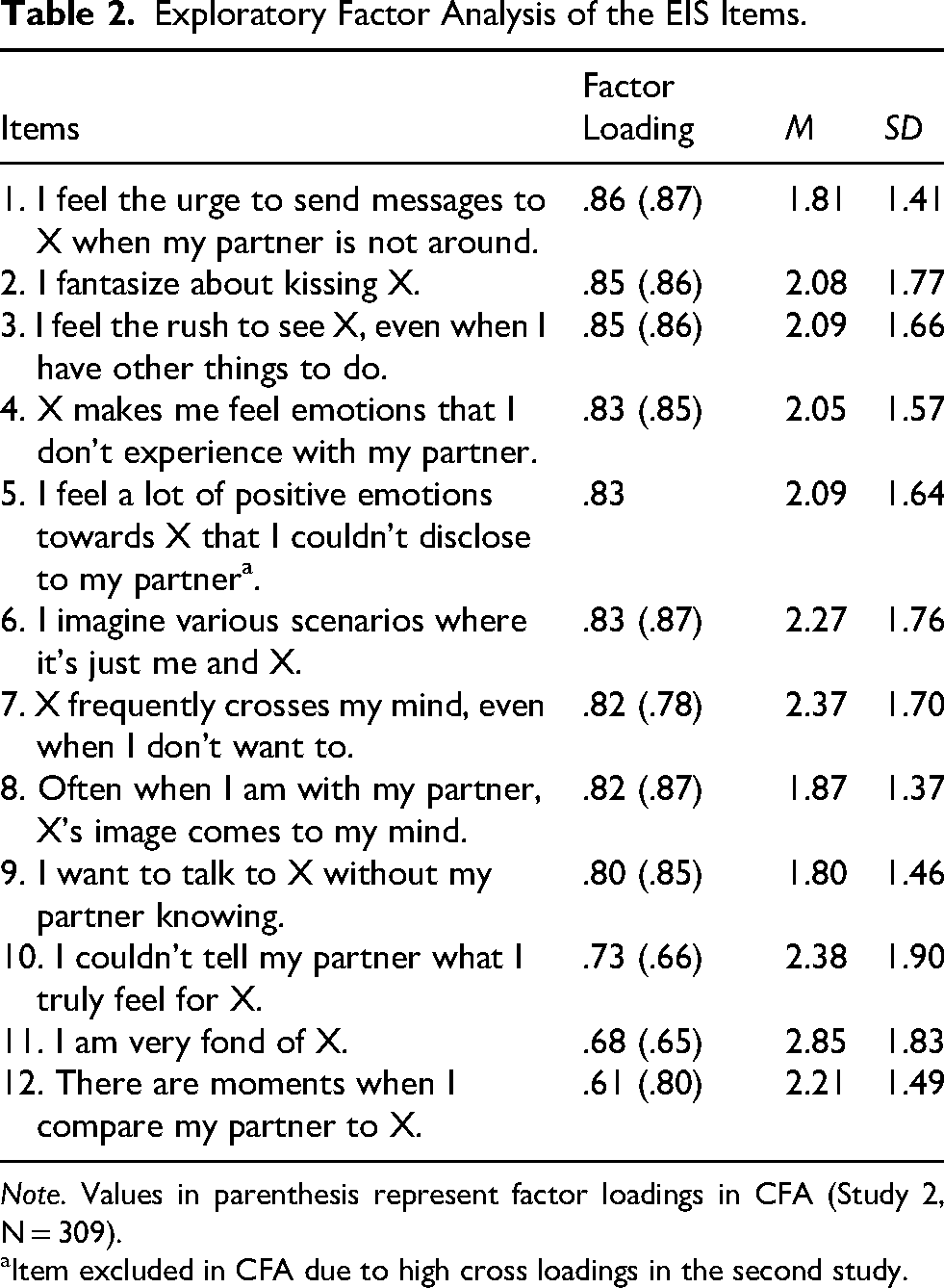
Note. Values in parenthesis represent factor loadings in CFA (Study 2, N = 309).
aItem excluded in CFA due to high cross loadings in the second study.
Study 2
Method
Participants and Procedure
The second study used the same procedure and eligibility criteria as the first. A total of 337 individuals completed the survey, but 28 were excluded because either they were under 18 years old or not in a current committed relationship. Therefore, 309 participants (83.8% women) were retained in the final sample. They ranged in age from 18 to 58 years and had been in a relationship for at least a month. The majority of the participants lived in urban environments (61.8%) and were in nonmarital romantic relationships (68.6%). Regarding education, most of them had completed their bachelor's (48.5%) or master's studies (26.9%).
The sample size for this study was determined based on both structural and inferential statistical requirements. For the confirmatory factor analysis (CFA), the sample exceeds the commonly recommended minimum of 200 participants needed for stable parameter estimation in structural equation modeling (Kline, 2016). Beyond CFA, the study included bivariate correlations and a multiple regression analysis. To ensure sufficient statistical power for the regression model, and a priori power analysis was conducted using G*Power (Faul et al., 2009). Following Cohen's (1988) guidelines, a medium effect size (f2 = .15), α = .05, and power of .80 were assumed. The analysis indicated a minimum of 85 participants would be required to detect effects in a model with four predictors (gender, age, relationship duration, and infatuation). Thus, the final sample of 309 participants substantially exceeds these thresholds, supporting the robustness and reliability of the psychometric analyses.
Measures
Participants’ intimacy in their committed relationship was assessed by the Intimacy Scale of the Emotional Dimension (ISOTED; Euckie, 2022), consisting of 14 items (e.g., “I share personal information with my partner”), which require respondents to rate the frequency of different relationship aspects on a 5-point Likert-scale from 1 (never) to 5 (always). Higher overall scores indicate increased levels of emotional intimacy with romantic partner (α = .89).
The respect that participants hold for their romantic partner was measured with the 20-item Respect-for-partner scale developed by Frei and Shaver (2002). Participants had to express their agreement with each sentence (e.g., “S/he is sensitive and considerate of my feelings.”) on a 7-point Likert-scale from 1 (strongly disagree) to 7 (strongly agree). Higher overall scores highlight increased respect towards one's committed partner (α = .94).
Personal authenticity was measured with the Authenticity Scale (Wood et al., 2008), which assesses three specific dimensions: accepting external influence (items 3, 4, 5, 6; e.g., “I am strongly influenced by the opinions of others.”, α = .83), self-alienation (items 2, 7, 10, 12; e.g., “I don’t know how I really feel inside”, α = .80) and authentic living (items 1, 8, 9, 11; e.g., “I always stand by what I believe in.”, α = .72). Items are rated on a 1 (does not describe me at all) to 7 (describes me very well) response scale. Scores across specific items are summed to provide assessment of each of the three dimensions of authenticity.
The Multidimensional Jealousy Scale (Diotaiuti et al., 2022) was used to assess the intensity of jealousy that participants experience towards their committed partner. The scale addresses three specific dimensions of jealousy (i.e., cognitive, emotional and behavioral) through 15 items (e.g., “X smiles in a very friendly manner at someone else.”). Participants were asked to rate their feelings in different contexts where the romantic partner involves in various actions with another person on a 6-point Likert scale from 1 (I am very pleased) to 6 (I am very upset), and the frequency of different behaviors or cognitions on a 6-point Likert-scale from 1 (never) to 6 (always). Higher overall scores indicate increased levels of jealousy (α = .85).
The Infidelity Scale (IS; Drigotas et al., 1999) was used to assess participants’ past involvement in extradyadic behaviors, through the level of emotional and/or physical intimacy that they had with another person than romantic partner at that time. It consists of 11 items tapping different aspects of the intimacy experienced with the extradyadic person (e.g., “How emotionally intimate were you with this person?”). Ten items are answered on a 9-point scale by rating the intensity of the respective aspect, e.g., from 0 (Not at all) to 8 (Extremely intimate), while one item (about the initiation of the mutual attraction) is answered on a 3-point scale. Higher overall scores indicate increased infidelity (α = .95).
We also used the 12-item EIS addressing extradyadic infatuation that emerged from the first study, with the same response scale from 1 (strongly disagree) to 6 (strongly agree).
Results
Confirmatory Factor Analysis
The 12-item EIS was analyzed using a first-order Confirmatory Factor Analysis approach using Maximum Likelihood Estimation in AMOS 23.0. The items were not normally distributed at the multivariate level (Mardia's coefficient of multivariate kurtosis = 182.72, critical ratio = 94.96). Therefore, we used the maximum likelihood estimation method with bootstrapping on 2000 bootstrapped samples in order to obtain accurate estimations of the model parameters (Byrne, 2010; Nevitt & Hancock, 2001). Furthermore, we used the Bollen-Stine bootstrapping and its associated p-value in evaluating the fit of the model, with a cutoff of p > .05 indicating satisfactory model fit (Bollen & Stine, 1992).
Results indicated a poor fit of the hypothesized model to the data, with a Bollen-Stine bootstrap p = .005 < .05, thus indicating a significant discrepancy between the model and the data. Some of the fit indices usually used in the evaluation of model fit were also below their recommended thresholds (e.g., Hu & Bentler, 1999; Kline, 2016): χ2(54) = 336.83, p < .001, GFI = .84 < .95, CFI = .92 > .90, TLI = .90 < .95, RMSEA = .13 > .08, SRMR = .04 < .08. The major source of misfit was the high cross loadings between two items, i.e., items 5 and 10 in Table 2, due to their overlap in content. We eliminated item 5, which had not only the lowest mean and variance between the two, but also the lowest squared multiple correlation with the entire item set. Moreover, modification indices suggested that correlating the error variances of certain set of items that had some overlap in content (i.e., item 7 and items 3 and 11, respectively; item 4 and items 2 and 8, respectively; item 1 and 9) would improve model fit. When respecifying the model with these changes, the Bollen-Stine p-value = 0.10 > .005 suggested an adequate model fit, as did most of the other conventional fit indices: χ2(39) = 126.18, p < .001, GFI = .94, CFI = .97, TLI = .96, RMSEA = .08, SRMR = .03. The factor-item standardized regression weights ranged from 0.65 to 0.87 (see Table 2), with their bootstrapped lower 95% confidence interval higher than the .50 cutoff suggested by Kline (2016).
We also examined an alternative model aligned with the initially hypothesized theoretical structure of the EIS, in which its items are distributed across the three specific psychological facets of interpersonal attraction, i.e., cognitive, emotional and motivational. The results showed that the model including all the initial 12 items had a poor fit, Bollen-Stine bootstrap p = .005 < .05. The revised model that eliminated the main sources of misfit, which were the same as those in the previous analysis on the unidimensional model, improved model fit: Bollen-Stine p-value = 0.07 > .005, χ2(36) = 124.94, p < .001, GFI = .93, CFI = .97, TLI = .95, SRMR = .03. Nevertheless, the value of the RMSEA index of .08 was above its recommended threshold of .08 (Kline, 2016), indicating poor model fit. Moreover, the correlations between the three factors of this model ranged between .83 and .92, which indicates a strong overlap between these dimensions. Finally, the unifactorial model had lower AIC and BIC values, i.e., AIC = 180.18; BIC = 280.98, and therefore a better fit to the data than the alternative three-factor model (AIC = 184.94, BIC = 286.94). Overall, these results suggest that the unidimensional model is more adequate in reflecting the underlying psychological dynamics involved in responding to the EIS items.
Convergent and Criterion Validity
The Pearson bivariate correlations between variables (see Table 3) indicate that EIS is negatively associated with the measure of emotional intimacy we used (i.e., ISOTED). The correlations between EIS and the three subscales measuring specific dimensions of authenticity indicate that EIS is positively related to the tendency to accept external influence and to self-alienation and negatively related to authentic living. Thus, in general, high scores on the new scale are associated with low levels of overall authenticity.
Descriptive Statistics and Correlations Between Study Variables.

Note. **p < .01, *p < .05; EIS = Extradyadic Infatuation Scale; AL = Authentic Living subscale; AEI = Accepting External Influence subscale; SA = Self-Alienation subscale; ISOTED = Intimacy Scale of The Emotional Dimension scale; RFP = Respect for Partner scale; MJS-BV = Multidimensional Jealousy Scale-Brief Version; IS = Infidelity scale.
We further examined the convergent validity of the EIS through its average variance extracted by its factor in comparison to the variance due to measurement error (AVE), and its composite reliability (CR). The AVE value of the EIS was .66, and its CR was .94, both higher than the recommended thresholds of .5 and .7, respectively (Hair et al., 2009), indicating the convergent validity of the new scale.
Regarding criterion validity, the bivariate association between EIS and the measure of actual infidelity (i.e., the IS) emerged as positive and significant. We further explored the criterion validity of the EIS by examining it as a predictor of IS scores alongside other personal factors indicated by past research as significant predictors of involvement in extradyadic behaviors, particularly gender (e.g., Buss & Shackelford, 1997). To this aim, we performed a hierarchical regression including IS as criterion, and gender, age and relationship length as predictors included in the first block, while EIS was included in the second block. Results (see Table 4) show that EIS scores account for a significant amount of variance in IS even when controlling for differences in gender, age and relationship length.
Hierarchical Regression Model for Extradyadic Intimacy.

Note. **p < .01, *p < .05; EIS = Extradyadic Infatuation Scale. Gender was coded as 1 = women, 2 = men.
Relationships between EIS, Jealousy and Respect for One's Partner
The correlations in Table 3 also indicate that EIS is positively associated to jealousy and negatively related to respect, suggesting that people who score high on the new scale tend to hold less respect and, at the same time, experience more jealousy towards their partner.
Study 3
Method
Participants and Procedure
The third study used the same procedure and eligibility criteria as the first two, and its sample included 31 individuals who had been in a relationship for at least a month (80.6% women, aged 21 to 50 years, M = 34.16 years, SD = 8.94) and completed the survey over a two-week interval. Most participants (67.7%) were living in urban environments and were in nonmarital romantic relationships (58.1%). Regarding education, most of them had completed their bachelor's (38.7%) or master's studies (45.2%). As emphasized in prior methodological work, a minimum of approximately 30 participants is generally considered adequate for pilot-level evaluations of test–retest reliability (Bujang et al., 2024; Williams et al., 2025).
Measures
The 11-item EIS that emerged from the second study.
Results
The descriptive statistics of the EIS were M = 1.89; SD = 1.32 at Time 1 and M = 1.75; SD = 1.28 at Time 2, both close to the corresponding values emerged in Study 2. The Pearson correlation between Time 1 and Time 2 EIS scores was high (r = 0.90, p < .001), supporting the temporal stability of the measure.
General Discussion and Conclusions
Attraction to people outside one's committed relationship is a frequent occurrence (Belu & O'van, 2019; Mullinax et al., 2015), and it can extend for months or even years (Belu & O'van, 2019). Our aims were to examine the psychological content of this experience by examining individuals’ thoughts, feelings and desires about a third party, which may be included in the notion of “mental infidelity” together with other psychological contents which most people perceive as infidel, such as strong emotional bonds to and fantasies with another person (e.g., Guitar et al., 2016; Thornton & Nagurney, 2011; Wilson et al., 2011).
Extradyadic Infatuation as a Unidimensional Psychological Dynamic
While the EIS was designed to capture three theoretically distinct components of extradyadic infatuation—cognitive, emotional, and behavioral—the empirical data across our first two studies consistently supported a unidimensional factor structure. This indicates strong associations between the three facets of the psychological experience of thinking about a “crush” among people in committed intimate relationships, and suggests that extradyadic infatuation may represent a psychological experience in which cognitions, emotions, and the desire to connect with somebody outside one's primary partner are deeply interrelated, manifesting simultaneously across the cognitive, affective, and behavioral dimensions. Specifically, individuals infatuated with someone outside their primary relationship may simultaneously experience intrusive thoughts, emotional arousal, and motivational impulses as part of a holistic and undifferentiated state of attraction. Therefore, in the specific context of infatuation with an extradyadic partner, these components may not operate independently, but rather as an integrated psychological experience.
The difference between this unidimensional structure of the EIS and the tripartite structure of the theoretical model of interpersonal attraction (Montoya et al., 2018) underlying its development may also stem from the specific nature of extradyadic attraction. Unlike general attraction, which broadly describes feelings of interest or desire that may occur regardless of relational commitment, extradyadic infatuation specifically involves an internal conflict where an individual remains committed to their primary partner but is mentally and emotionally preoccupied with someone else. This distinction is important, as attraction does not inherently imply a breach of trust or relational boundaries, whereas extradyadic infatuation reflects a form of implicit infidelity characterized by unfaithful thoughts, feelings, and desires without necessarily manifesting in overt behavior (Rokach & Chan, 2023). Future research could explore alternative structural models to assess whether more nuanced dimensions of extradyadic infatuation emerge in larger, more heterogeneous samples or across different cultural and relational contexts.
The Reliability and Validity of the EIS
The EIS emerged as having excellent internal consistency and temporal stability. Moreover, its pattern of correlations and relevant psychometric indicators support its convergent validity. Higher scores on this scale were associated to lower authenticity and emotional intimacy in the committed relationship, in line with our theoretically – derived expectations and indicating that EIS is a valid measure of the experience of extradyadic infatuation. Furthermore, results show that high scores on this scale are associated with a higher occurrence of actual infidelious behavior, which supports its criterion validity.
Extradyadic Infatuation and Relationship Dynamics
We also found EIS scores to be related to jealousy and respect for one's partner, further extending the current insights on the psychological and relational dynamics associated to attraction to extradyadic individuals. Previous studies on the relations between attraction to “crushes” and relationship quality in one's committed relationship found that people who experience more intense such attractions have lower relationship commitment and satisfaction (Belu & O'van, 2024). Our findings pinpoint several factors (i.e., intimacy, respect and jealousy) pertaining to the interpersonal dynamics within the committed relationship that may be significant in decreasing commitment to one's partner and relationship satisfaction.
Firstly, people with higher extradyadic infatuation tend to have lower respect towards their partner. Respect entails, among others, honesty, loyalty, and truthfulness (Frei & Shaver, 2002), while one's secret mental preoccupation with the third party implies dishonesty and disloyalty in the committed relationship. This association suggests that people who hold higher respect towards their partner tend to censor their preoccupation with potential “crushes”, which further lower their chances of infidelity acts. Past research has highlighted that respect is related to relationship dissatisfaction (Frei & Shaver, 2002) and that lower levels of relationship satisfaction lead to infidelity (Fincham & May, 2017; Haseli et al., 2019).
Also, we found that people who are more mentally preoccupied with a third party are in relationships with lower levels of intimacy. Extradyadic infatuation involves hidden cognitions, feelings, and desires for interaction with the third party, which the individual refrains from disclosing to his/her partner and thus may hinder intimacy within the committed relationship. Conversely, the negative emotional experiences generated by low relationship intimacy, such as loneliness and isolation, affect one's commitment and relationship satisfaction and increase the likelihood of infidelity (Rokach & Philibert-Lignières, 2015). Therefore, low intimacy may also foster mental preoccupation with alternative romantic partners, further amplifying the emotional distancing within the committed relationship.
Our findings further highlighted a positive association between extradyadic infatuation and jealousy of one's partner. While past research has shown that one's infidelity frequently makes one's partner experience jealousy (e.g., Pichon et al., 2020), we found that people who think more often about someone else also tend to feel more jealous themselves. This association extends past findings indicating that infidelity can generate jealousy of one's partner (Omarzu et al., 2012) and may be mediated by the social projection of one's extradyadic romantic preoccupation on his or her partner (Ames et al., 2012; Krueger, 2000). In a closely related field, Neal and Lemay (2019) found that individuals who are attracted to alternative partners tend to project their own extradyadic attraction onto their partners and tend to feel angrier at their partners. Regarding jealousy, people who think more often about alternative romantic partners may suspect that their committed partner does the same and consequently feel jealous. Alternatively, this association may reflect a reverse causation, where one's intense jealousy in the committed relationship leads to lower relationship satisfaction. This, in turn, can prompt individuals to focus more on alternative partners, in line with past findings on the links between infidelity, jealousy, and romantic satisfaction (Haseli et al., 2019; Kılıç & Altınok, 2021).
In the realm of the mental predictors of infidelity, existing research has pinpointed attention to attractive alternatives as an individual factor (Belu & O'van, 2019). Our results highlighted significant links between extradyadic infatuation and the characteristics of the current committed relationship. These suggest a specific indirect route through which engaging in thoughts, emotions and desires about others may increase the likelihood of infidelity, i.e., by affecting intimacy in the committed relationship and by inducing jealousy of one's partner. Another potential mechanism linking jealousy, intimacy and extradyadic infatuation is that by which low emotional intimacy mediates the relationship between jealousy and the tendency to become mentally preoccupied with someone outside one's primary relationship. In this line of reasoning, jealousy negatively affects the emotional intimacy that partners experience, which further raises the likelihood that the other partner would psychologically detach from this relationship and engage in secret fantasies and emotions about another person.
Our findings also highlighted authenticity as an individual trait related to the tendency to be mentally preoccupied with someone outside of a committed relationship. This tendency emerged as stronger among individuals with low authenticity, consistent with the hidden nature of thoughts and desires about attractive others. People with low authenticity are more likely to conceal their true feelings and motivations and to indulge in daydreaming (Williams & Vess, 2016), thus being more inclined to also engage in secret mental imagery when they are attracted to someone outside their committed relationship. Therefore, inauthentic individuals may be especially prone to decreased intimacy in their primary relationships and heightened jealousy as a result of their stronger tendency to engage in hidden thoughts and emotions about somebody else than their partner. Alternatively, lower levels of authenticity in the relationship may reduce emotional intimacy, which in turn may increase vulnerability to extradyadic infatuation.
The Theoretical Significance of the EIS
Besides pinpointing the links between extradyadic infatuation and the features of the primary relationship discussed above, our research may contribute to the current theorizing on infidelity by foregrounding the psychological processes that foster behavioral infidelity. The EIS addresses a psychological dynamic by which an individual, while remaining behaviorally committed to their romantic partner, becomes cognitively (e.g., rumination, idealization, mental preoccupation), emotionally (e.g., positive emotions, longing), and motivationally (e.g., drive to connect) oriented toward an extradyadic person. This reconceptualization builds on and operationalizes past suggestions in the literature (Rokach & Chan, 2023) and challenges traditional definitions of infidelity that emphasize observable sexual or romantic transgressions by foregrounding internal states as meaningful aspects of relational fidelity. This further raises a critical question for relationship science: is external behavioral fidelity sufficient, or should relational fidelity also encompass partners’ psychological dynamics? By emphasizing the discrepancy between external loyalty and internal disloyalty, EIS expands current understanding and measurement of commitment and relational exclusivity and encourages a re-evaluation of how infidelity is investigated in psychological and relational research.
The Practical Significance of the EIS
The concept of extradyadic infatuation has important practical implications for understanding, assessing, and intervening in romantic relationships. By drawing attention to the internal psychological dynamics that may precede or accompany infidelity, entailing the increasing mental and emotional investment in another person, EIS provides a valuable framework for both clinicians and individuals seeking to maintain relational health. In therapeutic settings, EIS can be used to detect early warning signs of relational disengagement that are not yet behaviorally expressed. Therapists and counselors may benefit from integrating EIS into their assessment tools, helping clients explore not only external behaviors but also internal emotional and cognitive shifts. Addressing these internal dynamics may prevent further deterioration of the primary relationship and help partners re-establish emotional connection before behavioral infidelity occurs. For couples, EIS raises awareness about a less visible mental dynamic with a strong potential impact on future extradyadic behavioral involvement, occurring privately, in thoughts, emotions and desires. Recognizing the existence of such a shift can prompt open communication, reflective dialogue, and relational repair before physical boundaries are crossed. Overall, the EIS and its conceptual framework invite practitioners and individuals to move beyond a purely behavioral understanding of fidelity and to engage more deeply with the psychological and emotional processes that sustain or threaten romantic bonds.
Limitations and Recommendations for Future Research
Our research has several limitations. Firstly, our sample was highly gender imbalanced, with the large majority of our participants being women. Secondly, we didn’t examine whether our participants have acted on their extradyadic attraction or the closeness of their relationship; therefore, our results do not include any information on participants’ involvement in infidelity with the person that they feel attracted to. This not only limits our findings, but it may also be important for the psychological dynamics within the committed relationship, as past research found that women who have “crushes” but do not act on them experience increases in dyadic desire (Mullinax et al., 2015), which may also relate to variations in certain relationship characteristics that we investigated, such as intimacy and respect. Relatedly, our use of the IS scale for evaluating the criterion validity of our measure may limit the validity of this evaluation, as the IS assesses past (and not current) involvement in extradyadic behaviors. Generally, our reliance on self-report measures without incorporating behavioral data may have introduced social desirability biases affecting the accuracy of participants’ responses. Although no specific social desirability scales were used, participant anonymity was assured to help reduce response bias. Future studies could further address this limitation by including behavioral measures or dedicated social desirability controls. Thirdly, the cross-sectional design of our research did not allow for the examination of the variations in the attraction towards the extradyadic individual that our participants referred to. Future studies should investigate these variations through longitudinal design and the relations between mental preoccupation with someone than the committed partner and the changes in both the committed relationship and the extradyadic relationship, similar to recent work on “crushes” (Belu & O'van, 2024). In addition, given the cross-sectional design of Study 2, the relationships observed among the variables cannot be inferred as causal and should be interpreted solely as correlational. Future longitudinal research is required to elucidate the potential causal mechanisms underlying these associations. Fourthly, our process of scale development did not include the examination of the content validity of the EIS. Lastly, another limitation is that the first study omitted to collect demographic information on participants’ marital status, education levels and urban or rural residence.
It is also important to consider that the cultural context plays a crucial role in understanding infidelity, as cultural beliefs and norms surrounding romantic relationships can shape attitudes toward and experiences of extradyadic involvement (Haseli et al., 2019; Valor-Segura et al., 2022). This study was conducted in Romania, a country in Eastern Europe characterized by strong family values, a relatively high degree of Orthodox Christianity religiosity, traditional perspectives on romantic commitment, and strict norms of exclusivity (Mihai & Butiu, 2012; Rada, 2012). Most individuals strongly disapprove of extramarital relationships, and many report they would end a relationship if their partner engaged in sexual activity with someone else (Rada, 2012). These cultural and religious norms likely influence how individuals experience and report extradyadic infatuation. For instance, infidelity is commonly viewed as a moral transgression in this cultural context (Lişman & Holman, 2022), which may lead to internal conflict or underreporting when romantic or sexual attraction arises outside a committed relationship (Foster & Misra, 2013; McAnulty & Brineman, 2007). These dynamics must be considered when interpreting our findings, as they may limit generalizability to other cultures. Nonetheless, they highlight the importance of developing culturally sensitive instruments that account for how infatuation is experienced within diverse moral, religious, and relational frameworks. Also, future studies on the psychological dynamics of infidelity and their associations should broaden the cultural diversity of their samples, as past research (e.g., Abela et al., 2020) has noted significant variations among cultures in the complex realm of intimate relationships.
Conclusions
To conclude, this study developed a measure of extradyadic infatuation, addressing the thoughts, feelings and desires about a third party that individuals in committed relationship experience. The new scale showed satisfactory preliminary psychometric properties and emerged as related to individual's authenticity and past infidelity. Furthermore, individuals with stronger tendencies to engage in thoughts, emotions, and desires about someone else were found to be less emotionally intimate with their committed partner, less respectful and more jealous of their committed partner. These relationship dynamics may reflect, at least partly, ways in which extradyadic infatuation can increase the likelihood of future infidelity.
Supplemental Material
sj-docx-1-pac-10.1177_18344909261416561 - Supplemental material for Longing for Another: Extradyadic Infatuation and Its Associations with Features of the Primary Relationship and Infidelity
Supplemental material, sj-docx-1-pac-10.1177_18344909261416561 for Longing for Another: Extradyadic Infatuation and Its Associations with Features of the Primary Relationship and Infidelity by Teodora-Elena Huţanu and Andrei Corneliu Holman in Journal of Pacific Rim Psychology
Footnotes

Ethics Approval Statement
All studies reported in this manuscript received approval from the ethics review board of the institution where the authors are affiliated, under registration number 61/15.01.2024.
Informed Consent
Written informed consent to participate in the research was obtained from all participants prior to their voluntary decision to take part in the study.
Author Contributions
The authors contributed equally to this research.
Funding
The authors received no financial support for the research, authorship, and/or publication of this article.
Declaration of Conflicting Interests
The authors declared no potential conflicts of interest with respect to the research, authorship, and/or publication of this article.
Data Availability Statement
Supplemental Material
Supplemental material for this article is available online.
References
Supplementary Material
Please find the following supplemental material available below.
For Open Access articles published under a Creative Commons License, all supplemental material carries the same license as the article it is associated with.
For non-Open Access articles published, all supplemental material carries a non-exclusive license, and permission requests for re-use of supplemental material or any part of supplemental material shall be sent directly to the copyright owner as specified in the copyright notice associated with the article.
