




Abstract
Understanding how intrapersonal emotions shape prosocial behavior remains a central question in social and affective science. This research examines the roles of self-experienced emotions and trait empathy across three complementary studies. Study 1 (N = 503) assessed stable emotionality, trait empathy, and dispositional prosocial tendencies. Study 2 (N = 80) employed a daily diary design to capture how daily emotional fluctuations and trait empathy related to daily prosocial actions over time. Study 3 (N = 466) manipulated emotional states through video exposure to examine their effects on donation and volunteering, while testing trait and state empathy mechanisms. Across the three studies, we found that both positive and negative self-emotions were associated with higher prosocial behavior, but mainly among individuals with lower trait empathy, while high-empathy individuals remained consistently prosocial regardless of emotional states. This pattern supports an affect-as-compensation framework, suggesting that self-emotions may serve as motivational signals that compensate for weaker trait empathy. These effects varied in strength depending on contextual factors such as temporal accumulation or prosocial task type. Importantly, we identified distinct mechanisms behind this compensation: among low-empathy individuals, the effects of positive self-emotion were linked to higher other-oriented state empathy, empathic concern and empathic hopefulness, even after accounting for interpersonal emotions. In contrast, the effects of negative self-emotion were not reliably associated with state empathy and were instead related to greater norm-focused reasoning, suggesting a possible non-empathic motivational pathway. Together, this research offers an integrative answer to what kinds of emotions matter, who they affect, and how their effects unfold. It advances theories of emotion-driven prosociality by clarifying boundary conditions and mechanisms, and provides practical implications for cultivating prosociality.
Introduction
Prosocial behavior, which is broadly characterized as actions that benefit others or society and includes acts such as sharing, donating, helping, and comforting (Pfattheicher et al., 2022), holds a vital position in both the advancement of individuals and the maintenance of social cohesion and welfare (Su et al., 2022). Emotions are widely acknowledged as powerful motives of prosocial behavior, and researchers have proposed a critical distinction between interpersonal emotions (e.g., emotions expressed by others), and intrapersonal emotions (emotions experienced by the self), suggesting that these two pathways may operate via distinct psychological processes (van Kleef & Lelieveld, 2022). However, current theories that touch on intrapersonal emotions often remain intertwined with interpersonal factors. For example, empathic altruism theory highlights experienced empathic concern that is usually elicited by recipients’ emotions (Batson et al., 2015); similarly, the positive feedback loop theory emphasizes emotional reward gained from prosocial acts (Aknin et al., 2018; Hui, 2022), which also implies interpersonal engagement. The negative state relief model posits that prosocial behavior serves to alleviate one's own distress aroused by witnessing others’ suffering (Cialdini et al., 1987), again involving interpersonal emotional cues. Such theories have overshadowed the direct influence that self-generated emotions may exert on prosocial actions. To better isolate and advance understanding of the intrapersonal emotional effects, the current study focuses on self-emotions, defined as emotions experienced by the individual rather than those directly tied to interpersonal components. Specifically, we aim to address three core questions: What types of self-emotions influence prosocial behavior? Who is more susceptible to such emotions? How do these effects unfold?
For the “what” question, the current research investigates different forms of self-experienced positive and negative emotions across diverse contexts. For the “who” questions, the current research investigates the role of trait empathy, a stable dispositional tendency to perceive, understand, and resonate with others’ emotions (Håkansson Eklund & Summer Meranius, 2021), which is an essential social-emotional trait involved in prosocial behavior (Main et al., 2017). For the “how” question, we explore how state empathy, the transient, situational emotional response in reaction to others’ emotions (Heyers et al., 2025), serves as a mediator. Improving our understanding of these questions would not only advance the theoretical development of intrapersonal emotional prosocial motivations, but also shed light on practical implications by identifying which practices may effectively enhance prosocial behavior in different populations.
“What”: Intrapersonal Emotional Effects in Prosocial Behavior
Research has revealed distinct patterns in how positive and negative self-emotions affect prosocial behavior. While some studies suggest that positive emotions may hinder altruism due to increasing selfishness (H. B. Tan & Forgas, 2010), more evidence supports their enhancing effects. Subjective well-being and positivity are positively associated with various forms of prosocial behavior, from daily kindness to extreme altruism such as organ donation (Brethel-Haurwitz & Marsh, 2014; Snippe et al., 2018), and early positive emotional experiences predict later prosocial acts (Erreygers et al., 2019; Luengo Kanacri et al., 2017). Inducing or recalling positive events—such as success, unexpected rewards, gifts, or praise—also enhances prosociality (Isen, 1970; Isen & Levin, 1972), and so does viewing positive emotional content in videos or images (R. Guo & Wu, 2021; Ibanez et al., 2017).
By contrast, findings on negative emotions are less consistent. Some studies suggest that they tend to reduce prosocial behavior, whether induced by emotional videos (e.g., sadness, distress, anger, guilt, stress) (Drouvelis & Grosskopf, 2016; R. Guo et al., 2019; Nguyen & Noussair, 2022) or elicited through recalling adverse experiences (e.g., stress, failure, sad memories) (Sollberger et al., 2016; Yang et al., 2017). Conversely, other research indicates that negative self-emotions can promote prosociality; for instance, viewing sad clips (Kandrack & Lundberg, 2014) or experiencing negative life events (Li et al., 2013) have been shown to increase prosocial behavior such as resource sharing and donating.
In summary, the effects of intrapersonal emotions on prosocial behavior remain inconsistent in both directions and magnitudes. Rather than a failure of valence accounts, these discrepancies likely reflect three sources of variability. First, operational heterogeneity across studies complicates the synthesis, including differences in valence, temporal scope from dispositional to momentary, and induction methods such as memory recall, video, or questionnaires. Second, as differential susceptibility theory suggests (Ellis et al., 2011), person-level sensitivity moderates whether people use their own feelings as motivational cues; accordingly, we consider trait empathy to be a theoretically relevant boundary condition that may shape the strength and direction of intrapersonal emotional effects (Section 1.2). Third, self-emotions can engage distinct internal pathways, including state empathy in both self- and other-oriented forms, as well as non-empathic routes that channel behavior in different ways (Section 1.3). Adopting an integrative framework that links trait-level susceptibility with mechanism-level pathways helps to clarify when and how self-emotions relate to prosocial behavior
“Who”: The Role of Trait Empathy in Intrapersonal Emotional Effects
While trait empathy is widely recognized as a driver of prosocial behavior (Decety et al., 2016), its role in shaping how self-emotions influence such behavior remains unclear. This individual difference may help explain the inconsistent effects of intrapersonal emotions reported in prior research, as it captures variability in how people process and act upon their emotional experiences.
Some evidence suggests that individuals high in trait empathy are more sensitive to emotional information. They demonstrate greater accuracy in emotion recognition (Qiao et al., 2025) and report more intense emotional reactions when viewing happy or sad videos (R. Guo & Wu, 2021). However, findings that link high trait empathy to stronger behavioral effects are largely observed in contexts that emphasize others’ emotions or in samples where empathic capacities are not fully mature. For example, high-empathy individuals helped more only when recalling others’ sadness, not when recalling their own sadness or neutral experiences (Barnett et al., 1982), or donated more when the appeal emphasized others’ benefits (Cohen & Hoffner, 2013). In R. Guo and Wu (2021), which manipulated participants’ own emotions, high-empathy children shared more after experiencing happiness while low-empathy children shared less after sadness; critically, high-empathy children did not show higher prosociality than low-empathy peers in the neutral control condition, suggesting an unstable empathy-prosociality link.
Conversely, among adult samples whose trait empathy are more developed, evidence suggests that individuals with lower trait empathy are more reactive to both adverse and beneficial emotional cues. For instance, peer pressure more often drives low-empathy adolescents into binge drinking, whereas high-empathy peers show greater resistance (Laghi et al., 2019). In positive contexts, low-empathy individuals are more influenced by warm stereotypes in helping decisions (Q. Tan et al., 2024) and benefit more from oxytocin in enhancing mental state inference (Radke & de Bruijn, 2015). A plausible explanation is that higher trait empathy tends to co-develop with stronger emotion-regulation abilities (Thompson, 2011) and a stable prosocial orientation (Decety et al., 2016). Such regulation helps high-empathy adults maintain prosocial behavior while preventing empathic overload, making them less dependent on transient self-emotions than low-empathy adults.
Taken together, existing evidence suggests that trait empathy conditions how self-emotions are translated into prosocial action. In adults, in whom empathy more stably supports higher baseline prosociality, we therefore expect low-empathy individuals to be more susceptible to the influence of self-emotions in changing their prosocial behavior. To clarify the processes through which such effects unfold, the next section examines state empathy and related non-empathic mechanisms.
“How”: The Role of State Empathy in Intrapersonal Effects
Previous research has established the role of state empathy as a mediator of interpersonal emotions’ effects on prosocial behavior, with different emotional expressions by recipients evoking distinct forms of state empathy that lead to different prosocial outcomes. Empathic concern, an other-oriented motivation to improve others’ well-being, has been shown to mediate the prosocial impact of both negative and positive emotional displays (R. Guo et al., 2025; McAuliffe et al., 2018; Qi et al., 2020; Sassenrath et al., 2017). In contrast, personal distress, a self-focused aversive reaction to others’ suffering, can reduce helping by triggering withdrawal or self-protection (Batson et al., 1997; Grynberg & López-Pérez, 2018). More recently, empathic hopefulness, a feeling of inspiration arising from observing others’ positive states, has been proposed as a distinct form of state empathy that promotes prosociality in positive emotional contexts (R. Guo et al., 2025; Kemp et al., 2017).
While these studies focus on interpersonal contexts, it remains unclear whether state empathy also mediates the effects of intrapersonal emotions, that is, emotions arising from one's own experiences, on prosocial behavior. Emerging evidence offers theoretical support. According to emotion-congruency theory, individuals tend to process information aligned with their current emotional states (Yiend, 2010). Positive emotions have been found to enhance empathic sensitivity and accuracy, especially toward positive others or contexts (Cheng et al., 2017; Devlin et al., 2014). Moreover, shifting focus while reading the same material elicits either empathic hopefulness or personal distress, depending on the positivity or negativity of the focus (Andreychik & Migliaccio, 2015). These findings suggest that self-emotions may influence which form of state empathy is activated, thereby shaping prosocial outcomes.
A complementary explanation comes from the broaden-and-build theory, which posits that positive emotions broaden attention and increase other-focus (Fredrickson, 2001; Green et al., 2003), whereas negative emotions tend to narrow attention and increase self-focus (R. Guo et al., 2019). Following this logic, other-oriented forms of state empathy (e.g., empathic concern, empathic hopefulness) may mediate the effects of intrapersonal positive emotions, while self-oriented empathy (e.g., personal distress) may mediate the effects of negative emotions. Notably, negative self-emotions may also activate non-empathic mechanisms such as norm-awareness (H. B. Tan & Forgas, 2010), suggesting that state empathy might play a more central role in the positive emotion pathway.
Beyond mediating the direct effect of emotions on prosocial behavior, state empathy may also operate within the moderated pathway. Specifically, individuals with different levels of trait empathy elicit distinct forms and intensities of state empathy in the same emotional states, such as awe (Li et al., 2024) or xenophobia (Plieger et al., 2022). These findings imply that trait empathy shapes not only the direct impact of intrapersonal emotions on prosocial behavior, but also how those emotions are internally represented and processed through state empathy. Yet how such variations shape behavior remains an open question.
To address this gap, the current research examines state empathy as a key mechanism linking self-experienced emotions to prosocial behavior, and also investigates whether this mechanism is influenced by individuals’ trait empathy. This integrative perspective moves beyond isolated emotional or trait effects, offering a process-level account of how and for whom emotions foster prosocial behavior.
The Current Study
Building on the issues outlined above, we adopt an integrative framework that links what emotions are implicated, who is more susceptible, and how these effects unfold (Figure 1). The framework connects emotional valence with trait-level dispositions and process-level pathways across three complementary studies: trait-level emotionality (Study 1), naturally occurring daily emotions (Study 2), and experimentally induced emotions (Study 3).
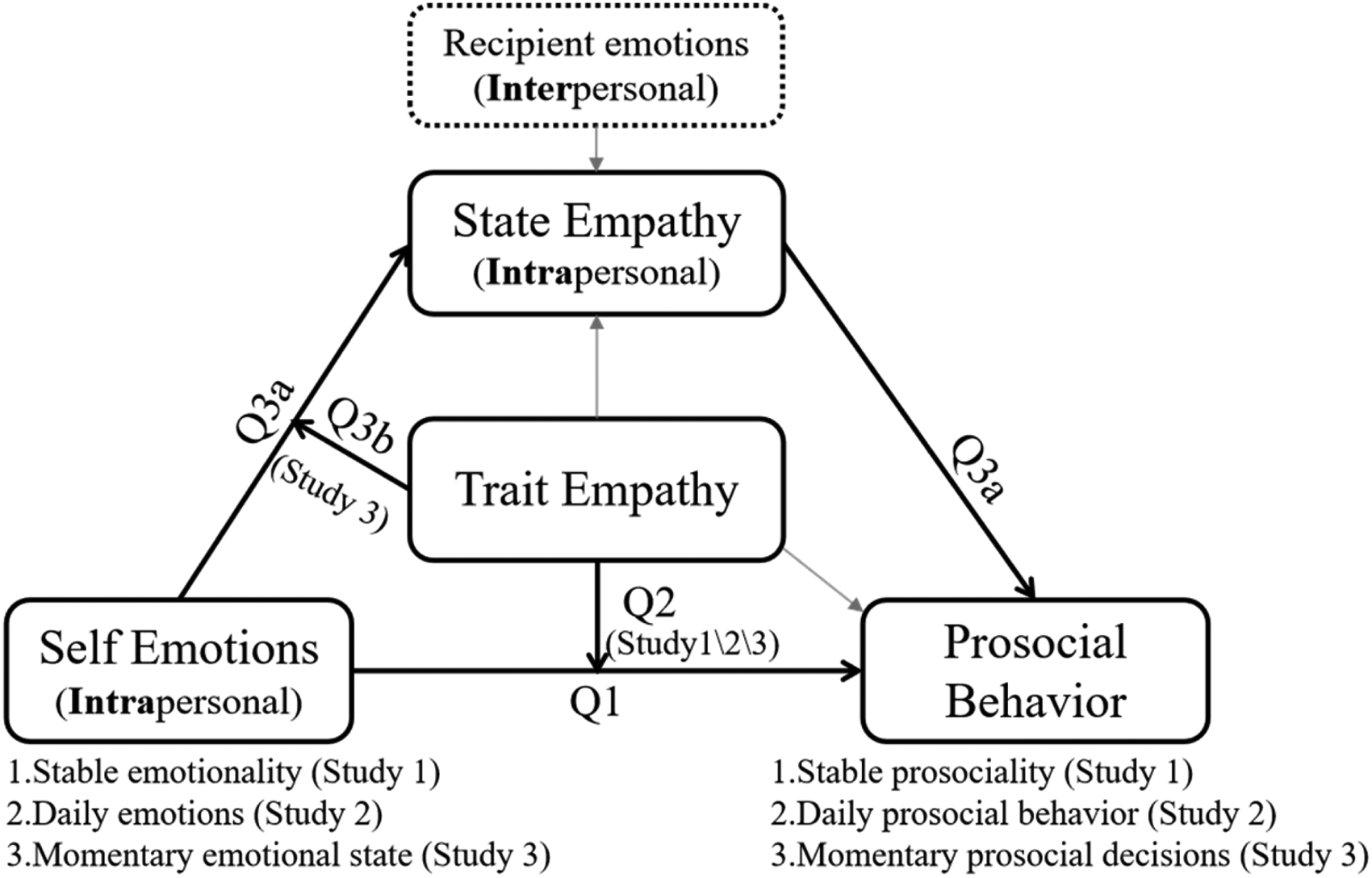
Conceptual model. Note: Arrows depict the proposed relations: self-emotions relate to prosocial behavior directly and indirectly via state empathy, with trait empathy moderating these relations. Gray lines indicate included main effects and covariates.
First, what types of self-emotions influence prosocial behavior (Q1)? We do not assume a uniform direction for valence; instead, we examine the distinct and comparative effects of positive and negative emotions across temporal and contextual domains, and assume that their effects are related to trait empathy and internal processes.
Second, who is more susceptible to these emotional effects (Q2)? We measure trait empathy across studies, and hypothesize that the influence of self-emotions on prosocial behavior would be stronger among individuals low in trait empathy, who possess weaker dispositional prosocial motivation and rely more on transient affective cues.
Third, how do these effects unfold (Q3)? In Study 3 we test state empathy (Q3a), distinguishing self-oriented (e.g., personal distress) and other-oriented forms (e.g., empathic concern, empathic hopefulness). We hypothesize that the promoting effects are mediated by empathic concern, the inhibiting effects of negative self-emotions are mediated by personal distress, and the promoting effects of positive self-emotions are mediated by empathic hopefulness. We also examine a moderated mediation pattern in which trait empathy moderates these indirect paths (Q3b), and hypothesize a stronger transmission of emotions into behavior among low-empathy individuals. Interpersonal emotional cues (e.g., recipient expressions) are statistically controlled to isolate intrapersonal processes.
Beyond these theoretical considerations, it is also important to note the cultural context of the present study. Most prior research on intrapersonal emotions and empathy has relied on Western samples, limiting generalizability. The present research was conducted in a Chinese context, where emotional expression is more restrained and social norms more collectivist (Ding et al., 2021; Soto et al., 2011). Such features may shape how emotions are experienced, regulated, and enacted. For instance, trait empathy in Chinese samples is more strongly linked to emotion recognition (Qiao et al., 2025) and prosocial behavior (Yin & Wang, 2023). Recognizing this cultural context complements the theoretical framework and underscores the broader significance of emotion-driven prosociality.
Study 1
Study 1 examined the associations among relatively stable intrapersonal emotionality, trait empathy, and prosocial tendencies, as assessed through self-report questionnaires.
Method
Participants
We created an electronic questionnaire (www.wjx.cn) and recruited participants from an online campus pool. A total of 527 adults completed the questionnaire, 503 of whom passed the screening questions and were retained for analysis (Mage = 24.67 years; SD = 7.28; 189 males). All three studies were approved by the Institutional Review Board of [blinded] (protocol: [blinded]). In Study 1, informed consent was obtained electronically prior to the start of the questionnaire.
Materials
Trait Empathy
We used the Chinese version of the Positive and Negative Empathy Scale (PaNES; Andreychik & Migliaccio, 2015; R. Guo et al., 2022), which contains14 items across two subscales: positive empathy (7 items) and negative empathy (7 items). Participants rated each item on a 5-point Likert scale (1 = does not describe me well; 5 = describes me very well), with no reverse-coded items and higher scores indicating higher trait empathy. Positive and negative empathy were highly correlated, r = 0.59, p < .001. Confirmatory factor analysis supported a one-factor structure: 1 RMSEA = 0.053, CFI = 0.951, TLI = 0.937, SRMR = 0.055. Cronbach's α = 0.891. Accordingly, we computed a composite trait empathy score by averaging all items to reduce collinearity and enhance interpretability.
Emotionality
We used the Chinese version of the Positive and Negative Affect Schedule-Expanded (PANAS-X; M. Guo & Gan, 2010; Watson & Clark, 1994). Positive emotionality comprised joviality (7 items, α = 0.935), serenity (2 items, α = 0.694), and self-assurance (5 items, α = 0.889); negative emotionality comprised hostility (6 items, α = 0.906), fatigue (3 items, α = 0.885), shyness (4 items, α = 0.914), guilt (6 items, α = 0.921), and sadness (4 items, α = 0.886). Participants rated their general feelings during the past six months on a 5-point Likert scale (1 = almost none; 5 = extremely), with higher scores indicating greater emotionality. Composite scores were calculated for each subscale.
Prosocial Tendencies
We used the Chinese version of the Prosocial Tendencies Measure (PTM; Carlo & Randall, 2002; Kou et al., 2007), comprising 26 items in six subscales: public (4 items, α = 0.811), anonymous (5 items, α = 0.841), altruistic (4 items, α = 0.815), compliant (5 items, α = 0.847), emotional (5 items, α = 0.829) and dire (3 items, α = 0.829). Participants responded on a 5-point Likert scale (1 = does not describe me at all; 5 = describes me greatly), with no reverse-coded items and higher scores indicating stronger prosocial tendencies. These subscales were later used as indicators of a latent prosocial tendency variable in the analysis.
Data Analysis and Results
We used SPSS 26.0 and Mplus 7.4 for data analysis. All variables were standardized prior to modeling.
Preliminary Analyses
We first conducted Harman's single-factor test on all scale items to assess common method bias. Factor analysis was performed without rotation, extracting factors with eigenvalues greater than 1. Thirteen factors emerged, with the first factor explaining 20.75% of the variance. These results satisfied the criteria of (a) extracting more than two factors and (b) the first factor accounting for less than 40% of the variance (Podsakoff et al., 2003), indicating negligible common method bias. Next, to model prosocial tendency, we specified a latent variable using the six PTM subscale scores as observed indicators 2 .Model fit was acceptable: CFI = 0.979, TLI = 0.960, RMSEA = 0.075, SRMR = 0.030.
Trait Empathy and Emotionality Predicting Prosocial Tendencies
In line with our hypothesis, we tested a structural equation model using Mplus to examine how positive and negative emotionality, together with trait empathy, jointly predicted the latent prosocial tendency. We computed the composite mean scores of positive (i.e., joviality, serenity, self-assurance) and negative (i.e., hostility, fatigue, shyness, guilt, and sadness) emotionality. The model was presented in Figure 2. Model fit was acceptable: χ2/df = 1.699, CFI = 0.982, TLI = 0.979, RMSEA = 0.037, SRMR = 0.042. Trait empathy not only positively predicted prosocial tendency (β = 0.464, p < .001) but also moderated the effects of positive emotionality (β = −0.085, p = .026) and negative emotionality (β = −0.095, p = .025). We further probed these moderation effect. For low-empathy individuals (−1 SD), both positive (β = 0.383, p < .001) and negative emotionality (β = 0.098, p = .047) positively predicted prosocial tendency. For high-empathy individuals (at +1 SD), positive emotionality remained significant (β = 0.277, p < .001), whereas negative emotionality did not (β = −0.062, p = .226).

Structural equation model in study 1. Note: Coefficients are standardized. Conditional effects are labeled for significant interactions. *p < .05, **p < .01, ***p < .001.
Brief Discussion
Study 1 showed that both positive and negative emotionality predicted stronger prosocial tendencies, addressing the “what” question of whether self-emotions matter. Importantly, the effects were stronger among individuals low in trait empathy, whereas those high in trait empathy consistently exhibited high prosociality, addressing the “who” question. Nevertheless, the reliance on cross-sectional self-reports limits causal inference, and trait-level measures may not capture dynamic fluctuations or real-world behaviors (Sheeran & Webb, 2016). To address these limitations, Study 2 adopted a daily diary design to capture emotional experiences and subsequent prosocial behaviors in naturalistic settings.
Study 2
Study 2 adopted a seven-day daily diary design to capture within-person fluctuations in emotions and their short-term links to prosocial behavior. This method offered greater ecological validity and allowed us to approximate causal dynamics in naturalistic settings.
Method
Participants
We recruited college students from a campus participant pool, yielding a final sample of 80 participants (Mage = 22.54 years, SD = 1.79; 52 females). Participants provided informed consent and first completed a sign-up questionnaire, followed by a seven-day diary phase. The questionnaire measured trait empathy and baseline emotions, while the diary tracked daily emotions and prosocial behaviors. All participants completed at least four diary entries, and 70 completed all seven. Six individuals who only completed the initial questionnaire were excluded.
Materials
Trait empathy: Trait empathy was measured in the sign-up questionnaire using the 14-item Chinese version of the PaNES, as in Study 1 α = 0.869.
Baseline emotions: Recent emotional states were assessed in the sign-up questionnaire using the International Positive and Negative Affect Schedule Short Form (I-PANAS-SF; Liu et al., 2020
Daily emotions and prosocial behavior: During the seven-day diary phase, participants reported their emotional states (using the same I-PANAS-SF items) and completed a checklist of daily prosocial behaviors each evening (20:00–24:00). The Daily Prosocial Behavior Checklist comprised 14 behaviors commonly occurring in interactions with strangers or acquaintances (e.g., opening a door, giving directions, picking up something others dropped). The checklist was adapted from Morelli et al. (2014) and Rushton et al. (1981).The full list and adaptation details are provided in the supplementary materials.
Data Analysis and Results
We used R (version 4.3.1) for all analyses. Linear mixed-effects models were estimated using the “lmerTest” package, with random intercepts to account for repeated daily measurements nested within participants. Continuous predictors were standardized before modeling.
Trait Empathy and Daily Emotions Predicting Daily Prosocial Behavior
To maintain comparability with Study 1, we first specified a linear mixed-effects model without time variables. Baseline and daily emotions, trait empathy, and their interaction terms were included as fixed effects, with participant-level random intercepts. As shown in Table 1, baseline and daily positive emotions significantly predicted daily prosocial behavior. However, trait empathy did not exhibit significant main or interaction effects in this model. These results suggest that while both recent and daily emotions contribute to daily prosociality, the role of trait empathy may depend on temporal dynamics, which were examined in the next section.
Linear Mixed-Effects Models of Daily Prosocial Behavior.
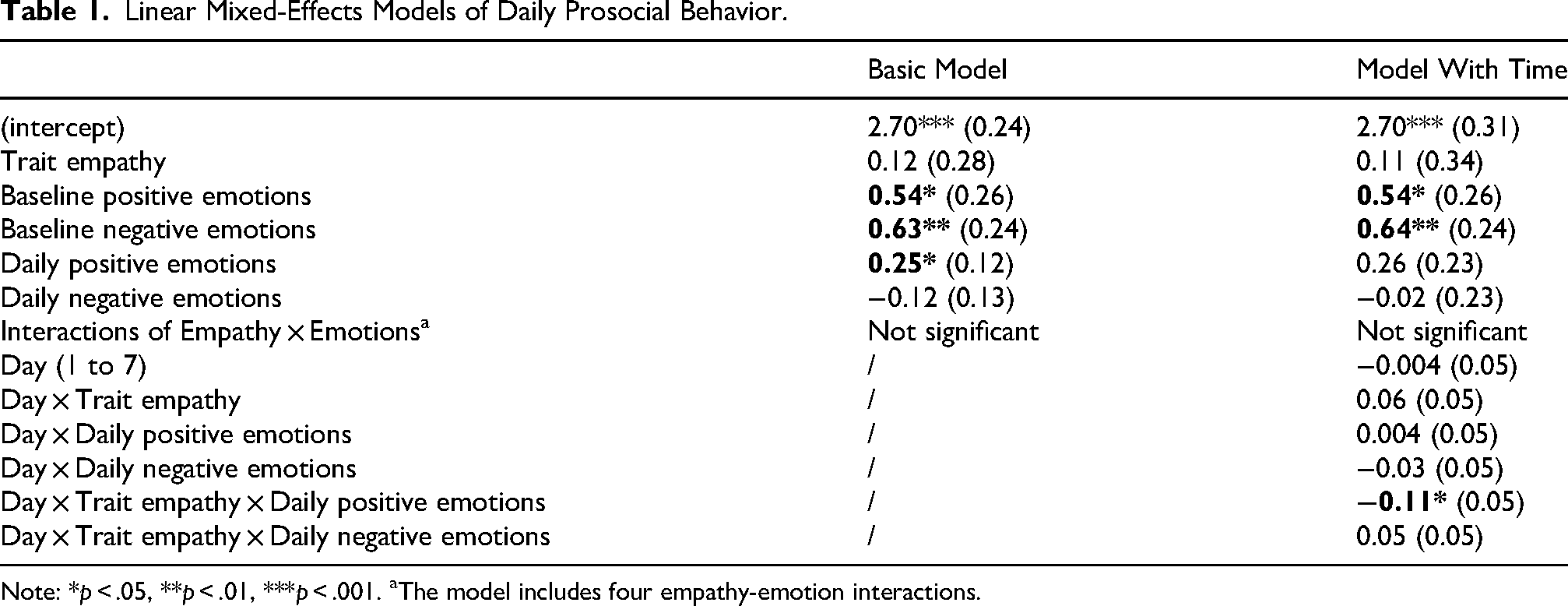
Note: *p < .05, **p < .01, ***p < .001. aThe model includes four empathy-emotion interactions.
Temporal Dynamics: How Emotional Effects Change Over Time
To examine how emotional effects on prosociality changed over time, we incorporated the “Day” variable (ranging from 1 to 7) and its interactions with daily emotions and trait empathy into the linear mixed-effects model. The model controlled for baseline emotions and included all two-way and three-way interactions among daily positive and negative emotions, trait empathy, and Day. Participant ID was specified as a random effect. As shown in Table 1, we observed a significant three-way interaction among daily positive emotions, trait empathy, and day (b = −0.11, SE = 0.05, p = .026).
To interpret this interaction, we conducted simple slope tests at −1 SD, the Mean, and +1 SD of the “Day” variable, corresponding roughly to Day 2, 4, and 6 of the diary study (see Figure 3). Results showed that around Day 2 (−1 SD), daily positive emotions did not significantly predict prosocial behavior for either low-empathy individuals (b = 0.10, p = .648) or high-empathy individuals (b = 0.42, p = .060). Around Day 4 (the Mean), daily positive emotions significantly predicted prosocial behavior for low-empathy individuals (b = 0.33, p = .047), and this effect became more pronounced around Day 6 (+1 SD; b = 0.56, p = .010). In contrast, for high-empathy individuals, the effect of daily positive emotions remained non-significant over time (bMean = 0.23, p = .163; b+1SD = 0.03, p = .876). No significant three-way interaction was found for negative emotions.

Changing effects of daily positive emotions by trait empathy over time. Note: Panels depict the interaction between daily positive emotions and trait empathy at Day = −1 SD, Mean, and +1 SD. Y-axis represents daily prosocial behavior; X-axis represents low (−1 SD) vs. high (+1 SD) daily positive emotions. Lines represent low (−1 SD) and high (+1 SD) trait empathy. *p < .05.
To address potential concerns that time-enhancing effect might be associated with emotional changes driven by prosocial behavior, we additionally examined temporal patterns in daily emotions. Two separate linear mixed-effects models were estimated with daily positive and negative emotions as dependent variables. Predictors included trait empathy, Day, baseline emotions, daily prosocial behavior, and all two-way and three-way interactions; participant ID was specified as a random effect. As shown in Table 2, daily negative emotions significantly decreased over time (bDay = −0.05, p < .001), while daily positive emotions remained stable (bDay = −0.03, p = .079). Daily prosocial behavior did not significantly predict either emotional outcome. Thus, the accumulative effect of daily positive emotion on prosocial behavior is not attributable to rising positive emotion over time or to prosocial behavior.
Linear Mixed-Effects Models of Daily Emotions (n = 80).

Note: *p < .05, **p < .01, ***p < .001.
Brief Discussion
Consistent with Study 1, the diary study showed that both recent positive and negative emotions facilitated subsequent prosocial behavior. Importantly, daily positive emotions predicted same-day prosocial behavior, particularly among individuals with lower trait empathy, and this effect intensified over time, suggesting dynamic amplification rather than a transient fluctuation. Because positive emotion was stable across days and prosocial acts did not feedback to increase emotion, this temporal amplification did not reflect mood escalation or reverse causality. In contrast, daily negative emotions declined over time and showed no cumulative influence on behavior, implying a weaker or more context-dependent role. Together, these findings reveal distinct temporal patterns in which emotions of different valence and timescale interact with trait empathy in shaping prosociality. To clarify the underlying mechanisms, we next turn to Study 3, which used an experimental design to evaluate a conceptual model of pathways and boundary conditions.
Study 3
Study 3 employed an experimental design to examine how induced emotional states affected prosocial behavior and how these effects are moderated by trait empathy. In addition, we tested state empathy as a potential mechanism and controlled for interpersonal emotions (i.e., recipient emotions) to better isolate intrapersonal emotional pathways.
Method
Participants
We recruited 466 adult participants (Mage = 24.55 years, SD = 6.16; 227 males) from an online campus participant pool. Participants were randomly assigned to one of nine conditions in a 3 (emotion induction: positive, negative, neutral) × 3 (recipient's emotion: positive, negative, neutral) between-subjects design. Table 3 presents the distribution of participants across conditions. The target sample size was determined via power analysis using G*Power 3.1.9.7 to detect a small-to-medium effect size (f = 0.20) with 80% power at α = .05, which yielded a minimum required sample of 384 (approximately 43 per group). Another 17 participants were excluded for failing one or more screening questions. Informed consent was obtained prior to participation.
Participants in Each Condition in Study 3.

Materials and Procedure
Trait Empathy
Trait empathy was measured at the start of the experiment using the same instrument (PaNES) as in Studies 1 and 2 (α = .891).
Emotion Induction
Participants viewed a positive (happy), negative (sad), or neutral video. Clips were selected from the Native Chinese Affective Video System (Xu et al., 2010) and were edited to 150 s 4 , following prior research (R. Guo et al., 2019; R. Guo & Wu, 2021). To check induction effectiveness, participants rated their emotions on a 7-point Likert scale (1 = extremely sad, 4 = neutral, 7 = extremely happy), both before (pre-video) and after (post-video) viewing the clip.
Welfare Project Exhibition
Participants were informed that the study was in collaboration with a public welfare project. They read a letter about a child with leukaemia, paired with the child's photo. The materials were presented in three versions reflecting the recipient's emotions: positive (smiling and hopeful), negative (crying and suffering), and neutral (wearing a surgical mask, neutrally described), served to control interpersonal cues. To check the manipulation, participants rated the recipient's emotion on a 7-point scale (1 = extremely sad, 4 = neutral, 7 = extremely happy).
State Empathy
After reading the letter, participants rated their state empathy on three subscales: empathic concern (sympathetic, compassionate, tender; α = 0.789), personal distress (disturbed, upset, distressed; α = 0.763), and empathic hopefulness (optimistic, hopeful, cheerful; α = 0.780). Participants rated each emotion on a 7-point Likert scale (1 = not at all, 7 = extremely). Items for empathic concern and personal distress were adapted from Batson's State Empathy Scale (Batson et al., 1997), and those for empathic hopefulness from Andreychik and Migliaccio (2015).
Prosocial Behavior
Participants’ prosocial behavior was assessed using three measures: (1) Willingness to donate: participants used a slider (0–200 CNY) to indicate how much they would like to donate, followed by an open-ended question about reasons for donating. (2) Sharing participation fee: participants decided how much of their 5 CNY participation fee (0–100%) to donate. They were told that the experimenter would transfer the chosen amount on their behalf to the project. (3) Volunteer time: participants indicated how much time (0–60 min) they were willing to spend supporting a follow-up phase of the project. Before these measures, participants rated the perceived efficacy of donation on a 7-point scale (1 = extremely ineffective, 7 = extremely effective), which was later controlled in the analysis.
Data Analysis and Results
We used SPSS 26.0 and Mplus 7.4 for the data analyses.
Preliminary Analyses and Manipulation Check
We first examined the effectiveness of the emotional manipulation. Both parametric (repeated-measures ANOVA and one-sample t tests on continuous emotional ratings) and non-parametric tests (binomial, chi-squared, and McNemar tests on coded emotional categories 5 ) were conducted. Descriptive statistics and results are summarized in Table 4. Results showed: (1) Before watching the videos, participants generally reported positive emotions, with no between-condition differences. (2) After the negative video, both mean scores and “positive” response rates significantly declined, falling below the midpoint and significantly lower than the other two groups. (3) After the positive video, scores remained high with a ceiling effect (15% of participants rated 7); emotional valence stayed above the midpoint. (4) After the neutral video, mean scores remained unchanged, but the proportion of “neutral” responses became dominant, exceeding both “positive” and “negative” categories. Manipulation checks indicated a robust induction in the negative condition, a high but maintained positive state in the positive condition, and a shift toward neutrality in the control condition. We therefore treat the manipulation as producing differentiated emotional states across conditions, while avoiding strong claims about induced positive elevation
Self-Reported Emotions Under Three Conditions.

Note:(1) */**/*** indicate significant deviation from chance level (p < .05, .01, .001): for continuous scores, one-sample t-test vs. midpoint 4; for categorical proportions, binomial test vs. 50%. (2) Superscripts a/b denote pairwise differences between conditions (b > a): for continuous scores, independent-sample t-tests; for categories, chi-square tests. (3) ↑/↓ denote significant post-video increase or decrease from pre-video: for continuous scores, paired t-tests; for categories, McNemar tests.
Next, we examined the effectiveness of the recipient emotion manipulation (see open materials). ANOVAs on perceived recipient's emotions confirmed that the positive recipient was perceived as significantly happier than the neutral and negative recipients, while the latter two did not differ significantly. This indicates that the manipulation of perceived recipient emotion was successful. To isolate the effects of intrapersonal emotions from potential interpersonal emotional cues, the recipient emotion condition was dummy-coded into two covariates (positive recipient, negative recipient), with neutral as the reference.
Finally, principal component analysis showed that the three prosocial behavior items (willingness to donate, sharing participation fee, volunteer time) loaded onto a single latent construct (loadings = 0.812, 0.654, 0.786), explaining 56.82% of the variance. A latent prosocial behavior variable was therefore used in subsequent models.
Trait Empathy and Induced Emotions Predicting Prosocial Behavior
Following our hypotheses and consistent with Studies 1 and 2, we first built a structural equation model in Mplus to examine how emotional induction and trait empathy interacted in predicting latent prosocial behavior. All continuous variables were standardized prior to analysis. The three-level emotional induction condition was dummy-coded into two binary variables (positive induction, negative induction), with neutral as the reference. The model showed a good fit: χ2/df = 0.859, CFI = 1.000, TLI = 1.015, RMSEA = 0.000, SRMR = 0.014. As shown in Table 5, trait empathy not only positively predicted prosocial behavior but also moderated the effects of positive induction (β = −.174, p = .032) and negative induction (β = −.176, p = .010). Simple slope analyses indicated that for individuals low in trait empathy (−1 SD), both positive (β = .241, p = .005) and negative (β = .252, p = .001) inductions enhanced prosocial behavior. In contrast, individuals high in trait empathy (+1 SD) exhibited high prosocial behavior, unaffected by either positive (β = −.026, p = .744) or negative (β = −.052, p = .551) induction.
Model Results in Study 3.

Note: *p < .05, **p < .01, ***p < .001. The coefficients are for the standardized model. Standard errors are in parentheses.
Underlying Mechanisms: The Role of State Empathy
To further examine the mechanisms underlying the interaction between emotional induction and trait empathy, we estimated a moderated mediation model using Mplus with 5,000 bootstrap samples. The conceptual model is shown in Figure 4. Model fit was adequate, χ2/df = 3.386, CFI = 0.897, TLI = 0.741, RMSEA = 0.072, SRMR = 0.038. The main results are reported in Table 5, and the conditional effects in Table 6.

Conceptual model of the moderated mediation in study 3. Note: Rectangles represent observed variables, ellipses represent latent variables. Black arrows indicate main predictive paths. Grey lines denote factor construction (no arrow), main effects and covariates (single arrow), and covariance (double arrow).
Conditional Direct and Indirect Effects in the Moderated Mediation Model.

Note: The coefficients are unstandardized. Values in parentheses represent 95% CIs. Bold values indicate significant effects, where the 95% CIs does not include zero.
As shown in Table 5, trait empathy moderated the effect of positive induction on both empathic concern (β = −0.165, p = .028, Cohen's f2 = 0.02) and empathic hopefulness (β = −0.134, p = .046, Cohen's f2 = 0.01). Simple slope tests indicated that, among individuals with lower trait empathy (−1 SD), positive induction significantly increased empathic concern (β = 0.179, p = .032) and marginally increased empathic hopefulness (β = 0.137, p = .057). These state empathy changes subsequently enhanced prosocial behavior, yielding significant indirect effects (Table 6). In contrast, among individuals with higher trait empathy (+1 SD), positive induction did not significantly influence either empathic concern (β = −0.074, p = .218) or empathic hopefulness (β = −0.069, p = .328), and no significant indirect effects emerged.
For negative induction, trait empathy moderated the direct effect on prosocial behavior (β = −0.136, p = .036, Cohen's f2 = 0.02). Negative induction increased prosocial behavior among individuals with lower trait empathy (−1 SD; β = 0.197, p = .009), but not among those with higher trait empathy (+1 SD; β = −0.038, p = .651). No mediation through state empathy was found for negative induction.
Although trait empathy positively predicted all three forms of state empathy, its direct effect on prosocial behavior became non-significant once state empathy variables were included in the model, suggesting a possible indirect-only pathway. Personal distress was positively associated with prosocial behavior but was not influenced by emotional induction and therefore did not mediate emotional effects. Recipients’ emotions affected personal distress (negative > neutral), but did not alter empathic concern or empathic hopefulness.
Exploratory Analyses on Open-Ended Qualifications
To supplement the main findings, we analyzed participants’ open-ended responses regarding the reasons for donating. Drawing on prior literature (R. Guo et al., 2019; H. B. Tan & Forgas, 2010) and iterative coder discussions, we developed a five-category coding scheme (Table 7): emotion-focused, norm-focused, self-focused, recipient-focused, and unclassifiable. Among 466 participants, 79.8% of responses were assigned to a single category, and 20.2% involved two overlapping categories. Coding agreement between a human rater and the DeepSeek large language model exceeded 88% at the category level.
Coding Scheme of Open-Ended Donation Reasons.

As shown in Table 8, chi-squared tests revealed significant differences across emotional conditions: participants in the positive condition more often provided emotion-focused reasons and less often self-focused ones; participants in the negative condition more often reported norm-focused reasons. Correlation analyses further indicated that emotion-focused and norm-focused reasons were positively associated with donation amount, whereas self-focused reasons were negatively associated.
Proportions of Reasons Across Conditions and Correlations with Donation.

Note: Within each row, different subscripts indicate proportions that differ significantly across conditions (b > a), whereas identical subscripts indicate no significant differences. For correlations: ***p < .001, *p < .05.
Brief Discussion
Study 3 replicated the moderating effect of trait empathy observed in Studies 1 and 2, showing that both positive and negative emotional states are associated with higher prosocial behavior primarily among individuals lower in trait empathy. Mechanistically, positive states were associated with higher empathic concern and empathic hopefulness and with more emotion-focused and less self-focused donation motives. Negative states did not reliably alter state empathy and were associated with more norm-focused reasoning, suggesting a distinct motivational pathway. At the same time, manipulation-check results indicated an asymmetry in emotional dynamics under video exposure. A negative emotional state was readily induced in the negative condition, whereas a positive emotional state was largely maintained rather than elevated, suggesting a ceiling effect. In light of this pattern, we avoid strong causal interpretations regarding positive emotion induction and instead interpret the positive condition as reflecting the situational maintenance of a momentary positive state. The pattern of findings suggests that both momentary negative and positive states facilitate prosocial decisions; however, the underlying mechanisms differ by emotional valence and level of trait empathy.
General Discussion
Summary of Findings
The present research employed multiple methods to examine the intrapersonal emotional effect on prosocial behavior by addressing three core questions: what types of self-emotions exert such influence, who is more susceptible, and how these effects unfold.
Regarding the “what” question, all three studies consistently showed that both positive and negative self-emotions can promote prosocial behavior across temporal frames and measurement methods, from stable dispositions (Study 1) to daily fluctuations (Study 2) and momentary states (Study 3).
Regarding the “who” question, results supported our hypothesis that individuals with lower trait empathy were more influenced by both positive and negative emotions, while those with higher trait empathy showed relatively stable prosocial behavior, less affected by emotional fluctuations. Study 2 further revealed that the impact of daily positive emotions among low-empathy individuals accumulated over time.
Finally, regarding the “how” question, findings partly supported the proposed mediation pathways. In Study 3, watching a positive video promoted prosocial behavior in low-empathy individuals via empathic concern and empathic hopefulness, whereas personal distress did not show a mediating role. Instead, qualitative analyses indicated that individuals watching a negative video more often reported norm-based reasons, suggesting adherence to social norms as a non-empathic pathway.
Together, these findings illustrate a nuanced pattern of intrapersonal emotional influences on prosocial behavior. We propose the “affect as compensation” framework: for individuals with lower trait empathy, self-emotions function as alternative motivational sources that compensate for their lower baseline prosociality. The following sections further elaborate this pattern (Section 5.2) and its underlying mechanisms (Section 5.3).
What Depends on Who: Trait Empathy as a Boundary of Intrapersonal Emotional Effects
The findings that self-emotions of both valences facilitated prosocial behavior contribute to the ongoing debate about whether intrapersonal emotions, particularly negative ones, promote or hinder prosociality (Drouvelis & Grosskopf, 2016; Erreygers et al., 2019; R. Guo & Wu, 2021; Kandrack & Lundberg, 2014; H. B. Tan & Forgas, 2010), and align with evidence showing that both negative and positive emotions can enhance donations compared to neutral states (Homer, 2021). By integrating multiple methods and contexts, this research systematically isolating and comparing different forms of intrapersonal emotional effects, extends prior work where emotional effects are typically studied in a single context or are confounded with interpersonal cues.
Crucially, these effects were not uniform across individuals. Rather, “what” influence depended critically on “who” was experiencing them: self-emotions exerting stronger effects among individuals with lower trait empathy. We therefore propose an “affect-as-compensation” framework: when stable empathic trait to motivate prosocial behavior is lacking, self-emotions may serve as compensatory cues. This interpretation echoes affect-as-information theory, which suggests that people use incidental feelings as heuristics for judgment and behavior (Clore & Huntsinger, 2007). High-empathy individuals already possess stronger internalized prosocial motivation (Baron-Cohen, 2011; Yin & Wang, 2023) and better emotion regulation (Thompson, 2011), and are therefore less reactive to incidental affect. In contrast, low-empathy individuals are more susceptible to incidental stimuli and rely more on contextual cues (Laghi et al., 2019; Radke & de Bruijn, 2015; Q. Tan et al., 2024), turning to their self-emotions as motivational signals.
Moreover, affect-as-compensation appears particularly effective under certain task demands or temporal conditions. The promoting effect of daily positive emotions among low-empathy individuals emerged only after temporal accumulation, and this effect was not attributable to increasing emotional intensity or reverse causality. This finding reflects how cumulative emotional experiences shape prosocial tendencies over time, complementing prior evidence that positive affect can build up to influence later prosociality (Chen et al., 2020; Erreygers et al., 2019). Our findings also suggest that affective compensation is more effective for higher-threshold or stable forms of prosocial behavior (Studies 1 and 3), while daily low-cost behaviors (e.g., Study 2) require stronger or more enduring emotional states.
Taken together, by delineating layered boundary conditions, our research moves beyond a binary debate to offer a more integrative understanding of when, for whom, and what emotions promote prosocial behavior. It bridges theories of intrapersonal emotional effects with empathy-related individual differences and pave the way for examining the mechanisms, as elaborated in the next section.
How: Distinct Mechanisms Underlying Affect-as-Compensation in Different Emotions
While both positive and negative self-emotions were associated with enhanced prosocial behavior among low-empathy individuals, they appeared to operate through distinct psychological mechanisms. For positive emotions, prosocial outcomes among low-empathy individuals were associated with a dual pathway involving empathic concern and empathic hopefulness, which support and expand the empathic-altruism hypothesis (Batson et al., 2015) and inspiration hypothesis (Kemp et al., 2017). Supporting this empathic interpretation, qualitative analyses showed more emotion-focused and fewer self-focused reasons in the positive condition, consistent with broaden-and-build theory and evidence that positive affect relates to a shift from self-focus to other-focus (Fredrickson, 2001; Green et al., 2003). These findings suggesting that positive states serve as compensatory signals for low-empathy individuals by reinforcing both emotional resonance and cognitive openness to others. We acknowledge that the manipulation checks in Study 3 showed the positive condition sustained a positive state, rather than elevating it above baseline, though it remained higher than the neutral condition. Therefore, we interpret the positive results as reflecting links to a momentary, condition-specific state and treat them with due caution.
In contrast, negative self-emotions promoted prosocial behavior via a non-empathic route. Although the negative-state relief model suggests that prosocial behavior in negative emotional states may serve as self-gratification by alleviating distress (Cialdini et al., 1987; R. Guo et al., 2019), our data did not support this account: negative emotion neither increased state personal distress nor self-focused reasoning. Instead, it elicited more norm-focused justifications, such as responsibility, morality, or social appropriateness. In collectivist cultures where negative affect often signals relational misalignment and unmet group expectations (Mesquita, 2001), this pattern suggests that the prosocial outcomes of negative self-emotions benefits from heightened adherence to social norms, as a way to accommodate environments when facing threatening signals (Forgas & Tan, 2013; H. B. Tan & Forgas, 2010).
In sum, self-emotions enhance prosocial behavior through distinct mechanisms: positive emotions via empathic-cognitive mechanisms, and negative emotions via normative motivations. Moreover, by experimentally manipulating and controlling recipients’ emotions, we isolated the intrapersonal contribution to state empathy, showing how self-emotions serve as a compensatory source of prosocial motivation.
Theoretical and Practical Implications
The research proposes the “affect-as-compensation” model, which integrates the “what,” “who,” and “how” dimensions of intrapersonal emotional effects into a coherent framework. By showing that self-emotions can substitute for low trait empathy through distinct empathic and cognitive routes, the model highlights the adaptive value of emotional fluctuations in sustaining social cooperation (Kleef & Côté, 2022), reframing transient affective states not as noise but as functional resources for maintaining prosociality. It extends prosocial motivation theories, such as empathic altruism (Batson et al., 2015), positive feedback loop (Aknin et al., 2018), and negative state relief model (Cialdini et al., 1987), which predominantly emphasize interpersonal components. The model also draws on and broadens the scope of affect-as-information theory, traditionally applied to information processing but rarely to the moral domain (Clore & Huntsinger, 2007), by illustrating when and for whom self-emotions translate into prosocial action. Furthermore, by incorporating both affective (state empathy) and cognitive (self–other focus) pathways, the findings enrich dual-process models of moral decision-making (Haidt, 2001). Evidence from a Chinese sample further expands the cross-cultural applicability of emotion-prosociality theories, underscoring the importance of situating emotional processes within diverse sociocultural contexts.
Beyond the theoretical contributions, the findings offer practical routes for prosocial interventions. For example, governments and organizations can implement social and emotional learning intervention to enhance empathic and emotional skills (Cipriano et al., 2023), particularly in low-empathy individuals such as criminals or callous populations. Additionally, the results may inform the development of emotionally responsive and morally aligned AI. Large language models have been found to exhibit emerging emotional intelligence (Wang et al., 2023) and differentiated behavioral outputs under emotional priming (Zhao et al., 2024). By revealing how self-emotions influence moral motivation, particularly among low-empathy targets, our findings provide conceptual grounding for designing AI agents that better simulate human-like emotional reasoning and promote socially beneficial outcomes.
Limitations and Future Directions
This study has several limitations that suggest directions for future research. First, in the experimental study, pre-to-post comparisons within the positive induction condition showed no reliable increase in positive affect, and continuous emotion ratings did not detect a significant difference between the positive and neutral conditions. This pattern suggests that the positive induction may have helped maintain, rather than newly increased, positive emotions. Such a pattern could reflect a ceiling effect in the positive condition or reflect emotional restraint and expressive modesty in Chinese culture (Ding et al., 2021). Although supplementary non-parametric analyses indicated clear differentiation among conditions, other uncontrolled factors, such as situational distractions, could not be fully excluded. Therefore, the causal strength of the positive induction should be interpreted with caution. Nevertheless, because the positive condition corresponded to a maintained but relatively higher positive state than the neutral condition in categorical analyses, the observed effects still carry interpretive value as links between this condition-specific momentary positive state and prosocial outcomes. Future research could employ more sensitive or multimodal measures, such as visual analogue scales, facial electromyography, or physiological indicators to capture subtle emotional fluctuations and verify the induction's effectiveness more precisely (Miu & Balteş, 2012; Paap et al., 2020). Second, we examined positive and negative emotions in general, without distinguishing discrete emotions. For example, sadness-inducing clips may also elicit guilt (Howell et al., 2012), and happy videos can evoke contentment or awe (Ellard et al., 2012). Since discrete emotions have divergent effects on social behavior (Shiota et al., 2017), future work could test how specific emotions (e.g., anger vs. sadness; excitement vs. happiness) differently shape prosociality. Third, although we aimed to isolate intrapersonal emotional influences, state empathy is responsive to interpersonal cues (e.g., recipient's emotions; Guo et al., 2025). While we controlled for these analytically, future work could compare the self-generated and other-induced emotions to clarify their interplay.
Conclusion
This research offers an integrative account of how intrapersonal emotions influence prosocial behavior across three methodologically diverse studies. We consistently found an affect-as-compensation effect: both positive and negative self-emotions enhanced prosocial behavior among individuals with lower trait empathy, thereby narrowing the prosociality gap with high-empathy individuals. Crucially, the underlying mechanisms diverged by emotional valence. Positive emotions operate primarily through other-oriented state empathy, including both empathic concern and empathic hopefulness. In contrast, negative emotions fostered norm-focused reasoning rather than state empathy. By clarifying what emotions matter, who they affect most, and how these effects unfold, the present research advances the understanding of emotion-driven prosocial behavior. It highlights the adaptive motivational functions of self-emotions, reframing transient affective states as resources that sustain cooperation and social bonds.
Transparency and Openness
We open all data, materials, and supplementary files necessary to reproduce the reported results in three studies on the Open Science Framework (https://osf.io/56ywk).
Supplemental Material
sj-docx-1-pac-10.1177_18344909261416065 - Supplemental material for Affect as Compensation: Self-Emotions Facilitate Low-Empathy Individuals’ Prosocial Behavior
Supplemental material, sj-docx-1-pac-10.1177_18344909261416065 for Affect as Compensation: Self-Emotions Facilitate Low-Empathy Individuals’ Prosocial Behavior by Rui Guo, Ziyan Guo, Yanjie Su and Zhen Wu in Journal of Pacific Rim Psychology
Footnotes
Acknowledgments
We are grateful to Chengyi Xu and Jialu Yu for methodology suggestions and help, to Delhii Hoid, Hao Liu, Miao Zheng, and Xinyu Shui for help with data collection; and to all participants for their participation. The authors acknowledge the language editing services provided by the SpringerNature Author Services.

Ethical Considerations
The studies (Studies 1 to 3) received ethical approval of Institutional Review Board at Tsinghua University (approval#202126, on May, 2021) and Beijing Normal University (approval #202303060045, on March, 2023).
Consent to Participate
Written informed consent was obtained from participants through online forms along with the sign-up questionnaires prior to participating:
Consent for Publication
Written informed consent was obtained from the individual(s) for the publication of any potentially identifiable images or data included in this article.
Author Contributions
All authors contributed to the study conception and design. Material preparation, data collection and analysis were performed by Rui Guo and supported by Ziyan Guo. Funding was acquired by Rui Guo and Zhen Wu. The first draft of the manuscript was written by Rui Guo and all authors commented on previous versions of the manuscript. All authors read and approved the final manuscript.
Funding
The author(s) disclosed receipt of the following financial support for the research, authorship, and/or publication of this article: This research was supported by grants from the National Natural Science Foundation of China (32300889; 32271110), The Humanities and Social Science Fund of Ministry of Education of China (23YJC710029), Tsinghua University Initiative Scientific Research Program (20235080047).
Declaration of Conflicts of Interest
The author(s) declared no potential conflicts of interest with respect to the research, authorship, and/or publication of this article.
Data Availability Statement
Supplemental Material
Supplemental material for this article is available online.
Notes
References
Supplementary Material
Please find the following supplemental material available below.
For Open Access articles published under a Creative Commons License, all supplemental material carries the same license as the article it is associated with.
For non-Open Access articles published, all supplemental material carries a non-exclusive license, and permission requests for re-use of supplemental material or any part of supplemental material shall be sent directly to the copyright owner as specified in the copyright notice associated with the article.
