




Abstract
The achievement goal perspective highlights the importance of mastery-approach goals in facilitating students’ academic achievement. However, a socio-ecological lens would suggest that the effectiveness of these mastery-approach goals might vary across different levels of income inequality, specifically national- and school-level income inequality. Understanding the role of income inequality is essential for advancing a socio-ecologically sensitive achievement goal approach. This study examines whether the association between mastery-approach goals and academic achievement is moderated by national- and school-level income inequality. Our hypothesis is that the adaptive benefits associated with mastery-approach goals are weaker in socio-ecological contexts with higher national- and school-level income inequality. The study involved 273,269 students nested in 10,785 schools from 33 countries. The results revealed that both national- and school-level income inequality significantly moderated the associations between mastery-approach goals and academic achievement in the three focal subjects of mathematics, reading, and science. Both national- and school-level income inequality weakened the positive role of mastery-approach goals, and this was especially pronounced for lower socioeconomic status students. These findings underscore the importance of considering socio-ecological contexts when evaluating the impact of mastery-approach goals on academic outcomes, highlighting the need to address both achievement goals and broader socio-ecological contexts to support academic success for all students.
Keywords
Introduction
Achievement goals play a central role in student motivation (Dweck, 1986; Elliot, 1997; Nicholls, 1984). Mastery-approach goals, which focus on mastering tasks and improving one's competence relative to intrapersonal standards, are important positive predictors of favorable academic outcomes, including higher levels of academic achievement and intrinsic motivation (Hulleman et al., 2010; Van Yperen et al., 2014). Although past studies have mostly examined the direct association between mastery-approach goals and academic outcomes, there is also an increasing recognition that the effectiveness of achievement goals, including mastery-approach goals, might depend on the socio-ecological context (Dekker & Fischer, 2008; King, 2022; Liem & Elliot, 2018; Zusho & Clayton, 2011)
One critical socio-ecological context is income inequality (Wilkinson & Pickett, 2021). Recent data indicate that the top 1% possess over 30% of total global wealth, while billions of individuals face economic setbacks (Oxfam, 2024). In settings with high levels of inequality, students lack access to sufficient educational resources and supportive school environments, making it more challenging to succeed academically (Berkowitz et al., 2017; Chiu, 2010). Meanwhile, inequality also shapes students’ daily experiences and perceptions. High income inequality can heighten social distance and reduce feelings of school belonging, which can undermine students’ achievement (Claes et al., 2024; King et al., 2022; Willis et al., 2022). These structural and psychological barriers together may diminish the effectiveness of mastery-approach goals, limiting students’ capacity to translate motivational strivings into actual performance.
On the other hand, in environments with lower income inequality, where resources and support are more evenly distributed (Browman et al., 2019; Du et al., 2024), mastery-approach goals may be more likely to promote academic achievement. By examining income inequality through the lens of achievement goal theory, we can gain insights into how socio-ecological factors can impede or facilitate students’ engagement, effort, and eventual achievement. Furthermore, such work promises to expand achievement goal theory's explanatory power beyond individual motivation, highlighting the differential benefits of mastery-approach goals in varying socioeconomic contexts (King et al., 2024a).
The present study investigates the associations between income inequality, mastery-approach goals, and academic achievement in three core subjects (mathematics, reading, and science). Of central interest, we test whether the links between mastery-approach goals and achievement in these domains are moderated by income inequality at both the national and school levels.
Achievement Goals
Achievement goals represent the pursuit of competence according to an evaluative standard (Dweck & Leggett, 1988; Elliot & Thrash, 2001). Elliot (1999) proposed the 2 × 2 achievement goal framework that differentiates goals according to two basic dimensions – how competence is defined and how it is valenced (see also Elliot & McGregor, 2001; Pintrich, 2000) Individuals may define competence in terms of inherent task demands or their previous performance (mastery goal), or they may define competence in terms of their performance relative to others (performance goal; Dweck, 1986). Furthermore, individuals may conceptualize competence in terms of a successful outcome they desire (approach goal) or an unsuccessful outcome they fear (avoidance goal; Elliot & Harackiewicz, 1996) Thus, the 2 × 2 framework identifies four types of achievement goals: Mastery-approach, performance-approach, mastery-avoidance, and performance-avoidance 1 . The present study focuses exclusively on mastery-approach goals (the only type of goal assessed in the PISA 2018 that served as the basis for this research).
Mastery-Approach Goals and Academic Achievement
Achievement goals are associated with distinct affective, cognitive, and behavioral processes that have an important influence on outcomes relevant to competence (Elliot & Hulleman, 2017; Huang, 2011; Pekrun et al., 2009). Among those goals, mastery-approach goals are particularly likely to facilitate deeper engagement in learning activities, resilience when facing setbacks, and higher levels of intrinsic interest in the subject matter (Huang, 2016; Hulleman et al., 2010). Most pertinent to the present research, numerous studies have documented a positive relationship between mastery-approach goals and students’ test scores and academic performance (Guo et al., 2023; Katz-Vago & Benita, 2024; King et al., 2024b; Mouratidis et al., 2018).
Although the effect sizes vary across studies (e.g., Cellar et al., 2011; Huang, 2012; Van Yperen et al., 2014), in general, meta-analytic evidence suggests that mastery-approach goals are positively associated with academic performance. For example, Payne et al. (2007) found that learning goals were positively associated with academic performance (r = .12). Similarly, Baranik et al. (2010) and Cellar et al. (2011) documented positive associations between mastery-approach goals and performance outcomes with medium effects (rs = .10 and .22, respectively). Huang's (2012) meta-analysis reported consistent positive correlations between mastery-approach goals and achievement (r = .10). Wirthwein et al. (2013) concluded that mastery-approach goals are significantly related to various achievement indicators (mean effect sizes from .11 to .18). Van Yperen et al. (2014) extended this analysis, finding that mastery-approach goals lead to better performance (r = .14) 2 . However, the specific associations between mastery-approach goals and achievement in particular domains remain under-researched.
In the present study, we attend to the associations of mastery-approach goals and academic achievement in three core academic subjects: Mathematics, reading, and science. These subjects represent distinct sets of knowledge and thinking skills, and are commonly featured in large-scale evaluations of student performance (Levin, 2013). Mastery-approach goals have been linked to benefits in these domains, including higher scores on math assessments, improved reading comprehension, and higher science achievement (Belenky & Nokes-Malach, 2012, 2013; Mouratidis et al., 2018). However, little research has been conducted that includes these three indicators of achievement within the same investigation. Based on the literature reviewed, we propose the following hypothesis:
Hypothesis 1 (H1): Mastery-approach goals are positively associated with (a) mathematics, (b) reading, (c) and science achievement.
Income Inequality and Academic Achievement
Income inequality refers to the uneven sharing of economic resources in a population, leading to a gap between high-income and low-income groups (Corak, 2013; Topuz, 2022). In the last few decades, this gap has widened globally, prompting researchers to examine its impact on social and individual outcomes, including educational outcomes (King et al., 2022; Workman, 2023). Viewed as a socio-ecological factor, income inequality underscores how broader structural conditions extend beyond individual-level differences (Layte, 2012; Sánchez-Rodríguez et al., 2019). These conditions of inequality significantly restrict students’ learning resources, hindering the achievement of learners from disadvantaged backgrounds (Berkowitz et al., 2017; Chiu, 2010).
Empirical evidence links income inequality with lower academic achievement (Chiu & Chow, 2015; Condron, 2011). For instance, research has revealed that in countries with higher inequality, students tend to display lower scores on tests and standardized assessments (Du et al., 2024; King et al., 2024a; Yan & Chiu, 2023). Disadvantaged learners in these settings may feel that future financial security is out of reach, potentially reducing their academic engagement (Sommet et al., 2024). Such dynamics create a context where students from low-income families face additional hurdles, including fewer high-quality resources and less encouraging educational environments (Browman et al., 2019; Chiu, 2010; García-Sánchez et al., 2024).
Despite an emerging interest in how income inequality is associated with academic achievement, little research has addressed whether this association varies as a function of the type or level of income inequality. By exploring both national-level and school-level income inequality, the present study seeks to acquire a more nuanced picture of the link between income inequality and academic achievement.
National-Level and School-Level Income Inequality
National-level income inequality pertains to income gaps between families across an entire nation, reflecting the extent to which economic resources are concentrated or evenly dispersed in a country's population (Solt, 2016). School-level income inequality represents gaps between families with high and low incomes within a school, reflecting the extent to which economic resources are concentrated or evenly dispersed among students who attend the same school (Menzer & Torney-Purta, 2012). Both forms of inequality have the potential to affect students’ educational experiences (e.g., Chiu, 2010; 2017; King et al., 2022).
At the national level, larger income inequality between wealthy and less affluent families can set the overall policy climate and resource allocation for public education (Brian, 2015; Chiu & McBride-Chang, 2010; Rodriguez-Bailon et al., 2017). When national-level income inequality is high, students from disadvantaged backgrounds may have less access to necessary support, such as sufficient school funding, well-trained teachers, and adequate learning. Several studies have indeed documented negative associations between national-level income inequality and academic achievement. For instance, Chiu and Chow (2015) found that national-level income inequality undermined reading achievement, and similar findings have emerged for mathematics and science achievement (King et al., 2024b; Wang & Wu, 2023). While these structural explanations are critical, income inequality may also operate at the psychological level. For example, Claes et al. (2024) demonstrated that national-level income inequality exacerbated students’ academic anxiety, which widened performance gaps between social classes across countries. This evidence highlights that the negative consequences of national-level income inequality are not limited to structural deprivation, but extend to psychological processes.
At the school level, income inequality is experienced more directly in students’ daily interactions with peers. Larger income gaps within schools can heighten perceptions of relative deprivation and intensify social comparisons, leading to lower belonging for disadvantaged students (King et al., 2022; Sommet et al., 2023; Willis et al., 2022). Moreover, school-level inequality has been linked to maladaptive outcomes such as aggression and bullying (Due et al., 2009; Menzer & Torney-Purta, 2012). These dynamics can create an environment that undermines collaborative learning and peer support, thereby reducing overall achievement, not only for disadvantaged groups but also for the broader student body within the school (Berkowitz et al., 2017; Marks, 2006; Owens et al., 2016). In contrast, more equitable schools tend to foster resource sharing and inclusive peer climates, which could support higher levels of achievement (Berkowitz et al., 2017; Marks et al., 2006; Owens, 2018).
Taken together, these findings suggest that income inequality at both the national and school levels constrains students’ achievement through a combination of structural and psychological mechanisms. Aligning with prior evidence that reduced inequality is often associated with improved educational outcomes (Broer et al., 2019; Du, 2024; Wilkinson & Pickett, 2009), the present study aims to investigate how both national- and school-level income inequality are associated with academic achievement. Understanding these dual layers of income inequality can clarify whether national socioeconomic conditions, more local socioeconomic conditions, or both influence variation in students’ academic achievement. We propose the following hypotheses:
Hypothesis 2 (H2): National-level income inequality is negatively associated with (a) mathematics, (b) reading, and (c) science achievement;
Hypothesis 3 (H3): School-level income inequality is negatively associated with (a) mathematics, (b) reading, and (c) science achievement.
The Moderating Role of Income Inequality
Previous research has revealed considerable variability in the association between mastery-approach goals and achievement, and meta-analyses have highlighted notable variability in effect sizes (e.g., Baranik et al., 2010; Huang, 2012; Hulleman et al., 2010; Van Yperen et al., 2014). Some meta-analyses have reported mastery-approach goals as positive predictors of performance (Huang, 2012; Van Yperen et al., 2014), while others found more inconsistent effect sizes depending on contextual factors (Burnette et al., 2013; Hulleman et al., 2010). This inconsistency reveals the presence of hidden contextual moderators that may amplify or constrain the benefits of mastery-approach goals. Beyond direct associations with academic achievement, national- and school-level income inequality may moderate the associations between mastery-approach goals and academic achievement.
Income inequality shapes both the distribution of material resources and the salience of social stratification in everyday life (Solt, 2016, 2020; Wilkinson & Pickett, 2009). By considering income inequality as a socio-ecological factor, we recognize that achievement goal pursuit is inherently linked to objective realities in students’ lives (Liem & Elliot, 2018; Oishi & Choi, 2017; Urdan & Kaplan, 2020). As a socio-ecological factor, income inequality exacerbates educational stratification. It strengthens the link between family background and student opportunity, while also making school systems themselves more selective and divided (Thorson & Gearhart, 2018; Wang & Wu, 2023). These inequalities also shape the association between mastery-approach goals and academic achievement, such that the same level of mastery-approach goals may yield different performance outcomes depending on how supportive or restrictive the opportunity structure is in a given environmental context (King, 2022, 2024a; Skinner et al., 2022).
From an achievement goal perspective, incorporating a socio-ecological lens on income inequality underscores that the pursuit of competence, particularly through mastery-approach goals, is not a solitary endeavor. While achievement goal theory indicates that learners who adopt mastery-approach goals, which focus on mastering material and enhancing skills, are more likely to have higher achievement, the structural reality of underfunded schools and unequal resource allocation may restrict the extent to which students can fully utilize these goals. In environments with higher national-level income inequality, the benefits of mastery-approach goals may be diminished due to structural barriers and resource deficits (Chiu & Chow, 2015; King et al., 2024b). Students in these contexts may struggle to access educational opportunities that facilitate higher performance, undermining the link between mastery-approach goals and academic achievement. In contrast, in settings with lower national-level income inequality, where resources are more evenly distributed, mastery-approach goals may be more likely to promote academic achievement (Erentaitė & Vosylis, 2025; Erentaitė et al., 2023; Liang et al., 2024; Michael & Kyriakides, 2023).
In addition to the broader national-level considerations, the role of school-level income inequality also deserves attention. School-level income inequality leads to daily encounters with resource disparities (Chiu, 2017), thereby shaping students’ immediate learning conditions in ways that can hinder mastery-approach goals. When substantial income inequality exists among students within the same school, it is possible that students from lower-income families may feel they lack adequate support and feel like they do not belong in school (Canning et al., 2020). Experiencing income inequity within schools may also trigger anxiety and crowd out more intrinsic aspects of motivation (King et al., 2024a). These factors can hinder students’ complete engagement in the process-oriented, self-improvement focus that is integral to the benefits of mastery-approach goals (Doll, 2022; Patrick et al., 2011). Consequently, in schools with higher school-level income inequality, mastery-approach goals may be less effective in fostering academic achievement.
Given the literature on both national-level and school-level income inequality, we consider the moderating role of income inequality – at both the national and school levels – on the association between mastery-approach goals and academic achievement. We propose the following hypotheses:
Hypothesis 4 (H4): National-level income inequality weakens the positive association between mastery-approach goals and (a) mathematics, (b) reading, and (c) science achievement;
Hypothesis 5 (H5): School-level income inequality weakens the positive association between mastery-approach goals and (a) mathematics, (b) reading, and (c) science achievement.
The Moderating Role of Socioeconomic Status (SES)
Although national- and school-level inequality are expected to be negatively associated with achievement, accumulating evidence indicates that inequality is more harmful for less advantaged students (Sommet et al., 2024). This pattern is theoretically consistent with the biopsychosocial model of challenge and threat. Competitive contexts associated with inequality can elicit either threat or challenge appraisals, with consequent performance costs or benefits that are strongly shaped by the availability of resources (Blascovich, 2013; Jamieson & Elliot, 2018; Seery, 2013). Empirically, cross-national PISA analyses show that the greatest harms of inequality accrue to disadvantaged students (Chiu, 2010; Claes et al., 2024). Accordingly, we expect stronger adverse associations of inequality with achievement among lower-SES students, and propose the following hypotheses
3
:
Hypothesis 6 (H6): SES moderates the negative association between national-level income inequality and (a) mathematics, (b) reading, and (c) science achievement.
Hypothesis 7 (H7): SES moderates the negative association between school-level income inequality and (a) mathematics, (b) reading, and (c) science achievement.
Concurrently, income inequality not only limits the availability of resources but also exacerbates class distinctions in parental investments, such as time, tutoring, and materials (Reardon & Bischoff, 2011; Schneider et al., 2018). Consequently, students with higher SES gain the necessary out-of-school support to translate mastery goals into tangible performance, while lower-SES students might not be able to achieve comparable returns. Additionally, income segregation and organizational stratification intensify comparative cues and concentrate resources, exacerbating disadvantages for low-SES students and further diminishing the efficacy of mastery-approach goals in unequal settings (Chiu, 2010; Marks, 2006). This study seeks to further investigate whether the income inequality-based attenuation observed in the association between mastery-approach goals and academic achievement is itself SES-based.
Hypothesis 8 (H8): SES moderates the interaction between mastery-approach goals and national-level income inequality on (a) mathematics, (b) reading, and (c) science achievement.
Hypothesis 9 (H9): SES moderates the interaction between mastery-approach goals and school-level income inequality on (a) mathematics, (b) reading, and (c) science achievement.
Method
Participants
This study used the Program for International Student Assessment (PISA) 2018 data 4 which included responses from 273,269 15-year-old adolescent students across 10,785 schools in 33 OECD countries 5 . The gender ratio was nearly equal: Females = 13,5760 (49.7%) and males = 13,7507 (50.3%). Table 1 presents country-level summaries of national inequality alongside correlations between school-level inequality, mastery-approach goals, and achievement (mathematics, reading, and science) for each participating OECD nation.
Correlations Among National-Level Income Inequality, School-Level Income Inequality, Mastery-Approach Goals, and Achievement in Each Nation.
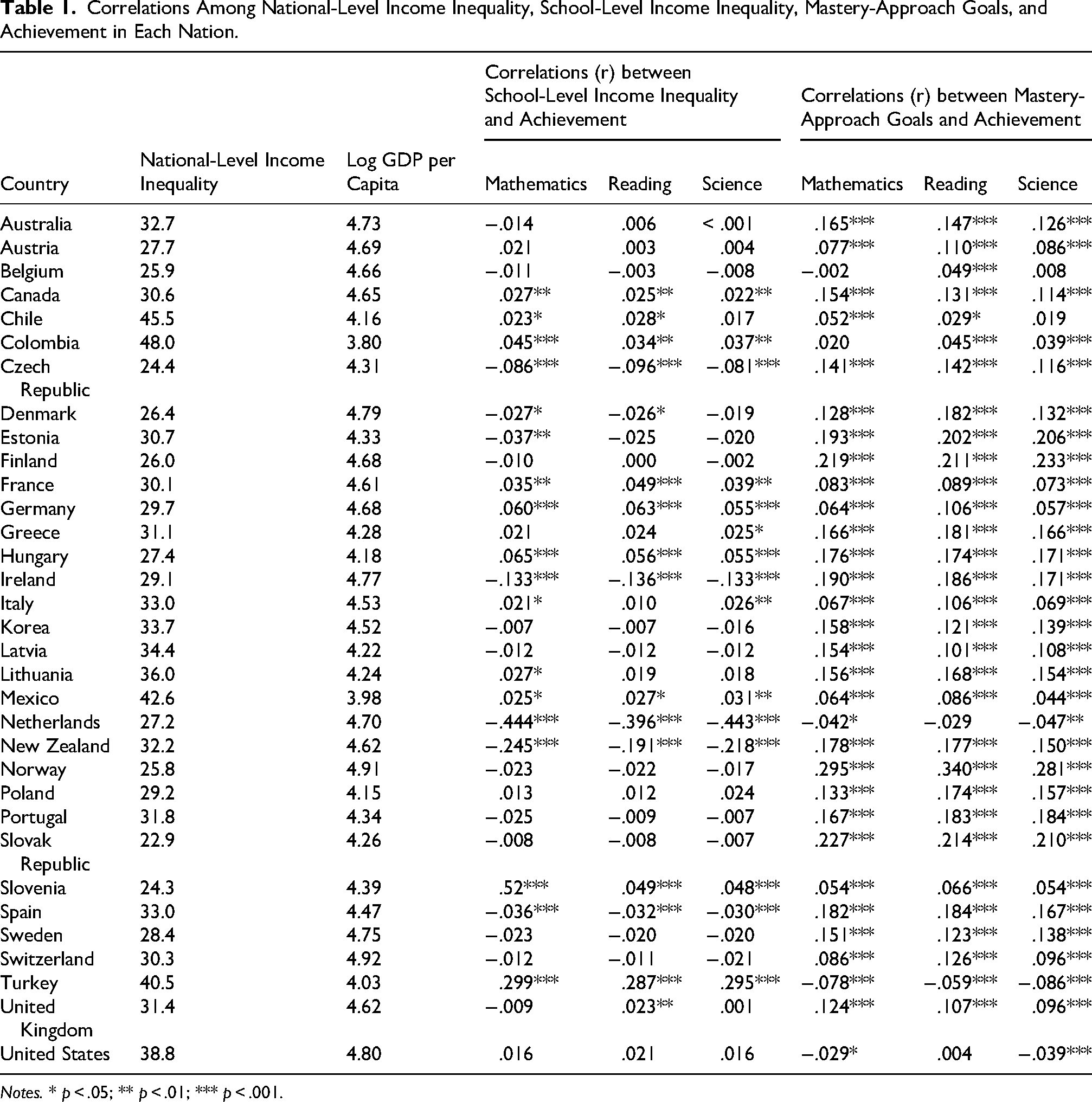
Notes. * p < .05; ** p < .01; *** p < .001.
Measures
National-Level Income Inequality
National-level income inequality was assessed using the Gini index from the Standardized World Income Inequality Database (Solt, 2020). The Gini index quantifies income dispersion on a scale from 0, indicating perfect equality (all individuals have the same income), to 100, denoting complete inequality (one individual possesses all income while others have none). Data for the Gini index of 33 OECD countries from the year 2018 were employed in this study (Solt, 2020).
School-Level Income Inequality
School-level income inequality was quantified by computing a school-level Gini coefficient for each school based on the dispersion of family economic, social, and cultural status (ESCS, a SES index formulated by PISA; OECD, 2019a). The Gini coefficient, commonly used to assess national-level income inequality, was applied here to the distribution of ESCS values at the school level, with a higher school-level Gini coefficient indicating greater inequality within that school. This approach has been used in prior studies that drew on the PISA dataset (e.g., Chiu, 2015; King et al., 2022).
Mastery-Approach Goals
Mastery-approach goals were measured using the index of mastery-approach goals provided in the PISA 2018 (OECD, 2019b). This index comprises three 4-point items, rated from 1 (not at all true for me) to 4 (extremely true for me). This scale was adapted and developed by the OECD based on the previously published Achievement Goal Questionnaire-Revised (Elliot & Murayama, 2008). A sample item is, “How true for you: My goal is to completely master the material presented in my classes.”
Mathematics Achievement, Reading Achievement, and Science Achievement
The PISA dataset contains achievement scores in three subjects: Mathematics, reading, and science. Ten plausible values were provided to indicate the estimates of the score the individual student might reasonably have from the assessment for each subject (OECD, 2009). Plausible values were generated using latent regression models that applied Item Response Theory (IRT) to scale cognitive data across multiple domains and incorporate background variables such as gender and participation in academic or non-academic activities as covariates. This method imputes ten proficiency values for each student, providing a range of potential scores rather than a single-point estimate for each domain, thereby acknowledging the uncertainty in a student's true achievement level (Lechner et al., 2021). These plausible values were scaled to have a mean of 500 and a standard deviation of 100 using the Rasch model PISA achievement scores, and the mean scores of ten plausible values of each subject were calculated to represent achievement in mathematics, reading, and science, respectively (OECD, 2019a).
Covariates
Participants’ gender (0 = female and 1 = male), grade level (coded 7–13 to represent Grades 7 through 13, respectively), SES (operationalized as the ESCS), and immigration status (0 = native, 1 = second-generation immigrant, and 2 = first-generation immigrant) were included as covariates. At the country level, we included Gross Domestic Product (GDP) per capita in 2018 (in U.S. dollars; World Bank, 2019), which was log-transformed for analysis (logGDP).
Data Analysis
The analyses were conducted using SPSS Version 29 and Mplus version 8.2. The incidence of missing data across all variables was minimal, peaking at 11% for mastery-approach goals. To address this, missing values were imputed using the Markov Chain Monte Carlo (MCMC) method, which is noted for its high accuracy in handling missing data, thus enabling the analysis of complex datasets (Marjoram et al., 2003).
The PISA dataset exhibited a nested structure, with students nested within schools, and schools nested within countries. To adequately account for this hierarchical configuration, three-level linear modeling was employed. This approach helps to disaggregate the residuals at the student, school, and country levels, thereby minimizing estimation biases. All student-level variables were school-mean centered, school-level variables were country-mean centered, and country-level variables were standardized to a mean of zero and a standard deviation of one. This centering strategy facilitated interpretation, reduced multicollinearity, and addressed between-country heterogeneity in the estimation of school- and student-level effects (Enders & Tofighi, 2007; Marjoram et al., 2003). Additionally, final student sampling weights were applied to address sampling errors and allow for population-level inferences (OECD, 2019a).
The analytical framework adopted for this study utilized a sequential modeling approach to rigorously test the hypotheses through a series of progressively complex models (Raudenbush & Bryk, 2002). Initially, null models were constructed as an unconditional model, incorporating only an intercept to ascertain the proportion of variance in mathematics, reading, and science achievement attributable to factors at the student, school, and country levels. This was quantified using the intraclass correlation coefficient (ICC).
Subsequently, we progressed to Model 1 (M1), which encompassed multilevel regression models developed specifically to explore whether mastery-approach goals, SES, school-, and national-level income inequality are associated with mathematics (M1a), reading (M1b), and science achievement (M1c). Building on this, Model 2 (M2) extended M1 by incorporating cross-level interactions between national-level inequality and mastery-approach goals, as well as school-level inequality and mastery-approach goals, to examine whether associations between mastery-approach goals and achievement were moderated by the levels of income inequality at the national and school levels. M2 also further examined whether SES moderates the associations of national- and school-level income inequality with achievement, as well as whether SES further moderates the cross-level interactions between mastery-approach goals and national-/school-level inequality.
To enhance the robustness of the findings and account for potential confounding variables, a multilevel moderation model with covariates (M3) was employed. This step further refined M2 by controlling variables at the student (including grade, gender, and immigration status) and country (log GDP) levels, providing a more comprehensive analysis of the hypothesized associations.
Results
Preliminary Analyses
The overall correlations for the whole sample are presented in Table 2, and the correlations specific to each country are detailed in Table 1. The scatterplots show how national-level (Figure 1) and school-level (Figure 2) income inequality is associated with achievement in mathematics, reading, and science.

National-level income inequality weakens the association between mastery-approach goals and (a) mathematics achievement, (b) reading achievement, and (c) science achievement.
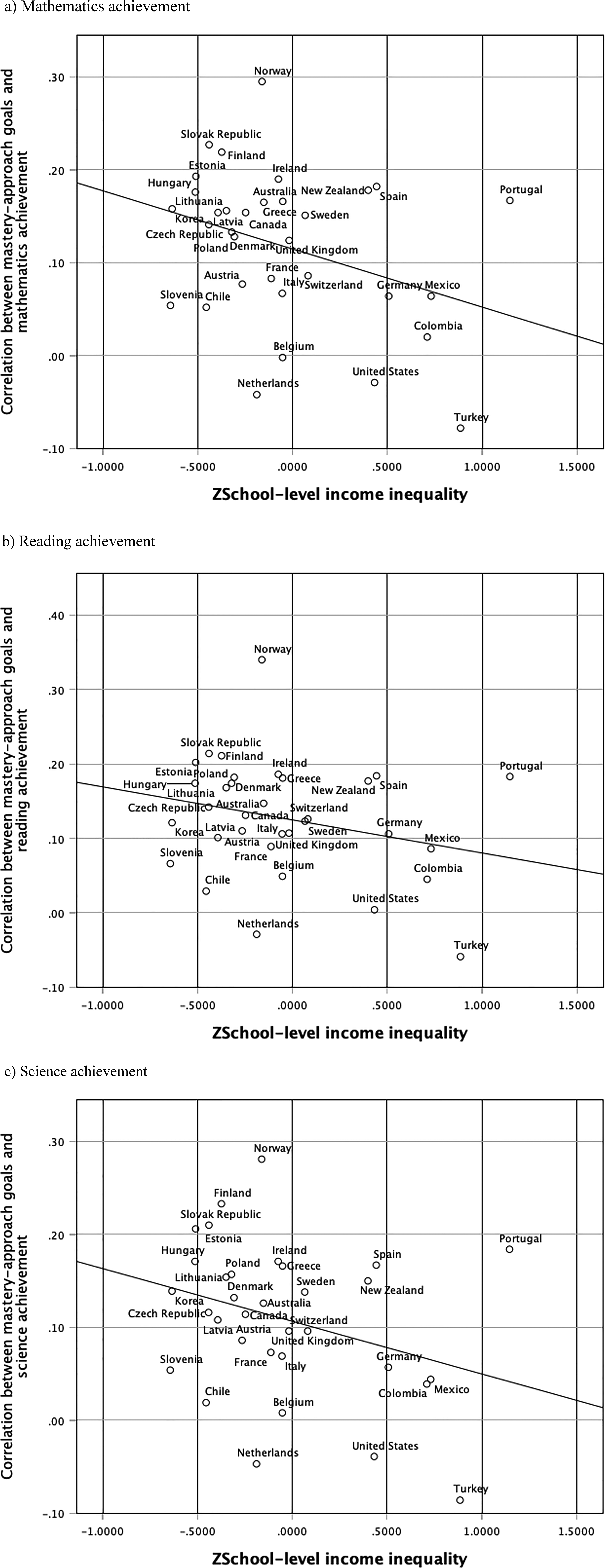
School-level income inequality weakens the association between mastery-approach goals and (a) mathematics achievement, (b) reading achievement, and (c) science achievement.
Descriptive Statistics and Correlations among the Variables.
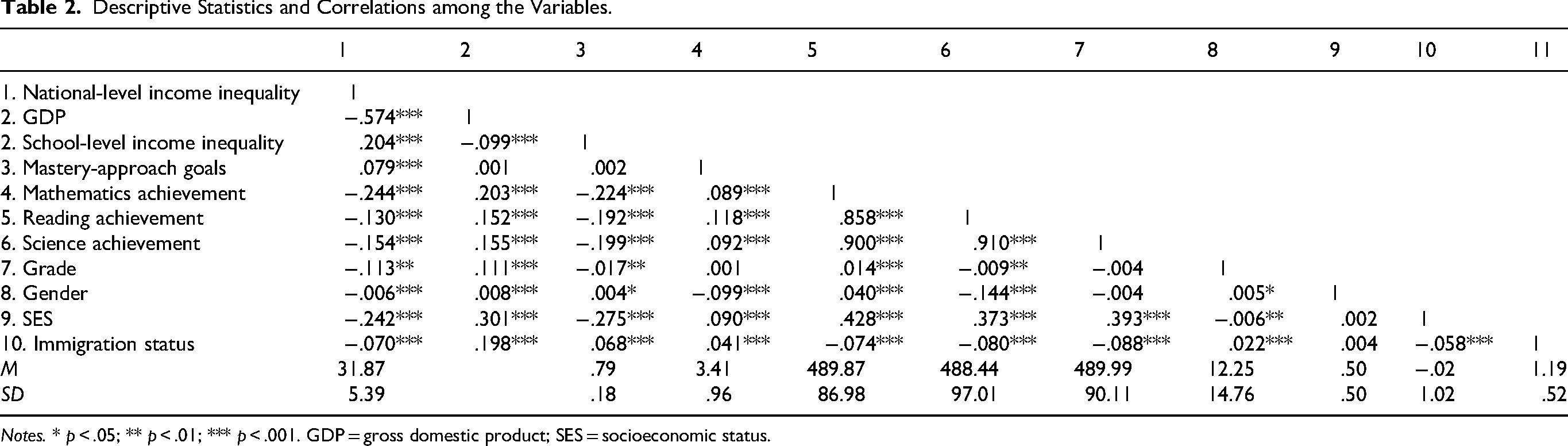
Notes. * p < .05; ** p < .01; *** p < .001. GDP = gross domestic product; SES = socioeconomic status.
Null Models
The ICCs revealed that a noteworthy portion of the variance in achievement in all three subjects was attributable to the country and school levels. Specifically, the ICCs demonstrated that 11.8% of the variance in mathematics achievement, 6.9% in reading achievement, and 7.9% in science achievement were at the school level. At the country level, the variances were even greater: 31.1% for mathematics, 29.1% for reading, and 29.5% for science. This means that a three-level analysis is appropriate to account for the variance attributable to the country and school levels.
Testing H1, H2, and H3
As shown in Table 3, we tested multilevel regression M1 models, and the results showed that mastery-approach goals were positively associated with mathematics (β = .09, p < .001), reading (β = .11, p < .001), and science (β = .09, p < .001) achievement. Thus, H1a, H1b, and H1c were supported.
Mastery-Approach Goals and Income Inequality as Predictors of Academic Achievement.

Notes. * p < .05; ** p < .01; *** p < .001. SES = socioeconomic status; GDP = gross domestic product.
Meanwhile, national-level income inequality was negatively associated with mathematics (β = −.74, p < .001), reading (β = −.45, p < .001), and science (β = −.54, p < .001) achievement. Hence, H2a, H2b, and H2c were supported. At the school level, the results indicated significant negative associations between school-level income inequality and achievement in mathematics (β = −.29, p < .001), reading (β = −.29, p < .001), and science (β = −.29, p < .001); thus, H3a, H3b, and H3c were supported.
Testing H4 and H5
The cross-level interaction between mastery-approach goals and national-level income inequality was negatively associated with achievement in mathematics (β = −.07, p < .001), reading (β = −.05, p < .001), and science (β = −.05, p < .01). Thus, H4a, H4b, and H4c were supported. Furthermore, the interaction between mastery-approach goals and school-level income inequality was negatively associated with achievement in mathematics (β = −.03, p < .001), reading (β = −.03, p < .001), and science (β = −.03, p < .001). Thus, H5a, H5b, and H5c were supported.
Testing H6 and H7
Mathematics (β = −.16, p < .001), reading (β = −.08, p < .05), and science (β = −.10, p < .01) were also negatively associated with the cross-level interaction between national-level income inequality and SES. Thus, H6a, H6b, and H6c were supported. Furthermore, the interaction between national-level income inequality and SES was significantly associated with mathematics (β = −.06, p < .001), reading (β = −.05, p < .001), and science achievement (β = −.06, p < .001). Thus, H7a, H7b, and H7c were supported.
Testing H8 and H9
Additionally, SES significantly moderated the interaction between mastery-approach goals and national-level income inequality on achievement in mathematics (β = −.02, p < .001), reading (β = −.01, p < .05), and science (β = −.01, p < .01). Thus, H8a, 8, and H8c were supported. Furthermore, the interaction among mastery-approach goals, school-level income inequality, and SES was significantly associated with mathematics (β = −.01, p < .001), reading (β = −.01, p < .001), and science achievement (β = −.01, p < .001). Thus, H9a, H9b, and H9c were supported.
Multilevel Moderation Models with Covariates
To enhance the robustness of the findings and account for potential confounding variables, we further tested the above multilevel moderation model with covariates. Most associations remained consistent after adjusting for these covariates; however, national-level income inequality was not significantly associated with reading (β = −.17, p = .31) and science achievement (β = −.29, p = .07). Meanwhile, all interactions involving national-level income inequality (mastery-approach goals × national-level income inequality, national-level income inequality × SES, and mastery-approach goals × national-level income inequality × SES) were no longer significantly associated with reading and science achievement, after covariates were controlled.
Discussion
The present study revealed three important findings. First, aligning with previous studies, we found positive associations between mastery-approach goals and academic achievement in mathematics, reading, and science.
Second, national- and school-level income inequality were negatively associated with achievement, but the strength of these associations varied across domains. Without controlling for GDP, national-level income inequality was associated with lower achievement across all three subjects, whereas with GDP included, only the negative association with mathematics achievement remained significant, consistent with previous research suggesting that mathematics may be especially sensitive to socioeconomic disparities (Condron, 2011; Dekker & Fischer, 2008). In contrast, school-level inequality was consistently and robustly associated with lower achievement in all three subjects.
Third, we found that both national- and school-level income inequality moderated the association between mastery-approach goals and academic achievement. These moderation effects were significant across three subjects before GDP adjustment, and the moderating roles of school-level income inequality were robust after GDP was included. At the national level, the weakening moderating role of income inequality on mastery-approach goals was more sensitive, disappearing for reading and science achievement once GDP was controlled.
Fourth, we extended prior research by showing that SES moderated these associations. Lower-SES students were disproportionately disadvantaged by national- and school-level income inequality, and the positive role of mastery-approach goals was further attenuated for lower-SES students in more unequal contexts.
Mastery-Approach Goals
We found that mastery-approach goals are directly associated with academic achievement in core subjects such as mathematics, reading, and science. These findings corroborate prior work which have consistently linked mastery-approach goals to favorable academic outcomes (Elliot & Sommet, 2023; Guo et al., 2023; Huang, 2012; Van Yperen et al., 2014). Furthermore, by investigating mastery-approach goals in the context of national and school-level income inequality, the present study extended prior work on achievement goals by highlighting the importance of a socio-ecological perspective (Wilkinson & Pickett, 2021).
Income Inequality
We found some differences between national- and school-level income inequality regarding academic achievement. The associations with national-level income inequality were more fragile to covariate adjustment. Our results revealed that significant negative associations with reading and science achievement disappeared after accounting for GDP, suggesting that broader economic prosperity and investment in human capital may partially offset the effects of inequality in these domains (Chiu, 2010; Hanushek & Woessmann, 2012). Mathematics achievement, however, remained linked to national-level income inequality, possibly because mathematics performance is more tightly tied to systemic inequalities in school funding, curricular quality, and teacher preparation (Condron, 2011; Dekker & Fischer, 2008).
School-level inequality, on the other hand, was consistently associated with lower achievement in mathematics, reading, and science. It is possible that the influence of school-level income inequality is experienced more proximally compared to national-level income inequality, which may exert a more distal influence. For instance, in highly unequal schools, learners might have unequal access to learning support or feel that academic success is less attainable (Blanden et al., 2023; Chiu, 2010). These issues may exert greater daily influence than broader, nationwide inequality that, while influential, can be less visible to students.
Robustness and Interpretation of GDP Effects
Importantly, the current findings revealed that some associations are highly stable across model specifications (e.g., school-level income inequality and SES), whereas others (e.g., national-level income inequality) are sensitive to the inclusion of GDP. This pattern indicates that inequality effects are not reducible to national wealth, but that the average level of economic development interacts with inequality in students’ academic achievement. One possible explanation is that GDP captures broader investments in educational infrastructure and social protection (Hanushek & Woessmann, 2012; OECD, 2019), which can buffer the negative impact of inequality in domains such as reading and science, where exposure to cultural resources and language-rich environments plays a central role (Evans et al., 2010). Mathematics, in contrast, may be more directly dependent on the quality of schooling and instructional practices, which remain highly stratified in unequal contexts, even after accounting for national prosperity.
Moderating Roles of National- and School-Level Income Inequality
A key novelty of our research lies in its examination of how mastery-approach goals function within varying levels of income inequality at the national and school levels. In environments with lower income inequality, mastery-approach goals are effectively associated with academic achievement because these settings offer more equitable access to educational resources and opportunities (Chiu, 2010; King et al., 2022). In contrast, in higher inequality settings, the effectiveness of mastery-approach goals may be compromised. Students in these environments face structural barriers that can impede their ability to engage fully with learning despite their achievement goals. Linking achievement goals to socio-ecological factors such as income inequality offers a more comprehensive understanding of how personal and contextual factors interact in influencing educational outcomes.
Moreover, our research contributes significantly to the broader discourse on income inequality and education by demonstrating that these economic disparities can attenuate the association between mastery-approach goals and academic achievement. Previous studies have predominantly focused on more immediate or direct impacts of inequality on education outcomes (Du et al., 2024; King et al., 2022). Our findings suggest that the associations between achievement goals and academic achievement are also crucially shaped by the broader socioeconomic contexts.
Furthermore, SES compounded these unequal dynamics. Lower-SES students were doubly disadvantaged, as income inequality both directly lowered their academic achievement and reduced the positive returns of mastery-approach goals. These findings align with previous research showing that inequality operates through both structural and psychological mechanisms, which disproportionately undermine the performance of lower-SES students (Claes et al., 2024; King et al., 2022).
Theoretical and Practical Implications
This study significantly contributes to the integration of achievement goal theory with the socio-ecological perspective, research areas that have traditionally progressed independently. While extensive research has explored achievement goals within educational psychology, less attention has been paid to how socio-ecological contexts, such as national-level and school-level income inequality, impact these goals and the subsequent academic outcomes.
Theoretically, these findings broaden the scope of achievement goal theory by integrating it with perspectives on income inequality. Achievement goal theory emphasizes that competence—whether it centers on personal growth or outperforming others—shapes students’ motivation and engagement (Elliot & Sommet, 2023). Our results indicate that mastery-approach goals might not function uniformly across all contexts. In higher-inequality environments, students may be more aware of disparities in resources and support, which can undermine their motivation to strive for improvement. Mastery-approach goals, while generally linked to deeper learning and resilience, may be undercut by external obstacles such as insufficient learning materials or peers who face similar resource-related challenges.
By linking mastery-approach goals with income inequality, our research illustrates and highlights how a socio-ecological perspective reveals the interplay between achievement goals and the broader socio-ecological context. This idea resonates with socio-ecological views of learning, where individual motivation is influenced by nested contexts (Skinner et al., 2022). From a theoretical perspective, it is likely that the observed associations are not unique to mastery-approach goals. Although this study was limited to mastery-approach goals, performance-approach and performance-avoidance goals have also been found to be significantly influenced by competitive environments (Elliot et al., 2018; Van Yperen et al., 2014). It is possible that income inequality could also shape performance-based goals by intensifying social comparison and fostering perceptions of relative deprivation (Rodriguez-Bailon et al., 2017; Sommet & Elliot, 2023). Inequality might also influence performance-based goals by amplifying competition and heightening anxiety. These ideas remain speculative, and future research is needed to determine whether such mechanisms operate consistently across different achievement goals.
Practically, the present research underscores the need for policymakers and practitioners to make learning settings more equitable so that mastery-approach goal pursuit can thrive. This could involve distributing resources more evenly, offering strong support to students from underprivileged backgrounds, and creating targeted programs that address diverse socioeconomic conditions (Muijs et al., 2004; Reimers, 2000).
In addition, these findings highlight how socio-ecological contexts can reduce the effectiveness of mastery-approach goals in certain schools. While mastery-approach goals generally support academic success, they may not be as helpful when there is a large income gap among students. Consequently, interventions aimed at strengthening mastery-approach goals should also address the effects of income inequality to ensure that all students can benefit.
Limitations and Future Directions
Several limitations of this research should be acknowledged. First, the use of PISA data, which are cross-sectional, does not allow a test of the causal relationships among mastery-approach goals, income inequality, and academic achievement. Longitudinal studies and experimental designs are necessary to determine causal relationships and track the development of achievement goals and income inequality over time.
Second, our analysis was restricted to 15-year-old students participating in the PISA. The associations among mastery-approach goals, income inequality, and academic achievement might differ across various age groups. Future research could benefit from examining these associations among different age groups.
Third, this study's focus was solely on mastery-approach goals, as these were the only achievement goals measured in the PISA 2018 dataset. This restriction precluded examination of other achievement goals, namely performance-approach, performance-avoidance, and mastery-avoidance goals. Future research would do well to include a broader range of achievement goals to develop a more comprehensive understanding of how inequality might moderate the influence of achievement goals.
Fourth, we focused on national and school-level income inequality but not other aspects of inequality, such as racial inequality and neighborhood segregation. Previous studies indicate that racial and neighborhood inequities can impact students’ everyday experiences and social interactions (Gordils et al., 2020; Pabayo et al., 2014; Roksa et al., 2017), potentially influencing their motivation and academic trajectory. Future research could incorporate these additional demographic and structural dimensions to provide a more comprehensive understanding of how various socio-ecological factors intersect with achievement goals to influence educational outcomes.
Conclusion
The present research advances our understanding of how mastery-approach goals relate to academic achievement within broader socio-ecological contexts. While mastery-approach goals are positively associated with achievement, their benefits are weakened in more unequal schools and countries, particularly for lower-SES students. Overall, our study highlights the need to address both achievement goals and broader socio-ecological contexts to foster academic success for all students.
Footnotes

Funding
This research was fundedby the Hong Kong General Research Fund (RGC Ref No. 14612424) and The Chinese University of Hong Kong Direct Grant (Project Code: 4058101) conferred to the corresponding author.
Declaration of Conflicting Interests
The authors declared no potential conflicts of interest with respect to the research, authorship, and/or publication of this article.