




Abstract
Despite a considerable body of literature on involution behavior, there has been an overlook of its measurement and predictors. We conducted two studies to address this issue. In Study 1, we developed an involution behavior scale through in-depth interview (N = 26) and surveys (N = 735). Based on grounded theory, the scale was categorized into three dimensions: meaningless work, compelled effort behavior, and health sacrificing behavior. In Study 2, integrating social comparison theory, self-determination theory and social cognitive theory, we investigated how subjective socioeconomic status (SES) impacts involution behavior. Using a cross-lagged design and two-wave data (N = 300), we identified a chain mediating role of competence satisfaction and self-efficacy in the relationship between subjective SES and involution behavior. These findings are of theoretical and practical significance for our understanding of Chinese involution behavior.
Keywords
Introduction
Scholars from various disciplines (e.g., philosophy, sociology, anthropology) have conducted in-depth research on the definition of involution, characterizing it as a state of “growth without development.” In 2020, involution (neijuan) has become a buzzword in China and was given psychological significance (Zhang et al., 2024). It is increasingly conceptualized within psychology as an irrational or inefficient effort pursued for expected outcomes (Yan et al., 2022). For example, while students are typically required to submit a 3,000-word course paper, some may choose to write 10,000 words in an attempt to achieve higher grades, potentially inducing anxiety or stress among peers. In this line, other students may feel compelled to increase their paper length to enhance their competitiveness and prospects for higher grades, exemplifying involution behavior.
Numerous studies have evidenced that involution behavior can lead to a range of negative psychiatric and psychological consequences, such as anxiety (Yi et al., 2022), and job burnout (Dou et al., 2022). Thus, it is important to explore the antecedents of involution to reduce its negative impact. However, due to the limited measurement of involution behavior, there is a lack of empirical research tackling the question. The existing involution behavior scale mainly targets academic involution behavior among college students (Yan et al., 2022; Zheng et al., 2022), which limits its applicability to broader populations. To better explore the anticipants and consequences of people's involution behavior, we believe that it is necessary to develop a new involution behavior scale for general populations.
Moreover, subjective socioeconomic status (SES) refers to individuals’ perception of their own socioeconomic standing within a societal context (Adler et al., 2000). Evidence shows that subjective SES is strongly related to competitive mindset, such as motivations to acquire wealth and status (Wang et al., 2020). Therefore, subjective SES might be an important factor in predicting individuals’ involution behavior. In particular, we propose that subjective SES impacts individuals’ involution behavior via a psychological process from competence satisfaction to self-efficacy based on social comparison theory (Festinger, 1954), self-determination theory (Deci & Ryan, 1985, 2000), and social cognitive theory (Bandura, 1997). Specifically, compared to those with high subjective SES, individuals with low subjective SES are more likely to feel more disadvantaged than others and less control in the society (Domhoff, 2018), which could not satisfy their competence needs (Greitemeyer & Sagioglou, 2016). Thus, they tend to lack confidence in facing fierce competition, thereby forcing themselves to engage in more involution behavior to secure resources (Yi et al., 2022).
To sum up, this study attempts to (1) develop a measure of involution behavior and (2) investigate the potential effects of subjective SES on involution behavior, examining the mediating roles of competence satisfaction and self-efficacy.
Theoretical Background and Research Hypothesis
Involution Behavior
The term “involution” has its own definition in different academic fields. In the eighteenth century, Immanuel Kant, a philosopher contrasted involution with evolution, describing that involution is a phenomenon of pursuing increments without any evolution (Kant & Pluhar, 1999). In the 1930s, Alexander Goldenweiser, an American anthropologist, adopted the term to denote cultural patterns that intensify in complexify under fixed external constraints, failing to evolve into new forms (Goldenweiser, 1936). In 1965, Clifford Geertz applied involution to Indonesian agriculture, where labor input continued to increase despite limited land area (Geertz, 1965). In 1986, Phillip C. C. Huang, a sociologist, extended this term to describe a phenomenon of China's rural economy: diminishing individual income amid expanding labor forces (Huang, 2021). To sum up, scholars characterized involution as a state of “growth without development” (Huang, 2021; Kant & Pluhar, 1999).
Later, involution was investigated in psychology, and many scholars have attempted to define it across various contexts (e.g., Dou et al., 2022; Yi et al., 2022). Some scholars focused on the state of employee involution and described it as employees facing intense internal competitive pressure, constantly sinking into energy and physical exhaustion, accompanied by doubts about self-efficacy (Dou et al., 2022). Some scholars regarded involution as a multidimensional construct and proposed four dimensions of involution: resource scarcity, social norm, psychological pressure, and competition (Zhang et al., 2024). That is, when individuals face a scarcity of social resources, competition within the organization may arise and occur frequently due to the competition for resources, resulting in new behavioral patterns — new social norms. Other scholars explored college students’ academic involution behavior and defined it as irrational competition for limited resources driven by peer pressure or extrinsic motivation (e.g., Yan et al., 2022; Zheng et al., 2022). Although the concept of involution in the current literature is relatively scattered, there are many similarities in their definitions of involution behavior, which is the pursuit of personal gains and avoidance of costs, social comparisons with others, and compulsory irrational efforts.
First, individuals possess a fundamental motivation to maximize gains and minimize costs. In resource-scarce environments, individuals tend to closely monitor available resources and invest disproportionate time and effort to secure them (Grossman & Mendoza, 2003). For example, college students’ admissions heavily depend on academic performance (Yi et al., 2022), and employees’ performance often hinges on their superiors’ subjective evaluation (Dou et al., 2022). These conditions can easily lead individuals to make competitive decisions in various aspects after cost-benefit analysis, striving to succeed within constrained systems and maximize desired outcomes.
Second, involution behavior fundamentally manifests as social comparison, particularly with high-achieving peers (Dou et al., 2022; Yan et al., 2022; Yi et al., 2022). Within resource-scarce environments, individuals have to make social comparisons with others around them to surpass others and secure resources. Social comparison theory posits that individuals would evaluate themselves through comparing with others around them, especially when there are no clear evaluation standards (Festinger, 1954). Crucially, upward comparisons with higher-performing peers may reduce self-esteem (Richmond et al., 2021) and trigger intense competitive responses such as involution behaviors (Gerber et al., 2018).
Third, involution behavior is generally characterized by compulsory irrational efforts (Dou et al., 2022; Yi et al., 2022). This manifests when individuals are compelled to put in disproportionate energy (e.g., imitating others’ actions) to acquire relevant resources, particularly following social comparison with others around them (Grossman & Mendoza, 2003). That is, when people compare themselves to those who are excellent, they might experience negative emotions such as anxiety and pressure, ultimately promoting themselves to engage in similar behaviors like others or putting in irrational efforts, to avoid competitive disadvantage (Yi et al., 2022). It is worth noting that involution behavior is different from reasonable efforts/involvement and competition. People participate in reasonable effort/involvement and competition to gain benefits or enhance their reputation or status, but these behaviors are often initiated by internal motivations (Shwalb et al., 1989), and the core of the behavior is the motivation to acquire resources or occur out of interest rather than comparative pressures (Yi et al., 2022).
Hence, we defined involution behavior as compulsory irrational effort driven by upward social comparisons to achieve competitive success or avoid failure.
Subjective SES and Involution Behavior
As social animals, humans are profoundly influenced by socioeconomic status, which shapes their cognition and behavior (Craik, 1973). Subjective SES refers to people's perception of their own socioeconomic status within a society (Adler et al., 2000). Compared to objective SES, subjective SES contains psychological factors (e.g., Adler et al., 2000; Tan et al., 2020), besides the objective economic factors (e.g., income, education). Subjective SES could be influenced by transient moods, or personal beliefs, which could significantly predict behavioral outcomes (Tan et al., 2020). Previous studies have evidenced that subjective SES is associated with human health, psychological well-being, and behaviors (Greitemeyer & Sagioglou, 2018; Tan et al., 2020). Specifically, high subjective SES could promote people's physical health (Kim & Radoias, 2021; Yang et al., 2024), and well-being (Zhao et al., 2021), while low subjective SES might lead to negative behaviors, such as aggression (Greitemeyer & Sagioglou, 2016), and conspicuous consumption (Wang et al., 2022).
According to social comparison theory (Festinger, 1954), individuals identify and pursue their own subjective SES through social comparisons (Becker et al., 2017). People with low subjective SES would exhibit heightened environmental sensitivity. Specifically, they would feel more disadvantaged than others (Greitemeyer & Sagioglou, 2016), more economic and psychological pressures, less personal freedom, and less control in the society (Domhoff, 2018). In this line, they might disproportionately adopt externally defined goals, mirroring majority-valued behaviors (e.g., compulsive overwork in resource-scarce contexts) to obtain limited social resources, even when such efforts yield diminishing returns. By contrast, people with high subjective SES may also exhibit stronger motivations to acquire wealth and status (Wang et al., 2020). Nevertheless, high subjective SES allows individuals to perceive more social and psychological capital than others (Jia et al., 2021), which could boost their confidence in competition. Crucially, the social/psychological capital enables them to anchor decisions in internal goals and autonomous motivation, rather than external comparison. Thus, people in high subjective SES would engage in more reasonable efforts and competition and less involution behavior. Therefore, we propose the following hypothesis:
The Mediating Role of Competence Satisfaction
According to self-determination theory, human development (e.g., psychological well-being) was significantly influenced by three basic psychological needs (i.e., autonomy, relatedness, and competence) (Deci & Ryan, 1985, 2000). Competence, a type of psychological fundamental need, is the desire to demonstrate and improve one's abilities (Cerasoli et al., 2016). Previous studies have identified that competence satisfaction plays an important role in performance outcomes and work behaviors (Cerasoli et al., 2016; Pinder, 2011; Trépanier et al., 2013; Weigelt et al., 2019). Thus, we proposed that competence satisfaction could be an essential mediator in the relationship between subjective SES and involution behavior.
Subjective SES could satisfy individuals’ competence needs. Specifically, the satisfaction of competence needs depends on the degree to which the social environment is responsive to individuals’ abilities (Deci & Ryan, 2000). As discussed before, high subjective SES grants enhanced access to environmental resources (Jia et al., 2021), which could provide individuals with a greater sense of control over their lives (Domhoff, 2018), thus fulfilling their competence needs. Moreover, competence satisfaction might alleviate an individual's involution behavior. Competence satisfaction boosts individuals’ self-confidence (Erdvik et al., 2020) and shifting focus toward their own growth and goals rather than external comparisons (Meng et al., 2024; Schüler et al., 2010). However, if individuals’ competence needs are not satisfied, they might evaluate their abilities and value through social comparison with others around them (Festinger, 1954). When observing others work hard, they might force themselves to engage in irrational efforts to secure resources. Therefore, we propose the following hypothesis:
The Mediating Role of Self-Efficacy
Self-efficacy refers to individuals’ belief in their capacity to execute tasks successfully (Bandura, 1997). A large body of knowledge has accrued from research on the positive relationship between self-efficacy and well-being (Fino & Sun, 2022), mental health (Sharma & Kumra, 2022; Zhou et al., 2021), creativity (Puozzo & Audrin, 2021), work or academic performance (Alghamdi et al., 2020; Chen et al., 2024; Li et al., 2023; Wu et al., 2020). Moreover, previous studies have evidenced that self-efficacy buffered the negative effect of bad childhood experiences on individuals’ health (Cohrdes & Mauz, 2020). Social cognitive theory posits that self-efficacy is the most effective determinant of human motivation, cognition, and behavior (Bandura, 1997; Benight & Bandura, 2004). Thus, we proposed that self-efficacy could be an essential mediator to explain why subjective SES and competence satisfaction reduce involution behavior.
On the one hand, people with high subjective SES might report higher self-efficacy. Compared to low subjective SES, high subjective SES provide people with greater access more social, material, and cultural resources, which could help them achieve goals and overcome difficulties (Gallo et al., 2005), thereby fostering their self-efficacy. Moreover, high SES might be accompanied by more positive feedback (Farah, 2017), which could make people gain more self-efficacy or confidence to move forward. Previous studies have evidenced that subjective SES was positively associated with self-efficacy (Boardman & Robert, 2000; Tazouti & Jarlégan, 2019). On the other hand, competence satisfaction might also promote people's self-efficacy (Klaeijsen et al., 2018). Social cognitive theory suggested that an individual's self-efficacy could be developed through past positive experiences and affective states (Bandura, 1997; Benight & Bandura, 2004). Competence satisfaction could make people experience positive affects, such as a sense of achievement (Quested & Duda, 2010), which can reinforce people's affirmation of their own abilities.
Furthermore, low self-efficacy might result in more involution behavior. According to social comparison theory, in resource-scarce competitive environments, people will inevitably estimate their opportunities to acquire resources through peer comparisons (Festinger, 1954), trggering stress and anxiety (Haney & Long, 1995; Yi et al., 2022). Crucially, self-efficacy plays a key role in stress reactions and the quality of coping in threatening situations (Bandura, 1997). Individuals with high self-efficacy believe that they can achieve their goals through their own efforts (Sopiah et al., 2021), reducing reliance on comparative evaluation and vulnerability to competitive pressures. By contrast, individuals with low self-efficacy undermines confidence in handling emotions and achieving goals, fostering chronic insecurity (Muris, 2002; Schönfeld et al., 2017). In contexts of perceived resource scarcity, this insecurity can prompt compensatory behaviors—individuals may initially conform to group standards to access resources, but anxiety about inadequacy may push them to strive for superiority over peers. For example, they might force themselves to put in the same or more irrational efforts as others, even if these things are meaningless (Yi et al., 2022). Based on the above, we put forward the following hypothesis:
Based on the above reasoning, integrating social comparison theory, self-determination theory, and social cognitive theory, we further propose a comprehensive research framework to explain why subjective SES reduces people's involution behavior. Specifically, people with low subjective SES are more likely to feel more disadvantaged than others, which could not meet their competence needs (Greitemeyer & Sagioglou, 2016). Thus, they tend to show a lack of confidence in facing intense competition, thus forcing themselves to put in more irrational efforts to obtain scarce resources (Yi et al., 2022). By contrast, people with high subjective SES could perceive more social resources and capital than others, which could fulfill their competence needs and strengthen their confidence in achieving goals, thus diminishing susceptibility to comparative pressures and reducing involution behavior (Jia et al., 2021; Meng et al., 2024). Accordingly, we propose our conceptual framework (see Figure 1) and the following hypothesis:

Conceptional Framework.
The Present Research
We conducted two empirical studies to test our conceptual framework regarding the process through which subjective SES acts as an antecedent in reducing individuals’ involution behavior 1 . Specifically, Study 1 developed and validated an involution behavior scale through interviews and surveys. In Study 2, using a new sample and cross-lagged design, further explored the chain mediating role of competence satisfaction and self-efficacy in the relationship between subjective SES and involution behavior.
Study 1
In Study 1, we developed an involution behavior scale through in-depth interview and conducted an exploratory factor analysis (EFA; Sample 1) and a confirmatory factor analysis (CFA; Sample 2) 2 on it.
Methods
Participants
Participants for in-depth interview
A total of 26 participants were interviewed (13 women and 13 men, Mage = 26.04, SD = 4.66), representing diverse professions: undergraduate and graduate students, internet operators, sales professionals, state-owned enterprise employees, and university teachers.
Participants for factor analysis
Sample 1 included 348 Chinese participants (114 women and 234 men, Mage = 29.76, SD = 6.29) recruited online via Credamo (https://www.credamo.com), which has been widely used to collect data among scholars (Dong et al., 2023). The sample consisted of 58 students, 72 individuals from state-owned enterprises, 163 from private enterprises, 35 from public institutions, and 20 from foreign-invested enterprises. Sample 2 included 387 Chinese college students recruited via the social platform of authors’ University (144 women and 243 men, Mage = 22.18, SD = 4.30).
Materials and Procedure
In-depth interview
Grounded in our theoretical framework, we formulated the interview questions as follows: (1) How do you define involution? (2) Have you observed involution behaviors among colleagues or classmates? (3) What observable emotional and behavioral manifestations characterize these individuals’ involution? (4) How does involution differ from related concepts like competition, conformity, and social comparison? Each interview lasted 30–50 min, with audio recording conducted after obtaining consent. Participants were rewarded with 40 RMB as compensation after interviews.
Subsequently, interview recordings were transcribed and analyzed using NVivo 12.0 PRO. Following previous studies (e.g., Dong & Xie, 2024), two researchers independently coded the interview transcripts, resolving any discrepancies through discussion to eliminate all nodes with Kappa values below 0.70. Then, thematic findings informed development of the Involution Behavior Scale.
EFA
Participants from Sample 1 completed the initial involution behavior scale. They were asked to indicate how often they behave like each scale item on a 6-point scale ranging from ‘totally disagree’ to ‘totally agree’. EFA was conducted by SPSS 26.0.
CFA
Participants from Sample 2 completed the revised involution behavior scale from EFA. CFA was conducted using Amos 24.0. All other analyses were performed using SPSS 26.0.
Results
In-depth interview
We employed a grounded theory approach, a systematic qualitative methodology for generating theories directly grounded in empirical data (Glaser & Strauss, 1967), through in-depth interviews to clarify the intricate psychological components of involution behavior. The coding process of grounded approach includes open coding (i.e., break down data into discrete concepts), axial coding (i.e., connect categories/subcategories), and selective coding (i.e., integrate categories into a core theory). The results of selective coding were shown in Table 1. Detailed coding results can be found in the website/link (https://osf.io/q9cxf/?view_only=8abe9498ff0e46068d9515f85524eed4). Table 1 showed the number of people who mentioned the performance of involution behavior, the frequency of the performance of involution behavior participants mentioned, and the examples of the performance of involution. Three performances of involution behavior were identified: meaningless work, compelled effort behavior, and health sacrificing behavior. Specifically, meaningless work refers to the behavior of individuals who, excessively focused on gains and losses, compel themselves to expend time and energy on meaningless or trivial pursuits, or engage in superficial social comparisons. Compelled effort behavior refer to the behavior of individuals who compel themselves to put more effort in learning and self-improvement, as well as dedicate additional energy to their work to prevent being eliminated or falling behind others. Health sacrificing behavior refers to the behavior of individuals who persist to work or study despite they feel unwell in order to maintain consistency with others.
The Results (Selective Coding) of in-Depth Interview Transcripts Coding in Study 1.

Note: Files: The number of people who mentioned performance of involution behavior. References: The frequency of performance of involution behavior mentioned.
Then, the initial Involution Behavior Scale was developed, which included three dimensions: meaningless work (e.g., “I intentionally present myself in front of leaders or teachers to gain advantages over others”), compelled effort behavior (“I always push myself to learn more skills to avoid falling behind”), and health sacrificing behavior (e.g., “In order to show my capabilities, I persist in working or studying even when I’m feeling very uncomfortable”), comprising a total of 28 items.
EFA
Responses from Sample 1 were analyzed with EFA. The Bartlett's sphericity test (χ2 = 7255.34, df = 378, p < .001) and the Kaiser-Meyer-Olkin (KMO) measure of sampling adequacy (KMO = .96) indicated that the data were suitable for EFA. We conducted a principal axis factoring with a promax rotation to estimate the factor structure of the involution behavior scale. The following criteria were used to determine the number of factors: (1) eigenvalues greater than 1; (2) commonality greater than .30; (3) factor loadings with absolute values greater than .30, with differences greater than .20 between loadings on different factors. Following these criteria, a total of 20 items were retained, distributed across three factors, with a cumulative variance of 67.50%. The factor loadings for the items ranged from .50 to .90, and the internal consistency coefficients for all three factors were above .80 (see Table 2).
Remaining Items and Results from EFA in Study 1.

We named the three factors as in-depth interview results: Meaningless work, compelled effort behavior, and health sacrificing behavior. Meaningless work (Eigenvalue = 10.28) consisted of 8 items with factor loadings ranging from .63 to .90, accounting for 51.38% of the total variance. Compelled effort behavior (Eigenvalue = 1.75) had 8 items with factor loadings ranging from .54 to .94, accounting for 8.76% of the total variance. Health sacrificing behavior (Eigenvalue = 1.47) consisted of 4 items with factor loadings ranging from .77 to .88, accounting for 7.36% of the variance.
CFA
We conducted CFA with maximum likelihood estimation on sample 2 using Amos 24.0. As shown in Table 3, the three-factorial model (Model 5, Standardized factor loadings and factor covariances for the scale see Figure 2) fit the data significantly better than the alternative models. The composite reliability (CR) and average variances extracted (AVE) for each factor were above the criteria of .90 and .50.

Standardized Factor Loadings and Factor Covariances for The Involution Behavior Scale (N = 387).
Fit Indices for Models with Different Numbers of Factors in Study 1.

Note: χ² = Chi-Square; df = degrees of freedom; GFI = Goodness of Fit Index; CFI = Comparative Fit Index; TLI = Tucker-Lewis Index; IFI = Incremental Fit Index; RMSEA = Root Mean Square Error of Approximation; AVEmin = the minimum AVE; CRmin = the minimum CR. Model 1 = One factor; Model 2 = Meaningless work + Compelled effort behavior and Health sacrificing behavior; Model 3 = Meaningless work and Compelled effort behavior + Health sacrificing behavior; Model 4 = Compelled effort behavior and Meaningless work + Health sacrificing behavior; Model 5 = Meaningless work, Compelled effort behavior and Health sacrificing behavior.
Study 2
To explore the conceptional framework, Study 2 used a new sample to examine the chain mediating role of competence satisfaction and self-efficacy in the relationship between subjective SES and involution behavior. Moreover, following previous studies (e.g., Dong et al., 2023), we collected data at two time points to minimize the likelihood of common method bias caused by questionnaire measurement in the study.
Methods
Participants
In the first time point, 450 adult participants were recruited form Credamo. Data on subjective SES, competence satisfaction and demographic variables (i.e., gender, age, education) were collected. In the second time point, a week later, a final sample of 300 participants (120 men, 180 women; Mage = 29.70, SD = 7.01), completed the follow-up questionnaires measuring their self-efficacy and involution behavior.
Measures
Subjective SES
Subjective SES was measured using the Subjective Social-Economic Status Scale (SES, Adler et al., 2000). Participants were given a picture of a 10-rung ladder and then asked to read the following instructions: “Think of this ladder representing the social status of different people in society. At the top of the ladder are people who are best off, those who have the most money, most education, and the best jobs. At the bottom are people who are the worst off, those who have the least money, least education, and the worst jobs or no job.” Finally, participants were asked to place an X on the rung that best represents where they stood in society, with higher scores indicating higher subjective SES.
Competence satisfaction
Competence satisfaction was measured using the Basic Psychological Need Satisfaction and Frustration Scale (BPNSFS) (Van der Kaap-Deeder et al., 2019). The scale consisted of eight items. The participants rated each item on a 5-point scale ranging from 1 = not at all true to 5 = totally true, with higher scores indicating higher competence satisfaction (Cronbach's α = .86).
Self-efficacy
Self-efficacy was measured using the General Self-efficacy Scale (Schwarzer et al., 1997). The scale consisted of ten items. The participants rated each item on a 5-point scale ranging from 1 = totally disagree to 5 = totally agree, with higher scores indicating higher self-efficacy (Cronbach's α = .89).
Involution behavior
Involution behavior was measured using the Involution Behavior Scale developed in Study 1. The scale consisted of twenty items, including three dimensions: meaningless work (Cronbach's α = .88), compelled effort behavior (Cronbach's α = .90), and health-sacrificing behavior (Cronbach's α = .89). The participants rated each item on a 6-point scale ranging from 1 = totally disagree to 6 = totally agree, with higher scores indicating higher involution behavior (Cronbach's α = .95).
Control variables
Age, gender, and education were included as control variables in the study.
Results
Common method bias
We employed Harman's single-factor test to check for common method bias. The results showed that the single factor explained only 30.94% of the variable and was lower than the suggested value of 40%, which means that common method bias did not appear to be a serious threat to our results.
Descriptive and correlative analysis
The means, standard deviations, and correlation coefficients of the main variables were presented in Table 4.
Descriptive Statistics and Correlation Matrix of Variables in Study 2.

Note: N = 300. Gender: 1 = male, 2 = female. * p < .05,** p < .01,*** p < .001.
Testing for the total effect
We conducted the regression analysis in SPSS 26.0 to test the H1. The results revealed that controlling for age, gender, and education, subjective SES was negatively associated with involution behavior (β = −.17, p < .001), supporting H1. Moreover, we tested the total effect of subjective SES on three dimensions of involution behaviors. The results showed that subjective SES was negatively associated with meaningless work (β = −.18, p < .001), compelled effort behavior (β = −.19, p < .001), and health sacrificing behavior (β = −.10, p < .05), respectively. The results were identical when excluding the control variables.
Testing for the mediation effect
We conducted multiple regression analysis to test the mediation effect. As shown in Figure 3, the results showed that controlling age, gender, and education, subjective SES was positively related to competence satisfaction, β = .23, p < .001. Controlling for subjective SES, competence satisfaction was negatively related to involution behavior, β = −.45, p < .001. Then we used “model 4” of the PROCESS macro 4.0 (Hayes, 2022) in SPSS to test the indirect effect based on 5000 bootstrap samples (Podsakoff et al., 2003). The results showed that there was a significant indirect effect of subjective SES on involution behavior (effect size = −.07, 95%CI = [−.11, −.04]) through competence satisfaction controlling for age, gender, and education, approving H2. Moreover, controlling age, gender, and education, subjective SES was positively related to self-efficacy, β = .28, p < .001. Controlling for subjective SES, self-effcacy was negatively related to involution behavior, β = −.42, p < .001. And there was a significant indirect effect of subjective SES on involution behavior (effect size = −.08, 95%CI = [−.12, −.05]) through self-efficacy controlling for age, gender, and education, approving H3. Smiliarly, controlling age, gender, and education, competence satisfaction was positively related to self-efficacy, β = .58, p < .001. Controlling for competence satisfaction, self-efficacy was negatively related to involution behavior, β = −.27, p < .001. And there was a significant indirect effect of competence satisfaction on involution behavior (effect size = −.24, 95%CI = [−.40, −.13]) through self-efficacy controlling for age, gender, and education, approving H4.

Regression Results of the Mediation Model in Study 2 (Standardized Coefficients) * p < .05, ***p < .001.
Testing the full model
We used “model 6” of the PROCESS macro 4.0 (Hayes, 2022) in SPSS to test the full model. The results are shown in Figure 4 and Table 5. We tested the chain-mediating effect of competence satisfaction and self-efficacy on the relationship between subjective SES and involution behavior, which resulted in a significant effect (effect size = −.02, 95%CI = [−.04, −.01], for other path coefficients, see Figure 4 and Table 5). The results suggested that subjective SES indirectly predicts individual's involution behavior, which is mediated first by competence satisfaction and second by self-efficacy, supporting H5. The results were identical when excluding the control variables.
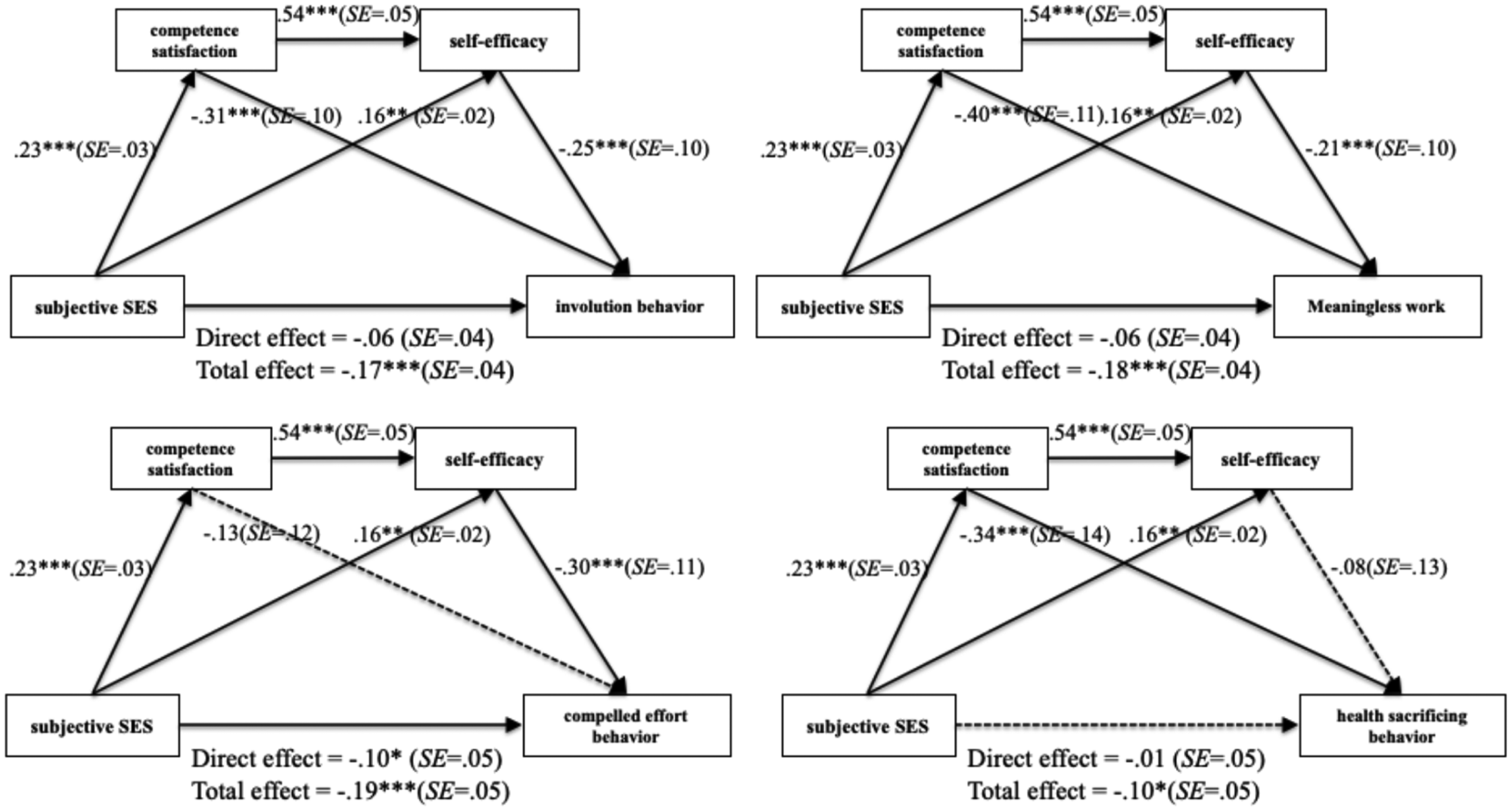
Regression Results of the full Model in Study 2 (Standardized Coefficients). * p < .05, **p < .01, ***p < .001.
Results of Indirect Effects in Study 2.

Note: N = 300. CS: competence satisfaction; SE: self-efficacy; IB: involution behavior; MW: meaningless work; CEB: compelled effort behavior; HSB: health sacrificing behavior
Furthermore, we found the significant effects of competence satisfaction and self-efficacy on the relationship between subjective SES and meaningless work (effect size = −.02, 95%CI = [−.04, −.01]) and compelled effort behavior (effect size = −.04, 95%CI = [−.06, −.01]), respectively. However, we did not find the significant effect of competence satisfaction and self-efficacy on the relationship between subjective SES and health sacrificing behavior (effect size = −.01, 95%CI = [−.03, .01], for other path coefficients, see Figure 4 and Table 5). The results were identical when excluding the control variables.
Discussion
Drawing on grounded theory, we explored the measurement of involution behavior. Specifically, through in-depth interview and factor analysis, Study 1 developed and validated an involution behavior scale, including three dimensions: meaningless work, compelled effort behavior, and health sacrificing behavior. Integrating social comparison theory, self-determination theory, and social cognitive theory, we investigated how individuals’ subjective SES impacted involution behavior through competence satisfaction and self-efficacy. In Study 2, using two-wave data, we identified the chain mediating role of competence satisfaction and self-efficacy in the relationship between subjective SES and involution behavior. That is, low subjective SES could increase people's involution behavior through decreasing their competence satisfaction and self-efficacy.
Notably, compared to the existing involution behavior scales, the scale we developed incorporates a distinct dimension—health sacrificing behavior. The behavior refers that individuals continue to work or study to maintain consistency with others despite feeling uncomfortable, which could reflect the detrimental nature of involution behavior (Yi et al., 2022) and echo the difference between involution behavior and reasonable efforts/involvement and competition. However, our mediation analysis did not support the pathway where low subjective SES increases individual health sacrificing behavior through competence satisfaction and self-efficacy. Emerging evidence suggests that Chinese young scholars overdraw their physical health due to excessive stress (Wang, 2024), implying that health sacrificing behavior may stem less from capability deficits than maladaptive work patterns. Future research could explore the contextual and habitual drivers of this behavior.
Theoretical Implications
Our research has several theoretical implications. First, our research makes an important theoretical contribution to the literature of subjective SES and involution by developing the involution behavior scale and exploring the impact of subjective SES on involution behavior. Subjective SES has been evidenced to be associated with physical and psychological health (Kim & Radoias, 2021; Yang et al., 2024). Our findings suggested that low subjective SES could promote people's involution behaviors (i.e., meaningless work and compelled effort). Even if the health sacrifice behavior is not directly predicted by subjective SES, it might still be an indirect or long-term consequence of meaningless work and compelled effort over time. Moreover, previous research on involution has largely regarded involution as a social phenomenon (Geertz, 1965; Huang, 2021) and mainly examined its psychological consequences (Dou et al., 2022; Yi et al., 2022). In the study, we re-conceptualized involution as a psychological behavior and highlighted the role of subjective SES on human competition (i.e., involution behavior). Thus, our research may promote dialogue and intersection between multiple disciplines such as sociology, psychology, and economics, providing new research paths and theoretical frameworks for interdisciplinary research.
Second, integrating self-determination theory, our research contributes to the literature by the understanding of the mediating role of competence satisfaction between subjective SES and involution behavior. On the one hand, by demonstrating a positive association between subjective SES and competence satisfaction, our research illuminates how individuals perceive their capacity to thrive within socioeconomic constraints (Bandura, 1997; Deci & Ryan, 2000), adapting their efforts to secure resources or validation through heightened striving. On the other hand, competence satisfaction, as an important psychological fundamental need, has been empirically linked to adaptive and maladaptive behavior patterns (Vansteenkiste et al., 2020). In particular, our research enriches the understanding of competence frustration, which acts as a catalyst for involution behavior, decoding why socioeconomic disadvantage fuels compulsive overwork in competitive environments.
Third, our research contributes to the literature by understanding the mediating role of self-efficacy between subjective SES and involution behavior. Consistent with previous research, our findings demonstrated that subjective SES is positively associated with self-efficacy (Boardman & Robert, 2000; Tazouti & Jarlégan, 2019). Indeed, compared to those with low SES, people with high SES could strengthen self-efficacy due to social and material resources (Gallo et al., 2005). Moreover, it has been evidenced that low self-efficacy might reduce individuals’ persistence and efforts (e.g., Lent et al., 1984; Zimmerman, 2000). However, our findings demonstrated that low self-efficacy could promote individuals’ irrational efforts. In resource-scarce competitive environments, people may experience stress and anxiety when comparing themselves to others (Yi et al., 2022). These with low self-efficacy are unable to digest these negative emotions, which might reduce their reasonable efforts and persistence. Nevertheless, if they want to acquire the limited resources, they might choose to engage in more involution behavior to secure resources.
Fourth, integrating the social comparison theory (Festinger, 1954), self-determination theory (Deci & Ryan, 1985, 2000) and social cognitive theory (Bandura, 1997), our research highlights the roles of competence satisfaction and self-efficacy in explaining how and why subjective SES impacts involution behavior. Firstly, our research demonstrated the positive association between SES and competence satisfaction, illuminating that high subjective SES could fulfill people's competence needs. Secondly, our findings suggest that competence satisfaction did promote individuals’ self-efficacy (Klaeijsen et al., 2018), thus decreasing their involution behavior. Based on that, our research enriches the antecedents of self-efficacy by identifying that subjective SES and competence satisfaction could positively predict individuals’ self-efficacy, helping people better understand the nuanced psychological mechanism.
Practical Implications
Our research also has several practical implications for reducing involution behaviors. The results showed that low subjective SES could promote the involution behaviors. Even so, it is difficult to intervene in subjective SES to reduce involution behavior. We could improve individuals’ self-efficacy and competence satisfaction to prevent involution behavior in individuals with low subjective SES as follows:
First, our findings demonstrate that self-efficacy is a protective driver of involution behavior among people with low subjective SES. This suggests that enhancing self-efficacy of people with low subjective SES might be a promising way to reduce individuals’ involution behaviors. For example, previous research has identified that cognitive-behavioral intervention (Kennedy et al., 2024), a useful intervention for improving self-efficacy, could decrease people's work burnout and promoting work engagement and performance (Bresó et al., 2011). Such interventions could similarly attenuate involution behavior by strengthening self-efficacy in people with low subjective SES.
Second, our findings indicate that competence satisfaction might play an essential role in reducing involution behavior among people with low subjective SES, supporting self-determination theory (Deci & Ryan, 1985, 2000). Practically, we can encourage people with low subjective SES to enhance their self-regulation skills, enabling them to independently set goals, manage time, and evaluate their progress to satisfy their competence needs. Furthermore, people with low subjective SES can cultivate their intrinsic interests or develop task-specific expertise (Maddens et al., 2023), which can enhance task mastery, thereby reducing involution behaviors.
Limitations and Future Directions
Our research has some limitations which need to be addressed in the future. First, our research relies on self-report measures although we did develop the involution behavior scale. Future research could explore the indirect or behavioral measures of involution behavior to further extend our findings. Second, while Study 2 used time-lagged data, causal inferences remain limited. In this vein, we recommend future research adopt experimental or longitudinal panel designs to further test and extend our theorizing. Third, our study exclusively focused on the impact of subjective SES on individual involution behavior, potentially overlooking other significant predictors, such as socio-cultural determinants factors (e.g., tight-loose culture). We recommend that future research examine these determinants to develop comprehensive intervention frameworks. Fourth, our study did not find the mediating role of competence satisfaction and self-efficacy between subjective SES and health sacrificing behavior. Future research could explore the other potential mechanisms to further extend our findings. Finally, our sample was limited to Chinese participants. Cross-cultural replications could test whether similar involution patterns exist in societies with differing labor norms.
Supplemental Material
sj-docx-1-pac-10.1177_18344909251387772 - Supplemental material for Poverty Makes me Overwork: The Influence of Subjective Socioeconomic Status on Involution Behavior
Supplemental material, sj-docx-1-pac-10.1177_18344909251387772 for Poverty Makes me Overwork: The Influence of Subjective Socioeconomic Status on Involution Behavior by Zhiwen Dong, Tianchen Yang, Xiaoyun Jia, Yi Cao and Yubo Hou in Journal of Pacific Rim Psychology
Footnotes

Ethics Statement
Study 1 and Study 2 were approved by the Institutional Review Board (IRB) for Human Participants of the authors’ university (Protocol #2022-02-15). All participants were informed about the study and all provided informed written consent. Participants were informed that their participation was completely voluntary and they could terminate the participation anytime they want.
Author Contributions
Zhiwen Dong and Tianchen Yang contributed equally to this article.
Funding
This work was supported by the Chinese National Natural Science Foundation (32271125).
Declaration of Competing Interest
The authors declare that they have no conflicts of interest.
Notes
Supplemental Material
All supplemental material mentioned in the text is available in the online version of the journal.
References
Supplementary Material
Please find the following supplemental material available below.
For Open Access articles published under a Creative Commons License, all supplemental material carries the same license as the article it is associated with.
For non-Open Access articles published, all supplemental material carries a non-exclusive license, and permission requests for re-use of supplemental material or any part of supplemental material shall be sent directly to the copyright owner as specified in the copyright notice associated with the article.
