




Abstract
Information is critical for decision-making, yet too much information often causes choice overload. Maximizers, individuals who strive to pursue “the best option” in decision-making, are particularly susceptible to choice overload, showing decreased choice satisfaction when choosing from larger assortments. However, limited research has explored how to alleviate this phenomenon. Filling this gap, this research explores when and why large assortments might enhance rather than diminish maximizers’ choice satisfaction. Building on the two-component model of maximization, we propose that task involvement can reverse the typical choice overload pattern among maximizers. Across four experiments in consumption contexts, we reveal a task involvement reversal effect: maximizers (both naturally and experimentally primed) reported greater satisfaction with large (vs. small) assortments when task involvement is high, whereas they experienced choice overload under low task involvement. We further demonstrate that this reversal is mediated by perceived information adequacy and is significantly more pronounced for maximizers than for satisficers or control groups. This research uncovers a significant benefit for maximizers. Theoretically, it challenges the prevailing view of maximziers’ choice experience, and advances our understanding of choice overload. Practically, it provides a clear strategy for retailers to improve consumer experience.
Keywords
Introduction
Choice presents a paradox in individual decision-making. On one hand, large assortments satisfy diverse needs and generally benefit both businesses and consumers (Sethuraman et al., 2022). On the other hand, extensive choices can trigger choice overload, a state associated with reduced decision confidence, heightened post-purchase regret, and diminished satisfaction (Chernev et al., 2015). In today's marketplace, where vast selections have become the norm in settings ranging from grocery stores with over 40,000 items to online platforms with hundreds of options per category (Reutskaja et al., 2020; Xie & Zhou, 2021), the negative effects of large assortments have attracted considerable research attention.
Maximizers, decision-makers who strive to identify the best option (Qiu et al., 2020), are particularly susceptible to the negative effects of large assortments. Their goal motivates them to invest significant effort in information search and comparison (Schwartz et al., 2002). The extensive decision costs combined with their relentless pursuit of the “best” make them highly vulnerable to choice overload (Cheek & Ward, 2019; Misuraca et al., 2024). They experience lower choice satisfaction when choosing from large assortments compared to those with lower maximizing tendencies (Dar-Nimrod et al., 2009; Liu et al., 2021; Misuraca et al., 2019). Notably, maximizing tendencies can stem not only from personal traits but also from situational cues that temporarily activate a maximizing mindset (Ma & Roese, 2014), suggesting that many individuals may behave as maximizers. This broadens the problem, as choice overload among maximizers can reduce the benefits of large assortments and harm retail interests. Thus, identifying strategies to mitigate this effect is of both theoretical and practical importance.
Despite its importance of this issue, research remains limited. While researchers have identified various strategies to reduce choice overload among general consumers (e.g., Scheibehenne et al., 2009; Spassova & Isen, 2013), these strategies may not be effective for maximizers, who exhibit distinctive behavioral patterns (Mittal, 2016; Saltsman et al., 2021). Consequently, strategies specifically designed to alleviate choice overload among maximizers have received limited attention. This research, therefore, addresses a critical question: when and why might large assortments enhance rather than diminish maximizers’ choice satisfaction?
To address this question, we introduce task involvement as a key moderator and propose a task involvement reversal effect. We posit that under high task involvement, maximizers will report greater satisfaction with large (vs. small) assortments, whereas the classic choice overload effect will persist under low task involvement. Our reasoning is that high task involvement shifts maximizers’ focus away from decision costs, enabling them to continue information search in pursuit of the best option. In this state, large (vs. small) assortments demonstrate advantages by offering greater information adequacy, thereby enhancing maximizers’ choice satisfaction. Thus, perceived information adequacy, representing the fulfillment of information needs, serves as the underlying mechanism driving this effect.
This research makes several contributions. Theoretically, this research identifies a key condition, high task involvement, under which large assortments can benefit maximizers. This finding challenges the prevailing view that maximizers consistently struggle with extensive choice (e.g., Misuraca et al., 2024). Furthermore, by identifying perceived information adequacy as the underlying mechanism, this research also advances the understanding of maximizers’ choice satisfaction. Practically, this research provides actionable guidance for retailers. By strategically increasing task involvement, retailers can improve maximizers’ choice experiences.
Theoretical Background and Hypotheses
Maximizers and Their Behavioral Patterns
Maximizers are individuals with high maximizing tendencies (Qiu et al., 2020). The concept of maximizing tendencies refers to the inclination to seek the best option and make an optimal choice (Schwartz et al., 2002). According to the two-component model of maximization (Cheek & Schwartz, 2016), maximizers can be understood from two dimensions: their maximization goal and maximization strategy.
First, the maximization goal driving maximizers is their inclination to pursue the “best” option available. This pursuit of best applies whether they judge “best” by objective criteria (Schwartz et al., 2002) or subjective criteria (Weaver et al., 2015). Compared to other decision-makers who may also have high standards, maximizers persist in searching for alternatives even after discovering options that would be considered satisfactory. This reveals that maximizers are driven not simply by high standards but by the specific goal of achieving the best possible outcome. This goal is evident across various measurement instruments. For instance, the Maximization Scale (Schwartz et al., 2002) captures this tendency through items such as “I never settle for second best,” and other scales similarly identify this feature (e.g., Diab et al., 2008; Lai, 2010).
Second, maximizers employ maximization decision-making strategies. Specifically, compared to satisficers, maximizers are more likely to use the “diligence” coping strategy when faced with multiple options, avoiding the “limiting” strategy that can simplify decision-making (Mittal, 2016). This means they process every available option without limitation during decision-making. This pattern is evident across multiple stages of decision-making. During the initial information searching phase, empirical research has found that maximizers exhibit higher information-seeking tendencies (Chowdhury et al., 2009) and invest more effort in information searching (e.g., Iyengar et al., 2006; Luan et al., 2022). In the evaluation of alternatives stage, they engage in more comparisons of alternatives (Schwartz et al., 2002). When it comes to the decision-making process, maximizers often spend more time making decisions (Chowdhury et al., 2009; Nenkov et al., 2008) and also subjectively perceive themselves as more stressed, tired, and overwhelmed (Iyengar et al., 2006). In conclusion, maximizers demonstrate distinctive characteristics in both their decision-making goals and strategies. These characteristics may shape both their decision-making approaches and their subjective experience of the choice process.
Choice Overload Effect Among Maximizers
The choice overload effect refers to the negative decision-making experience that arises when individuals choose from a large number of options (Chernev et al., 2015). This effect is primarily influenced by assortment size, defined as the number of available options in a given product category (Sethuraman et al., 2022). While large assortments can help individuals better match their preferences and reduce uncertainty compared to small assortments (Dörnyei et al., 2017), they can simultaneously overwhelm consumers, leading to negative experiences such as regret and dissatisfaction (e.g., Chernev et al., 2015; Schwartz et al., 2002). Given that low choice satisfaction is a key indicator of choice overload (e.g., Chernev et al., 2015; Iyengar & Lepper, 2000), this research specifically focuses on investigating maximizers’ choice satisfaction when choosing from large or small assortments.
Although the choice overload effect affects the general population, maximizers are more susceptible to choice overload (Cheek & Schwartz, 2016; Liu et al., 2021; Misuraca et al., 2024; Saltsman et al., 2021). Some research focused primarily on outcome-related factors, suggesting that choice overload occurs because larger assortments raise maximizers’ expectations while making it increasingly difficult to confirm they have selected the truly “best” option (e.g., Luan & Li, 2017; Schwartz et al., 2002). However, subsequent studies revealed that maximizers’ choice experiences are also shaped by the substantial costs associated with their extensive search strategies (Cheek & Ward, 2019; Nenkov et al., 2008; Sagi & Friedland, 2007). Building on the two-component model of maximization, Cheek and Ward (2019) further provide empirical evidence supporting this perspective. They demonstrate that maximizers’ search strategies generate negative experiences while their pursuit of the best creates positive experiences. These findings suggest that maximizers’choice experiences result from both the potential benefits they derive from final choice and the costs they incur during their decision-making process.
As assortment size increases, maximizers face a twofold challenge: heightened expectations of finding the best choice and increased decision-making costs. This creates a situation in which, despite investing substantial effort, maximizers often struggle to identify the best option. This potential mismatch between the costs expended and the perceived value of their choice leads to a negative choice experience, regardless of the objective outcome (Iyengar et al., 2006; Sagi & Friedland, 2007). Consequently, maximizers appear more vulnerable to choice overload, which stems primarily from their perceived mismatch between the substantial costs involved in decision-making and the benefits obtained from their final choice.
Building on this idea, we propose that factors that help maximizers focus less on costs might mitigate their experience of choice overload. In the present research, we suggest that task involvement is the factor that can reverse maximizers’ choice overload. We next introduce task involvement and discuss its moderating role in the relationship between assortment size and maximizers’ choice satisfaction.
The Role of Task Involvement
Involvement refers to the relationship between an individual or an object, such as a purchase task or a product (Behe et al., 2015). This research focuses on the task involvement, which reflects the extent to which individuals perceive purchase tasks as relevant based on their importance and necessity. Previous research supports that the perceived importance of a task is a key determinant of task involvement (e.g., Algharabat et al., 2020). High task involvement occurs when individuals view the task as highly important, while low task involvement corresponds to tasks perceived as less significant (Patterson, 1993).
As a crucial construct that characterizes the relationship between individuals and their decision tasks, task involvement impacts individuals’ attitudes toward effort during the decision-making process (Bateman & Valentine, 2021). Specifically, high (vs. low) levels of task involvement are associated with increased individuals’ information needs. Research supports this relationship, showing that individuals are more likely to have higher information needs when task involvement is high (vs. low) (Das & Ramalingam, 2022). Furthermore, task involvement shapes how individuals evaluate the rationality of their efforts during decision-making. In high task involvement contexts, individuals tend to view substantial effort as necessary and valuable, engaging in thorough information processing to minimize decision risk (Rokonuzzaman et al., 2020). Conversely, when task involvement is low, extensive information processing is generally considered unnecessary or is not encouraged (Liberman & Chaiken, 1996). Empirical evidence regarding actual costs also demonstrates that as task involvement increases, individuals are motivated to seek information and acquire knowledge (Delgado-Ballester & Munuera-Alemán, 2001). Additionally, individuals are more willing to incur costs when engaging in high-involvement purchase tasks (e.g., Luan et al., 2022). These findings indicate that task involvement alters individuals’ perspectives on information seeking and cost expenditure. Compared to low task involvement conditions, high task involvement leads individuals to pursue information acquisition more actively while perceiving their decision-making costs as necessary.
Building on this foundation, we propose that task involvement may reverse the choice overload effect among maximizers, who tend to perceive a mismatch between the benefits of their final choice and the substantial costs incurred. When task involvement is high, maximizers consider their costs as essential investments, which shifts their focus away from costs and enables them to continue searching for information in pursuit of the best option. In this context, large assortments become advantageous by providing sufficient information, while small assortments become disadvantageous by offering limited options. Consequently, we expect maximizers in high task involvement conditions to experience greater choice satisfaction when choosing from large (vs. small) assortments. Conversely, in low task involvement conditions, the decision costs associated with large assortments continue to trouble maximizers, thereby maintaining the choice overload effect.
We further propose that this moderating effect of task involvement is particularly pronounced among maximizers. This is because satisficers, or individuals with low-maximizing tendencies, typically adopt the “limiting” strategy to cope with large assortments (Mittal, 2016). Even as assortment size expands, these individuals do not incur substantial costs. The role of high task involvement in shifting their focus away from costs thus has a minimal impact on these individuals. Therefore, we hypothesize a task involvement reversal effect:
The Mediating of Perceived Information Adequacy
Why do maximizers exhibit higher choice satisfaction when choosing from large assortments in high task involvement contexts? Previous research demonstrates that choice satisfaction is determined by the fulfillment of individual needs and the evaluation of costs (Heitmann et al., 2007). In high task involvement contexts, maximizers shift their focus away from cost considerations while continuing to search for information to pursue their maximization goal of finding the best option. During this process, the fulfillment of information needs becomes crucial for their choice satisfaction.
This need fulfillment is reflected in the construct of perceived information adequacy (Fan, 2023), which refers to individuals’ subjective experience of whether they have sufficient information to assess options and make informed choices (Nagpal et al., 2011). Greater information access correlates with enhanced perceptions of information adequacy (Andrews, 2016). Thus, large (vs. small) assortments are more likely to provide maximizers with a sense of information adequacy in high task involvement contexts, thereby increasing choice satisfaction. We therefore propose that perceived information adequacy mediates the relationship between assortment size and maximizers’ choice satisfaction in high task involvement contexts. In contrast, in low task involvement conditions, maximizers’ reduced information needs may minimize the differencesin perceived information adequacy between large and small assortments. However, their inherent tendency to process all available information suggests that large assortments may still trigger choice overload. Under these conditions, information adequacy will not function as the underlying mechanism explaining the differences in maximizers’ choice satisfaction across different assortment size conditions. Accordingly, we hypothesize the following: H2: Maximizers will perceive higher information adequacy in large (vs. small) assortments when task involvement is high. When task involvement is low, the difference in perceived information adequacy between large and small assortments will be diminished. H3: Perceived information adequacy will mediate the effect of assortment size on maximizers’ choice satisfaction when task involvement is high but not when task involvement is low.
Overview of Studies
Four studies were conducted to test our hypotheses. Study 1a measured participants’ maximizing tendency to examine whether task involvement moderates the relationship between assortment size and choice satisfaction for both maximizers and satisficers (H1). Study 1b included a maximizing tendency priming group and a control group, further validating the moderating role of task involvement (H1). Study 2 focused on maximizers and measured their actual information-seeking behavior under different conditions of task involvement and assortment size to provide preliminary evidence for the mediating role of perceived information adequacy (H2). Pre-registered Study 3 further assessed maximizers’ perceived information adequacy and choice satisfaction under varying conditions to test the full mediated moderation model (H3). 1
Study 1: The Moderator of Task Involvement
Study 1 examined whether task involvement could reverse maximziers’ choice overload. This study included two parts: Study 1a assessed participants’ natural maximizing tendencies and tested how task involvement influenced the relationship between assortment size and choice satisfaction for both maximizers and satisficers. Study 1b replicated this effect by manipulating maximizing tendency, comparing participants who received maximizing primed against a control group. We hypothesized that task involvement could reverse the choice overload effect among maximizers (either natural or induced). When task involvement was high, maximizers would exhibit higher choice satisfaction when facing large (vs. small) assortments. This moderating effect of task involvement was expected to be pronounced among maximizers but minimal among satisficers or control participants.
Study 1a
Method
Participants and Design
Study 1a employed a 2 (task involvement: high vs. low) × 2 (assortment size: large vs. small) between-subjects design, with maximizing tendency as a continuously measured individual difference variable. A power analysis using G*Power 3.1 indicated that detecting a minimum R² of 0.03, consistent with previous findings (Luan et al., 2022), required at least 368 participants to achieve sufficient statistical power (1–β = .80). To safeguard against potential data loss, we recruited 420 participants from Credamo (www.credamo.com), a high-quality Chinese online survey platform like M-Turk. Participants were screened for data quality based on duplicate responses, attention check performance, and completion time. Those who completed the study too quickly (<60 s) or too slowly (>600 s) were excluded. After removing 17 participants who failed attention checks and one participant with excessive completion time, the final sample included 402 participants (280 females; Mage = 30.56, SD = 9.48) who received the platform's recommended monetary compensation (¥1). All participants had prior online shopping experience and provided informed consent for participation.
Procedure
Participants first completed the maximizing tendency scale. They were then randomly assigned to one of four experimental conditions and presented with an online purchase decision scenario requiring them to choose after reviewing the available options. Following their choice, participants’ choice satisfaction was measured, along with attention checks, manipulation checks, and demographic information.
Materials
A pretest 2 (40 participants, 50% females, M age = 23.46, SD = 5.69) was conducted to validate the effectiveness of our manipulations. Participants engaged in the same purchase tasks as in the formal study and rated both the assortment size and task involvement using the same items. A paired-samples t-test revealed significantly greater choice options in large assortments compared to small assortments (M large = 5.49, SD = 1.03, M small = 4.29, SD = 1.40, t(39) = 4.51, p < .001, Cohen's d = .98). Additionally, the mobile phone purchase task was perceived as significantly more important than the chocolate purchase task (M phone = 5.83, SD = .74, M chocolate = 4.33, SD = 1.23, t(39) = 6.11, p < .001, Cohen's d = 1.48). These results provide support for the validity of the manipulations of task involvement and choice assortments utilized in this study.
Results
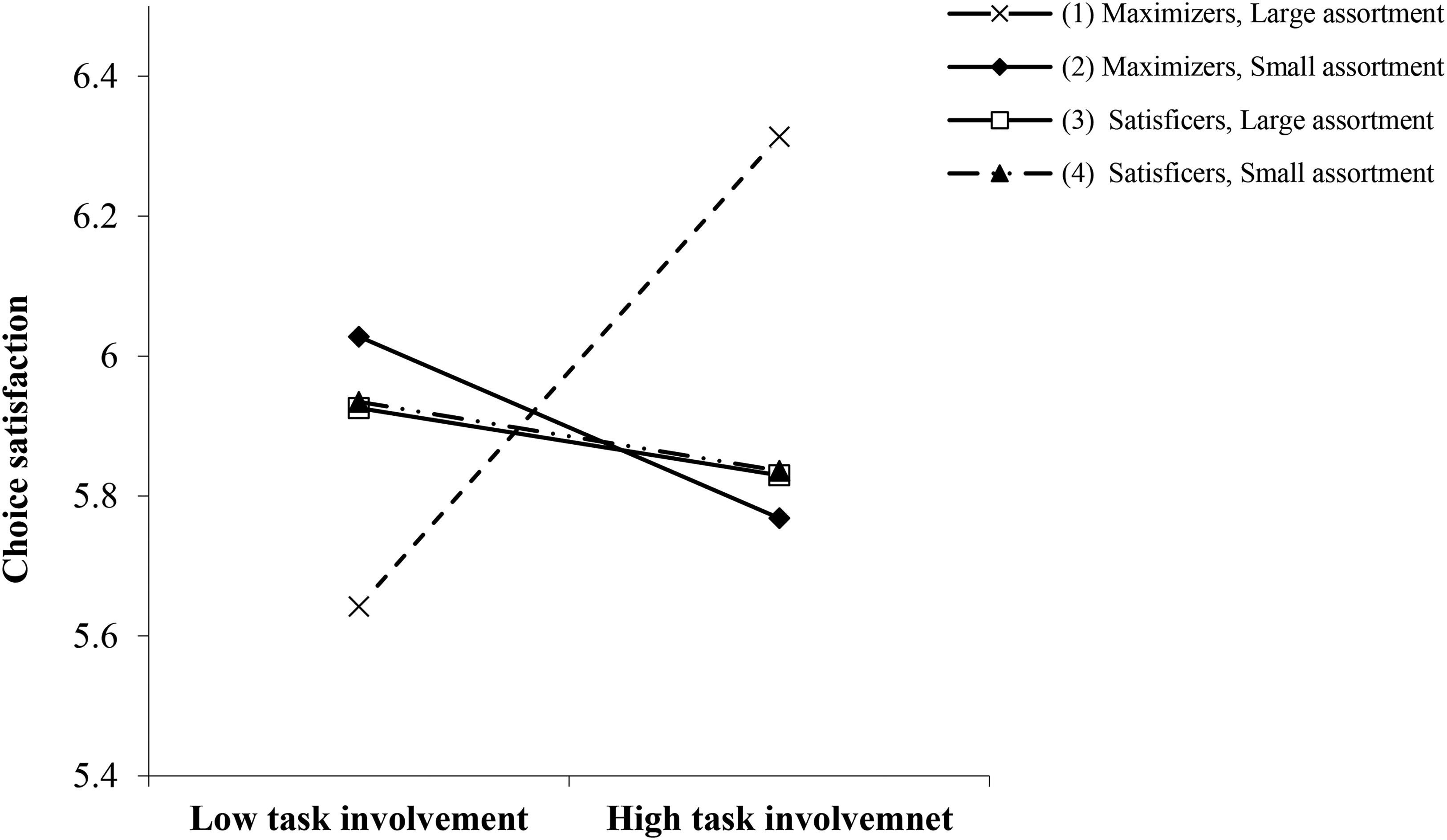
Results of Study 1a: The Three-Way Interaction among Maximizing Tendency, Task Involvement, and Assortment Size On Choice Satisfaction.
Descriptive Statistics and Correlations of Variables in Study 1a (N = 402).

None of the main effects (β < .03, t < .67, p > .505) or two-way interactions was significant (β < .08, t < 1.69, p > .09), except for the significant interaction between assortment size and task involvement (β = .12, SE = .04, t = 2.69, p = .008). This result suggests that participants in the high task involvement condition were more likely to report higher choice satisfaction when choosing from large assortments than small ones.
Furthermore, even when controlling for gender and age as covariates, the three-way interaction remained consistent (R2 change = .02, F(1, 392) = 6.69, β = .11, t = 2.59, p = .010). The interaction between task involvement and assortment size remained significant for maximizers (+1 SD; β = .23, F(1, 392) = 13.46, p < .001), but not for satisficers (−1 SD; β = −.02, F(1, 392) = .11, p = .744). Therefore, gender and age were excluded from the subsequent analysis as covariates.
Study 1b
Method
Participants and Design
Study 1b employed a 2 (task involvement: high vs. low) × 2 (assortment size: large vs. small) × 2 (maximizing tendency: priming vs. control) between-subjects design. We recruited 420 participants through Credamo. After removing 14 participants who failed the attention check and two participants with excessive completion times, the final sample comprised 404 participants (287 females; M age = 28.42, SD = 6.42). All participants provided informed consent for participation and received the platform-recommended compensation of ¥1.5. A power analysis using G*Power 3.1 indicated that our sample size exceeded the minimum requirement of 351 participants needed to detect a medium-small effect size (f = 0.15) at α = 0.05 and power of 1–β = 0.80.
Procedure
Participants first read materials that primed or controlled their maximizing tendency before being randomly assigned to one of eight experimental conditions. Each condition involved an online consumer decision task where participants reviewed available options. Following this decision task, participants rated their choice satisfaction, completed manipulation check measures, and filled out a demographic questionnaire.
Materials
We pretested the effectiveness of this priming task with 110 participants (66 females, M age = 30.34, SD = 8.10). Participants were randomly assigned to either the maximizing tendency priming condition or a baseline condition with no priming task (Ma & Roese, 2014). Following this, all participants rated their decision-making criteria and maximizing tendencies using the scale from Diab et al. (2008). An independent samples t-test revealed that the priming group demonstrated significantly higher maximizing tendencies (M priming = 5.75, SD = .51, M baseline = 5.18, SD = .88, t(108) = −4.12, p < .001, Cohen's d = .79) and higher motivation to choose what feels best (M priming = 7.93, SD = 1.10, M baseline = 5.20, SD = 2.93, t(108) = −6.45, p < .001, Cohen's d = 1.23), indicating effective priming.
Results
Among the two-way interactions, none were significant (F(1, 396) < 2.57, p > .11), except for the significant interaction between assortment size and task involvement (F(1, 396) = 17.67, p < .001, ηp2 = .043). In the high task involvement condition, participants reported higher choice satisfaction when choosing from large versus small assortments (M high−large = 5.89, SD = .65; M high−small = 5.55, SD = .77; F(1, 396) = 13.42, p < .001, ηp2 = .033). While in the low task involvement condition, a choice overload effect emerged (M low−large = 5.86, SD = .60; M low−small = 6.07, SD = .60; F(1, 396) = 5.19, p = .023, ηp2 = .013).
More importantly, the analysis revealed a marginally significant three-way interaction (F(1, 396) = 2.75, p = .098, ηp2 = .007). Simple effects analysis showed that for participants in the maximizing tendency priming condition, those who faced large (vs. small) assortments experienced lower choice satisfaction when their task involvement was low (M low−large = 5.76, SD = .48; M low−small =6.06, SD = .68; F(1, 396) = 5.33, p = .021, ηp2 = .013). In contrast, participants faced with large (vs. small) assortments reported greater satisfaction when in the high task involvement condition (M high−large = 6.00, SD = .60; M high−small = 5.54, SD = .87; F(1,396) = 12.72, p < .001, ηp2 = .031), as illustrated in Figure 2(a). However, this interaction between task involvement and assortment size was not observed in the control group (M high−large = 5.78, SD = .68; M high−small = 5.56, SD = .65; F(1, 396) = 2.69, p = .102, ηp2= .007; M low−large = 5.96, SD = .68; M low−small = 6.08, SD = .52; F(1, 396) = .80, p = .371, ηp2= .002) (Figure 2(b)).
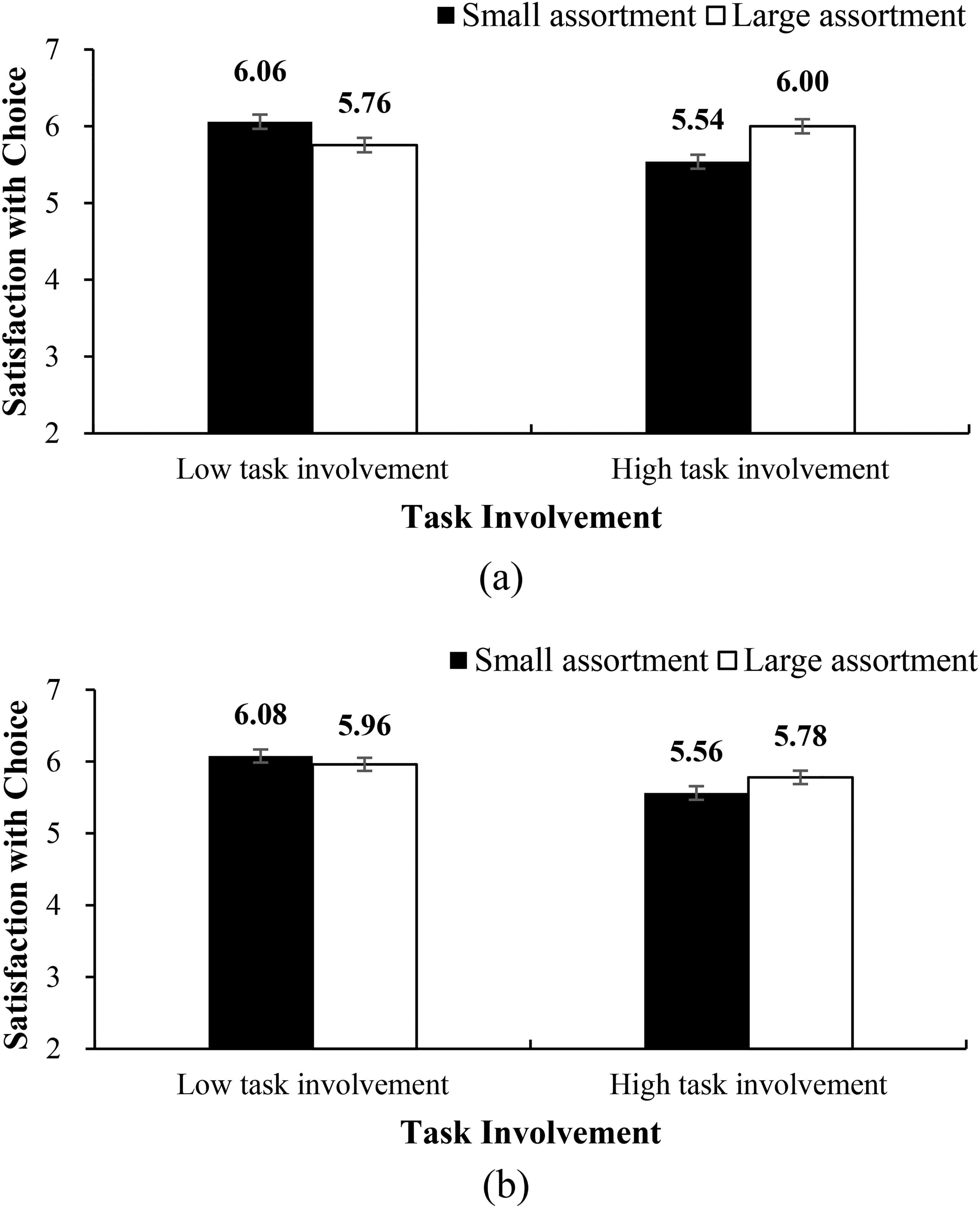
The Interaction Between Task Involvement and Assortment Size on Choice Satisfaction for participants with High Maximizing Tendency (a) and Control (b). Error Bars are Standard Errors of the Mean.
Discussion
Study 1 examined how task involvement moderates the relationship between assortment size and maximizers’ choice satisfaction across two experiments. Results showed that heightened task involvement reversed the choice overload effect among maximizers, regardless of whether maximizing tendencies were assessed as a trait (Study 1a) or induced experimentally (Study 1b). In the high task involvement condition, maximizers faced with large (vs. small) assortments expressed greater satisfaction, lending support to Hypothesis 1. Moreover, analysis of the two-way interactions between task involvement and assortment size on choice satisfaction showed that this task involvement reversal effect was predominantly present among maximizers. Building on these findings, Study 2 will focus on maximizers to investigate how task involvement influences their choice satisfaction across different assortment sizes.
Study 2: Maximizers’ Perceived Information Adequacy
Study 2 focused on maximizers and tested how task involvement and assortment size affect their perceived information adequacy, providing preliminary evidence for its mediating role. By activating participants’ maximizing tendency and adapting an online shopping scenario where participants could request additional options beyond the initial assortment, this study captured their actual information-seeking behavior as a measure of perceived information adequacy. We hypothesized that maximizers in the high task involvement condition would engage in less additional information-seeking (suggesting higher perceived information adequacy) when choosing from large (vs. small) assortments. This effect would not be observed in the low task involvement condition.
Method
Participants and Design
Study 2 used a 2 (task involvement: high vs. low) × 2 (assortment size: large vs. small) between-subjects design. Two hundred and six participants (155 females, M age = 22.48, SD = 2.96) were recruited from southern China through poster advertisements widely distributed across online social media to maximize outreach. All participants were informed that they would participate as consumers in this study and received monetary compensation (¥ 3). A power analysis using G*Power 3.1 indicated that the current sample size had adequate power for the planned analyses (f = 0.25, α = 0.05, 1–β = 0.80).
Procedure
Consenting participants first received a study link and were primed with a maximizing tendency. Following a manipulation check, they were randomly assigned to one of four conditions and viewed the corresponding product options to make an online purchase decision. After reviewing the initial product options, they completed manipulation checks for both task involvement and assortment size. Participants who wanted more information could view additional options sequentially until they decided to stop and make their final decision. The number of additional options viewed was recorded as an indicator of perceived information adequacy. This study concluded with participants completing a questionnaire that assessed their choice satisfaction and demographic information.
Materials
Results
Consistent with Hypothesis 2, a significant interaction effect between task involvement and assortment size on maximizers’ perception of information adequacy was observed (F(1, 202) = 6.35, p = .013, ηp2 = .030). As shown in Figure 3, contrast analyses demonstrated that maximizers faced with large (vs. small) assortments in the high task involvement condition required fewer additional options (M high−small = 8.23, SD = 9.39; M high−large = 1.90, SD = 3.70; F(1, 202) = 28.76, p < .001, ηp2 = .125). However, this effect was not significant in the low task involvement condition (M low−small = 2.98, SD = 5.34; M low−large = .93, SD = 2.86; F(1, 202) = 2.81, p = .095, ηp2 = .014).

Results of Study 2: The Joint Effect of Task Involvement and Assortment Size on Perception of Information Adequacy. Error Bars are Standard Errors of the Mean.
Discussion
By measuring maximizers’ actual information-seeking behavior and altering the manipulation of task involvement, Study 2 demonstrated that maximizers in the high task involvement condition sought less additional information when choosing from large (vs. small) assortments, while this effect was minimal in the low task involvement condition. Additionally, we measured participants’ choice satisfaction and found that in the high task involvement condition, maximizers who chose from small assortments but obtained sufficient information reported satisfaction levels comparable to those choosing from large assortments (see Appendix E for detailed results). These results support Hypothesis 2, providing evidence for the mediating role of perceived information adequacy. Study 3 will further measure both perceived information adequacy and choice satisfaction to test the full model.
Study 3: Full Model Test
Study 3 (https://aspredicted.org/cqyj-mcxw.pdf) aimed to replicate the main interaction effect and test the full mediation model by examining the underlying mechanism of perceived information adequacy. In this study, we primed participants’ maximizing tendency and employed a new task involvement manipulation while measuring their perceived information adequacy. We predicted that under high task involvement conditions, maximizers faced with the large (vs. small) assortment would perceive higher information adequacy, resulting in greater choice satisfaction. The perceived information adequacy would mediate this reversal effect.
Method
Participants and Design
Study 3 employed a 2 (task involvement: high vs. low) × 2 (assortment size: large vs. small) between-subjects design. We recruited 210 participants through Credamo. Five participants failed the attention check, and six participants were excluded due to excessive completion times. The final sample consisted of 199 participants (134 females, Mage = 31.44, SD = 7.78) 3 who completed the experiment and received monetary compensation (¥ 1) for their participation. All participants provided consent before the experiment and had prior experience in online shopping. This sample size provided adequate statistical power, exceeding the minimum of 128 samples as calculated by G*Power 3.1 (f = 0.25, α = 0.05, 1–β = 0.80).
Procedure
All participants were first primed with a maximizing tendency. They were then randomly assigned to one of four conditions to complete an online consumer decision task. After making their decisions, participants completed manipulation and attention checks and reported their perceived information adequacy, satisfaction with their choice, and demographic information.
Materials
Results

Results of Study 3: The Interaction between Task Involvement and Assortment Size on Maximizers’ Choice Satisfaction. Error Bars are Standard Errors of the Mean.
A significant interaction effect of task involvement and assortment size on perceived information adequacy was observed (F(1, 195) = 5.04, p = .026, ηp2 = .025). As predicted, maximizers faced with the large (vs. small) assortment reported higher perceptions of information adequacy in the high task involvement condition (M high−small = 4.53, SD = 1.25; M high−large =5.35, SD = 1.07; F(1, 195) = 10.71, p = .001, ηp2= .052). No such effect was observed in the low task involvement condition (M low−small = 4.54, SD = 1.38; M low−large = 4.58, SD = 1.25; F(1, 195) = .02, p = .900). These results are shown in Figure 5.

Results of Study 3: The Interaction Between Task Involvement and Assortment Size on Maximizers’ Perception of Information Adequacy. Error Bars are Standard Errors of the Mean.

Mediated Moderation Model. Note. *p < .05. **p < .01.
Discussion
Study 3 achieved two objectives through a new manipulation of task involvement. First, it replicated the task involvement reversal effect (H1), confirming that task involvement can reverse the choice overload effect among maximizers, regardless of the specific manipulation method used. Second, this study tested the full model and demonstrated that perceived information adequacy serves as the underlying mechanism through which task involvement reverses the choice overload effect among maximizers, thus supporting Hypothesis 3.
General Discussion
The current research aims to investigate when and why large assortments might enhance rather than diminish maximizers’ choice satisfaction. We address this question through four studies involving different maximizer identification methods, diverse task involvement manipulations, and various decision-making materials. Our findings reveal a task involvement reversal effect: in low task involvement conditions, maximizers faced with large (vs. small) assortments demonstrated lower choice satisfaction, confirming the choice overload effect. However, in high task involvement conditions, this pattern reversed, with maximizers reporting higher satisfaction when choosing from large (vs. small) assortments. Specifically, this reversal effect was consistently demonstrated across participants with both natural maximizing tendencies (Study 1a) and experimentally induced maximizing tendencies (Studies 1b & 3). Furthermore, comparisons with satisficers (Study 1a) and unprimed control groups (Study 1b) confirmed that this effect was pronounced for maximizers. Examination of actual information-seeking behaviors (Study 2) and perceived information adequacy (Study 3) revealed that perceived information adequacy mediated this reversal effect.
Theoretical Contributions
The present research offers several theoretical contributions. First, this work identifies a significant benefit for maximizers who typically suffer from choice overload when facing large assortments. While previous research posited that maximizers are more prone to choice overload (Misuraca et al., 2024), limited research has explored mitigation strategies. This research addresses this significant research gap by identifying task involvement as a critical moderator that can reverse the typical choice overload by maximizers. Specifically, in high task involvement conditions, maximizers report higher satisfaction when choosing from large (vs. small) assortments, which we call the task involvement reversal effect.
This research also helps reconcile seemingly contradictory findings in the field of maximizers. Previous research showed that maximizers experience lower satisfaction with large assortments in decisions like selecting ice cream (Dar-Nimrod et al., 2009) or posters (Sparks et al., 2012), but higher satisfaction with large assortments in decisions such as selecting bank accounts or phone plans (Karimi et al., 2018). By identifying task involvement as the key boundary condition, we provide a theoretical framework that explains these divergent results. Additionally, this research demonstrates that decision costs primarily burden maximizers in low task involvement contexts, while these effects diminish when task involvement is high. This deepens our understanding of how decision costs affect maximizers’ choice experiences. Furthermore, this reversal effect occurs specifically among maximizers (compared to satisficers or control groups), confirming the unique behavioral traits of maximizers (Mittal, 2016; Saltsman et al., 2021).
Second, this research contributes to the choice overload literature. Our findings provide new empirical evidence that maximizers are more susceptible to choice overload than satisficers or the general population, aligning with existing research (e.g., Cheek & Schwartz, 2016; Liu et al., 2021; Saltsman et al., 2021). However, we extend this understanding by showing that task involvement can eliminate or even reverse this choice overload effect. This contribution responds to calls for identifying moderators of choice overload (Misuraca et al., 2019) and complements existing task-related moderators such as decision difficulty (Haynes, 2009) and the construal level of tasks (Chernev, 2006).
Moreover, this research contributes to the literature on task involvement. It demonstrates that task involvement influences individuals’ information needs and cost considerations, aligning with prior research indicating that high task involvement increases information-seeking behavior (Belanche et al., 2017). By demonstrating these effects specifically among maximizers, this research extends the application of task involvement to a new population. Additionally, this research highlights how task involvement affects maximizers’ choice satisfaction across different assortment sizes, providing new insights into the relationship between involvement and choice experiences.
Lastly, this research deepens our understanding of choice satisfaction determinants. While Heitmann et al. (2007) established that decision costs and need fulfillment determine choice satisfaction, our findings reveal important contextual variations in these relationships. In high task involvement contexts, maximizers experience higher choice satisfaction when choosing from large (vs. small) assortments due to their enhanced perceived information adequacy. This suggests that in high task involvement contexts, information adequacy mainly influences maximizers’ choice satisfaction. However, in low task involvement contexts, decision costs dominate, leading to choice overload effects. These findings suggest that the relative importance of satisfaction determinants may vary by context, offering new insights into the literature of choice satisfaction.
Practical Implications
Due to the temporary activation of maximizing tendencies in contemporary society, researchers and marketers have been developing strategies to cater to maximizers (e.g., Kokkoris, 2018). This research contributes to this field by providing two strategic approaches: adjusting assortment size and considering task involvement. First, retailers could enhance maximizers’ choice satisfaction by providing assortments of varying sizes that align with product attributes. For high-involvement products, such as items that are relatively expensive or influence consumers’ future lives, providing large assortments is more effective (i.e., more than 16 alternatives). Conversely, for low-involvement products, retailers should avoid offering large assortments.
Second, manipulating the perceived involvement of product choices could be another effective way to please maximizers, especially for brands unable to adjust their assortment size. Our research shows that emphasizing the impact of current product choices, as demonstrated in Studies 2 and 3, can enhance maximizers’ task involvement. Thus, retailers could use slogans, advertising, and other approaches to underscore the impact of product choices on consumers, thereby mitigating potential dissatisfaction among maximizers when faced with large assortments.
Limitations and Future Directions
Although this research has verified our hypotheses through four studies, limitations remain that provide avenues for future research. First, while we have attempted to enhance the robustness of our findings by testing them in various experimental settings and measuring maximizers’ actual information-seeking behavior, future research could strengthen the external validity of our study through field studies. For example, researchers could cooperate with retailers to utilize real advertising to prime maximizing tendencies and collect individuals’ actual responses to different assortment sizes and products with varying levels of involvement, thereby making the findings more convincing.
Second, further study could explore other boundaries of our findings. Factors that help maximizers focus less on costs might mitigate their experience of choice overload, suggesting that additional boundary conditions beyond task involvement may exist. Previous research has shown that individuals’ categorization of consumption types influences their cost rationalization (Cheema & Soman, 2006). For instance, individuals might rationalize restaurant expenses with friends by categorizing them as necessary food expenditures rather than entertainment costs. Building on this logic, we propose that maximizers’ decision-making goals may serve as a boundary condition. Maximizers may experience higher choice satisfaction with large assortments when pursuing utilitarian goals compared to hedonic ones. This potential relationship warrants further investigation in future research.
Moreover, the present study examined the moderating effect of task involvement by manipulating task importance and relevance. While this approach aligns with the theoretical construct of task involvement (e.g., Gilliland & Johnston, 1997) and is widely employed in empirical research (e.g., Claeys & Cauberghe, 2014), other factors such as perceived value and perceived risk also affect task involvement (Juhl & Poulsen, 2000). Future research could explore whether increasing task value (e.g., by introducing financial incentives) or increasing task risk (e.g., by emphasizing potential negative consequences) would replicate our findings.
Furthermore, our findings reveal that perceived information adequacy explains why maximizers faced with large (vs. small) assortments experience higher choice satisfaction when task involvement is high. However, this mechanism does not fully explain how assortment size affects maximizers’ choice satisfaction when task involvement is low. Future research could further investigate why maximizers’ choice experiences in different assortment sizes differ across task involvement levels and identify potential mediating factors. One possible explanation could be that maximizers in conditions of different task involvement levels perceive varying degrees of fit between their information needs and the information provided by different assortment sizes. In high task involvement conditions, maximizers may view larger assortments as a better match for their information needs, whereas in low task involvement conditions, smaller assortments may be more suitable.
Supplemental Material
sj-docx-1-pac-10.1177_18344909251386469 - Supplemental material for A Benefit for Maximizers: How Task Involvement Eases Maximizers’ Suffering from Choice Overload
Supplemental material, sj-docx-1-pac-10.1177_18344909251386469 for A Benefit for Maximizers: How Task Involvement Eases Maximizers’ Suffering from Choice Overload by Xin-Ru An, Ai-Mei Li, Nan Liu, Hai-Long Sun and Zi-Ming Ye in Journal of Pacific Rim Psychology
Footnotes
Acknowledgements
Our special thanks go to Associate Professor Jin Zhang of the School of Management, Jinan University, whose insightful suggestions were instrumental in refining this research. We also wish to thank the two anonymous reviewers and the editors for their professionalism, diligence, and valuable feedback, which have helped us to enhance this manuscript.

Funding
This research was supported by the National Natural Science Foundation of China (71971099; 72401102; 72101062); Guangdong Provincial Philosophy and Social Science Planning Project (GD25YSG13); Postdoctoral Fellowship Program of CPSF (GZC20240523)
Declaration of Conflicting Interests
The authors declare that they have no known competing financial interests or personal relationships that could have appeared to influence the work reported in this paper.
Supplemental Material
Supplemental material for this article is available online.
Notes
References
Supplementary Material
Please find the following supplemental material available below.
For Open Access articles published under a Creative Commons License, all supplemental material carries the same license as the article it is associated with.
For non-Open Access articles published, all supplemental material carries a non-exclusive license, and permission requests for re-use of supplemental material or any part of supplemental material shall be sent directly to the copyright owner as specified in the copyright notice associated with the article.
