




Abstract
While the association between self-esteem and body image is well established, research on their long-term causal relationship in young people remains limited. This study addressed this gap by using three-wave longitudinal data and random intercept cross-lagged panel models to explore the bidirectional dynamics between self-esteem and body image, as well as the mediating role of psychological resilience. A sample of 313 college students (270 females; 43 males; mean age = 19.56 years; SD = 0.78) completed assessments of their self-esteem, psychological resilience, and body image at three time points spaced six months apart. The results revealed a reciprocal relationship between self-esteem and body image at the within-individual level, with psychological resilience mediating the effect of self-esteem on future body image. These findings highlight the importance of enhancing self-esteem and fostering psychological resilience in interventions aimed at improving body image among college students.
Introduction
Body image is a complex construct that encompasses individuals’ cognitions, emotions, and behaviors related to their physical appearance (Cash, 2004; Smith et al., 2024). In today's visually driven culture, and amid the pervasive influence of mass media, appearance has increasingly become a central aspect of personal value on a global scale. As a result, concerns about body image have risen worldwide, fueled by societal pressures to meet idealized beauty standards (Kamaria et al., 2016; Noh et al., 2018; Rodgers et al., 2023; Santhira Shagar et al., 2021; Todd & Swami, 2020).
Research has consistently shown that a negative body image is associated with a range of mental health and behavioral issues, including eating disorders (e.g., anorexia nervosa and bulimia nervosa), depression, smoking, and substance use (Bornioli et al., 2021; Cooley & Toray, 2001; Polivy & Herman, 2002; Stice & Shaw, 2003). Body image is shaped by a variety of factors, including individual physiological traits (e.g., gender, age, and body mass index; Holsen et al., 2012; Thompson et al., 1999), psychological characteristics (e.g., personality traits and cognitive styles; Allen & Walter, 2016; Himmerich & Mirzaei, 2024), and sociocultural influences (e.g., family dynamics, peer interactions, mass media, and cultural norms; Frederick & Reynolds, 2022; Thompson et al., 1999).
Among these factors, self-esteem stands out as a potentially significant influence on body image (Donnellan et al., 2007). While the relationship between self-esteem and body image is well documented (Ahadzadeh et al., 2018; Garbett et al., 2023; Husain et al., 2023; Morin et al., 2011; Munandar & Nabilla, 2023), the underlying mechanisms, as well as self-esteem's protective potential against negative influences, remain inadequately understood. This study aims to address this gap by examining the dynamic interplay between self-esteem and body image, offering insights that can inform more effective interventions to promote positive body image and improve mental health outcomes.
Association between self-esteem and body image
Self-esteem refers to an individual's evaluation of their own worth, based on self-awareness and subjective personal views (Orth & Robins, 2014). Rosenberg (2015) defined high self-esteem as reflecting an individual's perception of being a valuable member of society, whereas low self-esteem signals dissatisfaction with oneself. Most studies examining the relationship between self-esteem and body image have relied on cross-sectional designs, which consistently show a strong correlation between the two (Ahadzadeh et al., 2018; Berg et al., 2010; Garbett et al., 2023; Husain et al., 2023; Mäkinen et al., 2012; Ozmen et al., 2007; Zancu & Diaconu-Gherasim, 2024). However, while some longitudinal studies have attempted to explore the dynamic nature of this relationship, their findings have been inconsistent. For example, Park and Epstein (2013) found evidence for a bidirectional relationship, with mutual influences between self-esteem and body image among female adolescents. In contrast, Tiggemann (2005) reported a unidirectional relationship, where body dissatisfaction at Time 1 predicted low self-esteem at Time 2, but not vice versa. Additionally, Mellor et al. (2010) found no evidence of a dynamic relationship between self-esteem and body image in their longitudinal study.
Previous longitudinal studies have primarily relied on traditional cross-lagged panel models, which have notable limitations, including the potential to either overestimate or underestimate the longitudinal relationships between variables, leading to biased results (Hamaker et al., 2015). These biases may help explain the inconsistencies observed in previous research. To address these limitations, researchers increasingly advocate for the use of the random intercept cross-lagged panel model (RI-CLPM), which effectively separates inter-individual effects from within-individual effects, thereby eliminating potential confounding from between-person differences and offering more accurate causal inferences (Chen, Chang, et al., 2022; Chen, Chen, et al., 2022; Chen, Huebner, & Tian, 2022; Yang et al., 2024). Therefore, this study employs the RI-CLPM framework, where inter-individual differences examine whether college students with lower self-esteem consistently report lower body-image levels compared to those with higher self-esteem, while within-individual effects assess whether changes in an individual's self-esteem influence their body image over time, and vice versa. This distinction allows for more precise causal reasoning by isolating within-individual effects and reducing bias from inter-individual variation.
Body image can be conceptualized as a component of the broader construct of self-esteem, specifically termed body self-esteem (Franzoi & Shields, 1984; Shavelson & Bolus, 1982). Because overall self-esteem is largely shaped by evaluations in a specific domain (Dapp et al., 2023), it is expected that satisfaction with one's body—a domain-specific aspect of self-esteem—will influence future overall self-esteem levels. Conversely, individuals with higher overall self-esteem are likely to have a more positive outlook on various aspects of themselves, including their body, which in turn fosters greater body satisfaction (Orth & Robins, 2022). Therefore, a bidirectional relationship is hypothesized, where higher initial self-esteem will predict greater future body satisfaction, while initial body satisfaction will also predict higher overall self-esteem over time.
Mediating role of psychological resilience
Individuals employ a variety of coping strategies when faced with challenges, and psychological resilience—the ability to endure setbacks, adapt positively, and recover from adversity—plays a critical role in this process (Luthar & Cicchetti, 2000; Troy et al., 2023). Among the personal traits that contribute to resilience, self-esteem is considered a foundational psychological resource. Individuals with high self-esteem tend to interpret themselves and their environment more positively, maintain confidence in the face of stress, and access internal coping resources more effectively (Baumeister et al., 2003). Empirical studies have consistently demonstrated that higher self-esteem predicts greater psychological resilience (Benetti & Kambouropoulos, 2006; Tian et al., 2018), suggesting that self-esteem is an antecedent of resilience rather than a consequence.
Resilience, in turn, plays an important role in how individuals experience and regulate their body image. In the Female Body Image Resilience Model, Choate (2005) highlighted the capacity to resist sociocultural pressures and maintain body satisfaction as a function of psychological resilience. Although direct research on resilience and body image is still emerging, existing findings suggest that resilience can act as a buffer against a negative body image, especially in individuals facing body-related stressors such as illness or surgery (Izydorczyk et al., 2018).
Building on these theoretical and empirical foundations, the current study proposes that psychological resilience serves as a mediator, linking self-esteem to body satisfaction. Specifically, we hypothesize that individuals with higher self-esteem are more likely to develop resilience, which in turn helps them maintain or improve body satisfaction over time. Compared to the reverse direction (i.e., body image influencing self-esteem via resilience), this model aligns better with the view of resilience as a generalized coping trait and self-esteem as a core antecedent rather than outcome of domain-specific experiences such as body image (Orth & Robins, 2014).
Current study
Because body-image disturbance is theoretically linked to a range of maladaptive behaviors, clarifying how psychological resilience and self-esteem relate to body-image perceptions may inform future prevention efforts. As described above, although existing theories of global and domain-specific self-esteem (Marsh, 1986), along with indirect empirical evidence (Johnson & Wardle, 2005; Munandar & Nabilla, 2023), suggest a relationship between self-esteem and body image, the mechanisms underlying this relationship remain poorly understood. Moreover, much of the prior research relies on cross-sectional designs, which fail to capture dynamic longitudinal changes.
This study aims to address these gaps by examining the longitudinal relationship between self-esteem and body image, with a particular focus on the mediating role of psychological resilience. Methodologically, the study employs the RI-CLPM to disentangle within-individual processes from between-individual differences, providing more robust insights into causal mechanisms. Two hypotheses are proposed:
Methods
Participants
A convenience sampling strategy was employed to conduct a longitudinal questionnaire study among college students at a university in South China. Prior to the data collection, we distributed information about the study to all students within the school. Participation was entirely voluntary, and the students were free to decide whether or not to take part. In total, data was collected from 313 participants across three time points spaced six months apart between November 2022 and November 2023 (270 females; 43 males; mean age = 19.56 years; SD = 0.78). All of the participants provided their informed consent and had the option to withdraw at any time. The surveys were administered via the Questionnaire Star platform (www.wjx.cn). As an incentive, those participants who completed the survey and met the study's inclusion criteria were offered a mental health screening report prepared by a professional counseling psychologist.
Strict inclusion and exclusion criteria were applied to ensure the accuracy of the data. All of the participants were required to be between the ages of 18 and 24 and possess the cognitive ability to complete the questionnaire. Participants were excluded if their reported age or grade level was inconsistent, or if they failed a lie-detection question (“Please select C: I am an honest person”). The study received ethical approval from the ethics committee of the School of Psychology at South China Normal University.
Measures
All of the participants completed the same questionnaire at three time points (T1, T2, and T3). At the first time point (T1), they reported their basic demographic information, including age, gender, perceived family economic status, and place of family residence. Perceived family economic status was measured by asking: “Compared to those around you, how would you rate your family's financial situation?” The responses were recorded on a 5-point scale (1 = much better, 2 = somewhat better, 3 = about the same, 4 = somewhat worse, 5 = much worse). The place of family residence was coded as 1 = urban and 2 = rural.
Self-esteem
Self-esteem was measured using the Rosenberg Self-Esteem Scale, which consists of 10 items assessing an individual's overall feelings of self-worth and self-acceptance (Rosenberg, 2015). The scale uses a 4-point Likert scoring system (1 = very uncharacteristic to 4 = very characteristic). Lower total scores indicate lower self-esteem levels. In this study, the Cronbach's α coefficients for the Rosenberg Self-Esteem Scale were 0.839 at T1, 0.865 at T2, and 0.850 at T3.
Psychological resilience
Psychological resilience was measured using the translated and revised 10-item Conner–Davidson Resilience Scale (Campbell-Sills & Stein, 2007; Cheng et al., 2020). This scale has demonstrated good reliability and validity in the college student population. The items use a 5-point Likert scale (0 = never this way to 4 = always this way). In this study, the Cronbach's α coefficients for the scale were 0.958 at T1, 0.960 at T2, and 0.972 at T3.
Body image
Body image was assessed using the Body Image States Scale developed by Cash et al. (2002). This is a unidimensional scale containing 6 items (e.g., “Right now I feel ~ with my physical appearance”) that employs a 9-point scoring system (1 = very dissatisfied to 9 = very satisfied). Lower scores reflect lower satisfaction with one’s body image. In this study, the Cronbach's α coefficients for the scale were 0.963 at T1, 0.982 at T2, and 0.983 at T3.
Data analysis
The correlations among all the variables were analyzed using SPSS 26.0 software. Subsequent analyses were conducted with Mplus 8.0 software, employing RI-CLPMs to examine the relationships among the study variables over time. Four competing models were constructed to identify the most parsimonious and interpretable model: (1) an unconstrained baseline model; (2) a model with autoregressive paths fixed as time-invariant; (3) a model with cross-lagged paths fixed as time-invariant; and (4) a model with both autoregressive and cross-lagged paths fixed as time-invariant. Maximum likelihood robust estimators were applied in all the models to accommodate non-normal data.
The model fit was assessed using the comparative fit index (CFI), Tucker–Lewis index (TLI), and root-mean-square error of approximation (RMSEA) (Hu & Bentler, 1999). Acceptable model fit was determined by the criteria CFI > 0.90, TLI > 0.90, and RMSEA < 0.08 (Marsh et al., 2004). The criteria for model selection included |ΔCFI| < 0.01 and |ΔRMSEA| < 0.015. All of the primary analyses presented in the main body of the article (i.e., the main text) were conducted without covariates in order to provide a clear account of the longitudinal relationships among the key psychological constructs. To examine the robustness of our findings, we conducted supplementary analyses controlling for four theoretically relevant sociodemographic variables: age, gender, perceived family economic status, and residential location. Prior research has indicated that these factors may be associated with individual differences in self-esteem and body image (Bai et al., 2021; Cheng et al., 2015; Grogan, 2006; Hanson et al., 2024; Wodarz & Rogowska, 2024). Moreover, urban residence is generally associated with higher socioeconomic status in China, supporting the use of residential location as a proxy indicator of socioeconomic status (Song & Smith, 2019). The results from the covariate-adjusted CLPM and RI-CLPM models are reported in Tables S1 and S2, which are available in the online supplementary material.
Results
Correlation analysis of primary variables
Table 1 presents the correlations among all the primary variables across the three waves. As expected, the results indicate that all of the variables are significantly and positively correlated over time, providing a solid foundation for the subsequent RI-CLPM analysis.
Correlations between self-esteem, psychological resilience, and body image.
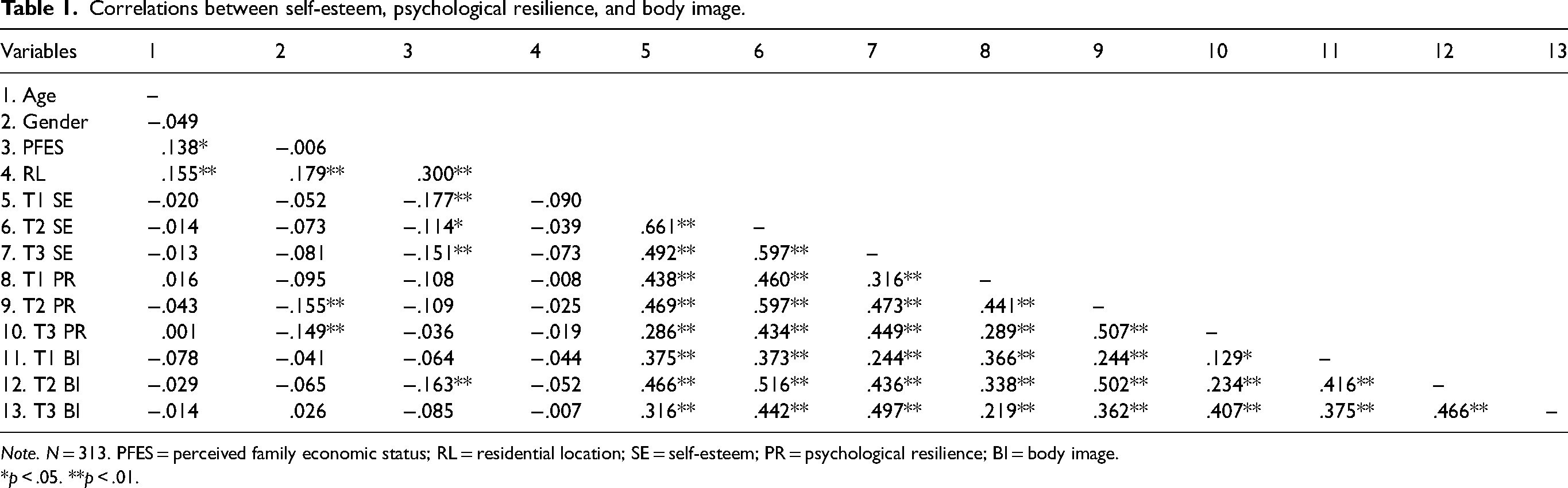
Note. N = 313. PFES = perceived family economic status; RL = residential location; SE = self-esteem; PR = psychological resilience; BI = body image.
*p < .05. **p < .01.
Model comparison
Table 2 presents the results of the model comparison. In both the RI-CLPM for self-esteem and body image and the mediation RI-CLPM involving self-esteem, psychological resilience, and body image, the fit of Model 2 (with autoregressive paths fixed as time-invariant), Model 3 (with cross-lagged paths fixed as time-invariant), and Model 4 (with both autoregressive and cross-lagged paths fixed as time-invariant) did not substantially differ from the baseline Model 1 (ΔCFI < 0.01; ΔRMSEA < 0.015). Model 4 was selected as the final model based on two considerations. First, the data was collected at equal six-month intervals, and the psychological mechanisms under study (i.e., self-esteem and body-image dynamics) are theoretically assumed to be stable across this time frame in early adulthood. Second, the constrained model demonstrated model-fit indices comparable to the unconstrained model, aligning with previous studies that emphasize parsimony and interpretability in the absence of theoretical justifications for time-varying parameters (Grimm et al., 2021; Zyphur et al., 2020).
Model fit and model comparisons for RI-CLPMs.

Note. CFI = comparative fit index; TLI = Tucker–Lewis index; RMSEA = root-mean-square error of approximation; CI = confidence interval; SRMR = standardized root-mean-square residual. Bold indicates the final selected model. Model 1 = baseline (unconstrained model); Model 2 = model with autoregressive paths fixed as time-invariant; Model 3 = model with cross-lagged paths fixed as time-invariant; Model 4 = model with autoregressive and cross-lagged paths fixed as time-invariant.
Longitudinal relationship between self-esteem and body image
An RI-CLPM was constructed to examine the longitudinal relationship between self-esteem and body image, with the standardized results presented in Figure 1. At the inter-individual level, a significant positive correlation was observed between the random intercepts of self-esteem and body image. At the intra-individual level, the results indicated that self-esteem at T1 and T2 positively predicted body image at T2 and T3, respectively. Similarly, body image at T1 and T2 positively predicted self-esteem at T2 and T3, respectively. The RI-CLPM demonstrated that self-esteem and body image mutually predicted subsequent levels of each other, thereby supporting Hypothesis 1.

The RI-CLPM of self-esteem and body image.
Mediating role of psychological resilience
For the model incorporating psychological resilience as a mediator, the standardized results are shown in Figure 2. At the inter-individual level, significant positive correlations were found between the random intercepts of self-esteem and psychological resilience, as well as between self-esteem and body image. However, no significant correlation was observed between the random intercepts of psychological resilience and body image. At the intra-individual level, the results (Figure 2 and Table 3) indicated that self-esteem predicted subsequent body image through psychological resilience (T1 self-esteem → T2 psychological resilience → T3 body image), but body image did not predict subsequent self-esteem via psychological resilience. Thus, the RI-CLPM revealed a unidirectional effect in which self-esteem predicted subsequent body image through psychological resilience, supporting Hypothesis 2.
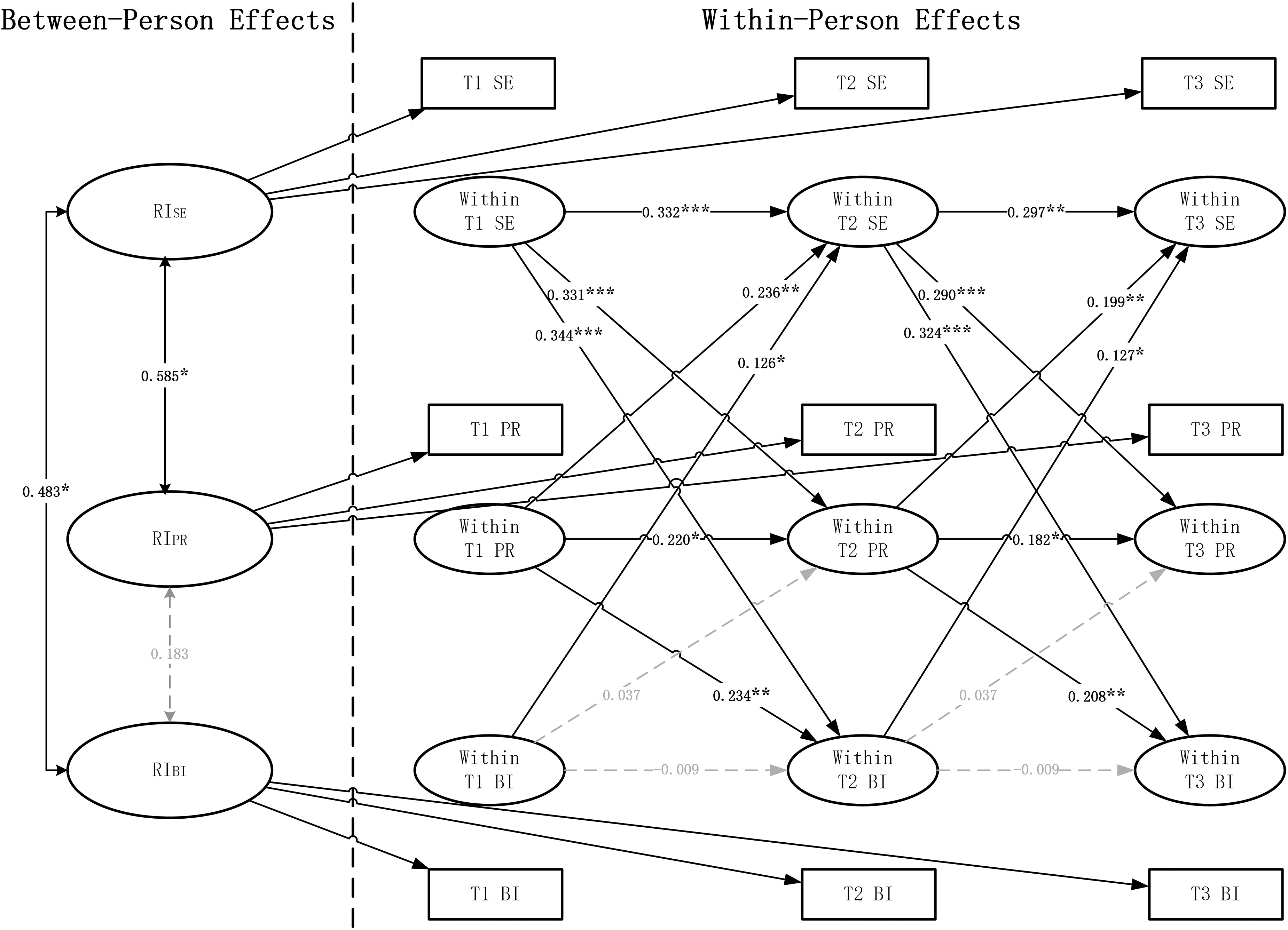
The RI-CLPM with the mediator.
Results of the indirect effects for RI-CLPM.

Supplementary covariate models
All of the key paths in both the CLPM and RI-CLPM remained significant after controlling for age, gender, perceived family economic status, and residential location (for full parameter estimates, see Tables S1 and S2 and Figures S1 and S2 in the supplementary material).
Discussion
This study aimed to examine the dynamic interplay between self-esteem and body image, as well as the mechanisms underpinning this relationship, using RI-CLPMs. The findings showed that, over time, higher levels of self-esteem in college students predicted subsequent improvements in body image. Furthermore, by enhancing psychological resilience, self-esteem positively influenced future body-image levels. In contrast, while higher body-image levels predicted higher self-esteem, psychological resilience did not mediate this relationship. These results offer new insights into the complex interactions among self-esteem, psychological resilience, and body image
Reciprocal relationship between self-esteem and body image
Previous longitudinal studies on the relationship between self-esteem and body image have yielded mixed findings. Some studies reported a bidirectional relationship, with self-esteem and body image predicting each other over time (Park & Epstein, 2013), while others suggested a unidirectional effect, where body image predicted self-esteem but not the reverse (Morin et al., 2011; Tiggemann, 2005). Additionally, some studies have found no longitudinal associations between the two (Mellor et al., 2010). Paxton et al. (2006) further proposed that the impact of body dissatisfaction on self-esteem may vary by life stage. For example, they found that initial body dissatisfaction predicted low self-esteem five years later in early adolescent girls and mid-adolescent boys, but not in mid-adolescent girls or early adolescent boys.
The current study, utilizing RI-CLPMs to separate inter-individual differences from within-individual processes, reveals a bidirectional longitudinal relationship between self-esteem and body image. This advanced methodological approach provides more precise insights into how these variables interact over time. The findings indicate that college students with lower self-esteem tend to experience greater body dissatisfaction over time, while those with a lower initial body image are more likely to experience declines in self-esteem in the future.
On the one hand, body image is often conceptualized as a component of self-esteem, such that a decrease in body image directly influences overall self-esteem (Wodarz & Rogowska, 2024), aligning with the results of this study. On the other hand, lower self-esteem may lead to more negative self-evaluations, which in turn foster dissatisfaction with one's body (O’Dea, 2012). Individuals with negative body perceptions are more susceptible to eating disorders and other mental health challenges. Enhancing self-esteem can thus improve body image, as it encourages individuals to value their bodies more positively and approach appearance-related information with a more constructive attitude. Furthermore, higher self-esteem can strengthen an individual's sense of social identity, which is crucial for resisting external pressures that negatively impact body satisfaction (Wood-Barcalow et al., 2010).
Mediating role of psychological resilience
Our findings supported Hypothesis 2, demonstrating that psychological resilience significantly mediated the longitudinal relationship between self-esteem and body image. Psychological resilience refers to the capacity to effectively utilize internal (e.g., self-esteem) and external (e.g., social support) resources to cope with life stressors, thereby enhancing one's ability to adapt positively and reducing the risk of negative developmental outcomes. Baumeister et al. (2003) suggested that individuals with higher self-esteem tend to interpret both themselves and their environments more positively, which helps them cope with adversity by maintaining confidence in their ability to manage life's challenges.
Previous research has shown that individuals with higher self-esteem were better able to recover from the emotional, attentional, and physiological effects of stress, preserving cognitive and emotional functioning, which in turn helps foster a more positive body image (Swami et al., 2016). Our study highlights psychological resilience as a key mediating factor through which self-esteem promotes a positive body image. In sociocultural theories, self-esteem is believed to act as a buffer against the negative impact of sociocultural pressures on body image (Ricciardelli & McCabe, 2001). Individuals with high self-esteem may enhance their body image indirectly by demonstrating higher psychological resilience when facing sociocultural challenges.
Limitations and future directions
While this study used RI-CLPMs to effectively distinguish between within-individual processes and stable inter-individual differences, thereby providing more robust causal inferences, several limitations should be noted. First, the exclusive reliance on self-reported questionnaires may have introduced response biases and subjectivity, potentially affecting the accuracy of the findings. Second, the sample had a relatively small proportion of male participants, limiting the generalizability of the results across genders. Future research should strive for a more balanced gender distribution and consider constructing separate RI-CLPM models for male and female participants to explore potential gender differences in the longitudinal relationships among self-esteem, body image, and psychological resilience. Third, the participants were recruited from a single university in southern China, which may restrict the generalizability of the findings to other cultural or regional contexts. Future studies should consider using more diverse and representative samples across different regions and cultural backgrounds to enhance the external validity of the results. Fourth, although we applied Harman's single-factor test (Harman, 1976) to assess common method variance, and found that the first factor explained 39% (T1), 48% (T2), and 45% (T3) of the variance, indicating a possible common-method-variance influence particularly at T2 and T3 (Podsakoff et al., 2003), we believe the use of RI-CLPMs has helped alleviate this issue to some extent. Specifically, the model's capacity to isolate within-individual dynamics from between-person variance provides partial control over stable response biases that typically drive common method variance (Hamaker et al., 2015; MacKenzie & Podsakoff, 2012; Mulder & Hamaker, 2021). Nevertheless, future research should incorporate methodological strategies such as multi-informant designs, time-separated measurement, or statistical controls for common method variance to enhance data validity.
Conclusion
This study investigated the longitudinal interplay between self-esteem, body image, and psychological resilience among Chinese college students in early adulthood, utilizing three waves of data. The findings reveal a reciprocal dynamic relationship: lower self-esteem predicts declines in body image over time, and vice versa. Additionally, lower self-esteem weakens psychological resilience, which in turn exacerbates body-image dissatisfaction. These results provide new insights into how personality factors contribute to poor body image and demonstrate that diminished self-esteem can undermine resilience, intensifying body dissatisfaction over time. Interventions that simultaneously target self-esteem and psychological resilience may be essential for improving body image among college students.
Supplemental Material
sj-docx-1-pac-10.1177_18344909251360073 - Supplemental material for Exploring the longitudinal dynamics of self-esteem, body image, and psychological resilience in college students
Supplemental material, sj-docx-1-pac-10.1177_18344909251360073 for Exploring the longitudinal dynamics of self-esteem, body image, and psychological resilience in college students by Jie Liu, Junhua Dang and Hongyu Zou in Journal of Pacific Rim Psychology
Footnotes

Declaration of conflicting interests
The authors declared no potential conflicts of interest with respect to the research, authorship, and/or publication of this article.
Funding
The authors received no financial support for the research, authorship, and/or publication of this article.
Ethical standards
All procedures performed in the study involving human participants were in accordance with the ethical standards of the institutional and/or national research committee and with the 1964 Helsinki Declaration and its later amendments or comparable ethical standards. The research received approval from the ethics committee of the School of Psychology at South China Normal University (approval number: SCNU-PSY-2022-217).
Supplemental material
Supplemental material for this article is available online.
References
Supplementary Material
Please find the following supplemental material available below.
For Open Access articles published under a Creative Commons License, all supplemental material carries the same license as the article it is associated with.
For non-Open Access articles published, all supplemental material carries a non-exclusive license, and permission requests for re-use of supplemental material or any part of supplemental material shall be sent directly to the copyright owner as specified in the copyright notice associated with the article.
