




Abstract
This article investigates a specific situation in which individuals retain psychological ownership of certain possessions even when they no longer physically own them. This lingering psychological ownership is influenced by age and subsequently affects the repurchase behavior of individuals across different age groups toward the same brand. The illusion of control serves as the underlying mechanism for this effect. We investigate age differences in the psychological ownership of formerly owned items and the downstream effects on consumer behaviors across six experimental studies. Study 1 confirmed a negative correlation between age and psychological ownership of items people no longer possess. Studies 2 and 3 demonstrated that this negative association occurs only when individuals have relinquished items, not when they currently own them. Study 4 explored the mediation effect. Studies 5 and 6 further showed that the influence of age on psychological ownership of relinquished items affects individuals’ repurchase behavior for the same product and brand. Compared to younger adults, older adults have less illusion of control of relinquished possessions, resulting in less psychological ownership and lower levels of repurchase intentions for the same brand. This finding challenges the notion that older consumers are more nostalgic and less likely to switch brands. In contrast, younger consumers exhibit greater consumption “stickiness” to a product and are more likely to repurchase it. This article expands psychological ownership theory, exploring target object transition. It aids marketers in identifying repurchase cohorts for formerly owned items among different age groups.
Psychological ownership plays a crucial role in everyday life. Individuals regularly interact with a variety of objects they possess, both tangible and intangible. The concept of psychological ownership, as defined by Pierce, Kostova, and Dirks in 2003, refers to people's sense that a target of ownership, or a part of it, is uniquely “theirs.” This cognitive-affective construct encompasses people's awareness, thoughts, and beliefs about their possessions (Pierce et al., 2003). Psychological ownership connects individuals with their belongings, aids in self-definition and presentation through these objects, and integrates these possessions into their self-identity (Belk, 1988; Pierce et al., 2003; Weiss & Johar, 2016). Despite the significant shift in research on psychological ownership from long-lasting, ownership-based solid consumption to transient, journey-oriented liquid consumption (Bardhi & Eckhardt, 2017; Bardhi et al., 2012; Mittal et al., 2019; Morewedge et al., 2020), the majority of scholars continue to associate psychological ownership with possessions currently owned by individuals. There is a shortage of discussion about psychological ownership of possessions that one no longer has. The present work aims to address this oversight by exploring how different age groups perceive the psychological ownership of their relinquished possessions and the impact of this perception on their personal consumer behavior.
The findings, akin to Young and Wallendorf's (1989) research, illuminate the act of discarding possessions as a process of “partial self-detachment” while retaining the “memory” imbued within the residual significance of those possessions. While a person may no longer be in physical possession of the item, the experiences once associated with it endure, thereby preserving a sense of psychological ownership over the relinquished object. Notably, across different life stages, individuals exhibit varying perceptions of relinquished belongings.
Compared to elderly individuals, young individuals in the early stages of the lifecycle manifest a heightened sense of control over possessions and often utilize material goods as a means of self-expression (Mirowsky, 1995). In later stages of the lifecycle, elderly people become more acquainted with the concept of loss; they prepare for the moment of mortality and foster a more magnanimous and sagacious disposition toward property (e.g., Price et al., 2000). Thus the significance attached to the loss or sale of belongings tends to be more pronounced among younger individuals than elderly individuals. Correspondingly, the psychological ownership that young individuals maintain over possessions they no longer own tends to surpass that of elderly individuals.
This phenomenon may originate from disparities between younger and older individuals in terms of the illusion of control, which refers to the erroneous belief that one's actions can influence outcomes that are, in reality, determined by chance (Langer, 1975). Recognition of the illusion of control is associated with age (Heckhausen & Schulz, 1995; Weisz et al., 1982). Compared to younger individuals, older adults possess greater experience and wisdom (Godoy et al., 2009; Koster et al., 2016), leading them to understand that they cannot exert control over former possessions. Lower control motivation results in diminished psychological ownership perceptions (Dixon & Street, 1975; Sartre, 2022).
This article makes worthwhile contributions to both theory and practice. From a theoretical perspective, it contributes to our knowledge about ownership by expanding the scope of research on the transition of target objects from ownership to loss. From a practical perspective, this study provides a foundation for marketers to identify repurchase cohorts for previously owned items.
We first review the literature on psychological ownership and its connections with the illusion of control and related consumption behaviors. We then report six experimental studies that test our proposed effect of age differences on psychological ownership and its underlying mechanism. We conclude by discussing theoretical and practical implications as well as directions for future research.
Theoretical framework
Age differences in psychological ownership of relinquished possessions
In contrast to younger adults, older adults tend to be more pragmatic when they relinquish ownership of possessions for various reasons. For instance, societal trends encourage the downsizing and simplification of one's lifestyle later in life, leading many older individuals to minimize their material belongings (Ekerdt et al., 2004). Physical factors such as declining health, the increased prevalence of chronic diseases, and the loss of physiological functions, collectively called “body time” (Luborsky et al., 2011), contribute to this shift in priorities. Previous research shows that whereas older adults may express concern about parting with possessions, they tend to focus more on the quality than the quantity of their assets (Cram & Paton, 1993). Older individuals consistently demonstrate considerable wisdom and experience in “letting go” and dealing with “loss.”
Regardless of ownership status, possessions serve as vehicles for psychological ownership. A sense of ownership arises when individuals establish a personal connection to a tangible or intangible target and experience the feeling that “this is MINE!” (Pierce et al., 2001). The term “target” refers to anything that signifies an object of attachment for an individual or group. Engaging in physical activities such as holding, touching, and manipulating a “target” fosters a sense of control over it and subsequently cultivates psychological ownership (Peck & Shu, 2009; Reb & Connolly, 2007). A sense of control is essential in developing and intensifying psychological ownership across various domains. Scholars have long acknowledged that when an individual's potential control over an object strengthens, the object is more likely to be considered a part of the self, thereby promoting perceived ownership (Csikszentmihalyi & Rochberg-Halton, 1981). Similarly, marketing researchers have found that a strong sense of personal control linked to physical control over an object leads to a heightened sense of possession (Furby, 1980; Peck & Shu, 2009). In later life, however, functional impairments and a decreasing sense of control are commonly associated with aging (Baltes et al., 1990; Clark & Maddox, 1992).
Based on this reasoning, we propose that psychological ownership decreases with age.
Although there are age differences in the perception of ownership over relinquished possessions, most individuals tend to place considerable importance on the things they currently own. As previously mentioned, older adults adopt a more pragmatic approach to their possessions, and this often includes using personal property such as artworks, collectibles, family heirlooms, and other items to symbolically achieve a sense of renewal and to combat the fear of death (Belk, 1988). Therefore, they place a high value on the possessions they retain in later life. In contrast, younger individuals emphasize ownership of their possessions as extensions of their identity and self-concept. Regardless of age, many people highly value how their current possessions reflect their self-identity and personal agency.
Therefore, based on the aforementioned theoretical framework, we propose that age differences in psychological ownership emerge only in the context of relinquished possessions.
Illusion of control: The factor that mediates the effect of age differences on psychological ownership
The emergence and development of psychological ownership over a specific target are intricately linked to the motivation for control over that target (Pierce et al., 2001). The illusion of control experienced over items no longer possessed may also, to a certain extent, influence one's psychological ownership of them. The illusion of control refers to the mistaken belief that one's actions can influence a specific outcome when, in reality, the outcome is uncontrollable and determined by chance (Langer, 1975). Prior research shows that children's illusion of control declines with age (Heckhausen & Schulz, 1995; Weisz, 1980; Weisz et al., 1982). Younger children attribute the outcomes of chance games to competence-related factors rather than random elements, whereas older children recognize the noncontingent nature of such games (Weisz, 1980). Developmental studies demonstrate that this age difference in the illusion of control extends to a broad age range, with a more pronounced illusion of control among children than adults (van Elk et al., 2015). Many scholars have proposed the age effect, suggesting that wisdom increases with age (Godoy et al., 2009; Koster et al., 2016; Reyes-García et al., 2013). Older individuals, who often have encountered more loss events in life than younger counterparts, tend to demonstrate greater experience and wisdom. Consequently, the illusion of control over past possessions is lower in older individuals.
Although the illusion of control is a false sense of mental control over a target, individuals who experience this state still feel that they can exert influence. Research in child development, sociology, gerontology, and psychology shows that controlling a target gives rise to psychological ownership (e.g., Dixon & Street, 1975; Sartre, 2022; White, 1959). Pierce et al. (2001) noted that controlling a target, familiarizing oneself with it, and investing oneself in it are the three primary ways of forming and developing psychological ownership.
This rationale further supports the idea that age negatively impacts individuals’ illusion of control and perceived ownership. We propose hypothesis 2:
Notably, there is a close relationship among individuals, possessions, self-extension, and psychological ownership. Belk (1988) proposed that possessions are often perceived as extensions of the self, and individuals define themselves significantly through the items they own (Hodder, 2012). Importantly, even objects that are not physically owned, such as brands (Luedicke et al., 2010) or consumer goods (Bardhi et al., 2012; Belk, 2010), can play a role in shaping self-identity. Psychological ownership, as noted by Kirk and Swain (2015), develops when individuals interact with possessions, manifesting in feelings of pride or self-identification associated with those items (Ekinci & Riley, 2003). Emotional attachments to possessions often embed within an individual's self-identity, influencing the process of self-extension (Dittmar, 1992), which reinforces the psychological ownership of these objects.
This connection becomes particularly relevant when possessions are relinquished. The loss disrupts the psychological link to these items, which not only diminishes ownership but also affects one's self-extension. Belk (1988) emphasized that such losses carry implications for an individual's self-perception, as the separation from possessions represents a severance of this extended self. Furthermore, the role of possessions as self-extensions varies across life stages. Adolescents, for example, may rely more on activities than on possessions for self-definition, while middle-aged adults tend to focus on possessions that symbolize social power and status (Csikszentmihalyi & Rochberg-Halton, 1981; Furby, 1978). Older adults, however, may shift from “having” to “continuing” as they grapple with the finitude of life (Lifton, 1973), relying on possessions as a means of preserving self-identity and continuity.
These dynamics suggest that the age-related decline in psychological ownership of relinquished possessions may be partially explained by differences in how self-extension operates across life stages. The subsequent research addresses these complexities by measuring self-extension directly and exploring its potential role in mediating the relationship between age and psychological ownership of relinquished possessions.
Lingering psychological ownership and downstream consumption behaviors
The economic and marketing literature suggests that the perceived value of products increases as psychological ownership intensifies. The perception of a product as “MINE” enhances its economic value, as demonstrated by studies conducted by Ericson and Fuster (2011), Morewedge and Giblin (2015), and Peck and Shu (2018). Moreover, the feeling that a product is “MINE” improves attitudes toward the product and strengthens attachment to it. The implications of increased perceived value for enterprises (i.e., product and brand) include higher consumer demand for a company's products and services, greater willingness to pay, positive word-of-mouth, and increased customer loyalty (Atasoy & Morewedge, 2018; Fritze et al., 2020; Fuchs et al., 2010; Vandewalle et al., 1995). Consequently, we propose hypothesis 3:
Overview of studies
We tested our hypotheses through six experimental studies. Study 1 confirmed a negative correlation between age and psychological ownership of possessions no longer owned. Studies 2 and 3 demonstrated that this negative association manifests only when individuals no longer have these possessions, not when they own them currently. Study 4 explored the illusion of control as a mediator in this effect. Studies 5 and 6 further showed that the negative influence of age on psychological ownership of relinquished items impacts individuals’ repurchase behavior for the same brand. Detailed information about the experimental materials can be found in the appendix. For comprehensive details on the experimental data, please refer to the following link: https://osf.io/u452q/?view_only=a47bca3e2f344e1bae58a3f55e3b5ef6.
Study 1
The aim of Study 1 was to validate the proposed effect of age differences on perceived psychological ownership of people's previously owned items. Specifically testing hypothesis 1: the perceived ownership of relinquished items was found to diminish as people age, whereas a decrease in age corresponded to an increased perception of ownership over relinquished items.
Participants
We recruited 212 participants from Credamo in China, divided into two age groups: 18–55 years and 56 years and above. This division was based on the Credamo survey platform's maximum age-group setting, which uses 56 years as the boundary. In previous literature on the senior market, individuals aged 56 to under 60 years are often referred to as “younger seniors” (Yoon et al., 2009).
Our survey commences with a screening criterion for participants: We inquire whether they currently possess a computer. If they do, they are allowed to proceed with the survey; if they do not, the survey is terminated for them at that point. During this screening process, 7 participants did not meet the eligibility requirements to continue, leaving 205 eligible participants (63.4% female, age in years range = 18–76, Mage = 41.60, SD = 16.42, 56 years and above (N = 81)).
Experimental design
Initially, the participants were asked to imagine that they sold their computer according to the following instructions: “Imagine that you sell the laptop in the market. You get compensated at its market value. Please write down your thoughts and feelings about this.” Subsequently, participants indicated their perception of the extent to which they feel like they own this computer by responding to two items: “I still feel like this is my computer” and “I still feel like I own this computer” (1 = strongly disagree, 7 = strongly agree). We averaged the two items to determine psychological ownership (α = 0.98). At the end, participants reported their age and gender.
Results
We conducted a regression analysis and found that the main effect of objective age on psychological ownership was significant (b = −0.01, SE = 0.004, t(203) = −2.02, p = 0.045).
Discussion
Study 1 revealed that age negatively predicts individuals’ perception of psychological ownership over relinquished items. In the subsequent studies, we validate this effect across different cultural contexts and empirically assess whether changes in psychological ownership occur when individuals do or do not possess the item.
Study 2
The purpose of Study 2 was to provide a more rigorous validation of hypothesis 1 based on the findings of Study 1 in diverse cross-national samples. We argued that the reduction in ownership perception due to age occurs only when people face or recall situations of no longer owning an item, and this effect does not exist in situations where they currently possess the item.
Participants
We recruited 302 participants via Prolific in the United Kingdom to complete an online survey. Of these, one failed the attention check (Oppenheimer et al., 2009; Touré-Tillery & Fishbach, 2017). Thus, the final sample consisted of 301 participants (59.80% female, age in years range = 18–70, Mage = 36.46, SD = 12.23, 56 years and above (N = 34)). Additional analyses involving the one excluded participant produced virtually identical results.
Experimental design
The study employed a two-cell (sold vs. possess) × age mixed design. We first selected qualified participants by asking whether they had sold certain items they had previously owned. Next, all participants were randomly assigned to one of two conditions. In the sold condition (N = 150), they read, “Think about your most recent sale. What is the item that you sold?” The participants in the possess condition (N = 151) read, “Think about an item that is in your possession right now and that you are not going to sell any time soon. Please write down what it is.” The purpose of writing the item is to enhance the salience of the manipulation.
Subsequently, we measured the participants’ psychological ownership with the following: “Even though the item belongs to someone else (you) now, you may or may not feel it is (still) ‘yours.’ To what extent will you feel this way?” The participants indicated their psychological ownership of the item by responding to two measures: “I (still) feel like this is my item” and “I (still) feel like I own this item” (1 = strongly disagree, 7 = strongly agree), adapted from Pierce et al. (2001). We averaged the two measurement items to determine psychological ownership (α = 0.98). Finally, the participants reported their age and gender.
Results
We conducted a moderation analysis with 5,000 bootstrap samples (Hayes, 2018; PROCESS Version 3.4, Model 1) using age as the independent variable, belonging status (0: possess, 1: sold) as the moderator, and psychological ownership as the dependent variable. The main effect of age was not significant (b = 0.01, SE = 0.01, t(297) = 1.04, p = 0.299, 95% CI [−0.01, 0.02]). The main effect of belonging status was significant (b = −3.73, SE = 0.37, t(297) = −10.02, p < 0.001, 95% CI [−4.46, −2.30]); and the interaction effect of age and belonging status on psychological ownership was also significant (b = −0.02, SE = 0.01, t(297) = −2.53, p = 0.012, 95% CI [−0.04, −0.01]).
We subdivided this interaction by testing the simple effects (see Figure 1). In the possess condition, age had no significant effect on psychological ownership (b = 0.01, SE = 0.01, t(297) = 1.04, p = 0.299, 95% CI [−0.01, 0.02]). However, in the sold condition, age had a significant negative impact on psychological ownership (b = −0.02, SE = 0.01, t(297) = −2.54, p = 0.012, 95% CI [−0.03, −0.004]). That is, the downward trajectory of psychological ownership with age was observed only when participants no longer had the item they indicated. The older participants were, the less psychological ownership they felt toward an item they no longer owned.

Psychological ownership in Study 2 (N = 301). The solid line represents the sold condition, and the dotted line represents the possess condition. Psychological ownership is a continuous variable ranging from 1 to 7.
Discussion
Study 2 confirmed the existence of the effect of age on psychological ownership and provided experimental results in a broader cultural context, confirming the robustness of the study in different cultural contexts of China and the West. Results revealed the moderating effect of the status of belongings on the age-difference effect, supporting the findings of Study 1. Age was negatively correlated with psychological ownership of items that had been owned but was not correlated with psychological ownership of items that were still owned by participants. In the following studies, we examine the process underlying the effect of age on psychological ownership.
Study 3
The objective of Study 3 was to address the issue of insufficient older participants in Studies 1 and 2 while focusing on the category of vehicles by requiring participants to recall their real past experiences of selling such items. Study 3 employed a between-subjects experimental design and used different stimuli to further test the robustness of the observed effects.
Participants
We recruited 405 participants via Prolific to complete an online survey. Of these, 78 were excluded from the dataset as they reported no prior experience of selling a vehicle, leaving a final sample of 327 valid participants (56.90% female, age in years range = 21–87, Mage = 52.86, SD = 16.12, 60 years and above (N = 170)).
Experimental design
The study employed a two-cell (sold vs. possess) × age mixed design. We first selected qualified participants by asking whether they had sold a vehicle they had previously owned. Only participants who had actually sold their own vehicle in the past were eligible to proceed with the questionnaire. Next, all participants were randomly assigned to one of two conditions. In the sold condition (N = 151), they read, “Think about your sold vehicle. What exactly did you sell?” The participants in the possess condition (N = 176) read, “Think about a vehicle that is right now in your possession, and you are not going to sell this vehicle in any time soon. Please write down what it is.” After reading the text, the participants wrote down the vehicle and the brand to enhance the salience of the manipulation.
Subsequently, we measured their psychological ownership with the following: “Even though the vehicle belongs to someone else (you) now, you may or may not feel it is (still) ‘yours.’ To what extent will you feel this way?” The participants indicated their psychological ownership of the vehicle by responding to two items: “I (still) feel like this is my vehicle” and “I (still) feel like I own this vehicle” (1 = strongly disagree, 7 = strongly agree), adapted from Pierce et al. (2001). We averaged the two to determine psychological ownership (α = 0.98). Finally, before reporting their age and gender, participants were asked to indicate how long they had owned the vehicle and their level of attachment to it.
Results
We conducted a moderation analysis with 5,000 bootstrap samples (Hayes, 2018; PROCESS Version 3.4, Model 1) using age as the independent variable, belonging status (0: possess, 1: sold) as the moderator, and psychological ownership as the dependent variable. After controlling for the effects of attachment and ownership duration, the main effect of age was significant (b = 0.01, SE = 0.01, t(321) = 1.64, p = 0.103, 95% CI [−0.002, 0.02]). The main effect of belonging status was significant (b = −2.33, SE = 0.41, t(321) = −5.74, p < 0.001, 95% CI [−3.12, −1.53]). The interaction effect of age and belonging status on psychological ownership was significant (b = −0.02, SE = 0.01, t(321) = −2.75, p = 0.006, 95% CI [−0.03, −0.01]).
We subdivided this interaction by testing the simple effects (see Figure 2). In the possess condition, age had no significant effect on psychological ownership (b = 0.01, SE = 0.01, t(321) = 1.64, p = 0.103, 95% CI [−0.002, 0.02]). However, in the sold condition, age had a significant negative impact on psychological ownership (b = −0.01, SE = 0.01, t(321) = −2.19, p = 0.029, 95% CI [−0.02, −0.001]). That is, the downward trajectory of psychological ownership with age was observed only when participants no longer had their former belongings. The older participants were, the less psychological ownership they felt toward an item they no longer owned.
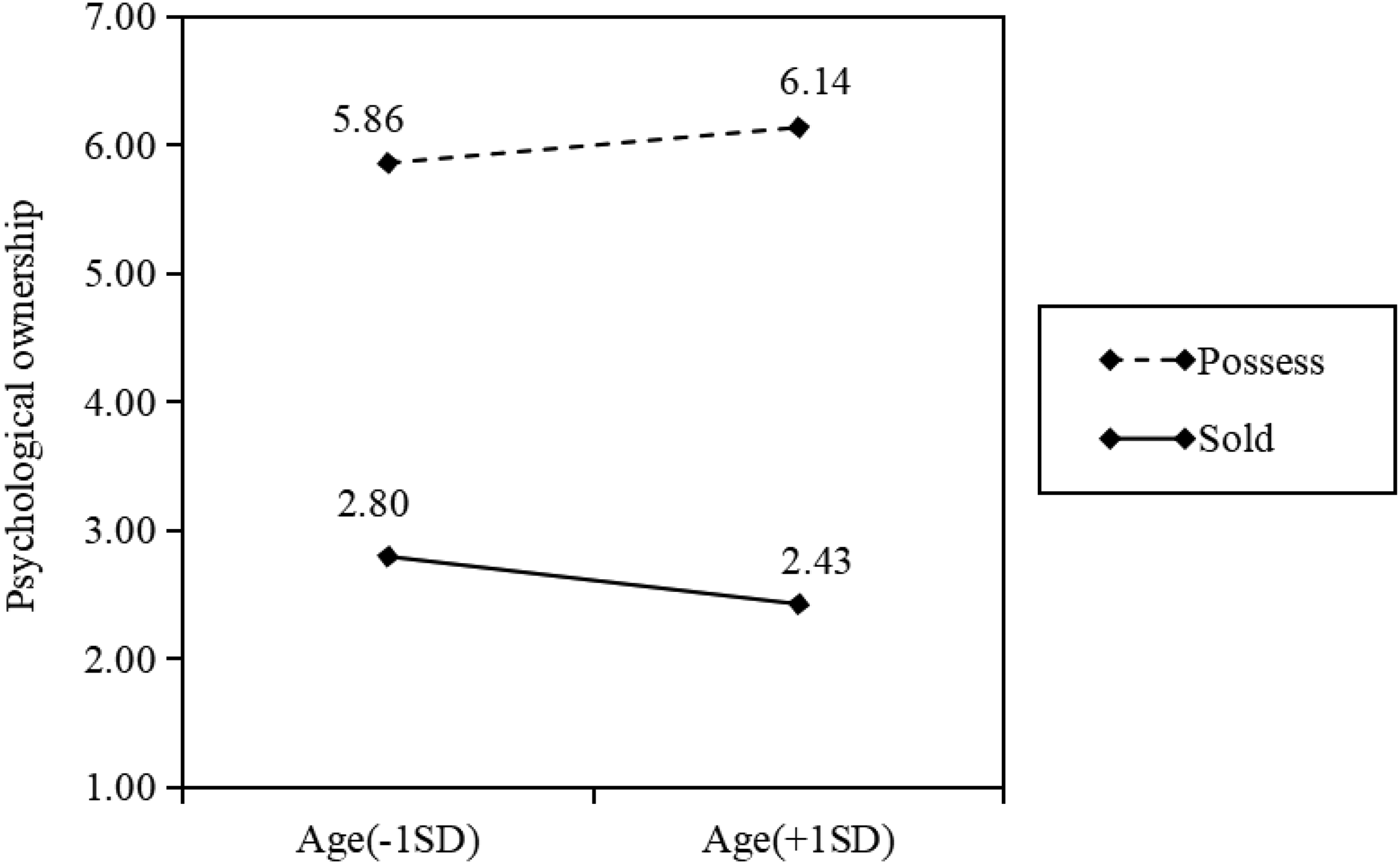
Psychological ownership in Study 3 (N = 327). The black solid line represents the sold condition, and the black dotted line represents the possess condition. Psychological ownership is a continuous variable ranging from 1 to 7.
Discussion
Study 3 provides robust evidence for the relationship between age and psychological ownership. The findings highlight the moderating role of item status on the effect of age, thereby offering additional support for the conclusions drawn in Studies 1 and 2. Specifically, age is negatively associated with psychological ownership over relinquished items, whereas no significant relationship is observed between age and psychological ownership of items still in possession. Next we focus on investigating the underlying mechanisms driving the influence of age on psychological ownership.
Study 4
The purpose of Study 4 is to examine the mediating mechanisms underlying the relationship between age and the reduction in psychological ownership over relinquished possessions. Specifically, it explores the potential roles of illusion of control and self-extension in this relationship.
Participants
We recruited 200 participants from Prolific in two age groups, 18–59 years (N = 100) and 60 years and above (N = 100). Consistent with the procedure of Study 1, our survey has an initial screening criterion. We inquire whether the participants currently possess a computer. If they do, they are allowed to proceed with the survey; if not, the survey is terminated for them at that point. During this screening process, 5 participants did not meet the eligibility requirement to continue, leaving 195 eligible participants (63.4% female, age in years range = 18–82, Mage = 51.08, SD = 17.10).
Experimental design
Consistent with the procedure of Study 1, the participants were initially asked to imagine that they sold the computer according to the following instructions: “Imagine that you sell the laptop in the market. You get compensated at its market value. Please write down your thoughts and feelings about this.” Subsequently, the participants indicated their perception of the extent to which they feel like they own this computer by responding to two items: “I still feel like this is my computer” and “I still feel like I own this computer” (1 = strongly disagree, 7 = strongly agree). We averaged the two to determine psychological ownership (α = 0.98). Afterwards, participants were asked to complete the measurements of illusion of control and self-extension by responding respectively to two questions for each measurement: “If you lose the computer, do you think you can still get it back in some way?” and “If you lose the computer, do you think you can still control it in some way?” (1 = strongly disagree, 7 = strongly agree); and “This computer is part of me” and “This computer represents who I am” (1 = strongly disagree, 7 = strongly agree). We averaged the two items of each measure to determine illusion of control (α = 0.73) and self-extension (α = 0.93). At the end, the participants reported their age and gender.
Results
Main effect
A regression analysis found that the main effect of age on psychological ownership was significant (b = −0.02, SE = 0.009, t(193) = −2.32, p = 0.022).
Mediation
We then ran a mediation analysis (Model 4; Hayes, 2018) with age as the independent variable, psychological ownership as the dependent variable, and illusion of control and self-extension as mediators (see Figure 3). As illustrated in the figure, age significantly predicted illusion of control (b = −0.02, SE = 0.01, p < 0.001, 95% CI [−0.03, −0.01]), indicating the presence of the first step of the mediation model (age → illusion of control). Including age in the model made the relationship between illusion of control and psychological ownership significant (illusion of control → perceived psychological ownership; b = 0.69, SE = 0.10, p < 0.001, 95% CI [0.49, 0.89]). When illusion of control was included in the model, the relationship between age and psychological ownership was nonsignificant (b = −0.004, SE = 0.01, p = 0.600, 95% CI [−0.02, 0.01]). Finally, the bootstrap confidence interval (CI) based on 5,000 samples showed that the indirect effect of age on perceived psychological ownership through illusion of control was significant (b = −0.02, SE = 0.005, 95% CI [−0.03, −0.01], not including zero). However, a bootstrapping analysis (5,000 resamples) revealed that self-extension (indirect effect = 0.002, SE = 0.01, 95% CI [−0.01, 0.01], including zero) did not mediate the relationship between age and psychological ownership.
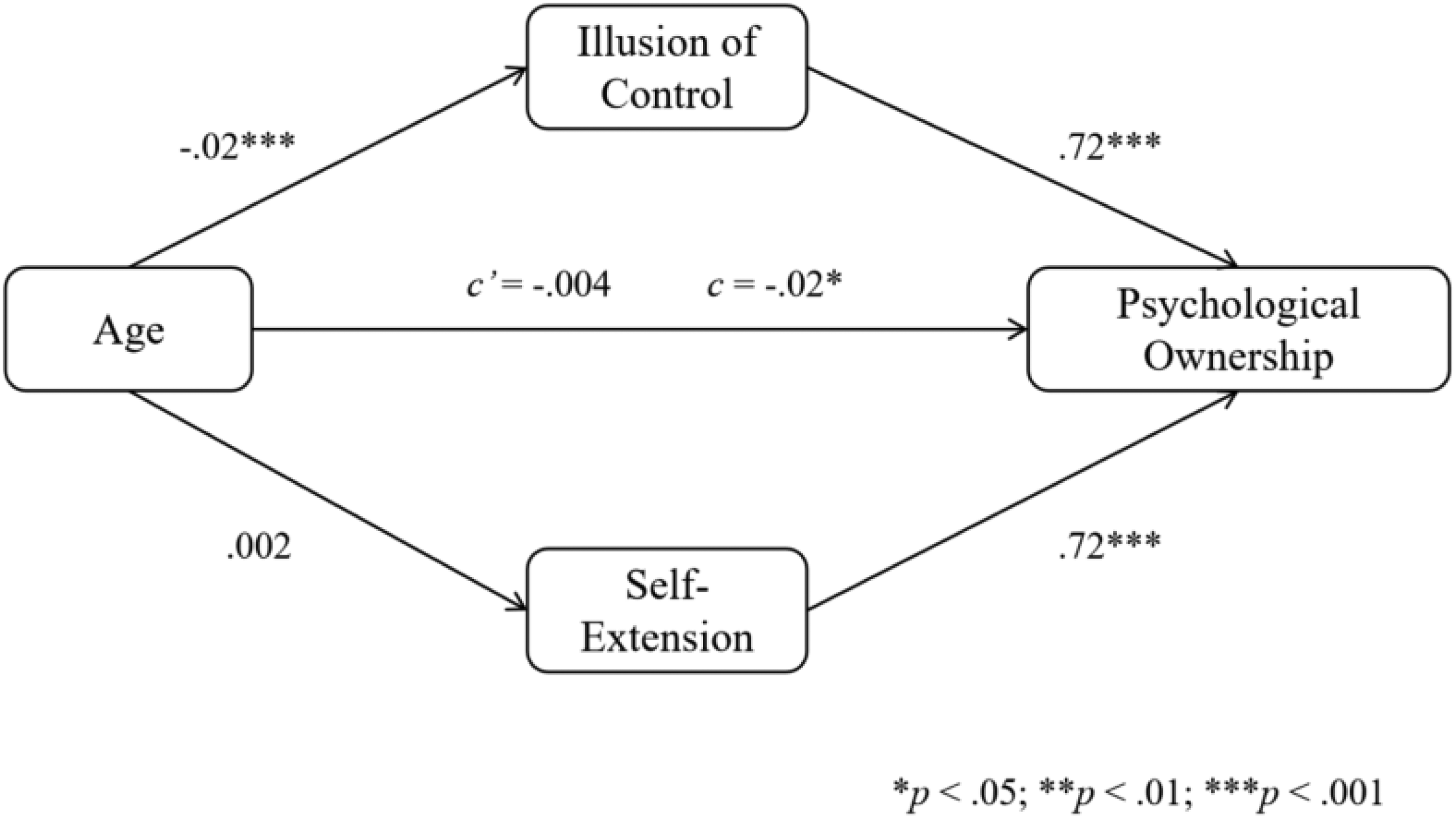
Mediation effects of the illusion of control and self-extension in Study 4 (N = 195).
Discussion
Study 4 further validated the main effect, confirming that age negatively predicts individuals’ perceived psychological ownership of relinquished items. Moreover, this study demonstrated the mediating role of the illusion of control. Specifically, older individuals exhibit a lower illusion of control over relinquished items, which leads to lower perceived psychological ownership. In contrast, younger individuals have a higher illusion of control over items they no longer possess, resulting in higher perceived psychological ownership. Additionally, this experiment excluded self-extension as a potential mediating factor, which indicates that individuals of different age groups perceive psychological ownership of relinquished items independently of the role of self-extension in relation to possessions. The next study examines how the processes tested in Studies 1–4 influence marketing outcomes.
Study 5
Study 5 linked marketing outcomes to the process behind age attenuating people's perceived psychological ownership of relinquished possessions and replicated the main findings in previous studies with different contexts.
Participants
We recruited 240 participants from Prolific in two age groups, 18–59 years (N = 120) and > 60 years (N = 120). Consistent with the procedure of Study 1, our survey has an initial screening criterion: We inquire whether the participants currently possess a TV. If they do, they are allowed to proceed with the survey; if not, the survey is terminated for them at that point. During this screening process, 8 participants did not meet the eligibility requirement to continue, leaving 232 eligible participants (50.4% female, age in years range = 20–80, Mage = 51.88, SD = 15.88).
Experimental design
Consistent with the procedure of Study 4, the participants were initially asked to imagine that they sold their TV according to the following instructions: “Imagine that you sell the TV in the market. You get compensated at its market value. Please write down your thoughts and feelings about this.” Subsequently, the participants were required to write down the TV brand. Then they indicated the extent to which they would be willing to repurchase a television from the same brand by responding to two items: “When buying another TV, I am committed to buying this brand rather than an alternative brand” and “During my next purchase of a TV, I will buy the same brand.” We averaged the two items to determine repurchase intention (α = 0.83). After participants rated their perceptions of psychological ownership of their sold TV, they completed the measurements of illusion of control and self-extension in line with Study 4. At the end, the participants reported their age and gender.
Results
Main effects
A regression analysis found that the main effect of age on psychological ownership was significant (b = −0.01, SE = 0.01, t(230) = −2.19, p = 0.030), and the main effect of age on repurchase intention was also significant (b = −0.01, SE = 0.01, t(230) = −2.04, p = 0.042).
Mediation
We then ran a mediation analysis (Model 4; Hayes, 2018) with age as the independent variable, psychological ownership as the dependent variable, and illusion of control and self-extension as mediators. As illustrated in Figure 4, age significantly predicted illusion of control (b = −0.02, SE = 0.01, p < 0.001, 95% CI [−0.03, −0.01]), indicating the presence of the first step of the mediation model (age → illusion of control). Including age in the model made the relationship between illusion of control and psychological ownership significant (illusion of control → perceived psychological ownership; b = 0.72, SE = 0.10, p < 0.001, 95% CI [0.52, 0.92]). When illusion of control was included in the model, the relationship between age and psychological ownership was nonsignificant (b = −0.005, SE = 0.01, p = 0.542, 95% CI [−0.02, 0.01]). Finally, the bootstrap confidence interval (CI) based on 5,000 samples showed that the indirect effect of age on perceived psychological ownership through illusion of control was significant (b = −0.01, SE = 0.005, 95% CI [−0.02, −0.01], not including zero). However, a bootstrapping analysis (5,000 resamples) revealed that self-extension (indirect effect = 0.003, SE = 0.01, 95% CI [−0.01, 0.01], including zero) did not mediate the relationship between age and psychological ownership.

Serial mediation effects of illusion of control and psychological ownership in Study 5 (N = 232).
Serial mediation
We ran a set of serial-mediation models (Model 6; Hayes, 2018) using age as the independent variable, illusion of control and psychological ownership perceptions as sequential mediators, and repurchase intention as the outcome (see Figure 4). This model revealed that age decreased people's illusion of control, which attenuated perceived ownership, resulting in lower repurchase intention (indirect effect = −0.002, SE = 0.001, 95% CI = [−0.004, −0.0002]). However, swapping the positions of illusion of control and ownership as sequential mediators revealed nonsignificant results (indirect effect = −0.001, SE = 0.001, 95% CI = [−0.002, 0.0002]).
Discussion
Study 5 examined how age attenuates individuals’ perceived psychological ownership of items they no longer own and how this process impacts marketing outcomes. Specifically, as individuals age, their illusion of control over possessions diminishes, leading to a reduction in their perceived ownership of these items, which in turn decreases their intention to repurchase similar products. Moreover, this study employed mediation analysis to rule out self-extension as an alternative explanation for the relationship between age and psychological ownership of possessions. Conducted across diverse contexts, this replication study further strengthens the robustness and generalizability of the earlier findings.
Study 6
In Study 6, we aim to replicate the relationship between age and repurchase intentions for relinquished possessions within a more realistic experimental context. Unlike Studies 4 and 5, which relied on participants imagining a scenario of selling an item, this study is conducted in a setting designed to closely reflect real-life circumstances.
Participants
We recruited 244 participants via Prolific to complete an online survey. Of these, 41 were excluded from the dataset as they reported no prior experience of selling a household ornament, leaving a final sample of 203 valid participants (66.0% female, age in years range = 19–79, Mage = 50.24, SD = 16.23, 60 years and above (N = 97)).
Experimental design
We first selected qualified participants by asking whether they had sold a household ornament they had previously owned. Only participants who had actually sold their own ornament in the past were eligible to proceed with the questionnaire, in which we specifically informed participants that any item they perceive as having decorative value could be considered a household ornament. Examples provided included paintings, jewelry, sofas, tables, clothing, and other similar items. Subsequently, participants were asked to provide the brand name, duration of ownership, and price of their sold ornament. Then they indicated the extent to which they would be willing to repurchase an ornament from the same brand by responding to two items: “When buying another ornament, I am committed to buying this brand rather than an alternative brand” and “During my next purchase of an ornament, I will buy the same brand.” We averaged the two items to determine repurchase intention (α = 0.83). After participants rated their perceptions of psychological ownership of their sold ornament, they completed the measurements of illusion of control. At the end, the participants reported their age and gender.
Results
Main effects
We conducted a regression analysis and found that the main effect of age on psychological ownership was significant (b = −0.01, SE = 0.01, t(201) = −2.25, p = 0.026), and the main effect of age on repurchase intention was also significant (b = −0.03, SE = 0.01, t(201) = −4.09, p < 0.001).
Serial mediation
We ran a set of serial-mediation models (Model 6; Hayes, 2018) using age as the independent variable, illusion of control and psychological ownership perceptions as sequential mediators, and repurchase intention as the outcome (see Figure 5). This model revealed that age decreased people's illusion of control, which attenuated perceived ownership, resulting in lower repurchase intention (indirect effect = −0.003, SE = 0.001, 95% CI = [−0.005, −0.001]). Even after we controlled for the duration of ownership and the price of the ornament, the results remained statistically significant (indirect effect = −0.003, SE = 0.001, 95% CI = [−0.006, −0.001]).

Serial mediation effects of illusion of control and psychological ownership in Study 6 (N = 203).
Discussion
Study 6 replicated the findings of Study 5 using participants’ actual experiences of selling items. Even after we controlled for the price and duration of ownership, the results remained consistent. Specifically, as individuals age, their illusion of control over possessions diminishes, leading to reduced perceptions of ownership over these items and, consequently, lower repurchase intentions for the same products. This experiment further strengthens the robustness of the findings.
General discussion
This research investigates the unique scenario wherein individuals maintain psychological ownership of specific items even after ceasing physical possession. This enduring psychological ownership exerts an impact on repurchase intentions toward the same brands across diverse age groups. Across six experimental studies, we found that age differences in psychological ownership of relinquished items exist for younger and older adults. First, we showed through Study 1 that age decreases people's psychological ownership of items they no longer own; that is, as people age, their perception of psychological ownership over relinquished possessions diminishes. Conversely, younger individuals exhibit a stronger sense of ownership over their relinquished items. Second, we validated the robustness of our main findings through different manipulation routes and confirmed through Studies 2 and 3 that this negative association manifests only when individuals release (sell) possessions, not when they own them. Third, through the measurement of the mediating variable, we verified that, as age increases, the illusion of control over relinquished possessions decreases, leading to lower psychological ownership of those items; we also ruled out self-extension as a potential alternative mediator through Study 4. Finally, at the marketing level, we explored the downstream behaviors of this effect and found in Studies 5 and 6 that the relationship between age and repurchase behavior for relinquished items is sequentially mediated by a lower illusion of control and reduced psychological ownership. In other words, as age increases, the illusion of control over possessions no longer owned decreases, leading to lower psychological ownership, which in turn reduces the repurchase intention for the same brand.
Theoretical contribution
This study makes a unique contribution to the literature on psychological ownership by examining the change in trajectory of psychological ownership with age, specifically among people who are no longer in possession of an item. Prior research on psychological ownership has concentrated on possessions that individuals currently own, whether tangible or intangible (Bardhi & Eckhardt, 2017; Mittal et al., 2019; Morewedge et al., 2020). In contrast, our study distinguishes ownership by considering whether or not individuals still possess the items. Our work expands existing research by investigating how psychological ownership changes with age. Findings complement the literature on psychological ownership by demonstrating that people's perceived ownership of relinquished items declines with age.
Whereas previous research explored the changing nature of psychological ownership in the context of evolving consumption patterns (Morewedge, 2021), little is known about how psychological ownership influences possessions that people no longer own and potential consequences on downstream consumer behavior. We argue that people can retain a sense of psychological ownership over things they no longer possess, which may affect their subsequent repurchase behavior for the same brand. Moreover, the current study explored the illusion of control as a potential underlying mechanism for the negative association between age and psychological ownership of relinquished possessions, altogether making a modest yet unique contribution to the theoretical understanding of the antecedents and consequences of psychological ownership.
Finally, this work contributes to the growing field of gerontology and to the understanding of how age influences the psychological processes related to ownership, offering useful insights into the complex nature of psychological ownership and its impact on consumer behavior in the context of aging populations.
Managerial implications
The market significance of this research lies in uncovering how older consumers’ psychological ownership and consumption behavior change after relinquishing possessions. The study highlights a downward trend in psychological ownership following a loss as individuals age, which directly impacts their repurchase intentions. As global population aging intensifies, the consumption potential of the elderly market continues to grow. By 2050, the population aged 60 and above is projected to double, accounting for 22% of the total population (Lunenfeld, 2008). Consequently, effectively reaching older consumers and designing targeted marketing strategies have become goals for many brands.
This research challenges the traditional view that older consumers are more nostalgic and brand-loyal (Turner & Stanley, 2021), demonstrating instead that older consumers exhibit significantly lower psychological ownership over sold possessions compared to younger consumers. Based on these findings, brands can adapt their product strategies and advertising schedules to better cater to this demographic. Specifically, the study reveals that younger consumers maintain stronger psychological ownership of relinquished items and are more inclined to repurchase the same products. In contrast, older consumers show weaker consumption stickiness after selling possessions. This suggests that brands targeting older adults should focus on developing more immediately attractive substitutes or innovative products to prevent customer attrition.
Moreover, the research implies that reduced psychological ownership may make older consumers more open to trying new brands, a critical insight for companies targeting the elderly market. Brands can leverage this openness by offering experiential products or services, such as free trials or exclusive membership activities, to ease the psychological burden of switching brands. Such strategies can enhance brand acceptance among older consumers, fostering stronger engagement and loyalty in this growing market segment.
Limitations and future directions
Any inferences drawn from the data should account for the limitations of our research and boundary conditions. First, our study provides only initial evidence of the negative relationship between age and psychological ownership of relinquished items. Further investigation is needed to verify the causal effect between age and psychological ownership. Due to the limitations of Chinese online survey platforms, the participation of elderly Chinese respondents in online surveys is relatively low. This can affect the rigor of data analysis to some extent. In future research, it would be beneficial to consider conducting field experiments or using different survey platforms to increase the proportion and number of elderly Chinese respondents. Third, we provided evidence of illusion of control as the primary psychological mechanism underpinning our results, yet there is need for research to explore other potential mechanisms, such as self-esteem. Studies have shown that self-esteem is positively correlated with psychological ownership (Jami et al., 2021), but this correlation decreases with age (Orth et al., 2010). Examining more mechanisms would offer a better understanding of why age decreases psychological ownership of belongings that people no longer own.
Supplemental Material
sj-docx-1-pac-10.1177_18344909251327669 - Supplemental material for Age differences in psychological ownership and their impact on consumer behavior: Exploring the lingering psychological ownership of relinquished possessions
Supplemental material, sj-docx-1-pac-10.1177_18344909251327669 for Age differences in psychological ownership and their impact on consumer behavior: Exploring the lingering psychological ownership of relinquished possessions by Yaojie Wang, Xinyue Zhou, Tiantian Mo and Aojie Zhang in Journal of Pacific Rim Psychology
Footnotes
Declaration of conflicting interests
The authors declared no potential conflicts of interest with respect to the research, authorship, and/or publication of this article.
Funding
The authors received no financial support for the research, authorship, and/or publication of this article.

Supplemental material
Supplemental material for this article is available online.
References
Supplementary Material
Please find the following supplemental material available below.
For Open Access articles published under a Creative Commons License, all supplemental material carries the same license as the article it is associated with.
For non-Open Access articles published, all supplemental material carries a non-exclusive license, and permission requests for re-use of supplemental material or any part of supplemental material shall be sent directly to the copyright owner as specified in the copyright notice associated with the article.
