




Abstract
The present study investigates the role of self-compassion in generating change amongst violent extremists through a study of terrorist prisoners in Indonesia. The aim is to provide insights into the under-explored role of self-transformation and agency in the deradicalisation process by applying Neff’s concept of self-compassion, which comprises psychological processes of self-kindness, perceptions of common humanity, and mindfulness. The study draws on qualitative data derived from interviews with three terrorist inmates incarcerated in Porong Prison, Indonesia. All three participants were at the time of the interview participating in a deradicalisation program implemented in the prison. Interview data indicate that the components of self-compassion play a role in self-change reported by terrorist inmates. This included the expression of remorse, seeking God's forgiveness, the acceptance of consequences and human frailty, and the ability to not linger or fixate on negative thoughts and past decisions and actions. The results of this study indicate that self-compassion is a potentially important element in the deradicalisation process, and that the development of self-compassion is an additional method by which interventions can assist the process of desistance from violent extremism.
Introduction
Self-compassion has been associated with transformative effects that lead to well-being and self-improvement. Self-compassionate individuals show greater intrinsic motivation to learn and improve (Chen et al., 2022; Neff, 2009a; Neff et al., 2005), are more caring and supportive and more eager to amend interpersonal mistakes and have problem-solving behaviours in intimate relationships (Baker & McNulty, 2011; Jacobson et al., 2018; Neff & Beretvas, 2013), and are also more likely to believe that their weaknesses can be changed and show a greater desire to make amends related to past transgressions and avoid similar transgressions in the future (Breines & Chen, 2012; Zhang & Chen, 2016). Self-compassion provides individuals with a greater willingness to learn and grow by admitting their mistakes and changing their behaviours to be more productive so that they can initiate positive changes in their lives in the face of challenges (Breines & Chen, 2012; Neff, 2009a; Zhang & Chen, 2016).
The role of self-compassion in personal change has been studied in clinical and non-clinical settings. In clinical settings, for example, self-compassion has been found to improve the effectiveness of therapies by enhancing the ability of professionals to cope with distress (Neff & Germer, 2022). In non-clinical settings, Singer and Klimecki (2014, p. 878) stated that ‘compassion training promotes not only prosocial behaviour but also augments positive affect and resilience, which in turn fosters better coping with stressful situations’.
Previous research in community samples shows that self-compassion is positively correlated with happiness, optimism, motivation, positive emotions, self-esteem, and personal initiative (Neff, 2012; Neff et al., 2007). Other studies have also shown that high self-compassion is associated with a decrease in behaviour that violates norms or ethics (Yang et al., 2020), impulsivity (Morley, 2019), and hostility (Morley et al., 2016b). Self-compassion makes individuals emotionally supportive of themselves and others when facing difficulties in their lives (Yarnell & Neff, 2012). It allows individuals to accept negative experiences in the past, increases trust in others, and makes individuals feel more accepting about how they are living their lives (Amitay & Ronel, 2023; Teleb & Awamleh, 2013). Self-compassion helps individuals to assert a locus of control over decision-making and to rationalise and justify past decisions and future actions (Amitay & Ronel, 2023; Neff, 2003a). Further, self-compassion can increase motivations for self-improvement (Breines & Chen, 2012; Neff, 2009a).
According to Neff (2003a, p. 87), ‘self-compassion entails seeing one's own experience in light of the common human experience, acknowledging that suffering, failure, and inadequacies are part of the human condition, and that all people—oneself included—are worthy of compassion’. Self-compassion encompasses attitudes towards oneself that are warm and understanding when facing life's difficulties, without judging personal shortcomings and weaknesses due to an awareness that making mistakes is part of the human experience (Dreisoerner et al., 2020; Neff & Germer, 2017; Neff, 2012; Neff, 2009b; Neff et al., 2007; Neff, 2003a 2003b). In general, self-compassionate individuals ‘have better emotional coping skills, are less afraid of failure, are more intrinsically motivated to learn and grow, are happier, are more curious and wiser, and feel more connected to others’ (Neff, 2009a, p. 561). The reason is that compassionate individuals will be more mindful of themselves and others, helping to generate self-connections (Klussman et al., 2020). Scholars in this area emphasise that self-connection entails self-awareness, self-acceptance based on this awareness, and the alignment of an individuals’ behaviour according to this awareness promoting self-actualisation, vitality, active coping, and well-being (Schlegel et al., 2012; Klussman et al., 2020).
Neff (2023; 2003a; 2003b) explains that self-compassion involves three inter-connected components: understanding and acceptance towards oneself (self-kindness); awareness that all humans can make mistakes (common humanity); and the acceptance of the presence of reality without supressing negative emotions (mindfulness). These three components combine and interact with each other in creating self-compassion.
Self-kindness is a positive and pro-active attitude toward oneself that leads to self-understanding when we encounter personal shortcomings, failures, or pain in our lives (Neff, 2012; 2011; 2003a). Self-kindness has the same benefits as self-esteem, but with fewer disadvantages, because self-esteem is associated with narcissism or unhealthy comparisons with others, while self-kindness is not (Neff, 2011; Neff, 2009a; Neff & Vonk, 2009). Individuals who have self-kindness realise that they are not perfect, can fail, experience bad things in their lives, and accept the consequences for past actions. This awareness allows them to treat themselves more positively and avoid feelings of anger, frustration, and self-judgment (Neff & Germer, 2017; Neff, 2012; 2011; 2003a).
The second component is common humanity, which is the realisation that no human is perfect, and that failures, mistakes, and calamities are experienced by all individuals (Neff, 2011; 2003a, 2003b). Common humanity provides awareness that all humans are interconnected and leads to the development of empathy (Fuochi et al., 2018). In contrast, individuals with lower feelings of common humanity tend to feel that they are the only ones who have had bad experiences, and think the world treats them unfairly. This understanding is different to self-kindness because it involves an acceptance of human fragility, which is common to all people.
The last component of self-compassion is mindfulness (Neff, 2003a). Mindfulness in self-compassion theory refers to a state of self-awareness of an individual's present reality. In this sense, mindfulness allows individuals to focus more on calming themselves, and balancing positive and negative thoughts and feelings without suppressing negative emotions. The element of mindfulness in self-compassion narrowly focuses on ‘the balanced awareness of negative thought and feelings involved in personal suffering’ (Neff & Germer, 2013, p. 2). It is important to appreciate that the experience of negative emotions is a feature of mindfulness, but mindfulness is characterised by the ability to allow these emotions to pass through, or wash over, oneself – that is, to sit with the uncomfortable feeling and look towards positive future aspirations and hopes – and not to dwell on negative thoughts. Thinking about the future and having an attainable belief in the future in turn increases psychological capital, resulting in positive influence, motivation, and improved goal achievement (Wang & Wang, 2021). By heightening awareness and communication of the co-occurrence of positive and negative experiences and emotions, individuals can increase their abilities to understand and self-regulate their emotional responses (Guendelman et al., 2017).
It is essential to understand that mindfulness can be differentiated into trait and state mindfulness. While a trait or dispositional mindfulness indicates one's innate capacity or personality trait ‘to be mindful in daily life’, state mindfulness or deliberate mindfulness refers to ‘a state practiced in mindful meditation’ (Kiken et al., 2015, p. 41). In the context of an intervention, state mindfulness focuses on the mindfulness moments experienced during the mindfulness training that are hoped to then increase after intervention, while trait mindfulness describes the baseline of mindful behaviour and thoughts (Tang et al., 2016). As personality traits, one's trait mindfulness may be stable overtime (Brown & Ryan, 2003; Kiken et al., 2015). However, growing evidence has demonstrated that trait mindfulness, like other personality traits, can change overtime due to life experience as well as mindfulness interventions (Kiken et al., 2015; Nyklíček et al., 2013; Shapiro et al., 2012; Tang et al., 2016). For this study, we view the mindfulness element of self-compassion as trait mindfulness, because we do not focus on specific momentary experiences of mindfulness that result from a targeted intervention. As we explain further below, the prison deradicalisation program that respondents were part of is a loosely informal and unstructured intervention, which is primarily facilitated by the prison officials through a personal and humanitarian approach.
Self-compassion of terrorist offenders and other violent criminals
Research on self-compassion in the context of terrorism studies has been rare. Self-compassion has, however, been studied in the context of non-ideological violent criminals. This research supports the view that the formation of self-compassion amongst perpetrators and former perpetrators of violent crime can have a variety of positive effects, such as to increase their social bonding, empathy, self-esteem, self-control, and prevent them from committing further violence or engaging in antisocial behaviour, as well as reducing their impulsive behaviour (Gómez et al., 2020; Morley, 2015; Morley et al., 2016a; Morley, 2018). Self-compassion has also been shown to help improve the mental health of incarcerated offenders (Ptacek & Daubman, 2020).
Several studies on self-compassion–based interventions have been conducted with the aim to rehabilitate incarcerated offenders and perpetrators of violence. Morley and Fulton (2020) and Morley (2018) found that self-compassion interventions can decrease criminal impulsivity and recidivism risks among various types of offenders. Rezapour-Mirsaleh et al. (2021) also showed that self-compassion interventions among male prisoners decrease criminal thinking, that is, attitudes and beliefs that rationalise and justify criminal behaviours. Murphy et al. (2005) conducted a workshop program designed to enhance compassion for self and others among men who had perpetrated intimate partner violence, and reported that the intervention significantly reduced relationship violence.
Based on these insights from existing studies in the criminal context, it is plausible that self-compassion is a potential important factor in understanding the process of self-change amongst violent extremists. We argue here that there is a strong theoretical basis to state that developing self-compassion is a process that may help to explain extremists’ self-change in the context of disengagement and deradicalisation. Literature on desistance from crime and violent extremism highlight that personal change amongst offenders can only be explained with reference to specific types of internal or psychological transformations (Giordano et al., 2002; Horgan, 2009; Maruna, 2001; Morrison et al., 2021; Raets, 2022). For example, in the context of Indonesia, Muluk et al. (2020) reported on the use of a psychological intervention for convicted terrorists to support an ideological shift and its motivational aspects. Using emotional expression and cognitive flexibility training, the study found that a higher compatibility between cognitive flexibility and emotional expression increased support for civic life, which is one of the main characteristics of desistance from violent extremism. The study supported previous findings on the role of emotions and cognitions as crucial psychological aspects in facilitating disengagement from extremism (Horgan, 2009; Simi et al., 2019). However, in the context of ideologically motivated offenders committed to a violent extremist cause, the exploration of concepts and processes related to individual internal states such as individual agency and self-introspection remain rare (Raets, 2022a). In this case, we considered that the development of self-compassion might be one individual cognitive transformation that supports the trajectory of other behavioural, relational, and cognitive changes.
We have at least three reasons for investigating self-compassion as a single factor in explaining the transformation of violent extremist offenders. Firstly, as suggested by Morley (2015) and Morley et al. (2016a), compared to other psychological concepts such as self-esteem, self-control, and social connectedness, self-compassion is a more promising concept as a negative indicator of violent criminality since it encompasses three elements (self-kindness, common humanity, mindfulness) which have been much studied in violent criminality (Morley, 2015). For example, the self-kindness element of self-compassion has a positive relationship with global self-esteem (Neff, 2011; Neff & Vonk, 2009); perceived common humanity has a positive association with social connectedness (Murphy et al., 2005; Neff et al., 2007); and mindfulness is related to self-control (Bowlin & Baer, 2012; Amitay & Ronel, 2023; Neff, 2003a) and self-efficacy (Liao et al., 2021; Smeets et al., 2014). In particular, self-compassion plays an important role in protecting individuals’ self-esteem, social connectedness, and self-efficacy, specifically in dealing with failure (Liao et al., 2021). Secondly, studying self-compassion in the rehabilitation of offenders also may have more benefits compared to self-esteem considering that high self-esteem can be associated with self-enhancement bias, self-narcissism, self-centeredness, and other negative mentalities which undermine well-being and increase perpetration (Murphy et al., 2005; Neff, 2011; Neff & Germer, 2017). In contrast, self-compassion can provide individuals with greater emotional resilience and stability and undistorted cognitive functions which enable them to gain motivations for self-change and improvement (Breines & Chen, 2012; Chen et al., 2022; Neff, 2009a; Neff et al., 2005; Neff et al., 2007; Neff, 2011; Zhang & Chen, 2016). Thirdly, compared to other psychological concepts of self, self-compassion is more relevant to the background of the extremist offenders who have been sentenced in prison and are undergoing prison rehabilitation programs to reform themselves, considering self-compassion is related to individuals’ resiliency when facing adversity, and is known to promote agency that motivates oneself to change (Neff 2003a; Neff, 2011; Neff & McGehee, 2010; Singer & Klimecki, 2014). Self-compassion supports change processes by facilitating positive cognitive restructuring, including increasing agency and belief in the possibility of change (Allen & Leary, 2010). Hence self-compassion is a part of self-transformation, we propose.
Therefore, we propose that self-compassion can offer a conceptual tool to explain the nature of psychological transformation by taking account of the agentic power of individuals. Raets (2022) states that agentic factors are highly relevant to understanding transformation amongst ideologically motivated offenders. Indeed, desisting from violent extremism can be understood as an ‘agentic process’ (Marsden, 2016, p. 39) which involves individual choices, motivations, and decision-making (Altier et al., 2014; Koehler, 2017; Riley & Schneider, 2020). For this reason, we propose that it is relevant to consider the role of self-compassion in the reported self-transformational processes of violent extremist offenders.
This article presents findings from research on self-compassion as a factor in terrorist convicts’ self-change. Our research centred on one main question: How do terrorist inmates who have been undergoing a prison deradicalisation program experience self-compassion? The aim was to explore the presence of self-compassion amongst the narratives of three violent extremist offenders incarcerated in Porong Prison in Indonesia. The study has merit given to date we are not aware of an attempt to explore the relevance of self-compassion to the self-change of extremist offenders, with it having implications for how we understand pathways out of violent extremism and how they can be supported by interventions. This study also can broaden our knowledge about how self-compassion functions in individuals from diverse cultural backgrounds, given the self-compassion concept may be partially determined by cultural context and influenced by group's norm, values, and practices (Gilbert et al., 2011; Neff et al., 2008; Montero-Marin et al., 2018), and has comparatively rarely been studied in the Indonesian context.
Method
The present study site
This article is based on a project that was carried out in 2020 in Porong Prison, 1 Surabaya, Indonesia. Porong Prison has been praised for its success in implementing the government's deradicalisation program in prison (Rahim, 2023; Suarda, 2020). Stakeholders involved in deradicalisation programs in Indonesia aim to persuade terrorist convicts to abandon their extreme ideology through the application of a soft approach which emphasises a process that ‘re-humanise[s] detainees and show[s] that the security forces can be kind, humanitarian individuals’ (Dhami et al., 2020, p. 52). To prove that they have reformed or deradicalised, apart from showing good behaviour, terrorism convicts must also cooperate with law enforcement to uncover terrorist activities, reject their previous extreme ideology, and most importantly pledge their loyalty to the Republic of Indonesia. These criteria have become the primary indicators of the successful deradicalisation in Indonesia's judicial system (Sukabdi, 2015).
The deradicalisation program in Porong Prison draws on the same national approach as stipulated by the Indonesian government. Porong Prison officially assigns a senior staff member, with a junior staff member as his assistant, to have responsibility for the implementation of what is referred to as a ‘humanitarian’ approach when engaging terrorist inmates. This staff member is responsible for developing trusted personal relationships with terrorist inmates and assessing the progress of deradicalisation. He and his assistant meet and monitor terrorist inmates and report about their progress on a daily basis. He also can facilitate special services such as assisting terrorist prisoners to communicate via video call with their families. Approaching the families of terrorist prisoners is indeed one effective way that Porong Prison aims to reform terrorist prisoners. In this way, inmates become closer to their family members and are more sensitive to the situation and conditions of their loved ones outside of prison, which is seen as helping them to abandon their terrorist group and ideology for the sake of their families.
On a practical level, Porong Prison also provides life-skills training programs to terrorist inmates. These primarily consist of business empowerment programs, in which prisoners receive a small amount of capital for starting a small business in prison, such as gardening vegetables, raising ducks, and selling food. Porong Prison also collaborates with non-governmental organisations (NGOs) to provide soft-skills training to terrorist inmates, such as conflict management and interpersonal communication skills. With the help of NGOs, Porong Prison also facilitates reconciliation initiatives which involve terrorist convicts meeting with victims. Religious experts and scholars, psychologists, as well as former repentant terrorists, are also invited to provide counselling, religious insights and engage in dialogue and debate with terrorist convicts.
As a medium security prison, Porong Prison in collaboration with the BNPT (the National Counter Terrorism Agency) and Densus 88 (the Special Detachment 88 Anti-Terror Police) also implements policies that allow terrorist prisoners to receive the same benefits as general prisoners, including remissions and parole, with the aim of preparing them for reintegration into society when released. Like other general inmates, the terrorist prisoners are also allowed to move freely outside their cells and interact with the general inmates and prison officials. They can also join in recreational activities such as sports and are allowed to be visited by families on certain days in a week as determined by the prison schedule.
Participants
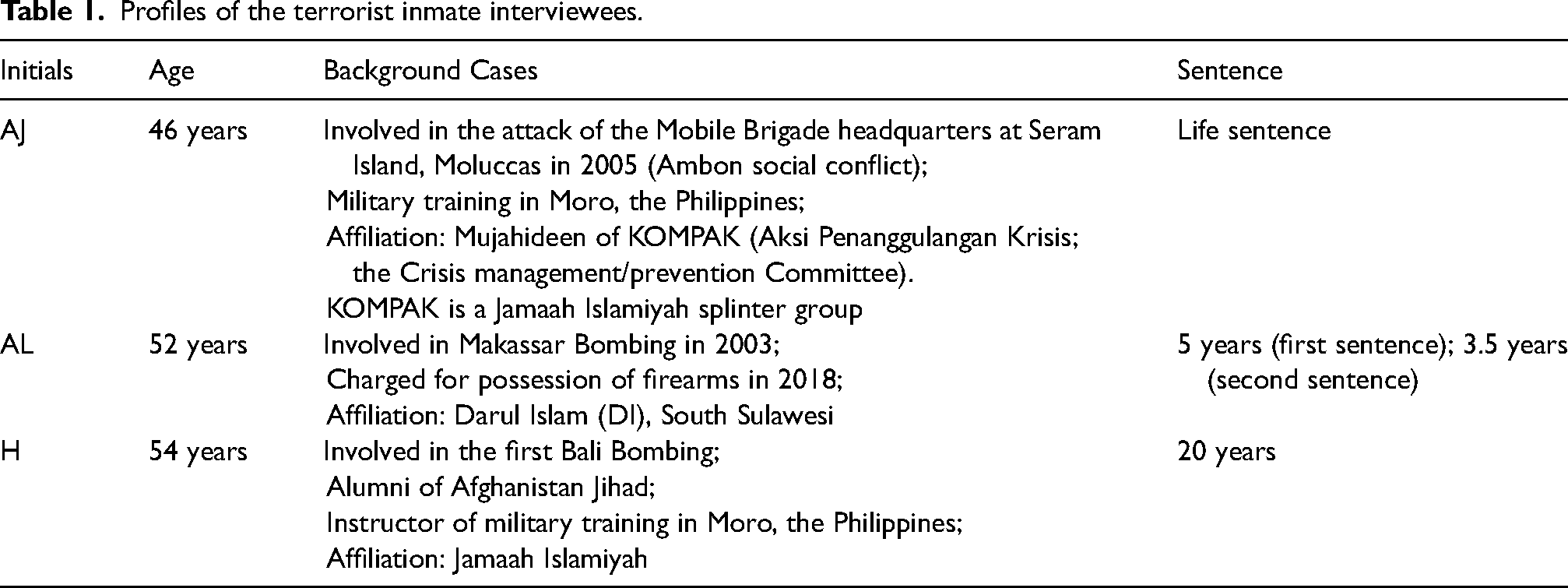
Three inmates convicted of terrorism were successfully recruited to be interviewed from a total of six terrorist convicts who were identified as potential research participants by prison authorities. This selection process was a condition set by the prison authorities and does raise limitations and the potential for bias (which we address in the limitations of this study). The timeline to complete the project did not allow for the recruitment of more prison or community participants (Institute for Policy Analysis of Conflict [IPAC], 2020; Sukabdi, 2015). The three successfully recruited participants were male, ranging from 46 to 54 years old. At the time of the interview each had been participating in the Porong Prison deradicalisation program and were deemed as exemplars of successful deradicalisation by prison officials based on the Indonesian prison system criteria, that is, they had signed an official statement regretting their past terrorist acts, demonstrated a rejection of their former extremist ideology, and had pledged allegiance to the Republic of Indonesia.
The profiles and case backgrounds of the three terrorist inmate interviewees are listed in Table 1.
Profiles of the terrorist inmate interviewees.
Procedure
The first and second authors visited the prison and met the participants face to face accompanied by a prison officer to inform them about the aims of the study and whether they were interested in participating. Approval to conduct the research was sought and granted by the Indonesian Ministry of Human Rights, Surabaya Office (approval W.15-UM.01.01-965). Standard informed consent processes were followed.
Data for this study were collected using semi-structured interviews which were conducted by the second author, once with each participant for a duration of 60–90 min. The interview schedule was informed by Neff's (2003b) conceptualisation of self-compassion with additional questions concerning the participants’ terrorism case backgrounds and rehabilitation and/or deradicalisation program they have been involved in during their time in serving their sentences (Appendix A). To be sensitive to the context of the participants of the present study, we constructed open-ended questions regarding self-compassion by referring to the broad meaning of each element of Neff's (2003a) concept of self-compassion, namely kindness towards oneself in difficult times (e.g., ‘How do you treat yourself as the person who has been punished for making a mistake?’), recognition that one's suffering is part of the shared human experience (e.g., ‘How do you see your current life difficulties while serving your prison sentence compared to those experienced by others?’), and bringing attention to one's suffering in a mindful, non-obsessive way (e.g., ‘How do you feel when you learn that your past mistake caused harm to yourself and others?’). The full interview schedule is included as Appendix A.
Because of the COVID-19 outbreak at the time of conducting the research, Porong Prison issued a policy to prohibit all visits to the prison, which impacted face-to-face interviews as planned for this study. Therefore, interviews with the three participants were conducted via telephone in April 2020. A prison officer arranged an office and office phone during the interviews for each participant, and the interview was conducted without this officer being present. In addition to the three participants, a senior prison official who had been responsible for assisting terrorist inmates in Porong Prison for 13 years was also recruited and consented to be interviewed. Data collected from the prison official allowed us to gain more understanding of the three participants’ accounts. It is possible that interviewing by telephone impacted on the information elicited, given that such interviews lack the dynamics and personal interactions of face-to-face interviews. However, face-to-face interviews were not possible at the time.
Interviews were conducted by the second author. At the time of the study, the second author was a final (fourth)-year student of bachelor program in psychology (supervised by the first author). He had completed the relevant modules and training in research methodologies including interview, observation, and data analysis in qualitative approaches before conducting this study. In the context of Indonesian education, the final (fourth) students of the bachelor program have the required qualification to conduct an independent research project. As reported by The Organisation for Economic Co-operation and Development (OECD) (2023), only 9.5% of the population aged 25–64 years in Indonesia obtained a bachelor's degree or equivalent higher education. Before conducting interviews for this study, the second author also simulated the actual interviews with the first author, a senior lecturer in psychology with experience in conducting qualitative research on social psychology topics including deradicalisation and disengagement from terrorism in the Indonesian context.
Data analysis
All interviews were recorded and transcribed verbatim. Data were analysed using thematic analysis identifying and categorising patterns from the data (Braun & Clark, 2006). We adopted an essentialist or realist assumption and analysed the semantic content of participants’ accounts. Themes were coded deductively based on the self-compassion framework of Neff (2003a) – that is, across the concepts of self-kindness, common humanity, and mindfulness. As suggested by Braun and Clarke (2006), deductive data analysis focuses more on providing detailed insights of specific aspects of the data set as interpreted through a particular theoretical lens; thus, it may provide a less rich description of the entire data set. Thematic analysis involves six analytical stages starting with data familiarisation, generation of initial coding, theme development, reviewing themes, defining themes, and writing of final analysis (Braun & Clark, 2006). We were guided by Neff's (2003a) concept of self-compassion and did not code linearly from the first phase to the next. Instead, we perform a recursive process by moving forward and backward throughout the coding process. In the initial stage, we develop a self-compassion coding structure consisting of three themes of self-compassion (self-kindness, common humanity, and mindfulness). We defined each theme and described when the theme occurs. In the second stage, initial coding was conducted manually by the second author by reading and re-reading all the transcriptions. All the codes identified from the data were then clustered to develop sub-themes which were later grouped under the ‘self-kindness’, ‘common humanity’, and ‘mindfulness’ themes. All codes and themes which did not fit these three themes were categorised separately and inductively under the ‘miscellaneous’ label. After this stage was completed, the first author independently reviewed the initial codes and sub-themes and evaluated whether each code accurately encompassed sub-themes and each sub-theme was theoretically matched. In this stage, the second author also evaluated all codes within the ‘miscellaneous’ category to determine whether they aligned with existing codes. During the writing process, the first author further refined the codes and sub-themes by returning to the original transcripts and self-compassion framework to check whether the themes reflected general findings across study participants and the theoretical framework. In writing up the final manuscript, codes and themes from the data set under the ‘miscellaneous’ category were excluded from the analysis.
Steps were adopted to enhance the methodological rigour of the present study. The validity of the coding was tested by both the first and second authors coding the data separately and then comparing each other's coding and interpretation. Where differences were found, a consensus was reached between both coders on the most applicable coding allocation. This reflects the process of peer review where the coding of the data was cross-checked for consistency (Creswell & Miller, 2000). To ensure transparency, the first and second author kept a research journal documenting field notes from interviews and decisions made throughout the data analysis process. Interviewing the prison official who had been assisting the participants for many years was also designed to seek data triangulation from alternate sources which can improve the validity of this study's findings (Yin, 2009). Also, to reduce bias in data interpretation, the authors provide transcripts excerpts as direct quotes in this paper. This ‘grounding in examples’ procedure has been suggested by Elliot et al. (1999).
Findings
Referring to the concept of self-compassion (Neff, 2023; 2003a; 2012), the findings of this study are categorised into three main themes: self-kindness, common humanity, and mindfulness. Each theme consists of several sub-themes and codes identified from the data set (Table 2). The ‘self-kindness’ theme highlights participants’ acknowledgment that their past involvement in terrorism was a mistake which led them to accept their prison sentence as redeeming their past mistakes. This stance eventually helps them to forgive themselves. Believing in God's forgiveness for human's wrongdoings and engaging in spiritual practices also becomes an integral part of participants’ self-forgiveness. The next ‘common humanity’ theme encompasses participants’ belief that all human beings can do wrong so that they are not alone who have erred. The sense of having the same imperfections as others and feelings of gratitude for being treated with kindness by security and prison officials helps them to avoid the feeling of isolation and instead engage in positive social relationships during their time in prison. The last ‘mindfulness’ theme describes how participants reflect on their past negative experience and current prison punishment. Making meaning of their current situation and drawing life lessons from their negative experiences help the participants in maintaining a positive outlook and not being overwhelmed by negative reactivity.
Themes emerged in the present study.
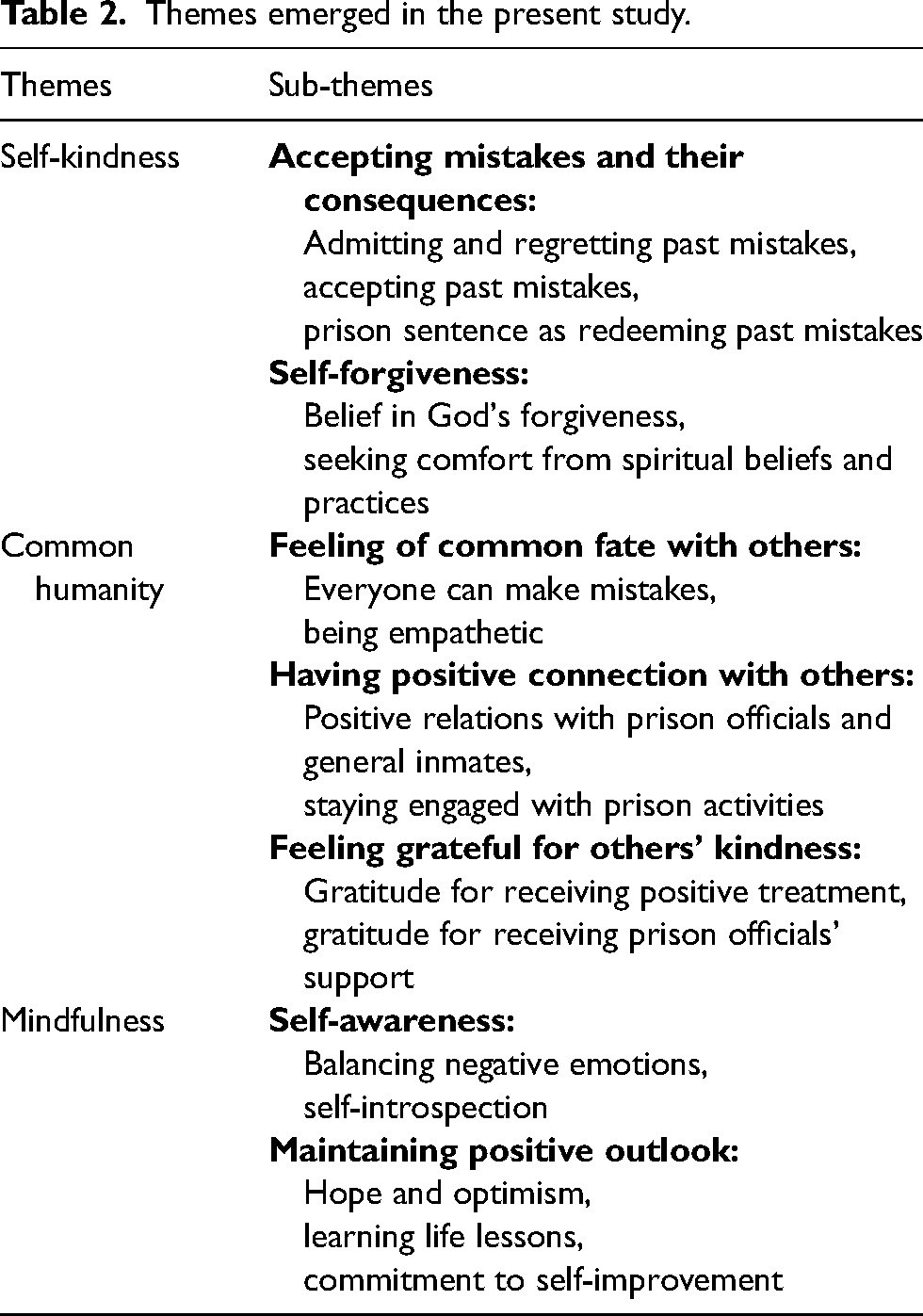
It should not be assumed that these themes (elements) of self-compassion occur or operate in a sequential order (Barnard & Curry, 2011). While these components are each discussed sequentially here for the purpose of presentation, they are not mutually exclusive but rather operate to shape the features of self-compassion among the participants (Neff, 2012; Wilson et al., 2020).
Self-kindness
As convicts of terrorism cases, the participants of this study experienced various negative life moments resulting from their arrest, detention, and imprisonment. Responding to their past experiences of being involved in terrorism, the three participants expressed remorse and admitted guilt. However, self-compassion stems from constructing or embracing a narrative understanding about the cause of their mistakes, which allows for regret and guilt to be managed psychologically through self-kindness, so that participants can forgive their own past mistakes and accept their current situation.
For example, participant AJ initially went to Ambon for a humanitarian mission, an area of Indonesia where there was social conflict between Muslims and Christians. He was exposed to the ideology of takfiri (perceiving fellow Muslims who reject their ideology as infidels, and whose murder is legitimate), and he ended up being involved in an attack on a police headquarters in Seram Island, Moluccas, which resulted in casualties. Part of his reported self-transformation involved voicing regret about his involvement in this action, stating: I regret holding takfiri ideology and justifying the blood of infidels so that it was easier for me to carry out violence [on police officers] in the name of the takfiri ideology. I eventually ended up being captured by the authorities and caused victims to lose their lives. (AJ)
AJ realised that the root of his past mistakes was the result of his lack of religious knowledge. The prison officer who was interviewed stated: He revealed to me that he regretted causing the loss of life that shouldn’t have happened. I quote [from] his pardon letter: ‘I admit it was my fault as a result of my stupidity as a result of swallowing one piece of information from one direction only without trying to seek understanding from another source so that I was easily provoked [to attack police officers].’ (Prison officer)
Reflecting on his past mistake, AJ eventually come to accept it. He said, ‘When I see it now, after I understand it, because it was my own mistake so I acknowledge and accept it.’ Therefore, he also accepts his punishment as an inevitable consequence: ‘This is the result of our mistakes, for every mistake there will be retribution both in this world and in the afterlife’ (AJ).
Another participant AL, also reported feeling remorse for being easily influenced by propaganda and narratives about violent intimidation experienced by Muslims in the Ambon and Poso conflicts, stating: About the past, [my involvement] in the Poso-Ambon conflict, and the Makassar Bombing, I feel guilty because of believing the narrative that all Muslims were oppressed, even though that was only some Muslims. That's what makes me regret it because the narrative had made me unable to control my anger. (AL)
Anger due to the belief in the narrative of the oppression of Muslims led AL to become involved in the Makassar Bombing operation. The feeling of remorse for his past involvement in terrorist acts generated a sense of self-acceptance that his prison sentence was ‘a way to redeem my mistakes in the past’ (AL).
Participant H also expressed acceptance that the punishment he received was a direct and acceptable consequence of his past mistakes, and he did not minimise those consequences, stating: I’ve said from the start that it [the Bali Bombing] was a mistake. Not because I was sentenced to jail, then admitted it was a mistake. Don’t misunderstand, I had admitted my mistake even before the Bali Bombings were carried out, meaning that I was against and disagree with the operation for many reasons … My guilt, that I conveyed to my friends, as happened in the Bali Bombings, was that it resulted in the death of many victims … (H) He [H] is the type of person who is sensitive, the type of person who gets carried away easily by the atmosphere. So, when he met [with] the victim of the [Bali Bombing], with those initiated by the Peaceful Indonesia Alliance, he cried and apologised even though [he] was not the [direct] perpetrator. (Prison officer)
The acknowledgment of mistakes and regrets for past actions shown by the participants did not necessarily lead to negative thoughts and feelings about themselves because at the same time they recognised their frailty as humans. The more important thing for these participants was how they responded to these past mistakes. As noted above, some reflected acceptance of their imprisonment as a justified consequence. It also included attempts to ‘draw closer to God’ (AJ) and strive for redemption by seeking forgiveness through faith and prayer. Such an internalised sense of spiritual forgiveness can become a source of self-kindness (Amitay & Ronel, 2023; Long et al., 2020).
For example, AJ stated, ‘Yes, after I understand this incident, when I feel guilty, I often ask for God's forgiveness, continue to pray or read the Qur’an, hoping that my mistakes will be forgiven’ (AJ). Seeking God's forgiveness when recalling past events that evoke feelings of guilt was not only drawn on by AJ, but also by H, whose current state of mind at the time of the interview meant, ‘Now, I’ve never blamed myself, because it's been almost 15 years. Lots of asking for God's forgiveness’ (H). In the case of AL, he believes that his past life is God's destiny: ‘We are believers, so we believe that what happened is determined by Allah.’ Therefore, religious activities and becoming more spiritually engaged while in prison was part of his self-change, with AL stating that prior to his imprisonment, ‘I rarely prayed sunnah prayers’, while when in prison he maintained both a prayer and fasting schedule, which reflected a desire to seek forgiveness from God.
Common humanity
The participants of this study showed an awareness of their own weaknesses as humans which generated a sense of acceptance that this was not unique to them as individuals. For example, AJ stated, ‘Now, I have no negative self-evaluation anymore as that has happened. Everyone must have made mistakes’ (AJ). When they were asked, ‘How do you feel when you recall your mistakes in the past?’, AL and H, responded by stating: So, regarding that issue, in the course of life we must be able to take lessons because everyone must have made mistakes. (AL) It is not unforgivable, because Allah is most forgiving and most merciful. If we really want to repent. Because everyone must have made a big mistake. (H)
It can be argued that expressions that ‘every human makes mistakes, fails, and experiences misfortunes’ can be a way of externalising fault and minimising responsibility for the seriousness of one's actions. Expressions of common humanity in this context must be understood as occurring alongside expressions of acknowledgement, guilt and remorse. Importantly this transformation can help to create a sense of connection and more empathetic and harmonious attitudes towards others, which can have an effect in influencing the formation of social ties (Amitay & Ronel, 2023). As participant H reported: Now [we] make relations with more and more people from heterogeneous communities. In the past, we were homogeneous. So, I know more about other people's conditions. In prison, you can mingle and laugh, so our hardship can be forgotten. (H) … he actually jokes a lot. He continues to interact with [general] prisoners of various ethnicities and religions. There is no problem with that … He is quite cooperative, and usually often plays tennis with the staff in the backyard. He continues to trade food, so it's good to be with fellow inmates. He also has a few [general] inmate friends who he invites to collaborate to sell vegetables in prison. (Prison officer)
This development though of a sense of common humanity was linked to the relationships inmates had formed with prison staff and how they were treated within the prison environment. All three interviewees referred to the positive social atmosphere within the prison, which was directly attributed to how staff engaged with them in non-judgemental ways that were underpinned by a humanitarian approach. Participants cited how this made them feel ‘normal’ and ‘human’. Participant AL referred to how this made him feel grateful and a ‘normal human being’. The prisoner officer that was interviewed stated engagements with prisoners are not based on the presentation of counter-narratives – which can be largely argumentative – but understandings of terrorist inmates as humans that have ‘family and personal problems that need to be assisted’ (prison officer). This helps generate a sense of common humanity that terrorist inmates are just like other people, who have common aspirations and needs.
Mindfulness
The accounts from the interviewees indicate that they exhibited characteristics of mindfulness, as the term is used in the self-compassion literature (that is, referring to co-existing positive and negative emotions). The participants openly expressed negative emotions about their capture and imprisonment and in some cases expressed feelings of being treated unfairly by authorities. For example, AJ voiced a sense of unfairness about the length of his life sentence, stating it was overly harsh when compared to the sentences handed down for other terrorist convicts. However, interviewees did not fixate or dwell on these perceptions and were quick to accept the reality of their current situation, so as to help reflect on their negative emotions in more positive ways. For example, AJ reported an ongoing sense of acceptance and a desire to improve oneself by embracing positive activities on offer in prison. His sense of optimism was underpinned by the hope he will one day be freed from prison and is actively seeking a pardon.
Participant AL also redefined his punishment in a more positive light stating: I don’t have a problem [with prison sentences]. I am not hurt. I realised that it [my past involvement] was a mistake according to state law. Living in prison is the same as living outside, it is only limited by walls. In this prison, we can do a lot of self-introspection. (AL)
Acceptance and commitment are important features of mindfulness (McCracken & Vowles, 2014), with AL stating, ‘I am grateful to be given life like this [reflecting acceptance]. We must be able to take lessons from problems in our lives [reflecting commitment]’ (AL).
Participant H also displayed similar characteristics of acceptance and commitment, stating, ‘I am grateful and of course continue to do self-introspection [acceptance], accompanied by continuing to do good [commitment].’
Discussion
This exploratory study has examined the role of self-compassion in how terrorist prisoners perceived their self-changes. Self-compassion is one way of helping to facilitate terrorist inmates’ personal transformation. The present results highlight that the characteristics of self-compassion, namely self-kindness, common humanity, and mindfulness, can be identified in the accounts of the three participants.
The findings show that participants felt remorse and guilt for their past involvement in terrorism. However, this remorse and guilt is not paralysing. Psychological distress is managed through cognitive restructuring towards self-compassion: developing an awareness of their weaknesses as a human being and drawing upon their religious beliefs in God's forgiveness. The background of the participants is that they have been involved in an extremist religious group, and are currently rejecting extremism, but are still maintaining their religious motivation. In this context, religious faith contributes to a better acceptance of themselves (self-kindness), because the participants realise that humans cannot be free from sins and mistakes (see also Amitay & Ronel, 2023). Good intentions to repent, accompanied by concrete actions to improve themselves (such as participating in religious rituals and showing kindness to others), are perceived as a path to God's forgiveness and a better life. This perspective helped the participants to accept the limitations of life in prison and maintain their optimistic view about their lives.
In the prison context, negative thoughts and emotions are accepted as a reasonable outcome caused by past mistakes. Instead of responding to these negative thoughts and emotions with denial, the participants managed to choose a more balanced perspective by trying to find positive lessons from their negative experiences (mindfulness). This mindfulness tendency enables the participants to manage their guilt and remorse for their past mistakes so that they do not fall into negative self-judgment. Regret becomes the starting point for the process of self-change towards a more moderate stance. As Altier et al. (2017) suggest, regret is one of the main factors that motivates individual disengagement from terrorism. From the self-compassion perspective, regret becomes motivating rather than paralysing when it is experienced and communicated in relation to a mindful awareness of the present, and the possibility of future change.
Likewise, mindfulness of their own positive and negative emotions and experiences led participants to be more understandable, warm, and caring towards themselves (self-kindness). The ability to accept and care for their imperfect selves led the participants to be more empathic and caring towards others because of the awareness that human beings have weaknesses and can make mistakes, so that they too deserve to be helped and forgiven (common humanity), just like other human beings. This message was explicitly reinforced by how inmates were treated by prison staff involved in the counter-radicalisation program. An understanding of common humanity is an important foundation for being able to forgive and accept oneself and others (Long et al., 2020; Maynard et al., 2023; Mróz, 2022). Self-compassion is related to positive, optimistic, and grateful feelings that make individuals show acceptance of the imperfections in their life (Neff & Germer, 2017; Neff & Tirch, 2013; Reeves et al., 2021; Voci et al., 2019; Zhang & Chen, 2016).
For participants of this study, how they continue to improve themselves to become better persons is perceived as more important than fixating on their past mistakes. This encourages them to think positively and optimistically about their current life in prison. The feeling of being connected to fellow prisoners and the fate of imperfect humans that characterise common humanity, helped the participants to avoid self-judgment and be objective about the negative emotions that they still have, so they do not become fixated on them (Neff, 2003a; Odou & Brinker, 2015; Svendsen et al., 2017; Tirch, 2010). Not becoming fixated on defining themselves in relation to their sufferings in life allows these participants to accept the life they are currently living and take lessons from it (Breines & Chen, 2012; Neff, 2009a; Zhang & Chen, 2016; Zhang et al., 2020). This trait has also been identified as relevant to criminal desistance and the development of self-narratives – that is, redemption scripts – that help offenders rationalise decisions to desist and future aspirations to change (Amitay & Ronel, 2023; Brown, 1991; Giordano, 2016; Maruna & Roy, 2007).
This study also found that self-compassion characteristics such as self-forgiveness, a sense of inclusion, and mindful introspection, which have been identified as influencing the success of criminal desistance (Amitay & Ronel, 2023), also appear in the three terrorist convicts who have been reported by prison officials as ‘successful’ in their deradicalisation. They reported positive changes in their attitudes towards themselves and fellow human beings including self-warmth and the empathetic and peaceful attitude towards others. The present study supports previous findings that conclude that self-compassion is associated with better perspective taking skills, less dogmatism, and more cognitive flexibility (Martin et al., 2011; Neff & Tirch, 2013). Thus, individuals with self-compassion tend to be more open-minded and have a greater ability to switch cognitive and behavioural responses according to the contextual situation (Neff & Tirch, 2013). As found by Garfinkel (2007), one of the main characteristics of terrorists who have deradicalised is a change in perspective about their former extremism. This requires the ability to overcome negative thoughts and feelings about one's past decisions and actions. It requires acceptance about the reality of one past decisions and commitment to future aspirations about the capacity of self-change. These various attributes indicate that counter-radicalisation programs should focus on developing characteristics of mindfulness amongst participants, which includes the ability to recognise negative emotions and identify alternative courses of action, so they do not become debilitating (Zhang et al., 2020). The ability of the three terrorist interviewees to rethink their life journey and evaluate their negative emotions in more positive ways relating to their past, and current circumstances of being imprisoned, represents an attempt to assert self-control and self-efficacy over their present and future life. This highlights the possible importance of interventions in facilitating agentic change (Marsden, 2016; Maruna & Roy, 2007, Raets, 2022).
The present study also makes a contribution to the self-compassion literature by demonstrating its relevance to the personal change of the extremist offenders in a non-western cultural context. While Western societies may share an individualistic culture that promotes self-enhanced motivation as a primary orientation, Asian societies, including Indonesia, share collectivistic cultures that intend towards relational loss avoidance and the search for relational harmony (Elliot et al., 2001; Yuki, 2003). Thus, it might be assumed that personal needs may be less individualistic for Indonesian people, and, for example, self-enhanced motivation – like self-compassion – may not be shared by members of Indonesian terrorist groups (Milla et al., 2020). However, the findings of this study show that themes of individual agency such as the acceptance of emotions, self-introspection, and motivational self-improvement, indeed exist in the three components of self-compassion (self-kindness, common humanity, and mindfulness) reported in this paper. Therefore, self-compassion as a concept can be potentially a useful construct to explain the extremist offender's personal agentic process towards desistance from extremism.
This study also has lessons for the delivery of counter-radicalisation programs. The results support the potential importance of adopting a more humanitarian approach when it comes to engaging terrorist inmates. Positive treatment by prison staff was cited as relevant to the self-change reported by participants. This positive treatment cannot only help to change beliefs about others – for example, to facilitate an openness to beliefs that government officers are not enemies and must be fought under the takfiri ideology – but also to change prisoners’ beliefs about themselves. Studies indicate that terrorists’ mindsets can shift based on the level of compassion they receive from those who were originally viewed as enemies (Garfinkel, 2007; Rabasa et al., 2010). These findings also support arguments that non-coercive approaches which place emphasis on humanitarian issues can facilitate changes in radical thoughts and attitudes that generate desistance from extremism (Istiqomah, 2011; Putra et al., 2018; Schmid, 2013). It is an approach that centres on providing assistance targeting the personal needs of terrorist prisoners and is focused on being non-judgemental and gaining trust that authorities have an individual's best interests at heart.
Limitations
It must be emphasised that this is an exploratory study given our small sample size. There are limitations both in the study's approach and design with caution needing to be taken when generalising from the results.
First of all, our aim is to explore the presence of self-compassion as relevant to change amongst our sample. However, we cannot demonstrate exactly the sequencing of this process compared to other factors that may have influenced the self-reported shift away from extremist thinking and behaviours. This is important to acknowledge given each interviewee was participating in a formal in-prison counter-radicalisation program at the time of the interview and the interview schedule's key focus was on expressions of self-compassion. The retrospective interview data used in the present study are also dependent on participants’ self-reports of their past experiences, which they may distort consciously or unconsciously (Dawson & Amarasingam, 2017). Interviewees may want to represent answers to questions that are more socially acceptable and desirable, overemphasising some factors – for example, examples of change – while downplaying others – for example, residual sympathy in ideological beliefs (Dawson, 2019). These considerations are particularly applicable here given the respondents were seen as exemplars of successful deradicalisation attempts by prison authorities and had signed pledges and statements about their ideological change and commitment to Indonesian society. In this study efforts were also made to not take the claims of the terrorist inmates for granted by seeking other types of information for comparison, which included interviewing the prison official who had been assisting and engaging with the participants for many years. Of course, officers’ own assessments may also be biased, in wanting to portray the impact of the program and change amongst program participants in a more positive light. These points do not invalidate the results reported here. As argued by Dawson & Amarasingam (2017), it is methodologically detrimental to assume that all claims or accounts from terrorists or ex-terrorists will be deceptive (see also, Cherney, 2018). Verifying the ‘reality’ of accounts may be less important than acknowledging the significance of its meaning for the interviewee and for the change process.
Secondly, we recognise there are many other psychological processes at play when it comes to desistance from extremism, such as shifts in identity related to life-course changes, disillusionment, and age (e.g., see Raets, 2022; Morrison et al., 2021; Barrelle, 2015). We have focused here simply on one aspect of self-change – the development of self-compassion – in isolation from other factors and life changes amongst our sample.
Future directions
Our data only present a snapshot in time, and any long term self-reported change would require longitudinal follow-up. Further research needs to examine the development of self-compassion by comparing data from the prior and later stages during the implementation of a deradicalisation program.
Also metrics of self-compassion could be used to inform the evaluation of deradicalisation programs. It is argued that counter-radicalisation programs targeting convicted terrorists or those at risk of radicalisation will draw on a range of measures outside of recidivism reduction that contribute to reducing vulnerability and risk (Baruch et al., 2018; Cherney & Belton, 2021; Glazzard, 2022). Assessments of levels of self-compassion are one amongst several indicators that can be potentially drawn upon. In reference to Neff (2003b; 2016), self-compassion and its three psychological dispositions can potentially be used as indicators in assessing internal or psychological processes of personal transformation in the context of desistance from extremism. Studies have validated scales of self-compassion across adult and adolescent populations and different cultural contexts (Cunha et al., 2016; Muttaqin et al., 2020; Neff, 2003b; Neff et al., 2021).
Conclusion
This paper has proposed that self-compassion is a relevant factor in explaining self-change amongst extremist offenders. The research contributes to the study of self-compassion by demonstrating its relevance in a novel domain and in an understudied cultural context (Indonesia). We argue here that the study of self-compassion contributes theoretically towards filling the knowledge gap in explaining the internal processes of personal transformation occurring in radicalised offenders. It is a concept that has been explored in the process of criminal desistance but underexplored in relation to pathways away for extremism. The presence of self-compassion can help to facilitate cognitive change that can have a positive impact on behavioural outcomes and possibility long-term desistance. Further exploration of its role is relevant to expanding understanding about agentic change amongst violent extremists and also has implications for the content of intervention programs to counter radicalisation around the world.
Footnotes
Declaration of conflicting interests
The authors declared no potential conflicts of interest with respect to the research, authorship, and/or publication of this article.
Funding
The authors received no financial support for the research, authorship, and/or publication of this article.
