




Abstract
This study investigated and evaluated the interactive role of the dependent variable—marital satisfaction—with the independent variables of grace, self-compassion, perfectionism, legalism. The purpose of the study was to bring an awareness and understanding of the variables that predict marital satisfaction. The sample size consisted of 63 participants, 23 males and 40 females, ranging in age from 25 to 64. All participants reported themselves to be legally married, with 46% married between 10 and 25 years. A quantitative methodology was used to explore the study questions, including a Pearson correlation and a multiple linear regression. For statistical analysis, a simultaneous multiple regression was used to examine the predictive variables in marital satisfaction, an analysis of which showed that the variables together significantly influenced marital satisfaction. Independently, none of the variables were found to be significant. The Pearson correlation identified a significant positive correlation between self-compassion and perfectionism and a significant negative correlation between grace and legalism. The findings implicate that grace and self-compassion seem to have had the strongest effect on the model, impacting the results.
Couples often experience challenges in their relationship when they attempt to maintain their closeness despite the emotional pain and suffering caused by repeated arguments and relational injuries. Consequently, the moment that they sense an attack or feel threatened, they may succumb to intense emotional defensiveness and reactivity, causing feelings of helplessness and hopelessness (Birditt et al., 2017; Fishbane, 2007; Sells et al., 2009). However, when couples choose to respond with grace, considering each other's needs and suffering, their attitude and behavior may break a cycle of repeated relational injury and turn back toward achieving a stronger relationship and greater marital satisfaction (Nadolu et al., 2020; Sells & Yarhouse, 2011). Few studies have examined the influence of grace, self-compassion, and compassion on relationships; however, to date, no research has investigated how these variables interact and influence couples’ relational satisfaction (Baker & McNulty, 2011; Neff & Beretvas, 2013; Neff & Pommier, 2012; Patrick et al., 2012). The purpose of this study is to address the correlation between (a) grace and self-compassion, (b) self-compassion and emotional regulation, (c) self-compassion and compassion, (d) self-compassion and perfectionism, (e) grace and interpersonal legalism, and (d) the extent to which grace, self-compassion, emotional regulation, compassion, perfectionism, and interpersonal legalism predict marital satisfaction.
Grace is defined as a fundamental aspect of human life that promotes a sense of unity, connection, and understanding through an unconditional acceptance of others (Emmons et al., 2017). In a couples’ relationship, grace facilitates vulnerability and can encourage the development of trust, authenticity, empathy, and forgiveness (Patrick et al., 2012; Sells & Yarhouse, 2011). It is also essential for human growth and promotes the psychological wellbeing individuals receive from and extended to others. In relationships, grace is demonstrated through acts of kindness or thoughtful behaviors as individuals recognize their moral commitment to alleviate, decrease, or acknowledge the distress of others through assistance and compassion (Bufford et al., 2017; Emmons et al., 2017; Thomas & Rowland, 2014).
People demonstrate grace when they make a conscious choice to consider and respond to the needs of others with an attitude of gentle concern. Because they are driven by the desire to do good (Emmons et al., 2017), the givers overcome their self-interest for the benefit of others (Thomas & Rowland, 2014). Furthermore, inspired by positive feelings, the agent of grace responds spontaneously with behaviors that reflect compassion (Emmons et al., 2017).
Grace does not depend upon the receiver's behavior, attitude, or response. Instead, it is a voluntary, intentional choice that one makes without any expectation of reciprocity. In other words, it is like offering an anonymous gift to an individual without expecting anything in return, knowing that the receiver of the generosity could never reciprocate. As a result, grace minimizes the possibility of exerting one's power over another because the beneficiary is not expected to return the favor. In essence, grace is a selfless act requiring that individuals momentarily sacrifice their self-interest, thereby granting an unmerited gift to someone who has not earned and may not even deserve it (Emmons et al., 2017; Hal et al., 2023; Thomas & Rowland, 2014).
Potential Barriers to Grace
A factor that could interfere with the desire to offer grace derives from a legalistic view of God (Judd et al., 2018). Legalism emphasizes that righteous behavior determines the extent of God's love. Consequently, those individuals whose worldview encompasses a punitive depiction of God, tend to be rigid not only with others but also with themselves. Instead of responding with compassion, they respond with harshness, rigidity, and perfectionism, underlying characteristics that undermine the decision and willingness to experience grace (Allen et al., 2015; Emmons et al., 2017; Hall et al., 2023; Judd et al., 2018).
Another factor that could impact the ability to extend or receive grace is perfectionism, which is defined as a maladaptive coping mechanism that individuals use to hide from their own inadequacies and insecurities (Fletcher et al., 2019). Due to unrealistic expectations, individuals with perfectionistic tendencies can disrupt relationships as they pressure others to perform as expected (Fletcher et al., 2019; Lowens, 2010). Perfectionist attitudes tend to occur in people who are fearful and rigid and who function under a set of ideal standards that protect them from having to reveal their vulnerabilities (Keutler & Mchugh, 2021; Nadeau et al., 2021; Richardson et al., 2020). People with perfectionistic attitudes may be highly self-critical, believing that such harshness will motivate them to do better; consequently, they tend to have toxic, destructive interactions because they are inclined to have unrealistically high expectations of their partners (Fletcher et al., 2019; Keutler & Mchugh, 2021; Lowens, 2010; Richardson et al., 2020).
Potential Enhancers of Grace
Self-compassion reflects an attitude of acceptance, gentleness, nonjudgment, and self-forgiveness (Linnett & Kibowski, 2020; Lord, 2017; Neff & Pommier, 2012). As individuals acknowledge and embrace their weaknesses, letting go of their perfectionism and unrealistic expectations, they can extend to themselves unconditional love and grace by recognizing their humanity and accepting their limitations (Watson et al., 2011). Thus, it may be that those with higher self-compassion may be more likely to accept their partner's limitations and vulnerabilities. Baker and McNulty (2011) and Watson et al. (2011) stressed that grace and self-compassion are intimately related as they both reflect a kind and caring spirit toward the self. Emmons et al. (2017) emphasized that grace can transform and influence people's lives by evoking within them a sense of kindness, decreasing the impact of psychological distress related to perfectionistic tendencies (Ong et al., 2021). Notably, studies have suggested that self-compassion minimizes critical and perfectionistic tendencies, enabling self-acceptance and a sense of belonging within interpersonal relationships (Quaglia et al., 2022; Richardson et al., 2020; Stoeber et al., 2019).
In romantic relationships, self-compassion increases intimacy because couples are more attuned to their partners’ needs, respecting their individuality and differences while nurturing their union and commonality (Amari, 2019; Brace, 1992; Neff & Pommier, 2012). Neff and Beretvas (2013) examined how well self-compassion correlated to relational satisfaction and autonomy among heterosexual couples. The results indicated a significant connection between self-compassion and a couple's level of emotional closeness and autonomy. The findings suggest that those who are self-compassionate can create secure relationships that are supportive and accepting (Neff & Beretvas, 2013; Neff & Pommier, 2012).
Self-compassion is also known to correspond with emotional regulation, which is having the ability to recognize and manage cognitive and emotional reactions triggered by stressful circumstances, threats, pessimism, and irrational thoughts (Inwood & Ferrari, 2018; Morawetz et al., 2017). People with high self-compassion can better regulate their emotions, thus lessening the impact of their negative experiences (Miyagawa et al., 2018). Self-compassion can also lessen the impact of negative emotions due to failure. Rather than reacting to their circumstances, individuals who practice self-compassion choose to believe in themselves, finding encouragement and kindness within (Neff et al., 2005). Furthermore, when confronted with difficult and disappointing situations, self-compassion enables individuals to find calmness within, protecting them from becoming overwhelmed by emotions and circumstances (Baker & McNulty, 2011; Quaglia et al., 2022).
Compassion and grace seem to share common characteristics as they both reveal sacrificial love and unconditional acceptance (Bassett et al., 2019). Sabey et al. (2014) also indicated that among couples, compassion strengthens bonds and promotes marital satisfaction. In relationships, compassion is a mediator, replacing interpersonal distress and disconnection with understanding, restoration, unity, and emotional regulation (Dunn & Rivas, 2014; Hollingsworth, 2008). By becoming attuned to personal feelings and mindful of the pain and distress of one's partner, not only can individuals regulate their emotions, but also help to calm the feelings of their partner, thereby deterring hostile reactivity (Hollingsworth, 2008; Lord, 2017; Quaglia et al., 2022). Clearly, compassionate responses can transform relationships by encouraging reciprocal reactions. That is, the energy that transpires when extending compassionate love can stimulate a mutual reaction, enhancing personal and relational satisfaction (Dunn & Rivas, 2014; Sabey et al., 2014).
A greater understanding of the factors that could positively or negatively influence partner's extension of grace to each other, and how these variables may ultimately affect marital satisfaction, would aid couples and counselors in promoting those elements that could mitigate the potentially injurious effects of conflict. Therefore, this study investigated the following research questions: (1) What is the relationship between grace and self-compassion? (2) Does self-compassion correlate with emotional regulation? (3) Do high levels of self-compassion correlate with higher compassion among married couples? (4) Does self-compassion associate with perfectionism? (5) What is the relationship between grace and interpersonal legalism? and (6) Does grace, self-compassion, compassion, emotional regulation, perfectionism, and interpersonal legalism predict marital satisfaction?
Method
The purpose of this study was to examine the relationships between grace and self-compassion, including if higher levels of self-compassion could predict greater emotional regulation indicated by less reactivity, defensiveness, and irritability. It was hypothesized that higher levels of self-compassion would lead to decreased self-criticism, perfectionism, and legalism. Using a quantitative correlational design, this study also examined the relationships between grace, compassion, self-compassion, legalism, perfectionism, and marital satisfaction.
Approval from a university internal review board was obtained prior to participant recruitment and data analysis. Due to the COVID-19 pandemic, participants were asked to complete the survey online. Instruments were collated in Survey Monkey, and a link, along with a description of the study was posted to various social media platforms like Facebook, Craigslist, and emailed to churches, community programs, and private practitioners in a large, Midwestern urban and suburban area. The online survey provided an explanation of the study, instructions, assessment instruments, and informed consent about participant's right to decline or withdraw from the study without penalty or prejudice.
Data collection occurred over a period of 3 months. The data collection period ended when a sufficient sample size of 110 participants for meaningful analysis was obtained. Data was analyzed, using SPSS Statistics, version 28.0.0. Simultaneous multiple regression was conducted to determine the predictive ability of all variables on marital satisfaction. Pearson correlations were conducted to examine the relationships between all variables.
Participants
The study employed convenience sampling. The sample consisted of males and females aged 21 and older who have been in a legal heterosexual marriage for at least one year. Participants included 23 (37.5%) males and 40 (63.5%) females, 96.7% of them ranging in age between 25 and 64. The majority of the samples were Caucasian/White volunteers (55.6%), with the remainder being Black or African American (12.7%), Hispanic or Latino (11.1%), Asian American (7.9%), and American Indian or Alaskan Native (11.1%). All participants reported they had been legally married between 1 and 45 years, with the majority (46%) married between 10 and 25 years. Religious affiliation of different faiths included 44 (69.8%) Christian, seven (11.1%) Jewish, four (6.3%) Islamic, two (3.2%) Buddhist, and one (1.6%) Hindu.
Instruments
The Richmont Grace Scale (RGS) is a 27-item four-point Likert scale, measuring the experience of grace based on four factors: (1) grace and forgiveness, (2) grace and responsibility, (3) grace and personal legalism, and (4) grace and interpersonal legalism. Each of the factors was found to have good internal consistency with alpha level of .84 to .87 as well as adequate convergent and divergent validity (Bufford et al., 2015; Bufford et al., 2017;Sisemore et al., 2011; Watson et al., 2011).
The Graceful Avoidance of Interpersonal Legalism (GAIL) is a subscale of the RGS, consisting four questions to assess about grace based on merits. Although the Cronbach alpha value of .64 call into question the instrument's internal consistency, it has been used in prior studies and has been determined to be an effective tool to examine the construct of legalism (Allen et al., 2015; Wang et al., 2018; Watson et al., 2011).
The Self-compassion Scale Short-form (SCS-SF) has 12 items, measuring six subscales of self-compassion such as self-kindness, self-judgment, common humanity, isolation, mindfulness, and over-identification (Raes et al., 2011). The total score for the SCS-SF is determined by reverse scoring (e.g., 5 = 1, 4 = 2, 3 = 3, 2 = 4, 5 = 1) the negative items (i.e., self-judgment, isolation, and over-identification) and adding the total subscores (Beduna & Perrone-McGovern, 2019). The SCS-SF has an adequate reliability with an internal consistency ranging from .75 to .84 (Raes et al., 2011; Yeshua et al., 2019).
The Compassion Scale (CS) is a 10-item scale, measuring generosity, hospitality, objectivity, sensitivity, and tolerance. In a study conducted by Martins et al. (2013), the compassion scale showed to have an item-to-total correlation of 0.50 to 0.71, and an internal consistency of 0.82. Moreover, when correlated with the Compassion Love Scale, the total score of the CS demonstrated equivalent construct validity.
The Emotional Regulation Questionnaire (ERQ) assesses two different coping styles of emotion management, defined as reappraisal and suppression. Reappraisal refers to the individual's cognitive experience (e.g., “I control my emotions by changing the way I think about the situation I am in”), while suppression refers to the individual's emotional expression (e.g., “I control my emotions by not expressing them”). In previous studies, the scores for the reappraisal and suppressor were analyzed independently (Gross, 2001; Gross & John, 2003). For this study, the total sum of all the scores was used for the Pearson correlation analysis. The ERQ has an internal consistency of an alpha value of .79 for the reappraisal factor and an alpha value of .73 for the suppressor factor, including “a test–retest reliability of .69 for both scales” (Gross & John, 2003, pp. 350 and 351). Also, the instrument has proven to have evidence of construct validity with Cronbach's alphas of .69 and .74 (Gouveia et al., 2018).
The Short Almost Perfect Scale (SAPS) is a subset of the Almost Perfect Scale-Revised (APS-R), consisting of eight items––four of which evaluate an individual's perfectionistic standards and expectations, and the other four of which measure the discrepancy between personal expectations and the individual's self-evaluation of his or her performance. The internal consistency value for the scales ranges from .84 to .87 (Rice et al., 2014, 2015; Rice & Taber, 2019). In a correlational study, the SAPS was found to have similar convergent and discriminant validity as the APS-R (Rice et al., 2014; Rice & Taber, 2019).
The Revised Dyadic Adjustment Scale (RDAS) evaluated the relational wellbeing and satisfaction of married couples. The instrument is a shortened version of the Dyadic Adjustment Scale (DAS), measuring three components of dyadic adjustment: marital satisfaction, consensus, and cohesion (Anderson et al., 2014; Farero et al., 2019; Hollist et al., 2012). The RDAS has proven to be an effective scale in assessing couples’ relationships, and studies have indicated that it demonstrated good internal consistency with an alpha level .90 and a split-half reliability coefficient of .95 (Anderson et al., 2014; Busby et al., 1995; Farero et al., 2019; Patrick et al., 2012; Ward et al., 2009). Evidence from previous studies have also demonstrated that the RDAS has adequate construct and criterion validity (Crane et al., 2000; Turliuc & Muraru, 2013).
Results
Of the 110 participants in the study, 63 participants (57%) fully completed and submitted the questionnaire. The 47 respondents who had missing or incomplete data were not included in the study. The Shapiro-Wilk (S-W) test was used to determine normality of distribution with a significance level of 0.01. The RGS (M = 27, SD = 6.15) ranged from 14 to 36. A S-W test indicated that grace did not follow a normal distribution, W (63) = .943, p = .006. Results for the GAIL scale (M = 7, SD = 3.7) indicated a range between .00 and14. Tests of normality followed a normal distribution, W (63) = .958, p = .030. The CS scores (M = 43, SD = 8.8) range between 26 and 70. The S-W test demonstrated a normal distribution, W (63) = .981, p = .450. With regard to the Self-compassion scale (M = 40, SD = 5.2), scores ranged between 26 and 48. The S-W test did not reveal normality within the distribution, W (63) = .943, p = .006. Results for the emotional regulation scores (M = 45.9, SD = 8) were between 21 and 61. The S-W test did not show a normal distribution, W (63) = .951, p = .014. Perfectionism scores (M = 37, SD = 6.9) ranged from 10 to 54. Normal distribution with the S-W test was not determined, W. (63) = .949, p = .012.
The Pearson correlation analysis was not found to be significant between grace and self-compassion, emotional regulation and self-compassion, and self-compassion and compassion among married couples. However, a moderate, significant, r (61) = .405, p = .001, positive linear relationship was found between perfectionism (M = 37.06, SD = 6.89) and self-compassion (M = 40.03, SD = 5.24). The Pearson correlation also showed a moderate to strong inverse correlation between grace (M = 26.92, SD = 6.16) and interpersonal legalism (M = 6.52, SD = 3.72). A significant negative linear relationship between grace and legalism was also found, r (61) = −.562, p = .001.
A simultaneous multiple regression analysis was conducted to find out if any of the variables could predict overall marital satisfaction. All variables were entered into the model to determine any effect of the variable in question while controlling for the other predictors. The following model was found to be statistically significant, F (6,56) = 2.919, p = .015: marital satisfaction = 18.790 −.613 (legalism) −.157 (compassion) + .454 (self-compassion) + .224 (emotional regulation) −.063 (perfectionism) + .430 (grace). The model predicted 15.7% of the variance in marital satisfaction (see below Tables 1 and 2).
Model Summary.
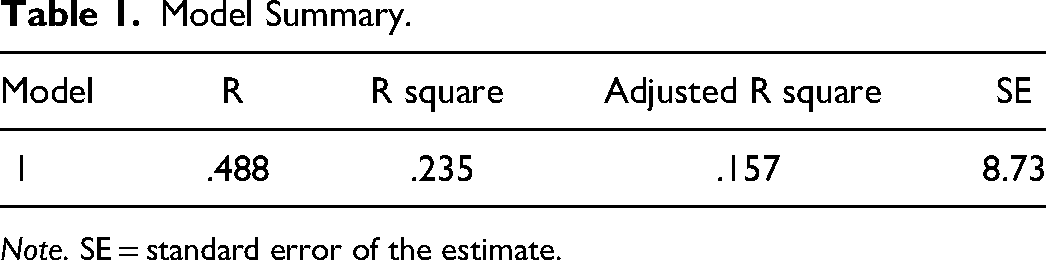
Note. SE = standard error of the estimate.
ANOVA Statistics for Study Variable.
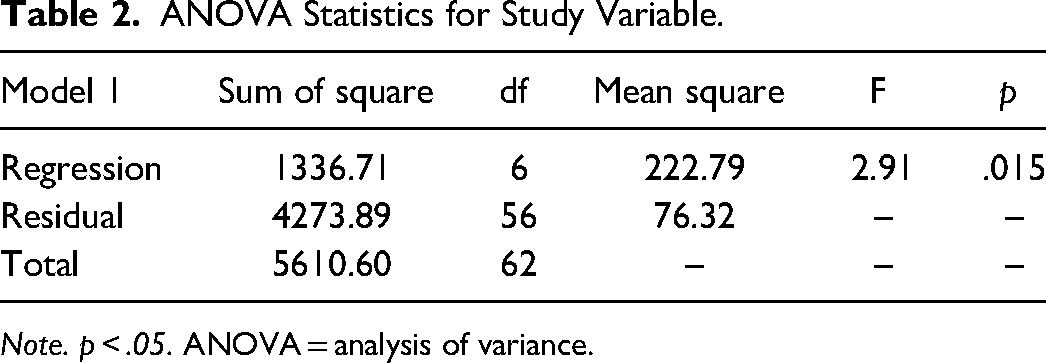
Note. p < .05. ANOVA = analysis of variance.
Discussion
Taken as a whole, the interaction of legalism, compassion, self-compassion, emotional regulation, perfectionism, and grace was found to have an effect on couples’ marital satisfaction. Higher levels of grace, self-compassion, and emotional regulation offset by lower levels of legalism, perfectionism, and compassion contributed to the amount of perceived marital satisfaction. This finding suggests that demonstrations of grace, self-compassion, and emotional regulation might co-occur with exhibiting less legalism, perfectionism, and compassion in a relationship. While this finding seems consistent with previous research, some aspects also appear somewhat contradictory.
Pearson correlations indicated a moderate positive relationship between self-compassion and perfectionism. Since items in the SCS-SF (i.e., self-judgment, isolation, and over-identification) were reverse scored, an inverse correlation between the variables suggested that as self-compassion decreases, perfectionism increases. This implies self-compassion could be central to the expectation of perfectionism. Participants who reported having less compassion, tolerance, and acceptance toward themselves had higher personal performance standards and self-criticism (Richardson et al., 2020). Not only would the finding suggest that one's low self-compassion could lead to a higher personal expectation of perfectionism, but it could also suggest this expectation is carried over toward one's relational partner (Rice et al., 2015; Stoeber et al., 2019).
An inverse moderate correlation between grace and interpersonal legalism was also found. This result is consistent with existing research that higher scores of grace closely relate to lower scores of legalism (Allen et al., 2015; Judd et al., 2018). The relationship between these variables reveals that participants who reported having a higher awareness and orientation of grace also reported fewer legalistic tendencies such as superior moral-conduct, maladaptive perfectionism, and perceived self-control and control of others (Allen et al., 2015; Bassett, 2013; Judd et al., 2018). The findings add support to the notion that grace could provide a buffer against legalistic beliefs and practices and have a significant positive impact on both personal and family relationships (Bufford et al., 2015; Judd et al., 2018; Spradlin, 2002).
The regression model accounted for 15.7% of the variance in marital satisfaction. However, none of the variables (legalism b = −.613, p = .147, compassion b = −.157, p = .251, self-compassion b = −.157, p = .079, emotional regulation b = .224, p = .167, perfectionism b = −.063, p = .733, grace b = .430, p = .074) alone were found to have a significant relationship to marital satisfaction. This finding could suggest that as constructs, these variables may overlap and thus be less distinguishable statistically. Since grace (B = .278) and self-compassion (B = .250) displayed the strongest effect, could these variables have played a role in influencing the results? An exploratory post hoc regression analysis was conducted on whether grace and self-compassion alone would influence marital satisfaction. The analysis showed that the construct of grace and self-compassion were deemed to be statistically significant, F (2, 60) = 6.480, p = .003. This equation accounted for 15% of the variance. It may be that grace and self-compassion are distinct variables that also subsume the elements of compassion, legalism, and perfectionism. If grace is the opposite of legalism, then it may be that legalism would not have the predictive strength captured by the variable grace.
A stepwise multiple regression was conducted to test the possibility that some variables may be overshadowing others. This revealed the variable grace as a significant predictor of marital satisfaction, F (1, 61) = 10.92, p = .002. This result is in line with the findings of Neff and Beretvas (2013), Neff and Pommier (2012), and Patrick et al. (2012), implying that “relational grace” (Patrick et al., 2012, p. 151) and self-compassion influence married couples’ interaction, understanding, and relational security.
The present study suggests that “relational grace” can protect couples against the pain-defense conflict cycle (Patrick et al., 2012, p. 147). However, a few limitations need to be taken into consideration. The first is the lack of racial and religious diversity among participants, which may affect the generalizability of these findings. For example, 55.5% of the participants were White or Caucasian and 69.8% identified themselves as Christians. By the same token, a Christian worldview may have also influenced participant's interpretation of grace and legalism. Thus, the results found here may not reflect how grace is defined from other religious perspectives (Allen et al., 2015; Bassett, 2013; Bufford et al., 2015; Judd et al., 2018). Last, the data from the grace, self-compassion, and perfectionism scales did not follow a normal distribution, suggesting that most participants had low levels of grace, self-compassion, and perfectionism. However, this may also yield more insight into the sensitivity for grace to influence marital satisfaction. If the sample reflects those experiencing lower levels of grace, but grace still positively influences marital satisfaction, then it is possible that even small changes in grace could have a useful effect on a couple's relationship.
Despite the limitations of this study, the findings provide important information about the correlation between grace and self-compassion in couples’ relationships. Further research is needed on interactive factors between grace, self-compassion, and compassion that predict marital satisfaction because such research would contribute to the understanding of how these components influence couples’ conflicts and relationships. This study could be replicated with a larger sample size and a more diverse population to improve external validity.
This quantitative study demonstrated that grace significantly correlates with lower levels of interpersonal legalism. The interaction between these variables implies that participants with higher levels of grace indicated they had fewer legalistic traits such as rigidity and maladaptive perfectionism as well as excessive moral conduct. The results also support the existing knowledge that grace serves as a protective layer against the adverse effects of legalism, which negatively influence couples’ ability to understand and connect with one another (Allen et al., 2015; Bassett, 2013; Judd et al., 2018).
Footnotes
Declaration of Conflicting Interests
The authors declared no potential conflicts of interest with respect to the research, authorship, and/or publication of this article.
Funding
The authors received no financial support for the research, authorship, and/or publication of this article.
