




Abstract
The aim of this article is to explore whether COVID-19 aroused an awareness of death, inflamed death anxiety, and affected mental health and to assess the degree that meaning in life played in the relationship between death anxiety and general mental health. A total of 197 participants were recruited using convenience sampling and were divided into an experimental group (n = 100) and a control group (n = 97). All participants completed the Death Anxiety Scale (DA), the Meaning in Life Questionnaire (MLQ), and the General Health Questionnaire (GHQ-12). Death anxiety had a significant positive predictive effect on general mental health and meaning in life. When death anxiety and meaning in life were included in the regression equation, death anxiety still had a significant positive predictive effect on general mental health, and meaning in life had a significant positive predictive effect on general mental health. These results indicated that meaning in life played a partially mediating role in the influence of death anxiety on general mental health. In the COVID-19 context, death information was found to arouse awareness of death and death anxiety, which adversely affected mental health, and it was also confirmed that meaning in life played a partially mediating role between death anxiety and general mental health, which suggested that mental health problems could be alleviated in the future by helping people find meaning and value in their lives and cope more positively with death.
Infectious diseases have become one of the main threats to global public health (Mak et al., 2010) in the twenty-first century, with these diseases affecting both the physical and mental health of the general public (Lau et al., 2010). The new coronavirus (COVID-19), which emerged in late 2019, has developed into a global pandemic (Bradbury-Jones & Isham, 2020). As of March 7, 2022, there had been 445,425,284 confirmed cases and 6,022,329 deaths worldwide (World Health Organization, 2020). With the increase in the number of confirmed cases, COVID-19 has caused public panic and placed heavy mental health pressure on the public (Bao et al., 2020).
Terror management theory and mental health
Many studies have found that the COVID-19 pandemic has adversely affected mental health. For example, Rajkumar (2020) found that anxiety, depression (16–28%), and stress (8%) were common psychological responses to COVID-19, and another study also found that, after the COVID-19 outbreak, 40.4% of adolescents were prone to psychological problems (Liang et al., 2020). Terror management theory provides a perspective to understand this problem.
Terror Management Theory (TMT) was proposed (Greenberg et al., 1986). The core of TMT is that similar to all other animals, humans have the instincts and motivation to survive. However, they also have advanced cognitive functions and are aware of the limitations of their own lives. Because people can foresee the future and self-reflect, they are more aware of their own mortality, which in turn can be emotionally expressed as anxiety and/or fear. Therefore, the survival instinct and death consciousness give rise to a unique dilemma—death anxiety—which can threaten life. Using their inherent defense mechanisms, people change their thinking and behaviors to alleviate this anxiety in their daily lives (Greenberg et al., 2014; Lu et al., 2019; Pyszczynski et al., 2015).
TMT emphasizes the impact of mortality on human cognition, moods, and behavior (Lu et al., 2017) and suggests that mortality awareness can threaten mental health. Specifically, death anxiety is a negative emotional experience when people are faced with the inevitability of death (Zhang et al., 2005). Xue and Liu (2021) found that epidemic information, such as the outbreak degree, expert interpretations, and hospital-related reports, positively predicted death anxiety, and many western studies have also confirmed these symptoms. For example, research has found that watching film clips related to death increased anxiety (Greenberg et al., 1992), people with a low personal need for structure (PNS) reported higher levels of death anxiety after death threats (Routledge et al., 2013), and that death-related cognition produced negative emotions, state anxiety, and decreased subjective vitality (Routledge et al., 2010). Because death anxiety is triggered by death reminders, mental health may be adversely affected. The broaden-and-build theory of positive emotions proposes that positive emotions can expand an individual's momentary thinking and action sequences, expand their range of potential coping strategies, and assist them in developing and building personal resources to better cope with life's challenges, which in turn can improve their mental health (Gao & Tong, 2010). Conversely, negative emotions, such as anxiety about death, can impair mental health.
From this discussion, Hypothesis 1 is proposed: Death anxiety is caused by the COVID-19 death reports, which in turn adversely affects general mental health.
The mediating role of meaning in life
Death thought accessibility (DTA) has inevitably increased during the COVID-19 pandemic, as information related to death has been ubiquitous in news reports. These constant reports activate remote defense mechanisms against a death consciousness, such as maintaining a cultural worldview and improving self-esteem (Pyszczynski et al., 2015). Because the cultural worldview involves a common understanding of the world, including the identification of cultural values or the recognition of belief systems, maintaining and sharing cultural worldviews can provide a sense of immortality that enables a person to regain meaning and value in the face of death (Greenberg, 2012). From this perspective, pursuing meaning in life could be a strategy for maintaining an individual worldview and could be an important research variable for death anxiety.
Meaning in life specifically refers to people's understanding and experience of life and their comprehension of target tasks or missions (Steger, 2009). It can be divided into two dimensions, namely, the presence of meaning in life and the search for meaning in life. Among them, the search for meaning in life is the motivational component, while the presence of meaning in life is the cognitive component (Steger et al., 2008). In this study, meaning in life refers to the meaning that individuals strive to establish and understand in life. Many studies have confirmed that meaning in life is closely related to death anxiety. For example, Lyke (2013) found that people who actively sought meaning in life had less fear of death, and Zhang et al. (2019) found that meaning in life was significantly negatively correlated with death anxiety and could predict death anxiety. Meaning in life has also been found to be a stable and reliable predictor of mental health, and meaning in life and mental health (Shiah et al., 2015), life satisfaction (Dewitte et al., 2019), and happiness (Ho et al., 2010; Krok & Telka, 2019) have been found to be positively correlated. Conversely, a lack of meaning in life can lead to depression (Mascaro & Rosen, 2005, 2006; Steger et al., 2009), anxiety (Shiah et al., 2015), and suicide (Kleiman & Beaver, 2013). Therefore, there is a possible correlation between meaning in life, death anxiety, and mental health. And it may be a positive psychological factor to alleviate death anxiety (Routledge et al., 2010; Zhang et al., 2019), but the mechanism of action between the three needs to be further confirmed. Based on this discussion, Hypothesis 2 is proposed: Meaning in life plays a mediating role between death anxiety and general mental health.
This study sought to investigate the impact of death anxiety on mental health in the context of COVID-19 and explore whether meaning in life played a mediating role in alleviating the impact of death anxiety on mental health.
Methods
Before conducting the survey, informed consent was given by all participants, who were also informed that participating in the research was voluntary, they could withdraw at any time without penalty, and their data would be anonymized. Participants were then randomly assigned to one of two experimental conditions; a mortality salience group (MS) and a control group (No MS). It took approximately 15 min to complete the data collection.
Participants
G*Power 3.1 was used to calculate the required sample size combined with previous relevant studies (Faul et al., 2007). When the average effect size was d = 0.45, α=0.05, and 1−β=0.95, at least 90 subjects were needed. A total of 197 college students were enrolled through a campus advertisement in a university town. They were randomly divided into experimental and control groups.
The participants were 197 college students (38.1% male and 61.9% female, M age = 23.5 years; SD = 3.75), each of whom was randomly assigned to either the mortality salience group (n = 100) or the control group (n = 97). Among the participants, 145 were unmarried, 48 married or cohabiting, and 4 divorced or widowed. In terms of education level, 5 had junior college education, 14 bachelor's education, 115 master's education, and 63 PhD-level education. On the economic side, 56 participants had disposable incomes of more than 5,000 per month Yuan, 78 participants a monthly disposable income of 4,000 to 5,000 yuan, 34 participants a monthly disposable income of 3,000 to 4,000 yuan, 14 participants a monthly disposable income of 2,000 to 3,000 yuan, and 15 participants a monthly disposable income of less than 2,000 yuan. Table 1 gives the specific participant details.
Demographic characteristics of the participants

Ethical considerations
The study procedure was approved by the authors’ institutional review board. All participants of the study were provided written informed consent and promised that they had the right to withdraw from the study at any time. The authors assure that all procedures that contribute to this work comply with the ethical standards of the relevant National and Institutional Committees on Human Experimentation and the 1975 Declaration of Helsinki as amended in 2008.
Before the formal start of the experiment, the subjects should be informed of the purpose and content of the experiment, including the content that may lead to harmful effects, participate in the case of resources, and have the right to withdraw at any time during the process of participation. In addition, the raw data, analysis code, and research materials are available on OSF (https://osf.io/p6bv8/?view_only=2cbf892d235c4406a3b35646ed55671f).
Procedures
After obtaining informed consent, the participants were randomly assigned to the mortality salience condition or the control condition. Participants in the death salience condition viewed 10 photos related to death during the epidemic, after which they answered two open-ended questions related to their own death: (1) Please imagine your own death and briefly describe your emotional experience at this time; (2) Please detail what you feel about dying and what would happen? Participants were given five minutes to write their impressions (Lee & Kim, 2021).
The control group participants were shown 10 photos depicting people reading books, after which they also answered two open-ended questions: (1) Please describe briefly what kind of emotional experience you had while looking at the photos; (2) Please recall your recent reading experiences. Participants were given five minutes to write their recollections (Lee & Kim, 2021).
Previous studies have found that mortality salience experiments can induce a mortality salience effect, with the effect still present five minutes after the experiment ended (Greenberg et al., 1994; Lee & Kim, 2021). Finally, participants from both conditions completed the DA, MLQ, and GHQ-12 questionnaires.
Measures
The mortality salience materials were 25 photos describing death-related themes related to COVID-19, such as tombs, funerals, mourning halls, dead bones, and corpses. Since these have been linked to death since the pandemic, greater exposure to such reminders of death can increase death anxiety (Chen & Li, 2014). Initially, 25 graduate psychology students were asked to evaluate each picture in two dimensions—whether it reminded them of death, and whether it was frightening—on a 7-point Likert scale, with 1 being the lowest and 7 being the highest. The 10 pictures with the highest comprehensive average scores were then selected as the death-highlighting materials for the subsequent experiment.
Death anxiety was measured using the Chinese version of the DA (Templer, 1970), which comprises 15 items rated on a 5-point scale from 1 (strongly agree) to 5 (strongly disagree). Previous studies have found the scale has good measurement properties for Chinese subjects (Wu et al., 2002); the higher the DA score, the higher the level of death anxiety. The Cronbach's α of this scale was 0.574 in this study.
The MLQ compiled by Steger and his colleagues (2009) and translated and revised by Wang and Dai (2008) was used to measure the participants’ feelings about their meaning in life. The MLQ comprises 10 items divided into two factors: the presence of meaning in life (MLQ-P) and the search for meaning in life (MLQ-S), which are rated on a 7-point scale from 1 (completely disagree) to 7 (completely agree). The higher the score, the higher the experience or the higher the pursuit for meaning in life. The total meaning of life is about the sum of the search for meaning in life (MLQ-S) and the presence of meaning in life (MLQ-P) (Kishimoto et al., 2022). Since the function of searching for meaning in life is uncertain and controversial, it is not appropriate to calculate the total score of meaning in life directly. According to the actual situation and some existing research practices at home and abroad, only the presence of meaning in life is included in the regression analysis (Chen et al., 2021; Lightsey et al., 2014). The internal consistency coefficient for the two subscales was between 0.82 and 0.87, and the internal consistency reliability coefficients for Wang and Dai's revised 2-point scale were 0.85 and 0.82, respectively. The Cronbach's α of this scale was 0.86 in this study.
Mental health was measured using the GHQ-12, which has been proven to have good validity in Chinese samples (Fares et al., 2016). The GHQ-12 comprises 12 items rated on a 4-point scale from 0 (never) to 3 (usually), with the total score ranging from 0 to 36. The higher the score, the worse the overall health. A total score higher than 15 indicates a mental health problem tendency (Saravanan et al., 2002). The Cronbach's α of this scale was 0.71 in this study.
Data processing
SPSS22 was used to analyze the data. All statistical analyses were performed using SPSS 26.0 (IBM Corp), with the statistical significance set at p < 0.05. Independent-samples T-test was employed to assess the relationships between the sociodemographic characteristics, death anxiety, meaning in life, and the GHQ-12.
Results
Common method bias is due to the artificial covariation between predictor variables and calibration variables caused by the same data source or rater, the same measurement environment, item context, and the characteristics of the item itself. Such artificial covariation is a systematic error that can seriously confuse the results and potentially skew the conclusions. Since all the three variables were explored by questionnaire method in this study, SPSS22.0 was used to conduct exploratory factor analysis on the questionnaires before analysis to test possible common method bias (Zhou & Long, 2004). From this six common factors with characteristic roots greater than 1 were extracted, with the variance percentage for the common factor of the first component explaining 16.8% of the variance. This proportion is much smaller than the 40% judgment criterion recommended by Podsakoff et al. (Podsakoff et al., 2003, 2012), indicating that there is no common method bias problem in this study.
Variable score differences in the different groups
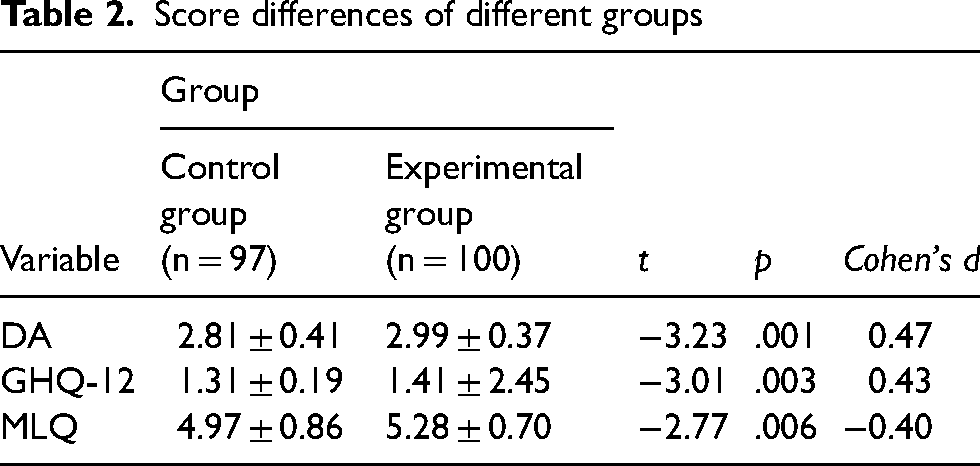
Table 2 shows that there were significant score differences between the experimental group and the control group for death anxiety, general mental health anxiety, and total meaning in life, which appeared to indicate that COVID-19's association with death could increase death anxiety. The mean score and standard deviation of death anxiety for the control group was 2.81 ± 0.41, the mean score and standard deviation of general mental health was 1.31 ± 0.19, and the mean score and standard deviation of meaning in life was 4.97 ± 0.86. The mean score and standard deviation of death anxiety for the experimental group was 2.99 ± 0.37, the mean score and standard deviation of general mental health was 1.41 ± 2.45, and the mean score and standard deviation of meaning in life was 5.28 ± 0.70.
Score differences of different groups
Correlation analysis
As shown in Table 3, the total death anxiety score was significantly and positively correlated with the total general mental health score (p < 0.05), and the total death anxiety score was significantly and positively correlated with the total meaning in life score (p < 0.05). The correlation coefficients between the general mental health, the presence of meaning in life (MLQ-P), and the search for meaning in life (MLQ-S) factors and total meaning in life were not statistically significant (r = −0.164, p = 0.104; r = 0.053, p = 0.601; r = 0.015, p = 0.884).
Analysis of related results of each variable

Note: *P < 0.05, **P < 0.05, ***P < 0.001.
Mediating effect of meaning in life
Based on the correlation results, SPSS macros compiled by Hayes (2012) were used (Model 4; simple mediation model) to further test the mediation effect of the meaning in life on death anxiety and general mental health when gender, education level, marital status, and average monthly disposable income were controlled for. The regression analysis showed (Table 4) that death anxiety had a significant positive predictive effect on general mental health (B = 0.48, p < 0.001), and death anxiety had a significant positive predictive effect on meaning in life (B = 0.51, p < 0.001). After death anxiety and meaning in life were incorporated into the regression equation at the same time, death anxiety was still found to have a significant positive predictive effect on general health (B = 0.64, p < 0.001), and meaning in life had a significant positive predictive effect on general mental health (B = −0.31, p < 0.05), which suggested that meaning in life played a mediating role in the impact of death anxiety on general mental health.
Regression analysis in the mediation model

Note: *P < 0.05, **P < 0.05, ***P < 0.001.
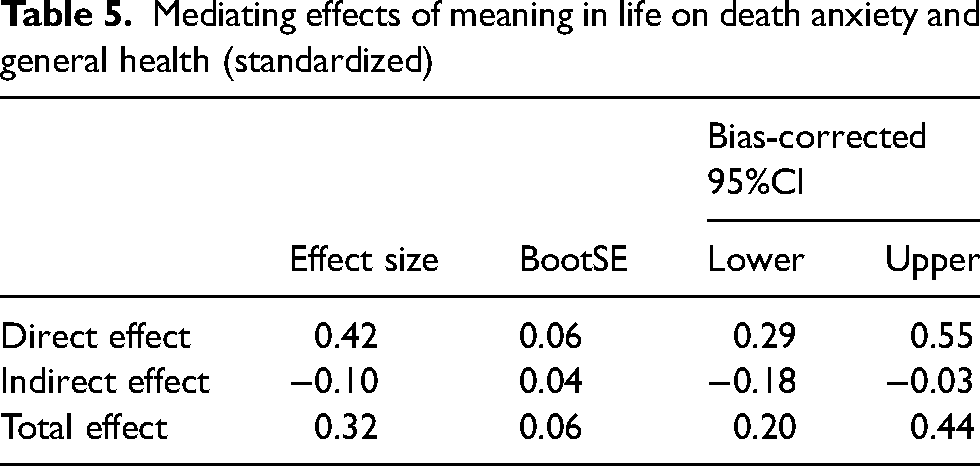
To further test the role of meaning in life in death anxiety and general mental health, Model 4 of Process in SPSS was used, with death anxiety as an independent variable and general mental health as an dependent variable. The findings: the mediating effect test results in Table 5 indicated that meaning in life played a mediating role between death anxiety and general mental health (SE = 0.04, p = 0.000, 95% CI = [−0.18, −0.03]).
Mediating effects of meaning in life on death anxiety and general health (standardized)
Discussion
In this study, the three variables were measured by scale, among which the Cronbach's α of the MLQ and the GHQ-12 were 0.86 and 0.71, respectively, both of which were relatively high, indicating relatively high internal reliability. However, the Cronbach's α coefficient of the DA was only 0.574, which was relatively low. Cronbach's α is the most commonly used reliability measurement statistic. In general, the reliability measured by Cronbach's α, α > 0.6, or α < 0.9 is acceptable. Some studies have pointed out that how high the reliability is acceptable is actually related to the type and purpose of the test (Zhonglin & Baojuan, 2011). In empirical studies, Cronbach's α coefficient only needs to reach 0.6. In this study, although it is less than 0.6, it is very close, that is, theoretically, it can be considered that the internal reliability of the scale in this study is within an acceptable range. In addition, some scholars believe that when Cronbach's α coefficient is low, its substitute index can be calculated, namely, composite reliability, whose calculation index is omega (McNeish, 2018). In this study, its omega value is about 0.7, which is generally considered acceptable reliability (McNeish, 2018). Therefore, in general, the reliability coefficient of the scale in this study is acceptable.
The death anxiety scores for the mortality salience group were significantly higher than for the control group, which indicated that the material selected was mortally salient and evoked the participants’ death anxiety, which was consistent with previous studies that found death anxiety to be activated as a form of death awareness when people were exposed to death cues, such as the ongoing COVID-19 pandemic (Zhong et al., 2021). Currently, in the context of the COVID-19 pandemic, the awareness of the current epidemic or virus outbreak has produced findings similar to those of other deaths, increasing the availability of death-related thoughts, due to daily updates of the death toll in the news and social media, continuous emergence of information related to mortality, and ubiquitous objective death clues such as masks and hand sanitizers. In addition, the subjects’ subjective cognitive processing related to the novel coronavirus will also strengthen their awareness of death (Zheng et al., 2023), thus increasing their anxiety about death.
The results showed that death anxiety predicted general mental health, that is, the higher the degree of death anxiety, the worse the general health status, which was consistent with previous studies (Greenberg et al., 1992). In addition, death anxiety can positively predict meaning in life, that is, the higher the level of death anxiety, the stronger the sense of meaning in life, which is consistent with the previous conclusion (Taubman-Ben-Ari, 2011). The terror management theory approach claims that the relationship between death anxiety and meaning in life can be easily explained, that is, as death destroys meaning in life, in the face of death, a meaningful life begins to lose value. Therefore, the manifestation of death anxiety arouses the threat awareness, which stimulates feelings regarding meaning in life. This view is consistent with previous studies, for example, people reported a higher meaning in life after being exposed to death reminders (King et al., 2009).
We initially hypothesized that meaning in life is an effective predictor of an individual's general mental health, and this hypothesis was confirmed in this study. In Table 4, meaning in life significantly negatively predicted the general mental health score (B = −0.31, p < 0.01), indicating that individuals with a higher sense of meaning in life predict a higher level of mental health, which is consistent with the conclusion of previous studies (Shiah et al., 2015). Positive psychology suggests that when people have higher meaning in life, they tend to have higher self-affirmation and self-acceptance, and are better able to combat negative emotions such as anxiety and depression (Frankl, 1962).
After meaning in life and death anxiety were incorporated into the regression equation at the same time, death anxiety still positively predicted general mental health, which indicated that meaning in life partly mediated the impact of death anxiety on general mental health. Specifically, death anxiety can directly affect general mental health or indirectly affect general health through meaning in life, which suggests that meaning in life has a certain buffer effect between death anxiety and general health. The mediation analysis indirect effect value was −0.10 and the total effect value was 0.32, which indicated that the mediation had a suppression effect (Wen & Ye, 2014).
The COVID-19 pandemic has awakened a death consciousness in many people, which has enlivened people's feelings about their place in the universe. Whenever a death clue is highlighted, it will remind them that life is precious and important, so when you realize that “When I die, I will pursue the meaning of life and find the value of life. With a more fulfilled heart, my mental health will be improved to a certain extent.” The results of this study verified the positive terror management model proposed by Vail Kenneth et al. (2012), which claims that death awareness can bring positive results to people, such as rethinking meaningful goals and values. Although the internal mechanism of these results is not yet clear, it is undeniable that positive acceptance and in-depth death consciousness can result in growth changes (Wei et al., 2015). In summary, death anxiety and meaning in life have varying impacts on general health. However, these results also indicated that to alleviate the negative impact of death anxiety on mental health, people should be encouraged to seek meaning in life, pursue life values, and clarify their life goals.
Limitations and future research
There were several limitations to this study. First, because the research sample only included college students, there were representativeness and generalizability limitations. In this study, if the tested group is medical staff or volunteers on the frontline of anti-epidemic, whether it will be inconsistent with the current research conclusions, it remains to be seen. Therefore, similar studies should be conducted on different groups. Previous studies have shown that there are differences in the meaning in life concept between individuals of different ages (Steger & Dik, 2009). Therefore, future studies could expand the sample size and explore the impact of the sociodemographic variables on each variable to more specifically identify the role of meaning in life. Although there is significant evidence that meaning in life is positively correlated with mental health and well-being, results have differed due to the specific meaning in life dimensions. Most research that has measured meaning in life from two dimensions (the presence of meaning in life and the search for meaning in life) has found inconsistent effects on mental health (Dong & Liu, 2016). Similarly, in this study, the relationship between meaning in life and general mental health was not confirmed, which could be explored in future research. Frankl originally proposed the concept of sense of meaning in life, which regarded the pursuit of meaning in life as the most original motivation of individuals. According to this concept, many researchers have linked the sense of meaning in life with suicidal ideation and behavior. It is generally believed that when individuals lack the sense of meaning in life, they are more likely to have mental health problems and thus suicidal intention or even suicidal behavior. At present, the suicide rate and the incidence of suicidal ideation among adolescents are still relatively high. The prevention of suicidal behaviors among adolescents requires multifaceted efforts, and good social support systems and intervention mechanisms are often employed to prevent suicidal behaviors among adolescents. A large number of studies have proven that sense of life meaning plays a protective role in individual health. It can not only provide life goals for individuals, affect their life attitude, but also improve their sense of control over life events. Therefore, it is important for college students to adapt to life as soon as possible to carry on the education of sense of life meaning. Finally, since the reliability of this study on death anxiety is lower than that of most studies, readers and relevant researchers should be cautious. There is no need to panic, as studies have shown that using any alternative is better than continuing with Cronbach's α (McNeish, 2018).
Conclusion
COVID-19–related death information can give rise to death anxiety. However, this study found that meaning in life played a partial mediating role between death anxiety and general mental health, which suggested that to cope with death and alleviate mental health problems, people need to be encouraged to find meaning and value in their lives.
Supplemental Material
sj-docx-1-pac-10.1177_18344909231165187 - Supplemental material for Impact of death anxiety on mental health during COVID-19: The mediating role of the meaning in life
Supplemental material, sj-docx-1-pac-10.1177_18344909231165187 for Impact of death anxiety on mental health during COVID-19: The mediating role of the meaning in life by Yuchang Jin, Qiao Zeng, Xianglong Cong, Junxiu An and Peixuan Zheng in Journal of Pacific Rim Psychology
Footnotes
Declaration of conflicting interests
The author(s) declared no potential conflicts of interest with respect to the research, authorship, and/or publication of this article.
Funding
The author(s) received the following financial support for the research, authorship, and/or publication of this article: the research is supported by National Social Science Foundation of China (Grant No. 21BSH016), the Ministry of Education of Humanities and Social Science Project of China (20YJA880023), “Double Major” cultivation projects of Sichuan Normal University (2021-SZPY-04). We appreciate this support both in finance and in spirit.
Supplemental material
Supplemental material for this article is available online.
References
Supplementary Material
Please find the following supplemental material available below.
For Open Access articles published under a Creative Commons License, all supplemental material carries the same license as the article it is associated with.
For non-Open Access articles published, all supplemental material carries a non-exclusive license, and permission requests for re-use of supplemental material or any part of supplemental material shall be sent directly to the copyright owner as specified in the copyright notice associated with the article.
