




Abstract
Conspiracy theories are often viewed as the manifestation of a “conspiracy mentality” grounded in power-challenging attitudes. Contrary to this approach, it has been proposed that conspiracy theories targeting relatively powerful groups (i.e., upward conspiracy theories) may be ideologically distinct from conspiracy theories targeting relatively powerless groups (i.e., downward conspiracy theories). We tested this contention in the Romanian context (n = 723, preregistered) and compared the ideological and socioeconomic correlates of anti-government (i.e., a relatively powerful group) and anti-Roma (i.e., a relatively powerless group) conspiracy beliefs. Using Principal Components Analysis, we showed that both categories of conspiracy beliefs are statistically distinct. Right-wing authoritarianism was significantly more related to anti-Roma conspiracy beliefs than to anti-government conspiracy beliefs. However, against our expectations, both types of conspiracy beliefs did not relate differently to subjective socioeconomic status. Overall, the ideological discrepancies between upward and downward conspiracy beliefs were less marked in the Romanian context. Finally, conspiracy mentality was more related to anti-government conspiracy beliefs than anti-Roma conspiracy beliefs. This corroborates the notion that generic measurements of conspiracist ideation may be mostly a measurement of upward conspiracy beliefs, and emphasizes the relevance of distinguishing conspiracy theories based on the types of groups they target.
Introduction
Conspiracy beliefs—beliefs that two or more actors have coordinated in secret to achieve an outcome, and that their actions are of public interest but not widely known by the public (Douglas & Sutton, 2022)—are strongly and positively interrelated, often to the point that they can be statistically considered as reflecting a single underlying construct (Sutton & Douglas, 2020). For this reason, many authors endorse the assumption that belief in conspiracy theories is to a large extent underpinned by some kind of conspiracist predisposition (Imhoff et al., 2022). Among the prevalent interpretations of the conspiracist predisposition is the notion that conspiracy beliefs are underpinned by a power-challenging attitude encompassing prejudice against powerful groups and distrust of authorities (Imhoff & Bruder, 2014).
By contrast, the assumption that conspiracy beliefs are predicated on power-challenging attitudes is challenged by research examining how conspiracy theories may also aid powerful groups to discriminate against minorities (e.g., Kofka & Sedek, 2005). Similarly, some studies have reported relationships between right-wing authoritarianism (RWA; Altmeyer, 1981) and belief in conspiracy theories (Grzesiak-Feldman, 2015, see however Wood & Gray, 2019). These results suggest that individuals’ propensity to believe in conspiracy theories may be rooted in conservative ideology, rather than in power-challenging attitudes (Nera et al., 2021).
To make sense of these theoretical and empirical discrepancies, Nera et al. (2021) proposed the distinction between upward conspiracy theories (i.e., targeting relatively powerful groups) and downward conspiracy theories (i.e., targeting relatively powerless groups). They showed that conspiracy theories targeting relatively powerful groups (e.g., bankers, governments, the media) were associated with power-challenging political attitudes (e.g., rejection of society's leadership), while conspiracy theories targeting relatively powerless groups (e.g., Muslim immigrants) are associated with conservative attitudes (e.g., conservatism). Moreover, in their data, 1 the sense of being at the bottom of the socioeconomic ladder was more strongly associated with upward conspiracy beliefs than with downward conspiracy beliefs, which is also congruent with the power-challenging rationale. Finally, they found that a generic measurement of conspiracy beliefs (i.e., the Single-Item Conspiracy Beliefs scale, Lantian et al., 2016) was more associated with belief in upward conspiracy theories, suggesting that these measurements were overly focusing on conspiracy theories targeting powerful groups.
The empirical grounds for distinguishing upward and downward conspiracy theories, however, involve data gathered in a specific geographical and cultural context, namely, the French-speaking community of Belgium. To examine the relevance of this distinction beyond this cultural framework, we carried out a conceptual replication-extension in another context, namely, among Romanian citizens living both in Romania and abroad. In addition, instead of measuring political orientation and conservatism, we used a measurement of RWA (Altmeyer, 1981). RWA refers to a personality trait consisting in a combination of conventionalism (i.e., attachment to traditional values), authoritarian submission (i.e., a tendency to value obedience to authority figures), and authoritarian aggression (i.e., hostility towards outgroups that are viewed as transgressing conventional norms and values). While Nera et al. (2021) examined the relationship between conservatism and conspiracy beliefs, their rationale centered on the violation of the ingroup's norms by threatening outgroups, which remarkably applies to RWA.
Conspiracy theories in Romania
Romania appears as a fertile ground for the thriving of both upward and downward conspiracy theories. Indeed, Romania was recently ranked amid the most corrupt countries of the European Union (Transparency International, 2022). In this regard, it differs from Belgium, which exhibits relatively low levels of corruption. Such a climate may foster the population's endorsement of conspiracy theories, as they are more prevalent in highly corrupted countries (Cordonier et al., 2021).
Moreover, Roma people, which constitute 3.3% of the Romanian population according to the 2011 population census (ACT Media, 2013), have regularly been the target of conspiracy theories throughout history (e.g., they have been accused of being part of international organizations whose goal is to rob and swindle other groups; Ortega, 2016). In general, Roma people are a stigmatized minority (Kende et al., 2020) that is viewed as taking advantage of the welfare system.
Studying anti-Roma conspiracy theories appears particularly relevant because it is a striking example of downward conspiracy theories. Indeed, minorities typically targeted by conspiracy theories can be seen as benefitting of the support of objectively powerful groups (e.g., Muslim minorities can be seen as supported by wealthy Muslim countries, and LGBT minorities can be seen as benefitting from the support of lobbies and intellectuals, see Nera et al., 2022). The Roma minority, by contrast, is indisputably a disempowered and marginalized minority. As such, conspiracy theories targeting Roma people appear as highly prototypical downward conspiracy theories, ideal to extend the reflection on the distinction between upward and downward conspiracy theories.
Overview of the research
In short, Romania appears as an ideal context to study conspiracy beliefs targeting the government and the Roma minority. These two types of conspiracy beliefs appear as prototypical upward and downward conspiracy beliefs, respectively. In this research, we examine to what extent conspiracy beliefs targeting the Romanian government and conspiracy beliefs targeting Roma people relate to each other, as well as to RWA, subjective socioeconomic status, and generic conspiracy mentality. In doing so, we first sought to examine whether, in line with the findings of Nera et al. (2021), upward and downward conspiracy beliefs are statistically distinct from each other, and whether they relate differently to RWA and individuals’ subjective socioeconomic status. Second, we examine if generic measurements of conspiracy beliefs are more adequate to capture upward conspiracy beliefs than downward conspiracy beliefs—which was the case in Nera et al. (2021).
First, we expect anti-government and anti-Roma conspiracy beliefs to be statistically distinct constructs (H1). Second, since downward conspiracy beliefs has been shown to be more associated with conservative attitudes than upward conspiracy beliefs, we expect that RWA will be more strongly related to anti-Roma conspiracy theories than to anti-government conspiracy theories (H2). Third, since upward, power-challenging conspiracy theories are expected to be more prevalent among individuals who feel disempowered, we hypothesize that socioeconomic status will be more strongly related to anti-government conspiracy beliefs than to anti-Roma conspiracy beliefs. Finally, since generic measurements overly focus on conspiracies hatched by powerful groups, we expect conspiracy mentality to be more strongly related to anti-government conspiracy beliefs than to anti-Roma conspiracy theories.
Hypotheses and sample size were preregistered on AsPredicted.org. The preregistration form, dataset, and materials can be found on the Open Science Framework at: https://osf.io/a6s74/?view_only=4297e139440a4e6e970449aa6438edb6.
Method
Participants
Our survey was completed by 1,078 participants, out of which 723 remained (556 female, 166 male, 1 gender X, 2 MAge = 35.9, SD = 11.2, min = 18, max = 76) after removing participants who identified as Roma, who failed the attention check (“please choose the answer ‘I slightly agree’”), the seriousness check (“is there any reason why we should not trust your answers?”), or made errors in the encoding of their age (e.g., reporting being 45,352 years old) or country of residence (i.e., chose the empty choice in the top-down country list). Exclusion criteria were preregistered. All participants had the Romanian nationality (except for 4 people that had renounced it but had been living in Romania before the age of 18). Many of them were expats who lived outside of Romania (n = 437, 60.4% of the sample), and participants reported 27 countries of residence spreading over all the habitable continents.
This is slightly below the planned sample size (n = 782). Given a power of .80, the achieved sample size enables us to detect a correlation of r = .10 (two-tailed).
Procedure and materials
The questionnaire was disseminated on Facebook, and data collection took place between March 21, 2021 and April 4, 2021. It was shared by the Romanian relatives of the second author and shared on multiple Romanian expats’ Facebook pages. The title of the survey was “The attitudes of Romanian people regarding different controversial subjects.”
The available versions of the scales used in this research were in English, and we had no knowledge of any validated Romanian translations. To create the material, the survey was firstly elaborated in English (i.e., the language in which the scales were available), and thereafter translated to Romanian. The Romanian version of the questionnaire was individually reviewed by 7 native Romanian people with a C1–C2 English level.
The questionnaire started with sociodemographic questions: age, gender (M/F/X), Romanian nationality (Y/N), country of residence (drop-down list), identification as a member of the Roma community (Y/N). Participants then reported the level of education of their parents (a proxy of their objective socioeconomic status), as well as their subjective socioeconomic status. The latter was measured using the McArthur Scale of Subjective Social Status (Adler et al., 2000). It consists in showing to participants a 10-point scale and asking them to position themselves on it, with 1 corresponding to “people who are the worst off, those who have the least money, least education, worst jobs, or no job,” and 10 corresponding to “people who are the best off, those who have the most money, most education, and best jobs.”
Participants then completed the following scales, in this order. They reported their agreement on a scale ranging from 1 (completely disagree) to 5 (completely agree).
The Right-Wing Authoritarianism scale (Van Assche et al., 2018)
This 6-item scale (3 reversed) was designed as a modern measurement of RWA (“Obedience and respect for authority are the most important virtues that children must learn”; α = .61). Because it dramatically reduced the reliability of the scale, 3 item 6 (“The judges rightly do not deal too hard with drug users. Punishment wouldn’t work well anyway”) was removed from the averaged scores.
The Conspiracy Mentality scale (Imhoff & Bruder, 2014)
This measure captures a general propensity to endorse conspiracy theories. It consists in twelve items (e.g., “There are many very important things happening in the world about which the public is not informed,” α = .90).
Anti-government conspiracy beliefs
Seven items were designed based on the Generic Conspiracist Beliefs scale (Brotherton et al., 2013) to capture belief that the Romanian government engages in conspiratorial activities (e.g., based on the item “the government keeps many important secrets from the public,” we designed the item “The current Romanian government keeps many important secrets from the public,” α = .91).
Anti-Roma conspiracy beliefs
Seven items were designed to capture belief in popular conspiracy theories involving the Roma minority in Romania (e.g., “Many Roma people manipulate the public into thinking they are helpless when in fact they have a lot of wealth and power,” α = .90). These items were designed based on the personal knowledge of the second author who grew up in Romania, who discussed the issue with other Romanian acquaintances. As can be seen in Table 1, the average endorsement of anti-Roma conspiracy beliefs was 2.52 on a scale ranging from 1 to 5, suggesting that these beliefs were moderately endorsed by participants.
Correlations and descriptives
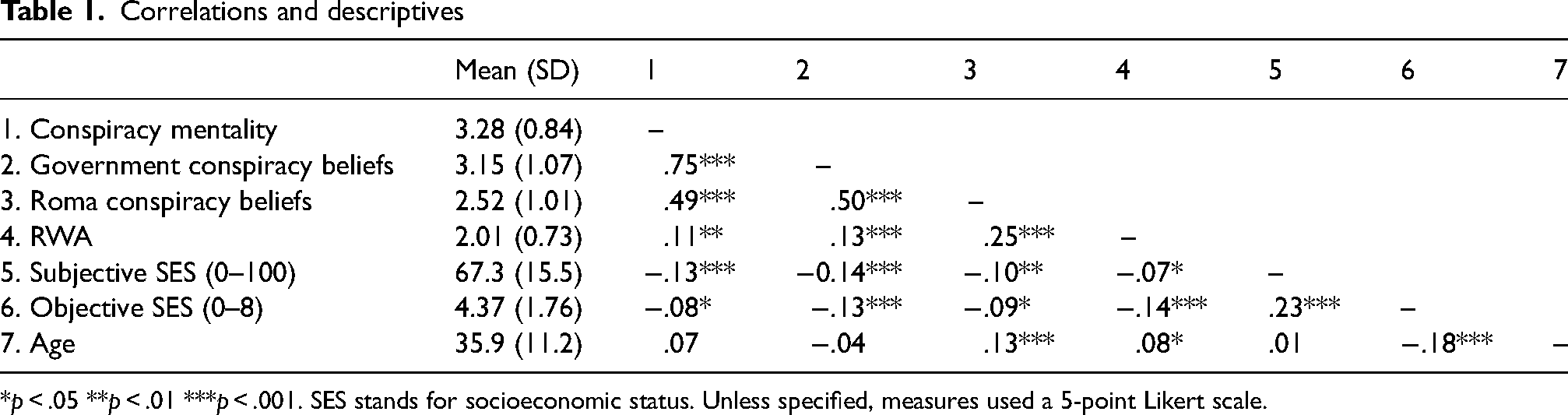
*p < .05 **p < .01 ***p < .001. SES stands for socioeconomic status. Unless specified, measures used a 5-point Likert scale.
The questionnaire ended with an open-ended comment and the seriousness check.
Results
Correlations and descriptive statistics between variables can be found in Table 1. H1 was that anti-Roma and anti-government conspiracy beliefs would appear as distinct factors when carrying out a principal component analysis. As preregistered, we carried out a Principal Components Analysis with an Oblimin rotation, which yielded the expected two-factor structure (see Table 2). The two factors were, however, substantially correlated, r = .50, p < .001.
Principal components analysis on government and anti-Roma conspiracy beliefs.

Note: The factor structure is highlighted in bold.
H2–4 were that the independent variables would relate differently to anti-government and anti-Roma conspiracy beliefs. To test this hypothesis, we used the method proposed by Judd et al. (2017). We computed a new variable consisting of the difference between anti-government conspiracy beliefs and anti-Roma conspiracy beliefs and regressed it on RWA, subjective socioeconomic status, and conspiracy mentality. The rationale is that in a linear regression, if an independent variable significantly predicts the difference between the two dependent variables, we can reject the hypothesis that these two dependent variables have an undifferentiated relationship with the independent variable. To avoid issues due to collinearity between the independent variables, we tested the three hypotheses in separate linear regressions.
As expected, in the first, RWA was a significant predictor of the difference between anti-government and anti-Roma conspiracy beliefs, B = −0.23, t = −4.80, p < .001, R2 = .03. Hence, RWA relates differently to anti-government and anti-Roma conspiracy beliefs. As expected from H2, RWA was more strongly related with anti-Roma conspiracy beliefs, r = .25, 95% CI [.18, .32], p < .001, than with anti-government conspiracy beliefs, r = .13, 95% CI [.06, .20], p < .001. 4
Using the same procedure, we found that, contrary to H3, subjective socioeconomic status did not significantly predict the difference between anti-government and anti-Roma conspiracy beliefs, B = −0.00, t = −0.05, p = .96, R2 = .00. Thus, subjective socioeconomic status was not significantly more correlated with anti-government conspiracy beliefs, r = −.14, p < .001, than with anti-Roma conspiracy beliefs, r = −.10, p = .005. We might also note that objective socioeconomic status was also weakly and negatively correlated with both anti-government conspiracy beliefs, r = −.13, p < .001, and anti-Roma conspiracy beliefs, r = −.09, p = .012.
Finally, congruent with H4, conspiracy mentality was a strong predictor of the difference between anti-government and anti-Roma conspiracy beliefs, B = 0.41, t = 10.36, p < .001, R2 = .13. In line with our expectations, conspiracy mentality was more strongly correlated with anti-government conspiracy beliefs, r = .75, 95% CI [.72, .78], p < .001, than with anti-Roma conspiracy beliefs, r = .49, 95% CI [.43, .54], p < .001.
Discussion
In this research, we intended to further investigate the distinction between upward and downward conspiracy beliefs (Nera et al., 2021) in a different cultural setting than the original studies, specifically, the Romanian context. This distinction challenges the common assumption that conspiracy theories are endorsed by members of relatively powerless groups and target powerful groups and that conspiracy theories are underpinned by a power-challenging ideology. It posits that conspiracy theories targeting relatively powerful groups have different ideological correlates compared to conspiracy theories targeting relatively powerless groups.
The present study returned nuanced results. In line with Nera et al. (2021), we found that conspiracy beliefs targeting different groups, while substantially correlated, are statistically distinct. As such, it further calls into question the idea that conspiracy beliefs can be apprehended as a relatively homogeneous phenomenon. However, the discrepancy between upward and downward conspiracy beliefs in their association with RWA, while statistically significant, was rather small. Moreover, contrary to our hypotheses, the two types of conspiracy beliefs did not differ in relation to subjective socioeconomic status—which was modest and negative in both cases (the same pattern was observed for objective socioeconomic status). In sum, the ideological discrepancies between upward and downward conspiracy beliefs found in a Romanian sample were less pronounced than in previous works conducted in different contexts (Nera et al., 2021; see also Wood & Gray, 2019). Indeed, the best predictor of anti-Roma conspiracy beliefs were other conspiracy beliefs, whereas in Nera et al. (2021), the best predictor of downward conspiracy beliefs were conservative attitudes.
Finally, we found that conspiracy mentality was significantly more correlated with anti-government conspiracy beliefs than with anti-Roma conspiracy beliefs. Nera et al. (2021) proposed that such measurements (e.g., the Generic Conspiracist Beliefs Scale, Brotherton et al., 2013) may capture belief in conspiracy theories targeting powerful groups, rather than conspiracy beliefs in general. The current study corroborated this claim by showing that, in a different context, a different measurement of propensity to believe in conspiracy theories (the Conspiracy Mentality Scale, Imhoff & Bruder, 2014) was substantially more correlated with anti-government conspiracy beliefs than with anti-Roma conspiracy beliefs. The strength of the relationship between anti-government conspiracy beliefs and conspiracy mentality (r = .75) suggests substantial conceptual overlap.
Limitations, future directions, and conclusion
To begin with, the distinction between upward and downward conspiracy theories has some shortcomings (see Nera et al., 2021). Notably, some conspiracy theories targeting powerful groups may be grounded in conservative concerns, because such conspiracy theories may enable individuals to legitimate the system they live in (e.g., Mao et al., 2021). In this regard, further analysis of the interplay between the groups targeted by conspiracy theories and underlying ideologies (e.g., anti-establishment or pro-establishment, Wood & Gray, 2019) is required.
What is more, the reason why anti-government and anti-Roma conspiracy beliefs are positively correlated remains unclear. From a more global point of view, the positive and substantial correlations between upward and downward conspiracy beliefs is consistent with the existence of a conspiracist mindset. However, for the above highlighted reasons and as seen in Nera et al. (2021), the nature of such a mindset does not appear to be fundamentally power-challenging. Efforts are still needed to determine the nature of the “conspiracist mindset” (see Sutton & Douglas, 2020, for a critique of current approaches to the construct).
In conclusion, the relevance of distinguishing conspiracy theories based on the relative power of the groups they target found some corroboration in the present study. However, this study further emphasizes that upward and downward conspiracy theories have a lot in common and should not be considered as ideologically independent.
Footnotes
Declaration of conflicting interests
The authors declared no potential conflicts of interest with respect to the research, authorship, and/or publication of this article. They moreover confirm that this article adheres to ethical guidelines specified in the APA Code of Conduct as well as the national ethics guidelines of Belgium.
Funding
The authors disclosed receipt of the following financial support for the research, authorship, and/or publication of this article: this work was supported by the Fonds De La Recherche Scientifique—FNRS.
