




Abstract
The COVID-19 pandemic has placed a heavy psychological burden on the lives of many individuals and created a rise in the prevalence of anxiety, which could be detrimental to people's well-being. Nevertheless, there have also been reports about having hope in overcoming the challenges brought about by the pandemic. The study intended to find out whether the different locus-of-hope dimensions (internal, family, peers, and spiritual locus-of-hope) would moderate the impact of anxiety symptoms on well-being (psychological, social, and emotional well-being). A nationwide survey was conducted among Filipino adults (N = 10,529). Results showed that anxiety symptoms were negatively associated with psychological, social, and emotional well-being. Moderation analyses show that internal, family, and spiritual locus-of-hope buffered the negative effect of anxiety symptoms on specific well-being outcomes, whereas peer locus-of hope did not. The study demonstrates the importance of hope as a viable resource in facilitating an individual's well-being amid adverse and uncertain circumstances, such as the COVID-19 pandemic.
The coronavirus disease 2019 (COVID-19) has continuously brought tremendous disruption to the lives of individuals worldwide. The most recent global estimates state that 551 million cases of COVID-19 have been confirmed, with more than 6.3 million recorded deaths due to the virus (World Health Organization, 2021). Not only has the pandemic taken a toll on individuals’ physical health, but it has placed a heavy psychological burden on many people. For many, the pandemic has brought enormous uncertainty, fear of infection, as well as moral distress and grief, which could have long-term individual and collective impacts (Peteet, 2020). Hence, it is not surprising that recent systematic reviews and empirical studies reveal that the prevalence of mental health problems, including anxiety, has increased globally during the COVID-19 pandemic (Huang & Zhao, 2020; Kan et al., 2021; Mendoza & Dizon, 2022; Santomauro et al., 2021; Xiong et al., 2020).
Past studies have shown that anxiety can be detrimental to one's well-being (Bernardo & Mendoza, 2021; Golińska et al., 2021; Silva et al., 2021; Sola-Carmona et al., 2013). Despite the experience of anxiety and its negative effects, there have also been numerous reports about hope, or the belief in one's ability to act and find ways to overcome challenges (Snyder et al., 1996) during the pandemic (Braun-Lewensohn et al., 2021; Genç & Arslan, 2021; Pellerin & Raufaste, 2020). In contrast to anxiety, hope has been linked to increased well-being (Counted et al., 2022; Gallagher et al., 2021; Long et al., 2020; Pellerin & Raufaste, 2020). While the seemingly contrasting relationships of anxiety and hope with well-being have been investigated separately in the context of the COVID-19 pandemic (Counted et al., 2022; Gallagher et al., 2021), the interaction between these two is yet to be explored. This knowledge gap is interesting, especially since both constructs could co-occur within an individual when faced with a challenging situation (Gadosey et al., 2021). Further, given the complex interplay of factors that surround well-being, it is important to investigate how these negative (anxiety) and positive (hope) factors interact to explain well-being in the face of a global health crisis. Doing so would help individuals and mental health practitioners alike in understanding factors that could foster well-being amid the pandemic. Therefore, this study aims to examine the moderating role of hope in the relationship between anxiety and well-being using data from a large community sample collected during the outbreak of the COVID-19 pandemic.
COVID-19 pandemic and well-being
In March 2020, the World Health Organization (WHO) declared the COVID-19 outbreak a pandemic (World Health Organization, 2020). Since then, a series of lockdowns and quarantine measures were implemented by countries worldwide, which aimed to mitigate the spread of the virus. Along with these measures come the negative effects of the pandemic on people's mental health (Bendau et al., 2020; Salari et al., 2020; Schnell & Krampe, 2020). In examining the mental health effects of the pandemic, it is necessary to also look at the well-being of individuals during this difficult time.
Mental health, as defined by the World Health Organization (2004), “is a state of well-being in which every individual realizes his or her own potential, can cope with the normal stresses of life, can work productively and fruitfully, and is able to make a contribution to his or her community” (2004, p. 12). This definition highlights well-being to be a core concept in understanding mental health. Relatedly, Keyes’s (2002) concept of “positive mental health” contends that it takes a combination of three correlated but distinct types of well-being to be mentally healthy. The first is emotional well-being, which consists of positive feelings and life satisfaction (Keyes, 2007). The second is psychological well-being as characterized by the subjective evaluation of the optimal functioning of an individual (e.g., self-acceptance, purpose in life, autonomy, positive relations with others, environmental mastery, and personal growth; Ryff & Keyes, 1995). Lastly, social well-being consists of the subjective evaluation of positive functioning for a community through assessing social coherence, social acceptance, social actualization, social contribution, and social integration (Keyes, 1998).
Previous studies have found that well-being has been negatively affected by the current pandemic. Well-being decline has been reported in various samples globally such as among hospital staff in Australia (Holton et al., 2021), a community sample in Germany (Möhring et al., 2021), adults in the United Kingdom (White & Van Der Boor, 2020), and adults in the United States (VanderWeele et al., 2021). Given the immense disruptions to people's day-to-day lives, mental health problems such as anxiety were found to have increased prevalence in many countries during the current pandemic (Kan et al., 2021; Santomauro et al., 2021; Xiong et al., 2020). Although previous studies published before the COVID-19 pandemic already suggest that higher anxiety is correlated with lower well-being (Hunt et al., 2004; Stein & Heimberg, 2004), given the current prevalence estimates, it is important to look at how anxiety is associated with well-being amid the ongoing global health crisis to further understand the relationship.
Anxiety and well-being
Anxiety is a common mental health concern that is characterized by excessive and uncontrollable worry (American Psychiatric Association, 2013). Even before the COVID-19 pandemic, previous studies have already highlighted its high global prevalence among older adults (MacKenzie et al., 2011), adults (Remes et al., 2016), and children and adolescents (Mohammadi et al., 2020). Further, past studies have reported that anxiety is negatively correlated with well-being (Doré et al., 2020; Sola-Carmona et al., 2013; Stein & Heimberg, 2004). During the ongoing pandemic, higher anxiety symptoms were also found to be associated with lower well-being, and such anxiety symptoms intensified during the implementation of the strictest social distancing measures among nonclinical and clinical samples in Poland (Golińska et al., 2021). Further, anxiety is also negatively associated with a specific type of well-being (i.e., psychological well-being) among a general sample in Brazil (Silva et al., 2021). Similarly, lower subjective well-being was found to be correlated with higher levels of anxiety among university students in Argentina (Jones et al., 2021). Lower well-being scores were also found among those with high anxiety symptom scores among a general samples from the Philippines (Mendoza et al., 2022; Bernardo & Mendoza, 2021; Bernardo et al., 2022). Taken together, these studies strengthen the contention that anxiety is negatively associated with well-being.
However, despite these findings, little is known about the factors that can contextualize the link between anxiety and well-being, especially during a global health crisis. Addressing such a research gap is important to help mitigate the negative influence of anxiety on well-being.
Hope as a moderator: Locus-of-hope theory
Hope is a factor that can potentially influence the link between anxiety and well-being. Hope refers to a cognitive set involving agency, or the capacity to initiate and sustain motivation and actions, and pathways, or the capacity to find ways to achieve one's goals (Snyder et al., 1996). In addition, hope is conceptualized as a resource that can enable people to cope with situations that appear to be beyond their control (Lee & Gallagher, 2018). The locus-of-hope (LoH) theory posits that hope could be self-determined (internal hope) or could also involve external agents (external-family, peers, spiritual hope; Bernardo, 2010).
Past studies have demonstrated the buffering role of hope against common mental health concerns. For example, among medical staff treating COVID-19 patients, external-family and peer LoH moderated the association between perceived stress and depression (Zhang et al., 2021). In addition, internal LoH can buffer the influence of negative life events on depression among college students (Visser et al., 2013) and reduce depression and anxiety symptoms among college students across three time points (Arnau et al., 2007). Furthermore, external LoH has been found to moderate the financial stress and well-being of Filipino students (Bernardo & Fernando Resurreccion, 2018). Likewise, external-peer LoH buffers against the negative impact of discrimination (Datu & Jose Mateo, 2017).
It is also possible that hope would buffer the negative relationship of anxiety with well-being, given its function as a positive psychological resource (i.e., cognitive dispositions or habits that are beneficial to one's well-being (Hobfoll, 2002). Positive psychological resources, including hope, have been found to directly or indirectly protect well-being by buffering the effects of health and economic threats in a longitudinal study during the French lockdown (Pellerin & Raufaste, 2020). Thus, although anxiety could be detrimental to one's well-being during the COVID-19 pandemic, having the cognitive resource to believe that one can act and that there is a way to address what one is anxious about (i.e., having hope) could somehow lessen the negative effect of anxiety on a person's well-being.
The present study
Despite the wealth of studies highlighting the negative association between anxiety and well-being, we have found existing research gaps. One gap we found is that many of the studies that investigated the link between anxiety and well-being were focused on Western contexts. On the other hand, studies from the Eastern context, particularly from lower-middle-income countries (LMICs; e.g., the Philippines) were scarce. Studies that focus on such countries can help contribute to the scarce anxiety and well-being literature among LMICs, especially when the mental health burden is higher among people living in these countries (Alloh et al., 2018; Yatham et al., 2018). Another gap we found is that although the negative association between anxiety and well-being seems to be consistent across different samples and populations, the potential factors that can contextualize such a relationship are yet to be explored. Examining hope as a moderator between anxiety and well-being during a global pandemic is a step forward in this endeavor given the previously reported buffering effect of hope on common mental health symptoms’ negative influence on well-being.
In addressing these gaps, we aim to examine (1) the direct effect of anxiety on well-being, and (2) the moderating effect of hope between anxiety and well-being. We hypothesize that (1) anxiety will have a negative direct effect on well-being, and (2) hope will moderate the link between anxiety and well-being. As the study was conducted at the time of the COVID-19 pandemic in the Philippines when the enhanced community quarantine was implemented, we specifically hypothesize that internal, external-family, and spiritual LoH, but not external-peer LoH (since people were obligated to stay at home and were not able to interact as much with their friends), would buffer the negative relationship between anxiety and well-being. We illustrate the conceptual framework of this study in Figure 1.

Conceptual framework. The moderating roles of internal LoH, spiritual LoH, and family LoH in the relationship between anxiety symptoms and well-being.
Methods
Participants
There were 11,978 adults who participated in the nationwide mental health survey. Since the survey was openly distributed and accessible online, participants were free to share the survey to others. Thus, as in Kroeper et al. (2022), our stopping rule for the recruitment of participants was as many participants as possible. Data collected were done from March 2022 to July 2020, with more than 86% of the respondents participating between March and April in 2020. Given the distribution of the survey online, the collected sample size reached 11,978. After excluding participants with 5% of the missing data (n = 905), those with outlier responses using the Mahalanobis distance rule (n = 544) were also excluded. We opted to remove the outliers from the dataset given the high possibility of spurious responses in online surveys (Handorf et al., 2018; Leys et al., 2018). The final analytical sample size used is 10,529 (the dataset is openly shared in this link: https://osf.io/9mta7). The respondents' ages ranged from 18 to 70 years old (M = 27.12, SD = 7.45). Most of the respondents were female (n = 7,946; 75.47%) and more than 81% (n = 8,537) of them were single at the time of the data collection.
Procedures
The procedures of the present study comply with the ethical principles for research with human participants, consistent with the 1964 Helsinki Declaration and its later amendments. Two independent psychologists from a nonprofit organization registered under the National Youth Commission of the Republic of the Philippines reviewed and approved the procedures and ethics of the study. Because participants were recruited through social media posts, the sample represents a convenience sample and was not drawn at random. The measures were incorporated into an online self-evaluation survey designed to give people a platform for understanding their psychological and emotional well-being during the COVID-19 pandemic and the extended community quarantine that was enacted by the Philippine government on March 16, 2020. The platform had a section for informed consent that explained the terms of their participation, including the study's objectives, their rights as participants, and data privacy. People who withdrew or stopped participating in the study were not included in the sample. No personal identifiers were collected.
Measures
Demographic covariates
The demographic page inquired about the participants’ age, gender, and marital status.
Well-being
We used the Mental Health Continuum-Short Form (Lamers et al., 2011). This is a 14-item measure of general well-being, with items about emotional (3 items; e.g., “satisfied with life”), psychological (5 items; e.g., “that you had something important to contribute to society”), and social well-being (6 items; e.g., “that you had something important to contribute to society”). Respondents rate the items from 1 (never) to 6 (every day). The Filipino-translated version of this measure was used in this study (Bernardo & Mendoza, 2021). In the current study, the scale's three-factor construct validity had excellent fit to the data SBχ2(74) = 2,773.228, CFI = 0.959, TLI = 0.949, RMSEA = 0.064 (95% C.I. = 0.062–0.066), SRMR = 0.03, and the Cronbach's alpha was 0.93. The reliability of the subscales ranged from 0.78 to 0.89 (see Table 1).
Intercorrelations, and scale internal consistencies of variables.

Note: Scores shown in parentheses on diagonal are internal consistency reliabilities of the scales (Cronbach's alpha).
*p < .001.
Locus-of-hope
We used the State LoH Short Form in Filipino (Bernardo & Mendoza, 2021). This 16-item scale is comprised of four items for each of the four LoH dimensions (English translation in brackets): internal (e.g., “Naaabot ko ang mga layuning itinakda ko para sa aking sarili ngayon” [I meet the goals that I set for myself now]), external-family (e.g., “Kumpiyansa ako na susuportahan ako ng aking pamilya sa mga importanteng layunin ko ngayon” [I am confident that my family will support me in the goals that are important to me now]), external-peer (e.g., “Naabot ko ang aking mga layunin sa buhay ngayon dahil sa tulong ng aking mga kaibigan” [I am able to attain my current goals in life with the help of my friends]), and external spiritual (e.g., “Maaabot ko ang mga layunin ko sa buhay ngayon kung magtitiwala ako sa Diyos” [I will attain my current life goals by trusting God]). Respondents rate the items from 1 (strongly disagree) to 4 (strongly agree). In the current study, the scale's four-factor construct validity had excellent fit to the data SBχ2(98) = 3,288.642, CFI = 0.966, TLI = 0.959, RMSEA = 0.061 (95% C.I. = 0.060–0.063), SRMR = 0.04, and the Cronbach's alpha was 0.91. The reliability of the subscales ranged from 0.79 to 0.95 (see Table 1).
Generalized anxiety
We used the ultra-brief 2-item Generalized Anxiety Disorder-2 Scale in Filipino (GAD-2; (Kroenke et al., 2007). The two items of this scale (i.e., “Pakiramdam na ninenerbiyos, nababalisa o tensyonado” [Feeling nervous, anxious or on edge] and “Kawalan ng kakayahan na pigilan o kontrolin ang pag-aalala” [Not being able to stop or control worrying]) were based from first two items the GAD-7 (Spitzer et al., 2006). Respondents rate the items from 0 (not at all) to 3 (nearly every day). Previous studies have indicated the good internal consistency and acceptable discriminant validity of the GAD-2 as well (α = 0.81; Staples et al., 2019). In the current study, Cronbach's alpha was 0.81 (see Table 1).
Data analysis
All reported measures were included in the data analyses. Before conducting the moderation analyses, Confirmatory Factor Analysis (CFA) was conducted to examine the factor structure of the MHC-SF and the State LoH scale and to compute the factor scores of each subscale. We used factor scores derived from the CFA to account for item-level measurement errors, which may not be accounted for when mean scores or sum scores from the scale items are used. Consequently, bivariate correlations were conducted.
To conduct the moderation analyses, we used multiple regression to examine how generalized anxiety symptoms predict well-being and whether such a link is moderated by state LoH. A total of 12 models were tested: Models 1 to 4 examined how the four state LoH (internal, spiritual, peer, family) moderated the link between anxiety (predictor) and psychological well-being (outcome); Models 5 to 8 and Models 9 to 12 have the same model specification with that of Models 1 to 4 but with social well-being and emotional well-being as outcome variables. Age, gender, and marital status were included as covariates in each model. The predictor and moderator variables were mean-centered for the analyses. We also computed and plotted the Johnson–Neyman technique and the simple slopes analysis in R (R Core Team, 2016). The Johnson–Neyman technique determines the value throughout the range of the scores of the moderator at which the influence of the independent variable on the dependent variable changes from statistically significant to not (Hayes, 2013). The R commands used for all the analyses are available at this link: https://osf.io/qp9ne.
Results
Generalized anxiety, locus-of-hope, and well-being
Descriptive statistics, bivariate correlations, and scale reliabilities are shown in Table 1. Correlations show a negative correlation between anxiety and well-being outcomes, with correlations ranging from r(10,527) = −0.30 to −0.35, p < .001. Similarly, anxiety is negatively correlated with the components of LoH r(10,527) = −0.10 to −0.31, p < .001). The association between well-being and LoH were overall positive, with correlations ranging from r(10,527) = 0.30 to 0.69, p < .001.
The moderating role of locus-of-hope between anxiety and psychological well-being
All models analyzed through multiple linear regression included sex, civil status, and age as demographic covariates. Model 1 to Model 4 tested the moderating roles of the four state LoH factors (i.e., internal LoH, spiritual LoH, peer LoH, and family LoH) on the link between anxiety and psychological well-being, accordingly. Greater anxiety symptoms are found to be associated with lower psychological well-being across all models: Model 1 (β = −0.19; p < .001), Model 2 (β = −0.31; p < .001), Model 3 (β = −0.34; p < .001), and Model 4 (β = −0.30; p < .001). Further, higher internal LoH (β = 0.76; p < .001), spiritual LoH (β = 0.49; p < .001), peer LoH (β = 0.46; p < .001), and family LoH (β = 0.55; p < .001) are positively associated with higher psychological well-being. Lastly, both the interaction term anxiety × internal LoH in Model 1 (β = −0.02; p < .001; see Table 2) and the interaction term anxiety × spiritual LoH in Model 2 (β = −0.03; p = 0.001; see Table 2) were significant. Although only Models 1 and 2 had significant interaction terms, all four models were overall significant: Model 1 (R2 = 0.58, F(6,10,522) = 2,455.66, p < .001), Model 2 (R2 = 0.39, F(6,10,522) = 1,136.80, p < .001), Model 3 (R2 = 0.38, F(6,10,522) = 1,091.50, p < .001), and Model 4 (R2 = 0.44, F(6,10,522) = 1,376.95, p < .001).
Multiple linear regression testing the moderating role of locus-of-hope on the link between anxiety and psychological well-being.

Notes: All continuous predictors are mean-centered. ***p < .001; **p < .01; *p < .05. The values within the parentheses under the standardized coefficients are the t value, standard error, p value, and confidence interval, respectively.
The Johnson–Neyman plots illustrate that the effect of anxiety on psychological well-being remains statistically significant on the entire range of internal LoH scores (see Figure 2a) and spiritual LoH scores (see Figure 3a). A test of simple slopes (Bauer et al., 2005; Preacher et al., 2006) shows that anxiety symptoms were indeed negatively associated with psychological well-being in low (estimated β = −0.09, t(10,521) = −16.58, p < .001), moderate (estimated β = −0.11, t(10,521) = −23.48, p < .001), and high internal LoH respondents (estimated β = −0.12, t(10,521) = −18.24, p < .001; see Figure 2b). Relatedly, simple slopes analysis results show that anxiety symptoms were also negatively associated with psychological well-being in low (estimated β = −0.16, t(10,521) = −22.39, p < .001), moderate (estimated β = −0.17, t(10,521) = −32.98, p < .001), and high spiritual LoH respondents (estimated β = −0.19, t(10,521) = −25.60, p < .001; see Figure 3b).

Moderating role of Internal LoH between anxiety and psychological well-being.

Moderating role of Spiritual LoH between anxiety and psychological well-being.
The moderating role of locus-of-hope between anxiety and social well-being
The same sequence of steps from the multiple hierarchical regression Models 1 to 4 with anxiety as a predictor variable and the four state LoH factors as moderators were followed for Models 5 to 8 with social well-being as the outcome variable. Greater anxiety symptoms were also found to be associated with lower social well-being across all models: Model 5 (β = −0.15; p < .001), Model 6 (β = −0.22; p < .001), Model 7 (β = −0.25; p < .001), and Model 8 (β = −0.23; p < .001). Further, higher internal LoH (β = 0.52; p < .001), spiritual LoH (β = 0.39; p < .001), peer LoH (β = 0.32; p < .001), and family LoH (β = 0.38; p < .001) were positively associated with higher social well-being. Lastly, the interaction terms anxiety × internal LoH in Model 5 (β = −0.03; p < .001; see Table 3), anxiety × spiritual LoH in Model 6 (β = −0.03; p = 0.00; see Table 3), and anxiety × family LoH (β = −0.02; p < .001; see Table 3), were all significant. Although Model 7 did not have a significant interaction term, all four models were overall significant: Model 5 (R2 = 0.50, F(6,10,522) = 1,763.74, p < .001), Model 6 (R2 = 0.39, F(6,10,522) = 1,119.66, p < .001), Model 7 (R2 = 0.35, F(6,10,522) = 933.73, p < .001), and Model 8 (R2 = 0.39, F(6,10,522) = 1,124.88, p < .001).
Multiple linear regression testing the moderating role of locus-of-hope on the link between anxiety and social well-being.

Notes: All continuous predictors are mean-centered. ***p < .001; **p < .01; *p < .05. The values within the parentheses under the standardized coefficients are the t value, standard error, p value, and confidence interval, respectively.
In addition, the Johnson–Neyman plots illustrate that the effect of anxiety on social well-being remains statistically significant within the range of internal LoH scores (see Figure 4a), spiritual LoH scores (see Figure 5a), and family LoH scores (see Figure 6a). Simple slopes analysis results show that anxiety symptoms were indeed negatively associated with social well-being in low (estimated β = −0.07, t(10,521) = −14.16, p < .001), moderate (estimated β = −0.09, t(10,521) = −22.61, p < .001), and high internal LoH respondents (estimated β = −0.10, t(10,521) = −18.15, p < .001; see Figure 4b). In addition, results also show that anxiety symptoms were also negatively associated with social well-being in low (estimated β = −0.11, t(10,521) = −20.00, p < .001), moderate (estimated β = −0.13, t(10,521) = −31.09, p < .001), and high spiritual LoH respondents (estimated β = −0.15, t(10,521) = −25.17, p < .001; see Figure 5b). Lastly, the same results were found on the association between greater anxiety symptoms and social well-being in low (estimated β = −0.12, t(10,521) = −21.99, p < .001), moderate (estimated β = −0.13, t(10,521) = −31.68, p < .001), and high family LoH respondents (estimated β = −0.14, t(10,521) = −24.48, p < .001; see Figure 6b).

Moderating role of Internal LoH between anxiety and social well-being.

Moderating role of Spiritual LoH between anxiety and social well-being.

Moderating role of Family LoH between anxiety and social well-being.
The moderating role of locus-of-hope between anxiety and emotional well-being
Finally, we tested for the moderating roles of the four state LoH factors on the link between anxiety and emotional well-being in Model 9 to Model 12. Results showed that greater anxiety symptoms were also found to be associated with lower emotional well-being across all models: Model 9 (β = −0.13; p < .001), Model 10 (β = −0.19; p < .001), Model 11 (β = −0.22; p < .001), and Model 12 (β = −0.19; p < .001). Further, emotional well-being was positively associated to all internal state LoH factors: internal LoH (β = 0.42; p < .001), spiritual LoH (β = 0.29; p < .001), peer LoH (β = 0.25; p < .001), and family LoH (β = 0.32; p < .001). Lastly, both the interaction terms anxiety × internal LoH in Model 9 (β = −0.01; p < .05; see Table 4) and anxiety × spiritual LoH in Model 10 (β = −0.01; p < .05; see Table 4) were significant. Although Model 11 and Model 12 did not have a significant interaction terms, all four models were overall significant: Model 9 (R2 = 0.52, F(6,10,522) = 1,928.09, p < .001), Model 10 (R2 = 0.39, F(6,10,522) = 1,124.16, p < .001), Model 11 (R2 = 0.35, F(6,10,522) = 969.496, p < .001), and Model 12 (R2 = 0.42, F(6,10,522) = 1,267.15, p < .001).
Multiple linear regression testing the moderating role of locus-of-hope on the link between anxiety and emotional well-being.
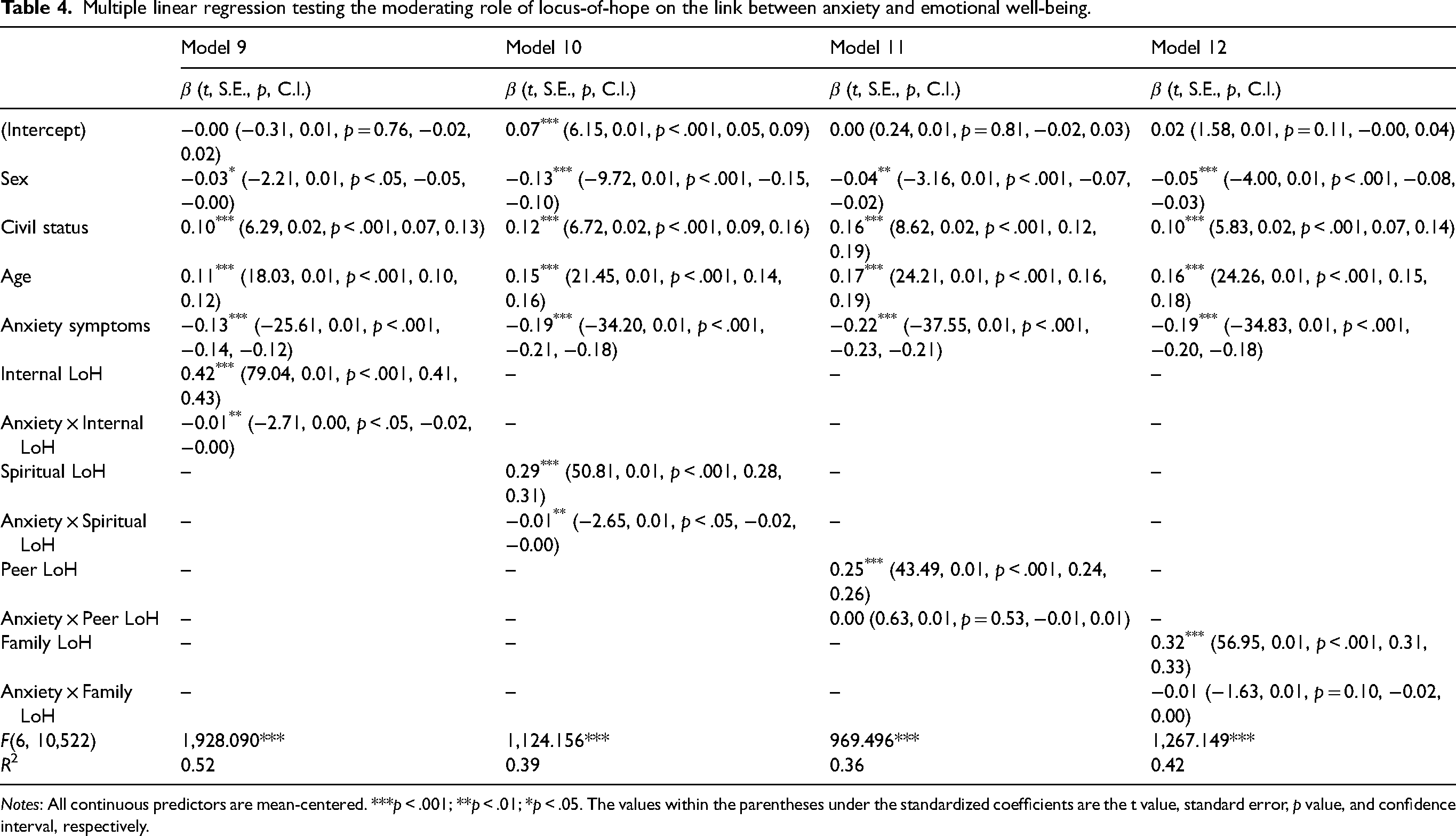
Notes: All continuous predictors are mean-centered. ***p < .001; **p < .01; *p < .05. The values within the parentheses under the standardized coefficients are the t value, standard error, p value, and confidence interval, respectively.
Furthermore, the Johnson–Neyman plots illustrate that the effect of anxiety on emotional well-being remains statistically significant within the entire range of internal LoH scores (see Figure 7a) and spiritual LoH scores (see Figure 8a). Simple slopes analysis results indicate that anxiety symptoms were in fact negatively associated with emotional well-being in low (estimated β = −0.07, t(10,521) = −18.33, p < .001), moderate (estimated β = −0.09, t(10,521) = −25.61, p < .001), and high internal LoH respondents (estimated β = −0.08, t(10,521) = −19.67, p < .001; see Figure 7b). Additionally, results show that greater anxiety symptoms were associated with lower emotional well-being in low (estimated β = −0.10, t(10,521) = −23.94, p < .001), moderate (estimated β = −0.11, t(10,521) = −34.20, p < .001), and high spiritual LoH respondents (estimated β = −0.12, t(10,521) = −25.87, p < .001; see Figure 8b). The summary of significant moderation effects are shown on Table 5.

Moderating role of Internal LoH between anxiety and emotional well-being.

Moderating role of Spiritual LoH between anxiety and emotional well-being.
Summary of moderation analyses results

*Statistically significant
Discussion
This study aimed to examine the link between anxiety and well-being and whether LoH subscales moderated such a relationship among a large community sample in the Philippines. The findings showed that anxiety is significantly and negatively associated with well-being. Further, internal LoH and external-spiritual LoH significantly moderated the relationship between anxiety and the three types of well-being. Specifically, lower anxiety symptoms are linked with higher psychological, social, and emotional well-being, especially among those with high internal and external-spiritual LoH. Additionally, external-family LoH was also found to be a significant moderator but only on the link between anxiety and social well-being.
The finding that anxiety negatively predicted psychological, social, and emotional well-being is consistent with previous studies (Doré et al., 2020; Sola-Carmona et al., 2013; Stein & Heimberg, 2004). It is one of the most common symptoms experienced by individuals, especially during the height of the pandemic, when lockdowns and strict social distancing measures were implemented (Golińska et al., 2021). Understandably, in such situations of uncertainty (e.g., not knowing when the lockdowns would end; not being able to go to work or see one's friends) and threats to one's safety (e.g., fear of getting COVID-19; limited access to basic needs), excessive and uncontrollable worry are common reactions of individuals, which could thereby take a toll on their well-being.
Despite the negative associations between anxiety and well-being, hope was found to have a moderating effect, which somehow lessens the detrimental influence of anxiety on one's well-being. This is especially true with hope that is derived from within oneself (internal hope) and from one's spirituality or a higher being (external-spiritual hope), which buffered the effect of anxiety on all three aspects of well-being; and hope from family (external-family hope), which buffered the effect of anxiety on social well-being. Indeed, at the time of the COVID-19 pandemic when individuals found themselves amid uncontrollable events and situations, hope could serve as a resource for people to cope with (Lee & Gallagher, 2018) and draw upon to deal with their experience of anxiety. Such psychological resources as hope could be beneficial for one's well-being (Hobfoll, 2002).
The pandemic has placed people into a lot of seemingly uncontrollable situations that were certainly anxiety-provoking (e.g., the continued rise in COVID-19 cases, and the implementation of strict lockdown rules that need to be followed). However, recognizing one's strengths and capabilities, and that there are still ways to achieve something positive despite the situation (internal hope), could somehow serve as a resource in maintaining one's well-being. Indeed, hope has been found to facilitate resilience and the ability to recover from the challenges of the pandemic, which allow a person to maintain well-being (Yıldırım & Arslan, 2020). There may also be situations during the pandemic where one may feel totally helpless. Nevertheless, they can still find hope in the belief in a higher being or through spiritual intervention (external-spiritual hope). Filipinos are known for their religiosity (del Castillo et al., 2020), and participating in religious activities (e.g., praying) may have helped them ease their anxiety and maintain their well-being. External-spiritual hope is rooted in the social axioms of fate control and religiosity (Bernardo & Nalipay, 2016), of which instrumentality and ego-defensiveness functions may have helped people cope with the inevitable challenges brought by the pandemic. Furthermore, the pandemic, especially during the lockdowns, had forced individuals to stay at home with their families, which could also serve as another source of hope for them (external-family hope). Having a support system in such a challenging situation could help maintain one's social well-being.
The study has important implications and contributions. In terms of theory, while anxiety and hope's roles in well-being have been widely studied in the literature, this study investigated how these two interact with each other. This is important as both (1) are commonly experienced during challenging situations, such as the pandemic; (2) have seemingly contrasting effects on well-being; and (3) are not experienced in isolation by an individual. Understanding the moderating role of hope provides valuable information in helping individuals deal with anxiety and facilitate their well-being. In terms of practice, such knowledge could be useful in designing interventions for individuals experiencing anxiety and diminished well-being in crises, such as the pandemic. Indeed, there are already existing hope interventions for well-being (Leontopoulou, 2020) that can easily be modified for this particular context.
Limitations of the study
The study has some limitations. Despite the large sample size, the use of convenience sampling may limit the generalization of the study findings. Also, the use of self-report comes with inherent biases (e.g., social desirability). Future studies are suggested to employ other forms of measurement or data collection methods (e.g., interviews, experiments) to address these. The study also made use of a cross-sectional research design, and hence, our ability to use structural equation modeling to test for causal or temporal relationships is limited. It is recommended that future research use experimental or longitudinal designs. Despite these limitations, the study also has some strengths such as being able to examine the interaction of anxiety and locus-of-hope in influencing well-being, rather than to look at their separate relationships as most studies do. It also employed Filipino samples, which are relatively underrepresented in research, and whose unique context and experiences could provide a better understanding of the pandemic.
Conclusion
Our findings highlight the differential impact of locus-of-hope as a moderating variable in the link between anxiety symptoms and well-being outcomes, by attenuating the negative effect of anxiety on well-being. Specifically, internal, family, and spiritual locus-of-hope significantly buffered the impact of anxiety on specific well-being dimensions. These results point to the relevance of fostering internal and external sources of hope amid the COVID-19 pandemic.. During uncertain or adverse situations that could potentially trigger symptoms of anxiety, hope could be a viable resource that could act as a protective factor to well-being. It is crucial todevelop interventions that can foster and strengthen the internal and external drivers of hope to alleviate the mental health burden caused by adverse contextual factors, such as the COVID-19 pandemic.
Supplemental Material
sj-docx-1-pac-10.1177_18344909231156532 - Supplemental material for Anxiety and well-being amidst the COVID-19 outbreak and the moderating role of locus-of-hope: Evidence from a large sample in the Philippines
Supplemental material, sj-docx-1-pac-10.1177_18344909231156532 for Anxiety and well-being amidst the COVID-19 outbreak and the moderating role of locus-of-hope: Evidence from a large sample in the Philippines by John Ian Wilzon T. Dizon, Norman B. Mendoza and Ma. Jenina N. Nalipay in Journal of Pacific Rim Psychology
Footnotes
Author Note
Authors Dizon and Mendoza have contributed equally and are therefore co-first authors.
Declaration of conflicting interests
The author(s) declared no potential conflicts of interest with respect to the research, authorship, and/or publication of this article.
Funding
The author(s) received no financial support for the research, authorship, and/or publication of this article.

Supplemental material
Supplemental material for this article is available online.
References
Supplementary Material
Please find the following supplemental material available below.
For Open Access articles published under a Creative Commons License, all supplemental material carries the same license as the article it is associated with.
For non-Open Access articles published, all supplemental material carries a non-exclusive license, and permission requests for re-use of supplemental material or any part of supplemental material shall be sent directly to the copyright owner as specified in the copyright notice associated with the article.
