




Abstract
Although it hasn’t been thoroughly proven yet, shyness may prevent people from seeking advice. The current study, which is grounded on social cognitive theory, seeks to understand how and why shyness affects advice-seeking. We specifically contend that shy people lack the social self-efficacy necessary to commence advice-seeking. In addition, we propose that this link is moderated by social support. We discovered that shyness was adversely correlated with social self-efficacy using a three-wave study with 240 participants and that the latter mediates the indirect association between shyness and advice-seeking. The indirect association between shyness and advice-seeking via social self-efficacy was further modulated by social support, such that the indirect effect was only significant when social support was low. We go over the theoretical and practical ramifications of our findings as well as potential research avenues.
Introduction
People frequently encounter different puzzles in daily life, which prompts them to seek advice from others. However, the propensity for advice-seeking might differ depending on personal characteristics and environmental conditions (Bamberger, 2009; Gino et al., 2012). In earlier research, the effects of assessment sensitivity, individual emotional state (such as anxiety), and environmental changes on advice-seeking were investigated (Bamberger, 2009; Gino et al., 2012). Notably, shyness is a personality trait marked by increased emotional pain, restriction in behavior, and cognitive caution when presented with social novelty and/or situations where one feels like one is being judged by others (Coplan et al., 2004; Rubin et al., 2009). Shy people lack social confidence and are driven by concerns about negative criticism, emotional stress, and anxiety in social situations (Gao et al., 2020). Additionally, anxiousness reduced people's self-confidence, and poor self-confidence prevented them from advice-seeking (Gino et al., 2012). Therefore, shyness may prevent people from asking for assistance or advice from others. However, little is known about how shyness may affect advice-seeking.
According to studies on shyness, more than 80% of Americans and 60% of individuals in the East said that being shy can occasionally become a significant problem (Zimbardo, 2009). According to Chen and French (2008), research on shyness needs to focus more on Asian cultures, especially China. We undertake a multi-wave study in response to these requests to clarify the process and boundary conditions governing how shyness affects people's desire to seek advice.
According to the social cognitive approach, people's self-efficacy beliefs regulate the majority of their behavior (Bandura, 1997). People who have a high level of social self-efficacy (SSE), which is the belief in one's ability to improve social situations, engage in successful social interaction, receive support from one's social networks (Alessandri et al., 2009; Smith & Betz, 2000), and may be more likely to seek advice because it involves using external social resources. Existing research indicates that people with high SSE trust their social skills to maintain relationships and get assistance from their social networks (Alessandri et al., 2009; Anderson & Betz, 2001; Smith & Betz, 2000). SSE, therefore, acts as a mediator in the link between shyness and advice-seeking.
According to social cognitive theory, human behavior and the self-regulatory system are most significantly influenced by the reciprocities of one's own ideas and outside social resources (Bandura, 1997). Given that shyness is typically manifested in the company of strangers (Rubin et al., 2009), shy people who experience high-quality social support—defined as the perception that others are taking care of them and giving them the help they need—can develop psychological capital (Newman et al., 2018; Siu et al., 2021), instrumental support, and information support (Kammrath et al., 2020). Additionally, people's high-quality social networks can connect them to outside resources that can assist them in overcoming obstacles and managing risks in their life (Carmeli et al., 2021). As a result, people with low SSE but high social support may find that asking for advice is not as challenging. The association between SSE and advice-seeking may therefore be moderated by social support. Together, we aim to investigate whether SSE mediates the indirect link between shyness and advice-seeking as well as the moderating role of social support. Figure 1 presents our proposed model.

The hypothesis model.
This study adds to the existing literature in various ways. First, research has specifically looked at the detrimental impacts of shyness, including emotional discomfort, retreat from social interactions, and hypersensitivity to negative social judgment (Hill, 1989; Pilkonis, 1977). The association between shyness and proactive conduct has hardly ever been studied (Crant et al., 2011). Given how prevalent shyness is among people, this is surprising (Zimbardo, 2009). As a result, this study considers shyness as a factor in advice-seeking.
Second, Crant et al. (2011) investigated how shyness affected voice behavior and found that shyness predicted advice-giving. Less is understood, however, about the underlying mechanisms of shyness's advice-seeking behavior as well as why and when it may occur. In response to recommendations for studies on advice-seeking to concentrate on the interactions between personality traits and context factors (Duan et al., 2020), this paper tries to investigate how shyness affects advice-seeking and its underlying mechanism.
Third, this study applies social cognitive theory to the area of seeking advice in order to clarify the mechanism and boundary condition of shyness in this context. According to social cognitive theory, human behaviors are mostly regulated by the reciprocities of internal beliefs (e.g., social self-efficacy) and external gains (e.g., social support). In this study, a model is developed to help explain how SSE and social support may encourage shy people to seek advice.
Theory and hypothesis development
Shyness and advice-seeking
Negative evaluation (Hill, 1989; Sun et al., 2018) and social anxiety (Blöte et al., 2019; Cheek & Buss, 1981) are both strongly correlated with shyness. These feelings provoke social withdrawal and avoidance (Gao et al., 2020; Henderson et al., 2014), which suggests that shy individuals are less inclined to participate in social interaction and have fewer opportunities to develop social skills. Previous research suggested that shy individuals were less likely to engage in peer interactions (Coplan et al., 2004) and showed fewer social skills in social settings (Rubin et al., 2009). With regard to SSE, theorists contend that shy people perceive their social skills far less favorably than less shy people, which may explain why they are more likely to be socially awkward (Cheek & Buss, 1981; Sun et al., 2018). Empirical studies supported this notion, showing shyness is related to social incompetence (Rubin et al., 2009; Zimbardo, 2009) and negative self-appraisal (Blöte et al., 2019). Shyness thus may result in a “self-fulfilling prophecy,” in which individuals’ social behavior constraint leads to negative self-appraisal, which in turn supports feelings of social incompetence (Rubin et al., 2009; Zimbardo, 2009) and reinforces social withdrawal and reluctance. So, it is reasonable that shyness may hinder individuals’ development of SSE. As a result, we hypothesize:
High SSE in social interaction can influence people's environments and behaviors, and it helps people use social resources more effectively and fosters a positive social environment (Carmeli et al., 2021; Gao et al., 2020). To initiate advice-seeking, people must be aware of two things: (a) the situation they are in requires further information or advice from others in order to be resolved (Duan et al., 2020); and (b) the existence of people in their social circles who can provide pertinent information or opinions (Buck & Smith, 2014). Therefore, high SSE individuals may feel more comfortable seeking support from their social networks, whereas low SSE persons may experience expectations of inadequacy in social interaction that would provoke anxiety, depression, and withdrawal. We thus propose the following hypotheses:
Hypothesis 1 predicts a negative relationship between shyness and SSE. Hypothesis 2 predicts a positive relationship between SSE and advice-seeking. Together, these hypotheses suggest that shyness indirectly influences advice-seeking through SSE. This view aligns with the previous study in advice-seeking literature that self-confidence is a mediating mechanism between anxiety and advice-seeking (Gino et al., 2012).
The moderating role of social support
The presence of social support can function as a potentially significant contextual condition that modifies the effects of SSE, despite the fact that SSE plays a fundamental role in people's social affect, motivation, and actions. Studies have shown that social support serves as an essential microenvironment system for individuals as well as vital positive psychological resources (Caines et al., 2019; Newman et al., 2018; Siu et al., 2021). So, we anticipate that social support may encourage people to seek advice. Indeed, research has revealed that people frequently turn to their closest friends and attachment figures for support (Buck & Smith, 2014; Kammrath et al., 2020). High-quality inner-circle social support (e.g., friends and families) provides a secure circumstance for individuals to discuss their conundrum (Caines et al., 2019). Additionally, those who have high-quality social networks have a sense of connection and belonging, which facilitates them to seek advice. For instance, studies revealed that when people lack social support, they are less likely to seek help (Cramer, 1999). This means that people who have strong social support networks will be more likely to ask for advice. For those with strong amounts of social support, the connections between SSE and advice-seeking are likely to be weaker in this situation.
However, without the availability of high-quality social networks, individuals may be more likely to rely on SSE to initiate advice-seeking. SSE enables individuals to make new social connections effectively and utilize them to receive help (Carmeli et al., 2021). Therefore, considering its relevance to advice-seeking, we argue that social support may moderate the relationship between shyness and advice-seeking behavior.
The conditional indirect effects
Along with our argument connecting SSE to advice-seeking, we proposed a conditional-indirect model in which the indirect effect of shyness on advice-seeking through SSE is dependent upon the quality of social support. Individuals with a high level of social support develop a sense of connectedness and belongingness, and they also have a secure micro-environment system that connects them to resources to which they can turn to seek advice (Caines et al., 2019). Therefore, regardless of their SSE, shy individuals may be more inclined to seek advice if they have a high level of social support. This implies that social support may act as a moderator in the association between shyness and advice-seeking through SSE. On this basis, we formulate the following hypothesis:
Methods
Participants and procedure
We conducted a three-wave study. Participants were 320 undergraduates from two universities in Eastern and Mid-China, who were recruited from undergraduate courses in 2021. At Time 1, of the 320 participants, 309 valid responses were collected regarding the participants’ demographic information, shyness, and social support (1st response rate was 96.56%). Three weeks later (Time 2), we invited those 309 participants to participate in the second-round investigation reporting their social self-efficacy and evaluation sensitivity (control variable), 285 valid responses were obtained (2nd response rate = 92.23%). At Time 3 (three weeks after Time 2), those 285 participants at Time 2 were invited again to report their advice-seeking behavior and 240 valid responses were returned (3rd response rate = 84.21%). All three waves were conducted online using the last four digits of the participants’ phone numbers as the markers matching the data of the three waves. Among the final 240 participants, 79.2% (190) were female and the average age was 20.62 years (SD = 1.42). Ethical approval for this study was obtained from the Institutional Review Board at ShangRao Normal University. All participants gave their written informed consent before participating and were told that they had the right to quit the study at any time.
Measures
For measures without the Chinese version, the Chinese versions were translated and back-translated following the translation and back-translation procedure (Brislin, 1980).
Shyness (T1)
Shyness was measured with the 8-item Shyness Scale revised by Cheek and Buss (1981). Responses to individual items were indicated on a five-point response scale ranging from “1 = very uncharacteristic or untrue” to “5 = very characteristic or true.” A sample item is “I feel tense when I’m with people I don’t know well.” Cronbach's alpha for the overall scale was 0.89.
Perceived social support (T1)
The 12-item Perceived Social Support Scale (PSSS), revised by Blumenthal et al. (1987) was used. This scale addresses perceived support from significant others (e.g., “There is a special person with whom I can share my joys and sorrows”), family (e.g., “I get emotional help and support I need from my family”), and friends (e.g., “My friends really try to help me”), other than strangers. Researchers often use this measurement to assess the quality of one's social support (Carmeli et al., 2021; Serlachius et al., 2017). Participants rated each item on a 5-Likert scale from 1 (strongly disagree) to 5 (strongly agree). Cronbach's alpha for the overall scale was 0.92.
Social self-efficacy (T2)
Social self-efficacy was measured using the 18-item scale of state Social Self-Efficacy developed by Grieve et al. (2014). Participants were asked to indicate their level of confidence in performing various activities using a Likert scale ranging from 1 (not at all confident) to 5 (very confident). A sample item is “How much confidence do you have that you could know how your actions will make others feel.” In the present study, Cronbach's alpha for the scale was 0.91.
Advice-seeking (T3)
We assessed the daily life advice-seeking behavior of the participants by the three-item advice-seeking scale (Curran et al., 2010). A sample item is “I go to others for advice regarding my study and work.” The scale was replied to on a 5-Likert scale from 1 (never) to 5 (always). Cronbach's alpha for the overall scale was 0.72.
Control variables
Except for age and gender, evaluation sensitivity, defined as individuals’ concern about the extent that their values are accepted or rejected by others (Grant & Beck, 2009), was also assessed as a control variable. Evaluation sensitivity has been demonstrated to be positively correlated with advice-seeking (Duan et al., 2020) and shyness (Chen & French, 2008; Colonnesi et al., 2014; Pilkonis, 1977; Young et al., 2021). The 6-item of Brief Fear of Negative Evaluation Scale (Grant & Beck, 2009) was used to measure evaluation sensitivity. A five-point Likert scale from 1 (strongly disagree) to 5 (strongly agree) was used. An example item is “My value as a person depends greatly on what others think of me.” Cronbach's alpha for this scale was 0.77.
Results
Confirmatory factor analysis
We used the R lavaan package (Rosseel, 2012) to perform a series of confirmatory factors to examine the distinctiveness of variables in the study. The CFA results (Table 1), based on the same parcels as indicators of their latent constructs as in the subsequent hypotheses tests, showed that the five-factor model, in which each indicator loaded on its intended latent construct, fit the data well and was better than all the other alternative models. 1
Confirmatory factor analysis.

Note: N = 240
Combines shyness and evaluation sensitivity into one factor.
Combines social self-efficacy and social support into one factor.
Combines social self-efficacy, social support, and advice-seeking into one factor.
Combines shyness and evaluation sensitivity into one factor, social self-efficacy, social support, and advice-seeking into another factor.
Combines all the factors into one factor.
Descriptive statistics
Table 2 reports the means, standard deviations, and correlations of the study variables. Shyness was negatively related to SSE (r = - 0.27, p < 0.001) and SSE was positively correlated with advice-seeking (r = 0.25, p < 0.001). Thus, both Hypothesis 1 and Hypothesis 2 were preliminarily supported.
Means (m), standard deviations (sd), and correlations in Study 1 (based on pairwise-deletion).

Note: N = 240. Gender: 0 = male, 1 = female. *** p < 0.001, ** p < 0.01, * p < 0.05. Cronbach's ɑ coefficients are reported on the diagonal.
Hypotheses testing
We adopted R package processR (Moon, 2021) to test the Hypotheses model, and the results are presented in Table 3 and Figure 2. Table 3 showed that, after controlling for participants’ gender, age, and evaluation sensitivity, shyness was significantly negatively correlated with SSE (B = −0.18, S.E. = 0.04, p = 0.001). Thus, Hypothesis 1 was supported. SSE was positively related to advice-seeking (B = 0.38, S.E. = 0.08, p < 0.001). Thus, Hypothesis 2 was supported.
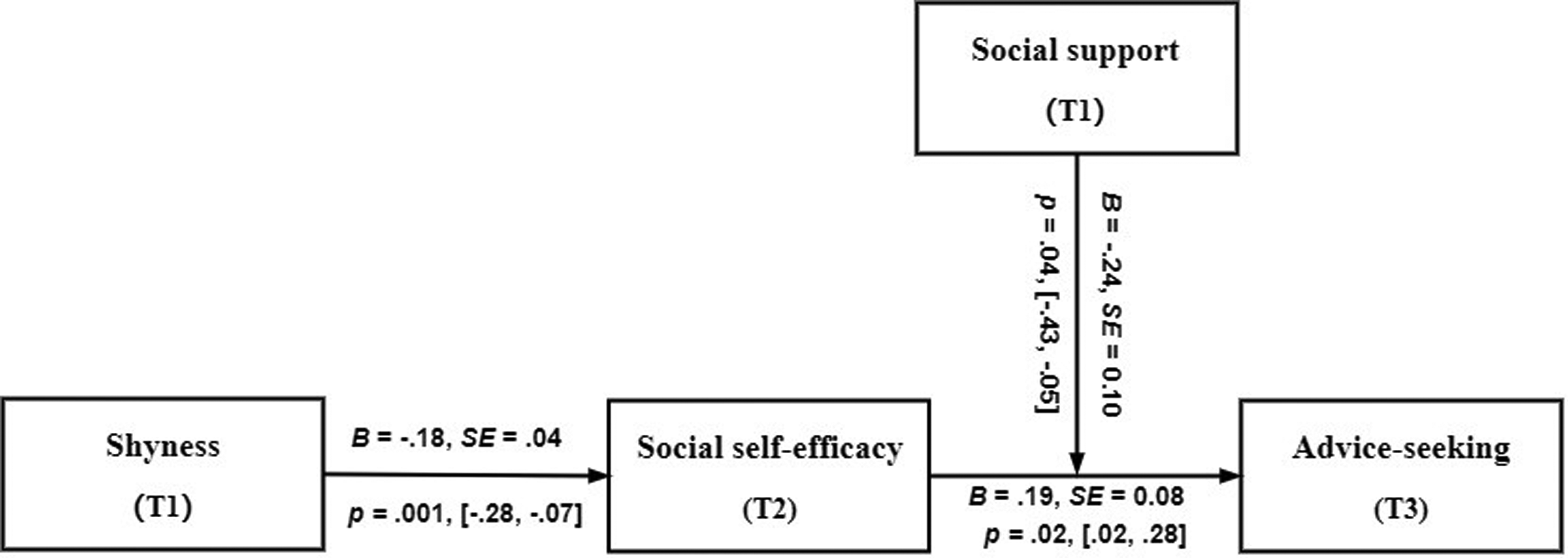
Results of path analysis, presenting standardized coefficients (N = 240). Note: Bs are unstandardized regression coefficients. SE = standard error. Bracketed numbers are 95% confidence intervals.
Results of regression analysis by r.

Note: N = 240. All data are unstandardized estimates. SSE = social self-efficacy. *** p < 0.001, ** p < 0.01, * p < 0.05.
Results showed that the indirect effect of shyness on advice-seeking through SSE was significant (B = −0.07, S.E. = 0.03, 95% CI [−0.12, −0.02]), and Hypothesis 3 was supported.
Next, we sought to assess whether social support moderated the relationship between SSE and advice-seeking. As shown in Table 3, the interaction of social support and SSE was significant (B = −0.24, S.E. = 0.10, p = 0.04). To determine the nature of the moderating effect, the simple slopes at high (1 SD above mean) and low (1 SD below mean) levels of social support were computed. As shown in Figure 3, the relationship between SSE and advice-seeking was significant when social support was low (r = 0.38, p < 0.001), but was not significant when social support was high (r = 0.001, ns). Thus, Hypothesis 4 was supported.

Moderating effect of relationship quality on the relationship between social self-efficacy and advice-seeking.
To further test Hypothesis 5, a moderated mediation analysis was carried out to calculate the indirect effects at different values of social support. The results are shown in Table 4. The indirect effect of shyness on advice-seeking via SSE was significant when social support was low (indirect effect = −0.06, 95% CI = [−0.12, −0.02]), but was not significant when social support was high (indirect effect = −0.001, 95% CI = [−0.04, 0.04]). Thus, Hypothesis 5 was supported.
The moderated-mediation effect of relationship quality on the relationship between shyness and advice-seeking via social self-efficacy.
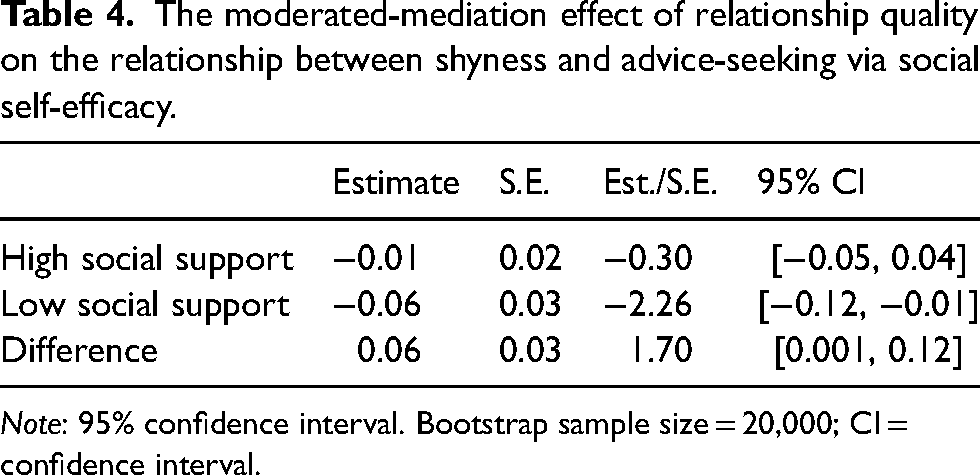
Note: 95% confidence interval. Bootstrap sample size = 20,000; CI = confidence interval.
Discussion
This study investigates the mediating and moderating mechanisms of shyness influencing individuals’ advice-seeking from the standpoint of social cognitive theory. Overall, shyness is related to seeking advice through SSE, and social support proved a position to compensate for shy people's lack of social skills and low SSE. Low-SSE but high-social-support shy people were more inclined to seek out advice. This is in line with claims that social support offers environmental and psychological resources (Gao et al., 2020; Kammrath et al., 2020; Siu et al., 2021) for people to cope with their social adjustments in life.
Contributions
Our findings contribute to the literature on advice-seeking, shyness, and SSE in several ways. First, despite the importance of seeking advice and the fact that a large proportion of people identify themselves as shy (Henderson et al., 2014; Zimbardo, 2009), we still have little knowledge about the factors that may drive shy individuals to engage in advice-seeking. Our findings revealed that with a high level of social support, shy individuals would be more likely to initiate advice-seeking.
Second, through exploring shyness as the personality trait that precedes advice-seeking, the study contributed to advice-seeking literature by integrating personality factors with context factors (social support) to understand the factors that influence advice-seeking. Emerging research suggested that individual differences influence advice-seeking and has called for exploring the impact of personality traits on advice-seeking (Duan et al., 2020). This research contributes to understanding how shy individuals tackle their inherent behavior inhibition propensity to seek advice.
Third, our findings also shed light on the underlying mechanism of the relationship between shyness and advice-seeking. According to studies, shy people may have smaller social networks (Jones & Carpenter, 1986). The present study enriches our understanding by demonstrating how advice-seeking among shy people might be encouraged by high-quality social networks. Specifically, it reveals that shy individuals with strong social support could be inspired to seek more advice. Taken together, these findings show that social support and SSE help shy people seek out more advice, which advances the social cognitive theory.
Limitations and future directions
There are limitations to our research. First, our study addressed SSE as the mediator and social support as the moderator in our model. Alternative mediators (e.g., state anxiety) or moderators (e.g., supportive leadership behavior), however, which may influence the relationship between shyness and advice-seeking in employees, should be explored in organizations in the future.
Second, there are two types of shyness: privately shy people and publicly shy people, despite the fact that the basis of shyness is the sensation of anxiety about being adversely judged and/or rejected by others (Pilkonis, 1977). The distinctions between the two types of shyness in seeking advice deserve further study. Furthermore, everyone experiences shyness to some extent. Specifically, situational factors might elicit a person's emotional state, such as situational shyness (Hill, 1989). Further study may explore how state shyness is related to people's advice-seeking after controlling trait shyness.
Third, we call for further research to explore the relationships among expectations, evaluations, and advice-seeking of shy individuals. Seminal work in advice-seeking literature (Brooks et al., 2015) suggests that advice-seekers fail to seek advice due to their higher mistaken beliefs of others’ expectations of what they should know. Shy people may be less inclined to seek advice if they think that other people are assuming that they can solve their difficulties on their own.
Finally, because undergraduates were used as subjects, caution should be taken when generalizing the findings of this study to other populations. Given the prevalence of shyness in the population (Zimbardo, 2009), future research should include a wider range of cohorts, such as staff members.
Conclusions
Exploring the mechanisms that can lead shy individuals to seek advice is crucial from a theoretical and practical standpoint because shyness is a widespread phenomenon. According to the results of the current study, shy individuals typically have lower levels of social self-efficacy, which inhibits their tendency to seek advice. Furthermore, social support moderates the indirect association between shyness and advice-seeking via social self-efficacy, ensuring that the indirect impact is only significant in low-social support situations. Future research should concentrate on the links between expectancies, assessments, and advice-seeking of private and public shyness among varied cohorts.
Supplemental Material
sj-docx-1-pac-10.1177_18344909231154927 - Supplemental material for Why and when does shyness hinder people from seeking advice?
Supplemental material, sj-docx-1-pac-10.1177_18344909231154927 for Why and when does shyness hinder people from seeking advice? by Fenghua Liang, Cheng Qian and Jinyun Duan in Journal of Pacific Rim Psychology
Footnotes
Acknowledgements
The authors thank Li-Xiao-Yun Shi and Zhao-Biao Zong for their valuable comments on the manuscript.
Data availability statement
The data that support the findings of this study are available from the corresponding author upon reasonable request.
Declaration of conflicting interests
The author(s) declared no potential conflicts of interest with respect to the research, authorship, and/or publication of this article.
Funding
The author(s) disclosed receipt of the following financial support for the research, authorship, and/or publication of this article: this work was supported by the the Education Science of Jiangxi-Provincial Office of Education (Grant No. 20ZD070); Humanities and Social Science Foundation of Chinese Ministry of Education (Grant No. 21YJC630050; Zhejiang Provincial Soft Science Project [2022C25023].
Supplemental material
Supplemental material for this article is available online.
Notes
References
Supplementary Material
Please find the following supplemental material available below.
For Open Access articles published under a Creative Commons License, all supplemental material carries the same license as the article it is associated with.
For non-Open Access articles published, all supplemental material carries a non-exclusive license, and permission requests for re-use of supplemental material or any part of supplemental material shall be sent directly to the copyright owner as specified in the copyright notice associated with the article.
