




Abstract
Two studies carried out in China examined the relationship between socioeconomic status and learning engagement and explored the roles of psychological needs satisfaction and growth mindset in this relationship. Study 1 investigated the relationship between socioeconomic status and learning engagement among 280 secondary vocational students by manipulating their perceptions of their relative socioeconomic rank. We found that Chinese secondary vocational students primed with high socioeconomic status scored significantly higher in learning engagement measurements than did those primed with low socioeconomic status. Study 2 consisted of 1,146 secondary vocational students (686 boys and 460 girls) who completed questionnaires assessing socioeconomic status, growth mindset, psychological needs satisfaction, and learning engagement. The results showed that psychological needs satisfaction mediated whereas growth mindset moderated the positive relationship between socioeconomic status and learning engagement. Theoretical and practical implications are discussed.
Keywords
Introduction
Vocational education in China was provided at three levels: junior, secondary, and tertiary. Junior vocational education has been decommissioned with the popularization of a nine-year compulsory education. As a result, secondary vocational education is the main body of current vocational education, consisting of more than 7,000 schools and over 13 million students in 2021. Secondary vocational students are a special group in the Chinese education system. Most of them passively choose to enter secondary vocational schools due to their poor performance in senior high-school entrance examinations. As a result, students in secondary vocational schools generally lack motivation for learning (Wu & Yao, 2013) and display lower learning engagement in the classroom (Zhu, 2015), compared with their senior high-school counterparts.
Learning engagement is conceptualized as a positive, fulfilling state comprising vigor, dedication, and absorption in learning (Schaufeli, Martinez, et al., 2002), which is one of the most important predictors of learning success (Skinner & Pitzer, 2012). Many scholars believe that learning engagement is closely related to learning achievement (Carmona-Halty et al., 2021; Öz & Boyacı, 2021), and take students’ learning engagement as an indicator of the learning atmosphere and teaching quality in the school (van Uden et al., 2014). Considering the large scale of secondary vocational education and its great influence on the labor market, it has become an important topic to improve the learning engagement of secondary vocational students and then improve the training quality of secondary vocational education.
Family is the first place of students’ psychological development and the main social background of individual development (Bradley & Corwyn, 2002). As an important family social context, the influence of socioeconomic status on individual learning development has always been a hot issue of learning and social concern (Liu et al., 2020; Terenzini et al., 2001). It remains unclear how exactly socioeconomic status influences learning engagement and what might make the influence stronger. To address these questions, this article intends to explore the effect of socioeconomic status on learning engagement and the mediating role of psychological needs satisfaction between socioeconomic status and learning engagement under the framework of self-determination theory.
We also explored the moderating effect of growth mindset on the relationship between socioeconomic status and learning engagement. Mindsets refer to a self-belief regarding the malleability of valued personal attributes (Dweck, 2006). People with a fixed mindset believe a given attribute is unchangeable, whereas those with a growth mindset believe that their attribute can be changed through effort. Given that mindsets vary by domain, the current research focuses on growth mindset regarding learning ability and intelligence.
Socioeconomic status and learning engagement
From the perspective of life history theory in evolutionary psychology, individuals with higher socioeconomic status have foresight for the future and slow life history strategies (Griskevicius et al., 2011), which help them achieve corresponding goals in different stages through effective expectation, planning, and implementation (Zhao et al., 2019). Meanwhile, poverty is an important feature of low socioeconomic status. Recent cognitive neuroscience findings show that poverty stress limits individual learning development by affecting prefrontal structure (e.g., smaller volume of gray matter) and functioning (e.g., poor individuals need additional compensation resources to monitor and suppress responses to distractors) (Gao, 2020).
Empirically, meta-analyses of cross-sectional studies showed that there was a moderate to strong correlation between family socioeconomic status and learning achievement in both China (Liu et al., 2020) and the West (Sirin, 2005). Longitudinal studies also found that socioeconomic status positively predicted individual learning achievement (Fergusson et al., 2008; Lurie et al., 2021). For example, in a cohort study, Zwieten et al. (2021) found that lower socioeconomic status at all ages (ages 4–5, 6–7, and 10–11) except 8 to 9 years had cumulative association with poorer learning performance at grade 7 (median age 12.5 years). The longer the duration of low socioeconomic status, the worse the learning performance at grade 7. More relevant to the current study, several cross-sectional studies also demonstrated that socioeconomic status was positively associated with learning engagement in secondary students (Benner et al., 2016; Tomaszewski et al., 2020). Taken together, the theoretical consideration and empirical evidence led to the development of the following Hypothesis 1: Socioeconomic status positively predicts learning engagement.
Psychological needs satisfaction as a mediator
Self-determination theory is macroscopic and regards the effects of the social environment on human motivation, emotion, and behavior (Ryan & Deci, 2000). It holds that people have three basic psychological needs: competence, relationship, and autonomy. The satisfaction of psychological needs can promote the best physical, psychological, and social functions (Ryan & Deci, 2017). According to self-determination theory, social environment determines the degree to which psychological needs are satisfied. Gitmez and Morcöl (1994) argue that socioeconomic status is an important environmental factor in determining psychological needs satisfaction, which was supported by both correlational and experimental studies. For example, several cross-sectional studies, including data from the Gallup World Poll (Diener et al., 2010), have found that socioeconomic status was positively correlated with psychological needs satisfaction (González et al., 2016). Meanwhile, people with low socioeconomic status often encounter more economic threats (Fritsche & Jugert, 2017). Dupuis and Newby-Clark (2016) found through an experimental study that participants who were faced with an economic threat reported lower psychological needs satisfaction relative to those in the threat-neutral and environmental threat conditions. Therefore, it can be speculated that socioeconomic status positively predicts psychological needs satisfaction.
Psychological needs satisfaction is an important antecedent variable affecting learning engagement (Reeve, 2012). Sulea et al. (2015) argue that psychological needs satisfaction is more important than personality in explaining students’ learning engagement. Prior cross-sectional studies have consistently found a positive association between psychological needs satisfaction and learning engagement (Benlahcene et al., 2021; Buzzai et al., 2021; Freer & Evans, 2019; Karimi & Sotoodeh, 2020; Liu & Flick, 2019; Zhou et al., 2019). Longitudinal studies also found that students’ psychological needs satisfaction positively predicted subsequent learning achievement (Jang et al., 2012; Yu et al., 2015; Zhou et al., 2021). The results of intervention studies showed that students’ learning engagement could be improved by increasing their psychological needs satisfaction (Cheon et al., 2012; Tessier et al., 2010). Similarly, in the field of organizational psychology, cross-cultural cross-sectional, longitudinal, and experimental studies have consistently found a positive impact of psychological needs satisfaction on employees’ work engagement (Kovjanic et al., 2013; Rahmadani et al., 2019; Wang et al., 2018). Based on the theoretical background and empirical evidence reviewed above, we proposed the following Hypotheses 2: Psychological needs satisfaction will mediate the relationship between socioeconomic status and learning engagement.
Growth mindset as a moderator
Longitudinal studies have found that although socioeconomic status significantly predicted students’ performance, there was a greater variation in performance among low socioeconomic status students (Ren & Xin, 2019). Therefore, lower socioeconomic status may not necessarily lead to poorer learning engagement, and it is important to explore the influence of socioeconomic status on learning engagement from the moderation mode.
It is generally believed that individuals’ positive qualities can resist and buffer the negative effects of disadvantages. In this article we focus on growth mindset. It has been found that growth mindset could influence individuals’ perception of frustration and stress (Zhao, Du, et al., 2021), improve individuals’ resilience (Zhao, Xiong, et al., 2021), and promote individuals to use more meta-cognitive adjustment strategies (Miele & Molden, 2010), all of which facilitate individuals’ resistance to setbacks and adversity. Previous study found that growth mindset about anxiety moderated the relationship between a history of stressful life events and coping, such that the relationship between the number of stressful life events and coping was stronger among individuals with a low growth mindset compared with those with a high growth mindset (Schroder et al., 2017).
The perception of stress has long been recognized as a key factor affecting individuals’ learning motivation and learning engagement (Pascoe et al., 2020). It can be predicted that, compared with low growth mindset individuals, individuals with high growth mindset can better cope with pressure from low socioeconomic status and show more learning engagement, which is in line with recent empirical evidence. For example, a national survey in Chile found that students with low socioeconomic status but high growth mindset performed better than students with high socioeconomic status but low growth mindset (Claro et al., 2016). A meta-analysis of the effect of growth mindset intervention on learning achievement showed that although the intervention of growth mindset did not improve the learning performance of students with high socioeconomic status, it worked for students with low socioeconomic status (Sisk et al., 2018). Based on this reasoning, we proposed Hypothesis 3: Growth mindset plays a moderating role in the relationship between socioeconomic status and learning engagement, such that socioeconomic status is a stronger predictor of learning engagement when growth mindset is low but becomes a weaker predictor when growth mindset is high. The proposed model is illustrated in Figure 1.

The mediating role of psychological needs satisfaction and the moderating role of growth mindset in the relationship between socioeconomic status and learning engagement.
Study 1: Socioeconomic status and learning engagement: Experimental study
In Study 1, we investigated the relationship between socioeconomic status and learning engagement by manipulating the perception of relative socioeconomic rank. We tested whether priming a perception of high socioeconomic status would lead participants to be more willing to learn.
Method
Participants
The participants were 280 secondary vocational students (199 female, 81 male) who were recruited from a vocational high school in Guangxi Zhuang Autonomous Region in November 2021. Their mean age was 15.74 (SD = .72). All participants were told that they would receive some gifts for their participation in the experiment.
Experimental design and procedure
The study used a single factor between-subject experimental design. Participants were randomly assigned to one of two groups (high socioeconomic status vs. low socioeconomic status), which was based on a manipulation of relative social class, adapted from measures of subjective perceptions of socioeconomic rank (Ostrove et al., 2000) and manipulations of relative deprivation (Callan et al., 2008).
Participants were first told that this was an association test, and then randomly divided into two groups to receive the socioeconomic status priming paradigm (Piff et al., 2010). Participants in the low socioeconomic status priming group were shown some pictures of luxury houses, cars, and goods, whereas those in the high socioeconomic status priming group were shown pictures about children's daily life and dilapidated buildings in poor mountainous areas (see Supplemental Materials). According to social comparison theory (Festinger, 1954), seeing pictures of luxury houses and cars can prompt individuals to perceive themselves as being in a lower socioeconomic position, whereas seeing dilapidated images leads them to perceive themselves as being in a higher socioeconomic position, which is also consistent with the contrast effects induced by extreme exemplars in priming (Herr et al., 1983). We expect that inducing participants to momentarily experience a higher or lower sense of relative social class rank would activate corresponding cognition and motivations that arise from having a relatively higher or lower socioeconomic position in society. Therefore, priming a high socioeconomic status may prompt individuals to report greater willingness to engage in learning, compared with priming a low socioeconomic status.
In order to immerse participants as much as possible in the perception of the primed socioeconomic status, after viewing the pictures we asked participants to try to use one sentence or three to five keywords to describe the pictures. A writing task like this was frequently used in previous research to activate rank-related states (Anderson & Galinsky, 2006; Kraus et al., 2009) and was included here to strengthen the effects of socioeconomic status manipulation.
After the manipulation, participants were asked to make a choice on a 10-point scale according to their own situation in Figure 2: “Where do you see yourself on the ladder? Please select the corresponding gradient.” If the score of the high socioeconomic status group was significantly higher than that of the low socioeconomic status group, the manipulation was considered successful. Finally, they filled in the learning engagement scale (see below) and relevant demographic information.

MacArthur scale of subjective social status.
Learning engagement scale
We adopted a short learning engagement questionnaire adapted from the Utrecht Work Engagement Scale (Schaufeli et al., 2006). The questionnaire contains nine items (e.g., “At this very moment, I am enthusiastic about my learning”). Each item was rated on a 7-point Likert from 1 (never) to 7 (always), with higher average scores indicating higher levels of learning engagement. In this study, the questionnaire demonstrated good reliability (Cronbach α = .78).
Results
Manipulation check
An independent sample t-test was performed on the subjective socioeconomic status of the study. The scores of the high socioeconomic status priming group on their own social status after watching the pictures (M = 5.30, SD = 1.50, n = 144) were significantly higher than those of the low socioeconomic status priming group ([M = 3.49, SD = 1.46, n = 136], t(278) = 10.21, p < .001, Cohen's d = 1.22, 95%CI = [.97, 1.48]), which proves that the experimental manipulation was effective.
Main effect on learning engagement
The independent sample t-test showed that the learning engagement score of the high socioeconomic status priming group (M = 5.36, SD = .77) was significantly higher than that of the low socioeconomic status priming group ([M = 5.09, SD = .69], t = 3.03, p = .003, Cohen's d = .37, 95%CI = [.13, .61]). That is, the higher the socioeconomic status, the more willingness to learn.
Discussion
The present study tested the relationship between socioeconomic status and learning engagement in an experiment by manipulating high and low socioeconomic status. We found that priming high socioeconomic status in secondary vocational students enhanced learning engagement. Hypothesis 1 was supported. However, it is unclear what the underlying mechanisms by which socioeconomic status impacts learning engagement are. Study 2 will further explore the underlying psychological mechanisms and boundary conditions between socioeconomic status and leaning engagement through a correlational study in a large sample.
Study 2: Socioeconomic status and learning engagement: Correlational study
In Study 2, we tested the proposed model illustrated in Figure 1 by measuring socioeconomic status, growth mindset, psychological needs satisfaction, and learning engagement.
Methods
Participants
The whole study was delivered online via a survey website (https://www.wjx.cn/). Participants were recruited from four secondary vocational schools in Guangxi Zhuang Autonomous Region. A total of 1,146 students participated in the assessment (Mage = 15.85, SD = .97): 686 males (59.9%) and 460 females (40.1%); 175 urban residents (15.3%) and 971 rural residents (84.7%); 803 (70.1%) Ethnic Han and 343 (29.9%) Ethnic Minorities.
Measures
Growth mindset. Growth mindset was measured by the Chinese version of the Growth Mindset Scale (Chen et al., 2021), which consists of eighteen items (e.g., “IQ and talent can be improved by studying hard”). Each item was rated on a 5-point Likert scale ranging from 1 (completely disagree) to 5 (completely agree), with higher average scores indicating higher levels of growth mindset. In the study, the Cronbach's α for this scale was .90.
Socioeconomic status. The socioeconomic status scale was measured by Griskevicius et al. (2013), which consists of four items on a 7-point scale ranging from 1 (completely disagree) to 7 (completely agree) (e.g., “I grew up in an affluent and stable neighborhood”). Higher average scores indicated higher levels of socioeconomic status. In the study, the Cronbach's α for this scale was .92.
Learning Engagement. The Chinese version of the learning engagement scale was adopted (Fang et al., 2008), which was based on Schaufeli, Salanova, et al. (2002). The scale contains 17 items (e.g., “I am interested in learning”). Each item was rated on a 5-point Likert from 1 (completely disagree) to 5 (completely agree), with higher average scores indicating higher levels of learning engagement. In this study, the scale demonstrated good reliability (Cronbach α = .97).
Psychological needs satisfaction. Psychological needs satisfaction was measured by the Chinese version of the Psychological Needs Satisfaction Scale (Liu et al., 2013) consisting of nineteen items (e.g., “People around me are very concerned about my studies and life”). Each item was rated on a 7-point Likert from 1 (completely disagree) to 7 (completely agree), with higher average scores indicating higher levels of psychological needs satisfaction. In this study, the scale demonstrated good reliability (Cronbach α = .88).
Procedure
The Research Ethics Committee of the first author's university approved this study. Informed consent was obtained from the participants and the school administrators. The data were collected from October 2021 to November 2021. Trained graduate students conducted the data-collecting activities. Participants were informed that their participation was voluntary, and they could terminate the survey anytime they wished. Participants received two yuan when they finished the questionnaire.
Data analysis
Data analysis was performed by using SPSS26.0 software and the PROCESS macro program developed by Hayes (2013), and the Model 5 of the 76 typical models provided by Hayes (2013) was selected for analysis.
Results
Descriptive statistics and correlational analysis
Description statistics and correlational analysis results showed that (Table 1): socioeconomic status was significantly and positively correlated with psychological needs satisfaction and learning engagement, and psychological needs satisfaction was significantly and positively correlated with learning engagement.
Mean, standard deviation, and correlations of major variables (N = 1146).

Note: * p < . 05; **p < . 01; ***p < . 001.
Mediation and moderation
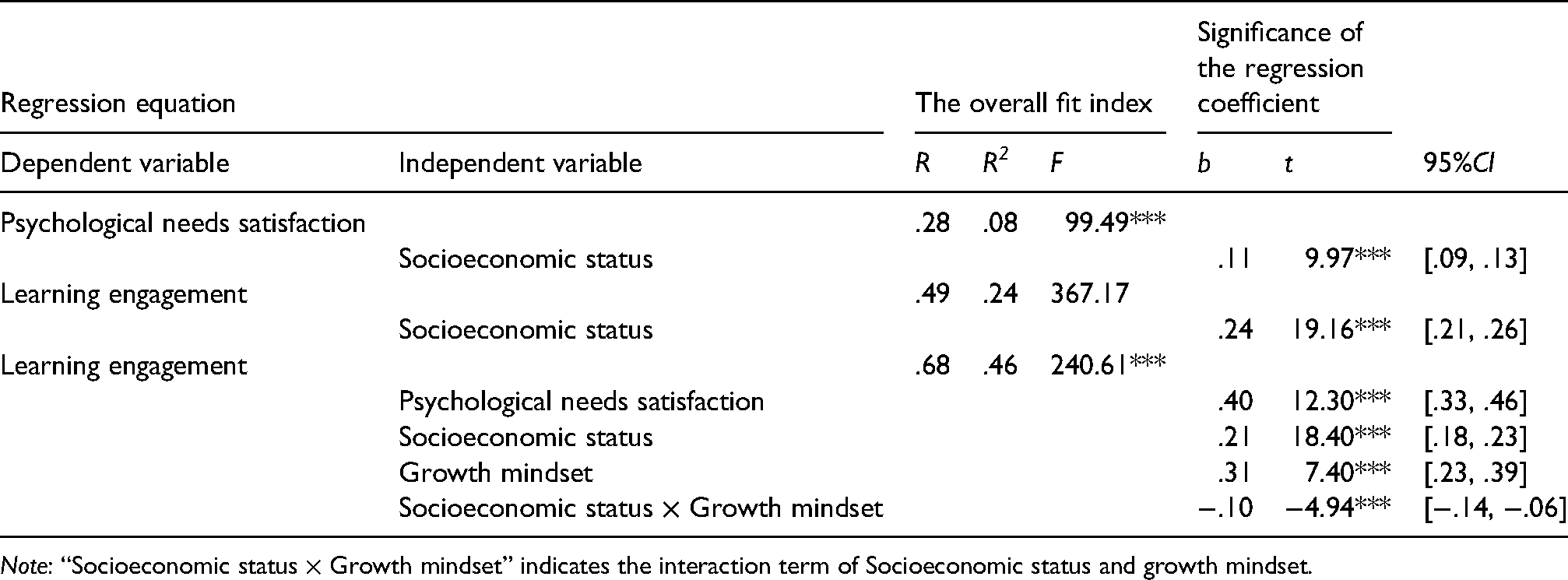
The mediation model with moderated direct path was tested by using Model 5 in the PROCESS macro, with socioeconomic status as the independent variable, psychological needs satisfaction as the mediating variable, learning engagement as the dependent variable, and growth mindset as the moderating variable. The results indicated that (Table 2) socioeconomic status alone positively both predicted psychological needs satisfaction (b = .11, SE = .01, t = 9.97, p < .001, 95%CI = [.09, .13]) and learning engagement (b = .24, SE = .01, t = 19.16, p < .001, 95%CI = [.21, .26]). When all predictors were added to the model, both socioeconomic status (b = .21, SE = .01, t = 18.40, p < .001, 95%CI = [.18, .23]) and psychological needs satisfaction (b = .40, SE = .03, t = 12.30, p < .001, 95%CI = [.33, .46]) could significantly predict learning engagement, suggesting a partial mediation. The completely standardized indirect effect of socioeconomic status on learning engagement was .09, 95%CI = (.07, .11).
Results of mediating and moderating effect analysis
Note: “Socioeconomic status × Growth mindset” indicates the interaction term of Socioeconomic status and growth mindset.
The product term of socioeconomic status and growth mindset significantly predicted learning engagement (b = − .10, SE = .02, t = −4.94, p < .001, 95%CI = [−.14, −.06]), indicating that growth mindset could moderate the relationship between socioeconomic status and learning engagement. In order to better explain the moderating role of growth mindset, growth mindset was divided into high (M + 1SD) and low (M − 1SD), with simple slope analysis. Figure 3 shows that when growth mindset is low, the predictive effect of socioeconomic status on learning engagement (b = .26, SE = .02, t = 15.89, p < .001, 95%CI = [.23, .29]) is stronger than when growth mindset is high (b = .15, SE = .01, t = 10.33, p < .001, 95%CI = [.12, .18]).
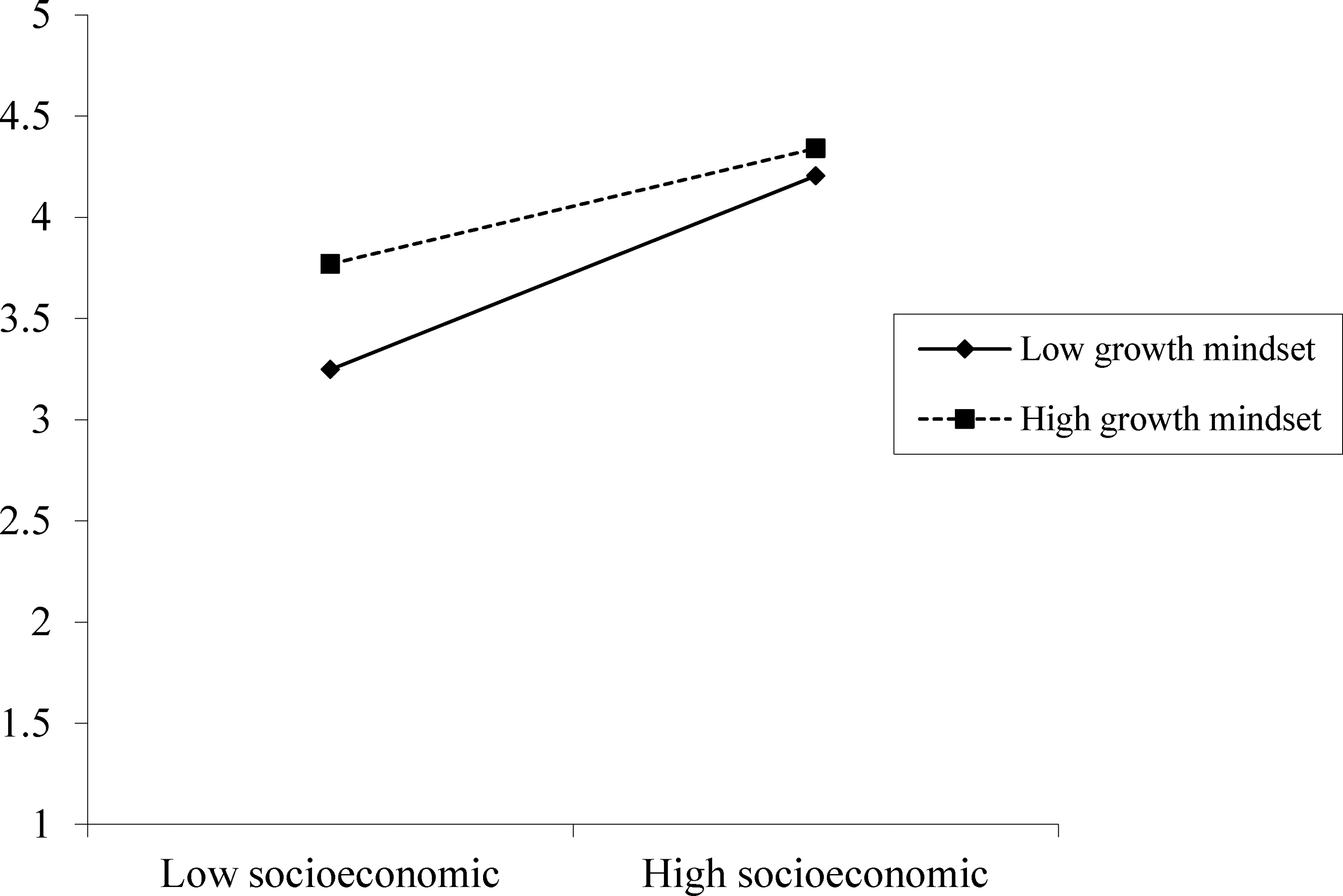
The moderator role of growth mindset between the link of socioeconomic status and learning engagement.
Discussion
Positive Youth Development Perspective (PYD) suggests that positive family resources (e.g., high socioeconomic status) and individual positive factors (such as growth mindset) effectively promote the development of adolescents (Damon, 2004). This article examined the mechanism of socioeconomic status affecting the learning engagement of secondary vocational students by constructing a conditional direct effect model. The results showed that psychological needs satisfaction mediated whereas growth mindset moderated the relationship between socioeconomic status and learning engagement.
Mediating effect of psychological needs satisfaction
This study found that psychological needs satisfaction partially mediated the relationship between socioeconomic status and learning engagement. Self-determination theory suggests that promoting social environments that satisfy psychological needs will support people's internal activities, promote more optimal motivation, and produce the most positive psychological, developmental, and behavioral outcomes (Ryan & Deci, 2000). As an important environmental background for individual development, the level of socioeconomic status will satisfy the individual's psychological needs to varying degrees. Previous studies have shown that having economic resources is the basis for psychological needs satisfaction (Dewitte, 2006; Kraus & Stephens, 2012). Both subjective socioeconomic status and objective household income positively predict psychological needs satisfaction (Di Domenico & Fournier, 2014), whereas structural economic exclusion (economic disadvantage or poverty) is not conducive to individual psychological needs satisfaction (Jiang & Ngai, 2020).
The satisfaction of psychological needs has many benefits to individual learning development. From the perspective of personal experience, individuals with high psychological needs satisfaction have higher satisfaction with vocational education (Volodina et al., 2019). From the perspective of motivation formation, the satisfaction of psychological needs is conducive to cultivating internal learning motivation (Holzer et al., 2021; Karimi & Sotoodeh, 2020), which further promotes the learning engagement of learners (Howard et al., 2021). Other researchers believe that psychological needs satisfaction affects individuals’ learning engagement in high school by improving individual executive function (Bindman et al., 2015; Neuenschwander et al., 2012). Therefore, socioeconomic status affects the psychological needs satisfaction of individuals, which in turn affects learning engagement, confirming the mediating role of psychological needs satisfaction.
Moderating effect of growth mindset
This study found that growth mindset moderated the relationship between socioeconomic status and learning engagement. Specifically, when growth mindset was low, the predictive effect of socioeconomic status on learning engagement was stronger than when growth mindset was high. To put it in another way, when socioeconomic status was low, compared with secondary vocational students with low growth mindset, those with high growth mindset showed higher engagement. When socioeconomic status was high, regardless of whether the growth mindset of secondary vocational students was high or low, there was no difference in their learning engagement. Therefore, as an academically and economically disadvantaged group, Chinese secondary vocational students with low socioeconomic status are more likely to benefit from growth mindset, which is in line with a recent meta-analysis (Sisk et al., 2018) showing that people with low socioeconomic status could benefit from mindset intervention. More broadly, it is also consistent with the view that growth mindset brings greater potential payoffs for vulnerable students (Claro et al., 2016; Yeager et al., 2019; Yeager & Dweck, 2020). As the PISA data revealed, growth mindset was associated with a larger score gain for girls and disadvantaged and immigrant students when compared to boys and advantaged and non-immigrant students (Gouëdard, 2021).
Cognition vs. motivation
Although we found psychological needs satisfaction mediated whereas growth mindset moderated the relationship between socioeconomic status and learning engagement, it is important to specify how exactly this works. In general, there are two pathways through which socioeconomic status exerts effects on learning engagement. First, insufficient physical resources may restrict the healthy development of cognitive functions mainly based on prefrontal regions (Gao, 2020). Second, insufficient physical resources may induce high levels of psychological stress and reduce motivation to engage in learning (Inzlicht et al., 2014). Our study is more relevant to the motivational pathway. One the one hand, when addressing the direct effects of socioeconomic status on learning engagement, Study 1 manipulated subjective socioeconomic status, which cannot be interpreted by cognitive deficits. On the other hand, when it comes to the mediating and moderating effects, both psychological needs satisfaction and growth mindset mainly address how people can be motivated by altering their needs and beliefs. However, we do suggest that the cognitive pathway also plays a very important role, as demonstrated by the vast literature. Considering both pathways can help to reconcile some seemingly contradictory findings. For example, unlike the current results and previous findings, King and Trinidad (2021) showed that growth mindset predicted achievement only among students from high socioeconomic status. We need to take the cognitive constrains into account to interpret this finding. That is, in certain cases the cognitive functions’ normal development for children from low socioeconomic backgrounds may have been severely disrupted. Therefore, the provision of extra incentives rarely helps.
Practical implications
This is the first time that the moderating effects of growth mindset among Chinese secondary vocational students has been revealed. Measures should be taken to encourage schools and parents to cultivate more growth mindset in secondary vocational students so as to eliminate educational inequality and enhance their academic engagement. For example, recent intervention studies of Chinese adolescents have found that growth mindset can be promoted by fostering autonomy (Zhao et al., 2022). We also need to identify the cultural obstacles to nurturing a growth mindset. For example, in China and many other Asian countries, parents and teachers often prefer outcome-oriented (vs. process-oriented) practices, which has been linked with students’ fixed mindset longitudinally (Park et al., 2016). Governments and educators may need to pay attention to such issues when formulating educational guidelines.
Meanwhile, we need to be aware that growth mindset is not a cure-all. Our study found that although growth mindset could moderate the relationship between socioeconomic status and learning engagement, the predictive effect of socioeconomic status on learning engagement was significant even when growth mindset was high. The results are in line with some recent criticism of growth mindset interventions that portray growth mindset as a silver bullet that will solve all manner of educational ills. This leads to the premature belief that there is no need to address critical social-structural barriers (e.g., poverty) that prevent students from achieving (King & Trinidad, 2021).
Meanwhile, the mediating role of psychological needs satisfaction between socioeconomic status and learning engagement suggests that in cases where socioeconomic status is immutable, learning engagement can be improved through interventions designed to create a context to support psychological needs satisfaction (Ryan & Deci, 2020). For example, new teachers can be trained to improve their teaching style. Studies found that students were receptive to these changes and reported higher psychological needs satisfaction and learning engagement (Tessier et al., 2010).
Limitations
On the one hand, psychological needs satisfaction and psychological needs frustration are distinct concepts, and psychological needs frustration and a lack of psychological needs satisfaction are asymmetric (Vansteenkiste & Ryan, 2013). In the latest study on the relationship between culturally adaptive stress and mental health, researchers found that psychological needs satisfaction and psychological needs frustration had different effects on happiness and depression (Jiang & Ngai, 2020). Given that socioeconomic status is also closely related to psychological needs frustration (Rodríguez-meirinhos et al., 2020), future studies could consider both psychological needs satisfaction and psychological needs frustration as mediating variables. On the other hand, participants of this study included a considerable proportion of ethnic minorities. Previous studies have shown that racial discrimination was negatively correlated with the psychological needs satisfaction of ethnic minority participants (Sanchez et al., 2016). Indeed, we did not consider the possible differences between Han Chinese and ethnic minorities in the architecture of this study, which can be addressed by future studies.
Supplemental Material
sj-docx-1-pac-10.1177_18344909221141984 - Supplemental material for Growth mindset matters: Influences of socioeconomic status on Chinese secondary vocational students’ learning engagement
Supplemental material, sj-docx-1-pac-10.1177_18344909221141984 for Growth mindset matters: Influences of socioeconomic status on Chinese secondary vocational students’ learning engagement by Zuozhi Fang, Baorui Chang and Junhua Dang in Journal of Pacific Rim Psychology
Footnotes
Declaration of conflicting interests
The author(s) declared no potential conflicts of interest with respect to the research, authorship, and/or publication of this article.
Funding
Baorui Chang is supported by the Innovation Project of Guangxi Graduate Education (JGY2022059), Guangxi Philosophy and Social Science Planning Research Key Project (22ASH001), and Key Project of Guangxi Ethnic Education Development Research Center (2022MJZD001).

Supplemental material
Supplemental material for this article is available online.
References
Supplementary Material
Please find the following supplemental material available below.
For Open Access articles published under a Creative Commons License, all supplemental material carries the same license as the article it is associated with.
For non-Open Access articles published, all supplemental material carries a non-exclusive license, and permission requests for re-use of supplemental material or any part of supplemental material shall be sent directly to the copyright owner as specified in the copyright notice associated with the article.
