




Abstract
To support teachers in facilitating students’ moral reasoning development as specified within the Singapore Ministry of Education Character and Citizenship Education curriculum, the Moral Reasoning Questionnaire (MRQ) was developed and underwent preliminary validation. Based upon expert reviews, cognitive interviews and a classical test theory-based factor analytic approach, the development and preliminary validation found evidence (i.e., content appropriateness, response processes and internal structure) to support the validity and reliability of the MRQ. This study aims to extend the validation by examining the purported MRQ items and scale at a deeper level on the Rasch Measurement Theory, given that it is the only model that presents appropriate properties of interval measurement on a log-linear scale. The Rasch analysis found anomalies including differential item functioning and disordered thresholds in the initial set of items. Upon remediation and a second Rasch analysis, the MRQ responses were consistent with that expressed by the Rasch model (i.e., an item with an endorsability higher than what a respondent would tend to endorse would have a lower probability of being endorsed than an item exhibiting an endorsability below what that respondent would tend to endorse) and hence, there was sufficient evidence to support measurement invariance, and that MRQ scores could be concluded to characterise persons invariantly across a continuum.
Introduction
The Character and Citizenship (CCE) curriculum developed by the Singapore Ministry of Education (MOE) aims to develop students into confident people who are discerning in judgment and possess a strong sense of right and wrong (MOE, 2012, 2016, 2020). This supports the MOE desired outcomes of education, which include qualities embodied within a person who is: (1) confident, (2) a self-directed learner, (3) an active contributor and (4) a concerned citizen. Learning outcome eight (LO8: Reflect on and respond to community, national and global issues, as an informed and responsible citizen) of the CCE curriculum appropriates a charge in supporting the desired outcomes of education. LO8 is detailed by key stage outcomes, in part addressing the values of respect and responsibility, and the social awareness domain. Inextricably linked to moral reasoning, the intended key stage outcome is for students to: (1) be able to distinguish right from wrong at the primary level, (2) have moral integrity at the secondary level and (3) have the moral courage to stand up for what is right at the pre-tertiary level (MOE, 2012, 2016, 2020).
In part to achieve LO8, the CCE curriculum intends for students to progress through various levels of moral reasoning based on Kohlberg's stage-based theory of moral development (Kohlberg, 1984) (Figure 1). To do this, curriculum documents have suggested several approaches that teachers can apply (e.g., discussing moral dilemmas on a clarify–sensitise–influence approach and modelling how decisions could be made in the context of these dilemmas). While personable and desirable, the approaches suggested are considerably resource intensive, given that teachers would have to record their discussions with each student as a form of tracking, without which they might not be conscious of progress made by each student. In light of this, the Moral Reasoning Questionnaire (MRQ) was developed upon an operational definition of moral reasoning proffered by Lim & Chapman (2021a) for use in Singapore schools on a large-scale basis for students aged between 12 and 18 (between grade 7 and 12), after an extensive review of established instruments found concerns with content appropriateness and group administrability (Lim & Chapman, 2021b). Based on critical stages recommended by the Standards for Educational and Psychological Testing (American Educational Research Association, American Psychological Association & National Council on Measurement in Education [AERA, APA & NCME], 2014), the MRQ was preliminarily validated in part on a classic test theory (CTT) factor analytic approach to establish its factorial structure, and the analyses found both quantitative and qualitative support for validity evidence and the reliability of the MRQ (Lim & Chapman, 2021c); quantitative support was established via the factor analytic approach (i.e., exploratory factor analysis followed by confirmatory factor analysis) and parallel analysis, while qualitative support was established via evidence from: (1) content appropriateness where an expert panel critique the initial item pool, and (2) response processes, where the items were validated through engaging five students, within the age range by which the MRQ was intended, in cognitive interviews (Willis, 2017).

Kohlberg's stage-based theory of moral development.
Rasch Measurement Theory
Despite its widespread application in the field of educational measurement since the 1920s (Kohli et al., 2015), the CTT-based factor analytic approach is subject to several limitations, owing in part to its circular dependency in terms of conceptualisation. In CTT, person statistics (i.e., observed scores) are inherently item-sample dependent and often assumed to be normally distributed, while item statistics (i.e., difficulty and discrimination) are person-sample dependent (Boone, 2016; Ewing et al., 2005; Kohli et al., 2015). This restricts the applicability of CTT in various important measurement situations (e.g., situations in which different tests must be equated). Further, in situations that involve rating scale data (e.g., ordinal scales such as the Likert scale), approaches grounded in CTT do not provide a basis for exploring the additivity of scores, a critical attribute of any valid measure (Wu & Leung, 2017). These call for an additional validation of the MRQ, and Rasch Measurement Theory (RMT), posited as an elaboration of CTT (Andrich & Marais, 2019), fits the purpose of this study. The view that Rasch analysis is designed for dichotomous or polytomous response data, makes no distributional assumptions and enables rating scales to be modified through identifying and dealing with misfitting items so that an instrument fittingly measures a latent trait supports RMT as a suitable method for extending the validation of the MRQ (Hendriks et al., 2012; Pallant & Tennant, 2007).
Developed by Georg Rasch in 1957, an important feature of RMT is a table of expected response probabilities reflecting Rasch's view that a person with a greater proficiency than another should have a higher probability of solving or endorsing an item; conversely, an item that is more difficult or more difficult to endorse than another implies that for any person, the probability of endorsing or solving the other item is higher (Andrich, 1997; Andrich & Marais, 2019; Bond & Fox, 2015; Rasch, 1960). By first locating and ordering persons and item difficulty on a log-linear scale reflecting degrees of the latent trait (e.g., easy to difficult; most to least endorsable), incorporating the ordering features of Guttman scaling, and the focus on probabilistic distributions of examinees’ performance at the item level, rather than on test-level information, RMT offers an alternative basis for constructing measurements within and beyond education (Pallant & Tennant, 2007; Rasch, 1960).
Following the ordering of person and items on the log-linear scale, psychometric properties of an instrument can be determined; these include the dimensionality of the instrument, fit to the Rasch model (i.e., person and item fit), threshold ordering, differential item functioning (i.e., item bias), local independence and person-separation index (PSI) (i.e., internal reliability). An important advantage of the Rasch approach derives from the fact that the item parameters obtained do not depend on the characteristics of the persons taking the test, and that the person parameters do not depend on the specific items chosen for a given test (Andrich & Marais, 2019; Bond & Fox, 2015). The parameters produced through Rasch analysis are thus independent of specific sample characteristics; the interpretation of person measures are taken with reference to the items defining the purported latent trait, as opposed to CTT, where person measures are interpreted with reference to the sample mean (Ewing et al., 2005). In view of this, the Rasch approach, taken as an elaboration of CTT, addresses issues with the CTT-based factor analytic approach. Further, Rasch measurement models are tenable as a basis for examining scores obtained through rating scales, because these models provide a means by which the hierarchical structure, unidimensionality and additivity of the scores can be evaluated.
It is noteworthy that while there have been various terms involving Rasch analysis and its application to dichotomous or polytomous scoring structures, Andrich et al. (2018) suggested that there remains only one model (i.e., the unidimensional Rasch model for ordered categories) involved with different types of items; terms such as Dichotomous Model, Partial Credit Model, Rating Model are unnecessary and have misled some to assume that there are different Rasch models.
Moral Reasoning Questionnaire
The 26-item MRQ was developed by the recommendations of Lim & Chapman (2021b) in their review of existing moral reasoning measures whilst considering the intended audience (see Appendix A). Based upon Kohlberg's stage-based theory of moral development (Kohlberg, 1984), the MRQ was initially developed with 30 items, of which four were discarded during the preliminary validation. The MRQ is intended to be delivered online and the items within are of a two-tier response format. In tier one, respondents would select one of two ‘action’ options after reading a moral dilemma vignette. Tier two, an ordering response format, would then be presented based on respondents’ selection in tier one; tier two requires respondents to rank the options in order of importance to themselves, and each of these options correspond to a level based on Kohlberg's stage-based theory of moral development. Figure 2 presents an example of an item within the MRQ.

Example item with vignette and corresponding options.
Responses to the MRQ are scored based on the scoring matrix presented in Table 1. This scoring matrix had been applied during the preliminary validation and there was no evidence to suggest, based on the CTT factor analytic approach, that it was inappropriate (Lim & Chapman, 2021c) (see Appendix B for results).
Scoring matrix of two-tier items.

Participants
Data for this study were drawn from the responses of participants who took part in the preliminary validation that was approved by the authors’ respective institutional review board (IRB). As required by the IRBs, each participant received a consent form and a participant information sheet that specified that: (1) participant involvement in the research was voluntary (2) participants were free to withdraw at any stage without prejudice in any way, with no reason required for withdrawal and (3) all data would be anonymised and each participant would not be identifiable. As all the participants were considered minors, parental consent was sought before each of the participants took part in the study. The participants were from three secondary schools (grades 8 to 12, aged between 12 and 18) in Singapore that agreed to support the study following the access permission that was granted by the MOE in 2015. Of the 670 participants whose parents/guardians agreed to let them participate in this study, 497 were female. The age range of the participants was 12 to 18 years (M = 14.24, SD = 1.30 years). As to schools, 36.7% (n = 246) of the participants were from school M (a mixed-sex government secondary and secular school), 44.2% (n = 296) from school P (a single-sex autonomous government-aided secondary and mission school) and 19.1% (n = 128) from school X (a mixed-sex autonomous government secondary and secular school). All school types follow the national syllabus with the following distinctions: (1) instituted by various community and religious organisations, government-aided schools include mission schools and serve the educational needs of specific communities; (2) autonomous schools offer a wider range of programmes for students.
The participants from the three participating schools were considered diverse as they represented different educational levels and streams. At the point of data collection, 17.6% (n = 118) of the participants were from secondary one, 27.8% (n = 186) were from secondary two; 28.4% (n = 190) were from secondary three, and 26.3% (n = 176) were from secondary four. As to streams, 79.4% (n = 532) were from the express stream, 16.3% (n = 109) from the normal-academic stream and 4.3% (n = 29) from the normal-technical stream; the majority of students in Singapore secondary schools are from the express stream. There were no missing values or incomplete responses when the data were processed after collection.
Rasch analysis
The Rasch analysis was conducted using the Rasch Unidimensional Measurement Model (RUMM2030) software version 5.4 (RUMM Laboratory Pty Ltd, Perth, Australia). The analysis was performed primarily to assess the data fit to an unrestricted Rasch model, without assuming a uniform distance between response thresholds. The MRQ and its items were evaluated, using parametric statistical tests, for: (1) threshold ordering and reliability, (2) the overall model fit, (3) individual item and person fit (4), the item characteristic curves, (5) local dependency and differential item functioning and (6) dimensionality.
Threshold ordering and reliability
Initial results obtained from the Rasch analysis indicated the presence of disordered thresholds across a number of items in the MRQ, and a significant chi-square statistic, χ2 (270, N = 669) = 517.27, p < .001 (see Appendix C for illustration of disordered thresholds). The reliability of the MRQ, however, appeared to be good, with a PSI of 0.88. This PSI value indicated: (1) a good spread of item estimates given the presence of multiple thresholds (six response categories) for each item and (2) a high estimated true variance in respondents’ moral reasoning levels (i.e., only 12% of the variance attributable to error variance).
The presence of disordered thresholds suggested that respondents might not have been able to distinguish between the six response categories presented within the MRQ based on the Rasch model. Given this result, a remediation was undertaken to have the categories revised into a smaller number, as suggested by Andrich and Marais (2019), and the data was re-scored based on this revised scoring matrix and subjected to a second round of Rasch analysis (results reported from here on). The revised categories, presented in Table 2, were premised on the following assumptions: (1) that a respondent would score 2 if she or he identified the pre-conventional level as the lowest level of moral judgment; (2) a respondent would score 0 if she or he identified the levels of moral judgment opposite to that of Kohlberg's stage-based theory of moral development; and (3) a respondent would score 1 for all other rank order permutations.
Scoring matrix of two-tier items with revised categories.

In the Rasch analysis performed on the MRQ using the revised categories, items A5, A11, A13 and A20 were removed as disordered thresholds (i.e., persons at a higher moral reasoning stage demonstrated a probability of endorsing a more endorsable item lower compared to that of persons at a lower moral reasoning stage and vice versa) remained evident. All other items did not have disordered thresholds using the revised categories. This is in agreement with the preliminary validation that also identified these four items as items that likely caused a model misfit based on the factor analytic approach. Figure 3 presents the threshold map for the remaining 26 items and Table 3 shows the uncentralised item thresholds that indicate all category responses have been used as expected consistently.

Threshold map for remaining 26 items.
Uncentralised item thresholds.

Despite the removal of items A5, A11, A13 and A20, the Rasch analysis continued to find adequate reliability estimates (i.e., a PSI of .84 and Cronbach's α of .89) based on the minimum PSI recommended by Tennant and Conaghan (2007) as .7. These outcomes suggest that the MRQ scale should be able to differentiate between at least two groups of respondents, given that the PSI reflects whether the scale is adequately robust and provides for differentiation between subgroups or individuals within the data set (Andrich, 1982; Streiner et al., 2015).
Overall model fit
In terms of the overall fit of the model, the χ2 test for the overall fit to the Rasch model remained significant at χ2 (234, n = 647) = 333.74, p < .001 based on the Rasch analysis with revised categories. While a p-value less than .01 indicates that the data would likely not fit the Rasch model, it should be noted that the χ2 statistic increases with sample size, and that other sources of evidence such as the item characteristic curve should also be reviewed (Andrich & Marais, 2019). In view of the sensitivity of the χ2 statistic to the sample size, an adjusted sample was used, and the overall fit test indicated χ2 (234, n = 527) = 271.84, p = .05; the adjusted sample is an algebraic adjustment option in RUMM2030 involving the same data set (Andrich & Marais, 2019). This non-significant item–trait interaction χ2 statistic suggested: (1) a good overall model fit; and (2) that the items collectively measure a common latent trait. The good overall model fit was also supported by the item fit residual (M = -.14, SD = 1.53) and person fit residual (M = −.16, SD = .95), which had means close to zero and standard deviations close to one, as suggested by Andrich and Marais (2019), and Tennant and Conaghan (2007).
Individual item and person fit
Examining the individual item and person fit outputs, fit residuals should lie within the range of ± 2.5 for an item to be considered fitting to the Rasch model (Tennant & Conaghan, 2007; Tennant & Pallant, 2006) though Andrich and Marais (2019) stated that ‘there are no absolute criteria for interpreting fit statistics’ (p. 196). In this case, all items (with Bonferroni adjustment) except for A9 (2.71) and 26 (−2.65) were within the threshold and p-values were >.01 (Table 4). Based on this evidence, the vast majority of items within the MRQ meet the criteria for adequate fit.
Fit statistics for MRQ with revised categories.

Item characteristic curves
Item characteristic curves (ICC) are reviewed as part of any Rasch analysis (e.g., when the p-value of the χ2 statistic is less than .01) (Andrich & Marais, 2019). In this Rasch analysis, reviewing all the 26 ICCs did not reveal major concerns, with the exception of items A9 and A26 that showed modest non-systematic misfits. The ICC of item A9 (Figure 4) suggests that respondents at the post-conventional level of moral reasoning found it difficult to endorse this item, and this likely influenced the item fit. The ICC for item A26 (Figure 5) suggests that the item misfit observed could have been influenced by over-discrimination where respondents at the post-conventional level found the item slightly too endorsable while those at the pre-conventional level found it slightly more difficult to endorse.

ICC of item A9.

ICC of item A26.
Though the fit residuals of items A9 and A26 were slightly beyond the ± 2.5 range, their χ2 probability with Bonferroni adjustment was not less than .01. In view of this and the modest item misfit, it was concluded that all 26 items measure a common underlying construct (i.e., moral reasoning). With regard to person fit, only 10 respondents excluding extreme cases had a fit residual, out of the ± 2.5 range, between −3.69 and 3.11. This could indicate anomalies in the score patterns of these respondents, which may have reflected fatigue. As there was no data entry error and given the good overall model fit, these respondents were not removed.
Local dependency and differential item functioning
Violations of local dependency were investigated based on the residual correlation matrix (Pallant & Tennant, 2007). From the Rasch analysis, the maximum inter-item residual correlation (r = .18) was between items A2 and A3, less than the .2 threshold proffered by Andrich et al. (2018). This indicates minimal local dependency and how a respondent performs for an item would have little or no bearing on other items.
Differential item functioning (DIF) occurs ‘when items do not function in the same way for different groups of people, who otherwise have the same value on the trait’ (Andrich & Marais, 2019, p. 199). The DIF analyses performed in this study afford the determination of evidence of any item bias within the MRQ, although these analyses were somewhat limited by the data that could be obtained in the study. As the MRQ is designed to assess moral reasoning across students at secondary one to four across gender, schools and streams, DIF was assessed for school, stream, gender and level. A Bonferroni correction (i.e., dividing the probability value of significance by the number of tests of fit) was used in these analyses. Table 5 presents the p-values of the ANOVA (main effect) used to determine the existence of DIF by level, gender, school and educational stream. From the results, it was concluded that no DIF was evident for school, educational stream, gender and level, with the exception of item A10 that exhibited item bias (i.e., uniform DIF) across different levels, F(3, 607) = 12.70, p < .001; there was no evidence of non-uniform DIF for item A10 based on the ANOVA (interaction effects), F(27, 607) = 0.74, p = .83.
DIF by level, gender, school and education stream.

To appreciate the extent of the item bias, the ICC with level plots for item A10 of the MRQ (Figure 6) was generated and reviewed. Visually, there is item bias between the secondary one (S1) and secondary four (S4) levels at 0 to 0.5 logits and above 2.5 logits. The uniform DIF could be significant due to the large sample size given that a small difference in how an item functions across subgroups would result in a significant statistical test (Dogan et al., 2018; Teresi et al., 2021). Further, upon reviewing the wording and structure of the vignette of item A10 (Figure 2), the DIF was deemed to be benign rather than adverse (Douglas et al., 1996). Despite the lack of evidence of non-uniform DIF that would warrant a removal of the offending item (Pallant & Tennant, 2007), item A10 was removed to ascertain if model fit would be impacted. The Rasch analysis found that model fit was not impacted even with the removal of item A10. In view of these, and the evidence supporting the adequacy of how the data fits the Rasch model, item A10 was eventually retained.

ICC with level plots for item A10.
Dimensionality
Further to the non-significant item-trait interaction χ2 statistic, evidence from the principal components analysis (PCA) supported the unidimensionality of the MRQ. All the items loaded on one principal component, which also supported the assumption of item local independence. The PCA revealed two patterns of items that loaded (positively and negatively) onto the first principal component. An independent

PCA t-test of ± loaded items on first principal component.
The findings presented so far point to a good overall model fit based on the Rasch model, and support the unidimensionality of the MRQ. The person-item threshold distribution that places student (person) and item location estimates on the same logit scale (Figure 8) shows that the items and thresholds spanned almost the range of person scores except for some who scored very high on the MRQ. This could be explained by the MOE's expectation that more secondary school students fall within the conventional to post-conventional levels of moral development.

Person-item threshold distribution.
Further analyses suggested that inferences drawn from the measure would not be confounded by students’ demographic attributes (i.e., gender, school or educational stream). Females did have slightly higher moral reasoning scores, but did not differ significantly from males (F(1, 668) = 2.91, p = .09) (Figure 9). Moral reasoning scores were also not influenced by where the school participants were from (F(2, 667) = .09, p = .92) (Figure 10) or by the educational stream (F(1, 668) = .31, p = .58) (Figure 11) that the participants were in. Nonetheless, for the levels of study, there was a statistically significant difference in moral reasoning scores (F(3, 666) = 2.87, p = .04) (Figure 12). While this difference is to be expected, as moral reasoning should be developmental, there was no definitive trend in the analysis that students at higher levels of study scored higher on the MRQ.

Person-item measure threshold distribution by gender.
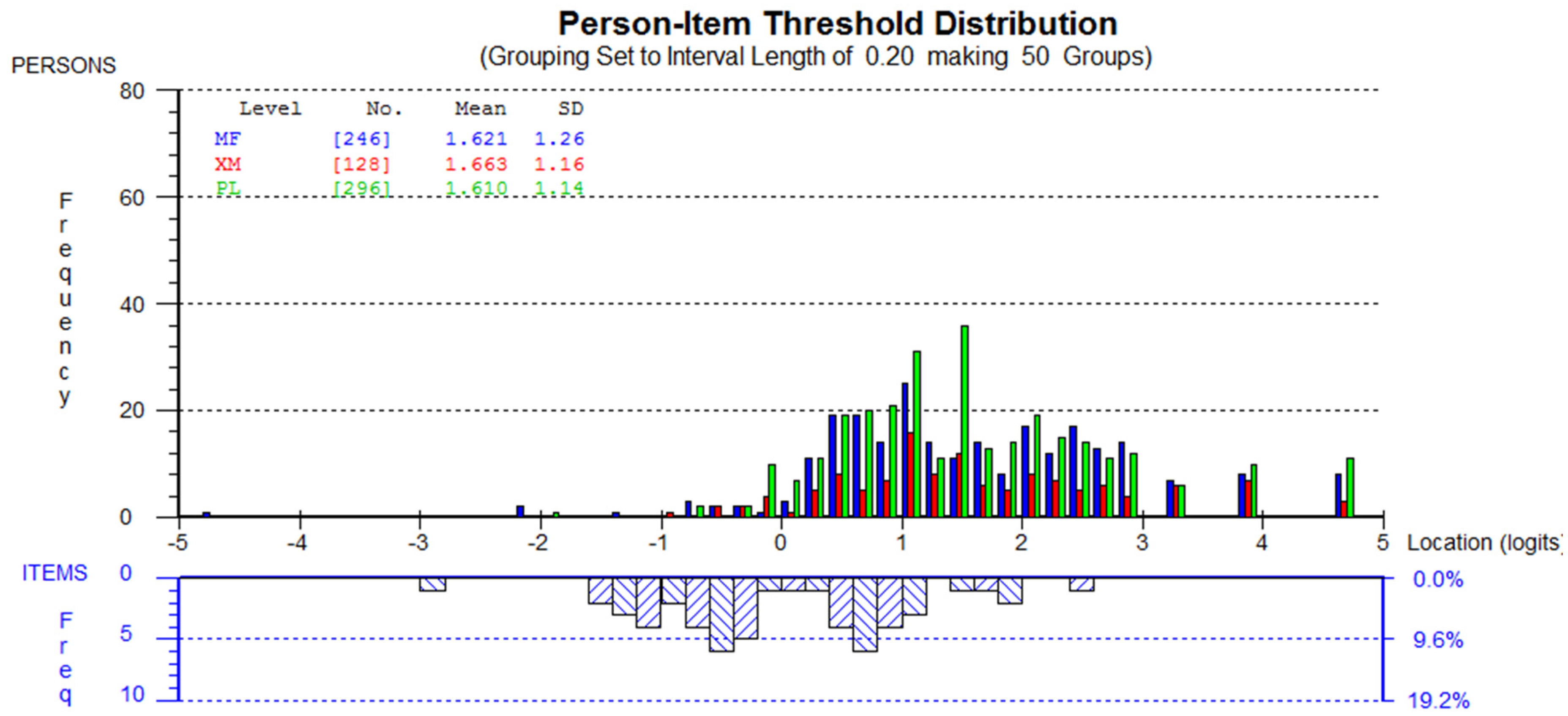
Person-item measure threshold distribution by school.
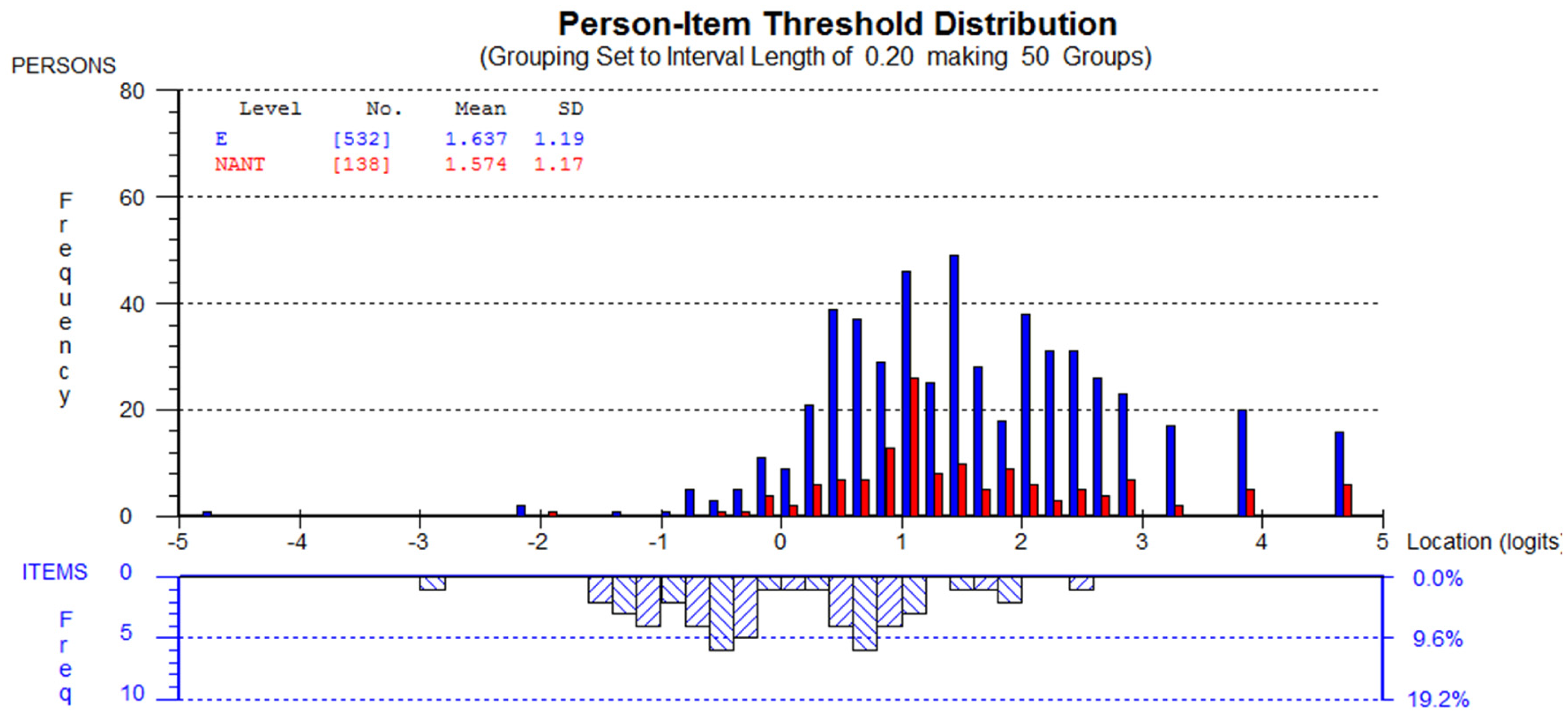
Person-item measure threshold distribution by educational stream.

Person-item measure threshold distribution by level of study.
Discussion
Based on the analyses presented in six areas (i.e., threshold ordering and reliability, overall model fit, individual item and person fit, item characteristic curves, local dependency and differential item functioning, and dimensionality), there was adequate evidence to affirm the unidimensionality and hence the intended purpose of the MRQ. The MRQ items also proved to be functioning as anticipated, based on how the data fit the Rasch model.
The Rasch analysis presented item A7 as the least endorsable item on the log-linear scale (i.e., item location = .998), with adjacent category thresholds −.4 and 2.4 logits (Figure 13). Based on the polytomous Rasch model as expressed by equation (1) (Andrich & Marais, 2019), the probabilities of a student with a proficiency at the zero logit scoring 0, 1 and 2 are .38, .57 and .05, respectively; the probabilities of an average student with a mean of the order of 1.624 (Figure 8) scoring 0, 1 and 2 are .23, .65 and .11, respectively. In the same vein, the most endorsable item on the log-linear scale, item A15 (i.e., item location = −.779) had adjacent category thresholds of −1.2 and −.3 (Figure 14). Based on equation (1), the probability of a student with proficiency at the zero logit scoring 0, 1 and 2 are .11, .37 and .52, respectively, and that of a student with a mean proficiency of the order of 1.624 are .00, .00 and .94, respectively.

Threshold probability curve of item A7.

Threshold probability curve of item A15.
Considering these and that the MOE expects most secondary school students to fall within the conventional to post-conventional levels of Kohlberg's stage-based model, it appears that the targeting of the MRQ (Figure 8) could be further refined and subsequent versions of the MRQ could include more ‘difficult to endorse’ items to assess the conventional to post-conventional levels of moral reasoning.
More could also be done to establish the MRQ as a measure of moral reasoning independent of cognition and intelligence, given that various previous studies have reported correlations in the .20 to .50 range between moral judgments and measures of intelligence, aptitude and achievement (Rest, 1979; Thoma & Dong, 2014). The data used in this study were from students from mainstream secondary schools and hence the MRQ appears to be fit for purpose in Singapore mainstream secondary school students. To ascertain that there is no DIF across a wider range of cognitive levels, and hence provide assurance that students of higher scholastic aptitude do not necessarily exhibit higher levels of moral reasoning, the MRQ could be administered to students who have comparable literacy levels but are not from mainstream secondary schools.
Though the Rasch analysis suggested that inferences drawn from the measure would not be confounded by students’ demographic attributes (i.e., gender, school or educational stream), the disproportionate sample by gender and educational stream, owing to availability sampling, could optically suggest otherwise. Hence, a more representative sample could be invited to participate in subsequent studies. With more data, measurement invariance by educational stream and gender could be affirmed.
Disordered thresholds that were identified through this study called for the MRQ scoring matrix to be revised. Hence, the revised scoring matrix should be used moving forward so that a log-linear person-measure of the MRQ can be established for the meaningful comparison of respondents’ moral reasoning.
Based on the triangulation of evidence across all of these analyses, the present study together with the preliminary validation present the MRQ as an instrument that can be used in Singapore secondary schools to monitor students’ development in the area of moral reasoning. As an accessible instrument with sound psychometric properties founded upon both CTT and RMT, the MRQ would be suitable for use on a large-scale basis. A further advantage of this instrument is that minimal training is required for teachers to administer and score the test. This adds further support to the notion that the MRQ can provide a practical means by which students’ development in moral reasoning can be monitored, hence addressing a major gap identified in this context (Lim & Chapman, 2021b).
Conclusion
This paper detailed how the RMT approach was used to validate the moral reasoning scale based on the MRQ, how the analyses were interpreted and how identified issues were resolved. The RMT approach undertaken in this study served as an elaboration of the CTT-based factor analytic approach used within the preliminary validation of the MRQ.
The Rasch analysis found evidence to support, amongst the reported psychometric properties, the unidimensionality and intended purpose of the MRQ, though issues related to disordered thresholds were identified. This led to a revised scoring matrix upon which further analyses found that invariant comparisons of persons and items could be drawn. Hence, it appears that the MRQ presents a viable scale free of DIF for measuring moral reasoning in students within the context of Singapore secondary education.
By its nature, the ‘validation process never ends, as there is always additional information that can be gathered to more fully understand a test and the inferences that can be drawn from it’ (AERA, APA & NCME, 2014, p. 21). While this study is an extension of the preliminary validation and presents the MRQ as an instrument holding considerable promise for use within the Singapore context, further research might be needed to support adoption on a widespread basis. As a concluding example, other Rasch analysis software could be applied to ascertain the findings of this study.
Footnotes
Consent to participate
Consent to participate was obtained from all participants either in hard copy (in the case of qualitative interviews) or online (in the case of online instrument delivery) format.
Consent for publication
Consent for publication was obtained in the same format as for consent to participate.
Ethics approval
Approvals to conduct this research were obtained from the Human Research Ethics Committee of the University of Western Australia (RA/4/1/7813) and from the Ministry of Education, Singapore (RQ105-15(09)).
Declaration of conflicting interests
The author(s) declared no potential conflicts of interest with respect to the research, authorship and/or publication of this article.
Funding
The author(s) received no financial support for the research, authorship and/or publication of this article.

Article Note
Under Appendix 11B1, the following text “not touch the laptop in case your classmates disapproved of your action” has been changed to “change the mark in case your classmates disapproved of your action”.
Correction (July 2023):
Article updated; for further details please see the
Appendix A: Questionnaire
report the truth. not report the truth. ______ report the truth as you might be disqualified for the presidency if you were found for hiding the truth. ______ report the truth as it is your duty to do so as the current treasurer, and it is against the Students’ Council rule to hide the truth. ______ report the truth as it is important that the elections are conducted fairly. ______ not report the truth as you would benefit more being a president than a treasurer. You believe you can be a better president than the current one. ______ not report the truth as you think that the current president will need more time to focus on her school work next year. ______ not report the truth as everyone has the right to pursue his/her goal.
-------------------------
report the cheating. not report the cheating. ______ report the cheating as you might be removed from the prefectorial board if you were found for not reporting it. ______ report the cheating as you want your friend to learn what is right. ______ report the cheating as it is important to be fair to everyone who took the test. (3) ______ not report the cheating as you would not want your best friend to hate you. ______ not report the cheating as you don't want your best friend to be caned. ______ not report the cheating as everyone has a right to do what is best for himself.
-------------------------
report that your friend copied the essay. not report that your friend copied the essay. ______ report the matter to the teacher as she might give you a zero for the essay if she found out that you ignored the act of copying. ______ report the matter as copying is not allowed according to the school rules. ______ report the matter as it is important that everyone in the class is assessed fairly. ______ not report the matter so that your friend won't hate you. ______ not report the matter as you should be sincere in the friendship and your friend asked you to keep it a secret. ______ not report the matter as it is everyone's right to strive to be promoted.
-------------------------
report the cheating. not report the cheating. ______ report the cheating to the teacher. Hiding the truth from the teacher might cost you the position of team captain. ______ report the cheating to the teacher as school rules state that cheating is a serious offence. ______ report the cheating as it is more important that everyone is treated fairly for the exam. ______ not report the cheating to the teacher as your teammates would be unhappy with you if they knew you did. ______ not report the cheating to the teacher as your friend asked you to keep it to yourself. ______ not report the cheating as your friend has a right to pursue his interest in badminton even if it meant cheating for the promotional exam.
-------------------------
report this matter. not report this matter. ______ report it to the teacher so that you might not face detention class if the online chat was found out. ______ report this issue to the teacher as the school encourages us not to badmouth others. ______ report this if your friends continue talking bad about the classmate. It is more important that your friends learn to respect others. ______ not report the remarks as they may not be true and more importantly, it wouldn't benefit you if your classmates found out you reported it. ______ not report this as everyone seems to be enjoying the chat. After all, the chat topic will soon die off. ______ not report this as everyone has the right to discuss about their opinions of others.
-------------------------
copy the assignment. not copy the assignment. ______ copy your best friend's assignment and submit it so that you won't be scolded. ______ copy your friend's assignment as the teacher does not allow any late submission and school rules state the assignments should be submitted on time. ______ copy your best friend's assignment and submit it on time so that your parents and teacher would not be disappointed with you. ______ not copy your best friend's assignment as you might be punished if you were found out. ______ not copy your best friend's assignment as it is against the school rule to copy assignments. ______ not copy but do what you can within 15 min and submit the assignment as it is more important to be honest.
-------------------------
copy his notes. not copy his notes. ______ copy his notes but use it for yourself instead of sharing it entirely with your team so that you might have a chance to be the best speaker. ______ copy and share his notes with your team to have a better chance of winning. ______ copy his notes and share with your team as both teams have been given equal opportunities to prepare for the debate whatever it takes. It is a fair fight. ______ not copy his notes as you might be punished and disqualified if you were found out. ______ not copy his notes as the school does not allow copying without acknowledging the source. ______ not copy his notes nor take a look as both teams should have equal chances to win the debate.
-------------------------
allow John in. not allow John in. ______ allow John in by pretending to look away and not shutting the gate so that you won't be reprimanded by the Prefect Master for letting a latecomer in. ______ allow John in. If your classmates see you allowing John in, they wouldn't dislike you. ______ allow John in as he wasn't late intentionally. It wasn't really his fault. ______ not allow John in as you might be punished by the teacher if she saw it. ______ not allow John in as you are duty bound as a prefect. ______ not allow John in as it is important to be fair to every latecomer.
-------------------------
report Jane to the teacher. not report Jane to the teacher. ______ report Jane to the teacher as you might be given a zero if your teacher found out that you knew but didn't report the matter. ______ report Jane to the teacher as the school does not allow cheating. ______ report Jane to the teacher as it is more important to ensure fairness in the test for everyone. ______ not report but ask Jane what the questions were and discuss the answers with her so that both she and you would benefit and she would value you as a friend more. ______ not report but ask Jane to share the questions with the class so that everyone in the class can do well. ______ not report Jane as this could be a morale booster for her to work harder in future tests.
-------------------------
divide the class randomly. divide the class randomly with conditions. ______ divide the class randomly for fear of being accused and later punished by the teacher for being biased. ______ divide the class randomly as the teacher instructed you to do so. ______ divide the class randomly as it is important to be fair to everyone. ______ divide the class randomly but for your own group you would ensure that members would only be those you can work with. ______ divide the class randomly based on your classmates’ preferences so that they would be happy with you. ______ divide the class randomly but ensure that each group has a classmate known to be notorious. Everyone should learn how to work with difficult people.
-------------------------
amend the marks on the laptop. not amend the marks on the laptop. ______ change the mark on the laptop so that you won't be scolded by your parents. ______ change the mark in case your classmates disapproved of your action. ______ add 1 mark to everyone in the class so that everyone gets 1 mark more. This would be fairer to everyone. ______ not change your mark in case your teacher finds out and you are punished. ______ not touch the laptop as it is against the school rule that states that one should be honest and upright. ______ close the laptop screen and ensure that the laptop was not meddled with until the teacher returned as it is important to be fair to everyone.
-------------------------
report him to the teacher. not report him to the teacher. ______ report him. If you don't report him and the teacher finds out, you might be reprimanded and lose the position of prefect. ______ report him to the teacher as you are duty bound as a prefect and the school rules do not allow smoking in school. ______ report him as it is more important that he leads a healthier lifestyle. ______ not report him so that you won't lose him as a close friend. ______ not report him so that his parents would not abuse him or feel hurt. He would also not feel worried about suspension. ______ not report him but ask him to admit to the teacher that he smoked in the toilet and ask the teacher for help to kick the habit.
-------------------------
give true feedback. not to give true feedback. ______ give true feedback so that you won't be criticised by anyone for being dishonest. ______ give true feedback as the school values honesty. ______ give true feedback as it is more important for the teacher to know the truth and improve. ______ give false and nice feedback so that you would not be marked by the teacher. ______ give false and nice feedback so that you will not feel different from your peers. ______ give false feedback as this teacher might only be hurt unnecessarily if everyone gives harsh and true feedback.
-------------------------
suggest Samy's name. not suggest Samy's name. ______ suggest Samy's name as the Vice-Chairman. If Samy becomes Vice-Chairman, you won't have any trouble working with him as you know him well. ______ suggest Samy's name as the Vice-Chairman as Samy is your good friend and he told you he wants to be Vice-Chairman. ______ suggest Samy's name as the Vice-Chairman. You know that Samy can co-lead the uniform group well with you and bring it to greater heights. ______ not suggest Samy's name to avoid any scolding by the teacher if she finds out that you mentioned Samy's name because he is your close friend. ______ not suggest Samy's name as you know there is a more qualified schoolmate and the most qualified person should be recommended. ______ not suggest Samy's name as it is more important to be fair to everyone and the uniform group.
-------------------------
report the error. not report the error. ______ report the error to the teacher. If she found out later that you knew but didn't report the error, you would be scolded for being dishonest. ______ report the error to the teacher as the school rules state that one must be honest. ______ report the error to the teacher as it is important that the grading is accurate and fair to everyone. ______ not report the error as it wasn't your fault and you wouldn't be blamed for the error. ______ not report the error since your friends told you to let it be. You wouldn't want to be blamed for any change in grade for your friends’ grades if the teacher found other mistakes in the class's results. ______ not report the error. You feel that there's more benefit to leave the Mathematics grade as A1; you can get into the Science stream and your parents will be happy.
-------------------------
report the matter to the authorities. not report the matter to the authorities. ______ report the matter to the relevant authorities quickly so that you won't be criminalised if the dirty kitchen was found out by authorities. ______ report the matter to the relevant authorities as the law does not permit such unhygienic practices. ______ report the matter as it is important that all diners consume clean food. ______ not report the matter to the relevant authorities so that you won't be scolded by the restaurant manager. ______ not report the matter otherwise your classmates may dislike you for causing them a loss of income should the restaurant be forced to close. ______ not report it but do your best to clean the kitchen as it is more important that the kitchen be properly cleaned than authorities clamping down on the restaurant business.
-------------------------
feign illness to skip the test. not feign illness to skip the test. ______ feign illness to skip the test, have more time to prepare for it and score better than the rest. ______ feign illness to skip the test. This way, you can have more preparation time and your parents or teacher won't be disappointed with you for not doing well for the exam. ______ feign illness to skip the test and have more time to prepare for it as it doesn't hurt anyone to do so. ______ not feign illness to skip the test as you might be punished if you were found out. ______ not feign illness as it is against the school rule to lie and skip the test without a valid reason. ______ not feign illness to skip the test as it is important to be fair to everyone.
-------------------------
take alcoholic drinks. not take alcoholic drinks. ______ drink and enjoy the company but keep it from your parents. If your parents found out, they might ground you for a few days. ______ drink and enjoy the company at selected birthday parties and explain your intention to your parents. This way, both your friends and parents won't get totally upset. ______ drink as you don't see anything wrong with drinking as long as you do not overdo it. ______ not drink no matter how to avoid scolding and punishment by your parents. ______ tell your friends you won't drink as the legal age for alcohol consumption is 18. ______ tell your friends you can't drink as your parents are concerned with your health.
-------------------------
go for dinner with your friends. not go for dinner with your friends. ______ go for dinner with your friends and come home way before your parents are home so that you won't get into trouble. ______ go for dinner with your friends so that your friends won't be unhappy. ______ go for dinner with your friends because it is not right to ground you because you failed a test. ______ not go for the dinner in case your parents find out and punish you. ______ not go for dinner as you have to abide by house rules set by your parents. ______ not go for dinner because you can stay home and study and not disappoint your parents.
-------------------------
report the lost pouch to the police. not report the lost pouch to the police. ______ report the lost pouch to the police in case someone saw you taking it and you could get into trouble. ______ report the lost pouch to the police as taking without permission is similar to stealing which is against the law. ______ report the lost pouch to the police as the owner may need the money urgently and source for alternative funding for your brother. ______ keep the $500 for your brother as he would be grateful to you. ______ keep the $500 for your brother as he needs it urgently for his exams. ______ take $250 for your brother and report the remaining amount and lost pouch to the police. At least, you would be happy that you were able to help your brother.
-------------------------
return the handphone and tell the shop you found a crack on it. Ask for a one-for-one exchange. not return the handphone. Just live with the crack. ______ return the handphone, say you found a crack on it and ask for a new one so that your parents won't scold you for being clumsy. ______ return the handphone, say you found a crack on it and ask for a new one so that you wouldn't be wasting your parents’ hard-earned money. ______ return the handphone, say you found a crack on it and ask for a new one as everyone has the right to make his/her hard-earned money worth and well-spent. ______ not return the handphone so that your parents won't scold you for being dishonest. ______ not return the handphone as insisting that that you found a crack on it and asking for a new one is unlawful and can be considered as cheating. ______ not return the handphone as it is more important to be fair to the store that sold you the handphone.
-------------------------
return the excess change. not return the excess change. ______ return the excess change as you do not want to be caught and sent for detention class for being dishonest. ______ return the excess change as it is against the school rules to be dishonest. ______ return the excess change as it is more important to be honest than to save some money. ______ keep the excess change since nobody would find out you took it and you won't get into any trouble. ______ use the excess change to buy another textbook as you can help your parents save money and they would be happy. ______ use the excess change to make a donation to the needy.
-------------------------
note the list of questions. ignore the list of questions. ______ note the list of questions but not tell your team about it so that it doesn't reflect poorly on you. During the quiz, you would try to answer as many questions as possible so that your team can win most of the $10,000. ______ tell your team the questions so that the team won't feel so stressed about preparing for the quiz. ______ note the list of questions and get your team to win most of the $10,000 for the sake of charity. It is more important to win more than less for charity. ______ ignore the list of questions as you might be caught and disqualified for cheating even if it is for charity. ______ ignore the list of questions as this is against competition rules. ______ ignore the list of questions as it is important to be fair to the other team and the prize sponsor.
-------------------------
report the old man to the authorities. not report the old man to the authorities. ______ report the old man to the authorities as you wouldn't want to be criticised for not reporting such unlicensed practices to authorities. ______ report the old man to the authorities as it is not right for people to sell food without a license by law. ______ report the old man as you would be helping other potential customers avoid eating the dirty curry puffs. ______ not report the old man as you normally don't eat his curry puffs and you don't want to be in any unnecessary trouble. ______ not report the old man so that you won't be seen by others as a heartless person. ______ not report the old man but speak to him and offer help in other ways like referring him for financial aid.
-------------------------
help the old man. not help the old man. ______ help the old man as you do not want the public at the bus stop to criticise you for being unhelpful. ______ help the old man as you are wearing the school uniform and what you do reflects on the school. ______ help the old man even if you were late because his safety is more important. ______ not help the old man as you don't want to be punished for being late. Besides, others will see and come and help him. ______ not help the old man as the school rules require students to be punctual. ______ not help the old man as you do not want to disappoint your parents and teachers in being late again.
-------------------------
buy tissue paper from anyone who approaches you. not buy tissue paper from anyone who approaches you. ______ buy tissue from anyone who approaches as you do not want people around to criticise you for being unhelpful. ______ buy tissue from anyone who approaches you as they will be happy that someone is buying from them. ______ buy tissue from anyone who approaches you as they are just earning a living. ______ not buy tissue from anyone who approaches you as you might get into trouble if authorities see you supporting unlicensed sellers. ______ not buy tissue from anyone who approaches you as the law doesn't allow unlicensed sellers. ______ not buy tissue from anyone who approaches you so that licensed sellers such as shops around the hawker centre have a chance to earn a living.