




Abstract
The global COVID-19 pandemic has caused a rising interest in the use of digital pedagogies and the need to teach remotely. This article aims to conceptualize the dimensions described below and offer a model for digital pedagogy to provide tools for using digital technologies in teaching. The model for digital pedagogy is discussed in terms of three dimensions: 1) pedagogical orientation; 2) pedagogical practices; and 3) the digital pedagogical competencies it provides for the teacher. This study examines how the dimensions of digital pedagogy are presented in the current research literature. The research is conducted through a systematic literature review surveying articles published in the years 2014 to 2019; a total of 12 articles are included in the review. The findings suggest that, first, in many cases, pedagogical orientation is labeled as socio-constructivist and student-centered. Second, pedagogical practices are the methods used to promote students’ learning; they involve, for example, collaboration and social knowledge construction. Finally, in addition to technological, pedagogical, and content knowledge, teachers’ success in blending digital technologies into their teaching is improved by high self-efficacy and strong peer-collaboration skills.
Keywords
Introduction
The current generation of youth is being educated in a world filled with digital technologies that shape everyday life. Digital technologies have, among other things, created new opportunities to seek and share information more easily. Education systems around the world are adapting to the changes that digital technologies are causing in society and are preparing to meet the new learning expectations of 21st-century pupils (Nehring et al., 2019, pp.5–6). The global COVID-19 pandemic has caused schools to rethink their pedagogical practices because they had to arrange remote teaching. Remote teaching must provide learning experiences of the same quality for pupils as contact teaching. Municipalities and school administrations are also paying attention to these changes when designing and planning in-service training for teachers. Nowadays, the development of new learning expectations for pupils and new digital technologies have necessitated that teachers continuously rethink their pedagogical practices (Sailin & Mahmor, 2018, pp.146–147). This study contributes to the field by summarizing some theoretical issues and offering a model for effectively integrating digital technologies into teaching.
The aim of the current research is to contribute to a broader understanding of what digital pedagogy really is, beyond the simple use of digital technologies in teaching. First, the study investigates how the dimensions of digital pedagogy are conceptualized in the current literature. This is done by examining its pedagogical orientation, pedagogical practices, and digital pedagogical competencies. Second, this study presents a model based on the dimensions of digital pedagogy. The study then maps the scope and types of recent research and models related to digital pedagogy through a systematic literature review. A systematic literature review was chosen as the research method because it helps to provide an up-to-date understanding of the topic at hand (Creswell, 2018, p.25). The existing literature has begun to address digital pedagogy as a concept, but thus far seems to lack detailed studies and surveys that contribute to a broader understanding.
Dimensions of digital pedagogy
Digital pedagogy is a challenging concept to define because it can be examined from many perspectives. Generally, “digital pedagogy” refers to the use of electronic elements to enhance or change the experience of education (Croxal, 2012). Kivunja (2013, p.131) presented a more detailed definition, referring to “digital pedagogy” as the skill of embedding digital technologies into teaching so that they enhance learning, teaching, assessment, and curriculum. Therefore, digital pedagogy can also be considered a pedagogical use of digital technologies. A model of digital pedagogy is introduced in this study that aims to explain the pedagogical use of digital technologies. This model of digital pedagogy comprises three dimensions: 1) pedagogical orientation; 2) pedagogical practices; and 3) digital pedagogical competencies.
The planning of digital pedagogical activities begins by considering the pedagogical orientation. Udd (2010, p.47) defines “pedagogical orientation” as a teacher’s perceptions of what the learning process should look like, how individuals learn, and how they should be taught and counseled. According to Law (2009, p.313), pedagogical orientation depends on curriculum goals, the teacher’s role in relation to teaching practices, and students’ roles in relation to learning practices. Tondeur et al.’s (2017) conceptualization of pedagogical beliefs is similar to pedagogical orientation and is defined as the understanding, premises, and propositions regarding teaching and learning. They argued that changes in teachers’ pedagogical beliefs may occur when technologies are integrated into teaching (Tondeur et al. 2017).
A traditional pedagogical orientation comprises the predefined learning goals, the teacher’s role as an expert and assessor, and the students’ role as completing the given closed-ended tasks (Law, 2009, p.317). A constructivist pedagogical orientation emphasizes students’ activities in learning and the social and reflective construction of knowledge (Udd, 2010, p.48). A constructivist pedagogical orientation does, however, take the teacher’s role into consideration as well. The teacher is seen as a facilitator whose goal is to enhance students’ deep understanding of the topic by giving them opportunities to express their conceptions and perceptions (Payne & Reinhart, 2008, p.35). Milton and Vozzo (2013, p.76) argued that digital pedagogy has more in common with the constructivist approach to teaching than it does with traditional pedagogy, because it concentrates on how students construct their own knowledge. Prestridge (2012, p.449) argued that “digital pedagogy” cannot be considered only as the use of digital technologies within teacher-directed approaches; rather, it also includes practices in which ICT is used to enable learners’ collaboration, creation, and active use of information (p.457). Social theories of learning, such as socio-constructivism and social cultural theory, are related to Vygotsky’s (1978) ideas in which social factors and culture are emphasized in cognitive development.
Pedagogical orientation may change when digital technologies are integrated into teaching. Butler et al. (2017, p.235) noted in their research that the use of digital technologies in teaching and learning resulted in learners taking more responsibility for their own learning, which increased their collaboration and activity. There was a shift in pedagogical orientation because the use of digital technologies enabled teachers to design learning environments that supported pedagogical practices involving students’ collaboration, problem-solving, and knowledge-construction (Butler et al., 2017, pp.235–236).
The term pedagogical practices here refers to the methods the teacher uses to teach. Prestridge (2012, p.453) recognized four factors that represent teachers’ ICT practices. The first factor is “foundational ICT practices,” which refers to teachers’ initial thoughts on incorporating ICT into their teaching practices, including understanding that ICT should be integrated into learning areas in schools and planning ways in which to incorporate ICT into their own teaching. However, teachers in this first phase do not have a deep understanding of how ICT enhances learning. The second factor is “developing ICT practices,” which means that teachers are starting to understand the curricular implications of ICT. In the third factor, “skill-based ICT practices,” teachers focus on ICT skills rather than the use of ICT to enhance learning. The fourth and last factor is “digital pedagogical practices,” in which teachers understand ICT to be a tool that enables learners’ engagement with problem-based activities. These factors illustrating different ICT practices indicate that several approaches can be recognized when defining “digital pedagogy” (Prestridge, 2012, p.453). Milton and Vozzo (2013) agreed with Prestridge (2012) that the definition of “digital pedagogy” contains many variations and subtleties—it is not merely the use of technologies in teaching.
Digital pedagogical competencies are referred to here as the skills teachers need to integrate digital technologies successfully into teaching. Apelgren and Giertz (2010, p.30–31) argued that pedagogical competence comprises six aspects: attitude, knowledge, ability, adapting to the situation, perseverance, and continuous development. “Attitude” refers to the fundamental pedagogical outlook that facilitates the creation of practices to promote students’ learning. “Knowledge” comprises teachers’ subject knowledge and understanding of the teaching process and methods. “Ability” refers to the skills needed to plan and organize activities and to present information to students in an appropriate way. “Adapting to the situation” means that teachers can handle a diversity of factors to optimize students’ learning. “Perseverance,” in this context, refers to teachers’ commitment to maintaining high quality in their teaching. Finally, “continuous development” refers to teachers’ understanding that pedagogical competence is not a static skill but is rather something that always needs to be evaluated and developed (Apelgren & Giertz, 2010, p.30–32).
From (2017) took a similar approach in defining “pedagogical digital competence” (PDC), seeing it as a new dimension of contemporary teachers’ pedagogical skills and competencies (p.43). PDC has three levels: the interaction level, the course level, and the organizational level. The interaction level involves pedagogical interaction with students, the course level includes the design process and implementation of digital technologies in courses, and the organizational level comprises the educational goals and strategies being developed throughout the organization. Therefore, PDC is connected to teachers’ knowledge, skills, and attitudes in relation to digital technology, learning theory, and context (From, 2017, pp.47–48).
Mishra and Koehler (2006) developed a teacher knowledge framework for technology integration. The technological pedagogical content knowledge (TPACK) framework attempts to describe how the three main components of teachers’ knowledge relate to each other. The first component, content knowledge, describes teachers’ knowledge about the subject being taught. The second component, pedagogical knowledge, refers to teachers’ understanding of the processes and methods of teaching and learning. The third component, technological knowledge, refers to teachers’ ability to apply technology productively at work and in their everyday lives (Mishra & Koehler, 2006).
While the TPACK framework is a teacher-centered approach to technology integration, Redecker (2017, p.8) sought a more student-centered approach. He created a framework for the digital competence of educators (DigCompEdu) that attempts to define the specific digital competencies that educators need to tap the potential of digital technologies in education. Specifically, the DigCompEdu framework takes the learner’s role into consideration as well, which is not emphasized in the TPACK framework devised by Mishra and Koehler (2006). In Redecker’s (2017) DigCompEdu, educators’ pedagogical competencies are divided into four segments: digital resources, teaching and learning, assessment, and empowering learners. “Digital resources” refers to educators’ ability to choose and apply digital resources effectively to support their teaching. “Teaching and learning” refers to designing, planning, and implementing various methods of digital technology used in different phases of the teaching and learning process. “Assessment” is the use of digital technologies for formative and summative assessment of learners’ performance and behavior. Finally, “empowering learners” refers to the use of digital technologies to facilitate learners’ active engagement. Digital technologies can support learning by making it possible to personalize education depending on learners’ needs (Redecker, 2017, pp.19–22).
Research questions
The first aim of the study was to find out how the dimensions of digital pedagogy are conceptualized in the current literature. This was done by examining its pedagogical orientation, pedagogical practices, and digital pedagogical competencies. The second aim of the study was to define a model based on the dimensions of digital pedagogy. As such, the following research questions were identified:
How are the dimensions of digital pedagogy conceptualized in the current research literature? What kind of model can be defined based on the dimensions of digital pedagogy?
Methodology
The literature review is a significant part of any research or development work. A basic goal in conducting a literature review is to help the researcher become familiar with the current research topic and recognize areas of concern that might point to specific matters worth studying in the future. Through a literature review, researchers can gain an understanding of the context in which the research topic exists and develop their knowledge on the topic (Hart, 1998, pp.13, 26–27; Gray, 2004, p.52). Creswell (2018, p.29) stated that there is no single way to conduct a literature review, but many researchers agree that it is about capturing, evaluating, and summarizing the literature.
In the current review, studies related to the topic were located and summarized following Creswell’s (2018, pp.29–30) steps in conducting a literature review, as follows:
Identify keywords Choose databases Begin searching Locate related articles and books Identify useful literature Design a literature map Assemble the literature review
Literature search
The keywords were identified from preliminary readings and were used as search terms in each of the chosen databases. The search terms used were as follows: digital pedagogy, competence, skill, knowledge, pedagogy, teaching, digital, technology, and pedagogical orientation, including various combinations of these terms. The information specialist at the author’s university library was consulted to ensure the search terms’ suitability for each of the chosen databases. The searches were conducted in May 2020 using various online retrieval systems of scientific articles and databases, which are listed in Table 1.
Online retrieval systems and databases.
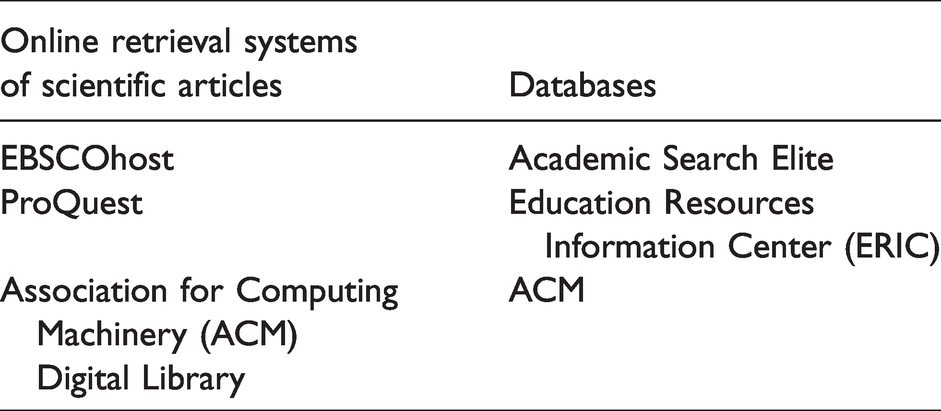
The searches were conducted using EBSCOhost, ProQuest, and the Association for Computing Machinery (ACM) Digital Library, which are online retrieval systems for scientific articles related to the educational, psychological, and behavioral sciences. The search terms were adjusted as needed for the retrieval system. The searches were targeted to three databases: Academic Search Elite, the Education Resources Information Center (ERIC), and the ACM. Table 2 presents the databases used and the search terms used in each of them.
Search terms and results from various databases.

“Digital pedagogy” as a search term provided a total of 99 results among all the databases. While the term was mentioned in each of the articles, it was not defined in most cases. The articles did not provide sufficient information about digital pedagogical orientation, practices, or competencies; this meant that the literature search had to be widened by employing more versatile search terms. Digital pedagogy is often linked to the pedagogical use of technology or successful technology integration in teaching, which led to the idea of looking for information about the use of technologies in teaching.
Generally, the literature searches in the ERIC database provided the largest number of articles, while the searches in the ACM database provided the smallest number of articles. The articles found in the ERIC database focused mostly on the pedagogical use of certain digital technologies or were associated with teachers’ professional development through organizational measures. The articles in the ACM database were mostly focused on research related to technology but were not related to the pedagogical use of technology. The searches in the Academic Search Elite database provided most of the related articles about the topic of this review. Altogether, these searches provided all the articles included in this literature review.
Inclusion and exclusion criteria
The inclusion and exclusion criteria were defined based on the research aims and questions: to find information relating to the concept of digital pedagogy and to teachers’ digital pedagogical competencies. Table 3 presents the inclusion and exclusion criteria used in this research. The articles included in the literature review had to be peer-reviewed, written in English, and published between the years 2014 and 2019. Articles published in 2020 were not included in the literature review because 2020 was ongoing at the time the searches were conducted. Both empirical and theoretical research articles were included because both article types could provide valid information concerning this topic. The study also considered only articles that either defined the concept of digital pedagogy or focused on the pedagogical use of technology. Several articles were either related to the integration of a certain technology in teaching or focused on a group of people other than those working in a teaching profession; these articles were excluded from the review.
Inclusion and exclusion criteria.

Data extraction
The data extraction process began with the identification of articles from the three chosen databases. This was followed by screening the articles. Figure 1 illustrates the article extraction process.

The identification and screening process for the literature used in this study.
Literature searches in the three selected databases identified a total of 987 articles. The searches did not provide any duplicates. The 987 articles’ titles and abstracts were screened to exclude ineligible articles. The screening of the articles’ titles and abstracts focused on finding the keywords and determining whether the context of the study was suitable for the scope of this research. In total, 146 articles were retained, at which point the full text of the articles was screened. At the end of the screening process, 12 articles were included in the literature review and they were published between the years 2014 and 2018. Any of the articles published in the year 2019 did not meet the inclusion criteria. The excluded studies did contain some keywords but did not correspond with the focus of the research. First, several of the excluded articles included “digital pedagogy” as a keyword but did not define it; defining “digital pedagogy” was one of the inclusion criteria. Second, many of the articles did not focus on the field of teachers’ competencies concerning technology integration in teaching. Articles may have discussed teachers’ competencies concerning the use of certain digital technology but did not relate to the competencies they needed to integrate digital technologies into their teaching. Last, some excluded articles focused on teaching students about digital technologies rather than the pedagogical use of those technologies.
Chosen articles and their contents
The chosen articles defined “digital pedagogy,” discussed pedagogical orientation, pedagogical practices related to digital pedagogy, or conceptualized teachers’ digital pedagogical competencies. Table 4 presents the topics discussed in each of the 12 chosen articles.
Chosen articles and their contents.

This study aimed to provide a model for digital pedagogy by outlining its pedagogical orientation and pedagogical practices, and identifying teachers’ digital pedagogical competencies. Thematic analysis was used to explore the contents of the chosen literature in order to create a literature map. Thematic analysis can be conducted in many ways, but all approaches share the aim of identifying interesting themes in the data. This study was conducted following Braun and Clarke’s (2006) approach to thematic analysis, which comprises generating initial codes, searching, reviewing, and defining themes. The analysis was conducted using the qualitative data analysis computer software NVivo 12.
Pedagogical orientation was discussed in eight of the chosen articles. While pedagogical orientation was mentioned in more than eight of the articles, it was not related to technology use in teaching; this meant they were excluded from the literature review. Pedagogical practices were discussed in four of the chosen articles. These articles discussed pedagogical practices in relation to the use of digital technologies in teaching. Teachers’ digital pedagogical competencies were discussed in four of the chosen articles, which examined the competencies teachers need to integrate technology successfully in teaching.
Results
Dimensions of digital pedagogy
The first aim of this study was to conceptualize the dimensions of digital pedagogy based on the current literature. This section reports the findings gathered for the dimensions of digital pedagogy from the chosen articles. Table 5 presents and summarizes the dimensions of digital pedagogy and their contents according to authors of the 12 chosen articles. One author may present ideas relating to one or more dimensions of digital pedagogy.
Dimensions of digital pedagogy and their contents by the selected authors.

The chosen literature was divided into three different dimensions for digital pedagogy. The first dimension included the articles discussing pedagogical orientation as related to technology use in teaching. The second dimension concerned discussion of digital pedagogical practices. The third dimension comprised articles about teachers’ digital pedagogical competencies. The following section presents a more detailed introduction to each of the dimensions.
A model for digital pedagogy
The second aim of the study was to define a model based on the dimensions of digital pedagogy. The integration of technology into teaching was mentioned in all the chosen articles as a key part of digital pedagogy. Sailin and Mahmor (2018, p.146) argued that digital pedagogy is the meaningful integration of digital technologies into teaching practices. Montebello (2017, p.165) stated that digital pedagogies are ways in which to embed digital tools or aids into teaching to facilitate the learning process. Both Sailin and Mahmor (2018) and Montebello (2017) agreed that digital pedagogy is the integration of technologies into teaching to enhance students’ learning. While these perspectives emphasize the meaningful integration of technologies into teaching, the studies did not comment on any specific pedagogical orientations or practices associated with the pedagogical use of technologies. Figure 2 presents a model for digital pedagogy in which the ideas from the theoretical framework and the selected articles are fused together.

Conceptualization of dimensions and a model for digital pedagogy.
Considering all the definitions above, digital pedagogy can be fundamentally defined as the pedagogical use of digital technologies. The main differences among the scholars mentioned above were the ways in which they discussed pedagogical orientation in relation to the use of technology in teaching. The next section, therefore, provides a more detailed discussion of the dimensions of digital pedagogy: 1) pedagogical orientation; 2) pedagogical practices; and 3) digital pedagogical competencies.
Pedagogical orientation
Pedagogical orientation may change when digital technologies are implemented in teaching. In this research, pedagogical orientation refers to teachers’ perceptions about effective teaching and learning methods and strategies. Pedagogical orientation is generally divided into two types: constructivist pedagogical orientation and traditional pedagogical orientation. The constructivist pedagogical orientation is based on collaboration, student-centered activities, and students’ active participation in discourse rather than on the teacher-led transfer of information. Therefore, technology is considered a cognitive tool that supports students’ learning. Traditional pedagogical orientation involves teacher-centered activities in which communication flow is mostly from teachers to students. In traditional pedagogical orientation, technology is used to support teacher-centered activities (Looi et al., 2014, p.224). According to Pittman and Gaines (2015, p.550), both the constructivist and the sociocultural learning theories facilitate the integration of technologies in the classroom.
Sailin and Mahmor (2018, p.144) argued that the teaching and learning processes should become more constructivist and learner-centered when digital technologies are integrated into teaching. The constructivist and learner-centered approaches are expected to enhance the skills students need in the 21st century (Sailin & Mahmor, 2018, p.146–147). The constructivist and student-centered approaches can be considered even during the planning and implementation phases of digital pedagogy. Gillett-Swan and Sargeant (2017, p.41–42) argued that having a student-centered perspective is essential for planning and implementing digital pedagogy to fully realize the potential of such digital applications. Therefore, digital pedagogy includes more than just the teacher’s perspective of teaching and learning; it must also include the students’ perspective. According to Wadmany and Kliachko (2014, p.24), the use of technology in teaching is the key element of digital pedagogy; however, its advantages cannot be achieved without appropriate pedagogy. To apply digital pedagogy, the teacher’s and students’ roles must change. The teacher’s role is to work as a facilitator who uses student-centered teaching approaches, makes it possible for students to control their own learning processes, and encourages students in collaborative learning (Wadmany & Kliachko, 2014, pp.23, 26–27). Tondeur et al. (2017, p.561) also noted that the use of technologies in teaching may help teachers to practice becoming more constructivist and student-centered.
Greenlaw (2015, p.896) took a different approach, identifying contrasts between teacher-centered pedagogies and learner-centered pedagogies. Teacher-centered pedagogies are based on content knowledge, theory, and direct instruction, while learner-centered pedagogies are presumed to be more practice-based, wherein skills are learned through collaboration. Teacher-centered pedagogies are not necessarily less effective than learner-centered pedagogies; both have useful features, and teachers should try to find a balance between them when using digital technologies in teaching (Greenlaw, 2015, p.896, 902). Adam (2017, p.36), however, stated that technology-integrated pedagogical practices should not be automatically labeled as constructivist. Montebello (2017, p.165) also argued that digital pedagogies do not guarantee enhanced learning outcomes and that their use still requires teachers to fulfill the classical role as the guide, facilitator, and leader of the learning process.
The scholars mentioned above do not necessarily share the same ideas about the pedagogical orientation of digital pedagogy. Still, constructivist and student-centered approaches seem to be largely associated with digital pedagogy. This might be because many scholars believe that teachers who use constructivist/sociocultural, student-centered pedagogical approaches tend to adopt new technologies in their teaching more easily than teachers who use teacher-centered pedagogical approaches (cf. Montebello, 2017). Therefore, scholars tend to agree that a constructivist/sociocultural, student-centered pedagogical orientation is beneficial for integrating technologies meaningfully into teaching, but they do not necessarily label digital pedagogy as such because it can also be teacher-centered (cf. Greenlaw, 2015). The model for digital pedagogy created in this study, however, presented a socio-constructivist approach to teaching by bringing together constructivist and sociocultural perspectives (cf. Vygotsky, 1978). Traditional and teacher-centered approaches were not presented in the model because the selected literature did not provide enough evidence that they would be beneficial when integrating technologies in teaching.
Pedagogical practices
Pedagogical orientation is clearly reflected in digital pedagogical practices. According to Wadmany and Kliachko (2014), digital pedagogy is pedagogy in an information- and technology-rich learning environment; it is about creating a learning environment in which students can engage in problem-based exercises, with technology integrated into the teaching, learning, and assessment processes. This perspective emphasizes the pedagogical use of technologies but also considers some pedagogical activities and the teacher’s and students’ roles when technologies are integrated. Learners should take the initiative to learn independently and through collaboration with peers. In many cases, while the use of ICT does not lead teachers to reexamine or change their current practices concerning teaching and learning, constructivist pedagogical beliefs tend to help teachers adopt technology and use it effectively in teaching (Wadmany & Kliachko, 2014, pp.23, 26–27).
Digital pedagogy should involve more than the simple use of technology in the classroom; the use of technology should be based on problem solving and developing higher-order thinking skills (Sailin & Mahmor, 2018, pp.146–147). Pittman and Gaines (2015) stated that the sociocultural approach emphasizes giving learners the opportunity to contact other individuals and parties who are not in their immediate vicinity with the help of various media or technologies. Therefore, learners should become the creators of knowledge themselves by interacting with the environment (Pittman & Gaines, 2015, pp.540, 550).
Prestridge (2012) categorized teachers’ ICT practices into four factors (see p. 2). The ideas presented by the authors above are similar to the fourth and last factor, whereby teachers understand ICT to be a tool that enables learners’ engagement with problem-based activities. Student engagement, problem-based exercises, collaboration, and social knowledge construction are emphasized among scholars with regard to digital pedagogical practices. Therefore, they were considered in the model for digital pedagogy.
Digital pedagogical competencies
Integrating digital technologies into teaching requires the teacher to possess several skills or competencies. This section describes how such digital pedagogical competencies are seen in the reviewed articles. Mena et al. (2018, p.588) stated that digital competencies include the contents, skills, knowledge, and attitudes that connect technical expertise with pedagogical purposes to enhance students’ learning. Such competencies are needed to integrate technology into regular teaching practices. Even though Mena et al. (2018) referred to “digital competencies” instead of “digital pedagogical competencies,” the authors seem to mean the same thing. Mishra and Koehler’s (2006) TPACK framework resembled Mena et al.’s (2018) definition of “digital competencies,” although Mena et al. included attitude as one of the four main competencies.
Mannila et al. (2018) noted that teachers’ self-efficacy is a key factor in the implementation of technologies in teaching because it comprises individuals’ resilience and perseverance in facing challenging situations and problems. Low self-efficacy suggests a higher chance of failure in completing the tasks at hand. High self-efficacy, however, suggests the will and ability to put more effort into the tasks at hand, decreasing the chance of failure. Therefore, self-efficacy should also be considered in the development of teachers’ technological skills and knowledge (Mannila et al., 2018). The concept of self-efficacy is absent from both Redecker’s (2017) DigCompEdu framework and Mishra and Koehler’s (2006) TPACK framework.
From (2017) defined PDC as the knowledge, skills, attitudes, and approaches related to digital technology, learning theory, subject, context, and the relationships among these concepts. From’s (2017) ideas closely align with Mannila et al.’s (2018) and Mena et al.’s (2018) discussions about competencies in digital pedagogy because, in all cases, successful technology integration in teaching requires more than plain technological, pedagogical, and content knowledge. McCarthy et al. (2017, p.73) noted that, in addition to technological and pedagogical support, personal support—such as peer collaboration and coaching—is needed when digital technologies are integrated into teaching. Therefore, the integration of digital technologies into teaching also requires different types of support from the working environment.
The digital pedagogical competencies presented in the model are one way of comprehending the skills teachers need to integrate digital technologies into teaching. The competencies included in the model are related to teachers’ self-efficacy and personal knowledge areas in relation to the integration of digital technologies; they also consider some aspects of the working environment, such as personal support and continuous development.
Limitations
The literature search conducted in this review returned hundreds of articles, but only a few of them related appropriately to the topic of this research. In many cases, the articles lacked conceptual clarity concerning digital pedagogy, which limited the number of articles that could be included in this literature review. Most of the excluded articles were dismissed during the screening phase; therefore, there is a chance that some excluded articles might have been included if the full text were screened. The screening of the articles’ titles, abstracts, and full texts was, however, conducted carefully, and articles were only excluded from the literature review if they lacked the required level of detail or precision.
The present study was limited to articles that clarified the concept of digital pedagogy with a sufficient level of detail and precision. However, the review could also have been conducted by including articles in which the concept of digital pedagogy was mentioned but not defined. This would have provided interesting information about the use of digital pedagogy but would have required the use of a different type of analysis; limited time and resources created boundaries that required the researcher to make certain choices, one of which was limiting of the scope of the review to articles that defined “digital pedagogy.” The model for digital pedagogy requires further evaluation and development to support educators’ use of digital technologies in teaching. The model provided by this review, however, provides a good starting point for familiarizing oneself with the topic.
Discussion
Defining the concept of digital pedagogy was the most difficult part of this study. The searches provided hundreds of articles that included the concept of digital pedagogy, but the term itself was not defined at all in most cases. Many scholars seem to expect the reader to be familiar with the concept. Still, “digital pedagogy” was understood differently in many articles. This review gathered together various dimensions of digital pedagogy and can help in becoming familiar with it. As a result of this review, it is evident that there is a need to better understand why teachers are not integrating digital technologies into teaching and what kinds of skills they need to do so. It is not sufficient to have technological skills, subject content knowledge, and pedagogical knowledge, as even the teachers who possess all these skills do not necessarily integrate technology into their teaching. The reason for this may be teachers’ attitudes or lack of resources or support; however, pedagogical orientation may also factor into this phenomenon. Teachers’ attitudes toward technology use in teaching may have been affected by good or bad experiences with digital technologies. Bad experiences may be the result of low self-efficacy, lack of knowledge, or lack of peer collaboration. The possibilities raised by these scenarios seem to be endless, as there are different individuals and contexts, so greater insight is required to determine the main causes.
There also remains a need for discussion about what is meant when discussing digital pedagogy and what competencies are needed to integrate digital technologies meaningfully into teaching. With regard to Mishra and Koehler’s (2006) TPACK framework, this involves the question of what may be missing rather than whether the wrong factors have been included. Rust (2019, p.126) argued that knowledge about pedagogy and technology also requires positive beliefs about the potential of new technological devices and tools to integrate them successfully in teaching. Teachers must reflect on their own beliefs about teaching and learning and decide whether they are willing to change them and integrate new technological tools into teaching. This kind of critical digital pedagogy does not, however, necessitate the constant integration of every new and upcoming digital tool; instead, it emphasizes only what is necessary for efficient learning (Rust, 2019, pp.126–127). Teachers must believe in their own pedagogical choices and should not increase their workload unnecessarily by integrating technologies that do not serve the right purposes.
The model for digital pedagogy provided by this study can help educators utilize digital technologies in their work. Testing the model could provide valuable information and help in evaluating and developing it further. Subsequent research could involve educators using the model in planning their teaching. This could reveal more information about pedagogical orientation, pedagogical practices, and digital pedagogical competencies related to the use of digital technologies in teaching. For further studies, it would be beneficial to include the learners’ perspective in order to gain more information about the changes digital pedagogical solutions may cause on the whole learning process. Examining the learners’ perspective in future studies could broaden our understanding of digital pedagogy and at the same time provide means to evaluate the effectiveness of the learning process involving digital pedagogical solutions.
Conclusion
This article introduces a conceptual model for digital pedagogy to provide tools for teachers to rethink their pedagogical orientation, pedagogical practices, and competencies when integrating digital technologies into their teaching. The literature search yielded hundreds of articles about the integration of technology into teaching. These articles often related to enhancing teachers’, teacher students’, or teacher educators’ competencies or skills in digital pedagogy. Mishra and Koehler’s (2006) TPACK framework was the most common framework discussed in the articles. One interesting result of the literature search was that even though the concept of digital pedagogy was mentioned in many articles, it was often not defined at all. However, in such cases, “digital pedagogy” seemed most often to refer to the use of technologies in teaching.
The systematic literature review and article analysis demonstrated that the concept of digital pedagogy is used in many contexts, and scholars have various definitions of it (cf. Adam, 2017; Greenlaw, 2015; Wadmany & Kliachko, 2014). All scholars agreed, however, that it relates to technology use in teaching. Teachers’ pedagogical orientation was raised as a key issue in the context of digital pedagogy. In most of the reviewed articles, the scholars agreed that technology integration is more likely to be successful if the teacher possesses a constructivist, student-centered pedagogical orientation (cf. Montebello, 2017; Wadmany & Kliachko, 2014). This might be one reason why digital pedagogy is seen among scholars in the field as a more constructivist and student-centered approach to teaching than is teacher-centered pedagogy. However, not all scholars shared the same view of the pedagogical orientation of digital pedagogy, and many noted that digital pedagogy should not be automatically labeled as constructivist or student-centered because it can also be traditional and teacher-centered (cf. Adam, 2017; Greenlaw, 2015).
This literature review identified the need to determine why some teachers do not integrate technologies into their teaching even though they have all the competencies outlined in previous frameworks, such as Mishra and Koehler’s (2006) TPACK and Redecker’s (2017) DigCompEdu. Teachers’ digital pedagogical competencies were discussed broadly and from different points of view in the reviewed articles, and all the scholars shared the idea that teachers need more than plain technological, pedagogical, and content knowledge in order to integrate technologies successfully into their teaching (cf. From 2017; Mena et al., 2018). Attitude, self-efficacy, and peer collaboration skills were raised as some competencies that can contribute to the successful integration of technologies in teaching (cf. McCarthy et al., 2017; Mannila et al., 2018).
Footnotes
Declaration of Conflicting Interests
The authors declared no potential conflicts of interest with respect to the research, authorship, and/or publication of this article.
Funding
The authors received no financial support for the research, authorship, and/or publication of this article.
