




Abstract
The purpose of the present study is to explore the organization of communicative memory among Hungarians. We were also interested in the factors possibly influencing the composition of communicative memory, such as conspiracy beliefs and system justification. The study involved 339 participants who were asked to name the three historical events that have occurred during the lifetime of people they personally knew and had the most significant impact on their country. A latent class analysis was conducted to explore possible associations of event choice with conspiracy beliefs and system justification. The results showed that the most frequently selected events partly corresponded to the Hungarian national historical canon, but progressive events significant on a European scale were also frequently nominated. The latent class analysis revealed two historical profiles. One was characterized by a progressive and Eurocentric view of history, whereas the other showed a canonical historical view with victimhood orientation. The analysis showed that individuals who believe in conspiracy theories were more likely to select events corresponding to the national historical canon, whereas system justification was unrelated to event choice. The results are discussed in terms of the importance of cultural memory and the measured individual constructs in the forming of communicative memory.
Representation of history and collective memory attracted many scientists from various disciplines in the past half-century. In social psychology, the study of collective memory began with Bartlett’s work but did not gain considerable attention until the 1990s. Studies on collective memory extend from the formation and organization of collective memory to its function (see Licata & Mercy, 2015). Questions addressed to collective memory primarily focused on the general organization of the past events (i.e., Pennebaker et al., 2006; Liu et al., 2009) and its effect on the present (Liu & Hilton, 2005). It is only recently that research has turned to the composition of recent past (i.e., communicative memory) and its individual and societal concern (Liu et al., in press). Following Halbwachs’s (1992) thought that “the past is not preserved, but reconstructed on the basis of the present” (p.40), the current study aims to examine the organization of recent events and its potential for inducing changes in the perception of the past.
Historical memories as building blocks of national identity
A fundamental postulate of collective memory is that people need to remember in order to belong (Assmann, 2011). Remembering past events is essential for the existence of any social group. Maintaining a common past provides group members with a basis for self-definition and a sense of continuity in time (Wertsch, 2002). It tells about “who we are, where we came from and where we should be going […] and ascertains what its options are for facing present challenges” (Liu & Hilton, 2005, p.44). Among the rich array of events that happen to a group, not all are equally important to collective memory. According to Halbwachs (1980, p.80) groups preserve only those events in their memory that are “capable of living in the consciousness of the groups”, that is, if they meet their current psychological needs. Two primary motivations underlying collective memory are the epistemic and the identitary (Licata & Mercy, 2015). Epistemic motivation refers to group members’ need for a definite knowledge of the ingroup’s origin, while identitary motivation provides a clear concept of “who we are”. The two motives are strongly related since knowledge of the past delineates group identity. Collective memory enables group members to realize their group identity and legitimize their claims for territorial and psychological self-determination (Liu & Sibley, 2015).
Assmann (1992) stresses that in order for a group to survive, it needs to provide its members with a sense of continuity. The author demonstrates this by making a distinction between “communicative memory” and “cultural memory” as two modi memorandi of collective memory as defined by Halbwachs (1980). Cultural memory is an externalized and objectified form of collective memory, which traces back the group’s history to the ancient times of its origin. These memories have specialized carriers and institutions of preservation (i.e., griots, historians, teachers, or poets) since the system of participation in cultural memory is not egalitarian. Collective memories that have cultural messages addressed to posterity are destined for repetition. This so-called “active dimension” of cultural memory is responsible for supporting group identity by assigning the normative way of remembering, also known as canonization (Assmann, 2010), that could refer to the nomination of events as well as their content. Events that become part of the canon have the most significance and value in society. There is a high consensus in society concerning their meaning, and they take the form of what Moscovici (1988) called hegemonic representations. By contrast, greater variety characterizes communicative memory. It is a non-institutional, non-formalized form of collective memory developing and shaped in everyday interactions between group members (Assmann, 1992). It is the “recent past” (Vansina, 1985) attached to its living carriers and experiences of not more than three or four generations. Representation of events circulated within this time frame is polemic and exposed to constant debate (Jovchelovitch, 2012; Reicher & Hopkins, 2001).
A clear distinction between communicative and cultural memory may only be made for theoretical purposes, while the two modi memorandi are closely associated in practice. Cultural memory is always influenced by the currently debated memories of the recent past in the sense that each present-day context “puts the objectivized meaning into its own perspective, giving it [the past] its own relevance” (Assmann & Czaplicka, 1995). That is, events in the communicative memory have a significant impact on the evaluation of the distant past by assigning more or less importance and value to certain aspects of events in the cultural memory (Welzer, 2008). This reconstructive capacity of collective memory has the potential for challenging the normative way of remembering (Kus et al., 2013). The polemic representations of recent events potentially involve diverse interpretations of the distant past, which may contribute to changes in the hegemonic representations of cultural memory (e.g., Goody & Watt, 1963; Liu & Hilton, 2005; Sibley & Liu, 2004). Nonetheless, any understanding of the recent historical past must be aligned with the endorsed cultural memory representations in order to maintain the historical continuity (Connerton, 1989; Jetten & Wohl, 2012). A sense of historical continuity emerging from the interaction between the two modi memorandi is motivated by a need for group identity (e.g., Kirkwood, 2019; Schwartz, 1996; Schwartz et al., 1986).
Schematic narrative templates of history
Arguing for a narrative organization of collective memory, Wertsch (2008a) points out that historical narratives are “cultural tools” (Bruner, 1990) organized around a certain schematic template. They summarize and generalize the major historical problems, events, and figures along with a unique general storyline (Wertsch, 2008b). These abstract narrative templates are very similar to what Propp calls “recurrent constants” found to be fundamental components of Russian folk tales (Propp, 1968, p.20). Such elements in Propp’s analysis are the functions of the characters that can vary in the specific form they are fulfilled in different folk tales (i.e., by whom and how it is fulfilled), but the function itself is constant. In a similar vein, Wertsch (2004) argues for a generalized, abstract structure that underlies the narratives of collective memory in each cultural tradition besides the variety across individual narratives. Schematic narrative templates are simplified knowledge structures that emerge from the repeated narration of historical events. Such templates serve to make sense of complex new information and to organize collective experiences according to abstract categories (Wertsch, 2012). Wertsch (2007) notes that “these templates act as an unnoticed, yet very powerful ‘co-author’ when we attempt to simply tell what really happened in the past” (p.654). Schematic templates are not universal archetypes but specific to cultural traditions, which are reflected in diverse narrative forms such as historical textbooks, novels, and folk-historical accounts, among others (László, 2008; Wetsch, 2009). Studying Russian history, Wertsch (2002) has revealed the template of a master narrative beginning with a peaceful setting, which is followed by the aggression of alien forces leading to crisis and suffering, which in turn is ended by the triumph of the Russian people. It was also found that this single pattern is recurrent in several Russian historical memories from the Mongol invasion to the Second World War (Wertsch, 2017). By analysing British history textbooks, Van der Vlies (2016) found a narrative template summarized as “danger of invasion and British military power to prevent this”, which shows continuity across different historical periods and events. Concerning American identity, McAdams (2006) has found that the cultural narrative of the “redemptive self” resonates with many stories in contemporary Americans’ cultural heritage. This narrative template is about “a ‘chosen people’, destined to live free and spread freedom, even if the world does not wish to go along” (McAdams, 2008, p.21).
Collective memory tends to show conformity to narrative templates, that is, potentially new collective experiences that are inconsistent with the templates are often ignored or rejected (Wertsch, 2012). Examples such as the Molotov–Ribbentrop Pact (Wertsch, 2008a) or Christopher Columbus’ discovery of the Americas show that even in the face of major revisions of official history, little or no change was brought about in the Russians’ and Americans’ ideas about the past (Schuman et al., 2005).
Narrative templates also have an impact on communicative memory, that is, on the collective understanding of the recent past. Examining Russian interpretations of the 2008 Russo–Georgian war, Wertsch and Karumidze (2009) concluded that these interpretations were aligned with the national narrative template of the Expulsion-of-Alien-Enemies. Wertsch (2012) suggests that “schematic narrative templates seem to introduce an important element of conservatism that makes collective remembering quite resistant to change” (p.656). It is not surprising, given that collective memory must ensure historical continuity between past and present to provide a solid basis for a group identity that fulfils the group’s need for existential security (Durkheim, 1951; Jetten & Hutchison, 2011). In this way, schematic narrative templates have an essential impact on the collective understanding of contemporary events (Liu & Hilton, 2005). This “inertia of memory” (Schuman et al., 2005), that is, the recurrence of conventional narrative templates, is assumed to be a universal phenomenon (Wertsch, 2009). That is not to say that traditional views of the past might not be changed. Temporally extended historical developments such as minority rights movements in the USA that began after the Second World War, or more specific events such as the Americans’ failures in the Vietnam War or the Restoration of the First Republic of Estonia in 1991, have led to changes in perceptions of the past (Kus et al., 2013; Schuman et al., 2005; Schwartz, 1996). There are additional factors that might promote changes in the conservative views of the past. Such factors are pointed out by the generational hypothesis (Mannheim, 1928/1952), which argues that diverse views of political and social reality are held by different generations of society, and by studies on the reminiscence bump (Conway & Pleydell-Pearce, 2000; Fitzgerald, 1988; Franklin & Holding, 1977), which emphasize young adulthood as a significant life period in terms of establishing public attitudes that essentially contribute to changes in the common traditional views of history. These changes are driven by changes in the societal and historical settings in which individuals grow up, and which heavily influence their shared representations, attitudes and values (Bouchat et al., 2018; Ester et al., 2002). This was well documented by Barry Schwartz (Schwartz, 1998), who revealed a slow erosion of America’s grand narrative and of the historical reputation of America, which resulted from the political and societal crisis of the twentieth century and from the critical attitude gradually developed and widely held among the Americans, particularly among young and non-conservative Americans (Schuman et al., 2005). In sum, schematic narrative templates that organize cultural memory impose a constraint on developing the hegemonic representations of the past and on historical continuity by shaping the views of the present. In turn, communicative memory acts as a counterforce by giving scope to alternative narrative accounts of collective experiences that challenge the conventional views of history. However, it takes a relatively long time for such traditional views to undergo significant changes, since potential changes always pose a threat to historical continuity and thereby to group identity.
Narrative templates of the Hungarian historical trajectory
An empirical analysis of the most important Hungarian historical memories (László et al., 2002; László, 2014) revealed the structure of a trajectory predominated by a recurring narrative schema of initial victories followed by defeat. The first half of the historical trajectory reflects the nation’s greatness, including a series of successive triumphs from the foundation of the Hungarian Kingdom to the initial victories against the Ottoman invaders. At the same time, the eventual occupation of the country by the Ottomans starts a different series of events characterized by the Hungarians’ repeated attempts at regaining political independence and territorial integrity from different oppressors, which invariably end in defeat (the 1848 revolution and war of independence against the Habsburg rule, the Trianon Peace Treaty ending WWI, participation in WWII, and the 1956 revolution against the Soviet rule).
A series of content analytical studies of Hungarian laypeople historical accounts and textbook narratives revealed measurable linguistic markers of the psychological state of the Hungarian national identity, which are consistent with the predominant narrative template of initial victories followed by defeats, losses and oppression (László, 2014). Among others, a distinctive pattern of ingroup emotions including fear, hope, enthusiasm, sadness and disappointment (Fülöp et al., 2013), and the generally low ingroup agency (László et al., 2010) indicate that the national self-representation is centred around a sense of collective victimhood (Bar-Tal et al., 2009; Noor et al., 2017). More recent studies also suggest that self-perceived collective victimhood is closely associated with the Hungarian identity (Szabó et al., 2020; Kövágó, 2020).
Collective victimhood is the belief shared by group members that the group suffered harm inflicted by an outgroup, which was undeserved and unjust, and the group was not able to prevent it (Bar-Tal et al., 2009). When a group is unable to cope with the harms suffered as a result of a past intergroup conflict, it develops an identity based on a “chosen trauma” (Volkan, 1997), that is, the traumatic memory becomes a central part of group identity, and it is transmitted to later generations. A sense of victimhood may heavily influence the appraisal of intergroup conflicts. It means that group members tend to take the victim’s perspective even on those events in which the ingroup appears as a perpetrator, and harms done by the ingroup are usually judged as being just (see Bar-Tal et al., 2009; László, 2014, Volkan, 1997). Groups with a sense of victimhood mindset are more prone to develop “dangerous beliefs” (Eidelson & Eidelson, 2003; Maoz & Eidelson, 2007, Mészáros & Szabó, 2018), that is, a worldview involving the feeling of collective vulnerability, general beliefs that other groups are untrustworthy and dishonest, belief in ingroup superiority, and a collective mindset of helplessness. These beliefs together are central features of victimized groups (Bar-Tal, 2000, Eidelson 2009; Schori-Eyal et al., 2017).
The accumulated empirical findings show that the Hungarian historical memory follows a regressive trajectory (László et al., 2002; Kovács & Pántya, 2012), and the Hungarian collective memory is centred around collective victimhood, which is the predominant way of remembering, and it functions as a framework for the interpretation of current events, albeit “in an unreflective, unanalytical and unwitting manner” (Bartlett, 1995, p.45).
The role of conspiracy mentalizing and system justification in reinforcing the dominant line of historical memory
Conspiracy theory denotes the belief that important events are carried out as a secret plan or a suspected conspirational act by powerful or malevolent groups (Imhoff & Bruder, 2014; Douglas & Sutton, 2011). Belief in conspiracy theories often appears during social crises or rapid societal changes when construals of the situation are awkward or ambiguous (Petrović et al., 2019; van Prooijen & Douglas, 2017). In such circumstances, people may experience uncertainty, fear, and lack of control, which motivates them to make sense of the situation (Sullivan et al., 2010). Finding causal explanations for events not only serves epistemic purposes, but it also provides individuals with a sense of security and control (Douglas et al., 2017; van Prooijen & Acker, 2015). The intergroup approach to conspiracy theory (Kofta & Sedek, 2005; Cichocka et al., 2016) stresses the importance of intergroup factors. This approach assumes that people who believe in conspiracy theories categorize themselves as members of an ingroup and the conspirators as an outgroup (Bilewicz & Krzeminski, 2010). Individuals endorsing this way of thinking about intergroup relations “portray certain out-groups as ‘collective enemies’ set up to dominate in-groups through subversive (hidden) activities” (Kofta & Sedek, 2005, p.41). Belief in a collective enemy is often associated with a political elite or an outgroup involved in a past intergroup conflict (e.g., a national outgroup; van Prooijen & van Lange, 2014).
Conspiracy theories related to past intergroup conflicts typically emerge when the explanation of the conflict seems to be inadequate or non-definitive (Gray, 2010a; Drinkwater et al., 2012; Dagnall et al., 2015), or when there is a need for balancing the ingroup’s disadvantaged position (Swami, 2012; Klein, 2013). By using the term “collective motivated cognition”, Krekó (2015) suggests that conspiracy theories serve to construe unexpected and important events in a way that fits the group’s needs.
Traumatic losses of a group, which are difficult to comprehend and elicit feelings of powerlessness and deprivation ingroup members (Swami & Furnham, 2012; Whitson & Galinsky, 2008), often lead to conspiratorial explanations (Klein et al., 2015; Krekó, 2015). Recent findings also show that groups with self-perceived victimhood are more likely to endorse such conspiracy theories. Bilewicz et al. (2013) found that Polish people with high collective victimhood consciousness showed stronger belief in a Jewish conspiracy. Furthermore, those seeing past ingroup victimization as unique are more likely to endorse conspiracy theories concerning contemporary events (e.g., the Smoleńsk air disaster; Bilewicz et al., 2019). In a similar vein, Mashuri and Zaduqisti (2014) demonstrated in an Indonesian context that perceived victimhood among Muslims was not only related to the belief in Jewish conspiracies but also to the belief in Western people’s conspiracies in general. These findings show the importance of a historical basis of conspiracy theories. That is, a single tragedy or a series of tragedies may lead to collective victimhood consciousness, which in turn may give rise to conspiracy theories. These are broadly shared legends and myths about past traumas, which are an inherent part of the group’s self-view and therefore fulfil an identity function.
An example offered by the Hungarian national history is the Trianon Peace Treaty, which ended the First World War for Hungary in 1920 and is one of the major collective traumas. The treaty approved a tremendous loss of territory and Hungarian-speaking population, to which the public or the government could give no meaningful response. As a result, Trianon trauma was folklorized, and conspiracy theories emerged, which have survived the last 100 years and have influenced the people’s historical thinking (Romsics, 2002; Toomey, 2018). Trianon has become the symbol of reclaiming Hungary’s greatness, and its memory expresses the hope “to turn a nightmare into a dream” (Turda, 2020). Moreover, conspiracy theories have contributed to the survival of historical revisionism demanding the restoration of pre-Trianon Hungary, which was a priority on the agenda of the Hungarian governments between the two World Wars.
In post-Trianon Hungary, a victimhood-oriented political discourse focusing on externally imposed calamities predominated historical thinking throughout the twentieth century (Toomey, 2018). Post-Trianon historical losses and defeats (i.e., the Second Word War, suppression of the 1956 Revolution against the Soviet rule) readily fitted into this interpretative framework and further fostered the creation of conspiracy theories attached to victimhood (Gyáni, 2016). Presumably, individuals who adopt a victimhood-oriented perspective on national history are more likely to remember tragic events and to interpret ambivalent events negatively. Furthermore, when collective victimhood is central to the historical canon, one would assume that it is more readily accessible to individuals with a conspiracy mentality due to its potential for conspiratorial explanations.
The powerful effect of history-based conspiracy theories is due to their carriers, who actively participate in the creation and transmission of conspiracy narratives and in this way construct an alternative path of historical interpretation that fulfils the identity needs of a group. While conspiracy theories are usually created by ordinary people, they may also be facilitated and endorsed by political power (see Butter & Knight, 2020). As de Guevara (2016) notes, “myths are one of the structuring elements of broader discourses which construct political problems and legitimate policy solutions” (p.19). This suggests that conspiracy theories may, at least in some instances, contribute to system justification, despite a large amount of contradicting empirical evidence (Gray, 2010b; Sapountzis & Condor, 2013).
The theory of system justification (Jost & Banaji, 1994) proposes that any concrete or abstract social system (i.e., family, institutions, the nation, or rules and norms) that individuals are attached to may evoke processes aimed at defending the legitimacy of the system (Jost et al., 2004; Thorisdottir & Jost, 2009). The primary psychological mechanism underlying system justification is its palliative function (Jost & Hunyady, 2002) that satisfies epistemic, existential, and relational needs (Hennes et al., 2012). It helps people make a common sense of and manage their social world, achieve certainty and cope with external threats (Kay et al., 2008). Carter et al. (2011) argue that when the system justification motive is applied to the nation, it takes the form of nationalism. According to the authors, the information or symbols associated with a nation (e.g., national flag, national anthem) serve a nationalist function; it reinforces the political power and contributes to preserving the national character. When these symbols are activated, attitudes and behaviours shift towards nationalistic beliefs, which advocate for the legitimacy of the political system and lead to the expression of system justification (Carter et al., 2011). Historical memories, especially those of the historical canon underlying a group’s self-view, likewise contribute to system justification. It is particularly likely in national groups with collective victimhood, in which a series of traumatic events induce the creation of conspiracy theories that reflect the perspective of the “vernacular culture” as well as that of the “official culture” (Bodnar, 1994). Ramanathapillai (2006) argues that (re-)traumatizing memories serve as a means to create a common point of view and “perpetuate a cultural and political identity of victimhood” (p.5). Even the trauma-interpretations attached to conspiracy theories may provide a common ground for understanding, and they may in this way contribute to maintaining the status quo (Jolley et al., 2018; Krekó, 2015). The hypothetical positive relationship between conspiracy theories and system justification call attention to the political function of conspiracy theories. When history-based conspiracy theories meet the perspective of the authorities, they may serve as legitimizing myths for the prevalent political power.
In Hungary, the historical canon and the corresponding schematic narrative template are organized around the topos of the “victimized”, which reinforces self-perceived collective victimhood as a predominant way of historical remembering. The losses and suffering that the Hungarians experienced following the Trianon Peace Treaty (the defeat in the Second World War and the suppression and aftermath of the 1956 Revolution against the communist regime) could be readily incorporated into a victimhood-oriented frame of reference. The construction of conspiracy theories concerning the Trianon Peace Treaty and the subsequent historical losses, alleviating the uncertainty in accordance with the identity needs of the group, has led to a view of Hungarian history that resonates with the perspective of those in political power. Over the past decade, several political actions demonstrated adherence to the victimized frame of reference. Recent examples are the official appointment of June 4 as the “Day of National Unity”, which is the day of commemoration of the Trianon Peace Treaty signed on the same day in 1920, the erection of a controversial monument entitled the “Memorial to the Victims of the German Occupation”, which depicts Hungary as an angelic victim of the Second World War, or the establishment of the House of Terror, a museum devoted to the victims of the fascist and communist regimes. These examples all illustrate the victimized framework of collective memory (Frazon & Horváth, 2002; Toomey, 2018).
In this perspective, it appears likely that inasmuch as the dominant historical memories may be used to legitimize the prevalent political system (Liu & Hilton, 2005), individuals inclined to justify the status quo may also be prone to selectively remember past events that support the dominant line of historical memory. This connection between system justification and historical remembering is presumably more pronounced among those who strongly identify with their national group (see Szabó et al., 2020) and/or have strong trust in the government (Rubin, 2016; Shockley & Shepherd, 2016).
Study
Research aims
The purpose of the present study was to explore the composition of communicative memory and to examine the influence of belief in conspiracy theories and system justification on the organization of communicative memory.
The following specific hypotheses were tested:
Method
Dataset and sample
The analysed data were obtained from Hungarian participants of the Digital Influence 2 Survey (see Liu et al., in press) which was conducted in 40 countries/societies including the Americas, Asia, Europe, and South Africa. The Hungarian sample consisted of 463 participants, of whom 124 were excluded due to missing or inadequate responses (e.g., mentioning events of personal significance). The final sample included 339 participants, of whom 183 (54.1%) were females, 155 (45.9%) were males, and one participant did not indicate his/her gender. Participants’ age ranged from 19.00 to 70.00 years (M = 40.9, SD = 12.8). The sample appeared relatively liberal (M = 6.09, SD = .13), wealthy (M = 6.34, SD = 1.98) and 43.65% had a tertiary degree.
Measures
Choice of events
In response to an open-ended question, the participants named the three historical events that had occurred during the lifetime of people they personally knew and had had the most significant impact on their country. Then the participants gave a subjective evaluation of each selected event on a 7-point scale ranging from 1 (completely negative) to 7 (completely positive).
Main independent variables
In accordance with our hypothesis, the following two main independent variables were assessed.
Control variables
We controlled for the effects of political orientation, national identification, trust in the government, age, gender, education, and perceived social status.
Political orientation was measured with one item (“On political issues, where would you place yourself on a scale of 0 to 10?”) rated on a 10-point scale ranging from 1 (conservative/right-leaning) to 10 (liberal/left-leaning).
Level of trust in the government was measured with three items of the Global Trust Inventory (Liu et al., 2018). Participants indicated the extent to which they had trust in the national and local governments and the prime minister of Hungary. Each item was rated on a 7-point scale ranging from 1 (do not trust at all) to 7 (completely trust). The three-item scale showed adequate internal consistency (Cronbach’s α = .90).
Identification with the national ingroup was assessed with one item (“I identify with my nationality”) rated on a 7-point scale ranging from 1 (completely disagree) to 7 (completely agree).
Perceived social status was measure with one item (“On a scale of 1 to 10, with 10 being people who are the most well off in society, and 1 being the people who are least well off, where would you describe your position?”). Participants also indicated their gender, age and level of education.
General outline of data analysis
Three historical events nominated by the subjects were coded based on the coding scheme reported by Liu et al. (2005). As a first step, the coders determined whether the answer given by the participant was historical or not. In the second step, each event was clustered by specific event codes. The specific event codes ranged from the most common global events (e.g., WWII or Cold War) to national events (e.g., 1956 Revolution, National Elections in 2010). Based on the frequency (using 10 as the cutoff) and the meaning of the nomination, new codes could be developed, especially for national events. Each event mentioned by the participants was counted only once, apart from the number of individual nominations. After coding the events, a list of the ten most important events was assembled based on the frequency of nominations to depict a general structure of communicative memory. We were especially interested in the appearance of victimhood-oriented events (
To further elaborate the organizational structure of communicative memory, a latent class analysis (LCA) was performed on the selected events, which could be used to define distinct classes of participants (profiles). The analysis served to assess the co-occurrence of the events and to display a more subtle organization of communicative memory. Corresponding to our presumption (
Following the LCA, a binary logistic regression analysis was conducted to examine the effects of system justification, and conspiracy beliefs on the organization of communicative memory (
Results
Most important events in communicative memory
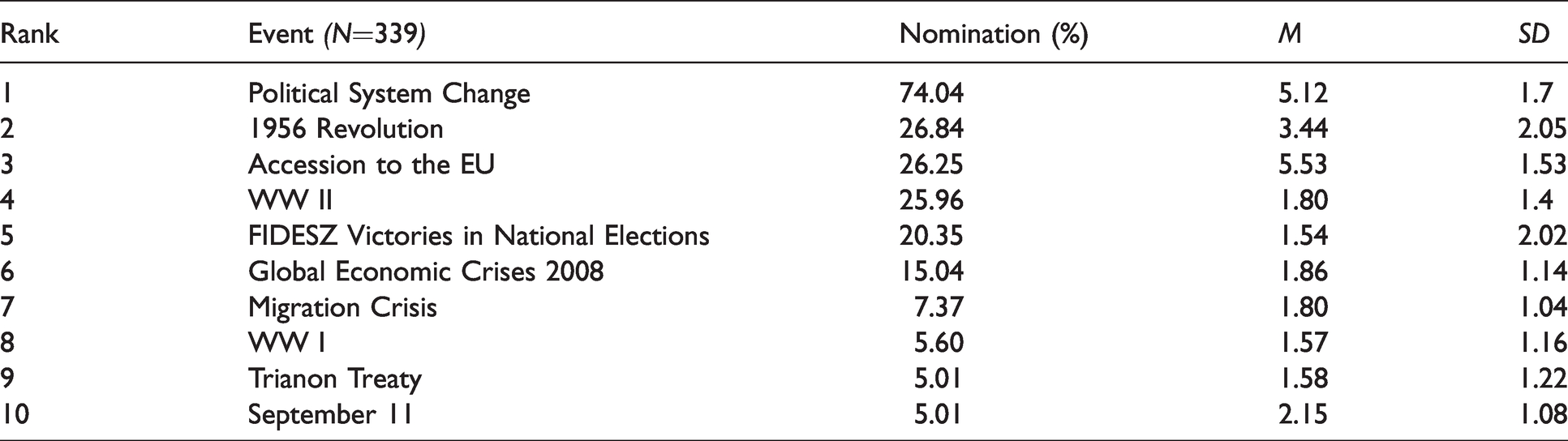
The most frequently selected event category was the 1989 Political System Change mentioned by almost two-thirds of the participants (n = 251). It was followed by the 1956 Revolution, Accession to the EU, and WWII, each mentioned by little more than one-quarter of the participants (n = 91, 89, and 88, respectively). Similarly, high importance was assigned by the sample to the victories of the FIDESZ party (Federation of Young Democrats) in the last two national elections and the 2008 Global Economic Crisis (n = 69 and 51, respectively). The event category of FIDESZ Victories included choices that mentioned the results of the 2010 and 2014 national elections, or the current mandate of the FIDESZ government in general. Relatively few participants selected the remaining events on the top 10 list: the Migration Crisis, WWI, the Trianon Treaty, and September 11 (n = 25, 19, 17, and 17, respectively). As expected, 8 of the top 10 historical events were negative, and most events were consistent with a victimhood-oriented frame of reference (e.g., Trianon Treaty, World Wars, 1956 Revolution). The results are summarized in Table 1.
Most frequently nominated events and associated evaluations.
The participants’ mean evaluation of each event in the chronology of the 10 most frequently selected events follows an inverted U-shaped trajectory (see Figure 1). Negative events predominate the first half of the twentieth century, followed by a positive period (except the terrorist attacks on September 11), which turns again into a period of events that received negative evaluation on average.

The evaluative trajectory of communicative memory.
Latent class analysis of communicative memory
A latent class analysis (LCA; Goodman, 1974) was performed to reveal meaningful patterns of event choices. First, the data were reorganized to be more suitable for the theoretical concerns and statistical assumptions of the LCA.
A careful examination of event evaluations showed that our sample was highly divided by two events: the 1956 Revolution and the Political System Change. Since these two events were the most frequently nominated (together they accounted for 48% of all nominations), and the ambiguity was reflected in the data (the median was 5 for the Political System Change and 3 for the 1956 Revolution, while other events had more unequivocal evaluation), we split the participants into two subsamples according to their evaluations of the two events.
Within each event category, cases with evaluation ≥ 5 (on a 7-point scale) were labelled as “positive” (coded as 1 on a new variable), while those with evaluation ≤3 were categorized as “negative” (coded as 2). Of those who selected the 1989 Political System Change, 48 participants evaluated it positively (≥5) and 91 negatively (≤3), and of those who mentioned the 1989 Political System Change, 132 evaluated it positively and 48 negatively. The neutral participants (with evaluation = 4 for the 1956 Revolution and/or the Political System Change) were omitted when estimating the effects of these two events, while they have been kept in the models for all other events.
Since the small sample size (N = 338) and the number of indicators (10 events) might have impaired the accuracy of cluster determination (Wurpts & Geiser, 2014), we decided to collapse the categories WWII and WWI into one single indicator (World Wars). We also removed the September 11 terrorist attacks from the analysis, which showed the lowest relative importance among the top 10 list events. Although the Trianon Treaty had an equal number of selections, we preferred to keep it in the analysis because of its significance in Hungarian history. As a result, nine of the top 10 events were used in the latent class analysis.
The analysis revealed two competing models (see Table 2), of which the two-class model (Model 2) was preferred over the three-class model (Model 3), considering that the BIC and log-likelihood indices used for optimal model selection were lower for the two-class model and that the two-class model showed better stability as revealed by bootstrapping. Although the entropy of the three-class model was higher than that of the two-class model, the latter was also acceptable (the entropy for Model 2 was 0.68; see Asparouhov & Muthén, 2014). Considering the average posterior probabilities of group assignment (AvePP > 0.7) and the odds of correct classification (OCC > 5) also showed a high level of accuracy for Model 2 (see Nagin, 2005).
Goodness-of-fit statistics for LCA models with different numbers of classes.

Note. The models were obtained by setting na.rm = TRUE, nrep = 30, maxiter = 10000 in the poLCA function. LL = log-likelihood; BIC = Bayesian information criteria; SABIC = sample-size-adjusted Bayesian information criterion; cAIC = corrected Akaike information criteria.
The two-class model (see Table 3) showed that 72% of the participants (n = 252) fell into Class 1. The most frequently selected event in this group was the Political System Change, which was positively evaluated by 53% of the participants (M = 5.92, SD = 1.04). Hungary’s Accession to the EU was also associated with similarly high importance (probability = .31) and similarly positive evaluation (M = 5.61, SD = 1.47) in this class. These events were followed by the 2008 Global Economic Crisis and the FIDESZ Victories, which appeared to be slightly less important (probability = .19 and .26, respectively), while their evaluation was negative (M = 1.81, SD = 1.1 and M = 2.48, SD = 1.97, respectively). This historical profile indicates that individuals in this class had a comparatively dynamic communicative memory, including unequivocally positive and negative events. The selected national historical events seem to outline an EU-oriented (as reflected in the importance of Hungary’s Accession to the EU and the 2008 Global Economic Crisis) and a progressive, forward-looking communicative memory indicated by the mostly twenty-first-century events that predominate this class. We labelled this complex pattern as an
Latent class probability of historical events and associated event evaluation.

Note. AvePP = average posterior probability; OCC = odds of correct classification.
In contrast to Class 1, events recalled by individuals in Class 2 were limited to the twentieth century with mainly negative evaluation. The highest probability events were the World Wars (probability = .69), followed by the 1956 Revolution (probability = .37) with identically negative evaluation (M =1.63, SD = 1.03 and M = 1.67, SD = 0.79, respectively). The 1989 Political System Change and the Trianon Treaty were the two least important events in Class 2 (probability = .19 and .17, respectively), which were likewise negatively evaluated (M = 2.15, SD = .90 and M = 1.59, SD = 1.23, respectively). It seems that participants in this class, based their overall evaluation of the 1956 Revolution on its eventual suppression rather than on Hungarian revolutionaries’ initial victories (while it is a possible understanding of the events that these victories eventually contributed to the subsequent shift of the political regime to a more benevolent form of dictatorship). The negative events that predominated this historical profile more evidently reflected a victimhood-oriented frame of reference (i.e., Trianon Treaty, World Wars, 1956 Revolution), including the memory of the 1989 Political System Change. We called this profile a
Effect of conspiracy theorizing and system justification on historical profiles
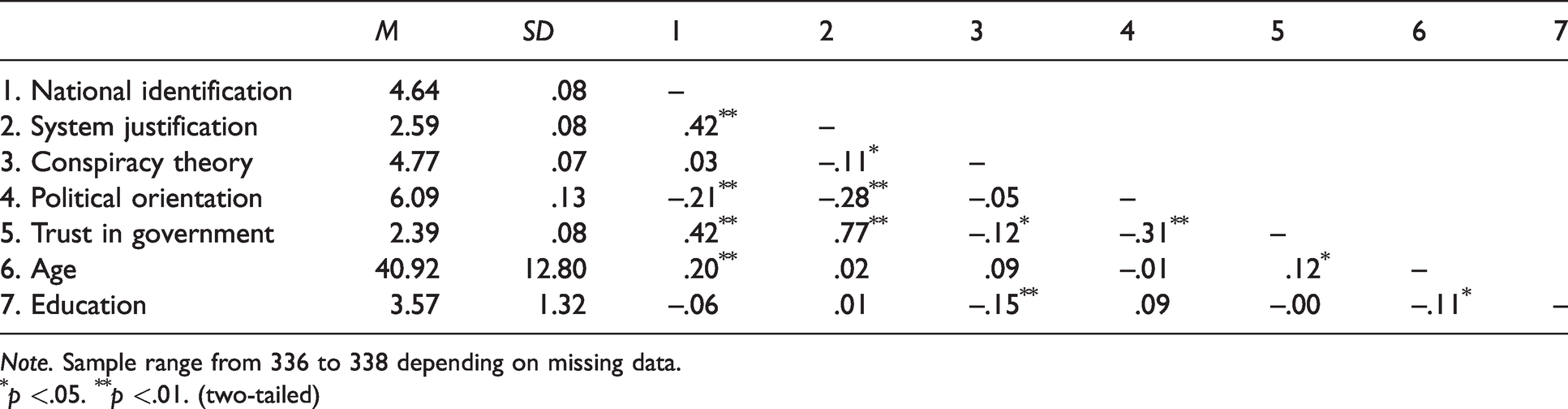
In the next stage of the analysis, we examined the effect of system justification and belief of conspiracy theory on the organization of communicative memory. We first looked at the correlations between the main independent variables and the control variables (see Table 4). The results show that individuals with conservative political orientation r(337) = .198, p < .001 and elderly participants r(338) = .205, p <.001 tend to show higher identification with the nation, and higher identifiers display more intense trust in government r(337) = .422, p < .001. We also found that stronger identification with the nation was more likely to connect with perceiving the societal system as legitimate and fair r(338) = .425, p < .001. Trust in government r(338) = .774, p < .001 and conservative political orientation r(337) = .284, p < .001 also show a positive relationship with system justification, while belief in conspiracy theory was negatively related to system justification r(338) = –.114, p = .037, trust in government r(337) = –.118, p = .031 and education r(338) = –.154, p = .005. Finally, we found that trust in government shows a negative relation with liberal political orientation r(336) = –.310, p < .001 and rather typical for elderly individuals r(337) = .12, p = .027.
Overall means and Pearson correlation of variables.
Note. Sample range from 336 to 338 depending on missing data.
p <.05. **p <.01. (two-tailed)
Binominal logistic regression was obtained to examine the effect of conspiracy theorizing and system justification on the organization of communicative memory. Two models were constructed to examine the relationships between the independent variables and the two-class historical profiles (see Table 5). The first model was developed for testing the impact of conspiracy beliefs and system justification on the organization of communicative memory. The results showed that conspiracy beliefs significantly predicted class membership, b = 0.304, p = .005, 95% CI [1.09, 0.68]. The odds ratio for conspiracy beliefs indicated that participants with a stronger conspiracy mentality were 1.33 times more likely to have a victimhood-oriented communicative memory. Contrary to our expectation, the impact of system justification did not reach a significant level.
Binary logistic regression predicting historical profile membership.

Note. Model1 R2 = .032 (Cox and Snell); R2 = .047 (Nagelkerke); Model2 R2 = .058 (Cox and Snell); R2 = .085 (Nagelkerke), CI = confidence interval; LL = lower limit; UL = upper limit.
In the second model, we assessed the effects of the control variables. The model comparison revealed no improvement in the odds ratio for conspiracy theorizing, χ2(6) = 9.22, p = .161, which means that the odds ratio for conspiracy theory did not change significantly when holding all other variables constant. These results are consistent with related previous findings (see Bilewicz et al., 2019), and they support the hypothesized relationship between a victimhood-oriented perspective on national history and the endorsement of conspiracy beliefs.
By contrast, the results do not support the hypothesis that the endorsement of a victimhood-oriented framework of communicative memory (which is consistent with the historical canon) is positively associated with system justification. Specifically, system justification did not have a significant effect on class membership, which suggests that the relationship between system justification and communicative memory is more complex and potentially involves factors that fall out of the scope of the present study. Among the assessed control variables, only education had a significant effect on the structure of communicative memory b = –.216, p = .041, 95% CI [0.65, 0.99], which suggests that individuals with relatively low levels of education are more likely to adopt a victimhood-oriented view of the recent historical past.
Discussion
The present study explored the organization of communicative memory among Hungarians. The most frequently selected events partly corresponded to the national historical canon (the 1989 Political System Change, the 1956 Hungarian Revolution, WWII, the Trianon Peace Treaty), while there were some differences as well. A notable difference reflects the recency effect on collective memory (Liu et al., 2005; Pennebaker et al., 2006). That is, memories that are not part of the history curriculum but are highly accessible due to the recency and impact of the recalled events (e.g., FIDESZ Victories) also appeared among the most frequent event choices. The selection of recent events (i.e., Migration Crisis, Accession to the EU) shows a Eurocentric view of communicative memory (Glowsky et al., 2007; Liu et al., 2009; Pennebaker et al., 2006). However, the results also revealed a global orientation (e.g., Global Economic Crisis). It seems that mass media and social media expand individuals’ historical perspectives, and people will probably assign increasing importance to events of a global effect due to accelerated globalization.
The evaluation of the events showed a considerable shift as compared to the findings of the previous study. In this study, where subjects were asked to name the most negative and the most positive national historical event, László et al. (2002) found that the overall trajectory of Hungarian history followed a regressive path (Gergen & Gergen, 1988). The results revealed that the majority of positive events had occurred in the distant past, which were followed by negative events spanning several centuries. This portrayal of Hungarian history reflects what is known as the Hungarian pessimism (László, 2008). In the present study, the positive overall evaluation of the 1956 Revolution, the Political System Change, and Hungary’s Accession to the EU seemingly contradicts this pessimism. However, the observable progression is overshadowed by the overall negative evaluation of events of the most recent past, including events of global significance such as the Global Economic Crisis or the Migration Crisis, and events of primarily national significance such as the mandates of the FIDESZ government.
These results only partially support our hypothesis and imply that events suited to the victimhood-oriented framework are still part of the historical remembering but not as predominant as expected and showed by previous studies (see László, 2014).
The finding was further supported by the latent class analysis, which revealed two historical profiles based on two distinct patterns of event choices. A large part of the participants was characterized by a progressive and Eurocentric view of history. In this class, individuals were mostly present-orientated and more likely to recall recent, non-canonical events. Furthermore, this profile showed a diverse composition of the communicative memory, including both negative (e.g., FIDESZ Victories) and positive (e.g., Accession to the EU) and both national (e.g., Political System Change) and international events (e.g., Global Economic Crisis). Interestingly, the two most contradictory and canonical events (the 1989 Political System Change and the 1956 Revolution) were average positively evaluated comparing to the other class, contrary to their ambivalent evaluation consistently found in other studies (László et al., 2002; Kovács & Pántya, 2012 Csertő et al.,2019; Liu et al., 2009, Krekó, 2019).
By contrast, the communicative memory endorsed by the participants in the other historical profile was clearly oriented towards the historical canon with predominantly negative events, primarily including major traumas and losses of the twentieth century (i.e., World Wars, 1956 Revolution, Trianon Treaty). This organization of events reflects a focus on historical calamities and hopelessness resulting from failures, an image of the ever-grieving Hungarians, which is consistent with the dominant narrative template of the national historical memory and with an ethos of victimhood well expressed in a telling line of the Hungarian national anthem: “Long torn by ill fate, Bring upon it a time of relief” (Kölcsey, 1823; translated by Korossy, 2003). Participants evaluated the 1989 Political System Change and the 1956 Revolution negatively, suggesting the effect of historical canon on communicative memory. Comparison of the two classes for the overall evaluation of the events also shows a generally negative view of the recent past among individuals with a victimhood-based historical profile, which potentially reflects greater historical continuity as compared to the EU-oriented progressive class.
The results show the presence of victimhood-oriented historical view in communicative memory, though to a lesser degree. A large part of the sample has a less homogenous and restricted view of the recent past with a primary focus on the present events. Besides, participants with a progressive-Eurocentric view have a relatively positive attitude toward living history.
Overall, the increased number of non-victimhood, present-oriented events nominated by the participants and the disproportional distribution of the two historical profiles emphasizing the progressive-Eurocentric perspective may indicate a shift from the national canon in historical remembering. The result supports the potential of recent events to challenge the conventional historical view.
We also expected that conspiracy beliefs and system justification would be positively associated with a victimhood-based historical memory. Concerning conspiracy beliefs, the obtained results confirmed our hypothesis. Recurrent suffering and losses of the Hungarian nation, which are central to the Hungarian identity and part of the historical canon, gave rise to numerous conspiratorial explanations in the course of history (see Romsics, 2002), which are still part of the public discourse. Our finding is in line with previous research (Bar-Tal et al., 2009; Bilewicz et al., 2019) showing that perceiving the ingroup as a victim is related a general sense of distrust and that historical traumas may provide a basis for conspiracy beliefs and may influence contemporary historical thinking.
A similar relationship was expected between system justification and event selection. We hypothesized that canonical historical memories as the building blocks of Hungarian identity would also provide the basis for and contribute to the perpetuation of the current political national system. Paraphrasing Carter et al. (2011): there is a minimum level of system justification in society, without which the stability of a nation is highly vulnerable. Following this argumentation, we expected system justifiers to more frequently select canonical events. However, the obtained results did not meet this expectation. One possible explanation lies in the generally low level of system justification in Hungary. Most empirical data on system justification were collected from Western European and North American samples, who reported relatively high levels of system justification (the mean level was usually above the scale mid-point (Jost & Hunyady, 2005).
Interestingly, the few available studies conducted in Eastern European countries consistently found low levels of system justification (the means were below the scale mid-point; e.g., Baryla et al., 2015; van der Toorn et al., 2010; Kelemen et al., 2014). A popular explanation is the perceived incomplete transition from socialism to democracy (or ‘stolen’ transition; for conspiracy theories of the transition see Krekó, 2019), as a result of which the general public developed a critical and distrustful attitude towards the new system, accompanied by a nostalgia for the former regime (Hunyady, 2018). Studies examining system justification in the Eastern European region found overwhelmingly dominant system-critical attitudes (Cichocka & Jost, 2014), which were usually associated with general pessimism, existential uncertainty and malcontent public sentiments characterizing the general Hungarian population, including higher-status individuals (see Hunyady, 2018). These results indicate that system criticism could be another means of measure for studying the dynamics of communicative memory in the Eastern European region. However, contradicting results from recent studies (Liu et al., in press; Bou Zeineddine & Qumseya, 2020) also call attention to a more thorough examination of the link between system justification and historical memory.
The current study failed to prove the positive link between conspiracy mentality and system justification, nevertheless the two phenomena may contribute to historical remembrance independently. On the one hand, as prior studies pointed out historical traumas are fundamentally capable of promoting conspiracy theories, and individuals with perceived collective victimhood are more prone to endorse conspiracy theories (e.g. Bilewicz et al., 2019). The present study also demonstrated that individuals who believe in conspiracy theories are more likely to remember traumatic events. On the other hand, when the current political power utilizes a historical event, it becomes part of the ideological system of historical justification and function as a legitimizing myth (e.g. Kus et al., 2013; Seewann, 2018). System justification and conspiracy mentalizing might be positively associated if a traumatic event becomes central to the political power’s ideological system (Kofta and Soral, 2019). Supporting the governing power is very likely to result in acceptance of the historical view of the political power and the associated conspiracy theories triggered by the events. Accordingly, it was also plausible to expect that the effect of system justification on the preference of canonical events, to some extent, may show concomitance with trust in government. Referring to the national traumas and defeats is part of the contemporary Hungarian political rhetoric mostly used by the nationalist-populists to portray themselves as protectors of the nation. For this reason, we expected that besides system justification, trust in the government would also be associated with canon-consistent event choices. However, the obtained findings did not support our expectation. One possible explanation is the generally low trust in the government (M = 2.39, SD =.08) measured in the overall sample, further supported by its generally liberal political orientation (M = 6.09, SD =.13) . Low level of system justification and trust in the government imply that participants in class 2 might have a victimhood-oriented historical view independently from their political orientation and the conspiracy mentality found in class 2 might derive solely from the self-perceived victimhood; however, we did not measure it directly.
Finally, we did not find a relationship between national identification and canon-consisting remembering, which could be explained by the inadequacy of the single-item measure of national identification.
The important contribution of the study to the field is that it employed a novel method to analyse the structure of communicative memory, that is, latent class analysis. Previous studies commonly used simple frequency measures to reveal the composition of historical memory and failed to explore more subtle patterns of event choices. This method enables researchers to analyse the relationship between historical memory and various related factors, such as conspiracy beliefs and system justification. By an analysis of the connection between conspiracy beliefs and historical memory, we were able to demonstrate a more profound contextual dynamics of communicative memory.
Another important contribution of the study is that it corroborates the hypothetical link between a victimhood-oriented view of national history and the endorsement of conspiracy beliefs. Our results highlighted the impact of cultural memory and the well-established narrative templates on contemporary historical thinking, suggesting that adherence to the canonical group experiences of the distant past may pose a serious obstacle to future changes. Individuals with a victimhood-based historical profile were oriented towards the past (no twenty-first-century event was selected at a considerable frequency in this class) and generally showed a negative, pessimistic view of the event. Recalling traumas, losses, and defeats, which readily evoke commonly held conspiracy theories, may result in general distrust, and may lead to contemporary conspiratorial explanations. However, as perceived historical continuity was not directly measured, the negative appraisal of recent past events provided by individuals with victimhood-based profile imply a greater historical continuity.
By contrast, those endorsing a progressive and Eurocentric communicative memory showed a more dynamic and balanced view of history in terms of the evaluation and the temporal and geopolitical scope of the selected events, which suggests detachment from the national historical canon. That is not to say that the participants with this profile did not know or share the memories of the canonized national historical events, but they seemed to approach the recent past from a different perspective, which could form a basis for potential changes.
Limitations and future direction
There are some limitations that should be considered for future research directions. We did not measure collective victimhood; however, our result indicated a strong presence of victimhood oriented historical view. If we could have assessed collective victimhood, we might have obtained stronger support for our results. It is important to know that the present study was part of an international survey with many other measures and additional scales would have extended the time of completing the questionnaires drastically. A second limitation, for the same reason, is using a single item for measuring the level of national identification. We suppose that measuring national identification on a multidimensional scale, which enables to assess the different mode of identification (see Roccas et al., 2006), would have been a more adequate choice in methodological terms. Finally, although the present study did not find a link between system justification and historical memory, it does not question the importance of historical memory in system justification. However, the low level of system justification found in the present study in line with other studies (Liu et al., in press) points out the importance of an alternative measure such as system critical attitudes.
Footnotes
Declaration of Conflicting Interests
The authors declared no potential conflicts of interest with respect to the research, authorship, and/or publication of this The authors received no financial support for the research, authorship, and/or publication of this article.
Funding
The author(s) disclosed receipt of the following financial support for the research, authorship and/or publication of this article: This work was supported by the European Union, co-financed by the European Social Fund (grant number EFOP-3.6.1.-16-2016-00004, grant title: Comprehensive Development for Implementing Smart Specialization Strategies at the University of Pécs).
