




Abstract
The aim of this study was to uncover how digital storytelling advances students’ self-efficacy in mathematics learning and what kinds of learning experiences contribute to self-efficacy. Four Chinese classes with 10- to 11-year-old students (N = 121) participated in the project. The mathematics learning theme was geometry. Quantitative data was collected with questionnaires. The qualitative data was based on teachers’ and students’ interviews and observations. Both data sets showed that the students’ self-efficacy increased significantly during the project. The most important mediator was students’ perception of the meaningfulness of mathematics learning; digital storytelling enhanced the students’ ability to see mathematics learning as useful. They became more confident that they could learn mathematics and understand what they had learned. They also felt more confident in talking with their classmates about mathematical concepts. The role of self-efficacy was twofold: it supported students’ learning during the project and it increased due to meaningful mathematics learning experiences.
Worldwide, globalization is increasing the requirements of learning for the future. International organizations, such as the Organisation for Economic Co-operation and Development, the European Union, and the United Nations (Organisation for Economic Co-operation and Development, 2013, 2019; Redecker et al., 2011; Scott, 2015), and researchers (Binkley et al., 2012; Griffin et al., 2013) have identified the most important factors in future learning. How to prepare the younger generation for the future is an urgent concern in both western and eastern countries (Lee & Tan, 2018). The capacity to use technology and intelligent tools in learning is an essential aspect of future competencies.
In addition, one of the most important factors for successful learning is students’ agency. Many studies have shown that students’ self-efficacy (SEF) is an important predictor of how persistent, active, and effective they are in their learning (Ayotola & Adedeji, 2009; Bandura, 1986, 1997; Bassi et al., 2007) and engagement (Ainley & Ainley, 2011; Linnenbrink & Pintrich, 2003; Reeve et al., 2004). Bandura (1986, 1997) defined SEF as the belief in one’s ability to execute a required course of action, govern one’s choice of behavior, and mobilize and maintain effort. Usually, SEF is seen as a predictor, but in this study we investigated how a new video technology, digital storytelling (DST), could support students’ SEF in mathematics learning when integrated with a student-centered pedagogy. We likewise assessed what the key mediators were in their learning processes. Students learned by producing digital stories and worked in groups, searching for information and solutions for their videos.
In this article, we first present a conceptual analysis and introduce the theoretical model of the study’s key concepts. Adopting a mixed-methods approach, we collected both quantitative and qualitative data. The questionnaires consisted of an SEF scale based on Bandura’s (1986) conceptualization and measures of engagement, problem-solving, mathematics learning meaningfulness, and mathematical knowledge creation. The qualitative data was based on observations and teacher and student interviews. The data was collected in four Chinese classrooms with 121 student participants (aged 10 to 11) and their teachers.
Conceptual Analysis
DST for Knowledge Creation and Problem-Solving
Researchers across the globe have investigated DST, with studies in the United States, Europe, Asia, and the Middle East. Most of the current literature on DST focuses on empowering students in their own lives or social contexts (e.g., Hull & Katz, 2006). Increasingly, DST studies have focused more on school subjects given that they can support students’ understanding of subject matter, as well as improve their technical, presentation, and writing skills. Robin (2008) found that DST also cultivates students’ higher-order thinking, such as problem-solving and critical thinking.
According to Niemi et al. (2014), Niemi and Multisilta (2016), and Multisilta and Niemi (2018), learning through DST is a socially and culturally related process that happens when interactions occur among learners, material tools, psychological tools, and other people (Vygotsky, 1978). In our study, interactions took place between students and also between learners and mobile devices. The human–device interaction was a continuous and iterative process. Students used mobile phones and tablets with advanced video technology. They shot, edited, and modified their stories with different kinds of images and effects. The technology was intelligent, but the learners had agency in the human–machine interaction. They decided what they used. Our DST project built on the constructivist learning model, in which students played a central role in exploring and building knowledge with the digital technology as creators, producers, and discussants rather than as mere passive recipients. In many DST studies, the aim has been to promote learning through connective technologies and digital mobile devices to produce meaningful stories (McGee, 2015).
Jenkins et al. (2009) and Robin (2008) described DST as a 21st-century pedagogical method. It makes student-centered knowledge creation possible in schools (Dreon et al., 2015; Sadik, 2008), and when students are constructing knowledge for their videos, they also often solve problems in their topics and have a chance to create knowledge from their own starting points (Lambert, 2013; McGee, 2015; Multisilta & Niemi, 2018; Niemi et al., 2018; Robin, 2008). Evidence has suggested that this method encourages active participation as well as collaborative learning and creativity (Lambert, 2013; McGee, 2015; Multisilta & Niemi, 2018; Niemi et al., 2014; Niemi & Multisilta, 2016; Sadik, 2008; Shelby-Caffey et al., 2014; Sukovic, 2014; Woodhouse, 2008).
Hung et al. (2012) applied a project-based DST approach to a science course at an elementary school and concluded that DST can effectively enhance students’ science learning motivation, problem-solving competency, and learning achievement. Overall, DST creates a stronger sense of purpose in learning (Hull & Katz, 2006). Engagement, which refers to the intensity of a person’s behaviors and emotional quality during a task (Niemi et al., 2018; Reeve et al., 2004), often includes peer-to-peer relationships among students. This collaboration has been an important advantage for mathematics learning as well. The process encourages student participation and engagement, helping them better learn the concepts. Suwardy et al. (2013) emphasized that digital stories, especially student-led productions, demand a certain level of understanding of the topic, which prompts students to reflect and think more deeply as they personalize their experience and communicate their ideas (see also Sandars et al., 2008). Gould and Schmidt-Crawford (2010) applied DST to trigonometric functions and reported that it provided students with a learning opportunity that connected mathematical concepts to their real-world experiences. Schiro (2004) used DST to teach students algorithms and problem-solving. The main advantage of DST is that it situates learning in an interesting, engaging, and relevant context.
SEF in Academic and Nonacademic Learning
Bandura (1986) introduced the concept of SEF in the 1980s. Since then, its importance as an integral component of human agency has been confirmed in several studies on learning and learning outcomes (Ayotola & Adedeji, 2009; Bassi et al., 2007; Britner & Pajares, 2006; Schulz, 2005; Wang et al., 2008). Bassi et al. (2007) collected the learning outcomes of academic and nonacademic tasks and showed convincingly that high SEF learners had much better outcomes than low SEF learners. These results were also evident in students’ achievement levels in the Programme for International Student Assessment’s (PISA’s) measurements (Schulz, 2005). Wang et al. (2008) found that SEF is related to learning outcomes, learning motivation, learning strategies, and internal attribution. Internal attribution reflects a learner’s perceived confidence in a learning assignment or task. Learning motivation and strategies are clearly associated with positive and predictable effects on learning results (Wang et al., 2008).
A belief in SEF helps determine how much effort individuals will expend on an activity, how long they will persevere when confronting obstacles, and how resilient they will be in the face of adverse situations. It influences thought patterns and emotional reactions: individuals with low personal SEF often perceive tasks to be tougher than they really are. This belief nurtures stress, depression, and a restricted vision of how best to solve a problem. Individuals with high SEF beliefs, in contrast, approach difficult tasks and activities with feelings of conviction and serenity (Bandura, 1997). By strengthening students’ SEF, educators can help learners who have motivational and emotional difficulties.
SEF in Mathematics Learning
Learning mathematics has been a difficult issue in most educational systems. Students are either uninterested in mathematics or have so-called “mathematics anxiety,” which prevents them from involving themselves in mathematics learning (Whyte & Anthony, 2012). Most countries have students dropping out of mathematics courses in high school and college (Fan & Wolters, 2014).
The relationship between SEF and mathematics learning has been widely researched. Schulz (2005) found that mathematics, SEF, and student expectations were related. His results, based on PISA’s 2003 mathematics measurements, revealed that SEF is positively correlated with learning outcomes and negatively correlated with mathematics anxiety. These findings are largely consistent across member countries of the Organisation for Economic Co-operation and Development (Schulz, 2005). Several studies have since confirmed the relationship between mathematics learning and SEF (Deacon, 2011; Fast et al., 2010; Lee, 2009).
Renninger (2011) also explored how motivation and SEF are related in mathematics learning. She identified three clusters of motivational profiles, proving that the higher the SEF, the better students learned mathematics, even when they did not have much interest in mathematics learning. However, SEF and motivational factors are often interrelated. Findings from Abramovich et al. (2019) indicate that, when working with mathematical contents, educators should accommodate teaching and learning such that they support students’ motivation and SEF. Studies of SEF indicate that the mere amount of instruction in mathematics has minor and even insignificant effects, whereas SEF increases if teaching activates students’ personal knowledge construction toward understanding, and if the learning environment is mastery-oriented, challenging, and caring (Keşan & Kaya, 2018).
Engagement in Learning
In this DST study, engagement was related to motivation and emotional perception. We defined engagement from two perspectives: positive emotional experience and persistence. Taylor and Parsons (2011) analyzed the concept of engagement and found several types: academic, cognitive, intellectual, institutional, emotional, behavioral, social, and psychological. A common feature of these definitions is that learners are motivated and actively involved in learning processes, and they perceive learning as relevant, real, and often also intentionally interdisciplinary. Engagement plays an important role, especially in science and mathematics learning (Ayotola & Adedeji, 2009). Student engagement has been the focus of research in mathematics and science learning because, in the last two decades, much evidence has emerged that students are not motivated in these subjects or have related emotional problems (e.g., mathematics anxiety) preventing them from getting involved. Evidence suggests that if students do not fear mathematics and, rather, embrace it, they can succeed (Uzunboylu et al., 2012; Whyte & Anthony, 2012).
Learners may experience anxiety when the situation requires more than their existing skills provide (Csikszentmihalyi, 1990, pp. 72–77). In this study, when preparing their video productions, the aim was that students would work persistently and that their learning would be emotionally rewarding. Positive emotions are like fuel when working toward a goal. In earlier studies, engagement with positive emotions and SEF had a strong relationship, especially in mathematics learning (e.g., Keşan & Kaya, 2018; Uzunboylu et al., 2012; Whyte & Anthony, 2012).
Meaningfulness in Mathematics Learning
The meaningfulness of learning has its roots in the late 1960s (Ausubel, 1962). A challenge with efforts to make mathematics more meaningful for students has been that students either see mathematics as difficult or cannot see how it is related to real life. The PISA framework (Organisation for Economic Co-operation and Development, 2006) proposes that learners should identify and understand the role of mathematics in today’s world. They need to learn mathematics in a way that corresponds with current and future challenges and demands, helping them to become constructive, committed, and reflective citizens. One approach to making mathematics more meaningful is including a paradigm of mathematical literacy as part of mathematics education (Jablonka, 2003; Machaba, 2018; Masal & Yılmazer, 2014; Niemi et al., 2018; Uzunboylu et al., 2012; Vithal & Bishop, 2006). The PISA framework described mathematical literacy and highlighted that learners should identify and understand the role of mathematics in today’s world (OECD, 2006).
Machaba (2018) asserted that mathematical literacy aims to develop students’ capability and willingness to use mathematical concepts and make sense of them in real-life situations. Mathematical literacy is based on content but is connected to authentic contexts; learners have to solve familiar and unfamiliar problems and tasks required for decision-making and communication. In this DST study, the students worked in small groups. They planned a mathematics-related video story, seeking information and designing a presentation in which mathematical concepts were applied to real life.
Theoretical Model and Research Questions
We created a theoretical conceptual model (see Figure 1) based on earlier studies showing that SEF is related to learning outcomes, learning motivation, learning strategies, and internal attribution (Ayotola & Adedeji, 2009; Bassi et al., 2007; Britner & Pajares, 2006; Schulz, 2005; Wang et al., 2008). These learning experiences have been found to be essential perceptions when DST is applied in schools. Therefore, in this model, the focus is first on how SEF mediates students’ mathematical knowledge creation, problem-solving, engagement, and mathematics learning meaningfulness.
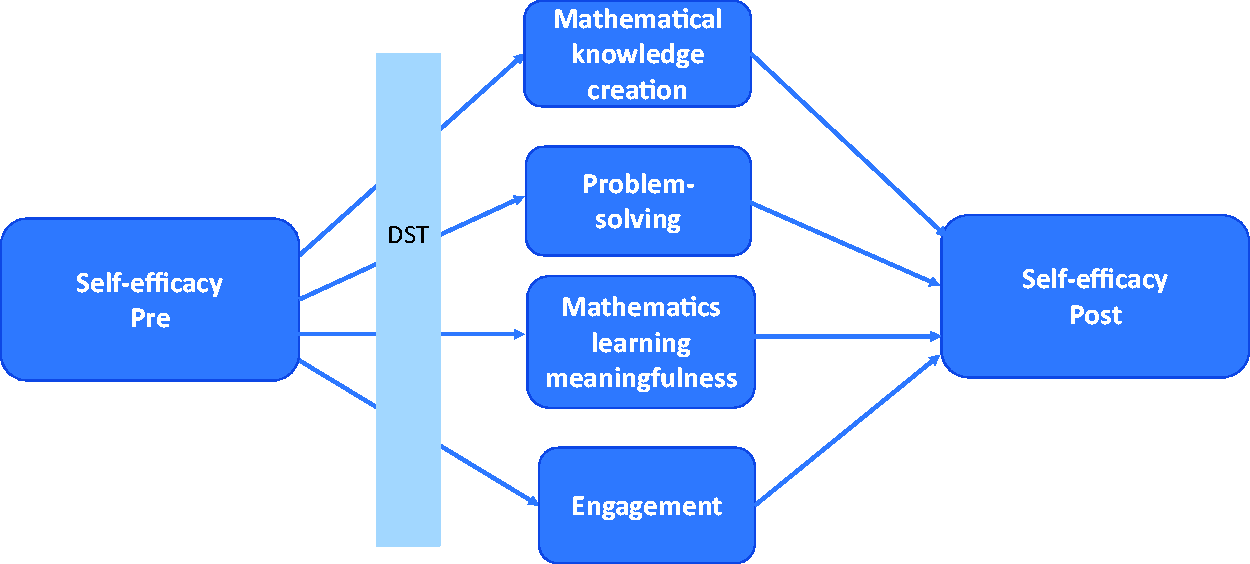
Theoretical Concepts of the Study
Second, the model assumes that pedagogical methods and students’ positive cognitive and emotional experiences in mathematics learning mediate their SEF. Schunk and Meece (2006) found that educators can influence SEF development through students’ learning experiences. According to Schunk and Meece, a sense of mastery, meaningfulness, positive emotions, and interest are important mediators of SEF. Kotluk and Kocakaya (2017) saw DST as an excellent tool to develop SEF. In our model, we used the key experiences found in connection with DST as mediators: knowledge creation, problem-solving, engagement, and learning meaningfulness (Jenkins et al., 2009; McGee, 2015; Multisilta & Niemi, 2018; Niemi et al., 2014; Robin, 2008). Because our study had pretests and posttests, we could first identify the role of SEF in the pretest and then examine mediators of SEF in the posttest. The model thus worked as a basis for quantitative hypothesis testing. We used the qualitative data to deepen our understanding of the quantitative findings.
Based on the foregoing considerations, we posed the following hypotheses: Hypothesis 1: SEF (pre) will increase during the intervention. Hypothesis 2: The beginning SEF will affect students’ perceptions of mathematical knowledge creation, mathematics learning meaningfulness, problem-solving, and engagement. Hypothesis 3: Mathematical knowledge creation, mathematics learning meaningfulness, problem-solving, and engagement will work as mediators for a higher SEF.
Context, Methods, and Materials
Our aim was to discover how DST, as a student-driven pedagogical method with mobile phones and tablets, could advance students’ SEF in mathematics learning in Chinese classrooms. The school, in an area with a diverse population, was affiliated with a Chinese university. The students were from local areas and not selected by any special criteria. The teachers and students were used to pedagogical projects, although they had not used DST before. We informed the school principal and teachers about the project, and the principal invited the teachers to volunteer. The school informed parents and students about the research and the students’ participation. Neither the teachers nor the students received any reward for participation.
Four teachers and their fourth-grade classes participated in the study. Students at this age (10 to 11) were selected because, globally, there is an urgent need to find new methods to increase their interest in mathematics learning. One longitudinal study revealed a continuous 20% decline in mathematics interest and mathematical achievement, starting from age 9 and continuing to age 16 (Gottfried et al., 2007). This decline has been confirmed by many other studies (e.g., Potvin & Hasni, 2014) and is typical during the transition from primary to secondary school, when students are 11 to 12 years old. The participating Chinese teachers recommended this age because they had seen this decline in practice.
The classes integrated DST into mathematics lessons during normal school days. The theme was geometry—specifically, how to measure and calculate surface area and apply this knowledge in their everyday lives. The teachers did not teach area calculations. The students, working in small groups, were to acquire new knowledge and plan how they might present the principles of calculation to their peers through videos on their mobile phones or tablets with advanced video technology. The teachers’ role was to facilitate the working process, scaffold groups by providing materials and tools when needed, and coach the students with questions (Niu & Niemi, 2019). The DST pedagogical process in the classrooms was implemented in four stages:
Preparation: the teachers introduced and explained the project. The students formed groups, selected the group topic, discussed options, and made plans for their videos. Development: the students actively searched for information and solutions using the Internet and information sources for their digital stories, and recorded their videos. Production: the students edited and produced their digital stories. Outcome: the students shared their videos and taught each other. Feedback and assessment were also carried out at this stage.
The DST method cultivates student-driven knowledge creation. The students could ask for help from the teachers if they did not know how to proceed or had difficulties, but they were expected to be the active agents in their learning. In the preparation stage, the teachers discussed with the students the process of creating digital stories of mathematical concepts and showed one example. All of the students received a handout (see Appendix 1), which described the important elements in good digital stories to guide them. The study was not based on a design with experimental and control groups. Rather, it was a field experiment that took place in the real-world setting of school classrooms.
Data Gathering
At the beginning of the project, the students completed a pretest questionnaire to assess their SEF. Originally, there were 130 students. Some students were absent due to illness or other reasons during post-measurements; 122 students participated in both measures. One student’s answers were disqualified because the student had responded to all questions, including background questions, using the same irrelevant score. The final number of students was thus 121 (see Table 1). The sample consisted of all fourth-graders in the selected school to provide rich data for quantitative multivariate analysis, as well as qualitative observations and analysis. Because the students were aged 10 to 11, the questionnaires had to be short and easy to complete. To obtain further insight into the process, at least one researcher observed each lesson in the classrooms. We also took photographs and had discussions with the teachers and students before and after each lesson. The researchers interviewed the teachers, students, and principal after the project. Interviews were conducted on completion so that our questions would not bias or influence the outcomes.
Study Participants.

Instruments and Analysis Methods
The questionnaires consisted of an SEF scale following Bandura’s (1986) ideas of measuring SEF based on a well-tested questionnaire from earlier researchers (Schwarzer & Jerusalem, 1995). Measures of engagement, problem-solving, mathematics learning meaningfulness, and mathematical knowledge creation had been tested in earlier studies (Niemi & Multisilta, 2016; Niemi et al., 2018). The process of designing and validating the instruments in two languages had many phases. All the instruments were originally created in English and translated collaboratively by two postdoctoral researchers with extensive experience in international comparative studies, one English-speaking and one Chinese-speaking. The meanings of the questions and the set of instructions were checked several times between languages, ensuring that they could be understood the same way. The questions were first tested by a few 11-year-old students in China to confirm that they understood the meaning and could respond. A 1–10 scale was used (which is commonly used in Chinese schools instead of a 1–5 scale), with which the students were familiar.
The quantitative data was analyzed using descriptive statistics and correlations. Factor analysis was used for the SEF measures to confirm the structure found in earlier studies (Schwarzer & Jerusalem, 1995). It was one-dimensional in both pre- and post-measures, with high reliability scores (α = .95). We analyzed the structures of the other instruments using exploratory factor analysis, and the summative variables were counted based on validity and reliability (see Table 2). All of the items had a scale from 1 = not at all true for me to 10 = very true for me. The other variables were found through factor analysis (principal axis) and given the following names: engagement, mathematical knowledge creation, problem-solving, and mathematics meaningfulness. Based on the structural analysis, the internal consistency reliability scores varied between .77 and .95: SEF (pre and post), α = .95; engagement, α = .82; mathematical knowledge creation, α = .77; problem-solving, α = .78; and mathematics meaningfulness, α = .94. Mathematical knowledge creation consisted of three items, with two of them covering mathematical content. It came out that almost all of the students used the highest value, 10, in these two content questions, and the results were skewed. These two items were omitted in the regression analysis, and the remaining item was included as a variable named mathematical knowledge-seeking.
Study Measures.

aMathematical knowledge creation was changed to mathematical knowledge-seeking for regression analysis because the two other variables about learning contents were extremely skewed, M = 9.6 (kurtosis = −3.11) and M = 9.8 (kurtosis = −3.98), and they were left out.
We used regression analysis to test the theoretical model of the study. The normality of the variables was examined before the regression analysis. The students mainly used the very positive scores of the scale in all measures, particularly in the post-measures, to describe their experiences during the DST project. The distributions were negatively skewed, illustrating that the students had very positive experiences during the DST project and underwent a powerful change to very high SEF. Only a few students used the lowest values. Both Kolmogorov–Smirnov and Shapiro–Wilk tests indicated that the variables differed from normality (p < 0.05). For the regression analysis, the variables were recoded, combining the first classes of the SEF scales and other mediators. For the SEF scales, 1–4 were recoded as 1; 5 was recoded as 2; 6 was recoded as 3; 7 was recoded as 4; 8 was recoded as 5; 9 was recoded as 6; and 10 was recoded as 7. For the other mediators, 1–8 were recoded as 1; 9 was recoded as 2; and 10 was recoded as 3. The new distributions are shown in Table 3.
Descriptive Statistics.

Note. N = 121.
Values for asymmetry and kurtosis were also calculated. Traditionally, values between −2 and 2 are considered acceptable to prove normal univariate distribution (George & Mallery, 2010). As shown in Table 3, SEF fulfilled the kurtosis criteria in the beginning, but the dependent variable’s kurtosis value is 2.446 and does not completely fulfil the criteria because the students’ SEF had grown so much. Linear regression analysis was used because the aim was not to generalize the findings but to obtain knowledge about the relationships between the mediators and SEF.
Besides the quantitative data, we also collected qualitative data to enhance the quality and reliability of this research. Using the main theoretical concepts as starting points (see Figure 1), we applied a flexible deductive content analysis to the qualitative interview data. We wanted to hear all the interviewees’ comments outside the conceptual model and get feedback on the challenges in the DST project. The themes of the students’ interview questions were as follows:
What did you learn from using DST in learning math? Compare how you learned math before with learning through DST. In your opinion, which way do you like more? Please explain why you like it more. When making the digital story, did you have difficulties or challenges? How did you solve the difficulties and challenges in your group? Please reflect on the whole process of using DST in math learning. How did you feel using it? Were you engaged and participating actively in the activities?
The themes for the teachers’ interview questions were as follows:
What is your overall experience with DST as a teaching method? How does DST change teachers’ pedagogy? How does DST support students’ learning?
Results
Changes in SEF During the DST Intervention
The first research hypothesis, which focused on changes in SEF during the DST intervention, expressed that SEF (pre) would increase. The changes were tested at the item level using parametric and nonparametric tests (see Table 4). All the changes in the mean values were statistically significant (p < .001). The standard deviations were smaller in each SEF variable in the post-measure. The student group was more homogenous, and changes were strongly toward high scores, as illustrated in Figure 2.
Students’ SEF Before and After the DST Project.

Note. N = 121. The significance and asymptotic significance (two-tailed) was p < .001 for all questions.

Students’ SEF Mean Values Before (Series 1) and After (Series 2) the DST Project.
The summative variable of SEF was used in a power analysis. Table 5 indicates that the observed power was the highest possible with all assessing methods. Based on the analysis, we can conclude that the null hypothesis can be rejected, and the first hypothesis—“SEF will increase during the intervention”—is confirmed.
Power Analysis of the Repeated Measurements of SEF.

Note. Design: Intercept Within-Subjects Design: SEF. Significance was p < .001 for all questions.
aComputed using α = .01. bExact statistic.
SEF as a Predictor
The second hypothesis expressed that SEF (pre) would affect students’ perceptions of mathematical knowledge-seeking (originally mathematical knowledge creation), mathematics learning meaningfulness, problem-solving, and engagement. As shown in Table 6, SEF (pre) was significantly correlated with SEF (post; r = .48). Regression analyses of SEF’s effect on different learning experiences led to the following standardized beta scores: mathematics meaningfulness (β = .32, p < .001), problem-solving (β = .25, p = .006), engagement (β = .28, p = .002), and mathematical knowledge-seeking (β = .25, p = .005). The strongest effect (very statistically significant) was on mathematics meaningfulness (see Table 7). The effects on the other dependent variables were more moderate, although at least p < .006. Overall, we can conclude that Hypothesis 2 is accepted.
Correlations Between Pre and Post SEF and Students’ Learning Experiences.
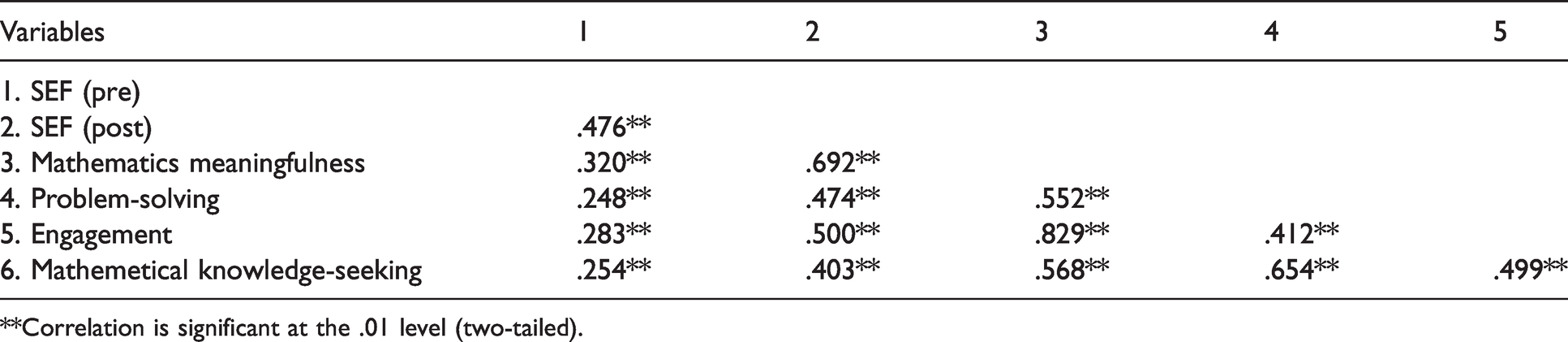
**Correlation is significant at the .01 level (two-tailed).
SEF as a Predictor of Students’ Learning Experiences.

Mediators for a Higher SEF
The third hypothesis expressed that mathematical knowledge-seeking, mathematics learning meaningfulness, problem-solving, and engagement would work as mediators for a higher SEF. All of the mediators had significant intercorrelations with SEF at the end of the project (from r = .40 to r = .69; see Table 6). The highest correlation of SEF (post) was with mathematics meaningfulness (r =.69); the second highest was with engagement (r =.50). Engagement and mathematics meaningfulness had a very strong relationship (r =.83), making meaningfulness related to motivational aspects and vice versa. For a better understanding of the different mediators’ effects on students’ SEF at the end of the project, we applied regression analysis. The model was based on the concepts in Figure 1.
A significant regression equation was found, F(5, 115) = 31.575, p < .001 (see Table 8), with an R2 of .579 (adjusted .560). In the model, the predictors explain 56% of the variance in SEF at the end of the project. All of the independent variables had an effect on SEF, but they varied. The strongest predictor was mathematics meaningfulness (β = .760, p < .001), the second strongest was SEF (pre; β = .285, p < .001), and the third strongest was engagement (β = −.226, p = .041). Problem-solving and mathematical knowledge-seeking did not have a direct effect on SEF (post) and were not significant. Mathematics learning meaningfulness had high intercorrelations with the other mediators (see Table 6), which may suppress the effect.
The Effect of Students’ Learning Experiences on SEF at the End of the Project.

Note. Model summary: R2 = .579 (adjusted .560), F(5, 115) = 31.575, p < .001.
We can conclude that Hypothesis 3 is confirmed, but only partially. Only mathematics meaningfulness impacted SEF clearly. The other mediators’ effects were much lower, or else suppressed by the high correlations with SEF (pre) and meaningfulness during the project. Mathematics meaningfulness included the following items:
I see more clearly than before that math is useful for me. I am more certain that I can learn math. I have a better understanding of what I have learned in math. I feel more confident when talking about matters relating to math with my classmates.
The data indicates that DST provided opportunities to learn mathematics such that students understood what they had learned and had the confidence to talk about mathematics with their peers. The main quantitative findings are presented in Figure 3.

Empirical Findings Between the Theoretical Concepts.
Qualitative Perspectives on Students’ SEF
The qualitative data was analyzed from the perspective of the conceptual model while allowing for other issues that emerged in the discussion. The interviews were an important information source, but observations also validated the students’ experiences. The students’ SEF was observed in how they worked during the project, determined by a combination of persistence and trust in their ability to make a good video. In the classroom observations, we saw that the students wanted to improve their digital story videos: they shot the video many times, added images and music, and tried various methods to make the videos better. At first, the students were not sure what they were doing; this was the first time they had undertaken a student-centered learning project. Gradually, we noticed that they became more confident, and dared to make something new by trying out different possibilities. Many problems had to be solved. By the end of the project, the students were proud of their achievements. We saw their joy, confidence, and pride when they presented their videos and taught their peers.
In the student interviews, one student said the following: “I feel really happy about doing this. In the beginning, I felt it was difficult to make the digital story. After we finished the digital story, we felt so proud of ourselves, that we can do such difficult things.” Another student had this to say: “We really enjoyed doing it. We were very serious about doing the things. When we saw the final results, we also felt very proud of ourselves, that we can achieve so much.” One boy excitedly added to the conversation: Teacher, did you know that we took the video shot seven times? We did it again and again until we were satisfied. In the past, when I did my homework, I only tried to do it twice. If the second time I did not succeed, I just gave up. In our DST project, we just kept on trying to do it better and better and find more ways to solve the problems.
Meaningfulness
The students’ digital story videos demonstrated that their mathematics learning happened in authentic contexts. The students were trying not only to discover how to calculate the surface area of three geometric shapes, but also to connect those shapes to real-life situations. For example, the students investigated parking spaces, flag shapes, the floor, the roof designs of different buildings, earring designs, and many geometric elements that they had not paid attention to previously. Here are quotes from two students: “I have learned different geometric shapes and how to calculate the size of the shapes and how to use it in a real-life situation”; “I learned to use many different ways to calculate the area size of different geometric shapes.”
The students’ digital videos confirmed what the interview data evidenced: the students connected their mathematics learning with real-life phenomena. One mathematics teacher discussed how the students constructed their knowledge and its impact on their learning: “The students discovered ways by themselves; they will remember the things much better than by the teacher just giving the knowledge to them in lectures.” She commented on her students’ knowledge creation and application: The students paid lots of attention to how to create knowledge to calculate the area size of geometric shapes. They tried to discover many different ways to do it. They also found information on how to use knowledge in real-life situations. We can pay more attention to this in the future to make the digital stories more attractive for the audience. The digital storytelling method is a very good way for students to learn. It was the first time we did this. It included many elements; the students were not only learning math and taking and editing video using computers and iPads, but also learning many skills, such as communication, collaboration, presentation skills, etc.
Engagement
The classroom observations and photographs of the students in the learning process confirmed that they were extensively engaged in the DST production. They used time in school and at home to prepare the videos. Regarding the students’ participation and engagement in learning, one teacher commented: “All the students actively participated in the learning process and activities.” Another teacher confirmed: “In my teaching career of more than 15 years, it was the first time that the students came to my office and asked to start the lesson before the lesson time. This has never happened before.” This teacher added: “The children were very excited and engaged with what they were doing during the digital storytelling project.” A third teacher stated: “The school gate closes at 5:00 p.m., but the students did not want to go home; they wanted to continue to work on their digital story project.”
When we asked the students to reflect on their feelings and learning from the DST project, several responded similarly to the following child: “I also had fun doing it, and I am also very into doing DST. Since the very beginning, I felt that it is very interesting to do the activities, and I am very engaged in all the activities.” The students were strongly engaged in mathematics study with the DST learning method. They emphasized that it was fun and it made them solve problems. One said: “I like to use DST to learn math. The reason is that it is much more fun and I’m the one who finds a way to solve the problem. I feel proud of myself.” Another added: “I also like using DST to learn math. I feel that my interests and motivation to learn math increased.”
Problem-Solving
In the videos, the students first introduced the theme they had selected from the topics proposed by the teachers. They actively searched for information and used their prior knowledge to construct new knowledge to solve problems. Often, they strove to discover several approaches and ways to solve the problem. One teacher stated during the interviews: “Every child was very active and had high spirits … . The students are learning how to research and how to solve problems.”
When the students answered the question comparing traditional lessons and DST in learning mathematics, they stated clearly that they liked the latter. One said: “In digital storytelling, we find ways to learn math by ourselves. We can make decisions!” Another stated: “I like using the digital storytelling method to learn. It gave us the opportunity to talk, discuss, and show our ideas … . We found our own ways to calculate the area size of geometric shapes.”
Challenges with DST
The teachers’ comments indicated that challenges did exist in using the DST learning method. One teacher commented: “It took quite a long time to carry out the project. We need to plan it better when we use it next time.” Teachers are pressured with a demanding curriculum and have limited time, making it challenging for them to invest the time necessary for a student-centered learning method. Another teacher noted: “We need to find more physical space for the students to create their videos, since the classroom is too small for all students to do their group work.” When many students are in one class and the classroom’s physical size limits the space for group work, DST can be especially challenging.
Benefits of DST
A quote from the school principal described the project in an interesting way: “Through conducting the digital storytelling project at our school, we realized that the students have much more resources and capability to do many things. In the past, we have underestimated students’ skills and abilities.” One student gave a comprehensive summary of the project: We felt that it was exciting when we tried to find ways to solve the math problems, and we took videos when we were trying to solve the math problems. It is very nice to do this in a group together. It is not like the normal way of learning math. In the normal way, the teacher teaches us one way to solve the math problem, then we practice what the teacher told us. In the digital storytelling way, it is very nice to discuss and do the research with your peer students together. We were very concentrated and engaged in what we were doing.
Discussion
The aim of this pilot study was to discover how DST enhances students’ SEF in mathematics learning and what kinds of learning experiences contribute to SEF. Usually, SEF is a predictor of successful learning. In this study, it was first an independent variable and then, after the DST project, the dependent variable. It has been an important factor in mathematics learning for decades, but the ways DST can promote it are still a new research area. The results are promising, but given that the DST method is dependent on many variables, more research is needed to confirm the effects of the students’ own activity, the teachers’ facilitating role, and the possible influence of the researchers in the classroom. This study was conducted in authentic circumstances—in a school setting—and this kind of research is always open to many interrelated factors that influence the results.
Being a predictor of students’ perceived learning, the effect of SEF was statistically significant at a moderate level. The strongest effect of SEF (pre) was how meaningful students perceived their mathematics learning to be (β = .32, p < .001); its effects on other measured learning experiences varied (β = .25–.28). By providing grounds for successful learning, SEF (pre) had a positive effect on learning experiences, as many studies of academic tasks have shown (Ayotola & Adedeji, 2009; Bassi et al., 2007; Britner & Pajares, 2006; Schulz, 2005; Wang et al., 2008), particularly in mathematics learning (Abramovich et al., 2019; Renninger, 2011).
This study also examined how learning experiences with DST affected SEF in the posttest. The model of regression analysis explained 56% of the variance in SEF. The most important mediator was students’ perceptions of the meaningfulness of mathematics learning. This variable included questions about how useful they considered mathematics learning, how confident they were that they could learn mathematics, and whether they understood what they had learned and felt more confident when talking about mathematics with their classmates. These issues are fundamental and began to be noted in the late 1960s (Ausubel, 1962). Meaningfulness later came to be seen as a keystone in constructivist learning. Key elements in meaningful learning are authentic contexts and materials, students’ active involvement in the learning process, knowledge construction, purposeful learning, and collaboration (Ausubel, 1962).
Expanding meaningful learning to mathematics, Oers (2013) criticized teaching only mathematical facts or skills; rather, it is important that students understand what they learn. Vithal and Bishop (2006) emphasized a person’s meaningful learning experiences. One of the most important reasons for the high values in all the variables in the DST project is that DST gave the students opportunities to structure their own learning and apply concepts to real-life contexts. In producing the videos to teach mathematics to their peers, they had to find the knowledge they needed, write scripts, make design and implementation decisions, and problem-solve. This process helped the students to learn mathematical concepts and increase their mathematical literacy, which is an important concept in mathematics education (Machaba, 2018; Masal & Yılmazer, 2014; Uzunboylu et al., 2012; Vithal & Bishop, 2006). The DST project offered new ways of enhancing students’ motivation to learn mathematics by making it more meaningful and connecting it with real-life contexts.
The qualitative and quantitative data shows that the students’ SEF increased significantly during the project, even though it lasted only 4–6 weeks. Important goals were to ascertain whether DST can help children to have more agency in their learning, to promote equity and the quality of learning in schools, and to increase SEF. The findings provide strong evidence that these goals were achieved. A DST approach can make mathematics meaningful, and meaningful experiences in mathematics learning can enhance students’ SEF.
Limitations and Future Research
This study had limitations, and the findings point to the need for further research. It was conducted in only one school for a few weeks. It is important to follow students’ development and motivation for longer periods of time in more settings to be able to generalize the findings. The DST method was new to the students and teachers; it provided more options than normal lessons and it made the school day different. This novelty may have positively biased the findings. More investigation could determine whether the method works with wider implementation and in other subjects.
Similarly, DST was applied to only one theme in geometry. Wider perspectives and applications to other areas and concepts in mathematics learning are needed. The participating students were 10 to 11 years old. Including other age groups in future studies would secure a more holistic picture about this method of learning. More information is needed about personal experiences and how DST can help those with very low or very high SEF. We did not measure students’ socioeconomic status. Its influence is widely known in education studies (e.g., Organisation for Economic Co-operation and Development, 2020) and may have affected the students’ SEF. The results of this pilot study cannot be generalized to other communities or populations, but the findings indicate that more research is warranted, and schools should be encouraged to innovate new methods for SEF and engagement in mathematics learning.
As DST in mathematics learning is a new research area, we recommend more studies of how educators can use it to strengthen students’ SEF with meaningful mathematics learning. The students in this study used advanced video technology. Future research could use artificial-intelligence-based analytics of how they proceeded to construct their videos to better understand their learning processes. This human–device interaction could add to the significance of DST in successful learning processes.
Conclusion
In this DST project, students used mobile phones and tablets with video technology to create their own products. We brought technology into teaching and learning with student-driven and collaborative approaches wherein students had autonomy and responsibility in their learning. According to Robin (2008), DST enhances information-gathering; cultivates higher-order thinking, such as problem-solving skills and critical thinking; and facilitates students’ ability to work in collaborative teams. Saavedra and Opfer (2012) claimed that 21st-century skills require 21st-century teaching. In this DST project, the most important learning experience was meaningfulness in mathematics learning. Technology was not itself an aim but rather a tool to be integrated with learning. The students needed to inquire, analyze, and apply knowledge to their video stories.
The role of schools has expanded from delivering content knowledge to developing students’ competence in applying that knowledge. In most countries (Organisation for Economic Co-operation and Development, 2013), educational systems aim to deliver generic skills that provide the competence for knowledge inquiry, critical thinking, problem-solving, and other so-called 21st-century competencies (Lee & Tan, 2018). Many studies have investigated how DST integrates content knowledge and more generic competencies such as active knowledge creation, collaboration, communication, and information technology (Niemi & Multisilta, 2016; Penttilä et al., 2016; Robin, 2008; Wang & Zhan, 2010; Yang & Wu, 2012). However, the role of students’ SEF has not been the focus of this research.
To foster an innovative learning environment, students must have opportunities to be active agents in their learning, and technology should be integrated as a natural part of their learning (Organisation for Economic Co-operation and Development, 2013). Mevarech and Kramarski (2014) stressed that 21st-century competencies and mathematics learning should be integrated, noting that mathematical communication is an important route for acquiring relevant skills. They proposed that students in all age groups should be encouraged to engage in mathematical discourse and share ideas and solutions, as well as explain their own thinking. Developing these competencies may result in enhancing social skills and producing mathematically literate citizens, bringing future learning to the present.
Footnotes
Declaration of Conflicting Interests
The author(s) declared no potential conflicts of interest with respect to the research, authorship, and/or publication of this article.
Funding
The author(s) disclosed receipt of the following financial support for the research, authorship, and/or publication of this article: We want to thank the Advanced Innovation Center for Future Education at Beijing Normal University and the University of Helsinki for supporting this study financially.
