




Abstract
In recent years, webinar platforms have been broadly utilized in online learning where students meet one another synchronously online. This research’s underlying value is its recognition of the utmost importance of the awareness that online learning is a social process, as is all learning. This study aims to find out what kinds of synchronous collaborative online coaching pedagogy models have been used in previous research and proceeds to construct a preliminary pedagogical model for a coaching pedagogy for synchronous collaborative online learning (CPSCOL). The methods comprise a systematic literature review and qualitative-data and theory-driven content analysis. Through the systematic literature review, peer-reviewed articles spanning 2014–2018 are carefully examined. The results identify the following pedagogical framework, theory, and model combinations for synchronous collaborative online learning: the Community of Inquiry framework, including social, cognitive, and teaching presence; social presence in conjunction with the media synchronicity theory or the broaden-and-build theory, or the 4E Learning Cycle (engagement, exploration, explanation, and extension); no specific pedagogy; problem-based learning with Community of Inquiry framework or FISh (focus, investigate, and share); collaborative learning and collaborative learning connected to social presence; Carpe Diem with the Five-Step Model; and coaching pedagogy. The preliminary results indicate a scarcity of research on synchronous coaching pedagogy in online education. Consequently, the CPSCOL model for collaborative online learning, including cognitive, social, and teaching presence, is introduced to formulate a new perspective regarding webinar pedagogy. The process of learners, skills, and competences should factor in the pedagogical methods designed by a coach (teacher), and the results show that webinar pedagogy enables and enhances active collaborative learning and knowledge construction in groups. In addition, 18 CPSCOL principles of practice have been developed to support the practical implementation of the CPSCOL model.
Keywords
Online learning provides flexible opportunities for different forms of study and also facilitates continuous learning (Oosi et al., 2019). On a global scale, universities now furnish their whole curriculum online, rather than just single courses or modules (Means et al., 2014). Students at the University of Applied Sciences can earn a Bachelor’s degree after completing online programs, either within or outside Finland. The current study begins with the conception that students should have the right to gain the knowledge and skills required for their future professions not just in traditional learning environments, but also via online learning. Students should also anticipate enjoying the same degree of services from online and campus studies (Eliasquevici et al., 2017). Interaction and collaboration—two crucial soft skills and competences in the 21st century—are indispensable for today’s work life, and even for the future (Dean, 2017; Fung, 2017; Kyllönen, 2013). These skills are equally vital to cloud work in digital environments, to such an extent that synchronous online learning via webinars is a feasible space to equip learners with these soft skills and competences.
Webinars are utilized within educational, technological, and economic domains. Technological advances, such as fast telecommunication connections, make possible distance learning and online studies, and the core technology is becoming more affordable. In other words, online learning and synchronous online learning have financial advantages at the individual, institutional, and societal levels. Individually, students and teachers can cut down on their travel and dispense with the housing costs of campus-type learning, especially as nationwide and global educational institutions are curtailing the travel expenses of their personnel. On a societal level, online learning and synchronous online learning conform to environmental concerns (Versteijlen et al., 2017). Since spring 2020, the COVID-19 pandemic has showcased the downsides and upsides of asynchronous and synchronous online learning. Several countries and educational institutions opted to switch from campus-based learning to hybrid learning or various webinars to meet students’ needs. It is incumbent on the education sector to anticipate and prepare for a range of crises. At this juncture, webinar pedagogy (i.e., synchronous online learning) plays a prominent role and deserves immediate attention.
In this regard, research has been conducted concerning collaborative knowledge construction and digital learning methods in support of collaborative learning (Ruhalahti, 2019; Ruhalahti, Aarnio, & Ruokamo, 2018; Ruhalahti et al., 2016; Vuopala, 2013); computer-supported collaborative learning (Järvelä et al., 2016; Zheng & Huang, 2016); and online group learning (Glyn & Thorpe, 2019). Pedagogical designs for online learning processes have been extensively researched (Dalziel, 2016; Means et al., 2014; Ruhalahti et al., 2017; Salmon & Wright, 2014; Teräs, 2016). For collaborative online learning, the Community of Inquiry (CoI) framework and its three types of presence are premised on the evidence-based research of Garrison et al., (2000; see also Garrison, 2016, 2017). However, scant attention has been given to a coaching pedagogy for synchronous collaborative online learning (CPSCOL), which the current study endeavors to rectify (Themeli & Bougia, 2016). Another gap that needs to be bridged is webinar-focused research (Zoumenou et al., 2015). The more technically capable and skillful students become, the higher demands they make on webinars (Khechine & Lakhal, 2018). This study also acknowledges the need for future research, given that, between 2014 and 2018, no peer-reviewed articles shed light on synchronous coaching pedagogy—that is, coaching in online education.
Coaching in Education
Research has treated coaching in education since the early 2000s (Fletcher & Mullen, 2012). Coaching support in education can be attributed to faculties, students, or other educational interest groups (Nieuwerburgh, 2012). Coaching can be like counseling, as it falls within the person-centered scope that was initially developed by Carl Rogers (see Joseph, 2010). In the same vein, this research views coaching in education as group coaching.
Group coaching methods are believed to emanate from facilitation and active learning (Garvey et al., 2018). The role of a group coach and that of a group facilitator are distinct to the extent that a group coach participates in the learning process while a group facilitator leads it (Clutterbuck, 2010). Coaching also develops knowledge and skills acquired in an educational realm—for example, via reflection (Hackman & Wageman, 2005). Coaching, mentoring, and tutoring seem to be interchangeable terms, yet coaching is imbued with dimensions of the “technological (time, space, roles, skills, procedures), cultural (communication, understanding, value, beliefs), and political (allocations, distributions, dynamics of power, interests)” (Hargreaves & Skelton, 2012, p. 125).
There are various coaching methodologies, theories, and practices, one of which is the applied group coaching method (Cox et al., 2010). The aim of group coaching is to foster internal agency and uphold the common targets of the group. Coaching groups are demarcated into six categories: stable, cabin crew, standing project, evolutionary, developmental alliances, and virtual (Clutterbuck, 2010). A group has an educational function in coaching and poses “a learning intervention designed to increase collective capability and performance of a group or team, through application of the coaching principles of assisted reflection, analysis and motivation for change” (Clutterbuck, 2010, p. 271). Group coaching aims to create a group that functions, capitalizes on its members’ capacities and competences, and hones the skills to cooperate despite differences (Lee, 2010). Group coaching has recourse to individual or group narratives to uncover possible disagreements, to realign the target of the group, and/or to change commitment patterns (Drake, 2010). Positive group behavior or dynamics can be maintained to the group’s benefit through the positive psychology approach to coaching (Kauffman et al., 2010). There is a need to support, guide, and facilitate students as they learn in groups (Hackman & Wageman, 2005). Guidance and coaching help students study with their small coterie and learn how to behave effectively in group work situations of a different kind (Isosomppi et al., 2013). As for coaching in digital environments—that is, e-coaching (Garvey et al., 2018; Ribbers & Waringa, 2015) or virtual coaching—little research has been conducted (Garvey et al., 2018).
Synchronous Collaborative Online Learning
Collaborative learning means that learners are active and engaged agents in their own learning. The practical inquiry phases for collaborative learning are defined with such generic phases as triggering events, exploration, integration, and resolution (see Garrison, 2016, 2017; Garrison et al., 2000). Collaborative learning is, furthermore, seen as “a special model of learning and interaction” that entails “three levels of socio-cognitive activities: knowledge-, transactive- and monitoring-level activities” (Näykki, 2014, p. 17). These three levels of activity should occur mutually and side by side (Näykki, 2014). Learners collectively and interactively work together to solve problems. Problem-based online learning has exhibited a collaborative nature (Aarnio, 2015; Garrison et al., 2000) that “involves the construction of meaning through interaction with others and can be characterized by a joint commitment to a shared goal” (Littleton & Häkkinen, 1999, p. 21). In the literature concerning collaborative massive open online courses, students considered coaching groups significant in collaborative learning. They stated that active participation, communication, and commitment to the coaching group boosted collaborative learning (Ruhalahti, Söderlund & Timonen, 2018).
Online learning means learning that occurs via web-based services. Online learning can be synchronous, asynchronous, or blended. In the purview of this study, online learning occurs via synchronous online environments, such as webinars. The learning venue for an online course is where the learner is learning at that point (Mäkelä, 2010). In other words, the learning place can be at home, at university, or in an Internet cafe (Mäkelä, 2010). Timonen (2016a, 2016b) designated four online learning dimensions that reflect synchronous and asynchronous online learning, along with the place and time dimensions. This study explored the dimension of synchronous learning within the same digital learning environment—that is to say, online learning was synchronous and in real time, so all participants had an equal possibility to attend simultaneously.
A webinar is a synchronous online lesson, meeting, seminar, or videoconference. It provides a platform, environment, and place to study—a type of online classroom (Timonen, 2018). In this study, the online learning place refers to a digital location within the online learning environment—including synchronous environments or tools like webinars. Webinars have technical elements, such as voice feeds, chats, two-way video feeds, polls, breakout groups, shared screens, shared whiteboards, shared documents, changes of administrator, and recordings (Khechine & Lakhal, 2018; Snow et al., 2018; Timonen, 2018). Webinar environments—for example, Collaborate Ultra, Zoom, and AdobeConnect—provide a synchronous place for collaborative online learning in groups (Timonen, 2018). In this study, special attention is paid to the possibilities of a synchronous video feed for visual needs.
This study will survey four aspects of thematic importance based on the first author’s interests. These four aspects are related to the sociocultural learning approach (Säljö, 2004; Vygotsky, 1978) and frame the coaching pedagogy to be implemented in groups of collaborative online learning that take place in webinars. The four aspects are: (a) synchronous coaching pedagogy—coaching in education; (b) synchronous collaborative online learning; (c) synchronous learning in webinars; and (d) learning in coaching groups. This study aims to investigate what kinds of pedagogical models previous research has used in synchronous collaborative online learning, especially in these selected thematic aspects, as a starting point to construct a preliminary coaching pedagogical model with the aid of a systematic literature review (SLR) and qualitative content analyses. The second research question was determined based on the results of the SLR and qualitative content analysis, with the aim of extending the CoI framework.
This study answers the following research questions: Research Question 1 (RQ1): What kinds of pedagogical models are used for CPSCOL in previous research? Research Question 2 (RQ2): How can the CoI framework be developed into a preliminary CPSCOL model?
Method
Regarding the first research question, an SLR and qualitative content analysis were used as methods; for the second research question, qualitative content and theory-driven analyses were used as methods. An SLR aims to analyze and systematically review peer-reviewed articles and publications, and create a conceptual framework (Bryman, 2016; Karvonen et al., 2017; Palsa & Ruokamo, 2015; Salminen, 2011; Sun et al., 2018)—in our case, a preliminary model. A scientific literature search based on an SLR is a systematic, exact, and repeatable method. Through an SLR, the published material of researchers, scientists, and practicing professionals is recognized and evaluated (Fink, 2005, 2014). This study follows Fink’s (2005, 2014) steps and criteria for an SLR (see Figure 1).

SLR Process of the Study (RQ1)
The SLR, which was conducted prior to 2019, focused on the pertinent research carried out and texts written between 2014 and 2018. This time span was determined based on the latest developments in webinar pedagogy and used as a selection criterion a data set within the five years previous to 2019. Under the core themes (a–d), published worldwide research material was searched for, studied, and analyzed, and the SLR process was documented systematically (Fink, 2014; Palsa & Ruokamo, 2015) on ATLAS.ti memos. The search for peer-reviewed articles was conducted according to the SLR process plan (Fink, 2014; see Figure 1).
The databases for the search included the Education Resources Information Center (ERIC, ProQuest), Academic Search Elite (Ebsco), ScienceDirect (Elsevier), Scopus (Elsevier), Taylor & Francis Online, the Wiley Online Library, and journals like Seminar.net (Table 1). These databases were selected for the SLR in view of their quality and relevance to the online education field.
Review Material Searched in Library Databases, Online Databases, and Journals

Peer-reviewed articles were also sought with recourse to the counterparts of the exact key themes of this study. Different scientific databases have their systems for keywording; thus, the keywords used by each database were observed on finding a relevant article. The search was conducted with the thematic keywords a–d, according to the inclusion and exclusion conditions (Table 2).
Selection Criteria for the Data Search of the Articles
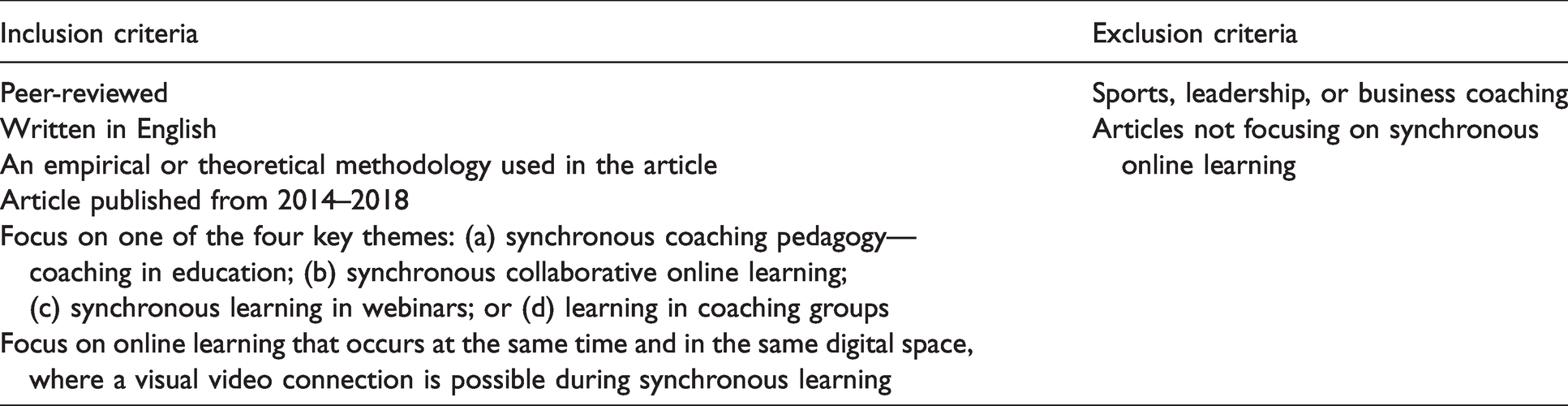
These selection criteria were created, and keyword sentences were used to screen the peer-reviewed articles from different international data sources. In alignment with these key themes and selection criteria, the findings were examined in pursuit of answers to the research questions. The data retrieval was completed during the first half of 2019, and the search review and search process were validated by an information specialist (Figure 1). The search was conducted through the application of the Boolean mode (see Table 3).
Boolean Mode Search Examples

Data Analysis
The empirical data was coded inductively during the analysis (Miles et al., 2014) and, via the codes, content meanings were interpreted (Creswell, 2012). The meaning of the data was analyzed, clustered, and segmented into categories (Miles et al., 2014). The articles (n = 19) were quality coded openly, which was followed by data-driven qualitative analysis methods to interpret the research content and answer the first research question. The codes were thematized and can be exemplified by longer quotations (Bryman, 2016). The codes were then extracted for themes. The coding process was iterative and achieved by constantly reading and analyzing the data (Creswell, 2012).
The results of the first research question (the selected SLR articles) can be seen as secondary data (Bryman, 2016) in the second research question. The secondary data was coded in a theory-driven manner, and the coding was submitted using the results of the first research question. Theory-driven analysis was carried out using the codes of cognitive presence (CP), social presence (SP), and teaching presence (TP), as well as the key themes (b–d). Data-driven and theory-driven analyses were used side by side (Patton, 2015; Puusa, 2020). The selected articles were analyzed according to qualitative content analysis through data-driven and theory-driven coding to answer the second research question (Timmermans & Tavory, 2012).
First, a total of 1,890 articles were found according to the search criteria. The keywords and abstracts of these articles were systematically read or screened. Second, a total of 129 articles corresponding to the criteria were scrutinized (Table 2). After careful perusal of the abstracts of the 129 articles for a second time, 24 articles were selected. Of these, 19 articles were finally singled out according to the SLR selection criteria. The articles were stored in the RefWorks database-reference tool (Table 4). The following is a more detailed description of the qualitative screening and analysis process.
Nineteen Selected Articles Divided by Core Themes A, B, C, and D With a Pedagogical Model Combination
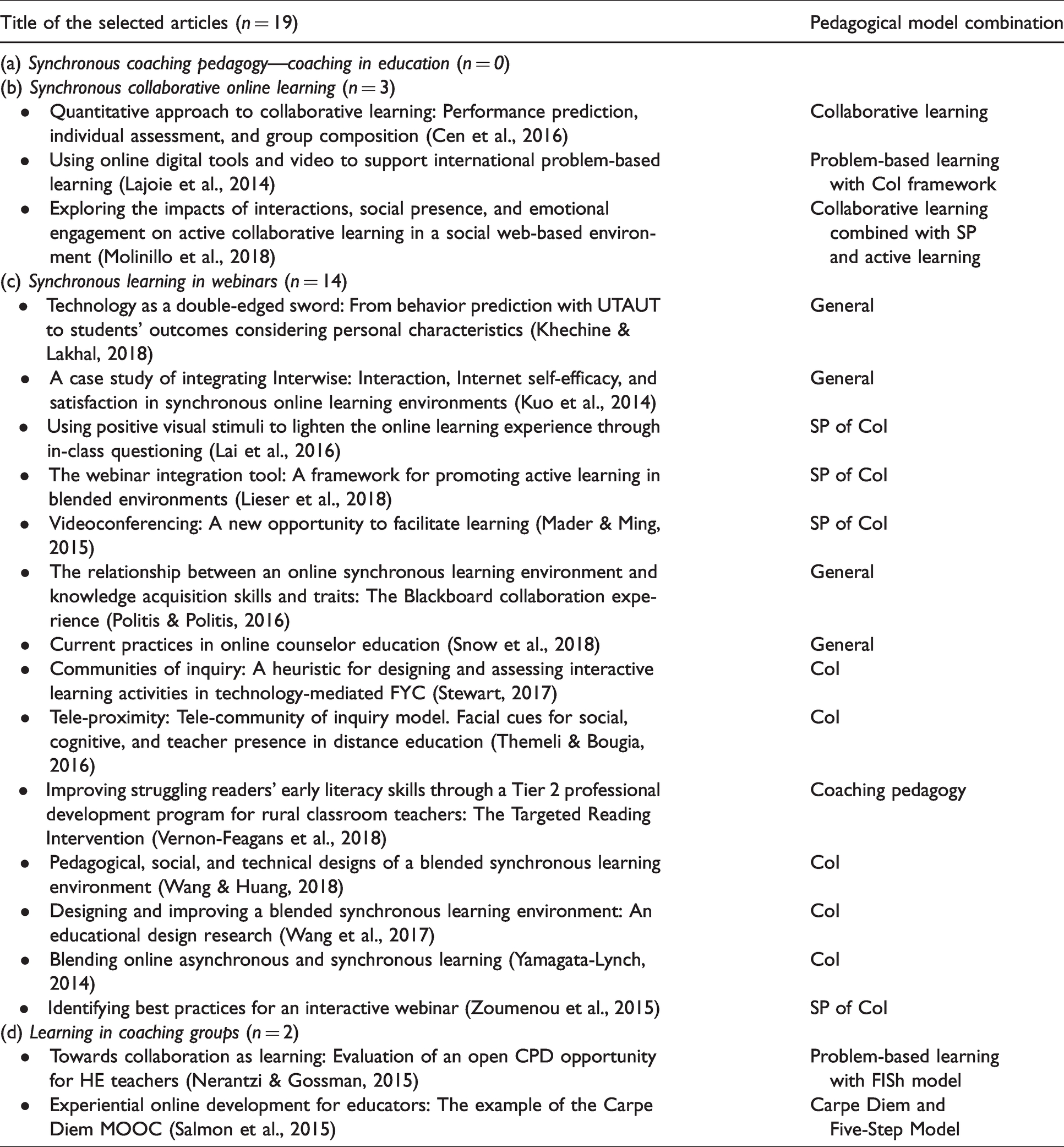
The selected articles were uploaded to the qualitative analysis program ATLAS.ti, where qualitative content coding and analysis of the content were performed. The selected peer-reviewed articles (n = 19) were distributed between the years 2014–2018 as follows: 2014 (n = 3); 2015 (n = 4); 2016 (n = 4); 2017 (n = 2); and 2018 (n = 6). The selected articles were representative of 14 journals. The core themes of this study and the selected peer-reviewed articles were divided as follows: (a) synchronous coaching pedagogy—coaching in education (n = 0); (b) synchronous collaborative online learning (n = 3); (c) synchronous learning in webinars (n = 14); and (d) learning in coaching groups (n = 2). The targets of the peer-reviewed articles were students (f = 8), academic professionals (f = 7), and other learners (f = 4). Each article was data-driven and color-coded according to the pedagogical models found (Table 4), and the results were tabulated via Excel as technological support. The peer-reviewed articles demonstrated particular pedagogical models (see the results section below). This led to the need to find more content on the research themes and key theme sentences from the articles. The research questions, methods, data, analysis, and study procedures are presented in Table 5.
Process of the Study: RQ1 and RQ2

Different searches were adopted for ATLAS.ti’s data, and most of the codes appeared only once or twice. However, some codes recurred more often. These occurrences were compared to the number of articles. The empirical material was analyzed using the codes created during the analysis. For example, the codes for all articles and all codes had the following occurrences: the search for the CoI code brought up 62 quotations; the TP code had 173 quotations; the SP code had 132 quotations; and the CP code had 75 quotations. As an example, the search of the pedagogical problem-based learning model code resulted in 21 quotations. In another example, coach as a code gave us a result of 16 quotations. Other code occurrences were webinar (112), collaborative (62), online learning (28), groups (24), and coach (16). After this analysis of the articles, there were 796 codes and 1,100 quotations. This data-driven content coding was used with the coding of the pedagogical models to confirm the preliminary results of the first research question.
Most of the pedagogical models attested to the CoI used for asynchronous online learning. Based on the analysis of the pedagogical models, the authors undertook the second step of the analysis. For the second research question, the qualitative content analysis and content coding adopted the CoI framework. Qualitative, descriptive, theory-driven coding was formed, and code identification, such as CP2 (cognitive presence 2), SP2 (social presence 2), and TP2 (teaching presence 2), was created. Then, the iteration, reading, and coding of the CoI framework and its three types of presence in the secondary data (n = 19) focused on encoding with the key themes of the study (b–d) (Table 6, Figure 2). In the theory-driven analysis, the codes were color-coded on ATLAS.ti to find more nuances for the categories and subcategories (Appendix 1).
Theory-Driven Content Analysis Results for the Quotations and Number of the SLR Peer-Reviewed Articles That Used the Codes CP, SP, and TP, and Key Themes


Garrison’s CoI Framework
The cross-screening and analysis of the articles for the second research question were conducted via theory-driven qualitative content analysis of the selected articles (n = 19), the CoI framework, and its three types of presence. The theory-driven coding and analysis of the materials amassed a total of 1,455 codes and 1,100 quotations. Code and document groups were created on ATLAS.ti to assist the search and analysis. A cross table of the quotations by frequency and percentage demonstrates the qualitative results of the theory-driven coding (Table 6).
Indicating the study’s trustworthiness, most of the quotations made on ATLAS.ti were included in the analysis of the second research question. A total of 1,100 quotations—851 quotations from the CoI framework, so 77.6% of all the quotations—are included in the study results.
Results
Pedagogical Models Used in Synchronous Collaborative Online Learning Research
As a result of RQ1, the following pedagogical framework, theory, and model combinations were identified:
the CoI framework SP connected to the media synchronicity theory or the broaden-and-build theory or the 4E (engagement, exploration, explanation, and extension) Learning Cycle problem-based learning connected to the CoI framework or FISh (focus, investigate, and share) collaborative learning and collaborative learning connected to SP Carpe Diem and the Five-Step Model coaching pedagogy general nonspecific pedagogical model or combinations
On closer inspection, 11 of the 19 articles used the CoI model’s presences (see Tables 4 and 5). Generally, there exist many more pedagogical models and frameworks, but this research presents those models or combinations found in the articles selected for the study.
The CoI framework and its three types of presence; CP, SP, and TP were discovered as a constant model in five articles. Garrison et al. (2000) highlighted the SP as “how real people feel to each other”, CP as “the thinking that results from interaction” and TP as “activity design, facilitation, and feedback” (Stewart, 2017, p. 67). According to Anderson et al. (2001), SP is limited to enabling only interactive learning. Thus, TP is required in course design for creating instructions, facilitating interactive learning, and enabling feedback (Stewart, 2017). Vygotsky’s (1978) zone of proximal development influences how Bruffee (1999) describes collaborative learning as a collective group zone established by peer interaction in groups, thereby creating CP (Stewart, 2017). In the CoI framework, the instructor designs activities that develop positive group dynamics, and SP is seen as an important factor in interactive learning. Regarding the issue of CP, Stewart (2017) called for the balanced presence of SP and TP.
Despite critiques of the CoI’s textual environment as narrowing the learning focus, the framework is an integral part of the Tele-proximity: Tele-community of Inquiry model. Sychronous Video Communication (SVC’s) accommodation of social context embodies tele-proximity and social interaction, and focuses on teacher presence, which creates tele-proximity to the teacher’s role and the learning outcomes, rather than on teaching (Themeli & Bougia, 2016).
The CoI is seen as a rich and beneficial pedagogical framework for designing and improving the blended synchronous learning environment, and TP is intended to establish a visual connection that enables blended online learning (Wang et al., 2017). The blended synchronous learning environment’s pedagogy is generated by pedagogical, social, and technical design, and rests on the SP, CP, and TP of the CoI framework (Garrison, 2016; Garrison et al, 2000; Wang & Huang, 2018). To obtain meaningful learning from the CoI, teachers need to create a design for asynchronous online courses. This design can be adapted particularly for the SP of synchronous learning, for which video and voice feeds are available (Yamagata-Lynch, 2014).
In videoconferences, SP is promoted from the learning environment’s perspective and the learner “feel[s] like a genuine part of the learning process” (Mader & Ming, 2015, p. 116). SP supports belonging and engagement, and motivates learners. The media synchronicity theory promotes information richness and identifies webinars in conjunction with face-to-face meetings as having the highest synchronicity (Zoumenou et al., 2015). The results indicate that positive visual stimuli in synchronous online learning support the creation of SP, particularly learner–instructor communication (Lai et al., 2016). Lieser et al. (2018) note that anxiety levels can be reduced by using SP in webinars. The 4E Learning Cycle is a general integration tool for webinars (Lieser et al., 2018).
Four articles were more generic and did not mention any specific pedagogical model. The articles were focused on the positive effects of webinar technology on learning (Khechine & Lakhal, 2018); synchronous learning and learner–learner and learner–instructor interactions (Kuo et al., 2014); the influence of synchronous online learning environments on the acquisition of knowledge and skills (Politis & Politis, 2016); and online distance education’s inclusion of a sound pedagogical framework that has interactive and collaborative elements (Snow et al., 2018).
Problem-based learning and the CoI framework focus on using a synchronous video environment for learning. The SPIKES (setting, perception, invitation, knowledge, empathy, summary/strategies) model is used in technology-supported problem-based learning settings as “a method for communicating bad news based on establishing the appropriate setting, assessing the patient’s perception of the problem, invitation for patient to ask questions, knowledge provided to patient, empathy for patient, summary/strategies for follow-up when communicating bad news” (Lajoie et al., 2014, pp. 62–63). According to Hmelo-Silver (2004), in the problem-based learning process, learners gain skills that support problem-solving and the collaborative creation of knowledge (see also Lajoie et al., 2014). The CoI framework’s social-constructivist component (Garrison et al., 2000) reinforces problem-based learning (Lajoie et al., 2014). Its focus is on teaching and teacher presence. The use of CP and SP is challenging in problem-based learning (Lajoie et al., 2014). Problem-based learning and the FISh model were researched regarding flexible, distance, and online learning. Problem-based learning contains a collaborative process in which learners in groups define an authentic problem while professionals provide support. The FISh model, which is a three-step problem-based learning model, was applied to activate small groups (Nerantzi & Gossman, 2015).
In computer-supported collaborative learning environments, educational content is created in collaborative settings and groups (Cen et al., 2016). According to Cen et al. (2016, p. 188), group collaboration contributes “to information exchange, conflict resolution, intersubjective meaning-making, group knowledge building, and participatory models” (see also Suthers, 2006). Collaborative learning and SP in social web-based collaborative learning rely on active learning (Molinillo et al., 2018). SP develops feelings of belonging, connection, affection, fellowship, and support for learning outcomes in open, collaborative learning situations (Molinillo et al., 2018). According to Niemi and Nevgi (2014), both the learning process and the members’ roles in the learning community play important roles in active learning (see also Molinillo et al., 2018).
The Carpe Diem learning design framework and the Five-Step Model (access and motivation, online socialization, information exchange, knowledge construction, and development) focus on the pedagogical scaffolding of massive open online courses. Carpe Diem’s learning design process (Salmon, 2011, 2013) has six phases for designing collaborative online learning (Salmon et al., 2015). Coaching pedagogy for kindergarten and rural first-grade classroom teachers’ professional development of Targeted Reading Intervention provided a literacy coach who offered support for teachers in the teaching situation by webcam and feedback after the teaching (Vernon-Feagans et al., 2018).
Screening, open coding, and analysis of the selected articles’ codes pointed the way to a collaborative CoI online learning framework (Table 4, Figure 2). The CoI framework incorporates three types of presence: cognitive, social, and teaching (Community of Inquiry, 2019; Garrison, 2016, 2017; Garrison et al., 2000). Despite no immediate contextual support from the SLR for coaching in education and coaching pedagogy, the CoI framework arose from the results we pursued with the second research question.
A Coaching Pedagogy Model for Synchronous Collaborative Online Learning
As an answer for RQ2, the following instances of cognitive, social, and teaching presence were found.
Findings for Cognitive Presence
As findings for CP, the data was analyzed into nine categories of CP: learning methods from coach (f = 47); collaborative learning/knowledge construction in groups (f = 34); learners’ processes, skills, competences (f = 31); process of coaching (f = 18); organizational prediction of success (f = 10); instructional materials and quality (f = 5); technical difficulties (f = 5); learning design (f = 5); and critical thinking (f = 4). These findings were divided into the b–d thematic areas (see Table 7).
Theory-Driven Content Analysis Results for the SLR Peer-Reviewed Articles Using the Code CP and Keyword Themes (RQ2)

Findings for Social Presence
Considering the theory-driven analysis, SP had the following 10 main categories: process/actions of coaching (f = 56); learning design (f = 45); organizational prediction of success (f = 42); learning methods from coach (f = 28); synchronous online presence of learners connected (f = 26); active collaborative learning in groups (f = 22); learners’ processes, skills, competences (f = 12); active learning or not (f = 10); critical thinking (f = 7); and technical difficulties (f = 6). These findings were then divided into the b–d thematic areas (see Table 8).
Theory-Driven Content Analysis Results for the SLR Peer-Reviewed Articles Using the Code SP and Keyword Themes (RQ2)

Findings for Teaching Presence
The theory-driven content analysis of TP resulted in the following 11 categories: learning design (f = 98); tips for webinars (f = 91); process/actions of coaching (f = 73); learning/pedagogy methods from a coach (f = 54); organizational prediction of success (f = 50); active collaborative learning knowledge construction in groups (f = 27); synchronous online presence of learners connected (f = 15); learners’ processes, skills, competences (f = 8); quality of instructional materials (f = 7); benefits of webinars—accessible and cost-effective (f = 4); and technical difficulties (f = 4). These findings were divided into the b–d thematic areas (see Table 9).
Theory-Driven Content Analysis Results for the SLR Peer-Reviewed Articles Using the Code TP and Keyword Themes (RQ2)
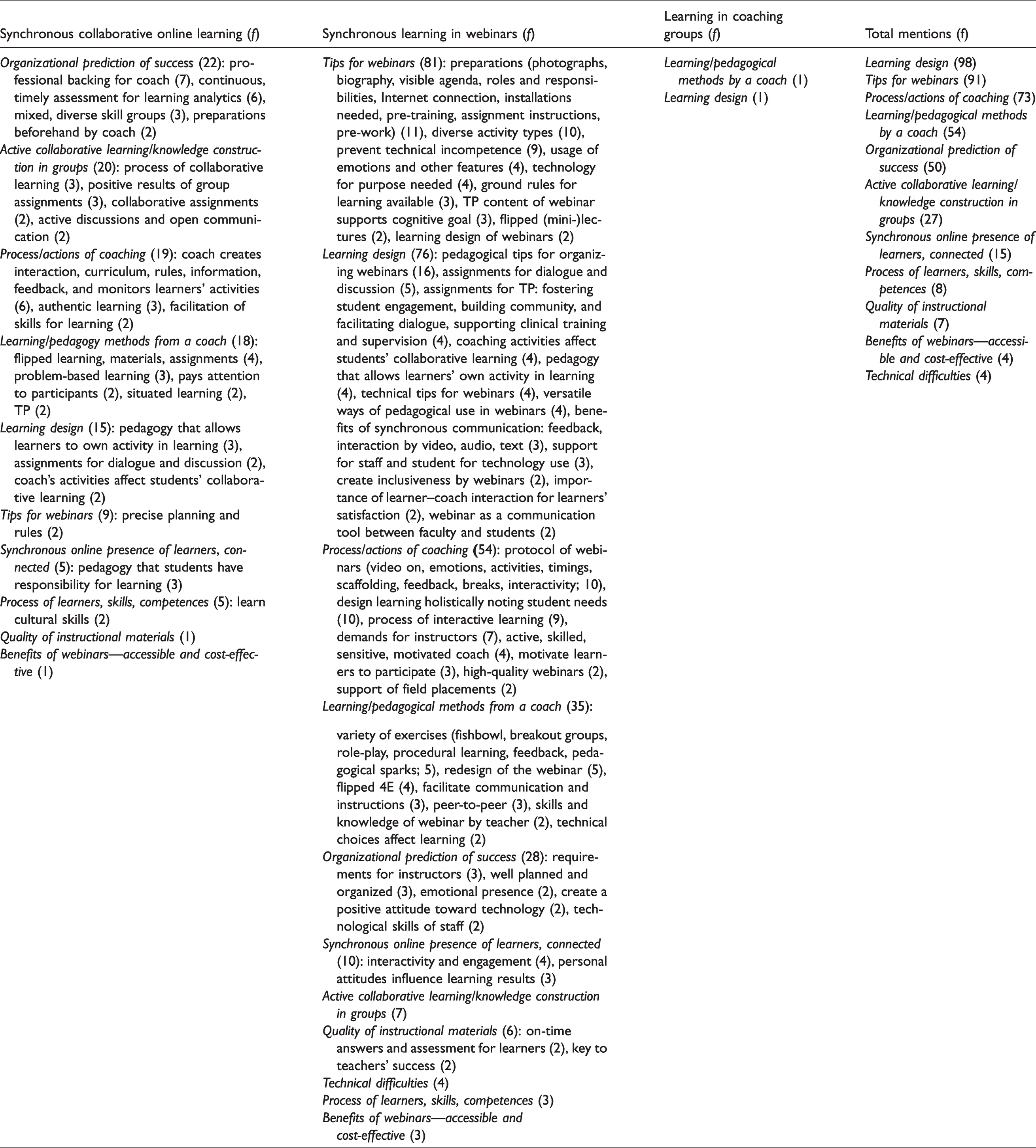
Learning design (f = 76) included pedagogical tips for organizing a webinar; assignments for dialogue and discussion; TP assignments, such as fostering student engagement, building community, and facilitating dialogue; supporting clinical training; and supervision. It also included coaching activities affecting students’ collaborative learning; pedagogy that allows a learner’s activity in learning; technical tips for webinars; versatile ways of pedagogical use in a webinar; and the benefits of synchronous communication, such as feedback and interaction by video, audio, and text. Furthermore, it included support for staff and students with the technology used; creating inclusiveness by webinars; the importance of learner–coach interaction for learners’ satisfaction; and a webinar as a communication tool between faculty and students. Learning design was coded for TP (f = 98) quotations and SP (f = 43) quotations; the two types of presence shared 13 of the same quotations. Subcategories included the development of a high level of SP—learners’ satisfaction; flipped learning; the active participation of teachers in webinar breakout rooms; tips for actions for a successful webinar; teachers’ technical skills in providing synchronous online learning; the creation of activities, teasers, and sparks for a webinar where participants can express themselves; learners as actors in webinars via different assignments; and the order, learning design, and content of webinars.
General Results Toward a Tentative Pedagogical Model
Notably, one key theme of this study, synchronous coaching pedagogy—coaching in education, did not produce any peer-reviewed articles. This finding reveals a research gap and a vital need for future studies. In general, the analysis of RQ1 resulted in particular pedagogical frameworks and model combinations. The CoI proved to be a feasible pedagogical framework in several of the study’s articles (Lajoie et al., 2014; Stewart, 2017; Themeli & Bougia, 2016; Wang & Huang, 2018; Wang et al., 2017; Yamagata-Lynch, 2014). Nearly all the SLR articles incorporated the CoI’s core concepts of social, cognitive, and teaching presence. In a similar vein, CPSCOL also evinces the elements of TP, CP, and SP (Figure 3).

Design of Preliminary CPSCOL Model
Our study enquires into two core themes—synchronous collaborative online learning and synchronous learning in webinars—in the full spectrum of the CoI’s three presences. Thus, the CoI framework can also be implemented for synchronous collaborative online learning (Table 10).
Results Regarding Coaching Pedagogy

The principles of practice for CPSCOL have been developed based on the study’s results (see Table 11). To this end, this article outlines the tentative principles for the study’s findings based on the results of the categories and subcategories of the three types of presence found in the empirical material (n = 19) and those that support the original CoI principles of practice. The contents noted above—including the extended framework of CoI for the CPSCOL preliminary model (Figure 3) and the CPSCOL principles of practice (Table 11)—provide the results and answers for this study’s research questions.
Principles of Practice for the CPSCOL

Discussion
The driving values behind this research are equal access for continuous learning and the recognition that online learning is also a social process (Lave & Wenger, 1991; Säljö, 2004; Vygotsky, 1978). Students learn online with one another synchronously and learn the soft skills that are so vital in the 21st century. Increasingly, more people are learning alone and independently, which may have negative effects on their social skills and ability to engage in useful dialogue. Soft skills may prove to be the key to online learning in the future. Coaching is linked to gaining soft skills, and being coachable may even be seen as a “green light” in the decision to hire a potential employee (Cottringer, 2018; Leppisaari, 2019). The methods of CPSCOL, applied in groups in webinars, can help online learners exercise and develop these much needed soft skills.
In this study, the theoretical cornerstone of the CoI framework lies in socio-constructive learning (Garrison, 2016) and sociocultural learning (Claxton & Wells, 2002; Garrison, 2016; Lave & Wenger, 1991; Phillipson et al., 2013; Säljö, 2004; Vygotsky, 1978). The well-regarded CoI framework for collaborative online learning (Garrison, 2016, 2017; Garrison et al., 2000) is expanded to encompass the additional perspective of a synchronous collaborative online coaching pedagogy. The model expansion is inspired by an SLR (RQ1) and is fleshed out by qualitative content and theory-driven analysis (RQ2). This study focuses on collaborative synchronous online learning by contextualizing it through a review of 19 peer-reviewed articles. Our search for this empirical material and its screening, data condensation, and analysis resulted in particular pedagogical frameworks and model combinations used in synchronous online learning. It produced a significant encounter between the theory and framework of CoI and synchronous collaborative online learning. Nevertheless, this study’s initial results also indicate a research gap when it comes to synchronous coaching pedagogy—coaching in education.
The creation of a preliminary CPSCOL model began with an inductively qualitative analysis of the empirical material selected for the SLR (see RQ1). This data-driven analysis displayed a picture of an existing pedagogical model arising from the coded material.
The preliminary CPSCOL model includes the CoI framework’s elements of cognitive, social, and teaching presence, as suggested by the study’s results. The authors are aware of the practical coding and content of the empirical material, which reveals the concrete implications of the extended CP, SP, and TP of the extended CoI framework. Further research is needed to inspect the differences and similarities between the CPSCOL model and the CoI framework (Table 12).
Differences and Similarities of the CoI and Preliminary CPSCOL

The theoretical background lies in socio-constructive and sociocultural learning within the socio-constructive research paradigm. As a result of this study, the CoI concept of CP addresses CPSCOL content-related issues like collaborative learning in groups and knowledge construction. Group coaching has three key features: the coaching caters to (helps) the group; the coaching is given at the correct time; and the conditions for both current and future support to the group are recognized (Hackman & Wageman, 2005). The collaborative action of the group is influenced by the group members’ collective efforts, appropriate action plans, and the knowledge and skills of the group members to fulfill the mission. At the beginning of a group’s life cycle, coaching supports the group in getting to work and both motivates and engages group members to do their job. In the middle of a group’s life cycle, support to help carry out the group’s action plan is profitable, and coaching is of an advisory nature. At the final stage of a group’s life cycle, the fulfillment of the group’s learning goals is supported; this is called educational coaching (Hackman & Wageman, 2005), which is also later reflected in the CoI’s presence types.
CP “engages with content” (Garrison, 2016, p. 59). In this study, there were content-related issues, including collaborative learning in groups and knowledge construction. The process, which includes learners, skills, and competences, is linked with content, and content is taught via a coach’s learning methods. CP and TP are “regulating learning” processes (Garrison, 2016, p. 59). Consultative group coaching and educational coaching (Hackman & Wageman, 2005) go hand-in-hand as part of one’s CP and TP.
SP is about community, collaborative learning, and learners motivating each other. This study supports Garrison’s (2016, p. 59) finding that SP includes “engagement with participants.” The study’s results affirm that SP is part of the learning design, is key to success, includes the learning methods offered by the coach, and promotes active collaborative learning in groups (Table 10). This is in line with Garrison’s (2016, p. 63) SP categories: “open communication, group cohesion, and personal/affective.” Between SP and CP, there is “supporting discourse” (Garrison, 2016, p. 59), which, in this study, includes both the process of coaching actions (SP) and the process of coaching (CP). The motivational coaching phase of group coaching (Hackman & Wageman, 2005) can support SP development.
TP includes “engagement re: Goals/Direction” (Garrison, 2016, p. 59). In this study, TP is composed of the learning design; concrete tips on how to organize a webinar; the process and actions of coaching and learning; the pedagogical methods used by a coach; and active collaborative learning and knowledge construction in groups. TP’s “goals and direction” (Garrison, 2016, p. 59) are supported by the organizational prediction of success (Table 10). Teaching is organized by coaching, scaffolding, and guidance regarding the coach’s role. At the center of the CoI lies “educational experience” (Garrison, 2016, p. 59; Figure 2). Correspondingly, this is where the heart of CPSCOL is situated and experienced by learners (Figure 3).
From the standpoint of this study, the lists of the code-category contents of each of the three types of presences are sufficient basis as a preliminary pedagogical model. To develop a theory or model, it is essential to convert actions into principles (Garrison, 2016). Therefore, Garrison (2011, 2016, 2017) created the following seven principles of practice:
plan for the creation of open communication and trust (SP) plan for critical reflection and discourse (CP) establish community and cohesion (SP) establish inquiry dynamics (CP) sustain respect and responsibility (SP) sustain inquiry that moves to resolution (CP) ensure that assessment is congruent with intended processes and outcomes
As a model for coaching pedagogy, the CoI framework allows comprehensive pedagogy to be used to fulfill the needs of the curriculum and competences targeted. The preliminary CPSCOL is flexible enough for different lengths of synchronous learning sessions, as well as for groups. It can likewise be implemented in learning design models. The designed principles of practice for CPSCOL support the implementation of the preliminary pedagogical model (Table 11).
Although the CoI framework follows sociocultural theory (Garrison, 2016), the CoI, as originally developed, does not directly answer the idea of a synchronous collaborative online coaching pedagogy. Adapting the CoI framework with webinar pedagogy in the future may be promising and rewarding in ensuring the quality of collaborative synchronous online learning via the three qualities of presence for both coaches and learners. For the preliminary CPSCOL model, a future step could be to study these three types of presence from the perspective of coaches, learners, and work–life partners.
The diversity among the SLR articles implies that different study themes and pedagogical designs can be conducted within the CoI framework. Feasibility is also attested to by the online educational experience of the first author. Problem-based learning (Lajoie et al., 2014; Nerantzi & Gossman, 2015) and flipped learning (Lajoie et al., 2014; Zoumenou et al., 2015) were mentioned in the SLR as potential pedagogical supports for online learning. Flipped learning has also been used with the 4E Learning Cycle which was presented by Lieser et al. (2018).
Webinar platforms are relatively new learning environments, and one significant issue is how to teach and learn in these synchronous environments, and how to achieve good educational results and outcomes. This study’s results establish the first iteration cycle of educational design-based research for webinar pedagogy. Through design-based research methods, the coaching pedagogy model for webinars will be further developed, tested, refined, and reflected in the educational field (Brown, 1992; Design-Based Research Collective, 2003, p. 6; Herrington et al., 2007). In summary, CPSCOL will entail further research. A tentative model for CPSCOL has been drawn up here. However, some questions and issues are left unanswered for more research regarding learners’ expectations and perceptions to learn via CPSCOL, and how teachers can most effectively teach via CPSCOL. These are the next steps of the research.
Collaborative synchronous online learning technologies must also be modernized. Generally, webinar technology, games, and virtual dialogue via avatars offer a synchronous collaborative place with synchronous videos for learning. However, webinar environments and technology could be more versatile. We could think outside the box and have a synchronous online learning platform as a learning environment and run online courses directly from there.
Strengths and Limitations
This research has been conducted with careful attention to ensure excellent research trustworthiness and validity (Korhonen et al., 2019; Miles et al., 2014). To answer RQ1, an SLR was conducted based on Fink’s (2005, 2014) SLR methodology model (Figure 1) and qualitative data-driven analysis. The study continued with qualitative data-driven and theory-driven content analysis to answer RQ2. The memos of the data search and selected peer-reviewed articles were compiled and saved online in ATLAS.ti. However, it is essential to underscore that 77.6% of the study’s quotations were included in the theory-driven analysis (RQ2). It is also essential to note that the results of the study are the subjective perspective of the researchers. Generally, qualitative analysis consists of interpretations (Creswell, 2012). By following the SLR process precisely with qualitative analysis, we aimed to ensure the trustworthiness of the research results generated. In this study, the CoI framework was selected to be further developed, as it is essential to examine in greater depth other pedagogical models in the future.
A strength and concurrent limitation of this study is the CoI framework, which in this study is extended toward the preliminary CPSCOL model. Conversely, the CoI framework lends credibility to this study due to the distinguished research history of the CoI framework (Garrison, 2017). The extension created by this study offers a challenge to science and requires further research.
Footnotes
Declaration of Conflicting Interests
The authors declared no potential conflicts of interest with respect to the research, authorship, and/or publication of this article.
Funding
The authors received no financial support for the research, authorship, and/or publication of this article.

Supplemental material
Supplemental material for this article is available online.
References
Supplementary Material
Please find the following supplemental material available below.
For Open Access articles published under a Creative Commons License, all supplemental material carries the same license as the article it is associated with.
For non-Open Access articles published, all supplemental material carries a non-exclusive license, and permission requests for re-use of supplemental material or any part of supplemental material shall be sent directly to the copyright owner as specified in the copyright notice associated with the article.
