




Abstract
Counterfactual thinking puts a negative reality and better or worse alternative outcomes in the mind simultaneously. The implicit theory of intelligence considers whether individuals believe that intelligence can be promoted by effort or not. Previous studies suggest that counterfactual thinking interacting with the implicit theory of intelligence would evoke a belief in an attainable future or a belief that a certain future could one day be reality, thereby producing positive effects. Three studies examined the hypothesis that belief in an attainable future through counterfactual thinking would predict psychological capital, which is a positive developmental state of individuals. In Study 1 (N = 62), belief in an attainable future was operationalized by introducing the implicit theory of intelligence and counterfactual thinking. Incremental theorists had higher psychological capital when engaged in counterfactual thinking than controls. In Study 2 (N = 71), belief in an attainable future was operationalized by introducing the likelihood of the antecedents and of the outcomes, which were conceptualized as how people believe in their counterfactual thinking. Belief in an attainable future predicted psychological capital even after controlling for the influence of future time perspective and present-fatalistic time perspective, two concepts that depict how individuals process time-related information. In Study 3 (N = 76), we conducted an intervention study. Participants in the experimental group were directed to construct attainable counterfactual thinking for one week. The experimental group had higher psychological capital than the control group. Across three studies, the findings consistently provided primary support for the hypothesis that belief in an attainable future would predict psychological capital.
Keywords
Psychological capital is a concept that emerged from the domain of positive organizational behavior. Luthans and Youssef (2004) describe it as an individual's positive psychological state of development that includes four positive psychological resources: self-efficacy, hope, optimism, and resilience (Avey et al., 2011; Luthans & Youssef, 2004). When individuals are in this state, they are confident in exerting the necessary effort to succeed (self-efficacy), persevere toward goals, redirect paths when necessary (hope), consider success positively (optimism), and bounce back from setbacks (resilience) (Luthans & Youssef-Morgan, 2017; Newman et al., 2014). People with a higher level of psychological capital know “who I am” and “who I can become” (Luthans & Youssef, 2004); that is, knowing “who I am” and “who I can become” is a feature of psychological capital. Many empirical studies have provided evidence for the validity of psychological capital as a unique construct and the reliability of its measurement tools. For example, psychological capital is positively related to many desirable outcomes, such as well-being, job commitment, and performance and is negatively related to undesirable outcomes, such as burn-out, depression, and intention to leave work (Avey et al., 2011; Luthans & Youssef-Morgan, 2017; Newman et al., 2014).
Exploring the antecedents and interventions of psychological capital has important theoretical and practical implications. Due to its “state-like” nature, psychological capital can be promoted by a micro-intervention that focuses on promoting its four factors in a short time period (Luthans et al., 2006). According to the definition, when people know who they are and who they can become, they should have a higher level of psychological capital. It is possible to promote psychological capital from this perspective.
Before people know “who I can become,” their mind must wander from the present to the future. Thinking about the future is considered an important process to attain desired outcomes (Hoyle & Sherrill, 2006; McElwee & Haugh, 2010; Oettingen & Mayer, 2002). However, thinking about the future has different effects on different people (McElwee & Haugh, 2010; Nurra & Oyserman, 2018). For example, when people think about the future, some may feel positive emotions, motivation, and greater willingness to devote effort and have better performance, while others may not obtain these effects (Bandura, 1997; Oettingen & Mayer, 2002; Oyserman & Lewis, 2017; Seligman, 1991; Taylor & Brown, 1988). Some researchers suggest that whether an individual believes the future is attainable may account for such differences (Oettingen, 2012; Oettingen & Mayer, 2002). As James (1890) suggested, “Everyone knows the difference between imagining a thing and believing in its existence, between supposing a proposition and acquiescing in its truth” (p. 283). However, it remains unclear why this effect occurs due to believing that the future is attainable (Hoyle & Sherrill, 2006).
We argue that belief in an attainable future might evoke a positive developmental state (psychological capital) for people, thereby producing a series of positive outcomes. Belief in an attainable future, which is a cognitive concept that involves the belief that a desirable future will become reality one day, produces widespread positive effects involving affection, motivation, and behavior. These effects are quite similar to the effects of psychological capital (Luthans & Youssef-Morgan, 2017). Whether individuals perceive that they are in a positive developmental state depends on certain conditions. First, individuals should be aware of reality and the desired goal. Second, individuals should identify the methods to realize the goal. Third, individuals must anticipate that the desired outcome will occur. This process overlaps with the process in which individuals judge whether the future is attainable. When individuals believe that the future is attainable, they should have high psychological capital. Hence, we propose that psychological capital will be high when individuals believe that a better future is attainable. However, although belief in an attainable future theoretically predicts psychological capital, few studies have examined them together. In the current research, we attempt to test the hypothesis that belief in an attainable future predicts psychological capital by conceptualizing the latter as “who I am” and “who I can become” (Luthans & Youssef-Morgan, 2017).
The second purpose of this study is to integrate the operationalization of the belief in an attainable future. Whether people judge the future as attainable is the key to differentiating belief in the future from fantasy. However, it remains unclear what makes people judge the future as attainable. Usually, participants are directly questioned about the likelihood that a future event will happen (Oettingen, 2012; Oettingen & Mayer, 2002). Judgement may rely on past experience (Bandura, 1997). In other domains, certain manipulations have been suggested to form beliefs in an attainable future. For example, several researchers (Dyczewski & Markman, 2012; Lockwood & Kunda, 1997; Nussbaum & Dweck, 2008) note that incremental theorists (who believe that performance and intelligence are promoted by effort) believe that the future is more attainable when they engage in upward counterfactual thinking than entity theorists (who believe that performance is explained by ability rather than effort). We use this and other operationalizations of attainable belief to test our hypothesis.
Counterfactual thinking as an anchor to form the belief in an attainable future and psychological capital
When individuals attempt to know who they are and who they can become, they first construct relevant representations in the mind. We infer that counterfactual thinking might help individuals complete this process. Counterfactual thinking is a special type of thinking in which alternative antecedents and consequences of a reality are constructed. It usually takes the form of “if only…then…” Through counterfactual thinking, people can hold a negative reality and better alternative outcomes in the mind simultaneously (Byrne, 2005; Epstude & Roese, 2008; Roese, 1997). For example, following an exam failure, students may spontaneously think, “If only I had spent more time studying, then I would have passed” (upward counterfactual thinking). When hearing about a serious accident, people usually think, “If Tom had not had the safety belt, then he would have been hurt more seriously” (downward counterfactual thinking). When people have the opportunity to improve negative outcomes, counterfactual thinking, especially upward counterfactual thinking, is beneficial. For example, people can obtain hints to improve performance, alleviate negative affect, gain personal control, and even gain a broader self-inference of efficacy (Boninger et al., 1994; Epstude & Roese, 2008; Nasco & Marsh, 1999).
Conditions under which counterfactual thinking forms attainable beliefs in the future
Although counterfactual thinking can help people mentally construct a better alternative future, whether people believe this remains unclear.
Lockwood and Kunda (1997) noted that the extent of belief in counterfactual thinking varied across individuals. For example, when considering the same counterfactual thought, “If only I spent more time on practice, then I would have become a superstar like him,” incremental theorists believe that the alternative outcome is more attainable than entity theorists. Other researchers have found similar results (Dyczewski & Markman, 2012; Nussbaum & Dweck, 2008). Therefore, when engaging in counterfactual thinking following a negative event, incremental theorists believe that future success will eventually be a reality, whereas entity theorists do not. Other researchers (Markman & McMullen, 2003) suggest that incremental theorists can include their better future self in their current self through counterfactual thinking, so they believe in counterfactuals more than entity theorists do. In fact, some researchers (Petrocelli et al., 2011) suggest that people may qualitatively judge how believable counterfactual thinking is. These researchers proposed a new concept, counterfactual potency, to evaluate individuals’ general belief in counterfactual thinking. Previous authors (Petrocelli et al., 2011) have demonstrated that this “believing-in counterfactual” (p. 15) predicts responses to events, including responsibility, causation, and regret. For example, the more individuals believe that they could have won a lottery if they had changed one number, the more regret they feel. Although counterfactual potency was not developed to assess belief in an attainable future, when counterfactual thinking involves repeatable negative events, belief in counterfactual thinking implies that an alternative better outcome would occur by performing a certain action. Put simply, belief in an attainable future is one component of counterfactual potency. For example, following an exam failure, a student may think, “If only I spent more time doing exercises, then I would have passed the exam.” If the student evaluates both the likelihood of spending more time exercising and the likelihood of passing the exam as high, then a future in which the student passes the exam by spending more time exercising will be judged as attainable.
Some clarifications should be specified. First, according to Lewin (1935), there is a piece of the self in the goal space. An attainable future is represented concretely rather than abstractly as an attainable future self. Second, people believe that an attainable future is the key rather than just thinking about it. Therefore, it is different from fantasy, daydreaming, and wishful thinking, which usually involve desired outcomes without judgements of their attainability (Bar-Hillel & Budescu, 1995; Krizan & Windschitl, 2009; Oettingen & Mayer, 2002; Oettingen & Wadden, 1991). For example, we may daydream that we have powerful magic but realize that this is unrealistic. Alternatively, although a favorite team may have little chance of winning, fans may still think wishfully that the team will win (Bar-Hillel et al., 2008). Third, both attainable belief in the future and hope involve expected outcomes and pathway thinking (thinking about how to achieve goals) (Lockwood & Kunda, 1997; Snyder, 2002). However, attainable belief in the future is based on situation-specific goals and judges the contingencies in a specific goal pursuit, while hope focuses on the overall capability to achieve goals. In addition, attainable belief in the future includes the future better self in the current self (Oyserman et al., 2004, 2012), thereby alleviating the effect of negative outcomes. While hope focuses on achieving positive future outcomes, and the present may also be positive, hope has few self-expansion effects (for example, more self-efficacy, more resources, increased motivation) compared to belief in an attainable future (Aron et al., 1992, 2001; Snyder, 2002).
Belief in an attainable future and psychological capital
When people believe the future is attainable through counterfactual thinking, they know “who I am” and “who I can become,” which means they are in a positive developmental state. We propose that belief in an attainable future is an important antecedent of psychological capital. There is theoretical and empirical evidence for this proposition. In theory, psychological capital is a state in which individuals know that a better future is attainable (Luthans & Youssef-Morgan, 2017). Meanwhile, evidence has revealed that both counterfactual thinking and psychological capital have similar positive effects on people, such as more positive affect, more motivation, more engagement, and better performance (Avey et al., 2011; Bandura, 1997; Luthans & Youssef-Morgan, 2017; Newman et al., 2014; Oettingen, 2012). In addition, evidence in the counterfactual thinking literature provides indirect but consistent support for the link between belief in an attainable future and psychological capital. For example, many researchers believe that counterfactual thinking produces motivational consequences when a better future is assimilated into the self (Markman & McMullen, 2003; Stapel & Koomen, 2000). Epstude and Roese (2008) suggested that counterfactual thinking could prepare an individual for the future through causal inference, which means that the individual judges the likelihood of a certain future through counterfactuals. Other researchers have suggested that counterfactual thinking produces self-efficacy and mastery (Roese, 1999) as well as alternative actions to outcomes (Markman & McMullen, 2003; Roese, 1997), ameliorates regret and blame, and prevents future failure, which involves rebounding from failure (Boninger et al., 1994; Davis et al., 1995). Although the conditions of these effects have been depicted differently (e.g., controllable, self-mutable, and perceptions of opportunity) and the purposes of these researchers differed, the belief in an attainable future through counterfactual thinking and the accordingly positive developmental state can play an important role in organizing these data in a coherent way. Furthermore, belief in an attainable future is a cognitive concept. In general, cognition can influence affection and motivation, and psychological capital is a higher-order concept that includes affectional and motivational components. Most importantly, psychological capital is a state-like variable that is relatively easy to influence. Briefly, we hypothesize that belief in an attainable future through counterfactual thinking predicts psychological capital.
Overview of studies
The purpose of the current studies is threefold. First, we attempt to find more antecedents of psychological capital in terms of conceptualizing it as “who I am” and “who I can become.” Second, by considering psychological capital, we attempt to broaden the understanding of the effect of thinking about the future. Third, we integrate several operationalizations of belief in an attainable future and examine their benefits in terms of influencing psychological capital to foster related applications.
We conduct converging tests of the hypothesis that belief in an attainable future predicts psychological capital. This hypothesis is derived from the conceptualization that psychological capital reflects a positive state within which the individual knows “who I am” and “who I can become.” We adopt multiple operationalizations of the belief in an attainable future to test this hypothesis. In Study 1, we manipulate the incremental implicit theory of intelligence and upward counterfactual thinking simultaneously as the operationalization of the belief in an attainable future. In Study 2, we use the likelihood of antecedents and the likelihood of consequences of counterfactual thinking simultaneously as another operationalization of the belief in an attainable future. In Study 3, we instructed participants in the experimental group to construct counterfactual thinking of a highly attainable future, while the control group completed tasks unrelated to the belief in an attainable future.
Study 1
How do people believe in an alternative better outcome that counterfactual thinking constructs? According to some researchers (Dweck, 2000; Hong et al., 1999), people differ idiosyncratically in their lay theory of whether a better outcome will happen following a setback. As discussed previously, incremental theorists believe that better performance is more attainable than entity theorists do. Therefore, for the same counterfactual thinking, “If only I spent more time on practice, then I would have passed the exam,” the degree of belief in counterfactual thinking varies. In a series of studies, Lockwood and Kunda (1997) found that when incremental participants engaged in counterfactual thinking involving the success of superstars, the positive effect, such as promoting motivation and aspiration, was stronger than it was for entity participants. Other researchers (Dyczewski & Markman, 2012; Nussbaum & Dweck, 2008) agree that this effect could be explained by the more attainable belief in success. In Study 1, we tested the hypothesis that belief in an attainable future predicted psychological capital. This belief emerged from the interaction of incremental theory of intelligence and counterfactual thinking.
Method
Subjects
The participants were first-year students at a university in their first semester. Sixty-two students (44 males, 18 females) participated in this experiment.
Design
This study was a 2 (incremental theorist: entity theorist) × 2 (counterfactual thinking: control) between-subjects design.
Procedure
Participants were recruited after their self-study session. They were told about the related process and their rights. After the experiment, they were debriefed and thanked with a small gift.
Incremental theorists compared with entity theorists. A three-item questionnaire (Hong et al., 1999) was used to measure the participants’ belief in the implicit theory of intelligence. An example item is “You have a certain amount of intelligence, and you really can't do much to change it.” The participants were asked to express their degree of agreement with each item on a 6-point Likert scale that ranged from 1 (strongly agree) to 6 (strongly disagree). According to previous work (Hong et al., 1999), we chose participants with unambiguous beliefs on intelligence by eliminating participants who scored in the middle (with an average score higher than 3.0 and lower than 4.0). Participants with a mean score of 3.0 or lower believed that intelligence is fixed (entity theorists), whereas participants with a mean score of 4.0 or above believed that intelligence is malleable (incremental theorists). We recruited these two types of participants to participate in Study 1. The alpha coefficient for this sample was 0.92.
Counterfactual thinking manipulation. An assistant randomly assigned incremental theorists into a counterfactual thinking group or a control group and then randomly assigned entity theorists into a counterfactual thinking group or a control group (another assistant noticed incremental theorists and entity theorists to arrive in the lab at different time periods, but the assistant in the lab was unaware of this difference). A test for the scores of the implicit theory scale in both groups found no significant effect. The participants read material depicting an accident with detailed antecedents and outcomes. They were told that people often have thoughts of “If only …, then …” after an accident. Then, the participants were instructed to consider what factors caused their exam failure and to finally write down sentences on experimental papers. These sentences took the form of “If only I …, then I might have passed the exam/gotten a better grade” or “If only I …, then I might have gotten a worse grade.” We left sufficient room on the paper to encourage the participants to write down as many sentences as they wanted.
Control manipulation. In the control group, the participants read material concerning college life and then wrote down some things that impressed them.
Manipulation check. Two research assistants checked all the sentences, and all priming of counterfactual thinking met the requirements. For example, the contents were fitted in the context of exam failure, and they were all upward counterfactual thinking. All the participants wrote down more than two counterfactuals in the experimental group.
Psychological capital. Approximately 10 min. later, when all participants finished writing, they completed the measure of psychological capital using a 24-item scale developed by Luthans et al. (2007). To facilitate state-like framing, the scale asked the respondents to describe how they thought about themselves currently. A sample item was “I feel confident helping to set goals in my studies.” There were 31 entity theory participants in total, 15 in the counterfactual thinking group and 16 in the control group. There were 31 incremental theory participants: 16 in the counterfactual thinking group and 15 in the control group. One participant missed one item to evaluate. The alpha coefficient for this sample was .89.
Results and discussion
We used SPSS 26 and JAMOVI 1.6.23 to perform the analysis. A 2 (counterfactual thinking compared with control) × 2 (entity theory compared with incremental theory) analysis of variance (ANOVA) with psychological capital as the dependent measure revealed a main effect of implicit theory, F (1, 58) = 7.71, p = 0.007, partial η2 = 0.12, and incremental theorists had higher psychological capital (M = 19.9, SD = 2.9) than entity theorists (M = 17.9, SD = 3.1). However, the main effect of counterfactual thinking was not significant, F (1, 58) = 0.49, p = 0.488. The interaction of priming counterfactual thinking and implicit theory was significant, F (1, 58) = 9.70, p = .003, partial η2 (η2p) = 0.14, generalized η2 (η2G) = 0.14 (Lakens, 2013), and a simple effect test revealed that incremental theorists had higher psychological capital scores when they engaged in counterfactual thinking (M = 21.3, SD = 2.6) than entity theorists engaged in counterfactual thinking (M = 17.1, SD = 3.3), Cohen's d = −1.54, 95% confidence interval [CI] = [ − 2.32, −0.77]. In the control group, the difference in psychological capital between incremental theorists (M = 18.8, SD = 2.7) and entity theorists (M = 18.5, SD = 2.5) was not significant, Cohen's d = 0.12, 95% CI = [ − 0.60, 0.84]. Sensitivity analysis (G*Power) showed the required effect size partial η2 = 0.12 (with a sample size of 62, an alpha level of 0.05, and power of 0.8) (Lakens, 2013).
Because the belief in an attainable future and hope both involve goal and pathway thinking, to rule out the possibility that the effect resulted from only hope being promoted by the belief in an attainable future, we conducted further analysis by removing the scores of hope from the scores of psychological capital. The analysis revealed the same results, F (1, 58) = 10.74, p = .002, partial η2 = 0.16, Cohen's d = −.54, 95% CI = [ − 2.32, −0.77].
The results of Study 1 lent support to our hypothesis, even removing the influence on hope. The effect size observed was larger than the required effect size; however, it was not rigorous to obtain any conclusions. According to some researchers (Dweck, 2000; Markman & McMullen, 2003; Stapel & Koomen, 2000), implicit theory of intelligence also suggests whether the self is a mutable entity. Therefore, it might be the perceived mutability of the self rather than an attainable belief in the future that produced the observed effect. To further support our hypothesis, some other operationalizations of the belief in the future are needed.
Study 2
The goal of Study 2 was to further test our hypothesis. The focus in this study was whether such an effect would be found when we used another operationalization of the belief in an attainable future. It seems that incremental theorists have the advantage of forming positive beliefs in the future through counterfactual thinking. How do normal people form such beliefs? We obtain some clues from the work of Petrocelli et al. (2011). These authors proposed counterfactual potency to conceptualize how people believe in their counterfactuals, and whether the future better outcome is attainable is one particular belief in counterfactual potency. Therefore, we used counterfactual potency as another operationalization of the belief in an attainable future.
Individual traits related to belief in an attainable future
Individuals have different tendencies to believe in whether the future is attainable. Time perspective is a trait that describes individual differences in processing time-related information, for example, recalling past experiences, forming future expectations, and dealing with the present (Carstensen et al., 1999; Zimbardo & Boyd, 1999). Among the five time perspectives, two time perspectives conceptually relate to belief in an attainable future: future time perspective and present-fatalistic time perspective. Future time perspective reflects a general future orientation, suggesting that behavior is dominated by pursuing future goals and rewards, whereas present-fatalistic time perspective reveals a fatalistic, helpless, and hopeless attitude toward the future and life (Kooij et al., 2018; Zimbardo & Boyd, 1999).
To the best of our knowledge, we could not identify any published research that has related psychological capital to both time perspectives; however, there are encouraging theoretical connections between them. Theoretically, individuals with a future time perspective believe that future goals and rewards will be attained by regulating current behavior. Therefore, becoming a better self can be a reality one day. Obviously, an individual who knows that he or she can become a better person has high psychological capital with the conceptualization of “who I am” and “who I can become.” However, for present-fatalistic time perspective individuals, fate is dominated by uncontrollable forces, and they have no hope of becoming better people (Zimbardo & Boyd, 1999). Therefore, people with a present-fatalistic time perspective have low psychological capital.
There are some findings to support that these two time perspectives might be indirectly related to psychological capital. For example, some researchers found that more perceived age-related losses dampened future time perspective 2.5 years later, which in turn increased the level of depressive symptoms a further two years later (Dutt & Wahl, 2019). Depressive symptoms are negatively related to psychological capital (Han et al., 2019). A systematic search found that a future time perspective had small-to-medium-sized positive associations with goal setting, self-regulatory ability, and outcome (Baird et al., 2021). Meanwhile, psychological capital was positively related to outcome and self-regulatory ability. Some researchers found that present-fatalistic time perspective was positively correlated with chronic stress and depressive symptoms (Bourdon et al., 2020). Furthermore, individuals with a present-fatalistic time perspective were found to experience more emotional exhaustion and burnout (Meidani et al., 2019), which was contrary to the effects of psychological capital.
In Study 2, we use counterfactual potency to operationalize the belief in an attainable future. We presumed it would predict psychological capital. Furthermore, we speculated that this contribution would be independent of the effect of dispositional traits of individuals, particularly future time perspective and present-fatalistic time perspective.
Method
Subjects
The participants were first-year students at a university in their first semester. Seventy-four students (67 males, 4 females, 3 unknown) participated in Study 2.
Design
This study constructed a model to show the relationships between multiple variables (counterfactual potency, time perspectives, psychological capital).
Procedure
Participants were recruited after they finished their first midterm exam. The experimenter told them the related processes and their rights before the experiment. After the experiment, the participants were debriefed and thanked with a small gift.
Future and present-fatalistic time perspective scale. Prior to the experiment, participants were asked to complete future and present fatalistic time perspective scales from the ZTPI (Zimbardo & Boyd, 1999). The respondents were asked to indicate how accurately each term described them by selecting an appropriate numerical response category (from 1 = “very untrue” to 5 = “very true”). Example items are “I believe that a person's day should be planned ahead each morning” and “My life path is controlled by forces I cannot influence.” In the current sample, the future time perspective alpha coefficient was 0.73, and the present fatalistic time perspective alpha coefficient was 0.61.
Counterfactual thinking manipulation. First, participants were provided with the same reading material as in Study 1. Then, the participants were directed to consider the exam as well as how to change the negative outcome through counterfactual thinking.
Counterfactual potency. According to the previous findings, nearly all participants generated upward counterfactual thinking while considering their exam failure. We made a counterfactual thinking list of the participants by considering the frequency of each counterfactual thought. We included the top eight most frequently written sentences on the list (counterfactuals including “do exercises,” “take notes,” “seek help from others,” “review previous test questions,” and “limit time spent on cell phones/games”). The participants were asked to indicate which sentences applied to them and to choose these sentences. We left three sentences for them to complete if they had other thoughts. Afterwards, the participants were directed to read the selected sentences and then to consider just the first part of the thought (i.e., the “if” part of the statement) and to report their perceived likelihood of actually performing this part of the thought using a 9-point scale that ranged from extremely unlikely (1) to extremely likely (9). Then, the participants were asked to consider the latter part of the thought (i.e., the “then” part of the statement) and to report their perceived likelihood of this outcome actually occurring that corresponded to the antecedent using the same 9-point scale. The participants evaluated each statement they chose.
Psychological capital. Finally, all participants completed the measure of psychological capital that was used in the previous experiments. The alpha coefficient for this sample was 0.91.
Results and discussion
We used SPSS 26 and JAMOVI 1.6.23 to perform the analysis. Three participants quit the experiment halfway and did not complete the measurement of psychological capital, and their data were removed from the analysis. We multiplied the if- and then-likelihoods (if there were more than two counterfactual thoughts, we averaged all these multipliers) to obtain the counterfactual potency (Petrocelli et al., 2011) (see Table 1). A regression analysis was conducted to examine the degree to which the participants’ psychological capital could be predicted by their counterfactual potency. The results showed that the β of counterfactual potency on psychological capital was 0.32, with 95% CI = [0.10, 0.55], SE = 0.16, and p < .001, which suggests a direct effect. Our hypothesis is supported.
Descriptive statistics and correlations for measured variables (Study 2)
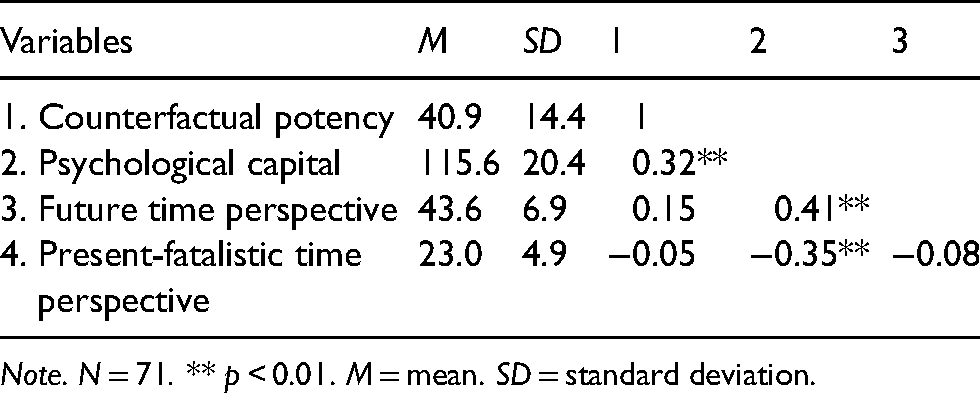
Note. N = 71. ** p < 0.01. M = mean. SD = standard deviation.
Stepwise regression analyses were performed to test whether counterfactual potency predicted unique variance in psychological capital beyond that explained by time perspectives. The results showed that the model was significant when time perspectives and counterfactual potency were added to the regression model in steps 2 and 3. The time perspective variables accounted for 10.1% of the variance. The results in model 3 showed that the β of counterfactual potency on psychological capital in the model was 0.26, counterfactual potency accounted for an additional 6.4% of the variance in psychological capital even after controlling for time perspectives (see Table 2), the R2 of counterfactual potency in model 3 was 0.09, with 95% CI = [0.00, 0.23] (CI-R2-SPSS), and the effect size was f2 = .07. Sensitivity analysis showed the required effect size of f2 = 0.12 (with a sample size of 71, alpha level of 0.05, and power of 0.8).
Regression predicting psychological capital as the result of counterfactual potency and TP (Study 2)

Note. N = 71. FTP = future time perspective. PF = present-fatalistic time perspective. CP = counterfactual potency.
As in Study 1, we conducted further analysis to remove the scores of hope from the scores of psychological capital and found a similar effect. Three participants quit the experiment halfway, and they did not complete the measurement of psychological capital, so we removed these three participants’ data. When we supplemented the data with multiple imputation (Rubin, 1987; Schafer & Graham, 2002), the results of five completed data sets were consistent with our initial results.
In sum, with a different operationalization of the belief in the future, the results found in Study 2 support our hypothesis, even controlling the influence of time perspectives. It was suggested that it might be a reliable way to promote an individual's psychological capital by fostering beliefs in the future, so we designed an intervention experiment in Study 3 to test our hypothesis.
Study 3
To explore whether directing participants to form attainable beliefs in the future through counterfactual thinking would promote their psychological capital, in Study 3, we conducted a short interventional experiment with a control group to further test our hypothesis. Negative affect is usually accompanied by a negative event (Watson et al., 1988). Previous findings have revealed that negative affect is negatively related to psychological capital (Avey et al., 2011; Culbertson et al., 2010). Therefore, in Study 3, we considered negative affect as a potential factor that might influence the observed effect.
Methods
Subjects
University students who had recently experienced negative academic events (such as exam failure, low GPA, or inability to complete a thesis; a preceding questionnaire identified whether the participants had any of these negative events) were recruited. Seventy-six students (27 males, 49 females) took part in this experiment (age M = 21.4 years, SD = 2.8).
Design
A short-term intervention study was conducted to explore whether attainable belief in the future would predict psychological capital. The main content of the intervention was constructing counterfactual thinking with high counterfactual potency in participants’ everyday life for one week. Participants in the control group were directed to write down important academic tasks as well as the progress of tasks each day for one week.
Procedure
The participants were told that they would take part in an experiment for a week and that there would be no danger from participating in the experiment. The students were also told their rights to decide whether to complete the experiment. After the experiment, all participants were debriefed and compensated with CNY100.
The week before the experiment, participants underwent measurements of negative affect and psychological capital. The students were randomly assigned to the experimental group (n = 38) or the control group (n = 38). First, the participants in the experimental group were instructed to learn about the definition, classifications, and examples of counterfactual thinking. Second, the participants were instructed to think counterfactually about how to improve their current negative academic state before they started their academic activities on each day of the week. The participants were required to counterfactually think about these activities at least three times each day and to write down all the counterfactual thoughts on a questionnaire, which was sent to the experimenter each day via smartphone.
Based on the operationalizations of previous experiments, we instructed the participants to engage in upward and self-focused counterfactual thinking. Then, the participants were required to assess the likelihood of their counterfactual thinking to eliminate ineffective counterfactual thinking according to the method introduced by researchers. Finally, when highly likely, upward, and self-focused counterfactual thinking was identified, participants were required to simulate the process of performing actions for the challenge goal. For example, one participant failed in an important exam. He might engage in counterfactual thinking such as “If only the teacher did not give us such difficult questions, then I might have passed,” “If I did more exercises before the exam, then I might have passed,” and “If I did not go to the party before the exam, then I might have passed.” The participant evaluated the counterfactual potency of all three counterfactual thoughts and then identified the counterfactual thinking with the highest counterfactual potency. Hypothetically, the second counterfactual thinking had the highest counterfactual potency. The participant simulated this process in his or her mind, such as how to do exercises and how much time to spend on the exercises. Some individuals might consider the first counterfactual thinking to have the highest counterfactual potency; however, an individual would be unlikely to influence the teacher to give an easier exam. It was suggested that other-focused counterfactuals should be avoided. To achieve a relatively long-term effect, participants repeated these steps each day for a week. Participants were also instructed that each day's counterfactual thinking should be built on the basis of the previous day's behaviors and performances. This continuous counterfactual thinking provided participants with a foundation to clarify which actions were helpful for behavioral regulation or which consequences could actually be obtained as a result of certain actions. Through intentional real-life activities, participants adjusted their counterfactual thinking to reach subgoals. The experimenter checked all the written counterfactual thinking via smartphone the morning after submission and notified participants if there was something wrong with the content of their counterfactual thinking, such as non-self-focused counterfactual thinking or illogical counterfactual thinking. Participants in the control group were directed to write down important academic tasks as well as the progress of tasks each day for one week. After seven days, all participants completed the psychological capital questionnaire again.
Negative affect measurement. Negative affect was measured by a questionnaire based on the Positive and Negative Affect Schedule (Watson et al., 1988). Negative affect was the sum of 10 items (i.e., upset, scared, ashamed, distressed, hostile, irritable, guilty, nervous, jittery, and afraid), each rated on a 5-point scale ranging from 0 (very slightly or not at all) to 4 (extremely). The alpha coefficient for this sample was 0.88.
Psychological capital measurement. Psychological capital was measured twice: before and after the full intervention. The measure of psychological capital was the same as in previous studies. The alpha coefficient for this sample was 0.89 for the pretest and 0.93 for the posttest.
Results and discussion
We used SPSS 26 and JAMOVI 1.6.23 to perform the analysis. To control for preexisting differences in psychological capital between the experimental group and the control group, we conducted an analysis of covariance (ANCOVA) to test for group differences, with the preintervention scores as covariates.
The means and standard deviations of all variables as well as correlations among all variables are reported in Table 3. We compared the mean psychological capital scores of the control group and the experimental group. An ANCOVA examining potential preexisting differences in psychological capital was conducted with psychological capital baseline scores as covariates. ANCOVA revealed a significant effect, F (1, 72) = 6.13, p = .013 (see model 1 in Table 4), partial η2 (η2 p ) = .08, and generalized η2 (η2 G ) = 0.02 (Lakens, 2013), Cohen's d = −0.57, with 95% CI = [ − 1.04, −0.10]. Sensitivity analysis showed the required effect size, partialη2 = .10 (with a sample size of 76, alpha level of 0.05, and power of 0.8). The participants showed a significant increase in psychological capital after the intervention.
Correlations between all variables: Means and standard deviations for the control and experimental groups (Study 3)

Note. N = 76. ** p < .01. PsyCap = psychological capital.
Comparison of the two groups with pretest psychological capital as a covariate (model 1) and comparison of the two groups with pretest psychological capital and negative affect as covariates (model 2) in Study 3
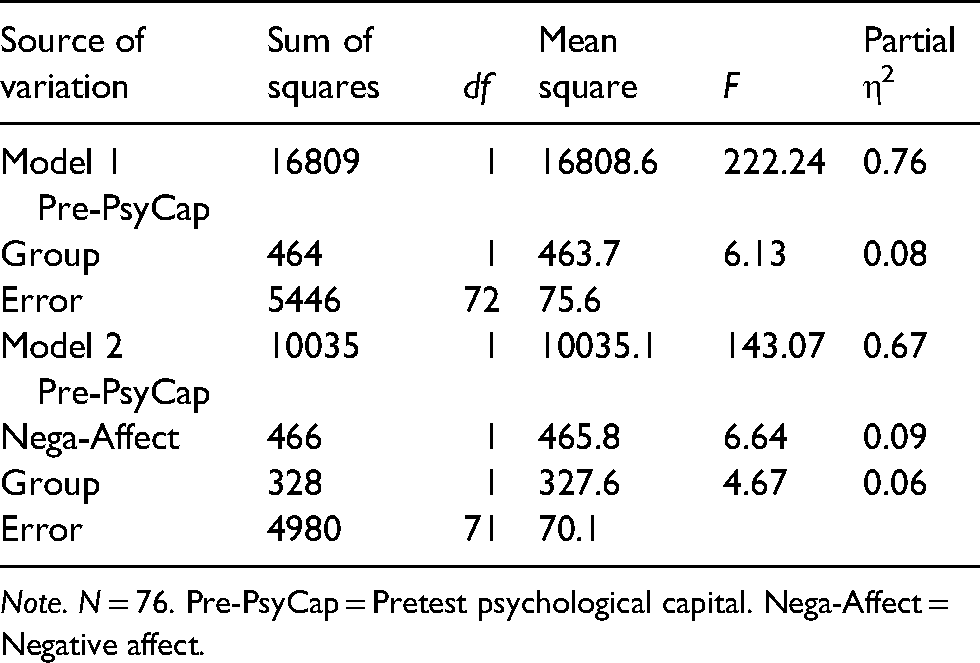
Note. N = 76. Pre-PsyCap = Pretest psychological capital. Nega-Affect = Negative affect.
To rule out the alternative interpretation that the result we found might be the influence of negative affect, we further controlled for negative affect. The results showed that the experimental group had higher psychological capital than the control group when we controlled for both pretested psychological capital and negative affect. ANCOVA revealed a significant effect, F (1, 71) = 4.67, p = 0.034, partial η2 = 0.06 (see model 2 in Table 4), Cohen's d = −0.51, with 95% CI = [ − 0.99, −0.03].
We conducted further analyses by removing the hope scores from the psychological capital scores. ANCOVA revealed a significant effect, F (1, 72) = 5.06, p = 0.028, partial η2 = 0.07, Cohen's d = −0.52, with 95% CI = [ − 0.99, −0.05] (see model 1 in Table 5). We further controlled for pretested hope, and the results showed that the experimental group had higher psychological capital than the control group when controlling for both pretested psychological capital (without hope) and hope. ANCOVA revealed a significant effect, F (1, 71) = 7.21, p = 0.009, partial η2 = 0.10, Cohen's d = −0.62, with 95% CI = [ − 1.10, −0.15] (see model 2 in Table 5). The participants showed a significant increase in psychological capital after the intervention when ruling out the score of hope.
Comparison of the two groups with pretest psychological capital (without hope) as a covariate (model 1) and comparison of the two groups with pretest psychological capital (without hope) and hope as covariates (model 2) in Study 3

Note. N = 76. Pre-PsyCap = Pretest psychological capital (without hope). Pre-Hope = Pretest hope.
When we controlled for the baseline psychological capital, by constructing counterfactual thinking with high counterfactual potency, participants’ psychological capital was promoted. The findings of Study 3 lent further support to our hypothesis.
General discussion
The three studies reported in this article provide consistent evidence that belief in an attainable future promotes psychological capital. This prediction was documented across two different academic contexts (exam failure among first-year students and different academic setbacks within the same duration) and with three different independent manipulations. In Study 1, belief in an attainable future was operationalized as the interaction of incremental theory of intelligence and upward counterfactual thinking. In Study 2, belief in an attainable future was operationalized as counterfactual potency. In addition, we tested its unique contribution with the influence of time perspectives. In Study 3, through an intervention experiment, we demonstrated that beliefs in an attainable future influenced psychological capital.
It is important to note some aspects of our results. First, our findings were observed in the conditions of upward counterfactual thinking and repeatable negative events (academic setbacks), and whether they could be found in other conditions needs further testing. Second, it is belief in counterfactual thinking rather than its content that causes the effect. Third, while present fatalistic and future time perspectives influence psychological capital, belief in an attainable future has unique contributions. Fourth, further analysis revealed that belief in an attainable future influences an individual's positive statements even when ruling out its influence on hope.
Our findings may provide a potential explanation for the effect of thinking about the future found in the literature. When people believe that the future is attainable, their psychological capital will be higher, thereby producing positive affect, motivation, and better performance (Hoyle & Sherrill, 2006; Oettingen, 2012).
The current findings provide a new perspective to explore the antecedents of psychological capital, that is, how to make individuals perceive the future as attainable. Our findings also provide a new lens to construct interventions for psychological capital. By forming attainable beliefs in the future, people may quickly develop a higher level of psychological capital without developing its four elements.
The current research has some practical implications. For example, these results can provide suggestions to form attainable beliefs in the future and to economically promote personal psychological capital in everyday life. By evaluating future attainability and strategically using the effect of higher belief in an attainable future through counterfactual thinking, people can achieve a higher level of psychological capital.
Limitations and future research directions
There are several limitations of this study. First, some effect sizes we observed were smaller than those required by sensitivity analysis, and the results should be considered with caution (Gelman, 2019; Richard et al., 2003). A more accurate estimation would be obtained through a meta-analysis. Second, our sample consisted of college students, who might have a relatively higher ability to think counterfactually; therefore, whether the results can be generalized to other populations needs to be further tested. Third, the treatment of the control groups was relatively simple. In our experimental group, counterfactual thinking was noted as a component of the intervention. Although we proposed that this action would naturally follow beliefs about an attainable future, it was necessary to use another control group that had relatively pure beliefs in an attainable future without noting specific action to rule out other influences. Fourth, in Study 1, we did not control the content of counterfactual thinking, so it might be possible that not all counterfactual thinking was about effort. In addition, we did not match the participants by sex and psychological capital. This might influence the effect we observed. Fifth, in Study 2, the participants were required to evaluate counterfactual potency according to a counterfactual thinking list, and this process might limit the participants from engaging in counterfactual thinking automatically and completely, thereby influencing the effect. Finally, we do not know whether the effect of belief in an attainable future on psychological capital lasts for a longer period of time because we only observed the effect for a one-week period.
Our consistent findings suggest that it is reasonable to embody psychological capital within self-related theories (such as the future possible self). Future research might broaden this line of exploration in the domain of self-related theories. For example, from the perspective of self-expansion theory (Aron et al., 1992; Shedlosky-Shoemaker et al., 2014), belief in an attainable future means that a future self is included in the current self, and this inclusion would expand the current self. Future research can further explore whether including others/things into the self would promote psychological capital.
Judging whether the future is attainable is an important aspect of making sense of the self and the world. By judging that the future is attainable, people can perceive a sense of coherence (Antonovsky, 1987; Costin & Vignoles, 2019; Martela & Steger, 2016). A sense of coherence is one facet of meaning in life (Costin & Vignoles, 2019; Martela & Steger, 2016). Future research can further explore the relationship between the sense of coherence in particular, the meaning of life in general, and psychological capital.
In a world where failure occurs more frequently than success, to maintain a continuous positive developmental state, people must find ways to believe that a better future is attainable and overcome the negative effects of setbacks.
Footnotes
Author contributions
LW and CW proposed the main research idea. CHW and LW made the research design. CW ran the experiments. CW did the statistic analysis. CW and LW wrote the manuscript.
Declaration of conflicting interests
The author(s) declared no potential conflicts of interest with respect to the research, authorship, and/or publication of this article.
Funding
The author(s) disclosed receipt of the following financial support for the research, authorship, and/or publication of this article: This work was supported by the National Natural Science Foundation of China (grant numbers 71021001, 91224008, and 91324201), and Beijing Well-being Foundation (Grant #0020344).
