




Abstract
Psychological capital (PsyCap) is a higher-order construct comprising hope, efficacy, optimism, and resiliency, which has attracted more and more attention from both academics and practitioners. Despite promising progress made in the PsyCap literature, the underlying mechanisms linking PsyCap to organizational outcomes still need more investigation utilizing longitudinal research design. Moreover, the reciprocal relationships between PsyCap and positive affect require more attention. Therefore, we aim to test the central role of positive affect in the relationships between PsyCap and affective organizational commitment (AOC) on one hand and organizational citizenship behaviour toward organization (OCBO) on the other hand as well as the reciprocal relationships between PsyCap and positive affect in this study. A three-wave longitudinal survey was conducted using a cross-lagged panel design with a one-month time lag between two consecutive waves. Panel data was collected from 208 workers in Beijing, China. The results support the hypothesis that positive affect serves as a mediator in the relationships between PsyCap and OCBO. Moreover, we also find some support for a reciprocal relationship between PsyCap and positive affect. The theoretical and practical implications of the findings are also discussed.
Keywords
Psychological capital (PsyCap) is an important personal resource and has been found to be beneficial to a variety of work-related outcomes among different countries (Carmona-Halty, Salanova, Llorens, & Schaufeli, 2019; Gupta, Shaheen, & Reddy, 2017; Luthans, Norman, Avolio, & Avey, 2008; Luthans, Youssef, & Avolio, 2015). Meta-analytic studies (Avey, Reichard, Luthans, & Mhatre, 2011; Kong et al., 2018) have indicated the significant positive relationships between PsyCap and desirable employee attitudes (job satisfaction, organizational commitment, psychological well-being), desirable employee behaviours (citizenship), and multiple measures of performance (self, supervisor, and objective evaluations). Among these outcomes related to PsyCap, affective organizational commitment (AOC) and organizational citizenship behaviours toward organization (OCBO) have drawn attention from researchers of this study as they are essential to organizational vitality, effectiveness, and productivity (Mathieu & Zajac, 1990; N. P. Podsakoff, Whiting, Podsakoff, & Blume, 2009).
Some positive associations have been found between PsyCap and AOC (Avey, Luthans, & Youssef, 2010; Çetin, 2011; Lather & Kaur, 2015), and also between PsyCap and OCB (Chamisa, Mjoli, & Mhlanga, 2020; Norman, Avey, Nimnicht, & Graber Pigeon, 2010). Despite that dearth, research has begun to examine potential mediators of the PsyCap-outcomes relationships such as psychological empowerment (Avey, Hughes, Norman, & Luthans, 2008) and work engagement (Gupta et al., 2017). However, research in this area is still underdeveloped. Theoretically, although several potential mechanisms through which PsyCap operates have been identified, these are conceptual in nature and have not yet been fully operationalized or closely examined empirically (Luthans & Youssef-Morgan, 2017; Newman, Ucbasaran, Zhu, & Hirst, 2014). For example, the emergence and sustenance of positive affect as an element and by-product of PsyCap, and the resultant broadening and building effects, are worthy of further empirical exploration (Luthans & Youssef-Morgan, 2017).
Moreover, we find that the empirical results on the relationship between PsyCap and positive affect are mixed. For instance, some research has demonstrated that positive affect generally mediated the relationship between psychological capital and attitudes and behaviours (e.g., Avey, Wernsing, & Luthans, 2008; King, Pitliya, & Datu, 2020), while other research has suggested that academic psychological capital mediated the relationship between positive affect and academic performance (Carmona-Halty et al., 2019), suggesting a reciprocal relationship between PsyCap and positive affect may exist when examining the effect of PsyCap on attitudes and behaviours. Therefore, we aim to examine the reciprocal relationships between PsyCap and positive affect.
In addition, most of the previous research on PsyCap is based on cross-sectional data (e.g., Avey, Luthans, et al., 2010; Avey, Nimnicht, & Pigeon, 2010; with exceptions: Carter & Youssef‐Morgan, 2019; Datu, King, & Valdez, 2018; Peterson, Luthans, Avolio, Walumbwa, & Zhang, 2011; P. Williams, Kern, & Waters, 2015), which precludes conclusive evidence regarding causal direction (Luthans & Youssef-Morgan, 2017). To our best knowledge, few studies have examined the mechanisms in the relationships between PsyCap and AOC on one hand, OCBO on the other hand using longitudinal data. To answer the call from Avey, Luthans, and Mhatre (2008) for using longitudinal designs to test theory-driven hypotheses related to PsyCap, the present study adopts a three-wave cross-lagged panel design to explore the mechanisms through which PsyCap impacts AOC and OCBO. As suggested by previous researchers (Cole & Maxwell, 2003; Jose, 2016), the causal chain of predictor, mediator, and outcome can only truly be demonstrated with at least three-wave panel designs when using non-experimental methods.
To conclude, this study aims to examine (1) the mediating effect of positive affect in the relationships between PsyCap and AOC, and between PsyCap and OCBO, and (2) the reciprocal relationships between PsyCap and positive affect using a three-wave cross-lagged panel design.
Theory and Hypotheses
PsyCap, AOC, and OCBO
With the development of positive psychology (Seligman & Csikszentmihalyi, 2000), Luthans (2002) proposed a framework of positive organizational behaviour (POB) in which positive-oriented human strengths and psychological capacities that can be measured, developed, and effectively managed are applied to improve performance in the workplace. Four positive constructs, namely hope, efficacy, optimism, and resilience, have been identified to best meet the criteria of the definition of POB (Luthans, Youssef, & Avolio, 2007). When combined, these four have conceptually (Luthans, Youssef, et al., 2007) and empirically (Luthans, Avolio, Avey, & Norman, 2007) demonstrated a second-order, core factor called psychological capital (PsyCap). PsyCap is state-like and “characterized by (1) having confidence (self-efficacy) to take on and put in the necessary effort to succeed at challenging tasks; (2) making a positive attribution (optimism) about succeeding now and in the future; (3) persevering towards goals, and when necessary, redirecting paths to goals (hope) in order to succeed; and (4) when beset by problems and adversity, sustaining and bouncing back and even beyond (resiliency) to attain success” (Luthans, Youssef, et al., 2007, p. 3).
PsyCap is proposed as a common underlying capacity considered critical to human motivation, cognitive processing, striving for success, and resulting performance in the workplace (Peterson et al., 2011). Consistent with the guidelines for “theory borrowing” suggested by Whetten, Felin, and King (2009), PsyCap draws its foundation and explanatory mechanisms from theory building in work motivation (Stajkovic, 2006), positive psychology (Lopez & Snyder, 2009), and Bandura’s social cognition (1986, 1997) and agentic (2008) theories, mainly drawing from psychological resource theory (Avey et al., 2011). Specifically, psychological resource theories such as conservation of resources (COR) theory (Hobfoll, 2002; Wright & Hobfoll, 2004) can be used to explain how employees are motivated to acquire, maintain, and foster the necessary resources as found in psychological capital to attain successful performance outcomes.
A growing number of empirical studies have shown that PsyCap has positive impacts on desirable outcomes in the workplace (Avey et al., 2011; Luthans & Youssef-Morgan, 2017; Newman et al., 2014), such as job satisfaction, work engagement, AOC, and OCB. Moreover, PsyCap, as a higher-order core construct, will prevent employees’ suffering from work stress (Meichenbaum, 2017) and the positive psychological states motivate individuals to exert greater effort and perform well in their job (Newman et al., 2014).
Our study focuses on examining the influence of PsyCap on organizational outcomes, such as AOC and OCBO. AOC reflects an individual’s desire to remain a part of the organizations; it also reflects a willingness to exert effort, and a belief in and acceptance of the values and goals of the organization (Lu, Siu, & Lu, 2010). Numerous studies have found that AOC is negatively associated with turnover (Meyer, Stanley, Herscovitch, & Topolnytsky, 2002), in which case it is an important variable to predict the stability of organizations. AOC has been suggested as the restrictive use of the three-component model of organizational commitment (Meyer & Allen, 1991) to an attitude toward the organization rather than attitudes toward specific forms or behaviour (i.e., normative commitment and continuance commitment) (Solinger, Van Olffen, & Roe, 2008). In particular, AOC is relevant to Chinese employees because this attitudinal construct is similar to the Chinese value of “loyalty” to the group (K. Yang & Yang, 1987), which, as has been shown through studies in the Greater China Region (Lu et al., 2010), could protect Chinese workers from stress.
Moreover, organizational effectiveness depends on more than simply maintaining a stable workforce; employees must perform assigned duties dependably and be willing to engage in activities that go beyond role requirements. OCBs have been found to be related to a number of organizational-level outcomes such as productivity and efficiency (N. P. Podsakoff et al., 2009). Organ (1988) originally proposed a five-factor OCB model consisting of altruism, courtesy, conscientiousness, civic virtue, and sportsmanship. Later, he refined OCBs as behaviours that contribute “to the maintenance and enhancement of the social and psychological context that support task performance” (Organ, 1997, p. 91). Larry Williams and Anderson (1991) suggested that organizational citizenship behaviours directed toward individuals (OCBI) are distinct from organizational citizenship behaviours directed toward the organization (OCBO). Similarly, Coleman and Borman (2000) found that organizational citizenship performance, referring to behaviour that benefits the organization and including Organ’s sportsmanship, civic virtue, and conscientiousness dimensions, is similar to OCBO (L. J. Williams & Anderson, 1991). Meanwhile, interpersonal citizenship performance, referring to behaviour that benefits other organizational members and including Organ’s (1988) altruism and courtesy dimensions, is similar to OCBI.
A number of empirical studies have also supported the positive relationships between PsyCap and AOC (Larson & Luthans, 2006; Luthans, Norman, et al., 2008) and OCBs (Norman et al., 2010). For example, a meta-analysis (Avey et al., 2011) indicated the expected significant positive relationships between PsyCap and desirable employee attitudes (such as organizational commitment), and desirable employee behaviours (such as citizenship). Given that the majority of the previous research relied on cross-sectional studies, we utilize a three-wave cross-lagged design to examine the relationships between PsyCap and AOC, PsyCap and OCBO. Therefore, we predict that: Hypothesis 1a: PsyCap at T1 is positively related to AOC at T3. Hypothesis 1b: PsyCap at T1 is positively related to OCBO at T3.
Mediating Role of Positive Affect in relation to AOC and OCBO
The workplace is a rich arena for the manifestation of human affect, both positive and negative (Muchinsky, 2000). Based on Luthans and Youssef-Morgan (2017), positive affect is one of the four theoretical mechanisms recognized for PsyCap. However, these mechanisms are conceptual in nature and have not yet been fully operationalized or closely examined empirically. Therefore, there is a need to operationalize identified conceptual mechanisms into measurable mediators that can be tested for a better understanding of how PsyCap leads to desirable outcomes (Luthans & Youssef-Morgan, 2017).
Affect refers to a mental state involving evaluative feelings (Parkinson, Totterdell, Briner, & Reynolds, 1996), and positive affect is elicited particularly when individuals are in pleasant situations (Fredrickson, 2001). It is an umbrella term that includes a wide range of dispositions, moods, emotions, and generalized affective reactions to events, objects, and daily experiences (Eby, Maher, & Butts, 2010). According to affective events theory (Weiss & Cropanzano, 1996), affective reactions play a mediating role between work events and work attitudes on one hand and work behaviours on the other hand. Besides, personal dispositions can also directly influence the way events produce affective reactions (Weiss & Cropanzano, 1996). It is widely demonstrated that PsyCap, as a state-like personal resource, is malleable and open to development but relatively more stable than, for example, emotions (Luthans, Avolio, et al., 2007). In that case, we believe that the positive nature of PsyCap can trigger positive affective states that will facilitate broadening one’s thought-action repertoires (Fredrickson, 2001, 2009). Specifically, employees with high PsyCap are optimistic and efficacious in getting their work done. When they encounter difficulties, resilient employees tend to find alternative approaches and bounce back quickly from adversity, conflict, and failures, which represents the development of positive adaptation patterns and processes to overcome adversities or risk factors by capitalizing on personal, social, or psychological assets (Masten, Cutuli, Herbers, & Reed, 2009). Hence, with the above psychological capacities, employees are likely to perceive their work favourably, which might enhance their overall positive affect.
It is conceivable that when they experience more positive affect, employees are likely to commit longer to the organization. Some research has shown that PsyCap leads to positive affect, which in turn leads to positive attitudes and behaviours (Avey, Wernsing, et al., 2008). In addition, a series of studies have suggested that positive affect reduces counterproductive work behaviour and increases OCBs (Bateman & Organ, 1983; Norman et al., 2010; Spector & Fox, 2002, 2010). Hence, we propose that positive affect mediates the relationships between PsyCap and AOC, and also between PsyCap and OCBO.
However, prior study (e.g., Lather & Kaur, 2015; Ramalu & Janadari, 2020) is limited in adopting the cross-sectional design, leaving the mediating process remaining unclear. In order to address this limitation, our study adopts a three-wave design to explore the mediating role of positive affect in the relationships between PsyCap and AOC and OCBO. Following previous research on longitudinal test of mediation (Cole & Maxwell, 2003), we hypothesize that: Hypothesis 2a: Positive affect at T2 mediates the relationship between PsyCap at T1 and AOC at T3. Hypothesis 2b: Positive affect at T2 mediates the relationship between PsyCap at T1 and OCBO at T3.
Reciprocal Relationships between PsyCap and Positive Affect
Hypothesis 2 implies that PsyCap predicts positive affect. Yet the relationship between PsyCap and positive affect may be more complex. It is also plausible that positive affect may enhance PsyCap as well (Carmona–Halty, Salanova, Llorens, & Schaufeli, 2019; Siu, Cheung, & Lui, 2015). As it was noted in the broaden-and-build theory (Fredrickson, 2001, 2004), positive affect helps to build resources, including physical, intellectual, interpersonal, and psychological resources. As PsyCap is conceptualized as a psychological resource, positive affect may influence PsyCap in a similar way. Specifically, positive affect broadens the mind, making it more likely for individuals to seek knowledge and explore their surrounding environment. Accordingly, individuals will be more likely to engage in physical exercise and acquire physical skills (Fredrickson, 2004). At the same time, individuals have more opportunity to interact with others, and when people express positive affect towards others, they are more likely to receive support from them, which in turn helps people build personal confidence or self-efficiency. Furthermore, positive affect help individuals to cope with setbacks by fuelling their psychological capacities and improving their psychological well-being (Fredrickson, 2004). For instance, researchers found that individuals with higher levels of positive affect before a stressful task were more resilient in the task; and resilience belongs to a core construct of PsyCap (Tugade & Fredrickson, 2007; Tugade, Fredrickson, & Feldman Barrett, 2004). Thus, according to the broaden-and-build theory, positive affect can be associated with building more personal resources such as physical, intellectual, interpersonal, and psychological strengths (Fredrickson, 2001, 2004), which also includes PsyCap.
Therefore, it is possible that the relationship between PsyCap and positive affect may be reciprocal. More generally speaking, PsyCap emphasizes the cognitive aspects while positive affect emphasizes the affective aspects of employees. It has long been debated whether affect precedes cognition or cognition triggers affect (Lazarus, 2006), yet no consensus has been achieved to date. Nonetheless, most researchers would agree that affect and cognition mutually and closely interact (Izard, 2009; Lindquist, Wager, Hedy, Eliza, & Lisa Feldman, 2012). As the empirical findings of the relationships between PsyCap and positive affect are mixed, we, therefore, intend to examine the reciprocal relationship between PsyCap and positive affect with three-wave data and propose a research question:
Research question 1: Is positive affect at T1 positively related to PsyCap at T2 and positive affect at T2 positively related to PsyCap at T3?
Method
A three-wave self-administered questionnaire method was adopted, with a one-month time lag between measurements. Following previous research (Cote & Morgan, 2002), a time-lag of one-month was chosen because it allowed enough time for work outcomes of positive affective attitude and citizenship behaviour to change. As PsyCap is state-like, we believe a one-month time lag is appropriate for investigating their reciprocal relationship and their effects on AOC and OCBO.
Participants and Procedures
The study was conducted in accordance with the Declaration of Helsinki, and the protocol was approved by Institutional Review Board of the Faculty of Psychology, BNU. All subjects gave their informed consent for inclusion before they participated in the study. The sample was recruited from full-time employees from various occupations attending different part-time courses in the School of Continuing Education at Beijing Normal University, China. They were instructed that this study was designed to investigate employees’ psychological states in the workplace. Participation in the survey was voluntary; the informed consent was on the first page of the paper questionnaire. Participants were ensured that the survey was anonymous and the data collected would be kept confidential. Those who volunteered to participate in the study were asked to complete the paper questionnaires in class. Moreover, they were asked to create a code so that data measured at Time 1, Time 2, and Time 3 could be linked.
The data were collected at one-month intervals (from March to May 2012). At Time 1, Time 2, and Time 3, respectively, 277, 286, and 267 questionnaires were collected, of which 265, 267, and 251 took part at all three time points, making the respective response rates 95.67%, 93.36%, and 94.01%. Data from participants who failed to complete at least two-thirds of the items at any time point were deleted. Additionally, at each wave of data collection, participants were asked, “Have any significant events caused turbulence in your affect in the past month? If so, please rate how much the events affected you on a 5-point scale.” Data from participants who had experienced significant affective events (i.e. scoring 4 or 5 on the 5-point scale) were removed. Finally, there were 208 matched participants who took part at all three time points, of whom 65.4% were female; 38.5% were aged between 20 to 25, 34.6% aged between 26 to 30, and 19.2% aged between 31 to 40; 44.7% were married; 37.5% had graduated from junior college and 62.5% had a bachelor’s degree; 20.8% had worked less than 3 years, 55.8% between 3 to 10 years, and 22.1% more than 10 years.
Measures
PsyCap, positive affect, AOC, and OCBO were assessed at all three time points. Demographic characteristics were only measured at Time 1.
Results
Measurement Models and Descriptive Statistics
We employed SPSS 26 and Mplus 8.3 to analyse the data. Given our relatively small sample size compared to the number of items, we constructed item parcels in Confirmatory Factor Analysis (CFA) as parcelling is often recommended in the common context of low item communalities and/or small samples (e.g., Sterba & Rights, 2016; C. Yang, Nay, & Hoyle, 2010). Compared with item-level models, parcel-level models have higher communalities and fewer estimated parameters, and may have lower risk of convergence problems (Little, Rhemtulla, Gibson, & Schoemann, 2013). In this study, PsyCap had four manifest indicators – resilience, self-efficacy, hope, and optimism – while three indicators were randomly formed for positive affect, AOC, and OCBO (see Appendix A). We specified all twelve latent variables (PsyCap, positive affect, AOC, and OCBO at Time 1, Time 2, and Time 3) into a single CFA. As suggested in previous studies (Brown, 2006; Ng & Feldman, 2012), the measurement model allowed error variances of the same indicators used across time points to be correlated to account for their non-independence. The results showed that the twelve-factor model provided a good fit with the data (χ2 (630) = 1309.91, p < .001; RMSEA = .07, CFI= .90; SRMR= .06). These results indicated that all of the study variables were distinct and measured in a consistent way at different time points. Table 1 presented the descriptive statistics, including the means and standard deviations and the correlations of the variables across the three time points.
Descriptive statistics and intercorrelations among main variables.
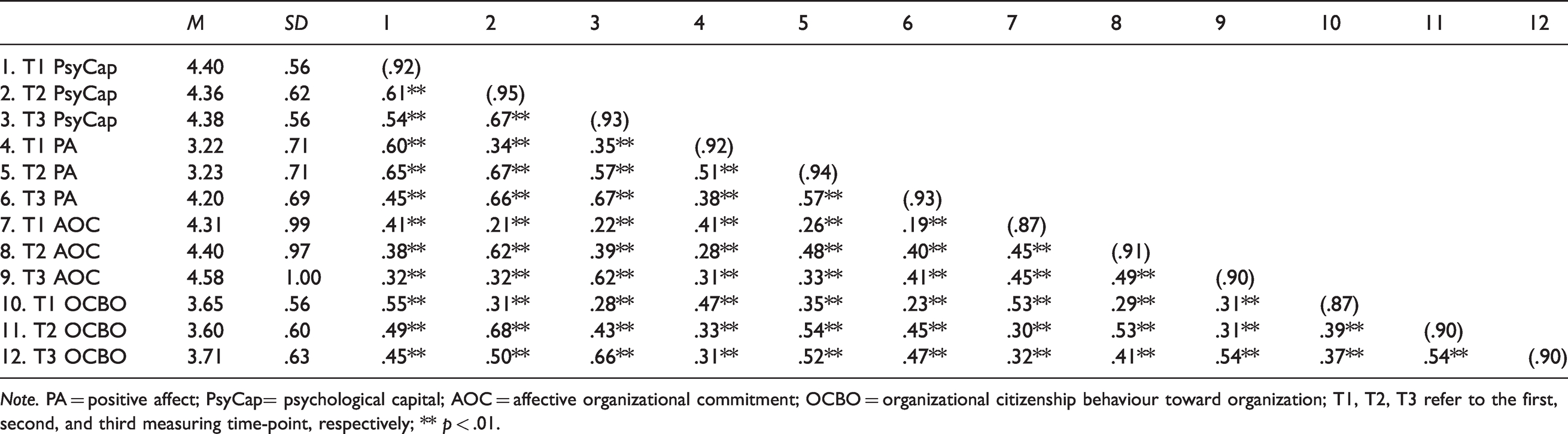
Note. PA = positive affect; PsyCap= psychological capital; AOC = affective organizational commitment; OCBO = organizational citizenship behaviour toward organization; T1, T2, T3 refer to the first, second, and third measuring time-point, respectively; ** p < .01.
Common Method Variance
As all of the variables in the present study were measured using self-report questionnaires targeting the same group of participants, there might be a problem with common method bias in the data. It is suggested by Philip Podsakoff, MacKenzie, Lee, and Nathan Podsakoff (2003) that in order to detect common method bias, a latent common method variance factor can be included and specified in the CFA model. Measurement items were allowed to load both on their underlying theoretical factors and on a latent common method factor. In addition, the correlations between the common method factor and other factors (i.e., PsyCap, positive affect, AOC, and OCBO) were constrained to zero. We compared the patterns of the significance of the factor loadings and factor correlations observed in the CFA model excluding a common method factor with those observed in the CFA model including the common method factor. We detected the common method bias for data at Times 1–3 separately. The results showed that there were no major changes in patterns of significant results after including the common method factor at Time 1. We repeated these procedures for the data at Times 2 and Time 3 and found that all of the factor loadings remained significant after the inclusion of the common method factor. Thus, common method variance was not a serious threat to any survey wave. In addition, the error variances of the same indicators have been correlated over time in both the comprehensive CFA model and the cross-lagged model.
Structural Models
We tested our hypotheses separately for AOC and OCBO (see Figures 1 and 2 for the hypothesized models). We also compared two alternative models with the proposed models. As can be seen in Table 2, the proposed model of AOC (i.e., Model 1) was better than Model 2 (i.e., an alternative model, which constrained the paths from PsyCap to positive affect and the paths from positive affect to AOC to be zero) and Model 3 (i.e., an alternative model, which constrained the paths from positive affect to PsyCap and the paths from PsyCap to AOC to be zero). Similarly, the proposed model of OCBO (i.e., Model 4) was better than Model 5 (i.e., an alternative model, which constrained the paths from PsyCap to positive affect and the paths from positive affect to OCBO to be zero) and Model 6 (i.e., an alternative model, which constrained the paths from positive affect to PsyCap and the paths from PsyCap to OCBO to be zero). For all the models, we included the autoregressive paths (i.e., stability effect), meaning that we investigate and predict changes over time, thereby strengthening our conclusions.

Results of the proposed model of AOC.

Results of the proposed model of OCBO.
Fit indices of structural models.

Notes. Model 1 and Model 4 are the proposed models. Model 2 and Model 3 are nested in Model 1; Model 5 and Model 6 are nested in Model 4. Chi-square difference test was used when comparing nested models. RMSEA = Root Mean Square Error of Approximation; CFI = Comparative Fit Index; SRMR = Standardized Root Mean Square residual; NNFI = Non-Normed Fit Index; PA = positive affect; PsyCap= psychological capital; AOC = affective organizational commitment; OCBO = organizational citizenship behaviour toward organization.
The results of the hypothesized models for AOC and OCBO were presented in Figure 1 and Figure 2, respectively. As shown in Figure 1, T1 PsyCap was not positively related to T3 AOC (β = .09, p = .86). Moreover, T1 PsyCap was not significantly related to T3 OCBO (β = .04, p = .46). Therefore, both Hypothesis 1a and Hypothesis 1b were not supported.
Hypothesis 2 predicts that positive affect mediates the relationship between PsyCap and AOC and OCBO. We included the test of indirect effect in the models using bootstrapping. Bootstrapping is a statistical re-sampling method that estimates the parameters of a model and their standard errors strictly from the sample (Preacher & Hayes, 2008). We extracted new samples (with replacement) from our sample 1,000 times and calculated the indirect effects we proposed. In line with our expectations, the bootstrap analyses confirmed the indirect effect of T1 PsyCap on T3 OCBO through T2 positive affect (bootstrap estimate = .07, standard error = .04, 95% CI [.01,.17]). Meanwhile, the indirect effect of T1 PsyCap on T3 AOC through T2 positive affect was not supported (bootstrap estimate = .01, standard error = .08, 95% CI [−.11,.13]). Thus, Hypothesis 2a was not supported while Hypothesis 2b was supported.
Research question 1 in our study intends to figure out whether positive affect at T1 is positively related to PsyCap at T2, and similarly from T2 to T3. Figure 1 showed that T1 positive affect did not relate to T2 PsyCap (β = −.11, p = −1.05) and T2 positive affect also did not significantly relate to T3 PsyCap (β = .10, p = 1.02) in the AOC model. Figure 2 showed that T1 positive affect was not significantly related to T2 PsyCap (β = −.07, p = .42) but T2 positive affect was significantly related to T3 PsyCap (β = .14, p < .05) in the OCBO model. Thus, research question 1 was partially proved.
Discussion
The present study adopted a three-wave cross-lagged method to investigate (1) the mediating effect of positive affect in the relationships between PsyCap and AOC, and between PsyCap and OCBO, and (2) the reciprocal relationships between PsyCap and positive affect. Our findings suggested that T2 positive affect served as a mediator in the relationships between T1 PsyCap and T3 OCBO, but not in the relationship between T1 PsyCap and T3 AOC. Moreover, we also found partial support for a cross-lagged reciprocal relationship between PsyCap and positive affect, that is, between T2 Psycap and T3 positive affect in the OCBO model. However, we did not find support for the cross-lagged effect between T1 PsyCap and T3 AOC, or between T1 PsyCap and T3 OCBO.
Our results regarding the mediating role of positive affect to some degree corroborated the cross-sectional study in which positive affect mediated the relationship between PsyCap and organizational attitudes and behaviours, such as engagement, cynicism, organizational citizenship, and deviance (Avey, Wernsing, et al., 2008). Our study has contributed to the literature by providing longitudinal evidence for the mediating effect of positive affect in the relationship between PsyCap and OCBO, supporting the emotion-centred model (Spector & Fox, 2002). While no cross-lagged mediating effect of positive affect between PsyCap and AOC was found in our study, we found strong support for the cross-lagged effect of PsyCap on positive affect. The reason why the paths from positive affect to AOC are not significant is maybe that there exist other mechanisms between PsyCap and AOC. As Luthans and Youssef-Morgan (2017) have summarized, four potential mechanisms of PsyCap may exist, namely, agentic conation, cognitive appraisals, positive affect, and social mechanisms. It is possible that cognitive appraisals are more reasonable than positive affect to explain the mechanism between PsyCap and AOC. Through positive cognitive appraisals, potentially negative or neutral situations are mentally reframed and reinterpreted in a more positive light. Therefore, future research may consider examine other potential mechanisms of PsyCap. Another explanation is that we did not control the effect of work experience variables in our research model. Regarding the definition and antecedents of AOC, both personal characteristics and work experience can be antecedents of AOC (Meyer et al., 2002). Therefore, future research may benefit from including control variables such as job characteristics in examining the effect of positive affect on AOC. To conclude, more longitudinal studies are needed to examine the mechanisms of positive affect between PsyCap and outcomes.
Another contribution of the study is that it provides some empirical evidence for the reciprocal relationships between positive affect and PsyCap (cognitive resource) advocated by the broaden-and-build theory of positive affect (Fredrickson, 2001, 2004). As argued earlier, very little previous empirical evidence has been presented in support of the broaden-and-build theory in the organizational context, and even fewer studies have empirically tested the dynamic reciprocal relationship between positive affect and psychological resources (PsyCap). Some researchers found the effect of PsyCap on positive affect (Avey, Wernsing, et al., 2008), whereas others Siu et al. (2015) found that PsyCap mediated the relationships between positive affect and the two components of work well-being (job satisfaction and stress symptoms), painting a more complex picture of the interplay between PsyCap, positive affect, and organizational outcomes. Our results to some degree reconcile prior mixed findings by showing the reciprocal relationship between PsyCap and positive affect. We call for more future research to further examine the reciprocal relationships.
Last but not least, this is one of the very few studies that tested the effect of a one-month time lag in PsyCap and positive affect research. As PsyCap is considered to be a state-like construct (Luthans & Youssef-Morgan, 2017), a one-month time lag is appropriate (Siu, 2013). In other words, one month is sufficient for work outcomes of positive affective attitude and citizenship behaviours to change. It is important to understand how state-like capacities of PsyCap and positive affect can build on each other to influence positive work attitudes and behaviours. However, it is rare to see how these two state-like constructs influence AOC and OCBO. The present study thus provides theoretical contribution to our understanding of the dynamic relationships between PsyCap, positive affect, and individual cooperative attitudes and behaviours.
Limitations and Future Research
Compared with cross-sectional studies, a cross-lagged study possesses obvious advantages for exploring the dynamic relationship between PsyCap and positive affect. However, our study still cannot confirm cause-and-effect relationships. In the future, experimental evidence is needed to promote conclusive evidence regarding casual direction (Luthans & Youssef-Morgan, 2017). Also, more intervention studies can help better understand the effect of PsyCap on work-related attitudes and behaviours.
Another limitation of our study is that we did not include any control variables such as job characteristics in the research model. Last but not least, our study used self-reported scales for all the variables. Yet self-reporting seems to be an appropriate way to assess PsyCap and AOC. Although a meta-analysis showed that a self-rating of OCBO is, to a large extent, consistent with other ratings of OCBO (Carpenter, Berry, & Houston, 2014), future studies may want to adopt other ratings of OCBO to verify the generalizability of our findings.
Practical Implications
The results of the present study highlight the upwardly spiralling relationship between psychological capital and positive affect and their impact on OCBO. These results suggest that in human resources management practices, both psychological capital and positive affect could be the focus of intervention to effectively ameliorate employees’ job attitudes and performance behaviours. As PsyCap consists of state-like capacities/resources susceptible to training, HR practitioners and managers in organizations can provide more training to supervisors who can then serve as role models to their subordinates. Training components should include the importance of positive affect (e.g., humour in the workplace) on physical and psychological well-being, and how positive affect relate to each of the state-like components of PsyCap (Luthans, Avey, & Patera, 2008). In other words, an emphasis should be put on the mechanism of how positive affect help individuals to cope with setbacks by improving the fuelling of their psychological capacities and psychological well-being.
Supplemental Material
sj-pdf-1-pac-10.1177_18344909211010514 - Supplemental material for Psychological Capital, Positive Affect, and Organizational Outcomes
Supplemental material, sj-pdf-1-pac-10.1177_18344909211010514 for Psychological Capital, Positive Affect, and Organizational Outcomes by Shu Da, Ze Zhu, Hongyu Cen, Xianmin Gong, Oi Ling Siu and Xichao Zhang in Journal of Pacific Rim Psychology
Footnotes
Acknowledgement
The authors are grateful to the editor and two anonymous reviewers for their constructive comments.
Declaration of Conflicting Interests
The authors declared no potential conflicts of interest with respect to the research, authorship, and/or publication of this article.
Funding
The author(s) disclosed receipt of the following financial support for the research, authorship, and/or publication of this article: This research was funded by Research on National Key R&D Program of China, grant number 2018YFC0810600.
Supplemental material
Supplemental material for this article is available online.

References
Supplementary Material
Please find the following supplemental material available below.
For Open Access articles published under a Creative Commons License, all supplemental material carries the same license as the article it is associated with.
For non-Open Access articles published, all supplemental material carries a non-exclusive license, and permission requests for re-use of supplemental material or any part of supplemental material shall be sent directly to the copyright owner as specified in the copyright notice associated with the article.
