




Abstract
This article centres around two concepts: public values and regulatory disconnection. It provides a study of the potential tensions Dutch distribution system operators (DSOs) encounter in their role as safeguarders of energy sector public values. The article elaborates how these public values tensions can be traced back to current energy sector legislation not being able to keep up with the energy transition. DSOs have the statutory task of safeguarding public values (understood as ‘properties of utility services’), such as availability, affordability and safety. They are expected to safeguard these public values in such a way that a certain balance between them is maintained. Based on interviews with Dutch sector representatives and an expert panel survey, we show that DSOs do strive for a balance between public values, but that the energy transition makes achieving it more difficult. Three cases were selected where DSOs apparently struggle. We find that the energy sector legislation DSOs have to comply with in these cases does not always account for the impact of the energy transition, thus constituting a regulatory disconnection. The discrepancy between the legislator’s and DSO’s intentions and the DSO’s daily practice would suggest additional research into mechanisms that may facilitate DSOs in conducting a more explicit trade-off, which would produce a public value treatment that is sustainable in terms of social acceptance. This would help secure the energy transition its much needed public support.
Introduction
The energy distribution network reaches into the capillaries of society. It literally penetrates into houses, office buildings and factories. The fundamental changes currently taking place in the energy sector have a noticeable impact on its use and, as a consequence, on the role of the distribution system operator (DSO). This article focuses on the DSO in the Netherlands, whose role in the transformation of the Dutch energy sector currently is subject to much debate. 1 The Dutch Electricity Act 1998 2 (E-Act) and the Gas Act 3 (G-Act) both contain a detailed catalogue of the DSO’s responsibilities. In sum, the DSO has to plan, build and maintain the distribution network, provide connection to the network, transport electricity and gas through the network and safeguard the safety and reliability of the network in the most efficient and sustainable fashion (Article 16, E-Act; Article 10, G-Act) (Figure 1).
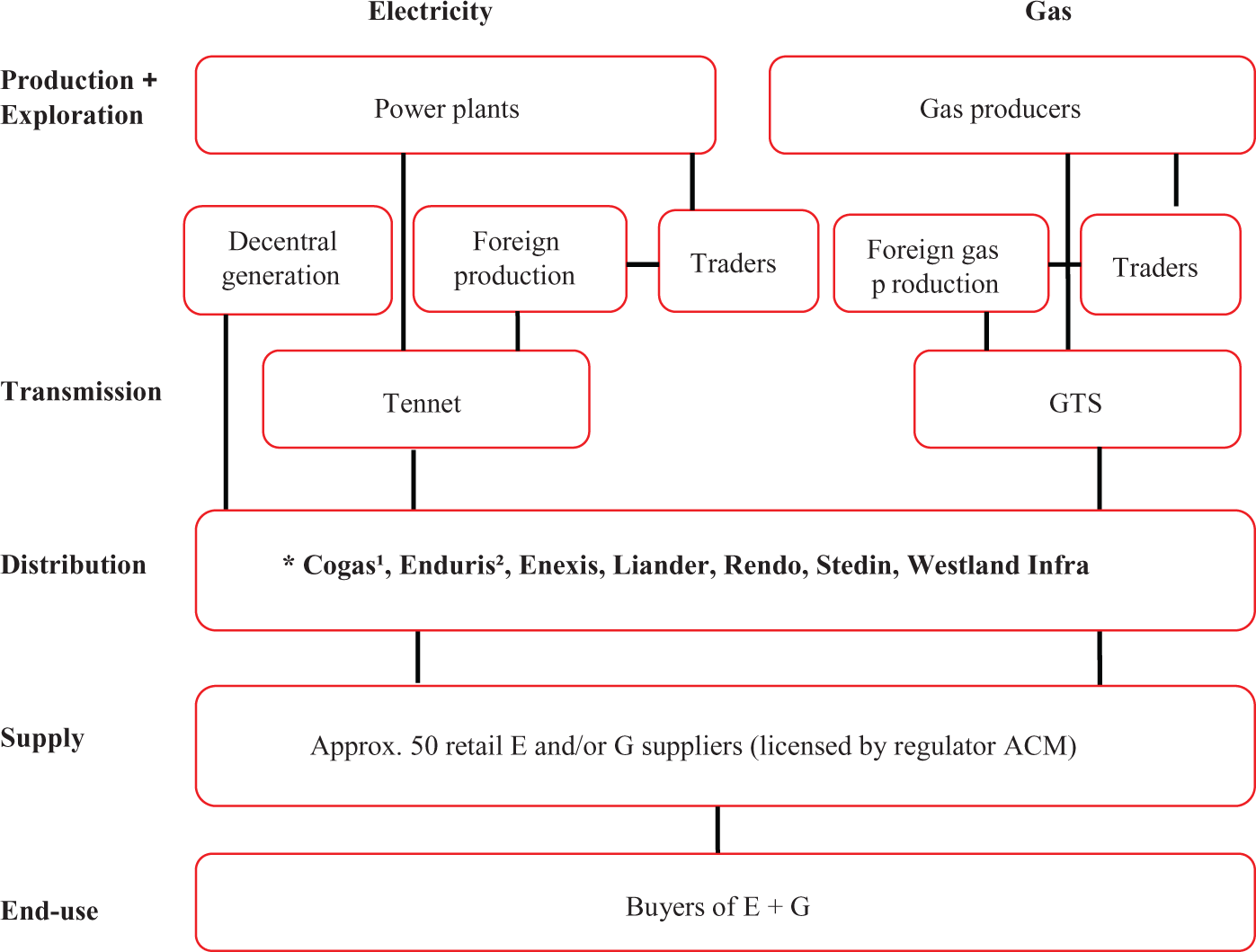
Market structure of the Dutch E + G markets. *Source: Netbeheer Nederland, July 2017. 1As of 1 September 2017 renamed as Coteq Netbeheer. 2As of 13 June 2017 wholly owned subsidiary of Stedin.
This role description makes clear that an important aspect of the DSO’s task is the safeguarding of public values which are inherent to the energy system. Public values in general can be understood as a framework of principles, rights and obligations that bind a society together. 4 When applied to the energy sector, public values refer to the features of the energy supply system, which can be expressed in terms of availability, affordability and other qualities. 5
Over the past two decades, the energy industry has radically changed: concentration, liberalization, unbundling, privatization and internationalization followed in rapid succession. Now, a potentially more fundamental change is affecting the energy sector. This phenomenon, known as the energy transition, consists of a simultaneous decarbonization, decentralization and digitalization of the energy sector. The term ‘transition’ implies that the existing energy system is evolving into a new one. Driving this change is the need to reduce the impact energy production and consumption have on the planet in terms of climate change and scarcity of natural resources. The new energy system is to be less polluting, more distributed and altogether smarter. 6 Achieving this transition requires a worldwide effort, comprising the development and use of new and innovative technologies, practices and forms of organization. 7 This also affects the DSO, which is steadily changing from a passive network operator, ‘burying copper in the ground’, to an active manager of a smart distribution system. 8 That is why independent consultants to the European Commission as well as the four European DSO associations have stated that the importance of the DSO for the energy transition is not to be underestimated. 9
A fair amount of research has been done into the nature of the public values at stake in network industries and into the mechanisms governments can apply to identify and safeguard them. 10 Particularly around the time of the liberalization and privatization of the Dutch energy sector, politicians and academics alike were concerned with the proper translation of these values into legislation and regulation. 11 Some further research has been done into the manner utilities (including DSOs) cope with conflicting values, 12 but not specifically into the additional tensions that may be caused by the energy transition. What has been studied is whether the energy transition is creating a ‘regulatory disconnection’, a gap between existing energy sector legislation and technological change. 13 So far, no in-depth research has been done into the occurrence of new public value dilemmas, although it has been expressly called for. 14 The need to reconcile legal obligations predating the energy transition with new demands, originating from a smart and decentralized energy system, may cause DSOs to experience a number of tensions caused by outdated legislation.
This article provides a study of the tensions Dutch DSOs encounter in their role as safeguarders of energy sector public values. It explores whether these tensions can be traced back to current energy sector legislation not being able to keep up with the energy transition. It aims to contribute to the theory on the safeguarding of public values and to offer a recommendation to the Dutch legislator.
A country’s energy sector generally consists of an electricity sector, a heat sector and a gas sector. ‘The future of the entire energy sector will, to a significant extent, be shaped by the evolution of the electricity sector, which is at the centre of most of the discussions to address the threat of climate change’. 15 The focus of this article is, therefore, predominantly on the Dutch electricity sector but will be broadened to include the heat and gas sector, if relevant. In the section ‘ Literature review’, the two key concepts of this article, public values and regulatory disconnection, are discussed from the energy sector’s perspective. The third section provides the details of the research method, followed by an overview of the research findings in the section ‘Survey findings’. The section ‘Discussion and recommendation’ concludes with a suggestion for a more sustainable public value treatment by policymakers and DSOs and a recommendation for further research.
Literature review
Public values as properties of utility services
Generally speaking, a society cannot ‘just be’. It also strives for its preservation, which leads it to hold certain opinions regarding the proper functioning of the overall system and its various components. This article uses the term ‘public values’ to describe the expectations a society holds concerning the performance of products or services and more in particular the ‘properties of utility services’. 16 When used in this context, public values are further specified as ‘substantive’ public values (as opposed to ‘procedural’ public values). Substantive public values can be understood as specifications for the object of government action, and procedural public values ‘refer to the way the public sector should act and to standards that the process of government action should meet’. 17 Or phrased differently, substantive public values ‘regard the qualities of the infrastructure itself’ whereas procedural public values ‘seek to enhance the quality of the decision-making process’. 18
Some generic examples of substantive public values associated with utility services are their accessibility, affordability, safety and security. Analysing the nature of these values more closely, Steenhuisen et al. noticed that safeguarding proves particularly difficult in case of ‘soft’ public values. These soft public values possess a number of distinctive, interrelated traits. 19 To begin with, they are almost invisible. The importance of ongoing energy infrastructure maintenance only becomes apparent in case of an outage. They are hard to operationalize. Values like accessibility are quite intangible and translating them into unequivocal norms proves difficult. Their implicitness makes them multi-interpretable and they are inherently competing. 20 It is when an attempt at specification is made, that inconsistencies become manifest. Even harder to operationalize are negative values like safety, which are best served indirectly through prevention. 21 Because they are rather ungraspable, soft values also have low enforceability. Without a clear definition, a value like security of service cannot be implemented accurately. Soft values have a long-term orientation. If the consequences of non-sustainable business practices will only affect future generations, why act now? Since soft values are difficult to pinpoint or to objectivize, they tend to be contested. 22
The ambiguity and contestability of these public values makes it hard to prioritize, let alone codify them. 23 Nevertheless, for the energy sector, an attempt at explication and codification has been made based on the assumption that a well-functioning energy supply is a fundamental concern for society and that only through government involvement its importance can be addressed adequately. 24 The Energy Report from 1995 proved to be particularly pioneering with the government stating what it believes is vital: the creation of a sustainable energy supply system. Sustainability here is to be understood as viable in the long term, not ‘just’ an energy supply solely based on renewables. This kind of sustainability, according to the government, requires an optimal combination of three public values, resulting in an energy supply that at the same time is available, clean and affordable. 25 This trilemma (with minor deviations in terminology) has been in use throughout Dutch energy policy documents and literature 26 until the Energy Report from 2015. The government now considers a low carbon dioxide energy supply system the overarching objective, but for the system to be sustainable over time, the government expects it to simultaneously serve public values availability, affordability and (mentioned explicitly for the first time) safety. 27
Article 16, E-Act and Article 10, G-Act (each based on their respective European Energy Directive 28 ) list the obligations for the Dutch DSOs in terms of public values. Their execution of this task is supervised by the Dutch energy regulator, Autoriteit Consument en Markt (ACM). 29 The general aim of Dutch energy sector regulation is the advancement of energy policy goals, such as availability, affordability and sustainability. 30 ACM has been provided ‘substantial discretionary powers which it can use […] to weigh up various interests in order to reach a decision’. 31 According to the European Energy Directives, ACM must be allowed to perform its task independently from market participants and policymakers 32 . This means that, generally speaking, the government will have to keep its distance. That awareness is reflected in the 2008 Energy Report, where the Dutch government describes how it sees its own role in securing the public values vital to the energy sector. The government provides a set of future proof boundary conditions, and provides guidance and encouragement, in order to preserve the balance between public values ‘available’, ‘affordable’ and ‘clean’. 33
Public value tensions resulting from regulatory disconnection
In the literature on technological change and innovation, a great deal of attention is devoted to regulation not ‘keeping up’ with technology. 34 In particular, technology with the ‘capacity to enable new forms of conduct’ is regarded as a possible instigator of legal problems, such as (1) ‘the need for special laws’ (tailor-made with new developments in mind); (2) ‘uncertainty’ (whether existing legislation can/must be applied to the new developments); (3) ‘over-inclusiveness and under-inclusiveness’ (existing legislation serves a certain goal, as a consequence of which it ‘may inappropriately include or exclude new forms of conduct’) and (4) ‘obsolescence’ (the raison d’être of legislation no longer applies). 35 If one or more of these legal problems arise, it is justifiable to suspect that existing legislation is losing its effectiveness as it fails to keep up with constantly developing technology. This occurrence is referred to as ‘regulatory disconnection’, 36 a concept developed by Brownsword to indicate the widening gap between ‘current laws and regulatory approaches which are designed for the technological landscape of the past’ and the technological changes which are reshaping that landscape. 37
‘We DSOs consider ourselves to be the embodiment of public values. Legislation should enable us to operationalize these values. Instead, we are being restricted by it.’ This quote by a CEO of a Dutch DSO, interviewed for this article, is a good summary of the tensions DSOs are increasingly having to deal with. Although DSOs have always operated in a field of tension, lately the issues seem to have become more poignant because the energy transition is generating technological (and behavioural) innovations which are not covered by current energy sector legislation, which dates back to the 1990s. For the transition to a sustainable energy supply a fundamental reappraisal will be required of European and Dutch laws, regulations, and decision-making procedures. The legislative framework and legal safeguards currently in place are still based on the traditional market model.
38
Research method
The research for this article consisted of three consecutive steps and followed a mixed methods approach. 39 The first step comprised a literature and policy review regarding public values, regulation of technological change and the roll-out of the energy transition and a legal review of current (and upcoming) Dutch (and European) energy law. It gave rise to the hypothesis that there is a growing discrepancy between the Dutch legislator’s objectives and the Dutch DSOs’ daily practice regarding the safeguarding of public values, resulting from the current Electricity Act 1998 and the Gas Act not keeping up with the energy transition. The interviews (step 2 of the research) were used to assess whether the interviewees recognize the assumed discrepancy and to explore how this discrepancy manifests itself. In the third step, the three examples of this discrepancy most widely reported by the interviewees were presented to an expert panel in the form of a survey.
Interview details
In order to empirically validate the insights gained from the reviews, in-depth interviews 40 were conducted with representatives of all major actors in the Dutch energy sector, namely the legislator (the Ministry of Economic Affairs), the regulator (ACM), DSOs, the Transmission System Operator (TSO) (Tennet), an association of large-scale renewable energy producers, an incumbent energy supplier and a new entrant, a renewable energy cooperative, an energy consumer organization and energy consultants, adding up to 27 experts from 14 different organisations. 41 Fifteen participants held an executive/managerial position and twelve participants were senior advisors/consultants. All were selected because of their in-depth knowledge of the Dutch energy sector. The interviews were conducted in person in Dutch, between July and October 2016, at the participants’ offices (with the exception of two interviews which took place at public locations), and lasted 1–1.5 h. Interviewees were asked to reflect on the hypothesis and to identify potential cases where DSOs have had to deal with public value tensions, prompted by open questions taken from an interview template. 42 The interviews were digitally recorded with permission from the participants. Verbatim quotes from participants were later submitted separately for their approval. After each interview, the recording was listened to and the references to cases of public value tensions were scored. On completion of the interview round, the scores were analysed to assess which cases were mentioned most frequently.
Three cases in particular were identified by all four DSOs. Of these cases, case A was also mentioned by 80% of the other organizations. Cases B and C were referred to by 50% resp. 40% of the other organizations. Other issues were referred to only incidentally. 43
A full case description is provided in Online Supplementary (Annex A, Interview Template and Case Description). The three main cases which were identified during the interviews and then selected for further analysis in the survey are as follows:
Case A: Network upgrading versus flexibility
With a view to maintaining network availability, DSOs are legally obliged to invest in network upgrading, despite lower social cost alternatives sometimes being available.
Case B: Gas connection versus electricity and/or heat connection
DSOs are legally obliged to keep creating gas networks and implementing gas connections, despite gas losing its importance as a consequence of electrification and the switching to heat.
Case C: Fixed connection fees versus flexible capacity rates
DSOs are legally obliged to charge all small consumers the same fixed connection fee, despite some consumers causing congestion which then triggers network upgrading.
Survey details
With a view to further explore the DSOs’ dealings with public values, a survey, comprising 77 close-ended questions/statements, was designed, using the three cases derived from the interviews. The survey consisted of five segments, each focusing on a concept from the previous legal and literature review. 44 To encourage the respondents to express a clear opinion, the survey used a four-point Likert-type scale. This way, the respondents could not settle for the neutral option but had to either (strongly) agree or disagree with a survey statement.
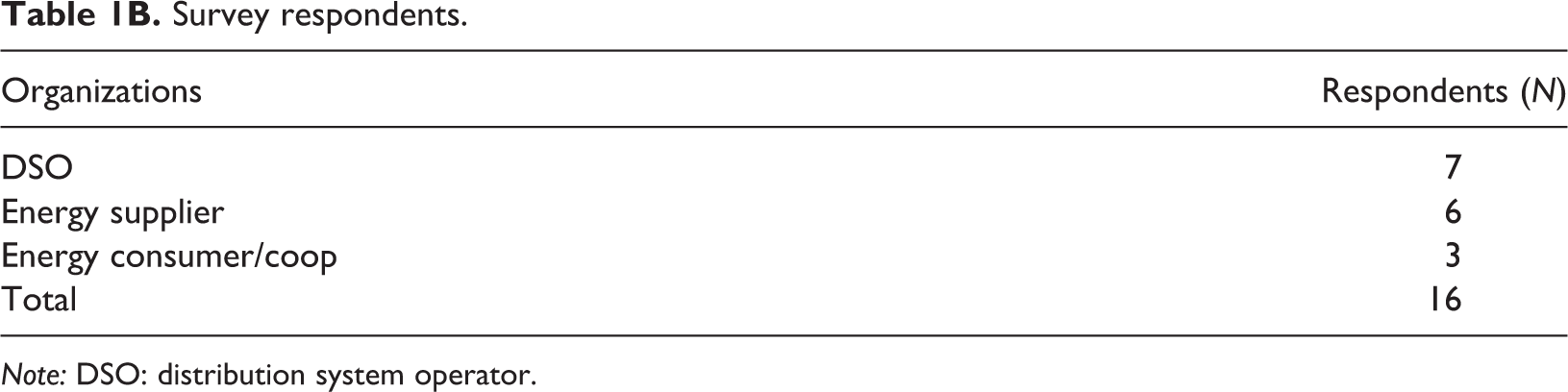
The survey was presented to all seven Dutch DSOs as well as a number of Dutch energy suppliers and consumer organizations/cooperatives. The selection of energy suppliers features the most common supplier categories: incumbents, whose presence in the Dutch energy market dates back to before the liberalization and privatization of the energy sector and whose shares are being held by either Dutch regional governments or foreign parent companies; new entrants with foreign parent companies who started their operations after the liberalization and privatization and newly established privately owned Dutch start-ups. Although the ACM licensed 55 suppliers (situation as of 1 March 2017), around 20% of them are part of a larger company or group of companies. With that in mind, the six companies that were selected to participate in the survey seem an adequate representation of the supplier segment. In the Netherlands, only a few consumer organizations consider themselves to be experts in energy matters. The choice of participants, therefore, proved to be limited. The survey consumer organizations/cooperatives category comprises the largest generic consumers association and a well-known green activist consumer organization, supplemented with a mid-size consumer cooperative, bringing the total of participants in this category to three. Thus, the resulting overall group of 16 organizations includes all seven DSOs and nine supplier and consumer organizations. Each was represented by one respondent, resulting in a well-balanced panel of 16 experts. 45 Of the 16 respondents, 3 held an executive position, 8 held managerial positions in legal and/or public and regulatory affairs and 5 were managers of strategy, business development or innovation departments. Seven of the survey respondents had been interviewed in step 2 of the research and had expressed an interest in further participation. All other respondents were freshly recruited based on their representing a particular organization (either a DSO or an organization likely to have a thorough understanding of the DSO’s rights and obligations and daily practice).
The survey, which consisted of a digital document, was conducted between December 2016 and March 2017. All submissions were combined in a matrix, showing the outcome for each question/statement per respondent and per respondent category. 46
The number of interviewees and survey respondents could be considered relatively small. However, this limitation is somewhat compensated by the fact that 100% of Dutch DSOs participated in the survey, and by the fact that the interviews involved DSOs as well as experts from eight of their organizational stakeholders, ranging from the legislator to the consumer, producing a 360° surround view of the DSO’s position.
Survey findings
‘DSOs have the statutory task to safeguard public values’. This opening statement of the survey was endorsed by all but one of the respondents (one DSO did not agree) (S1). When asked to select a DSO’s core public values, all DSOs mentioned ‘availability’, and so did all of the other respondents. For DSOs, ‘safety’ was of equal importance (100%), followed by ‘affordability’ (86%). For consumer organizations, it was the other way round: affordability scored 100%, followed by ‘safety’ with 67%. Like the DSOs, suppliers chose “safety” above “affordability” (83% vs. 67%). ‘Sustainability’ was considered least important by all respondents: it was recognized as one of the DSO’s core public values by 57% of DSOs, 17% of suppliers and none of the consumer organizations. Individual DSOs also provided additional terms for their core public values, such as ‘reliability’, ‘accessibility’, ‘security of supply’ and ‘quality’ (S2).
‘Public values serve as a touchstone for a DSO’s business operations’ constituted a view supported by all respondents (except for one of the suppliers) (S3). Apart from one DSO, one supplier and one consumer organization, all respondents agreed that ‘in their business operations DSOs have to weigh public values against each other’ (S4). A very large majority (88%) of all respondents felt that – generally speaking – the energy transition makes this balancing of public values more difficult (S75).
When asked which public value tensions, in their opinion, DSOs have to deal with most frequently, 71% of DSOs selected case B, so did 67% of the consumer organizations and 33% of suppliers. The majority of suppliers (67%), however, chose case A (S63). When asked to look at the three cases from other perspectives, like involving the highest avoidable social costs, and – if solved – contributing the most to the progress of the energy transition, 71% of DSOs again opted for case B. This time, the other respondents were of the same opinion (78% resp. 67% per perspective) (S64+67). The case whose solution is most urgent according to five out of seven DSOs is case A, whereas 56% of the other respondents chose case B (S66). DSOs and other respondents were almost equally convinced (57% vs. 56%) that the case ‘causing the largest imbalance between public values’ is case B. Still, 29% of DSOs attributed the largest imbalance to case A and 14% to case C. Cases A and C were weighed equally (22% each) by suppliers and consumer organizations (S65).
The previous review of policy documents and research reports, supplemented with responses from the interviews, indicated that public value tensions may occur when lagging legislation compels DSOs to favour availability of the network above its affordability. 47 This observation was confirmed for cases A and C by 56% resp. 44% of all survey respondents (S24+61). With regard to case B, only 31% recognized this trade-off (S42).
Neither the review nor the interviews did show that safety is perceived as a value that is likely to take second place to either availability or affordability. In their interview, the Ministry of Economic Affairs remarked that their current energy policy ‘requires that values be weighed against each other, but safety is paramount and cannot be compromised’. Industry information supports this statement in that it shows stable low, long-term averages for gas leaks, 48 and electric and magnetic field strengths remain below recommended maximum values. 49 All survey respondents (apart from one supplier who was not sure) expressed their (strong) agreement with the statement that ‘DSOs do not compromise on safety’ (S72).
Case A: Network upgrading versus flexibility
The indication, gleaned from interviewing energy sector representatives, that the energy transition is complicating network management was confirmed by the survey. Six out of seven DSOs and 67% of the other respondents agreed that ‘in their electricity distribution network DSOs increasingly have to deal with transport issues’ of which, according to – again – six out of seven DSOs and 89% of the other respondents ‘the number and complexity is increasing due to the energy transition’ (S7+9). That DSOs in case of capacity shortage are legally required to ultimately upgrade the network is an obligation all DSOs were fully aware of (S17). They were in no doubt as to its positive contribution to network availability (100%) but 71% felt that ‘addressing transport capacity issues through network upgrading contributes least to network affordability’ (S10+14). Suppliers and consumer organizations were less aware of a DSO’s legal obligations (67%) but all shared the opinion that ‘addressing transport capacity issues through network upgrading contributes most to the safeguarding of network availability’ (S17+13). The impact of upgrading measures on network affordability going forward was an express concern for all consumer organizations and 33% of suppliers (S14). DSOs and the other respondents differed in their assessment whether ‘the legal obligation to upgrade the network generates a socially acceptable balance between public values’ (29% vs. 67%), but they were more in line in their agreement that the upgrading obligation ‘causes avoidable social costs’ (71% vs. 56%) (S18+19).
Network availability may not only be increased through upgrading but also by creating more flexibility in network usage. All DSOs agreed that flexibility measures, such as the introduction of storage, may serve as an alternative to network upgrading, and so did 78% of the other respondents (S11+12). Although some uncertainty still existed with DSOs as well as with other respondents whether ‘flexibility measures are more cost-effective than network upgrading’ (31% ‘not sure’), 57% of DSOs and 44% of the other respondents expected flexibility to contribute in particular to the safeguarding of network affordability (S22+15).
At the moment, the – from a cost standpoint potentially attractive – flexibility option is not available to the DSO. Upgrading the network is its last resort, a legal obligation without which, according to 56% of the respondents, DSOs could achieve a better balance between public values (S23). This led 44% of respondents to conclude that ‘Article 24 para. 2, E-Act hinders DSOs in the best possible safeguarding of public values’ and another 44% to conclude the opposite. The separate respondent categories showed a wider variety: DSOs: 43% yes and 57% no; suppliers: 33% yes and 50% no and consumer organizations: 67% yes and 0% no (S25).
Case B: Gas connection versus electricity and/or heat connection
The future relevance and availability of the gas distribution network is becoming more and more of an issue for DSOs. That was the assessment of all survey respondents (S27). They all foresaw, apart from one DSO and one consumer organization, who were not sure, that ‘the gas function in households will be taken over by a combination of electricity and heat’ (S29). The existence of a legal obligation for DSOs to connect households to the gas network (with the exception of households situated in a designated heat-area) was acknowledged by all DSOs but denied or questioned by 44% resp. 22% of the other respondents (S31). Disregarding its legal status, a connection to the gas network (together with a connection to the electricity network) contributes most to ‘availability’, said 81% of all respondents, and least to ‘sustainability’ (63%) (S32+33). Conversely, 81% expected the envisaged future situation where electricity and heat will have replaced gas, above all to contribute to ‘sustainability’ (S34). If there was any apprehension, it was among (67% of) suppliers and consumer organizations, who expected the future situation to contribute least to ‘availability’ (S35).
Survey respondents also assessed the financial side: 56% were of the opinion that ‘the legal obligation to connect households to the gas distribution network causes avoidable social costs’ and (therefore), according to 25%, contributes least to ‘affordability’ (S37+33). Whether ‘creating a connection to the electricity (and heat) network is more cost-effective than to both the electricity and gas network’, DSOs and other respondents alike found difficult to answer. Of the DSOs, 57% agreed and 43% disagreed. Forty-four percent of the other respondents assumed electricity (combined with heat) to be more cost-effective than electricity and gas, whereas 22% did not (S40). The majority of both DSOs and other respondents (71% and 67%), however, agreed that presently DSOs are not ‘allowed to weigh creating a connection to both the electricity and gas network against a connection to the electricity and heat network’ (S39).
‘The legal obligation to connect households to the gas distribution network generates a socially acceptable balance between public values’. On this, DSOs, suppliers and consumer organizations were fully aligned in that a majority of each respondent category rejected this statement, resulting in an overall disagreement of 63% (S36). All respondents were similarly aligned (69%) regarding the observation that ‘without the legal obligation to connect households to the gas network, DSOs can achieve a better balance between public values’ (S41). Consequently, 63% of all respondents felt that ‘Article 10 para. 6, G-Act hinders DSOs in the best possible safeguarding of public values’. The score per respondent category also showed a majority agreeing with the observation: DSOs: 57% yes and 14% no; suppliers: 50% yes and 17% no and consumer organizations: 100% yes (S43).
Case C: Fixed connection fees versus flexible capacity rates
As they did in their assessment of case A, survey respondents again pointed to the energy transition as the cause of greater fluctuations in network capacity usage, resulting in transport issues. All DSOs supported this explanation and – building on it – expected more efficient network usage to ‘reduce the risk of transport issues’, and, consequently, ‘the need to invest in network upgrading’ (S46+47+48). Of the other respondents, 78% acknowledged this relationship (S46). This percentage rose to 89 resp. 100, when they were asked to assess the mitigating effect of an efficiency increase on the occurrence of transport issues and the need for upgrading investments (S47+48).
Whether flexible capacity rates would constitute an effective remedy was met with a less uniform response. All consumer organizations felt that ‘flexible capacity rates (with time- and location-dependent components) may promote more efficient network usage’, but so did only 57% of the DSOs and 50% of suppliers (S49). The potential financial repercussions of introducing flexible capacity rates also proved to be contentious. Forty-three percent of DSOs were of the opinion that ‘flexible capacity rates may negatively affect the affordability (understood as purchasing power) for small consumers’, whereas another 43% thought the opposite. The assessment that the financial impact on small consumers would be limited was shared by 56% of the other respondents (among which 67% of the consumer organizations) (S50). Only a minority (33%) of the other respondents felt that ‘the affordability of the electricity network overall’ may be positively affected by flexible capacity rates, but 56% did not. DSOs’ scores were 43% (‘agree’) and 29% (‘disagree’) (S51). Yet, 56% of all respondents agreed that the current practice of charging ‘fixed connection fees causes avoidable social costs’, but only 19% indicated that it contributes least to ‘affordability’ (S57+53). The introduction of flexible capacity rates would contribute most to ‘sustainability’, according to 67% of consumer organizations. An opinion none of the suppliers shared. They expected flexible capacity rates to contribute most to ‘availability’ and ‘affordability’ (50% and 33%), whereas consumer organizations foresaw no contribution to either public value (S54). DSOs, on the other hand, expected flexible capacity rates to contribute least to ‘availability’ (43%) and most to ‘sustainability’ and ‘affordability’ (43% each) (S55+54).
Although 44% of respondents agreed that (charging) ‘fixed connection fees generates a socially acceptable balance between public values’, the majority (56%) felt that by ‘charging flexible capacity rates DSOs can achieve a better balance between public values’ (S56+60). Among those agreeing were 50% of suppliers and 67% of consumer organizations. Yet, 50% of suppliers and 100% of consumer organizations were not sure whether the current legal provisions are the DSO’s main obstacle. DSOs, on the other hand, were less doubtful: 57% agreed that DSOs would ‘achieve a better public value balance’ by charging flexible capacity rates and they also felt that ‘Articles 28 and 27 para. 2, E-Act hinder DSOs in the best possible safeguarding of public values’ (S60+62).
Discussion and recommendation
The three cases that were surveyed showed that the unwavering application of the current legal framework has consequences for the balance between energy sector public values that deviate from the government’s intentions. In their 2008 Energy Report, the Ministry of Economic Affairs stated that a sustainable energy system requires a structural balance between the public values ‘available’, ‘affordable’ and ‘clean’. 50 Achieving this constitutes a ‘balancing act’. 51 This indicates that the government aims for multiple public values to be served simultaneously in such a way that no one particular value dominates the others, but that all three coexist in some sort of equilibrium. The survey confirmed a discrepancy between the Dutch legislator’s objectives and the Dutch DSO’s daily practice, showing that DSOs complying with current energy sector legislation do not always seem to achieve the public value balance that is envisaged: 44% of all respondents thought that DSOs fell short in case A, 63% in case B, 25% in case C and – by way of general assessment – 63% of all respondents thought so for the three cases overall (S25+43+62+76).
This modest assessment of the DSOs’ performance in terms of balancing public values may be explained from a shift in the perception of what constitutes the right balance. The provisions of the current E-Act and G-Act contain a public value balance, determined by government, which is a reflection of the government’s priorities for the energy sector prior to the roll-out of the energy transition. This balance has been translated into a number of DSO obligations, which include an implicit trade-off between public values, such as availability and affordability. DSOs acting in accordance with these dictated preferences for a long time contributed to the public value balance the government aimed for. Lately, this balance has come under pressure, as the survey showed. The current E-Act and G-Act oblige DSOs to take decisions that disregard the technological (and behavioural) changes brought about by the energy transition. Consequently, the public value trade-off, imposed by this legislation, is no longer perceived by the respondents as resulting in a socially acceptable balance between public values.
The literature on (substantive) public values (i.e. the ‘properties of utility services’ 52 ) acknowledges that these public values require a trade-off and also that realization of one public value may occur at the expense of another. 53 Less attention appears to be dedicated to the question whether there might be a limit to the extent of such a trade-off. The survey seems to indicate that a public value trade-off can be conducted up to the point where its entire outcome would be jeopardized because of a lack of social acceptance. It became clear that for the DSO, which is a major factor in the implementation of the energy transition, social acceptance is an important consideration. Their license to operate (and thus to a certain degree the successful roll-out of the energy transition) is affected by their treatment of public values and the kind of balance they manage to achieve (S6).
Some research has been done into the manner utilities (including DSOs) cope with conflicting values. Steenhuisen found that in their daily operations, the entities he studied adopted the strategy ‘not to balance competing values but to protect values against conflicts’. 54 The consequence he observed was that ‘many conflicts automatically displace to the operations where trade-offs structurally occur unmanaged’. 55 The survey, however, showed that all Dutch DSOs expressed the opposite intention (which matched the perception of the majority of other respondents): in their daily operations, DSOs do strive for a balance between public values (S5). Whether, on the other hand, they actually succeed in doing so, the majority of all survey respondents (including five out of seven DSOs) had serious doubts (S76). This apparent discrepancy between a DSO’s intentions and a DSO’s daily practice would suggest additional research into mechanisms that may facilitate DSOs in conducting a more explicit trade-off, which at the same time would produce a public value treatment that is sustainable in terms of social acceptance.
A major reason for the DSO’s public values seemingly being unbalanced is that the considerations implicit in the E-Act and G-Act are not (sufficiently) reflective of the changes that the energy transition brings to the energy sector and the role of the DSO. Sixty-nine percent of all respondents (among which six out of seven DSOs) felt that such is the case (S77). As shown by the survey, the energy sector legislation in question is perceived to produce the opposite effect of what was intended by the legislator. ‘Technological change has the effect of upsetting the balance reached at the time of the rule’s creation’. 56 Recently, two attempts could be observed to restore the connection between (European and Dutch) energy sector legislation and the technological change reshaping that same sector. In their so-called 2016 Energy Winter Package (Clean Energy For All Europeans), the European Commission proposed that DSOs will be entrusted with tasks concerning ‘the use of flexibility’, including the procurement of ‘services from resources such as distributed generation, demand response or storage’, and that ‘Member States shall provide the necessary regulatory framework’. 57 The Dutch legislator seems to have risen to the challenge. In their recently published 2016 Energy Agenda, the Ministry of Economic Affairs explicitly recognized some of the issues DSOs are struggling with. They also acknowledged that current Dutch legislation contains a number of obstacles to DSOs facilitating the energy transition.
The survey, however, showed that existing legislation is not considered to hinder public value balancing in all three cases to the same extent. It may be questioned, therefore, whether the deployment of any new legislation alone can help resolve the balancing issues that were identified. In case C in particular, additional considerations, such as the potential impact on the DSO’s role as neutral market facilitator 58 or the possibility of unwanted distribution effects 59 , may warrant other measures beyond the adaptation of energy sector legislation. If, however, new legislation is going to be part of the chosen approach, in cases A, B, and C some consideration should be given to the realization that ‘drafting techniques alone cannot prevent some laws from operating unfairly or poorly in a rapidly changing technological environment’. 60 What the survey findings have shown is that any balancing considerations embedded in legislation eventually become problematic due to the loss of regulatory connection. Bennett Moses for that reason emphasizes that ‘we need to consider how the legal system deals with dilemmas raised by technological change in a broader institutional context’. 61 It may, therefore, be considered a welcome development that the Ministry no longer intends to resolve all transition issues in detail in the law itself but chooses to merely lay down the rules (referred to as ‘assessment frameworks’) that will guide energy sector players (including DSOs) in their deliberations. 62 However, if these assessment frameworks are to sustain regulatory connection over a longer period of time, the Ministry might consider tapping into the ‘bridging capabilities’ of the regulator 63 in a way similar to the drafting of the current network codes: system operators (after having consulted representative organizations of electricity/gas market parties) may send a proposal to the regulator, which the regulator will check for its regard for considerations, such as a reliable, sustainable, efficient and environmentally responsible functioning of the energy market. If the proposal meets the requirements, the regulator will adopt (the adaptation of) the code. Assessment frameworks might follow a similar procedure, with the addition that the regulator should not just be checking whether individual energy sector public values are taken into account but also if the framework is constructed in such a way that it enables DSOs and other system operators to achieve and maintain a balance between these values. Compulsory periodic evaluation and adaptation would serve to detect and correct any regulatory discrepancies in an early stage. Thus, legislative and regulatory attention would be redirected to the ‘societal demands’ the production of utility goods and services has to meet. 64
More research is needed to assess which (combination of) instruments would constitute the most effective public value safeguarding regime. Even a mix of safeguarding mechanisms might be required to produce a tailor-made approach. 65 These additional insights would contribute towards a more sustainable public value balance, which would help (DSOs) secure the energy transition its much needed public support. In his interview, the Chairman of the Dutch Wind Energy Association (NWEA) concisely described the way forward: ‘If transition is what you want, you should also dare to innovate your laws and regulations’.
Footnotes
Declaration of conflicting interests
The author(s) declared no potential conflicts of interest with respect to the research, authorship and/or publication of this article.
Funding
The author(s) received no financial support for the research, authorship and/or publication of this article.
Supplemental material
Supplementary material for this article is available online.
Notes
Appendix 1
Survey respondents.
| Organizations | Respondents (N) |
|---|---|
| DSO | 7 |
| Energy supplier | 6 |
| Energy consumer/coop | 3 |
| Total | 16 |
Note: DSO: distribution system operator.
Supplementary Material
Please find the following supplemental material available below.
For Open Access articles published under a Creative Commons License, all supplemental material carries the same license as the article it is associated with.
For non-Open Access articles published, all supplemental material carries a non-exclusive license, and permission requests for re-use of supplemental material or any part of supplemental material shall be sent directly to the copyright owner as specified in the copyright notice associated with the article.
