



Abstract
With the rise of non-executive forms of diplomacy, political scientists have increasingly focused on the role of parliaments as diplomatic actors. This article aims to deepen the study of European parliamentary diplomacy through an extensive case study of transatlantic parliamentary diplomacy (TPD) between the European Parliament and the US Congress during the Obama and Trump administrations (2009–21). It is hypothesised that the decrease in EU–US political alignment under the Trump administration resulted in a corresponding decrease in both the salience and positivity of TPD. Counter-intuitively, the data shows that the decrease in political alignment correlated with a higher quantity of TPD. However, a content analysis of the joint reports of the Transatlantic Legislators’ Dialogue indicates that the attitude of this TPD is found to have become increasingly negative.
Introduction
With US presidential elections in November 2024, there has been much talk about how the electoral outcome could impact the transatlantic relationship between the EU and the US. One of the ways to deal with political uncertainty at the executive level is to invest in other channels of cooperation. With this in mind, within the EU–US relationship, the legislative partnership between the European Parliament (EP) and the US Congress is an increasingly strong force for fostering transatlantic cooperation. 1
Parliamentary diplomacy is a relatively under-developed field in international relations and diplomacy literature. The academic literature has only recently become more coherent and robust with the publication of two seminal works by Jaňcić and Stavridis (2016; 2017). In 2016, these authors co-edited a special issue of The Hague Journal of Diplomacy that was dedicated solely to parliamentary diplomacy; this was followed by the publication of their Parliamentary Diplomacy in European and Global Governance in 2017. Both works develop the concept of parliamentary diplomacy by presenting a consistent theoretical framework, as well as testing the concept through a range of case studies.
When defining the relationship between executive and parliamentary diplomacy in the European case, Zamfir (2019, 6) argues that the EP’s involvement in EU foreign affairs complements existing executive structures. Notably, Members of the European Parliament (MEPs) have more flexibility than diplomats to address sensitive issues—they are able to speak more freely on human rights violations, enhance electoral processes abroad and facilitate negotiations on complex issues such as climate change (Zamfir 2019, 6).
The EP and the US Congress—arguably the two most important parliamentary bodies in the northern hemisphere—have had a long-standing diplomatic relationship since their first informal meetings in 1953. What sets EU–US parliamentary diplomacy apart from most other transnational parliamentary efforts is the level of institutionalisation (Lazarou 2020, 63). In addition to ad hoc parliamentary visits, the regular meetings between both parliaments that have taken place since 1972 have been formalised in the Transatlantic Legislators’ Dialogue (TLD) since the 1995 New Transatlantic Agenda. The TLD comprises two interparliamentary meetings per year, supplemented by video conferences and direct interactions between legislators. The TLD is co-chaired by both parliamentary bodies.
On the European side, the TLD co-chair is concurrently the chair of the Delegation for Relations with the US. The Delegation meets approximately nine times per year and was the largest delegation within the ninth EP. On the US side, the TLD co-chair is appointed by the Speaker of the House. Compared to the EP, the US Congress has a less formalised approach to the TLD. Nevertheless, a bipartisan European Union Caucus exists, and further institutionalisation of the TLD with a US–EU interparliamentary group has been proposed in the House of Representatives (US Congress 2022).
Finally, the establishment of the European Parliament Liaison Office in Washington, DC (EPLO-DC) in 2010 has further facilitated interactions between MEPs and Members of Congress. The main tasks of the EP’s liaison offices are promoting the importance of the Parliament, engaging with citizens and stakeholders, corresponding with the media and supporting MEPs (European Parliament 2022). EPLO-DC was the first liaison office to be established outside of the EU, indicating the importance of the parliamentary relationship with the US.
To test the resilience of transatlantic parliamentary diplomacy (TPD), this article examines the impact of political alignment on European parliamentary diplomacy towards the US. The study comparatively examines the EP’s diplomatic efforts from the 111th to the 116th session of Congress, corresponding to the Obama (2009–17) and Trump (2017–21) administrations.
Transatlantic parliamentary diplomacy in times of turmoil
Data from the 2022 Gallup Report Rating World Leaders, presented in Figure 1, show that European public opinion underwent a dramatic shift from the Obama administration to the Trump administration. Europeans’ approval rating of the US leadership went from 44% in 2016 to 25% in the year after the change of administration, while disapproval surged from 36% to 56% (Gallup 2022, 10).
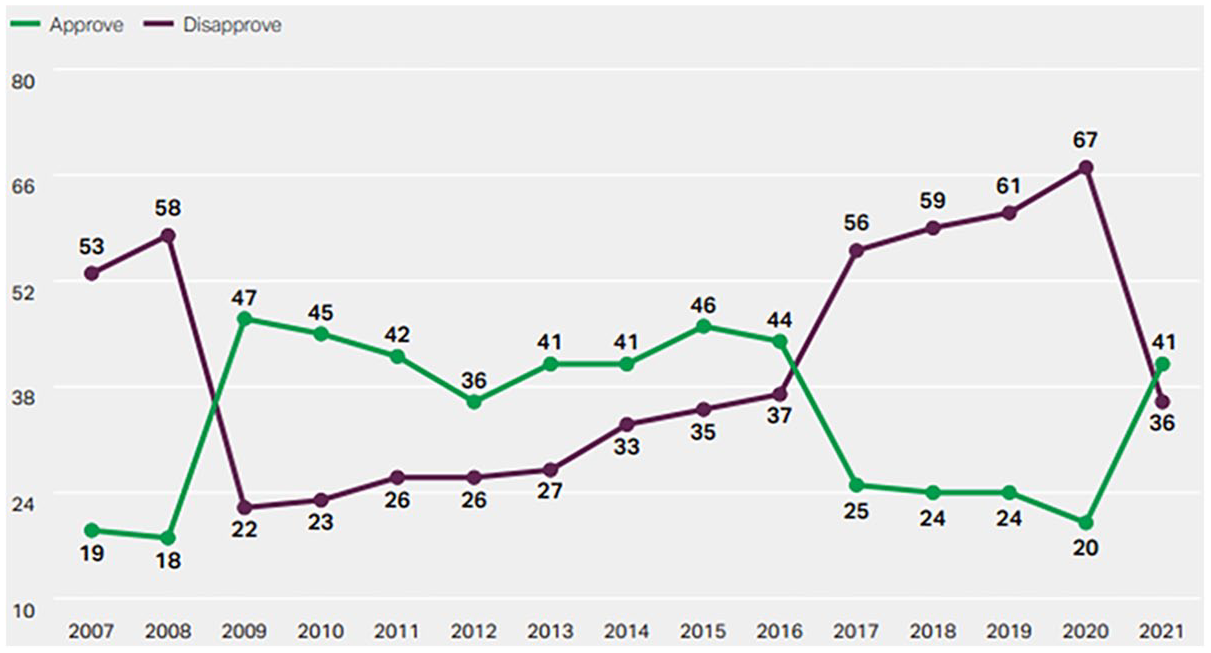
Approval of US leadership in Europe. Median ratings (%).
From these numbers, the conclusion can be drawn that political alignment between the EU and the US was significantly higher during both Obama administrations than it was during the Trump administration. Through a quantitative analysis of EP interactions with the US Congress during these two presidencies, presented in Figure 2, it can be shown how the shift in political alignment on the executive level affected the levels of European Parliamentary diplomacy.
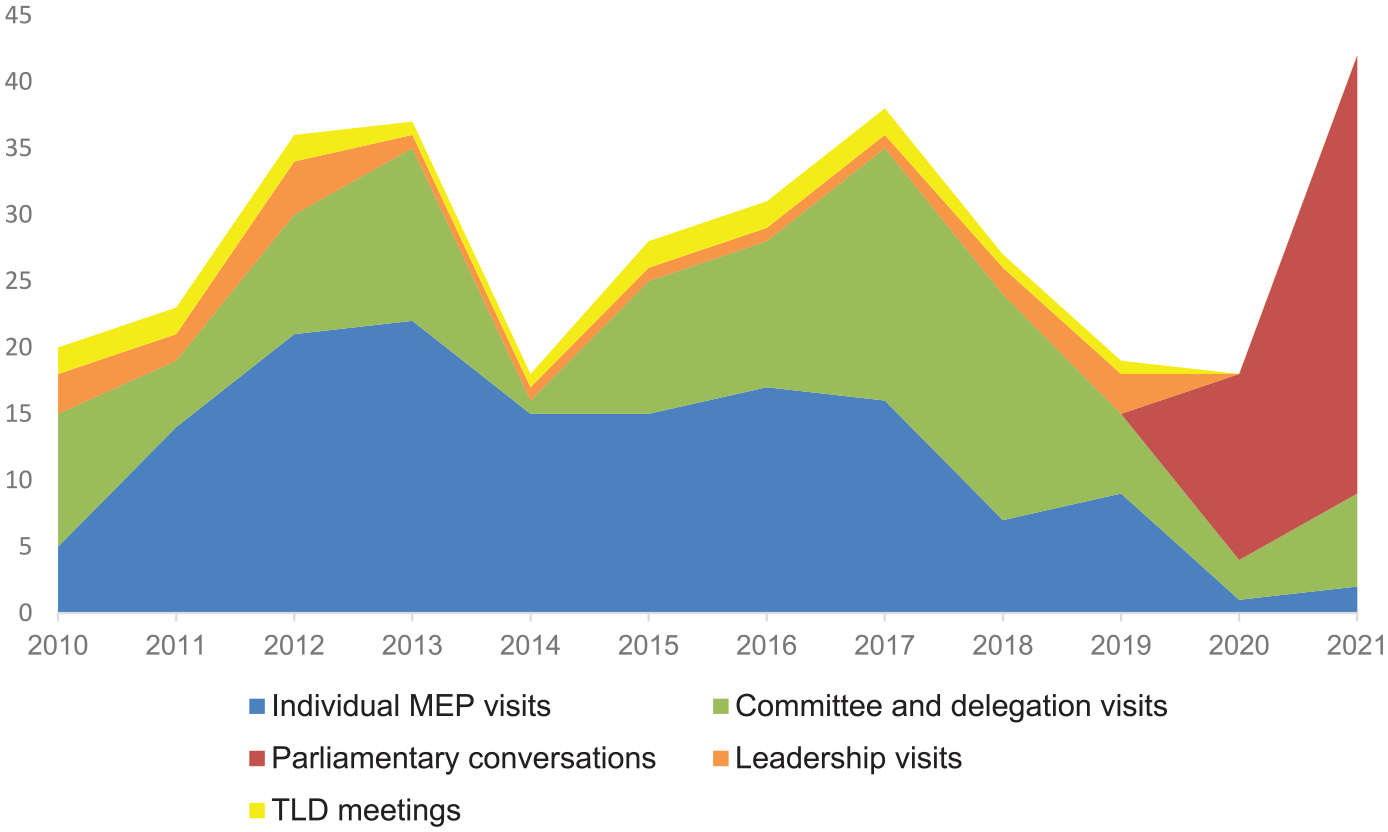
European Parliamentary interactions with US Congress (2010–21) 2
While EU–US political alignment was lower under the Trump presidency and the Republican majority in Congress, 2017 marked a record year for EU–US parliamentary engagements, driven largely by an increase in committee and delegation visits. The following year, also marked by Republican control of Congress, saw a decrease in TPD, due to a reduction in the number of individual MEP visits; however, overall there was a similar volume of interactions as in the Obama years.
In 2019, despite a slight increase, individual MEP visits remained at a low level. The next year, though plagued by the Covid-19 pandemic, saw similar numbers to 2019 due to the introduction of virtual parliamentary conversations. Despite Democratic control of the House in 2019 and 2020, the downward trend that had started with the arrival of the Trump administration continued. However, the committee travel prohibition (2019, see footnote 3) and Covid-19 pandemic (2020) make it particularly hard to draw strong conclusions about the reasons for this. The first year of the Biden administration, with Democratic control of Congress, showed the highest salience in TPD, driven by a high number of parliamentary conversations.
A sentiment analysis of all the available joint statements made after TLD meetings during the Obama and Trump administrations was carried out, and Figure 3 shows the share of positive and negative Dialogue outcomes per Congress. 3 The results show a positive correlation between political alignment and attitude, thereby indicating lower levels of positivity under the Trump presidency (115th and 116th Congresses) than the Obama presidency (111th to 114th Congresses). The 111th Congress, during which the Democrats also controlled Congress, shows the highest level of positive sentiment. During the 112th session of Congress, with the House flipping to the Republicans, positive sentiment declined, but remained high. The 113th Congress saw a significant drop, to a positivity rate of 42.8%, making it an anomaly during Obama’s presidency. During the 114th Congress, when Republicans gained a Senate majority in addition to their pre-existing control of the House of Representatives, positive sentiment increased to 52.8%. During the two Congressional terms under the Trump administration, it then decreased to 41.73% (115th Congress) and 38.02% (116th Congress).
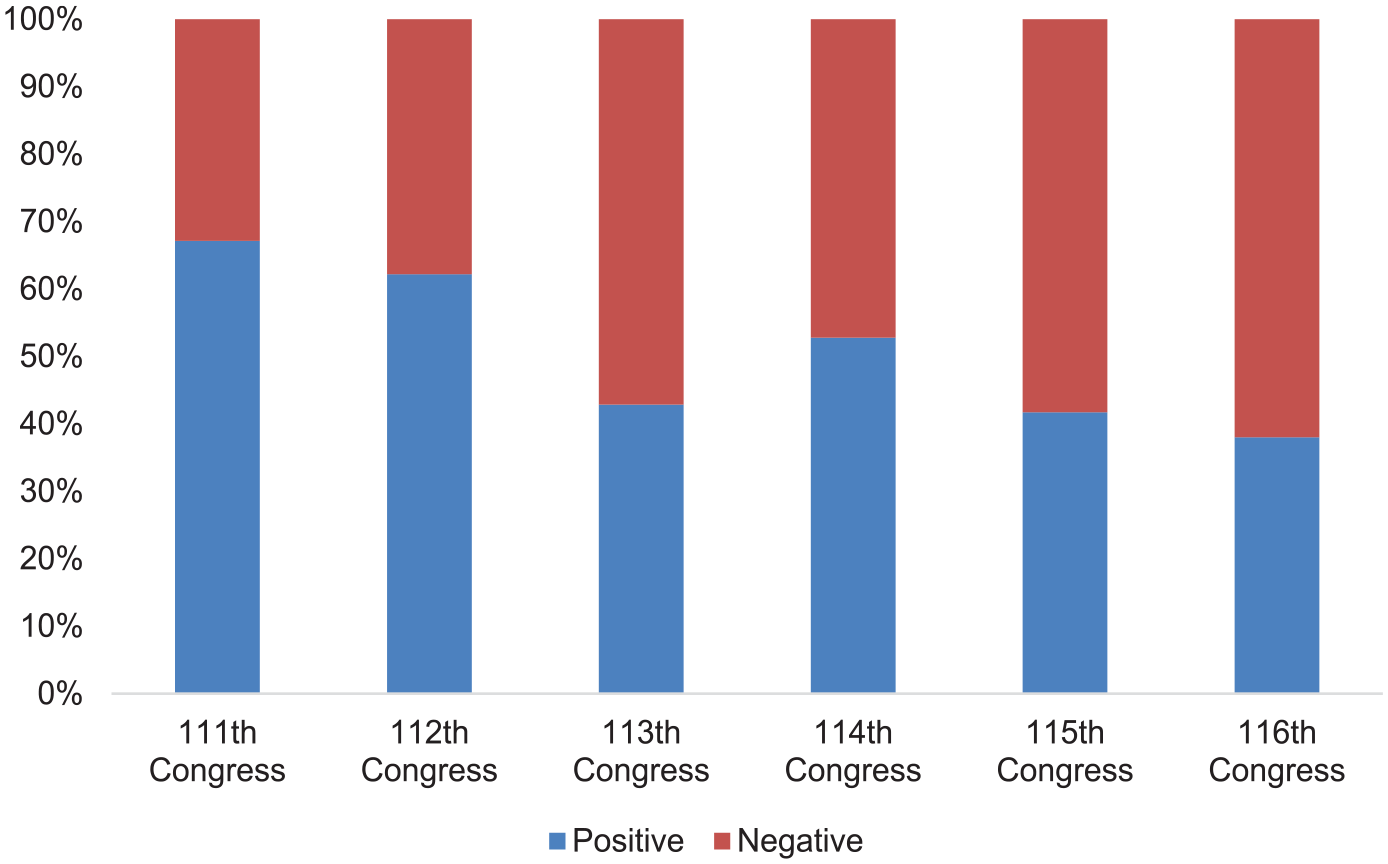
Sentiment analysis of TLD meetings, 2009–19.
When EU–US political alignment was at its highest, during the Democrats’ absolute control of the 111th Congress, positivity was at its highest level as well. Conversely, the sessions of Congress with the lowest levels of alignment (115th and 116th) showed the lowest levels of positive attitude. The positive correlation between political alignment and positive attitude is thus confirmed in both the Trump and Obama administrations. In both sessions of Congress in which the ruling party held both executive power and control of Congress (111th and 115th), positive attitudes were the highest in the respective presidential administrations, suggesting that, to some degree, full political control is linked with positive sentiment, regardless of political alignment.
The future of transatlantic parliamentary diplomacy
The findings of this article show that even during times of reduced political alignment, parliamentary diplomacy can flourish. More importantly perhaps, it shows that regardless of executive political alignment, legislative channels of diplomacy can function and develop independently. However, given the strict institutional independence of the EP and the US Congress from their executive counterparts, the same may not be true of parliamentary diplomacy in other national contexts where there is a strong linkage between parliament and government.
The increase in the quantity of European parliamentary diplomacy towards the US Congress during the period of lower political alignment suggests that legislative channels of communication can function as a diplomatic bridge at times when it may be most needed. At the same time, the analysis of the TLD meeting reports shows that levels of political alignment positively correlate with the attitudes of lawmakers. The success of EU–US parliamentary diplomacy during the period of reduced political alignment on an executive level could serve as a model to offset the insufficiencies of traditional forms of diplomacy.
TPD has evolved and will continue to do so. Amidst internal and external challenges, the parliamentary relationship between the EU and the US has proven to be resilient and innovative, with the introduction of virtual parliamentary conversations during the Covid-19 pandemic paying testament to this. Despite it being a time of global crisis, the number of interactions between legislators from the EU and the US reached record levels. For this trend to continue, much will depend on the efforts of the leadership of the EP and the US Congress to further institutionalise TPD. The idea of forming a robust transatlantic parliamentary assembly, for example, could definitively change the way we understand international relations. Academics as well as policymakers should play close attention to the development of parliamentary diplomacy, and there is hardly a better case to study than the EU–US ‘parliamentary bridge’ across the Atlantic.