




Abstract
The EU has put forward a very ambitious policy agenda for decarbonising its economy and limiting the dangerous consequences of climate change. However, parts of its approach have become untenable. This article argues that the current design of the EU’s climate agenda is becoming financially and socially unsustainable. Spiralling fiscal costs, a scarcity of vital energy and resources, and increasing societal strain risk derailing the European Green Deal. The text puts forward a number of centre–right policy proposals for a more realistic European approach to climate change that would deliver true sustainability and take the EU towards climate neutrality.
Keywords
Introduction
As many would agree, ‘the science is clear’. The prevailing scientific consensus is that mankind is directly responsible for most of the rising carbon-dioxide (CO2) emissions in the atmosphere and their related negative effects. The globally averaged combined land and ocean surface temperature data show a warming of about 0.85 °C (0.65 °C–1.06 °C) over the period 1880 to 2012 (IPCC 2014). Hence, the International Panel on Climate Change has recommended limiting global warming by the end of the current century to 1.5 °C compared to pre-industrial levels, with the expectation that this will reduce many of the challenging impacts of climate change globally (IPCC 2018). The EU has responded to this urgent call and has become the most influential global actor in advancing the international agenda on decarbonisation and the fight against climate change. Additionally, the majority of European citizens back taking more decisive action towards achieving a more sustainable economy (Eurobarometer 2021).
Indeed, both the scientific consensus and citizens’ expectations regarding climate change are clear. The problem of greenhouse gas emissions and the end goal of climate neutrality have been clearly defined. However, Europe is still at a crossroads as to how exactly to achieve these climate goals in a sustainable way. Which policy tools and state resources should be optimised without sacrificing economic competitiveness and vital social priorities? A complex policy equation is needed, one which also honours the Treaty theorem that environmental policy is a shared competence within the EU. 1
This article argues that parts of the EU’s climate policy equation are broken. These design flaws risk the misallocation of huge resources and could even derail the goal of carbon neutrality. The following text analyses the main fissures in the current EU climate agenda and makes the case that the quest for sustainability is becoming economically and societally unsustainable. Hence, the article puts forward a number of policy proposals from a centre–right perspective of climate realism, which aim to address these flaws and put in place the solid policy pillars for a truly sustainable EU economy. The article is part of the Wilfried Martens Centre’s ‘7 Ds for Sustainability’ initiative which provides strategic policy proposals for the European centre–right (Hefele, Welle et al. 2023).
Sustainability becomes unsustainable
There are at least three major issues severely hampering the EU’s current climate agenda: mounting financial costs, resource scarcity and societal strain.
First of all, the EU’s macro-spending programmes have become increasingly dominated by the Commission’s climate agenda. The current Multiannual Financial Framework (MFF) for 2021–7 sets an overall target of spending 30% of its total budget on climate-related activities. 2 On top of that, the innovative recovery instrument NextGenerationEU requires that at least 37% of its €700 billion is to be allocated for climate-related projects as part of the national recovery plans of every member state (Figure 1). The Commission also projects that reaching climate neutrality will require an additional investment of €142–€199 billion per year between 2030 and 2050 (European Commission 2019). For comparison, the required yearly sums would be much higher than the total annual EU budget for all EU spending lines.
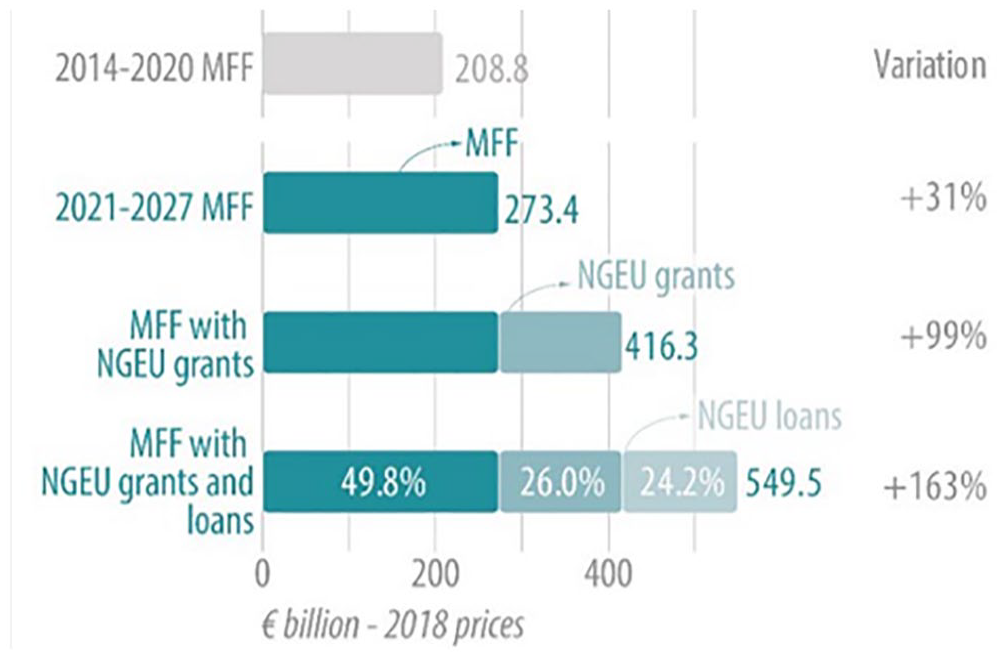
Evolution of climate-related expenditure within the MFF and the NextGenerationEU temporary recovery instrument.
Regrettably, the European Court of Auditors has signalled that the climate-related spending within the EU’s previous MFF suffered from a flawed methodology when justifying its ‘climate mainstreaming’ 3 (European Court of Auditors 2020, 4). A more recent report from 2023 soberly concludes that the European Commission ‘lacks data on the cost to the EU budget, national budgets and private sector’ of accomplishing specific climate targets (European Court of Auditors 2023, 5).
The rising financial uncertainty does not stop there. All of the original European Green Deal estimates and plans were made in 2019 when the EU had lower collective targets for CO2-emissions reduction and renewable capacity by 2030. Since then, the EU has made more ambitious commitments for overall emissions cuts and renewable energy deployment. Furthermore, there are already indications that the costs of the EU’s emergency borrowing could be at least twice as high as what was originally estimated due to inflationary pressures (Clayes et al. 2023). European policymakers have no idea of the ultimate price tag for ‘net-zero’. Simply put, the EU’s efforts to make our economies more sustainable are becoming financially unsustainable and could lead to astronomical costs with a limited impact on our collective climate goals.
Resource scarcity
The old continent has always been hobbled by its dependence on third-country energy imports. The unilateral weaponisation of pipeline natural gas by the Russian Federation in 2021–2 exposed the failure of the attempted positive trade engagement with Moscow. 4 The end of the Faustian bargain with Gazprom provided a welcome realisation that Europe needs to fundamentally change its energy import strategy and pivot to more reliable providers (Lilkov 2022). However, this is a long readjustment process and, at least in the short term, requires massive spending. Due to the proxy energy war with Moscow, EU countries have spent more than €1.1 trillion on emergency natural gas deliveries in the last 30 months; 4 times the previous average (Kennedy 2023). This astronomical spending was such that it pushed the EU to a record trade deficit of €432 billion (Figure 2).
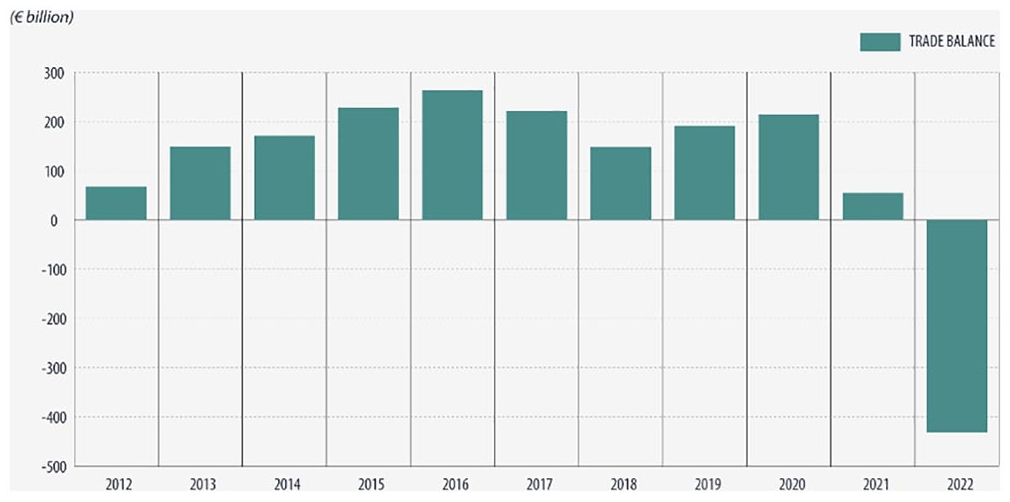
Extra-EU trade in goods, 2012–22.
Moreover, since the start of the energy crisis in late 2021, the EU has allocated and earmarked more than €600 billion in subsidies to shield households and industry from price rises (Sgaravatti et al. 2023). This type of energy insecurity has not only exhausted national coffers but has also caused high uncertainty and increased baseline energy prices for European business and industry. It is these specific economic sectors that provide additional funding for renewables deployment or investment; therefore stifling European growth and industry could further dampen Europe’s climate ambitions.
The EU’s relative energy resource scarcity is further exacerbated by the limited availability of or mining capacity for critical raw materials. The latest comprehensive supply-chain analysis and material-demand forecast reports that the EU shows significant vulnerabilities in its critical raw materials supply chain (Carrara et al. 2023, 9). Furthermore, our need for these minerals will only expand. Compared to 2020, potential European demand for lithium and graphite is expected to grow twelvefold by 2030, while there will be an expected thirtyfold increase in demand for platinum in the same timeframe (Carrara et al. 2023, 8). In parallel, the EU will be in competition with the rest of the global market, which will also be looking for similar supplies for the construction of next-generation renewables and electric vehicles. Today, most solar panel production, next-generation battery capacity, and processing of rare earth elements and critical materials is dominated by China. The current dynamic makes the EU systemically reliant on third countries for its renewable rollout and thus embeds additional vulnerabilities for our trade and national security policies.
Societal strain
Lastly, certain parts of European climate legislation have placed a growing sense of pressure on wide segments of European society. This issue goes beyond the delays and troubles of the Just Transition Fund, which was designed to support a gradual clean energy transition and employee reskilling in the most fossil-dependent European regions (Rosengren et al. 2023). The future ban on sales of internal combustion engine vehicles and increased measures to improve the energy efficiency of buildings or heating installations are novel EU proposals, but ones which ultimately push the final cost onto the end consumer. Citizens in Italy, for example, are wondering who will cover the exorbitant cost of the Energy Performance of Buildings Directive and its obligatory renovation requirements in a country where 60% of the building stock (Symons 2023) lacks proper insulation or window glazing. Additionally, the extension of the Emission Trading System to buildings and road transport will have negative social impacts, particularly for low-income households across the continent (Bajomi 2023).
There are strong indications that the burden of the energy transition in Europe will mostly be felt by our most vulnerable citizens or parts of the middle class. Estimate vary, but there are approximately 50 million people in the EU living in energy poverty (Gangale and Mengolini 2019). Recent calculations indicate that close to 70,000 Europeans lost their lives as a result of the rise in energy prices in the winter of 2022 (Economist 2023). These developments are causing an increased level of societal strain and could lead to a severe citizen backlash against Europe’s climate aspirations.
Climate realism and true sustainability
The considerations expressed above should not be seen as a call to abandon the EU’s monumental goal of carbon neutrality. Rather, they are an honest assessment that a realistic recalibration is necessary given that the EU is not on the right track with its decarbonisation policies. The most pertinent question is how should the EU adapt so that it delivers a truly sustainable transition which achieves climate targets and also safeguards vital economic and societal interests? A number of centre–right proposals can be put forward in order to lay the groundwork for a successful strategy of climate realism.
Championing economic growth and fiscal predictability
A sustainable transition to a clean-energy economy will be costly and remains impossible without achieving high levels of economic growth and industrial output. Public budgets in many member states are already under strain from growing deficits. In parallel, the private sector will not be able to support the clean-energy transition if it is restrained by an economic downturn or exorbitant energy prices. Ever since the 1970s and the Club of Rome’s report titled ‘Limits to Growth’, we have been bombarded with gloomy predictions about humanity’s collapse unless the world’s economy contracts and mankind reduces its consumption patterns.
None of these grim predictions has materialised. A retreat from economic growth is a misguided and dangerous proposal. The EU has already started to modernise and transform the economy with the aim of climate neutrality. Across the continent, most of the member states have successfully decoupled greenhouse gas emissions from economic growth (Ritchie 2021). We need to have a prosperous European society if we are to achieve our landmark climate goals.
Additionally, the European Commission should limit the financial unpredictability within its climate legislation, as recommended by the European Court of Auditors. During its new mandate, the European Commission should be obliged to provide approximate total costs for its proposals, on top of an extensive impact assessment.
Technological innovation is the master key for future decarbonisation
The EU needs to pool additional shared resources into research and development for renewables and support European companies’ efforts to create clean energy breakthroughs. The European funds invested in breakthrough research and development are very few compared to the huge annual sums spent on energy infrastructure. The EU cannot match China’s illicit state subsidies nor its cheap labour, but it needs to bet on its own comparative advantages when it comes to human talent and scientific excellence. There are huge opportunities for strategic investment in improved wind-generation design, carbon capture and storage (CCS), electrolysers and next-generation nuclear capacity. The EU needs to make sure that its clean-energy transition makes a compelling business case; its products and patents need to be competitive internationally. Not to mention the fact that much of the long-term progress on the path to net-zero will come from technologies still in development (Figure 3).
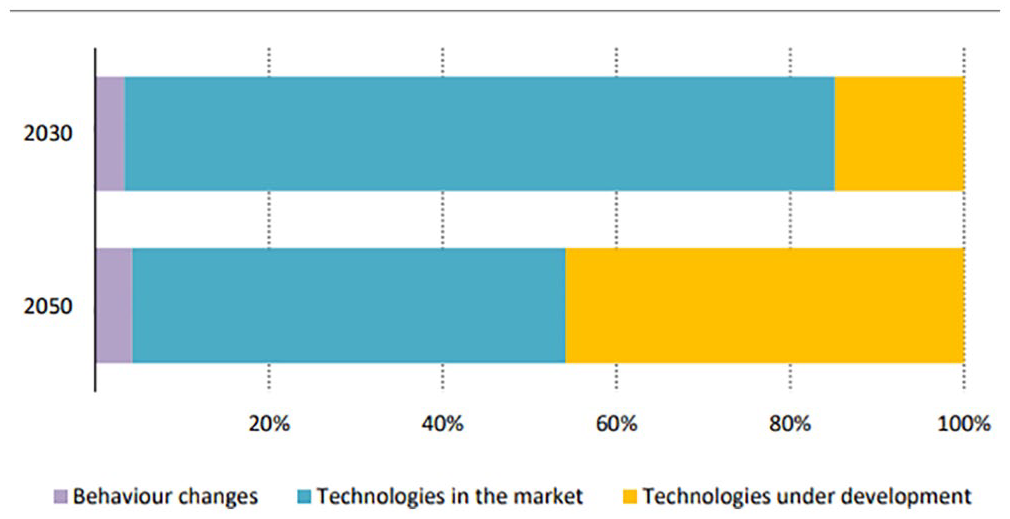
Anticipated annual CO2-emissions savings on the net-zero pathway, relative to 2020.
Europe needs to produce more domestic resources
Many governments are nervous about openly supporting new mining projects given the potential local backlash or the time restraints due to long permitting processes. However, the solution remains entirely in their hands given sufficient political will. An increase in domestic production and an improved predictability of supply could also bring the EU closer to achieving the additional goal of growing its critical materials stockpile in the long run.
A similar approach should apply to natural gas exploration activities within the Black, North and Mediterranean Seas. European member states should collaborate if necessary to explore joint sites and ramp up Europe’s domestic production of natural gas, which will play a key role as a transitory resource in Europe’s decarbonisation efforts.
Support for energy security and opposition to energy austerity
For years now, the EU has placed a huge emphasis on decarbonisation, taking energy supply availability and energy price stability for granted. However, climate change cannot be the only driver of Europe’s energy policy. The immediate priorities should be energy security and making energy resources affordable for households and industry. The EU needs to not only ensure short-term liquid natural gas shipments, but also commit long-term to a diversified portfolio of trusted providers for conventional pipeline deliveries.
Demand reduction and the optimisation of energy usage should also be a notable concern. Europe managed to overcome the latest energy crisis by reducing its overall gas demand by more than 17%. However, a fine line should be drawn between demand reduction and aggressive demand destruction. Europe’s industry needs to optimise certain processes, but it should not be forced to slow production due to a lack of energy supply. Gambling with energy austerity also means placing numerous households and small businesses under severe pressure due to volatile prices with extreme seasonal variations.
Ensuring nuclear energy’s role
Nuclear energy currently accounts for more than a quarter of the EU’s clean electricity generation and is a reliable zero-carbon source that produces output almost non-stop. There is scientific proof that nuclear energy does not do more harm to human health or to the environment than other electricity production technologies (SNETP 2021). The decision to pursue this type of carbon-free energy remains a sovereign right of every European member state. The European institutions should support the efforts of EU member states who already have this type of energy infrastructure. Moreover, nuclear energy should remain a part of the EU’s green taxonomy and be recognised as a source of clean tech which benefits from dedicated funding as a critical technology. Supporting advanced research into nuclear power capacities/small modular reactors will be key in Europe’s quest for carbon neutrality.
Renewable rollout, permitting and investing in grid stability
The successful deployment of renewable solar and wind infrastructure is an important piece of the decarbonisation puzzle. However, even provided that there is sufficient financing and availability of technological components, there are at least two additional major obstacles which need to be addressed. First, permitting processes in a number of EU member states take up to nine years due to the complexities and procedures built into national legislation. It has become apparent that these administrative timelines need to be shortened.
Additionally, all of the new renewable infrastructure places immense strain on the existing electrical grid—an elaborate network of cables, substations and transformers. This can create severe bottlenecks. Waiting times of several years are the norm, rather than the exception across the EU, as the physical grid connection is simply not available (Mooney 2023). The EU has ramped up its own targets for renewable energy deployment but policymakers need to be aware of the risk of creating stranded assets of expensive novel infrastructure, which may remain unplugged for up to a decade.
Subsidiarity and climate adaptation on the local level
The overall narrative on tackling climate change is usually communicated by citing the climate targets and pledges set by global agreements. However, when it comes to implementation, the agreements produce mixed results. The lack of major progress through international treaties on these issues is due, among other factors, to the top-down nature of the commitments, which are negotiated by high-level governmental representatives but ultimately have to be implemented on the local level (Lilkov 2018). Certain estimates project that regional and local authorities will be responsible for implementing more than 70% of climate-change reduction measures and up to 90% of climate-change adaptation measures (Committee of the Regions 2017).
Cities and regions are part of both the problem and the solution. Only with the fully fledged involvement of local and regional authorities can the implementation of climate-change measures and international agreements bring about effective results in the long run. Stronger political engagement with the various local political stakeholders is necessary in order to build a solid backbone for climate governance across the EU.
Conclusion
If politics is, indeed, the ‘art of the possible’, 5 climate politics in Europe is at risk of becoming the art of the impossible. A sober discussion is required about the future direction of the EU’s decarbonisation agenda; a discussion hopefully marked by pragmatism and ambition rather than dramatism and dogma. Unfortunately, the unsustainability of important parts of Europe’s current climate strategy threaten to jeopardise the long-term goals of the European Green Deal. This article has posited a number of centre–right proposals for a more realistic approach to European climate policy. A comprehensive list of all technical recommendations and actionable items goes beyond the limits of this article. The main ambition of the text was to suggest a viable macro policy alternative for the mainstream pro-European political parties, which have the common goal of making the European economy truly sustainable.
Footnotes
Notes
Author biography