



Abstract
This article argues that media regulations on correcting incorrect articles are in dire need of reform due to technological and behavioural changes. By using case studies from the UK, the authors demonstrate the huge difference between the number of people who were reached by the original article before the Independent Press Standards Organisation (the regulator in the UK) ruled it incorrect and the number reached by the correction or corrected article. The authors argue that media regulations must be reformed to ensure that corrections reach the same people as the original incorrect article to avoid misinformation impacting peoples’ decision-making, and that reforms must include social media platforms and search engines.
Keywords
Introduction
States have become increasingly aware of and worried about disinformation campaigns by nefarious actors. While the dangers of purposefully spreading disinformation have been placed on the agenda, reform of ‘traditional’ media regulations has been largely disregarded. We are convinced that incorrect news spread by reputable media is a parallel but equal danger to our society. Our hypothesis was to test whether the online reach of a news article that is later judged to have been incorrect by the British Independent Press Standards Organisation (IPSO) is greater than the reach of the article once it has been corrected after the IPSO ruling. This article will demonstrate through three case studies that there is a discrepancy in the number of people reached by incorrect news articles compared to the corrections of those articles after a ruling by the IPSO in the UK. After analysing the case studies, we will present a suggestion on how to reform media regulations to make the rules compatible with modern technologies.
Disinformation campaigns by state and political actors aim to sow discord, undermining trust in democracy and polarising societies for political gain. Evidence shows that disinformation spreads six times faster on Twitter than factual news (Vosoughi et al. 2018). However, the challenge for any disinformation campaign is to break out from the bot networks and get the false information spread by reputable media sources and real people. A notable ‘success’ story in this regard was the infamous ‘Pizzagate’, in which the media picked up a conspiracy theory that centred on Hillary Clinton being involved in a child abuse ring run from a pizza restaurant in Washington, DC. While no media source claimed that the story was true, by reporting on it, they spread it to tens of millions of people. There are very few ways to deal with such behaviour by the media without jeopardising press freedom if the article is merely reporting what is being discussed online. However, what are often overlooked are real cases of inaccurate news being published by reputable media outlets. When a reliable media outlet publishes an article containing wrong information, the article immediately reaches a wide audience that has every reason to trust the authenticity and reliability of that media outlet. Unlike purposeful disinformation campaigns, these articles benefit from the trustworthiness of their publisher and seem highly reliable from the beginning.
In this article, we demonstrate through case studies how articles which have later been judged misleading by the IPSO have a considerably different online reach 2 when first published compared to their subsequent correction. We will also argue that due to the role of media outlets as information gatekeepers and the recent habit of accessing news through social media and search engines, we must change the media regulations when it comes to publishing corrections to ensure that all persons who have been exposed to the false information will also see the correction. We believe that it is crucial to involve social media platforms as in the digital age news is transnational and English-language news in particular is widely shared outside of the country in which the media publisher is domiciled.
Danger of misinformation
The impact of fake news, regardless of where it originates and whether purposeful or accidental, is well documented. Fake information is particularly dangerous because it affects us at the psychological level and there are very few mitigating factors. According to research, people instinctively accept information that they come across and cherry-pick content which supports their worldview, whereas rejecting information takes a conscious decision (The Economist 2016). A recent study by Jonas de Keersmacker et al. shows that people are more likely to believe that information is true if they have already encountered it. This is called the ‘illusory truth effect’, and the study found that factors including intelligence and critical thinking did not mitigate it (de Keersmacker et al. 2019).
Studies by behavioural psychologists such as Amos Tversky and Daniel Kahneman clearly map in-built decision-making heuristics and the reliance on ‘cognitive ease’ in human decision-making. When making decisions, people often have to rely on incomplete or even contradictory information (Kahneman 2011, 410–11). To ease the cognitive burden of reaching a decision, we have developed heuristics, in other words, shortcuts which we rely on when making decisions. The most common of these are availability, representativeness, and adjustment and anchoring (Tversky et al. 1974).
The availability heuristic essentially means that we make decisions based on how easily we remember an occurrence. If we can recall an occurrence without much effort, we overestimate the probability of such events taking place. The representativeness heuristic is employed by people when we face one of the following kinds of questions: what is the probability that A belongs to category B?; or what is the probability that A will/has cause(d) B? Having incorrect information, in this case about A or B, which can be groups of people, events or phenomena, will have an impact on people’s decision-making and opinions (Kahneman 2011).
Adjustment and anchoring is used by us when we need to make estimates of probabilities. We take a value or piece of information which is then adjusted to yield our final estimate. It is a powerful heuristic because people’s answers when estimating probabilities can be statistically significantly altered by manipulating the information available onto which they anchor their thinking and estimates (Kahneman 2011).
The above-described heuristics are particularly dangerous when combined with misinformation. Not only do the studies show that we tend to believe that something is true if we have encountered it before, but that even when we know something to be erroneous, the information still has an impact on our decision-making through the heuristics which are in-built. It takes a conscious effort to try to minimise the impact of misinformation on our decision-making. For these reasons, we argue that once misinformation has been spread by reputable media, it is vitally important that the people exposed to the misinformation are shown that the original information was false. For us, reputable media are news agencies and publishers which follow editorial processes, whose mission is to report news truthfully and, in the particular case of the UK, who follow the Editors’ Code of Practice (IPSO 2019).
Case studies
To understand the difference in online reach between original online articles and corrected articles we looked at recent and notable examples of IPSO rulings. Ten articles were investigated, but three are shown here as they best demonstrate the point. Nine of the 10 articles showed a similar pattern when comparing the reach of the original publication and the correction. As stated in the introduction, our hypothesis was to test whether the online reach of a news article that is later judged to have been incorrect by the IPSO is greater than the reach of the article once it has been corrected after the IPSO ruling.
To test our hypothesis, we combed through the IPSO’s rulings from the last few years and identified articles which it had judged to have broken the Editors’ Code of Practice with regard to accuracy. After identifying articles from the IPSO website we used a social listening tool, Brandwatch, to crawl data for online mentions of the identified articles. Due to technological limitations with regard to crawling data, we had to limit our search to articles published since late 2015 because it was no longer possible to access complete data for older articles. Brandwatch is among the best social listening tools in the world and its software allowed us to gather unstructured data and metadata from social media and turn it into structured data in an efficient and robust manner. Online mentions include tweets, blog posts, forum posts and websites for a given search using Brandwatch. They do not include Facebook or Instagram posts due to the closed nature of these platforms. Each Brandwatch search collected any and all online mentions of the original article (link or keywords), the IPSO ruling statement (link or keywords), and any link shares of an affiliated article that appeared on the first page of results from a Google search for the article. Each Brandwatch search was language and geography agnostic. For each search the estimated online reach was determined using Brandwatch’s reach score (see Brandwatch 2019). This score, calculated by Brandwatch, aims to give a realistic estimate of the number of people who are likely to have seen an online mention. The score takes into consideration whether the online mention is a social media post, a blog or forum post, or a website by using metadata that is publicly available.
The articles were chosen from different media outlets and on different topics. The aim was to demonstrate that a similar reach pattern could be found across newspapers and topics.
Preliminary results
In general, we found that the reach followed a similar pattern in 9 out of 10 case studies. There was one big spike in interest on initial publication, followed by a lower level of interest in the IPSO ruling. The reach of the corrected article tended to be four to five times smaller than the reach of the initial article. In the second example given below, there was no interest in the IPSO ruling until nearly a month after the ruling had been made. With the third example, the online reach followed a different pattern. This is likely due to the pertinence of the topic and the article’s author, Boris Johnson. This suggests that unless the correction is shocking or scandalous in some way people tend not to pick up on it of their own accord. The case studies, excluding the example with Boris Johnson, demonstrate clearly that it is impossible, even in theory, to ensure that all the people who saw the original article see the correction, since the reach of the correction was at best 25% of the reach of the original article. This discrepancy in reach demonstrates why correction rules must be changed to ensure that corrections reach the people who saw the original article.
1. ‘How world leaders were duped into investing billions over manipulated global warming data’, Daily Mail (Rose 2017)
Article date: 4 February 2017
Date IPSO complaint received: 7 February 2017
Date IPSO decision issued: 7 July 2017
2. ‘1 in 5 Brit Muslims’ sympathy for jihadis’, The Sun (Newton Dunn 2015)
Article date: 23 November 2015
Date IPSO complaint received: 25 November 2015
Date IPSO decision issued: 17 February 2016
3. ‘The British people won't be scared into backing a woeful Brexit deal nobody voted for’, The Telegraph (Johnson 2019)
Article date: 6 January 2019
Date IPSO complaint received: 7 January 2019
Date IPSO decision issued: 4 April 2019
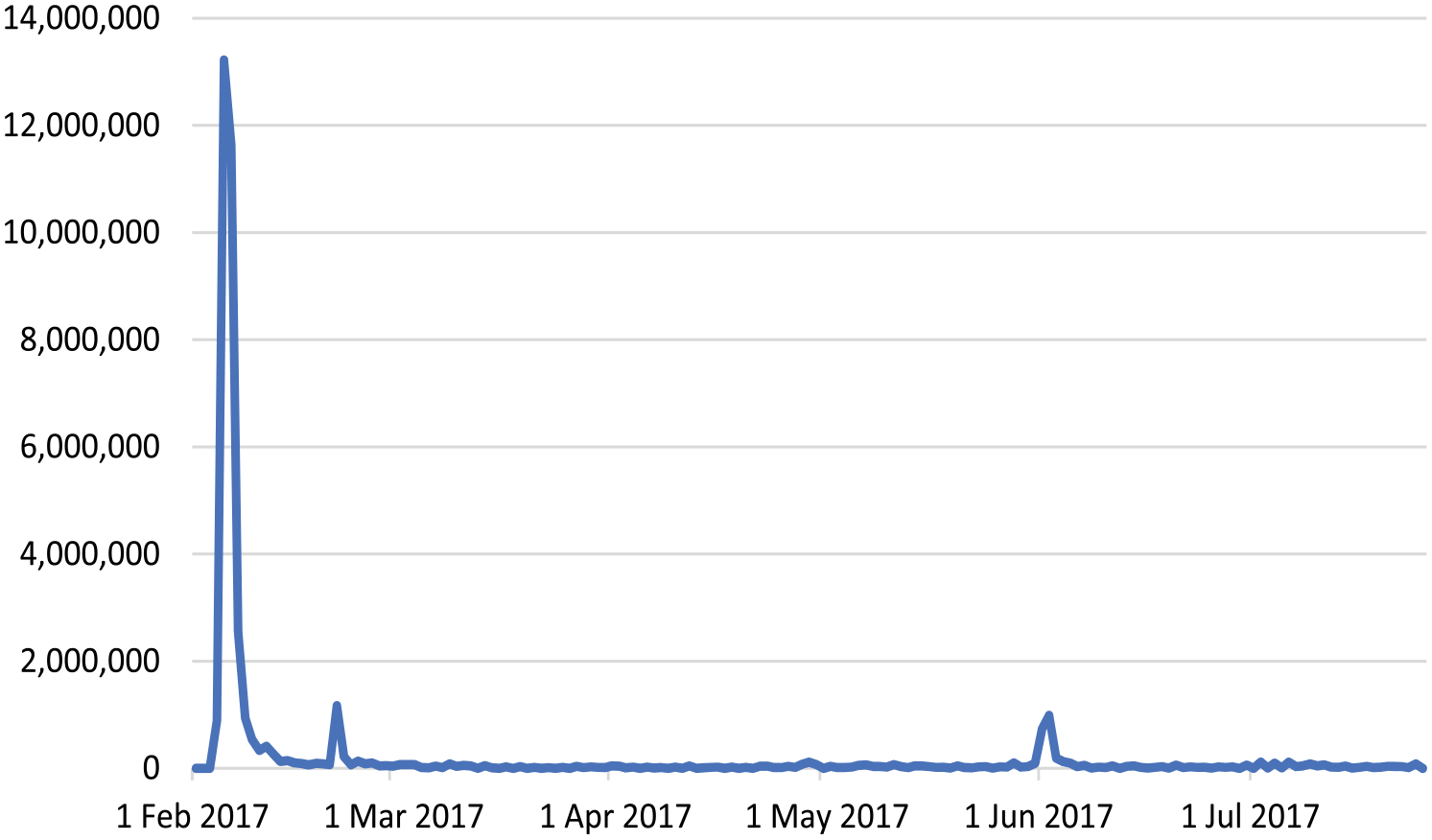
Estimated online reach of original Daily Mail article and IPSO corrected Daily Mail article over time by day, 1 February 2017 to 25 July 2019.
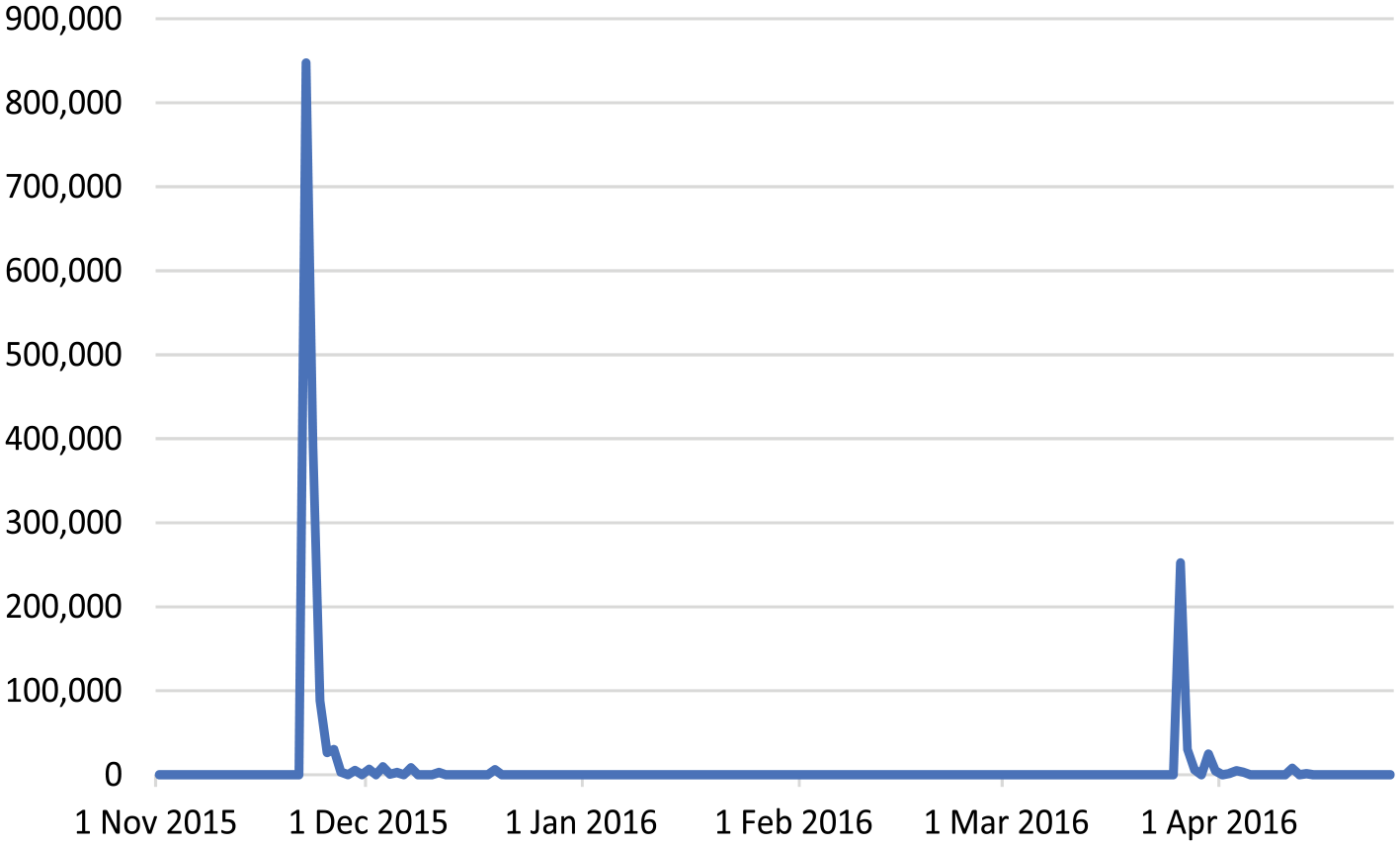
Estimated online reach of original The Sun article and IPSO corrected The Sun article over time by day, 1 November 2015 to 25 April 2016.
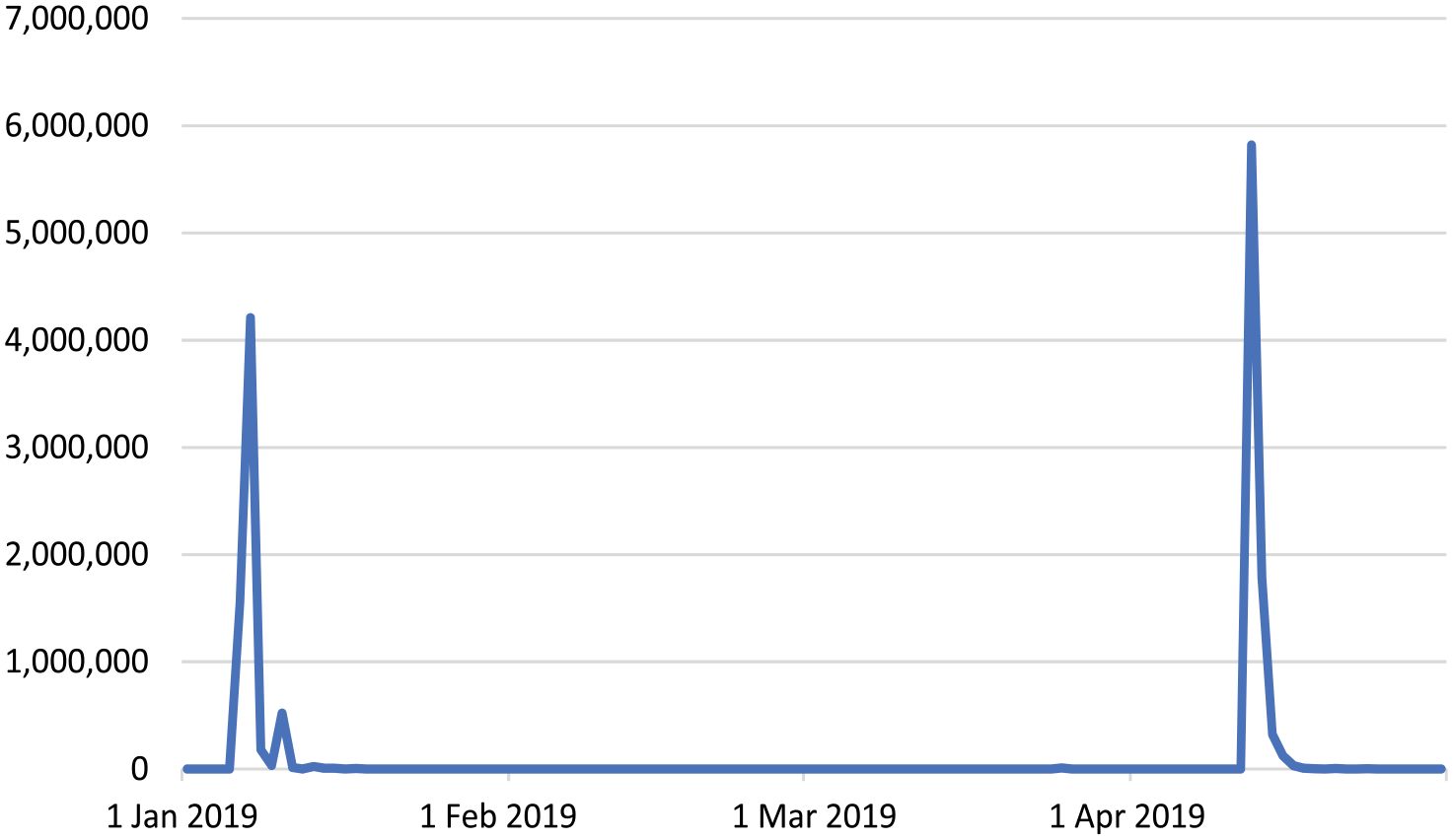
Estimated online reach of original The Telegraph article and IPSO corrected The Telegraph article over time by day, 1 January 2019 to 30 April 2019.
Estimated online reach of original Daily Mail article versus reach of corrected article.
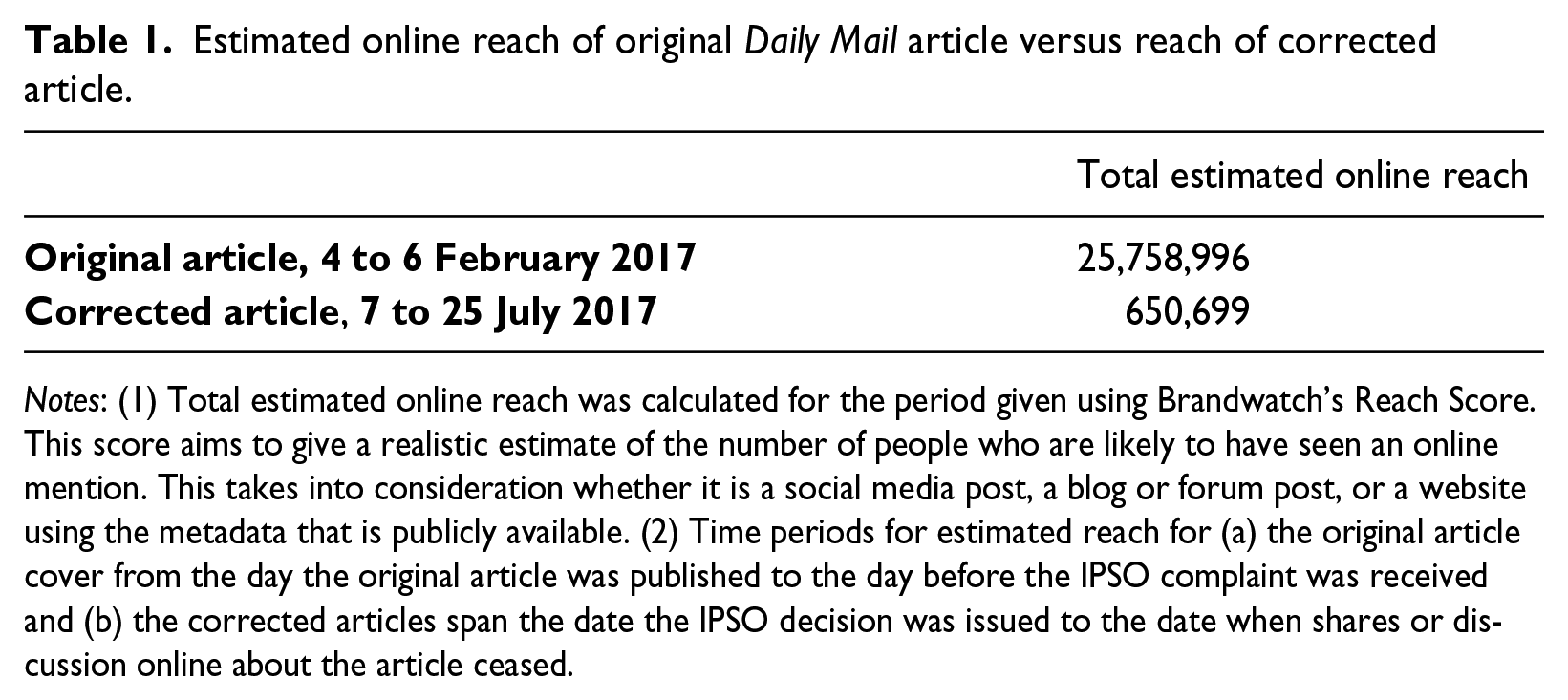
Notes: (1) Total estimated online reach was calculated for the period given using Brandwatch’s Reach Score. This score aims to give a realistic estimate of the number of people who are likely to have seen an online mention. This takes into consideration whether it is a social media post, a blog or forum post, or a website using the metadata that is publicly available. (2) Time periods for estimated reach for (a) the original article cover from the day the original article was published to the day before the IPSO complaint was received and (b) the corrected articles span the date the IPSO decision was issued to the date when shares or discussion online about the article ceased.
Estimated online reach of original The Sun article versus reach of corrected article.
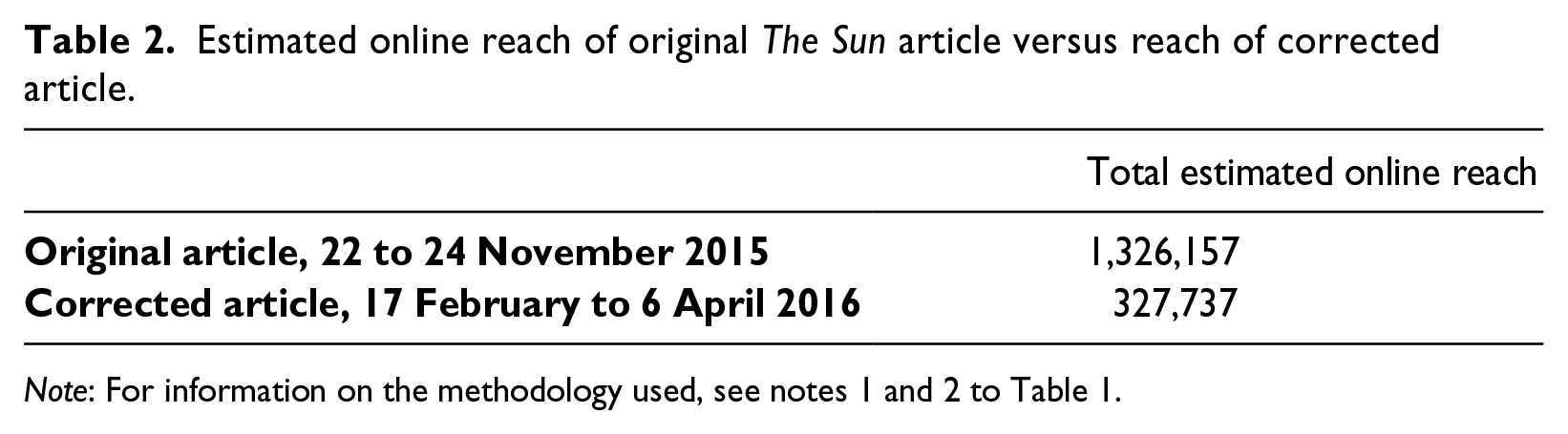
Note: For information on the methodology used, see notes 1 and 2 to Table 1.
Estimated online reach for original The Telegraph article versus reach of corrected article.
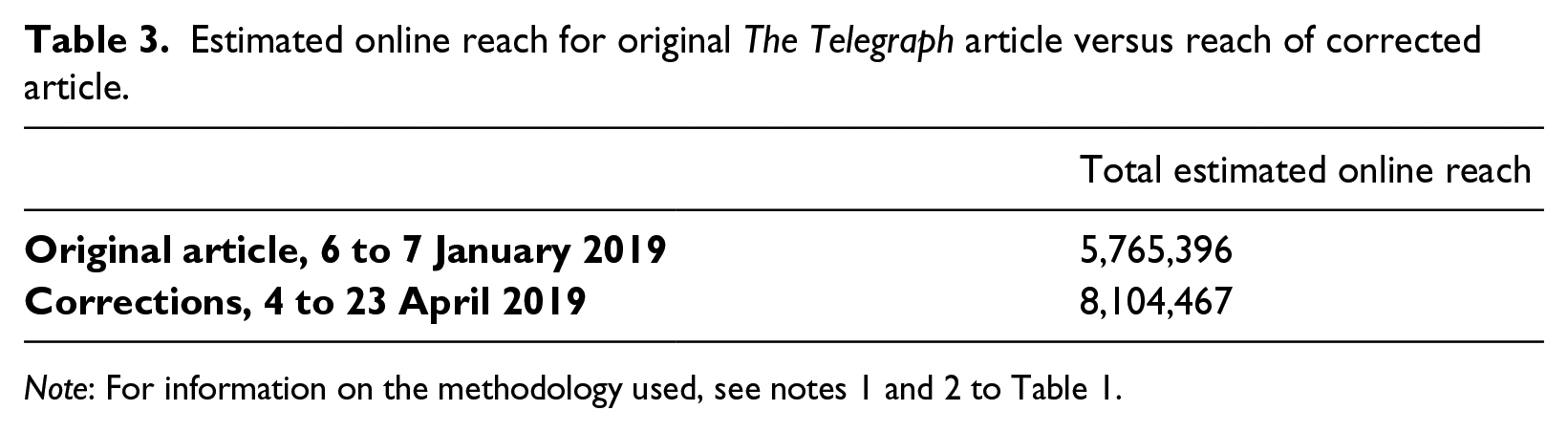
Note: For information on the methodology used, see notes 1 and 2 to Table 1.
Policy recommendations
The case studies and other research on the spread of fake news lead us to make certain recommendations on reforming media regulations. It is particularly important that we include the main social media platforms and search engines when talking about remedies for misinformation. This approach, which these companies would certainly find radical, is justified by the fact that 40% of people in the UK read their news through social media and 75% access their news online (including through social media) (Newman et al. 2019). This is a major change in approach to media regulation, but without it we are toothless in trying to resist the corroding impact of misinformation because those consuming the news through social media cannot, even in theory, see the corrections on the publishers’ websites.
Naturally we must also accept that our recommendations do not solve all the ills of erroneous articles. The cross-border interlinkage of articles is a particularly acute challenge since when an article based on an erroneous article is published in another country, it is nearly impossible to ensure that the correction reaches the readers there. We believe that there is room for national media regulators to work together to tackle this particular issue.
First, we would recommend that when the IPSO rules an article to have been misleading, the publisher must publish the correction on all social media platforms that the original article was published on and post the correction in the thread of the original article. Often IPSO rulings come many months after the original article, and the corrections do not reach the people who read, saw or shared the original article. This is particularly the case for those people who may have seen the article in their feed but did not interact with it. It is often the case that the IPSO requires articles that are found to be incorrect to be amended. However, this would be far more visible if the correction had to be displayed on the front page of the media source’s website, not only because it would be professionally embarrassing for the media company, but because it may also come at the cost of removing a revenue-generating advertising space for the period during which the correction is posted.
Second, to ensure that the people who read, shared and especially those who saw, but did not interact with, the original article are reached, the publisher should be obliged, in partnership with the most-used social media platforms, to ensure that the correction reaches the same people as the original article. Technically this could easily be done through a retargeting ad campaign on social media that only targets those who saw the original article. Naturally, the cost of the campaign should be covered by the media publisher. The easiest and least invasive way of achieving this would be to ensure, through the ad campaign, that those who saw the original false article see the correction on their feed as an ad from the original publisher. Hence, the information that the article was false would reach the people in question, but it would be up to the individual as to what, if anything, he or she decided to do about it.
Third, we would recommend that Google and other search engines become obliged to update the search results for the incorrect article with a visible tag that makes it clear that the article has been found to be erroneous. Simultaneously, Google should be obliged to show a link to the correction/ruling for those users who saw the original erroneous article. In this way, we can try to fight back against the in-built decision-making heuristics described by Kahneman and Tversky.
Fourth, we recommend that publishers should have to donate the advertising revenues generated by erroneous articles to charities which work to increase the quality of journalism, critical-thinking skills and media savviness in society. Media publishers receive their revenues from site visits and clicks, so there needs to be real consequences for their bottom line if we want to avoid incentivising the publishing of erroneous content which leads to high numbers of visitors and clicks.
Conclusion
We are convinced that current media rules on correcting erroneous articles are insufficient to address the issue of misinformation. We believe that the rules must be thoroughly reformed and updated to be compatible with the current technological landscape and media business models. Our policy recommendations would go a long way to addressing the problem of the insufficient reach of corrections and would also create an effective financial disincentive to protect against the publishing of erroneous articles. We believe that a free and high-quality media is of the utmost importance in defending liberal democracy against populists and authoritarians.
Footnotes
Notes
Author biographies