Abstract
After signing the COP 21 Paris Agreement, the EU pledged to become the leading force in the transition to a low-carbon economy. To this end, a new legislative package called ‘Clean Energy for All Europeans’ was passed at the end of 2018. By setting targets for the energy transition, the legislation represents both a great challenge and a great opportunity for European society. The package puts energy efficiency and the active participation of consumers at its core, and so does this article. Focusing on the specific role of buildings, the article argues that the package has significantly increased the potential for the middle class to become one of the driving forces behind the energy transition. Because of specific historical and social developments, the middle class has become capable of being and willing to be involved in environmental protection, and the package has given them more tools to be so.
Keywords
Introduction
It is common knowledge that climate change is closely related to the production of CO2. When asked ‘What are the biggest CO2 producers in the EU?’, many people tend to have a mental image of power plants, steel factories and cargo planes. But how many of us would picture our family home? Surprisingly, buildings are responsible for approximately 40% of energy consumption and 36% of CO2 emissions in the EU, making them the single largest energy consumer in Europe (European Commission 2019). Due to the existence of highly developed building technologies, reducing the energy consumption of buildings through the implementation of energy-efficiency measures (such as insulation and window replacement, among many others) is low-hanging fruit on the path towards achieving carbon neutrality by 2050, a goal that the EU has committed to in order to comply with the objectives of the Paris Agreement (negotiated at the 21st Session of the Conference of the Parties to the UN Framework Convention on Climate Change). The fact that efficiency is a step in the right direction is confirmed, for example, by research from the International Energy Agency, which has shown that 76% of investments needed to achieve the Paris Agreement goals must be made in energy efficiency (Euroace 2019, 12). To prove its leadership in tackling global warming, the EU has developed a new energy policy framework, titled ‘Clean Energy for All Europeans’, which consists of eight pieces of legislation that support the transition away from fossil fuels by investing in the mainstreaming of the latest technological solutions. Although it covers other strategic areas including mobility and the circular economy, it is a legislative package which puts buildings and their energy saving potential at its core.
An ambitious plan for European building stock
Having been passed in late 2018 and early 2019, the legislation will soon bring about changes in the lives of European citizens as member states start to implement steps to meet the targets set. Buildings are mainly discussed in the amended Energy Efficiency Directive, the Energy Performance in Buildings Directive (EPBD), the recast Renewable Energy Directive and the Governance Regulation. This legislation aims to set the right balance between making decisions at EU, national and local levels. Member states will continue to choose their own energy mix, but must prepare a strategy to improve energy efficiency and increase the use of renewables by 2030. The Energy Efficiency Directive requires member states to set their contribution to the European target and specify the measures they are planning to take. The EU headline target is to be at least 32.5% more efficient in energy use by 2030, with the possibility of an upward revision of the target in 2023. This is the result of a compromise which was reached after almost two years of difficult negotiations between the member states. Nevertheless, there were many who were hoping for a much higher level of ambition that would fully reflect the development of the market and increasing energy consumption (Morgan 2018; European Environmental Bureau 2018; World Wildlife Fund 2018). As the research suggests (Fraunhofer Institute for Systems and Innovation Research 2013; OPENEXP 2017), the highest cost-effective end-use energy savings potential for 2030 is around 40%. Less tense negotiations preceded the adoption of the Renewable Energy Directive, which sets a binding target of 32% for renewable energy sources in the EU’s energy mix by 2030. The EPBD was received quite positively. This directive aims to accelerate the renovation rate of buildings and exploit all smart technologies available, which will not only increase efficiency, but also contribute to improved health and safety. It focuses on the renovation of building stock and the creation of highly energy efficient and decarbonised stock by 2050. Among others, the directive requires all new buildings to have very high energy performance levels by the end of 2020. To implement these changes at the member state level, the Governance Regulation introduces National Energy and Climate Plans (NECPs), complemented by the EPBD’s Long-Term Renovation Strategies. However, despite being a compromise between European ambition and member states’ needs, there is a high chance that the implementation of the package will still not ensure that the goals of the Paris Agreement are met, as has been indicated by the early reports from the member states’ NECPs (Morgan 2019; European Climate Foundation 2019).
Who can help us to face the challenge?
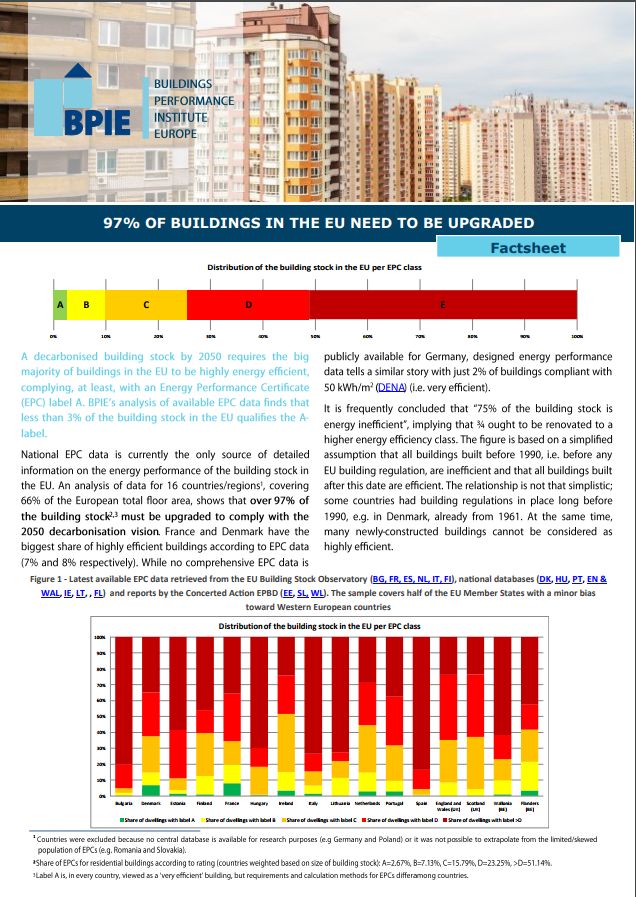
It is no surprise that member states have been careful about promising too much too soon in their NECPs. The task in front of them is truly enormous. Even with the law and the technologies in place, achieving the goals of the Paris Agreement by 2050 not only requires investment in new, highly efficient buildings, but first and foremost a massive renovation effort in record time. According to the Building Performance Institute Europe (2019), in 2017 just 3% of buildings in the EU were assessed as highly energy efficient, leaving the other 97% in need of renovation before 2050. However, this is hardly possible at the current speed of renovation, which in the EU is just 0.4%–1.2% of buildings per year (European Commission 2019). With the current renovation and building stock renewal speed, most of the existing buildings will still be standing in 2050 and they will likely be in the same state as now, or even in worse condition. Therefore, even with newly introduced targets that are pushing for the acceleration of member states’ efforts, significant change will not be possible without two things—the willingness of building owners and affordable financing. But who are these European building owners who hold the decisive power over the future of European energy consumption? They are the middle class.
The middle class as a climate change stakeholder
Across all member states, most of the floor area of buildings is within residential properties. The percentage varies from around 60% in Slovakia and Austria to more than 85% in southern countries like Italy (European Commission 2019). Almost 70% of all households in the EU28 are owner-occupied. In Central and Eastern Europe this ownership rate reaches almost 90%, mainly due to the privatisation policies of the 1990s. This means that the owners of residential buildings have the potential to influence a significant part of European energy consumption. However, mere ownership of a building does not ensure an interest in its efficiency. What differentiates owner-occupied buildings from any other is the existence of a person who cares: someone who cares not only about his investment or energy bill, but also about a high level of safety, health and comfort for himself and his loved ones. Arguably, this someone is very likely a member of the middle class.
The right to own property is one of the elements which made the creation of a middle class possible (Kocka 1995). According to Siegmann and Schäfer, ‘Being able to afford a house is an essential feature of what people perceive as middle class . . . The wealth situation of the middle classes is strongly defined by real estate property or housing’ (Siegmann and Schafer 2017, 3). However, as has been said above, property ownership is far from being the only defining feature of the middle class. More important is the special relationship of the middle class with its immovable property. It is often a symbol of social status and the main financial asset to be inherited by the next generation. Due to a higher than average level of education, which is another typical feature of the middle class (Kocka 1995), property owners not only understand the link between renovation and a higher value for and extended life of the building, but also have the capacity to recognise how the state of their dwelling impacts on their comfort and health. Most importantly, they can see that the impact of their ownership does not simply end at their doorstep but that they are part of a larger environment. These aspects are in addition to the fact that homeowners tend to stay in one place for longer than people who rent. As a result, they are keen to invest in the development of their immediate environment. In many cases they regularly invest in both their houses and their surroundings in order to enrich the property for the next generation. For all these reasons, members of the middle class tend to manage their houses with diligence and show interest in their neighbourhood and community relationships. Available research suggests that homeownership enhances the stability of the neighbourhood and the motivation for civic engagement (Rohe et al. 2010, 51).
It is the combination of these three middle-class characteristics—economic power, education and reasons for caring—which puts the middle class in the position of a key climate change stakeholder. With the right financial and informational support, middle-class homeowners can become one of the leading powers in the fight against climate change. And this is simply because it is to their own benefit. They are motivated to renovate their houses because of decreased energy costs, increased property values, and the comfort and health benefits such changes bring. Their level of education allows them to understand the impact of global climate change and, even if they do not believe in the global impact of their energy consumption, they are able to see and are concerned enough to care about the negative effects of air pollution in the proximity of their neighbourhood. Last but not least, and especially if they have experience of passing the property on from one generation to another, they will be more likely to see the parallels with passing a healthy environment on to future generations.
The argument linking private ownership with the fight against climate change was perfected by conservative thinker Roger Scruton, who said that ‘private ownership confers responsibility in the environment’ (Scruton 2017, 7). According to him, this civic responsibility arises from our sense of belonging, which ‘relates us not only to people, but also to the places where we reside and the customs that bind us’ (Scruton 2017, 8). In his book Green Philosophy—How to Think Seriously About the Planet, Scruton uses a special name for this sense of belonging (which is supposed to be the main motivation for care for the earth), oikophilia—meaning a love of the shared home and the desire to protect it. Oikophilia is what encourages people to make sacrifices for their surroundings. Instead of an excessive focus on top-down regulations, large-scale solutions and international treaties, Scruton suggests not underestimating the power of local initiatives, the potential of local governance or the possibility of behavioural changes that are motivated by concern for the well-being of loved ones. The issue cannot be confiscated by the state. Rather, it should be embedded in our daily actions and, even more importantly, in the education of children. The issue of subsidiarity, which Scruton touches on while stressing the importance of local ownership of the climate movement, is also an element of the new legislation. The European Commission claims that the package tries to find the right blend between central regulation, decision-making at the member-state level, and the encouragement of private actors and natural market forces. However, it is a shame that the local-level support is aimed at professional investors rather than support for local initiatives among citizens (who are potential investors), something which is not fully addressed.
Vital policies supporting individual homeowners
Although the author strongly agrees with Scruton that the power of the bottom-up approach has been overlooked, she still believes in the important supportive role of the EU and the member states. First, their incentives signal to developers and the financial sector the right direction of travel to make energy-efficiency solutions bankable. Second, public finance plays an irreplaceable role in raising awareness. Recent research by University Colleges Denmark suggests that ‘it is not only information about specific and possible solutions that is needed, but also for policymakers and planners to go into dialogue with homeowners with the aim of creating a shared understanding of the main problems and potential solutions’ (Baron 2015, 96). According to the research, the readiness for change needs to be in place before homeowners invest in measures to increase the energy efficiency of their homes. If the readiness does not come as a result of personal experience of climate change, it can be initiated by new laws.
The package supports this readiness in several ways. First of all, it invites local-level representatives to the table. The Governance Regulation prescribes the involvement of the public in drafting NECPs. The EPBD has similar requirements for the preparation of member states’ Long-Term Renovation Strategies, which also have to be subjected to public consultations and meetings with the key civil society stakeholders. The EU-financed Covenant of Mayors coordinates the involvement of regions and municipalities.
Furthermore, the package introduces policies addressing the key barriers to private investment such as a lack of trustworthy information or doubts about the possible benefits. The EPBD requires member states to actively facilitate actions that will support the mobilisation of investments such as the aggregation of projects and using public funds to leverage private investment. As an annex to the package, the European Commission introduced the Smart Financing for Smart Buildings initiative (European Commission 2016a), which harmonises existing and new finance and knowledge-sharing platforms (e.g. the Energy Efficiency Financial Institutions Group and the De-risk Energy Efficiency Platform) in order to make energy-efficient buildings more attractive to private investors. The initiative aims to unlock a total of €10 billion in public and private funds between 2016 and 2020. Alongside more traditional support for large-scale projects, the initiative gives space to public and private promoters of model sustainable energy projects, focusing on small and medium-sized energy investments. This is achieved mainly through the Horizon 2020 programme, which supports research and model projects that aim to accelerate the market and prepare societies for upcoming changes. An example of such an initiative is the SMARTER Finance for Families project (Romanian Green Building Council 2019), which has introduced green mortgage schemes in 11 European countries, replicating the experience of a Romanian pilot, while also providing educational tools, consultancy and networking opportunities for homeowners, developers, banks and green-solutions providers.
While promoting the package, the European Commission focused on the fact that consumers are at its core (European Commission 2019), stressing the availability of new tools to control their consumption, the freedom to switch energy suppliers and easier rules for selling their own renewable energy to the grid. Despite promising an active role in driving the energy transition, in the case of homeowners the promotion of the package only went halfway, perceiving them merely as consumers, and not addressing them as active players. The package put in place policies which aimed to unlock private investment in energy-efficient buildings, but it almost seems as if the Commission had forgotten that over 60% of buildings in Europe are residential, of which 70% are owner-occupied. If citizens are to become a driving force of the energy transition, they need to be encouraged to do more than just know their rights. They need to be inspired to take an interest in and be directed to sources of information. Unfortunately, the outreach technique of using easily explainable and relatable examples selected to bring the law closer to the citizens actually placed them in a somewhat passive position and did not do justice to the real potential of the package.
Conclusion
Despite the criticism of the low ambitions and the risk of the package not reaching its goals, the Clean Energy for All Europeans legislation sets promising conditions for the transition towards clean energy. It offers a complex solution to complex issues. As the article has tried to capture, improving energy efficiency in buildings is low-hanging fruit, but it requires the right coordination to be harvested. Acceleration of energy efficiency cannot be achieved without cooperation between the national and local levels and a readiness for change among citizens. Improving energy efficiency requires the financial sector to work in close cooperation with the construction sector and national governments to develop hybrid financial solutions that can open up energy-efficient solutions to a broad range of citizens without overburdening low-income groups. Due to all these sensitive synergies, which need to be handled with caution to create a successful project, energy efficiency had previously been overlooked and under-appreciated by the energy sector and policymakers, even though the cleanest energy is obviously that which we do not use. This has been changed by the new package, whose motto is ‘energy efficiency first’. It gives us the chance to tap into the potential of homeowners who, with the right tools, can become a strong force for change in more than their immediate environment. The need for compromise might be responsible for lower targets than energy-efficiency experts were hoping to see, but the package fully deserves recognition for enabling homeowners to contribute to the battle against climate change. Now it is up to member states to make sure homeowners get a seat at the table and can participate in the coordination of joint efforts.
Footnotes
Author biography